
VEDOVANZA. — This is the condition of a woman who has lost her husband.
Among the Jews, V. was a state of desolation and entailed particular prohibitions (cf. Gen. 38, 14, 19; Iud. 10, 2; 16, 9; II Reg. 20, 3; Lev. 21, 14). Thus the widow is a person who, by her very condition, commends herself to pity (cf. Ex. 22, 22; Deut. 24, 17; 19, 21; 14, 29; 26, 12-13; 16, 11, 14; 10, 18; 27, 19; 22, 24); very often, having no close relatives to defend her, she is at the mercy of violent men (cf. Iob. 22, 9; 34, 3, 21; Ps. 95, 6; Sap. 4, 10; Is. 1, 23; 10, 2; Ier. 7, 6; Ex. 22, 7, 25; Mal. 3, 5, etc.); she is comforted and helped only by the charitable man (cf. Iob. 29, 13; 31, 16; Ier. 22, 3; Zach. 7, 10; Is. 1, 17; etc.). The woman was always the property of a man: as a girl, she belonged to her father; as a wife, to her husband; as a widow, to her husband’s heirs (cf. II Reg. 3, 7; 16, 22; III Reg. 2, 13-18). The widow’s personal possessions were limited to what she had brought with her upon marrying and to what her husband had given her. If she remarried, she did not take with her the property of her deceased husband (cf. I Reg. 25, 42); if she did not remarry, she could return to her father (cf. Lev. 22, 13) or remain with one of the
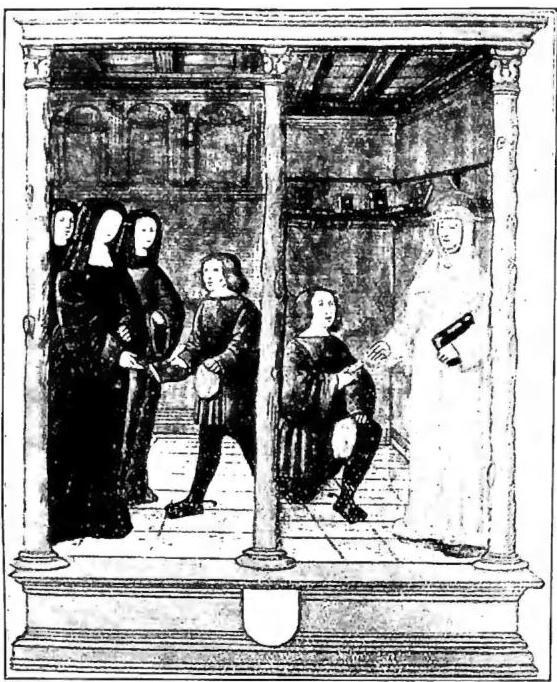
VEDOVANZA – Chastity in widowhood. Letter of St. Jerome
« to Madame Furia, daughter of a senator of Rome... translated
into French by Charles Bonin, priest » (15th-century
manuscript). The miniature depicts St. Jerome delivering the letter (Ep.
54: PL 22, 550–60) and the widow Furia receiving II.
her children (cf. II Reg. 14, 6–7). The widow could not
make vows without the consent of another (cf. Num. 30, 10). Sacred
Scripture, however, speaks of many widows who knew how
effectively to act for the benefit of their own people (v. GIUDITTA), or who gave an example of an austere and per-
fect life (v. ANNAM).
From the earliest civilizations, a widow was forbidden to
contract another marriage before a certain period had elapsed
since her husband’s death. Roman law, by a constitution of
the year 381 (cf. l. 2, C. de sec. nupt., 5, 9), increased
to one year the period of ten months established by a law
which tradition attributes to Numa. The prohibition had a twofold
basis: considerations of propriety and decency,
and the danger of turbatio sanguinis and uncertainty regarding
the paternity of the offspring (cf. l. 11, § 3, D, de
his qui not. inf., 3, 2). This system continued to be
applied during the period of the Romano-Barbarian laws
and passed into many modern legal systems, including the
Italian one.
According to art. 89 of the Italian Civil Code, the
prohibited period is ten months; it ceases to apply from the day
on which the woman gives birth, and does not apply
to a marriage declared null on account of impotence.
The aforementioned article and Law no. 847 of 27 May 1929,
art. 2, provide for the possibility of dispensation.
The law of the Church « ad vitandum incontinentiae
periculum, sustulit necessitatem anni luctus » (P. Ga-
sparri, Tractatus canonicus de matrimonio, II, Rome 1932,
p. 168 ff.). Nevertheless, under the concordat system, in
Italy, art. 26 of the Instruction of the S. Congregation of
the Sacraments of 8 July 1929, while decreeing that « the
authorization for the marriage of a widow before the
expiration of ten months from V. judgment
of the Ordinary », nevertheless specifies that « the Ordinary
must not grant permission to the widow before the expiration
of ten months unless he has sufficient certainty that
those inconveniences which the legislator intends to prevent
are excluded ». Therefore, according to the teaching
of the Church, although a chaste V. is preferable (I Cor.
7, 8 ff., 39 ff.), second and subsequent marriages are not
forbidden to the widow (v. MATRIMONIO, IV. Diritto e
teologia morale, Seconde nozze). The solemn blessing must
not be imparted to a widow who remarries and who
already received it in her first marriage (can. 1143). The
widow is obviously bound to observe imperfect chastity,
properly called widow’s chastity. The poverty of a
widow burdened with numerous and needy children constitutes
a reason for matrimonial dispensation. The widow may acquire,
in addition to quasi-domicile, a domicile of her own
(can. 93; cf., regarding citizenship, arts. 10–11 of the law
of 13 June 1912, no. 555). « The wife, during widowhood,
retains her husband’s surname » (art. 149 Italian Civil
Code). Where legitimate custom has been introduced,
the widow, during the first days after her husband’s death,
is excused from the precept of the Sunday Mass.
According to Roman law, the interest and profits of the
dowry, in the event of the husband’s death, did not accrue
to the wife until one year after her husband’s death had
elapsed (cf. Papinian, in D., in soluto matrim.,
24, 3). The Napoleonic Code in art. 1570, the Albertine
Code in art. 1561, and the current Italian Civil Code in art. 1415
adopt a different system. Under these provisions, in every
case the widow is entitled ipso iure to the interest on the
dowry, but she is granted the option of preferring to such
interest an allowance for maintenance during the year of mourning.
If the widow had brought no dowry at the time of the
marriage, she has no right of reservation (cf. arts. 132, 133,
156 Italian Civil Code). For property relations between
spouses, see arts. 159–220 of the Italian Civil Code and
the entry CONIUGI; for donations, art. 781; for intestate
and testamentary succession, cf. arts. 581–85, 542–54, 595,
etc., and the entry SUCCESIONE EREDITARIA.
The oppression of widows (as of orphans and the
poor), insofar as they are placed in a state of inferiority,
is one of the sins that cry out for vengeance before God:
« You shall do no harm to the widow or the orphan.
If you mistreat them, they will cry out to me, and I will
hear their cry » (Ex. 22, 2).
BISL: cf. the treatises of canon and civil law on marriage, and
also: L. Ramponi, Le condiz. del celibato e di V. nei testam.
e nei contratti, Florence 1893; F. Buhl, La société tiradlite d'après
l'A. T., translated by Cintré, Paris 1904; H. Lesêtre, Veuvage-veuve,
in DB, V, cols. 2411–13; A. Rosambert, La veuve en droit can.
jusqu'au XIVe siècle, Paris 1923; C. Ferri, Lutto vedovile, in
Nuovo Digesto, VII, 1086–88. Angelo Criscito
ARCHEOLOGY. - Damasus recalls that his mother, who
lived for approximately one hundred years, « sexaginta Deo vixit post foedera
prima » (Enc. Catt., IV, col. 1136).
Turtura, represented in widow’s dress in the celebrated
painting of Commodilla, with the two holy patrons Felice and
Adautto; the latter presents the widow to the Blessed Virgin,
seated on a throne with the Child. Obas attests that « post mor-
tem patris servasti casta mariti / sextriginta annis sic vi-
(phot. Anderson)
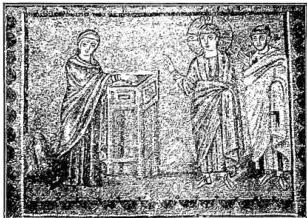
WIDOWHOOD - The widow’s mite. Mosaic of the 6th century in the
basilica of S. Apollinare nuovo - Ravenna.
widowed, you faithfully performed the duty of a father and mother toward your child...» (ibid., IV, col. 65). In the Lateran Christian Museum there is an «Octavia matrona vidua Dei» (O. Marucchi, Monumenti del Museo Crist. Pio Later., Milan 1910, pl. 54, no. 2); in Milan, a Diogenia «quae viduata viro vixit amica Deo» (CIL, V, p. 618, no. 10); in Verona (CIL, V, 3419); in Trier (CIL, XII, 3916); in Tabarka, «viduitatis et verecundiae preconium castitatis et pietatis exemplum» (Bull. archéol. du Comité, 1911, p. 172). Among Greek funerary inscriptions may be recalled those of a ΦΛΑΒΙΑ ΧΗΡΑ who lived 85 years, buried in Priscilla (G. B. De Rossi, Bull. arch. crist., 1886, p. 902, no. 130); of a ΒΙΚΤΩΡΙΑ ΧΗΡΑ in Callisto (G. Wilpert, La cripta dei Papi e la Cappella di S. Cecilia, Rome 1910, p. 70).
In certain rare pagan inscriptions, but more frequently in Jewish and Christian ones, one sometimes finds the term univira or the corresponding Greek μονασθρος, in praise of a woman who had had only one husband and who, when widowed, had not entered into a second marriage. In Christian inscriptions there is sometimes a periphrasis such as «uni devota marito» (G. B. De Rossi, J. J. J. J. J. J. J. J. J. J. J. J. J. J. J. J. J. J. J. J. J. J. J. J. J. J. J. J. J. J. J. J. J. J. J. J. J. J. J. J. J. J. J. J. J. J. J. J. J. J. J.
Well known is the inscription of Regina, «matri viduae quae sedit annos LX et aeclsa [ecclesiam] nunqua(m) gravavit unibyraque vixit annos LXXX mesor. V dies XXII», now in the Lateran Museum; examples are also found in Callisto, both in the Greek μονασθρος (G. B. De Rossi, Roma sotterr., III, Rome 1877, p. 145) and in Latin (G. Wilpert, La cripta dei papi e la cappella di S. Cecilia nel cimitero di Callisto, Rome 1910, p. 79); and also outside Rome (O. Marucchi, Scoperta di un antico cimitero cristiano al miglio 36 della via Prenestina, in Nuovo Bull. di arch. crist., 1914, p. 133 no. 10). The expression «ecclesiam nunquam gravavit» in Regina’s inscription occurs exactly in that of «Dafnen vidua», who «cum vix(it) ecclesiam nihil gravavit» (Marucchi, Mon. del Museo Lat., pl. 54, 2). The expression «vidua sedit» is found again in inscriptions from Ferentino (CIL, X, 5902) and Cagliari (CIL, X, 7787). The representation of the parable of the widow’s mite (Mk. 12, 41-44; Lk. 21, 1-4) occurs in the mosaic cycle of S. Martino «in caelo aureo» at Ravenna, now S. Apollinare nuovo; the scene was likewise represented in the basilica of S. Martino at Tours, completed by Bishop Perpetuo in 470; this representation was illustrated with verses by s. Paolino di Périgueux (PL 61, 1071): «non quae multa dedit, sed quae sibi nulla reliquit / laudari maruit iudicis ore Dei». It is found again in one of the miniatures of the Paris codex (Greek 510) of the Homilies
of s. Gregorio di Nazianzo (ed. H. Omont, Miniatures des plus anciens mss. grecs de la Bibl. nat. du VIe au XIVe siècle, Paris 1929, pl. 46) and in the cycle of S. Angelo «in Formis».