
MATRIMONIO. — Historically considered, it may be defined as the union of man and woman for the purpose of propagating and educating the human race. And since this purpose could not be rightly attained if the relations between the two sexes were not subject to discipline, from the most ancient times, by a necessity of nature itself, one observes, among all peoples, the establishment of a juridical-social institution which is precisely marriage.
The word matrimonio comes from the Latin matris munus or munium, which indicates the important role of the woman in the family. Other names: coniugio (Lat. coniugium), which the Catechism of Trent (part 2, ch. 6, 8) explains: « quia mulier cum viro quasi uno iugo astringitur »; connubio (Lat. connubium, from nubere, to veil, deriving from the custom of placing the flammeum on the bride’s head); from the same root comes the word nozze (Lat. nuptiae).
SUMMARY:
I. Marriage as a Sacrament
II. Marriage among primitive peoples
III. History of marriage
IV. Law and moral theology
V. marriage.MARRIAGE AS A SACRAMENT.
It is the sacrament that prepares new candidates for the kingdom of God. It originates (matrimony in fieri) from the mutual and free consent of two persons of different sexes, who unite themselves in perpetuity for the purpose of procreating and educating offspring in the worship of God. From mutual consent arises the indissoluble bond between the spouses (matrimony in facto esse).
SUMMARY: I. Marriage in dogmatic theology. Sacramental nature of marriage. —
II. Nature of the sacrament of marriage
III. Ends of the sacrament.I. MATRIMONY IN DOGMATIC THEOLOGY. SACRAMENTAL NATURE OF MATRIMONY — The sacraments of the New Law are sensible signs that produce grace, instituted by Jesus Christ (v. SACRAMENT). Since matrimony is a natural institution that has existed from the beginning of humanity, it is necessary to examine the sources of Revelation to determine whether it was positively elevated to the supernatural order as an efficacious sign of grace.
1. Sacred Scripture
The first pages of the Bible outline the structure of matrimony as a natural institution (Gen. 1:27–28; 2:18–24), whose constitutive elements are clearly indicated: a) it is instituted as an officium naturae arising from the nature of the sexes and their mutual attraction; God added a positive confirmation: “And God created man to his own image; to the image of God he created him, male and female he created them. And God blessed them, saying: Increase and multiply, and fill the earth” (Gen. 1:27–28); b) it is characterized by two fundamental qualities: unity and indissolubility: “Therefore shall a man leave his father and his mother, and shall cleave to his wife; and they shall be two in one flesh” (Gen. 2:24); c) it is oriented toward the primary end of procreation: “Increase and multiply, and fill the earth” (Gen. 1:28; cf. Tob. 8:9) and toward the secondary end of mutual assistance: “And the Lord God said: It is not good for man to be alone; let us make him a help like unto himself” (Gen. 2:18); d) from its origins, it bears a sacred character (cf. Prov. 2:17; Tob. 8:9; P. Heinisch, Teologia del Vecchio Testamento, trans. it., Rome 1950, p. 217), which all peoples recognized in the religious ceremonies with which they surrounded marriage.From the old Adam to the new, the primitive unity and indissolubility were not always observed, not even among the chosen people, who, because of their hardness of heart, obtained a temporary dispensation from God (cf. Heinisch, op. cit., pp. 220–22), nor, much less, among pagans, who, abandoning themselves to divorce and polygamy, soon sank to that low moral level from which Jesus Christ came to free the world. He, in fact, first restored matrimony to its primitive purity, reinstating the law of unity (Matt. 19:9; Mark 10:11; Luke 16:18) and indissolubility: “What God has joined together, let no man put asunder” (Matt. 19:6), and then elevated it to the dignity of a sacrament.
This elevation is foreshadowed in Christ’s manner of acting (cf. Leo XIII, encyclical Arcanum divinae sapientiae, 10 Feb. 1880) and is more clearly suggested by St. Paul in the famous passage of Eph. 5:22–28, where, after saying that a man must love his wife as Christ loved the Church, he adds: “For this cause shall a man leave his father and mother, and shall cleave to his wife, and they shall be two in one flesh (καὶ ἔσονται οἱ δύο εἰς σάρκα μίαν). This mystery is a great one, but I speak in reference to Christ and to the Church (τὸ μυστήριον τοῦτο μέγα ἐστίν, ἐγὼ δὲ λέγω εἰς Χριστὸν καὶ εἰς τὴν Ἐκκλησίαν). Nevertheless, let every one of you in particular love his wife as himself; and let the wife fear her husband.”
The clause “Sacramentum hoc, mysterium magnum est, ego autem dico in Christo et in Ecclesia” (v. 32) has been widely debated. Cajetan, J. Estius, B. Giustiniani, and especially L. Godefroy (Mariage dans l'Écriture, in DThC, IX, cols. 2066–71), I. Vosté (Commentarius in epist. ad Eph., 2nd ed., Rome 1932, pp. 272–88), and F. Amiot (L'enseignement de st Paul, II, Paris 1938, p. 8) hold that no proof can be drawn from this text in favor of the sacramental nature of matrimony, since the verse refers to the mystery of the union of Christ with the Church, of which the primitive institution of matrimony was a symbol (figure, typus). But, as F. Prat observes (La teologia di s. Paolo, trans. it., II, Turin 1937, p. 270), this hypothesis seems inadmissible, for it supposes an intolerable tautology: this mystery, namely the union of Christ with the Church, is great in reference to Christ and the Church. Therefore, most interpreters refer μυστήριον to matrimony and see in it the foundation of a biblical proof of its sacramental nature. The demonstrative process, which varies widely, can be reduced to three types of argument:
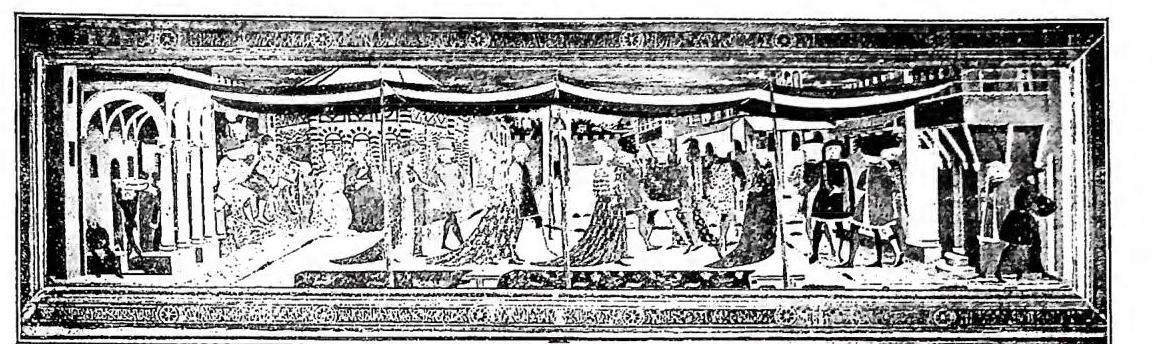
MARRIAGE – The Marriage of Boccaccio Adimari with Lisa Ricasoli. Work by the “Maestro dei Cassoni” (mid-15th century) – Florence, Uffizi. (Int. Alinari)
Marriage may be defined historically as the union of man and woman established by God for the propagation of the human race and for the mutual assistance of the spouses. In the Old Testament it was not yet elevated to the dignity of a sacrament, but remained a natural institution destined to prefigure the future union of Christ with the Church. In the New Testament, however, it was raised to the dignity of a sacrament by Christ Himself, who made it a sign and source of grace.
The proof of this sacramental dignity is drawn from the New Testament, where the marriage of Christians is presented as a sign of the union between Christ and the Church. Most interpreters refer μυστήριον in Ephesians 5:32 to marriage and see in it the foundation of a biblical proof of its sacramental nature. The demonstrative process, which varies widely, can be reduced to three types of argumentation:
a) Ex analogia fidei. – Sacred signs follow the nature of the supernatural economy to which they belong; in the Old Testament they had no sanctifying efficacy (Gal. 4:9: “infirma et egena elementa”), but were merely images and figures of future goods; in the New Testament, on the contrary, they have received from God, by the merits of the Redeemer, a supernatural power by which they penetrate the conscience, sanctifying it (cf. Heb. 9–10). In Eph. 5:32 a sacred sign is in question, which originated in creation and endures in redemption (St. Paul indeed speaks to Christians and extols the moral grandeur of their marriage considered as a sacred sign); it must therefore be held that in the Old Testament marriage was a symbol ordained by God to signify the future union of Christ with the Church (a prognostic sign, without any sanctifying efficacy), and that in the New Testament it remains, by divine will, as a sign of a reality already accomplished on the Cross, the mystical marriage of Christ with the Church; it is therefore a commemorative sign, which, belonging to the New Law, possesses the prerogative of interiorly sanctifying (a demonstrative sign of grace). Nor should the different orientation that marriage acquires in the successive states of Law and Grace cause surprise. Had circumcision been preserved by Jesus Christ as a sign of His covenant with humanity, one would have reason to think that it would have become a sacrament in the strict sense. Turned toward the past and no longer toward the future, it would have changed meaning and direction, becoming capable of effectively producing the grace of the interior covenant between God and souls, whereas abandoned as a natural element, it lost all value at the death of Christ. Thus marriage, which under the Law was the type and figure of the future union of Christ with the Church, changed meaning (because God preserved it in the capacity of a sign) when this union was consummated on Golgotha; from prophetic it became commemorative, from speculative it became practical, from inert it became efficacious.
This kind of argumentation, developed with warmth by D. Palmieri (De M. christiano, Rome 1880, pp. 62–70), was accepted by H. Hurter (Theologiae dogmaticae compendium, III, Innsbruck 1900, p. 592), L. Billot (De Sacramentis, II, 7th ed., Rome 1930, pp. 346–50), L. Lercher–F. Dander (Institutiones theologiae dogmaticae, IV, II, Innsbruck 1949, pp. 336–39) and by many others.
b) Ex oneribus. – Christian spouses, in their mutual relations, must be inspired by the relations that obtain between Christ and the Church: on the one hand, respectful submission even to the point of sacrifice (Eph. 5:22–24), and on the other, love and devotion even to the point of death (ibid., 25–29). The gravity of these supernatural obligations (cf. Mt. 19:10) implies a corresponding source of graces and divine aids. St. Paul precisely supposes that the souls of Christian spouses are immersed in an atmosphere of heavenly assistance when he exhorts them so warmly to imitate the relations of Christ with the Church, of which their marriage is the emblem. This argument is common to all theologians (cf., e.g., M. Cordovani, Il Santificatore, 2nd ed., Rome 1946, pp. 364 ff.).
c) Ex parallelismo. – Christian marriage receives its character from the mystery of the union of Christ with the Church, of which, according to St. Paul, it is the living image. It is not merely an exemplar standing outside, at the margins of the mystical marriage of Christ, but a copy, a reproduction sprung from that union, imbued with the same essence, which not only depicts but reproduces within itself, actively and efficaciously, the mystery of the relations of Christ with the Church. The two Christian spouses, already members of the Mystical Body, strengthen in their supernatural union the bonds existing between Christ and the Church, of whose mystical espousals they become an offshoot and an extension. As the living expression and concrete realization of the union of Christ with the Church, in order to fulfill perfectly what it signifies, it must necessarily reproduce and embody its fundamental lines and distinctive notes, namely, unity, indissolubility, and holiness.
This proof, touched upon with the author’s customary depth by M.-G. Scheeben (I misteri del cristianesimo, Italian trans., Brescia 1949, pp. 445–46), has been developed by J. Fischer (Ehe und Jungfräulichheit im Neuen Test., Münster 1919, p. 44), I. B. Colon (Paul [saint], in DThC, XI, cols. 2421–22), C. Adam (La dignità sacramentale del M., Italian trans., Milan 1935, p. 16), B. Bartmann (Manuale di teologia dogmatica, Italian trans., III, Alba 1950, p. 350), J. Huby (Les Épîtres de la captivité, 13th ed., Paris 1947, pp. 246–48). These arguments, though not decisive and so regarded by their authors, possess a character of marked probability that fully justifies the carefully phrased statement of the Council of Trent: “Paulus innuit” (Denz.-U., 969).
2. The Holy Fathers
The Church lived the doctrine of St. Paul before explaining it scientifically. In practice she held marriage to be a holy undertaking, shrouded in the shadows of the mystery of Christ. St. Ignatius of Antioch, at the beginning of the 2nd century, attests that the marriage of the faithful was celebrated with the authorization of the bishop: “It is fitting that husbands and wives should enter into marriage with the consent of the bishop, so that their union may be according to the Lord and not according to lust. Let all things be done to the honor of God” (Ad Polyc., 5, 1). Tertullian, reporting what was already customary in the 2nd century, enumerates with precision the interventions of the Church in the celebration of marriage: “Whence shall we suffice to describe the blessedness of that marriage which the Church joins together, the oblation confirms, the blessing seals, the angels announce, the Father ratifies?” (Ad uxorem, 2, 9: PL 1, 1415). From this text it appears that marriage was not only solemnized coram Ecclesia (“with the consent of the bishop, the Church joins together”), but was already surrounded by the most august rites: the offering of the eucharistic sacrifice (oblatio) and the priestly blessing (benedictio), of which an explicit testimony is found in the Praedestinatus, 3, 31: “Priests consecrating the beginnings of marriages and uniting them with the divine mysteries” (cf. St. Ambrose, Ep. 19, 7: PL 16, 98). The original grafting of the nuptial solemnities onto the liturgical action was required by the conviction, which the Church later explicitly manifested in its Sacramentaries and Euchologia, in which it placed marriage among the true sacraments and formulated prayers that expressly attribute to Christian marriage the efficacy of grace (cf. D. Palmieri, De Matrimonio christiano, Rome 1880, pp. 54–55; L. Duchesne, Origines du culte chrétien, 2nd ed., Paris 1898, pp. 413–19; A. Villien, Les Sacrements. Histoire et liturgie, 2nd ed., ibid. 1931, pp. 335–402).The same idea is developed in archaeological monuments. There Christian spouses are commonly represented in the act of joining hands; between them is placed as a sign of their mutual union (always conceived within the sphere of grace) either the hand of the Lord surrounded by the Constantinian monograms, sometimes accompanied by an inscription (e.g., on the sarcophagus of Tolentino: “Whom the Almighty Lord has joined in sweet marriage with equal merits”), or the jeweled column symbolizing the Church, or Christ standing between the spouses with the inscription: Θεοῦ Χάρις, or Christ considered as the “pronubus” of the marriages of His faithful, e.g., in the Albani fragment, according to the explanation of St. Paulinus of Nola: “Far be from these bridal chambers the vain licentiousness of the common crowd, Juno, Cupid, Venus, names of lust. Holy pledges, revered by the priest’s pact, are joined; peace, modesty, and piety come together... By such a law Jesus stands as Pronubus for those who marry in His way” (Carm., XXV, p. 12, 151: PL 51, 633–636; cf. O. Marucchi, La santità del M. confermata dagli antichi monumenti cristiani, Rome 1902; G. Wilpert, La fede della Chiesa nascente secondo i monumenti dell’arte funeraria antica, Vatican City 1928, pp. 249–55).
GIOVANNI BARGIGLI
Paralleling the liturgical and archaeological tradition, which is predominantly practical in character, is the theoretical reconsideration of the evangelical and Pauline motifs concerning Matrimony. From the 3rd to the 5th century three concepts are constantly reiterated:
a) Christian Matrimony is the symbol of the union of Christ with the Church (Clement of Alexandria, Stromata, 3, 12: PG 8, 1186; Origen, Fragmenta in Ioannem, 3, 29: CB, IV, 520; id., Homilia II in Numeros: PG 12, 643; Chrysostom, Homilia 40 in Ephesians: ibid., 62, 140; St Hilary of Poitiers, Tractatus de mysteriis, 3: CSEL, 65, 4-5; St Ambrose, Epistola, 76: PL 16, 399; Ambrosiaster, In Ephesians, 5, 31: ibid., 17, 399);
b) to which is connected the infusion of Grace: «Si ratum est apud Deum Matrimonium... habens iam ex parte divinae Gratiae patrocinium» (Tertullian, Ad uxorem, 2, 7: PL 1, 1229); «Deus quidem est, qui duo in unum compegit... et quoniam coniunctionis auctor est Deus, propterea iis inest Gratia, quia Deo coniuncti sunt; quod non ignorans Paulus connubium Verbo Dei consentaneum gratiam esse pronuntiat» (Origen, In Matthaeum, 14, 16: PG 13, 1229; cf. St Epiphanius, Panarion, 51, 30: ibid., 41, 941; St Innocent I, Epistola, 36: PL 20, 602; St Cyril of Alexandria, In Ioannem, 2, 1: PG 73, 224);
c) whose elevation to the order of Grace took place at Cana in Galilee, where the Redeemer perfected the work of the Creator: «In Cana Galileae externae sunt celebratae nuptiae... ut quod deerat emendaret ac iucundissimi vini suavitate mulceret et Gratia» (St Epiphanius, Panarion, 51, 30: PG 41, 941); «Cum nuptiae celebrantur... adest quidam Mater Salvatoris, sed et ipse cum discipulis suis invitatus venit... ut generationis humanae principium sanctificaret» (St Cyril of Alexandria, In Ioannem, 2, 1: PG 73, 224); «Vadit ad nuptias Dei Filius ut, quas dudum potestate constituit, tunc praesentiae suae benedictione sanctificaret» (St Maximus of Turin, Homilia, 23: PL 57, 274; cf. Theodoret of Cyrus, Haereticae fabularum compendium, 5, 25: PG 83, 537; St John Damascene, De fide orthodoxa, 4, 24: ibid., 94, 1209).
St Augustine, a staunch defender of the lawfulness of Matrimony against the Manicheans and Jovinian, was concerned to highlight the tripartite good: fides, proles, Sacramentum (De nuptiis et concupiscentia, 11: PL 44, 421; De bono coniugali, 24, 32: ibid., 40, 394). Focusing his attention on the last point of the trilogy (Sacramentum), St Augustine extensively develops the Pauline symbolism (cf. B. Alves Pereira, La doctrine du Mariage selon St Augustin, Paris 1930, pp. 184-223) and consistently concludes that the res Sacramenti is the indissolubility of Matrimony, which perfectly imitates the inseparability of the mystical marriage of Christ with the Church: «Huius procul dubio Sacramenti res est ut mas et foemina connubio copulati, quamdiu vivunt, inseparabiliter perseverent» (De nuptiis et concupiscentia, 1, 10: PL 44, 420); «Bonum nuptiarum, quod ad populum Dei pertinet, est etiam in sanctitate Sacramenti, per quam nefas est etiam repudio discedentem alteri nubere» (De bono coniugali, 24, 31: ibid., 40, 394). The bond of Christian spouses (res Sacramenti) is so profound that it can be compared to the indelible character of Baptism and Holy Orders (ibid.). In this perspective Grace is seen in Matrimony only obliquely, as the ultimate region (to which perhaps allusion is made in the word sanctitas) of the bond of the spouses, the perfect image of the union of Christ with the Church. But St Augustine must not be isolated from the other Fathers, whose teaching he accepted, and still less from the African writers, above all Tertullian, whose doctrinal tradition he continued.
Once the speculation on the intimate meaning of Sacrament of the New Law—implying the inseparable concept of sign and cause (id. officiis quod significat)—had matured by the mid-12th century, it was applied to Matrimony. Thus arose the opportunity to affirm, in a scientific form, what the tradition of the Fathers, drawn from biblical sources, had taught in a simple and popular manner. The application did not occur without controversy: in the 12th century Abelard, while acknowledging Matrimony as the dignity of a magnae rei Sacramentum, considered it a non-spiritual Sacrament and therefore «non alicuius meriti ad salutem, sed propter inconvenientiam ad salutem concessum» (Epitome theologiae, 28: PL 178, 1738); whereas Hugh of St Victor regarded it as a true source of Grace (De Sacramentis, II, 2, c. 8: ibid. 186, 496).
This doctrinal oscillation continued for a century (from 1150 to 1250) among canonists and theologians and was definitively resolved by the clear teaching of St Thomas Aquinas (Sentences, IV, d. 26, q. 2, a. 3), whose authority was not diminished by the tenacious resistance of Olivi and Durandus, since, having been incorporated into the Decretum pro Armeniis (Denz-U, 695 and 702), it became the authentic doctrine of the Church.
For centuries the Roman pontiffs had already numbered Matrimony among the true Sacraments of the New Law: at the Second Lateran Council (1139) and the Council of Verona under Lucius III (1184), in the Epistola ad Umbertum (1198) and the Professio fidei prescribed for the Waldensians (1208) by Innocent III, in the Professio fidei proposed to Michael VIII Palaeologus (1274) by Gregory X, and in the condemnation of the Fraticelli (1318) by John XXII (Denz-U, 367, 402, 406, 424, 465, 490).
4. Protestant errors. — It was against this centuries-old and solemn teaching that the bold innovations of Luther clashed: «Never is it read that anyone who has taken a wife has received the Grace of God. Indeed, the symbol was not even instituted by God in Matrimony... Matrimony may indeed be understood as an allegory of the union of Christ and the Church, but not as a Sacrament instituted by God; it is a Sacrament introduced into the Church by men through ignorance of things and words» (De captivitate Babylonica, 7, in M. Luther, Scritti politici, edited by G. Panzieri Saija, Turin 1949, pp. 314, 317). For the “reformer” Matrimony is an absolute necessity of life, like eating and drinking, regulated therefore by merely human laws, to be considered hence an affair exclusively civil: ein weltlich Ding (cf. A. Kawerau, Die Reformation und die Ehe, Halle 1892; L. Cristiani, Du luthéranisme au protestantisme, Paris 1911, pp. 181-82; J. Piquier, Luther, in DThC, IX, cols. 1276-82). These ideas were
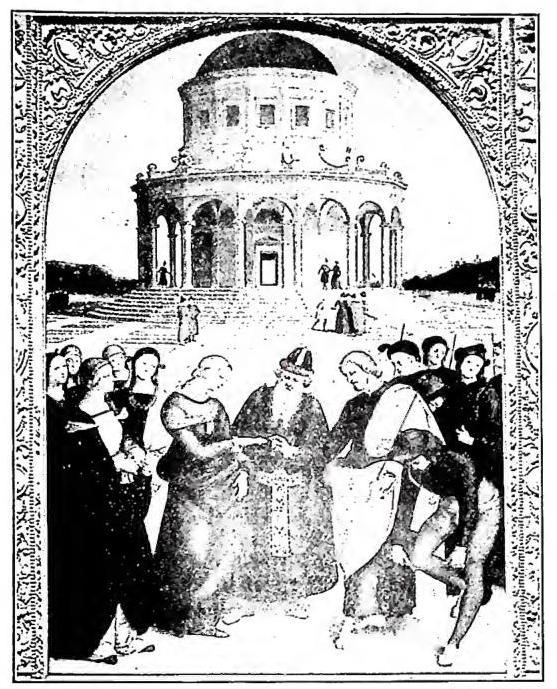
MATRIMONIO - Sposalizio della Vergine. Dipinto di Raffaello (1504).
Milano, Pinacoteca di Brera.
condivise da tutti i protestanti, particolarmente da Calvino
(cf. Institutio christianae religionis, 4, 19), che nel com-
mento alla Lettera agli Efesini stigmatizzò l'insegnamento
cattolico di crassee ignorantiac hallucinatio (Opera Calvini,
in Corpus reformatorum, LXXIX, 227).
5. Concilio di Trento
Contro questo svisamento della verità lottarono con ardore e erudizione i teo- logi cattolici del Cinquecento (cf. V. Zollini, De Ma- trimonii Sacramento novatorum errores, catholicorum explanationes, Roma 1943; tesi inedita dell'Ateneo di Propaganda Fide) e emise le sue solenni definizioni il Concilio di Trento, sess. XXIV (11 nov. 1563), che vigorosamente affermò l'indole sacramentale del M., trattando inoltre delle sue proprietà (Denz-U, 969-82). Le limpide e precise formole di Trento, felice epilogo della tradizione cristiana, che tanta uggia recarono ai regalisti e ai febroniani, accesi «secolarizzatori» del M., vennero riprese e illustrate, secondo le esigenze dei tempi, da Pio VI contro Scipione Ricci (Denz-U, 1556-60), da Pio IX, nel Sillabo (ibid., 1765-76); da Leone XIII nell'encicl. Arcanum divinae sapientiae, 10 febbr. 1880 (ed. F. Hürt, Roma 1942), di cui sono celebri la concisione del dettato e la robustezza delle formole; da Pio X nel decreto Lamentabili, contro i modernisti (Denz-U, 2251); da Pio XI nella classica encicl. Casti connubii, 31 dic. 1930 (ed. F. Hürt, Roma 1942).Ehe in den ersten drei Jahrhunderten, Berlino 1927; L. Godefroy,
Mariage dans les Pères, in DThC, IX, coll. 2077-2123; P. R. Pi-
vano, De essentia Matrim. ad mentem Patrum, in Rass. di morale
e diritto, 4 (1938), pp. 216-36; 5 (1935), pp. 132-55; A. Reuter,
S. Augustini doctrina de bonis Matrim., Roma 1942; N. Lado-
mérzak, St Augustin docteur du Mariage chrétien, ivi 1942. 3) Sco-
lastici: F. Falk, Die Ehe am Ausgang des Mittelalters, Magonza
1908; I. de Guibert, Le texte de Guillaume de Paris sur l'essence
du Sacrement du Mariage, in Recherches de science religieuse,
5 (1914), pp. 422-27; G. Le Bras, La doctrine du Mariage chez les
théologiens et les canonistes depuis l'an mille, in DThC, IX, coll. 2123-
2313 (conspicuo per la vastità e la profondità dell'indagine); L.
Miesery, Le Mariage, in st Thomas d'Aquin, Somme théologique
(ed. Revue des jeunes), 2 voll., Parigi 1930, nell'appendice di
ambedue i volumi; P. Abellan, El fin y la significación sacramental
del Matrimonio desde s. Anselmo asta Guillermo de Auxerre,
Granata 1939; V. Fagiolo, Il Sacramento del M. in s. Bonaventura,
Roma 1946 (tesi inedita dell'Ateneo Lateranense). 4) Prote-
stanti: E. Safeld, Luthers Lehre von der Ehe, Lipsia 1882; S. Ba-
ranovski, Luthers Lehre von der Ehe, Posen 1913; J. Fourey,
Le protestantisme français et le Mariage, Parigi 1925; F. Wendel,
Le Mariage à Strasbourg à l'époque de la Réforme (1560-1621),
Strasburgo 1928; id., Calvin. Vie et doctrine, Parigi 1950; J. Pa-
quier, Luther, in DThC, IX, coll. 1276-83. 5) Trattati clas-
sici: P. Ledesma, De magno Matrim. Sacramento, Venezia 1595;
R. Bellarmino, De Matrim., ivi 1599; Th. Sanchez, De s. Ma-
trim. Sacramento, Anversa 1617; B. Pontius, De Sacramento Ma-
trim., Salamanca 1624; I. Perrone, De Matrim. christiano, 3 voll.,
Roma 1858; M. P. Rosset, De Sacramento Matrim., 6 voll.,
Parigi 1895-96. 6) Studi recenti: I. Bilz, Die Ehe im Lichte
der katholischen Glaubenslehre, 2e ed., Friburgo in Br. 1920;
A. De Smet, De sponsalibus et Matrim., 4e ed., Bruges 1927;
I. Dermine, La doctrine du Mariage chrétien, 2e ed., Lovanio
1928; G. Kisslstein, De Matrim. sacramentalitate, in Rev. eclé-
siat. de Liège, 24 (1932-33), pp. 246-49; A. Koch, Symbolismus
der Ehe, in Stimmen der Zeit, 124 (1932-33), pp. 336-38; P. Don-
coeur, La sainteté du Mariage chrétien, in Études, 236 (1938),
pp. 38-55; P. Carré, Compagnon d'éternité, Parigi 1939; A. Chri-
stian, Le Sacrement est grand, ivi 1939; C. Boyer, Synopsis
prædectorium de Matrim., Roma 1942; B. Lavaud, Mariage. Na-
ture humaine et Grâce divine, Friburgo 1942; A. Piolanti, De
Sacramentis, 2e ed., Roma 1947, pp. 432-51; E. Boissard, Ques-
tions théologiques sur le Mariage, Parigi 1948; F. Taymans
d'Experson, La Ste Trinité et les Sacrements, Bruxelles-Parigi
1949, pp. 93-107; A. Piolanti, Dignità del M. cristiano, in Tabor,
4 (1949), pp. 202-206; P. Colli, La pericopa paolina ad Eph. 3,
37, nello interpret. dei SS. Padri e del Conc. di Trento, Parma 1931.
Antonio Piolanti
II. NATURE OF THE SACRAMENT OF MATRIMONY
6. Contract and Sacrament
Regarding the nature of this Sacrament, the fundamental question, from which all others logically derive, concerns the relationship between the contract and the Sacrament: whether, that is, Christian marriage, before being a Sacrament, must be considered as a contract, in such a way as to distinguish in it two successive elements, the first of which must be considered as the necessary foundation of the second; or whether instead the contract remains totally permeated by the Sacrament.The conception that separates the contract from the Sacrament entered late into doctrine and had advocates up to the 19th century, for reasons not always of a theological nature. Some well-intentioned theologians contributed to it, who certainly did not foresee the disastrous consequences that would ensue.
The first was Melchior Cano (Opera theologica, II, Rome 1900, ch. 8), according to whom the matrimonial contract is nothing but the matter of the Sacrament, to which is added the blessing of the priest as the sacramental form. This led directly to the view that a matrimonial bond not being a Sacrament was conceivable: and he himself affirmed this without hesitation. The Spanish theologian had many followers up to the threshold of the 19th century (e.g., Silvio, Estius, Tournely, even Benedict XIV before he became pope).
The same conclusion was reached by the theory of Vázquez and the Salmanticenses, according to which the two elements are certainly linked together, but the contract retains its natural value in the case where the betrothed intended to conclude only a contract: it would therefore remain in their power to separate the contract from the Sacrament.
Some modern theologians and canonists, Gallicans and Josephists (e.g., M. A. de Dominis, Launoy, Nuyts), separated the contract from the Sacrament even more. They held that between these two elements there existed only extrinsic relationships, inasmuch as the priest’s blessing would be added externally to the contract. Through the work of these theologians, the distinction descended from the theological to the political plane, lending valid support to the claims of the State in matters of marriage. In this way modern civil marriage was fostered.
According to Catholic teaching, on the other hand, in Christian marriage the contract and the Sacrament, although logically distinct, are really identified, since “Christ the Lord raised the very matrimonial contract between the baptized to the dignity of a Sacrament” (CIC, can. 1012 § 1). The contract, therefore, from the plane of an officium naturae is elevated to the order of Grace, in such a way that this sublimation of value totally permeates the contract. It is inconceivable to make a vivisection, whereby the contract would remain in the zone of nature and the Sacrament would accede to it, as it were, to perfect II. Hence the CIC declares that “among the baptized there cannot exist a valid contract that is not at the same time a Sacrament” (can. 1012 § 2).
This doctrine, although not proposed in the Church’s official teaching tamquam divinitus revelata, is nevertheless certain, indeed it has been judged by the S. R. Rota to be proxima fidei (AAS, 11 [1919], p. 933). Moreover, the Fathers were unaware of the distinction, as were theologians before the 16th century. Furthermore, Eugene IV in the Decretum pro Armenis implicitly affirmed that the matrimonial contract and the Sacrament in the faithful are not two distinct things (Denz-U, 702). The same concept is presupposed by the Council of Trent, which attributed sacramental value to clandestine marriages celebrated before the decree Tametsi (Denz-U, 990); and it is validly defended by Pius IX in a brief to the King of Sardinia (1852) and also in the allocution Acerbissimum vobiscum of 27 Sept. 1852 (Denz-U, 1640) and in the condemnation of contrary errors contained in propositions 66 and 73 of the Syllabus (Denz-U, 1766, 1773); by Leo XIII in the encyclical Arcanum (10 Feb. 1880: Denz-U, no. 1854) and by Pius XI in the encyclical Casti connubii (31 Dec. 1930: ibid., no. 2237).
7. Matter and Form
Since the Sacrament is nothing other than the natural contract elevated to the order of Grace, it follows that the constituent elements of the Sacrament must be identified with the constituent elements of the contract itself. The sensible sign of the Sacrament of Matrimony is therefore constituted by the mutual consent of the two spouses. The words that express this consent are considered as matter, inasmuch as they contain the donation of one party to the other, and as form, inasmuch as they imply the acceptance of this donation.No formal requirement of specific words is necessary, because Christ did not require as the sensible sign of this Sacrament anything beyond what is necessary to constitute a human contract: any sign by which internal consent is expressed is therefore sufficient.
This doctrine, formulated by Bellarmine, Suárez, and Sánchez, is commonly held by almost all modern theologians and recurs in the same constitution Paucis of 19 March 1758, of Benedict XIV. The words of the Council of Florence, which establishes a threefold element for the constitution of the Sacrament “rebus tamquam materia, words as form and the person of the minister,” cannot be opposed to it; on the basis of these words some theologians maintained that the bodies are the matter and the words by which the contracting parties mutually transfer the ius in corpus to one another are the form. In Matrimony, however, as in the Sacrament of Penance, there does not exist a true matter. The bodies of the contracting parties do not constitute the contract but are rather its object (remote matter circa quam). The contract is formally concluded by the fact that the parties outwardly express their consent. In this consists the sensible sign of the Sacrament of Matrimony (cf. St. Thomas, IV Sent., d. 26, q. 1, a. 1, sol. 2). At a later stage, by analogy with the other Sacraments, a determinable and a determining element are distinguished, namely a mutual donation and a mutual acceptance of the right over the body, respectively called matter and form.
Theologians who consider the priest as the minister of the Sacrament of Matrimony hold that the contract is the matter and the words of the blessing are the form that seals and confirms the contract. It has already been noted how such an opinion starts from an unsustainable principle. Its proponents adduce as an argument the words of the Ritual “Ego coniungo vos,” but it must be observed that these words do not exist in the more ancient Rituals, and that the Council of Trent left their use optional and permitted other somewhat different formulas (Denz-U, 990). This would not have been established if the Church had seen in these words the sacramental form of Matrimony.
8. Ministers
The ministers of the Sacrament of Matrimony are the contracting parties themselves: given the inseparability of the Sacrament from the contract, whoever makes the contract also makes the Sacrament. The priest celebrates the rite, not the marriage; his assistance is merely that of a qualified witness who receives the consent of the spouses in the name of the Church.The Fathers emphasized the blessing of the Church and required it, but nothing suggests that they saw in the blessing the necessary form: they never denied the validity of clandestine marriages. Scholastic theology held the same viewpoint. St. Thomas considered the priest’s blessing as a sacramental. Marriage is completed by mutual consent (Sum. Theol., Suppl., q. 45, a. 5), and this conception among the scholastics is all the more noteworthy inasmuch as they placed great emphasis on the action of the priest in the Sacrament.
The Council of Trent upheld the same doctrine, for although it imposed the requirement to contract marriage before the parish priest and two witnesses, it did not contest the validity of clandestine marriages (Denz-U, 990). Pius X, in the constitution Procida (18 January 1906) on marriage, required the Tridentine form, but in cases of prolonged absence of the priest, declared that the marriage could be validly and licitly contracted before two lay witnesses (Denz-U, 2069). The Code established: «Matrimonium facit partium consensus in personae iure habiles legitime manifestatus» (can. 1081). Therefore, the contrary opinion of Melchior Cano, the Gallicans, and the Josephinists, which once had many adherents, is now entirely abandoned.
4. Subject. — The only subject capable of receiving marriage “validly” is the baptized person who is free from diriment impediments.
To receive it “licitly and fruitfully,” the absence of prohibitive impediments and the state of grace are required. A marriage contracted with prohibitive impediments is valid, but grace is not conferred because the obstacle posed by grave sin at the moment of contracting prevents II. As for the state of grace, it is required because marriage is a sacrament of the living; this state can be obtained either through perfect contrition or through confession. Although the state of grace obtained through the sacrament of penance is prescribed only for the Eucharist, the CIC nevertheless orders the parish priest to exhort the betrothed to confess their sins and to receive Holy Communion piously before the celebration of marriage (can. 1033).
There can be no valid marriage between baptized persons that is not at the same time a sacrament, even when the contracting parties are unaware of this, or intend to contract a valid marriage while excluding the sacrament, or believe that marriage is not a sacrament. Therefore, the sacrament is received not only by Catholics but also by heretics, schismatics, and apostates. There is no controversy on this point. More debated, however, is the question of whether the sacrament is received when two unbaptized spouses convert and receive baptism. Some hold that an expressed or tacit renewal of consent is required; others maintain that such a marriage can never be elevated to the dignity of a sacrament. Today the prevailing opinion, already defended by Bellarmine (De Matrim. Sacramento, ch. 5), is that such a marriage becomes a sacrament at the very moment the two spouses receive baptism. Bellarmine has been followed by Sánchez, Perrone, Pesch, Billot, Cappello, De Smet, and Wernz-Vidal. This opinion has a biblical foundation, since the words of St. Paul to the Ephesians (Eph. 5:32) were addressed to Christians, many of whom had certainly married while still unbaptized; it is also theologically sound if one considers that the efficient cause of the sacramental bond in marriage between the baptized is the natural consent of the faithful, and that the only obstacle to the sacramental character of an unbaptized marriage is the lack of baptism. Once this is received, the enduring bond is elevated to signify the union of Christ with the Church, and nothing is lacking for the general principle to apply: “Matrimonium inter christianos est Sacramentum.” A new consent, necessary to have the sacrament, is to be excluded, because baptism does not dissolve but leaves intact the previous marriage; there is therefore a single, enduring marriage in which the original consent always retains its validity.
A different conclusion prevails in the case of a marriage contracted between a baptized and an unbaptized person. Some hold that such a marriage is a sacrament for the faithful party (Sasse, Rosset, Pesch). Others affirm this only when a dispensation from the impediment has been granted. But the more common opinion does not admit this division: if there is no sacrament for the unbaptized spouse, as is certain, then, because of the indissolubility of the contract and the sacrament, there can be no sacrament for the faithful spouse either (Wernz-Vidal, Cappello, Noldin, Gasparri).
5. Effects. — The effects of this sacrament consist in the formation of the sacramental bond, the increase of sanctifying grace, and the right to all actual graces necessary to live the married state in a Christian manner.
The marital bond constitutes the res et Sacramentum; it serves as a dispositive cause for the infusion of grace and endures until it is lawfully dissolved. The conferral of sanctifying grace is a truth of faith defined by the Council of Trent in sessions VII, canons 6 and 8 (Denz-U, 849, 851) and XXIV, canon 1 (Denz-U, 791). This is secondary grace, because marriage, by symbolizing the union of Christ with the Church, is a sacrament of the living. When it is received knowingly in a state of mortal sin, it is valid if all other conditions are met, but illicit. In this case, grace revives later when the obstacle is removed. If, however, it is received unknowingly in a state of sin, it produces “per accidens” the first justification through attrition.
The right to special actual graces is one aspect of the sacramental grace proper to this sacrament, by which spouses are enabled to attain the lofty purposes of married life. Already St. Paul alludes to the negative effect of moderating concupiscence: “To avoid immorality, each man should have his own wife, and each woman her own husband” (1 Cor. 7:2; cf. 1 Thess. 4:4–5). The Council of Trent also recalls among the effects produced by the sacrament the perfection of natural love and the strengthening of indissoluble unity, by which the spouses are sanctified, just as the bond uniting Christ with the Church is a bond of charity and holiness (Denz-U, 969). Casti connubii speaks of living marriage “whose efficacious power, although it does not imprint a character, is nevertheless permanent.” In this regard, the encyclical comments on a text by St. Robert Bellarmine: “The sacrament of marriage is like the Eucharist, which is a sacrament not only when it is conferred but also as long as it endures; for as long as the spouses live, their union is always the sacrament of Christ and the Church” (De Matr., II, 6). Therefore, all acts that translate into practice, continue, and ratify in detail the mutual gift—namely, everything between spouses that manifests sanctified love—is a source of grace. In this way, the state of marriage can be eminently sanctifying.
6. Powers of the Church. — The marriage of the faithful is always a sacrament, and the power to administer the sacraments was conferred exclusively by Jesus Christ upon His Church; to it, therefore, belongs the proper, exclusive, and independent right to determine what is necessary for the valid and licit celebration of Christian marriage (can. 1038).
In particular, the specific powers of the Church include: a) interpreting and declaring in an authentic and exclusive manner (without derogating from or dispensing without express mandate from God) divine law, by virtue of its teaching authority (can. 1322); b) determining diriment and prohibitive impediments and prescribing the conditions required for the licit and valid celebration of marriage; c) proceeding and adjudicating all matrimonial causes concerning the existence, validity, effects, and dissolution of betrothal and marriage itself, as well as conjugal separation; d) compelling delinquent spouses, even with penalties, to observe its laws and sentences. These powers of the Church indirectly extend even to the unbaptized, if such a person wishes to contract marriage with a baptized person; hence the law that directly obliges one of the contracting parties indirectly binds the other as well. In such a case, the baptism of one party is sufficient to establish the Church’s jurisdiction in the matter.
Da ciò segue che allo Stato non compete potere alcuno sulla liceità o validità del M. dei fedeli, per i quali il Sacramento non si distingue dal contratto. Esso può unicamente: a) fissare certe condizioni, obbligatorie civilmente, per chi voglia contrarre M., purché ciò sia richiesto dal bene pubblico e non contrasti con il diritto divino e canonico; b) legiferare sugli effetti temporali, separabili dalla sostanza del M. In questo la sua competenza è propria ed esclusiva.
L'esercizio di questo potere della Chiesa già si riscontra in s. Paolo (I Cor. 5); fin dai primi secoli la Chiesa affermò questi suoi diritti, indipendenti dal potere civile, così che durante il medioevo il diritto canonico divenne prevalente, se non esclusivo. Non mancarono resistenze da parte dei principi, ed errori da parte dei canonisti e teologi regalati. I protestanti, considerando il M. non più come Sacramento ma come semplice contratto, lo fecero dipendere esclusivamente dalla giurisdizione civile. Ma non mancarono teologi (Sánchez, Soto, Billuart) che, pur tenendo inseparabile per i fedeli il contratto dal Sacramento, concedevano ad ambedue le autorità il diritto proprio sul M., a meno che la Chiesa non volesse riservarsi, come si riservò, il diritto di stabilire l'esclusività. Ma anche in questo caso si concedeva allo Stato il diritto di stabilire impedimenti proibenti, riservando alla Chiesa i dirimenti.
La dottrina cattolica emerge da numerose ed esplicite dichiarazioni dell'insegnamento ufficiale della Chiesa: Concilio Tridentino (sess. XXIV, cann. 3, 4, 9, 12); Pio VI, Errores Synodi pistorienis, propp. 58-60 (Denz-U, 1558-60); Breve ad archiep. Trevirensem, 1782; Ep. ad episc. Motulensem, 1788; Pio IX, Syllabus, propp. 68-70 (Denz-U, 1768-70); Leone XIII, encicl. Arcanum; Pio XI, encicl. Casti connubii; CIC, cann. 1016, 1038, 1040, 1960-61.
BIBLI: Intorno alle questioni che riguardano la materia, la forma, il ministro, il soggetto e gli effetti di questo Sacramento: oltre alle opere citate nella bibl. antecedente: W. Sulerzski, Wer ist Minister bei dem Suhr, der Ehe?, Posen 1881; J. B. Sasse, De Sacramenti Ecclesiae, II, Friburgo in Br. 1898, p. 383 sgg.; C. Pesch, Praelectiones dogmaticae, VII, ivi 1920, n. 758 sgg.; L. Billot, De Ecclesiae Sacramentis, II, 7ª ed., Roma 1920, p. 361 sgg.; C. Pumar Cornes, De forma Sacramenti Matrimonii, Compostella 1930; anon., Quelle est la matière, la forme et le ministre du Sacrement du Mariage?, in L'Ami du clergé, 1931, p. 787 sgg.; F. Cappello, Tractatus canonico-moralis de Sacramenti, V, 6ª ed., Torino 1930, p. 27 sgg. Intorno si rapportò tra contratto e Sacramento: A. Roskovany, Matrimonium in
Ecclesia catholica, II, Augusta-Agria 1887, p. 467 sgg.; M. Covillard, Le Mariage considéré comme contrat civil dans l'histoire du droit français, Parigi 1889, p. 38 sgg.; E. Glasson, Le mariage de Gaston d'Orléans avec Marguerite de Lorraine, ivi 1896; J. Basdevant, Des rapports de l'Église et de l'État dans la législation du Concile de Trente au Code civil, ivi 1900, pp. 26-28, 106-22; G. Caviglioli, La precedenza del m. civile durante il Regno Italico, Novara 1914; G. Serviez, De quelques recherches concernant le Mariage contrat-Sacrement et plus particulièrement de la doctrine augustinienne des biens du Mariage, Parigi 1928; F. Gasparri, Tractatus canonicus de Matrimonio, I, 2ᵉ ed., Roma 1932, pp. 31-34. Circa il potere della Chiesa sul M. dei fedeli; J. Perrone, De Matrimonio christiano, II, Roma 1858, pp. 3-132; F. Huszar, De potestate Ecclesiae circa Matrimonium, ivi 1900; E. Grzymala, Ratio sacra in Matrimonio canonico et civili, Roma 1933; G. Stocchiero, Il M. in Italia, 5ᵉ ed., Vicenza 1946, p. 42 sgg. Guglielmo Zannoni
III. AIMS OF MARRIAGE
1. The Data of Revelation. — It has already been noted how God Himself establishes the natural foundations of marriage, promulgating its laws and determining its purposes in procreation and mutual aid (Gen. 1:26-31; 2:7-25).
These concepts are recalled elsewhere in the books of the Old and New Testaments. The teaching of St Paul on this matter is of particular importance, since it indicates another purpose to which God ordained the matrimonial institution after original sin, namely, the remedy for concupiscence. In the First Epistle to the Corinthians, speaking of widows and the unmarried, he says: “It is good for them if they remain even as I. But if they do not contain themselves, let them marry. For it is better to marry than to burn” (7:8-9); and further: “It is good for a man not to touch a woman. Nevertheless, to avoid fornication, let every man have his own wife, and let every woman have her own husband” (ibid. 7:1-2). And after teaching that it is good to abstain from marital relations in order to devote oneself to prayer, he adds: “But then return together again, lest Satan tempt you for your incontinency” (ibid. 7:5). These revealed data, sober yet profound, were later developed by Catholic tradition in systematic doctrine.
In marriage, man and woman, beyond the perpetuation of the race, seek and find a companion for life. Indeed, through the intimate, total, and definitive union of the spouses, marriage offers to each of them the complement they naturally desire: a precious material and spiritual support, which for the generality of men constitutes the providential means of their personal and social perfection, of their moral progress, and of their sanctification. One also speaks of the “completion” or “perfection” of the spouses. These terms well express the idea of a void being filled, of fullness, of the equilibrium of the entire being awakened by mutual love. Hence, in the spouses, there arises joy, dedication to the beloved person and to the hearth, courage in the hour of trial, and the harmonious and complete development of their own personality.
In addition to mutuum adiutorium in marriage, there is added, in the present order, the remedium concupiscentiae. For the concupiscence of the flesh is not merely a providential impulse toward the satisfaction of a natural exigency, but, after original sin, it is often a dangerous deviation of the natural impulse, inasmuch as it arises against the governance of reason and impels man toward the disordered use of sensual pleasure; the theology has regarded it as a vulnus naturae. A legitimate remedy for the wounded nature is marriage, which, while tempering the ardor of passion, restrains concupiscence by ordering it to the noble end of procreation.
3. Relationship Among the Aims of Marriage. — There is no opposition among the aims of marriage, but harmony. For while the spouses seek mutual completion, they contribute to the well-being of society; on the other hand, the procreation and education of children benefits not only the State and the Church, but also serves to cement conjugal love with new bonds.
These aims, however, are not on the same plane or of equal importance: there exists a hierarchical relationship, whereby one is higher and more important than the others. “The primary end of marriage is the procreation and education of offspring; the secondary end is mutual aid and the remedy of concupiscence” (CIC, can. 1013 § 1). This statement is a synthesis of the traditional doctrine of the Church. Indeed, following the Fathers, theologians, moralists, and canonists prior to the CIC consistently operated within this doctrinal framework. In particular, no one held that the primary end of marriage is other than the procreation and education of offspring: the only exception was Hugh of St Victor, who substituted the union of love between man and woman, from which, as a consequence, the generative function of the spouses derives (cf. M. Abellan, El fin y la significación sacramental del matrimonio, desde s. Anselmo hasta Guillermo de Auxerre, Granada 1939). St Thomas called it the “most essential end,” without which marriage cannot be understood or defined: “Proles est essentialissimum in Matrimonio; et secundo fides, et tertio Sacramentum” (Sum. Theol., Suppl., q. 49, a. 3). Thus the Church has also done after the CIC. The Casti Connubii of Pius XI (31 Dec. 1930) reaffirmed “what is also effectively expressed in the Code of Canon Law,” referring to can. 1013 § 1. Moreover, it is nature itself that leads to this hierarchy of relationships: only offspring can be considered as the natural term to which the very difference of temperaments is ordered, corresponding to the different roles of man and woman within the family. The matter is even more evident if one considers the remedy of concupiscence. To separate this end from procreation is to invert the order established by God, according to which pleasure joined with the use of marriage is by its nature a providential means to facilitate the spouses in the task of propagating the human race, and almost to counterbalance the grave responsibilities involved.
It must still be emphasized that the three ends are subordinated but distinct and absolutely irreducible. The secondary end, namely, does not merely serve as a means, an instrument—however noble—of the principal end, but retains its character as an end in itself, though subordinate to another which is principal; that is, it is not something accessory or accidental added to the essence of marriage, but belongs to the substance of the institution and of the Sacrament, and therefore is to be pursued for its own sake. This explains how, in certain periods, when the primary end is absolutely and temporarily unachievable, marriage and its use remain reasonable and lawful, since a sufficient end continues to give them a reason for being. The matrimonial union, however, deprived then “per accidens” of its higher end, toward which it does not cease to be oriented in its intimate constitution, is imperfect without its ultimate fulfillment.
4. New Theories and Authoritative Reaffirmations of Traditional Doctrine. — Recently, however, an attempt has been made to give primary emphasis to the psychological and affective element of conjugal society, which must be a full communion of souls between two spouses. In Italy, among others, those who leaned toward this current were B. Brugi (L'art. 107 del Codice civile italiano e lo scopo del M., in Rivista intern. di filosofia del diritto, 5 [1925], pp. 113 ff.); L. Cornaggia Medici (Dell'essenza del M., in Il diritto eccles., 39 [1928], p. 398 ff.); G. Viglino (Oggetto e fine primario del M., in Diritto eccles., 40 [1928], p. 142 ff.). In Germany, mention must be made of Dietrich von Hildebrand (Die Ehe, Munich 1928), N. Rocholl (Die Ehe als geweihtes Leben, Dulmen 1936), especially H. Doms (Vom Sinn und Zweck der Ehe, Breslau 1935), and B. Krempel (Die Zweckfrage der Ehe in neuer Beleuchtung begriffen aus dem Wesen der beiden Geschlechter im Lichte der Beziehungslehre des hl. Thomas, Benziger 1941).
On the reasons that led to this abandonment of the traditional position, the psychological motive prevails, namely the sincere desire to introduce into marriage a higher note of spirituality. The canonical conception does not seem sufficient, because, according to them, it would reduce marriage to a specifically sexual function, diminishing its spirituality and reducing it to something material and almost vulgar. Therefore, the current doctrine is considered outdated, as it would be linked to the state of biological sciences in the 13th century, and thus needs to be updated with the progress of psychological studies.
These theories threatened to cause doctrinal and practical deviations in a matter that, more than any other, requires clarity of terms and concepts. For these reasons, the Church deemed it opportune to reaffirm the immutable principles of its doctrine. A first intervention occurred on 3 October 1941, with the speech that Pius XII delivered to the Sacred Roman Rota: “Two tendencies are to be avoided: one that, in examining the constituent elements of the act of generation, gives weight solely to the primary end of marriage, as if the secondary end did not exist, or at least were not a finis operis established by the Ordainer of nature Himself; and the other that considers the secondary end as equally principal, detaching it from its essential subordination to the primary end, which, by logical necessity, would lead to disastrous consequences” (AAS, 38 [1941], p. 423).
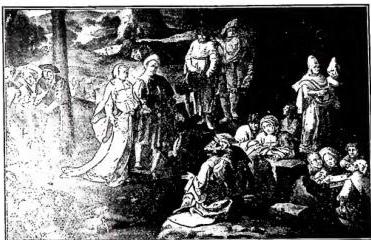
MATRIMONIO - Uno sposalizio, Dipinto di scuola di Luca di Leida - Roma, Galleria nazionale d'arte antica.
1913 § 1 come una semplice formola pastorale. Ma gli errori non si limitano a ciò. Per accennare alcuni: 1) se lo scopo principale del M. è il completamento dei coniugi, e la prole è soltanto un mezzo a tale fine, ne segue che questa potrebbe venire sacrificata quando potesse costituire una minaccia per la vita della madre. 2) Considerando poi il M. come un essenziale perfezionamento della vita umana, quasi
che fuori del M. l'uomo resti incompleto, ne segue un deprezzamento del celibato virtuoso, o dello stato sacerdotale e religioso, contro la dottrina tradizionale della Chiesa. 3) Ugualmente non rimane sufficientemente spiegata la gravità intrinseca dell'onanismo, così decisamente asserita dalla Chiesa, in quanto appunto si oppone al fine primario del M.
Secondo le ultime direttive del magistero ecclesiastico, occorre conservare la dicitura e il significato dei termini: fine primario e fine secondario, e affermare che i fini secondari sono subordinati al principale, e non indipendenti.
II. IL M. PRESSO I PRIMITIVI.
I. PURPOSE AND SOCIAL IMPORTANCE
Frazer, having expounded the so-called conceptional theory of the origin of totemism, a theory based on certain explorations by Spencer and Gillen among the primitives of central Australia and by Rivers among those of the Banks Islands in Melanesia, concluded that “the origin of totemism is a barbarous ignorance of the physical process by which men and animals reproduce their species; in particular, it is ignorance of man’s role in the procreation of a child.”It is clear that, if this evolutionary thesis of Frazer’s is accepted, marriage was not instituted by primitives nor can it be considered by them as having been established for the purpose of generating offspring, but rather for selfish ends. But Frazer’s hypothesis is unfounded. First, because it attributes to primitives an infantile mentality, whereas today, with the fall of Lévy-Bruhl’s prelogical and alogical theories, it is demonstrated that primitive mentality is fundamentally similar to our own. Second, the aforementioned peoples are not the most ancient ethnologically. Third, the facts considered refer only to those peoples and, as Granet has observed, may appear as an ethnological curiosity limited to an isolated and relatively small civilization. Fourth, even very recent research (e.g., J. Haeckel) has more clearly shown that such peoples of Australia, on the contrary, have the true concept of paternity and a high idea of the origin of life. The same has been observed among the most ancient ethnological peoples, the so-called gatherers. Indeed, their careful powers of observation have even enabled them to determine the most favorable time for conception. This is the case among the African Pygmies of the Ituri (P. Schebesta) and among the Tungus reindeer herders (Shirokogoroff). Precisely because primitives know the necessity of marriage for obtaining offspring, they regard marriage as the foundation and growth of society itself. According to these Pygmies, motherhood is the greatest desire of a woman, offspring is the end of the family; they consider marriage as an act of social importance; the principal idea they have of it is that of continuity and progressive increase of the population.
II. IMPEDIMENTS
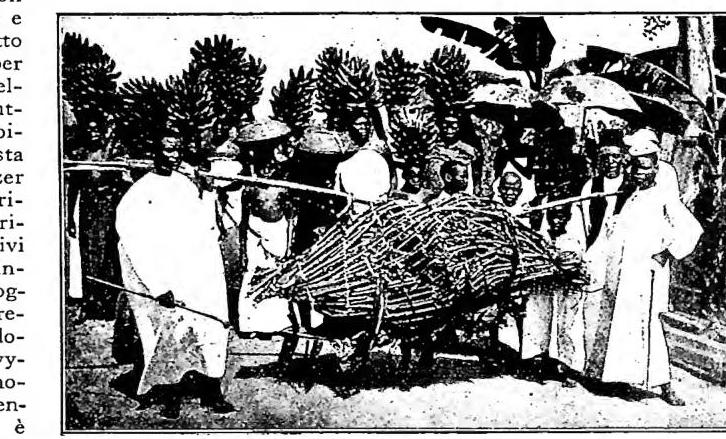
In contracting marriage, all primitive peoples observe a whole complex of rules and rites that form an important part of their traditional cultural heritage. The impediments to marriage are chiefly consanguinity, affinity, and—where the custom of adoption exists (Andamanese)—spiritual kinship. The degree of these impediments and sometimes even the persons to whom they apply vary in every type of civilization, and even among peoples of the same type of civilization (v. EXOGAMY; INCEST; KINSHIP). Among those primitive peoples where monogamy is the rule, another impediment to marriage is a prior contracted marriage.MATRIMONIO – Wedding gifts brought to the bride: a dozen bunches of bananas, a dozen chickens contained in the large cage-shaped basket, and salted eggs in smaller baskets. After consuming these foods, the bride must begin to work – Uganda.
(Karaya of Brazil; V. INDISSOLUBILITÀ DEL M. E DIVORZIO). Age, which, where initiation exists, begins after it, constitutes an impediment only to the use of marriage.
III. BETROTHAL
Among primitives, marriage ordinarily involves two distinct principal acts: betrothal, which is its beginning, and the wedding, which is its conclusion and fulfillment. Marriage should reconcile the manifold interests, namely those of the spouses, who must cohabit and educate their offspring at least in early childhood, that is, until the children are separated from the family and placed in the common houses of the young men and young women, where such a custom exists; and the interests of the two related clans, which are social and economic interests. Even in this regard, the greatest variety is observed among peoples of equal or different civilizations. Among the Tungus, for example, there are three forms of betrothal:1) arranged by the parents when the children are still young; 2) likewise arranged by the parents, but with consultation of the adult children; 3) arranged directly by the young man and young woman according to their mutual affection and love, reserving for the parents the due formalities, though a possible abduction might follow. Among the Bambuti Pygmies of the Ituri, all interests are harmonized or are brought to harmonization. Marriage is normally contracted for mutual affection between man and woman, but since it is primarily a contract between families (Sippe), it is not officially recognized unless it is economically and socially grounded. Among the Andamanese, who are also gatherers, betrothal is concluded by the parents or by the guardian, that is, the adopter, when the children are still young. After a brief formal cohabitation for the purpose of notification, the betrothed do not marry until physical maturity is reached; yet any infidelity on the part of the betrothed is considered a crime.
Among other peoples, ethnologically more recent than gatherers, the freedom of man and woman to contract marriage, with due exceptions, is little or not at all respected. One of these exceptions is betrothal concluded directly by the young people at common festivals called spring festivals, to which great ethnological importance has been attributed, these having been arbitrarily regarded as “mass marriages” and remnants of primitive promiscuity. Such festivals persist among many primitive peoples of Asia and formerly existed among the rural populations of China and Japan. The aforementioned interpretation of them by evolutionary ethnology is refuted by the fact that these festivals, even in their present complex form, are clearly related to individual marriage and derive from the initiation of youth. It should be noted, moreover, that true betrothal occurs after the preliminary betrothal arranged by the parents from the children’s earliest years, with which it is often in conflict. Indeed, the civilization of these peoples is a blend of that of the agricultural matriarchy with that of shepherds and totemists.
Various forms of betrothal exist in matriarchy (cf. DIRITTO. IX; MATRIARCATO).
The strangest form of betrothal has been observed among the totemic peoples of Central Australia. According to their highly complex system of kinship, every man has a primary right over the daughters of one or more women and secondary rights over the daughters of many other women. Initial agreements are made before the man’s birth and sometimes even before the birth of the future mother-in-law. The parties concerned sometimes modify the original agreement, which is not done without lengthy discussions. But when a man has reached the age of twenty or twenty-five, the agreement may be considered final: he knows with certainty who his future wife will be. She will then be only one or two years old, and so he must wait until she has reached the appropriate age, which is considered to be fourteen.
IV. GIFTS, DOWRY, AND BRIDE-PRICE
Among many primitive peoples, at the time of betrothal and marriage, and when a long interval elapses between the two—as in the case previously considered of Australian totemists—at certain times gifts must be exchanged between the two families according to the traditional customs proper to each civilized people. The significance of these gifts is manifold. They may first of all be symbolic and auspicious. Among the Woodlark Islanders in Melanesia, for example, the gift is a sign of the marriage proposal and, if accepted, of its approval or conclusion. The gifts may also constitute a sharing of the expenses of marriage and the necessities for setting up a new household. Among the Andamanese, for instance, and according to Man, useful gifts must be offered at the wedding. Among the aforementioned Tungus, the groom’s clan must give the bride’s clan for the marriage a fixed number of reindeer, horses, or other animals, or money and other gifts. This is called kalym.The bride, however, receives from her own clan a dowry of equal value, namely animals and personal effects for women. As a general rule, the dowry is considered the private property of the woman, over which she has almost unrestricted control, with the right to take it away if she leaves her husband’s clan, except in cases of certain crimes. It is then inherited by her daughter. In the so-called exchange of women between two or three clans, no kalym is given. Its value varies according to different tribes, but also according to the personal, familial, and domestic qualities of the bride. The same is observed among the Manchus and the Buryats. These peoples deny that, by giving the kalym, they intend to buy the bride. Indeed, it cannot properly be called a purchase, since the dowry is equivalent to the kalym. Moreover, with the dowry, the bride brings everything necessary to establish a household.
But among many other primitive peoples, there is a true purchase of the bride, as if she were an animal or any other thing. For example, in Cameroon (French Equatorial Africa), the father promises his daughter three or four times over—that is, each time a buyer appears with a higher price, he accepts a larger advance payment from each, which allows him to compensate for the damages of a rejected betrothal. The custom is exceedingly harmful, not only on the social level but also on the moral one, because, given the wide liberties permitted during betrothal, the girl, moving from one fiancé to another, often takes satisfaction in the variety of her experiences and moreover considers it a great glory to have pleased so many, with a long succession of quarrels and disputes.
V. THE BETROTHAL
It can be very simple and of a private family character, or it can be extremely complicated by the many religious and superstitious beliefs and practices that permeate it, as well as by the social festivities that may last several days, during which dances, songs, music are performed and speeches are made. Among the Andamanese, for instance, as Man expressly notes, the betrothal has no religious character, no invocation of God’s help and blessing, but is merely a public social and legal act.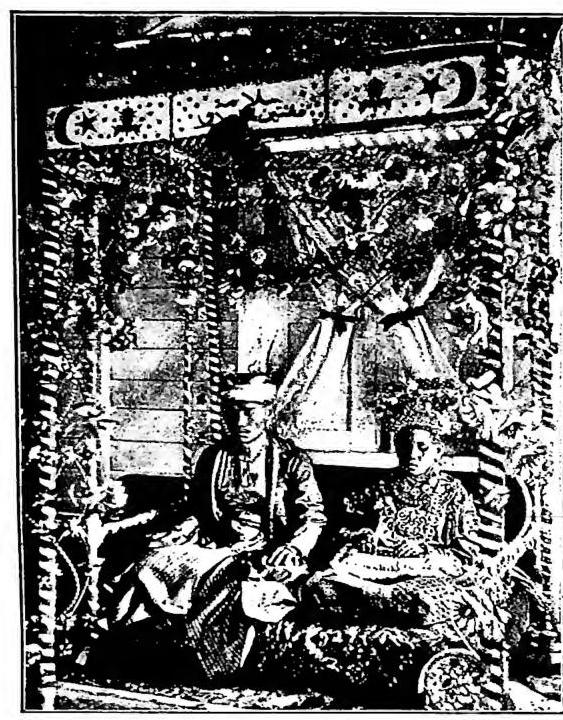
Among the Pygmies of the Ituri, no ceremony is performed for a single marriage. However, some groups have the custom of double betrothal, which essentially amounts to this: the families of the spouses gather in the forest, where they hold a three-day festival and dance. There is the handing over of the spouses, who then meet and gaze fixedly into each other’s eyes, signifying that they are contracting a kinship that binds them in destiny. The elders address words of exhortation to them: that they be friendly toward all, especially the elderly and children; that they procure food; that they be gentle and kind; and that from now on they may live in peace and bear children. For many other peoples, however, the betrothal has, in addition to its ethical and social character, also a religious one. For example, among the T’u jen (a Turkic-Mongolian people of Kansu in northwestern China), the betrothal is a grand and solemn social event during which many symbolic ceremonies and rites are performed. But the proper nuptial rite is directed by the groom’s grandfather, or in his absence by his maternal uncle. He orders the prostrations to the God of Heaven and to the spirits, then to the groom’s parents and to the relatives of both groom and bride, and invokes a blessing upon the new couple.
Among the Kachin in Burma, the officiant recites the legend of the first human couple; among the Lolo, the legend of the flood, in which the surviving brother and sister unite by God’s will. In this way, these peoples, and many others, link every marriage to the first human marriage. They themselves, and many others, also require the spouses to offer sacrifices to the ancestors of the family in which the marriage takes place. For those peoples who customarily arrange betrothals during spring festivals (or, in the case of some peoples, even during funerals, e.g., the Karens of Burma), this sacrifice does not have a definitive character for married life. For as long as no first child is born, the bride either returns to her father’s house and makes only fleeting visits to the groom’s house at certain times, or she remains with the groom but behaves externally—
Marriage — Malay spouses during the Bersanding or enthronement ceremony, in which they receive the homage due to a king and queen.
Such a union may be defined as temporary or conditional. When the betrothal festivities fall into disuse or are abolished, the marriage marks the true beginning of the stable life of the spouses. Thus, for these peoples, as well as for those who permit premarital relations among the young, once the marriage has taken place, what Malinowski observed among the Trobriand islanders in Melanesia holds true: “The marital bond, once tied, is firm and exclusive, at least in the ideal of the law, morality, and custom of the tribe.”
VI. REMARRIAGE AND FORMS OF MATRIMONIO
Remarriage is not prohibited; but, as Man noted for the Andamanese, the greatest respect is shown to those who remain in widowhood, living chastely, and preserve their esteem and love for their deceased spouse; remarriage is indeed judged unfavorably if the widow or widower is advanced in years. Remarriage becomes obligatory among those peoples among whom the levirate is practiced, such as the Sifan (Tibetans), the Tungus, the Buryats, the Koryaks, the Chukchi, the Aleuts, the American Indians, the ancient Hsien-pi, the Huns, etc.There are, finally, several forms of matrimony: monogamy, polygamy, polyandry, which have very different cultural meanings (see, in addition to FAMIGLIA, the relevant specific entries).
VII. ORIGINS OF MARRIAGE
According to evolutionist ethnologists, there was a time when men did not know marriage or the laws governing its institution, but lived in sexual promiscuity, like animals. Morgan, in his evolutionary scale of the history of marriage, calls this phase the “stage of agamy.” The reasons advanced in support of this thesis are essentially those adduced by Frazer, but, as has been seen above, these arguments prove to be unfounded in light of the latest scientific findings.According to the beliefs of primitive peoples, especially those ethnologically oldest, marriage was instituted by God, who created the first human couple—or, according to some, several human couples, but always in pairs—and forbade incest (q.v.). This belief is confirmed by most ethnologists and linguists, who, basing their conclusions on sound scientific grounds, recognize the monogamy of the human race.
### III. HISTORY OF MARRIAGE
CONTENTS:
I. Among the ancient Hebrews
II. In Roman law
III. In canon law.I. AMONG THE ANCIENT HEBREWS
In the opening pages of the Bible (Gen. 2:18–24) marriage is presented as the union between man and woman, willed by God for the reproduction of the species (ibid. 1:27–28) and for the mutual benefit of the two individuals (ibid. 2:20).Its monogamous character is also evident from the note of wonder with which polygamy is described (ibid. 4:19). Nevertheless, during the patriarchal (Jacob) and monarchical (David, Solomon) periods, the practice of a man marrying several women (polygyny) was considered legitimate and approved by God. After the exile, this custom gradually disappeared; by New Testament times, even among aristocratic circles, monogamous union prevailed.
Although there are allusions to accessory or ceremonial elements (cf. Gen. 29:22, 27; Eccles. 14:10; Ps. 18:6; Isa. 61:10; Jer. 7:34; 16:9; Cant. 3:11; 1 Macc. 9:37; Matt. 25:1, etc.), in the Bible only in Tob. 8:24 is mention made of a written document drawn up at the time of marriage.
This custom, however, appears to have been widespread in the Diaspora. Some specimens have been discovered in the Elephantine papyri (cf. A. Cowley, Aramaic Papyri of the Fifth Century B.C., Oxford 1923, nos. 15, 18, pp. 44–50, 54–56). Various conjectures are possible regarding the content of such a document. In the Code of Hammurabi (§ 128), on the other hand, the validity of marriage is made dependent upon the drafting of a written contract. It is difficult to speak of a free contract stipulated by the interested parties. Among the Hebrews, as among other Semitic peoples, it was the parents who decided the fate of their children (cf. Gen. 24:2–4; 28:1–2; Eccles. 7:27); occasionally, mention is made of the effective intention of a young man to marry a girl not approved by his parents (Gen. 28:6–9; Judg. 14:2–3). Much less freedom was granted to a daughter, though sometimes her consent was sought (Gen. 24:57).
In Hebrew law, mention is made of a sum or equivalent in kind that the groom had to deliver to the father of the bride (cf. Gen. 34:12; Ex. 22:16; 1 Sam. 18:25; Hos. 3:2). In Deut. 22:28–29, the price to be paid by the seducer of a virgin to her father before marrying her is fixed at fifty shekels. The Code of Hammurabi (§§ 138, 139, 164) also mentions a mōhar price (ti-fa-tu). The difficulty of comparing these customs with those of other related peoples and the uncertainty of the meaning of the Hebrew term mōhar, by which this price is designated in Gen. 34:12; Ex. 22:16; 1 Sam. 18:25, have given rise to differing explanations among various authors. Some see in the mōhar the essential element of the marriage contract, considered as a purchase price of the woman, or as a pretium pudicitiae (Eberharter, Neubauer, Zolli, Neufeld), or as a simple obligatory gift (Heinisch, Kalt, Burrows, Nötscher, etc.). Without doubt, from the various marriages described, the context of the three passages cited above, and the comparison with the modalities of genuine commercial transactions, it does not seem permissible to deduce that marriage represents the effect of a sale. In addition to the mōhar, the groom offered other gifts (cf. Gen. 24:53; 34:12). The bride also brought a dowry, of which she retained ownership (ibid. 24:53; cf. Code of Hammurabi, §§ 142, 149, 150, 156, 162, 163, 172, 173). If the dowry included a slave as a concubine for the husband (cf. Gen. 16:3; 24:59, 61; 29:24, 29), the mistress retained her right over her (ibid. 16:6; cf. Code of Hammurabi, §§ 144, 146, 147).
While the seducer is obliged to marry the young woman he has violated (Ex. 22:16) without the possibility of divorcing her (Deut. 22:29), the virginity of the girl is a conditio sine qua non for the validity of the marriage. Responsibility begins with the betrothal. A young woman who unites herself with a stranger is already condemned to death as an adulteress (Gen. 38:24). Such severity suggests that the young man who does not keep his marriage promise was at least liable to a pecuniary penalty, similar to that sanctioned in the Code of Hammurabi (§ 159).
The Holy Scripture does not specify a minimum age for the spouses. From the average age observed in Egypt and from Talmudic statements (Abhōth, V, 24; ed. Goldschmidt, VII, p. 1171), it may be concluded that men married at around 18–20 years of age, while for girls an even earlier age was sufficient. Regarding marriage impediments, Hebrew law generally concerns itself only with kinship and nationality. In the earliest period, the custom of marrying half-brothers (cf. Gen. 20:12; 2 Sam. 13:13) and cousins (cf. Gen. 24:15, 47; 28:2, 18–19) was practiced. Leviticus prohibits marriages between blood relatives, in particular with one’s own mother or father (Lev. 18:7), with a stepmother (ibid. 18:8; 20:11; cf. Deut. 22:30; 27:20), with a half-sister (Lev. 18:9; 20:17; cf. Deut. 27:22; 2 Sam. 13:1–2), with a paternal or maternal aunt (Lev. 18:12–13; 20:19), with a daughter-in-law (ibid. 18:15), with a sister-in-law (ibid. 18:16; 20:21), with a stepdaughter (ibid. 18:17), with the daughter of one’s own son or wife (ibid. 18:17), and with a mother-in-law (ibid. 20:14). The law against marriages between in-laws made an exception in the case of a man dying without children; the brother of the deceased was obliged to marry the widow to perpetuate the name and the firstborn of such a marriage was considered legally the son of the deceased himself (v. LEVIRATE).
Strenuous efforts were also made to condemn marriage with foreigners as a cause of religious syncretism and moral corruption (cf. Gen. 28:6–9; Judg. 3:5–6; 1 Kings 11:1–2; Mal. 2:11–12; Ezra 9:1–2; Neh. 10:30; 13:23–25). In particular, the prohibition applied to the various Canaanite peoples of Palestine or neighboring regions (cf. Ex. 34:11–16; Deut. 7:1–4). But in the earliest times, this law appears less strict (cf. Gen. 34:14; 41:45; Ex. 2:21; Judg. 3:6; 14:3, 10; Ruth 1:4). Even Moses had a Midianite wife (Ex. 2:21; Num. 12:1). After the exile, however, the exclusion became increasingly strict, as is evident from the books of Ezra and Nehemiah and from Talmudic tradition. The practice of marrying two sisters, as Jacob did, also shows an evolution; in Lev. 18:18, simultaneous union with such persons is prohibited. Particular strictness was required regarding the morality of future wives of priests (ibid. 21:7). The high priest could marry only a virgin Israelite (ibid. 21:13–14). A divorced woman who subsequently remarried was forbidden from remarrying her first husband (Deut. 24:4); a female heir could only unite herself with someone from the same tribe (Num. 36:6–9).
The law against consanguineous marriages explains the horror of incestuous relations (cf. Gen. 19:30–37; 35:22; 49:4; Lev. 20:11–12; Deut. 27:20, 22–23; Ex. 22:11). The sanctity of marriage, with a clear allusion to the primitive monogamous form, stands out in the constant use in the prophets and in the Song of Songs of representing the union between God and the chosen people with the metaphor of the bond existing between man and woman. In the same writings, idolatry is described as a grave sin of spiritual adultery. In Mosaic law, very severe penalties are imposed for adultery, particularly when the woman is at fault (cf. Gen. 39:7–20; Ex. 20:14, 17; Lev. 18:20; 20:10; Deut. 22:22; 2 Sam. 11:2–4; Jer. 5:8–9; Ezek. 23:20; Hos. 4:2). This severity is also found in other Semitic legislations (cf. Code of Hammurabi, § 129; Hittite and Middle Assyrian laws in G. Furlani, Leggi dell’Asia anteriore antica, Rome 1920, pp. 87, 96–99). Even on mere suspicion of adultery, the woman was subjected to a terrible ordeal by God (Num. 5:12–31; cf. Code of Hammurabi, § 132).
Dal racconto di Gen. 2, 24 risulta che l'unione fra l'uomo e la donna era considerata indissolubile. Tuttavia con il tempo si riconobbe al marito il diritto del divorzio (Deut. 24, 1-4). La motivazione generica («qualche cosa di turpe»), posta come causa della separazione, si prestava ad un'interpretazione elastica. Difatti si sa che verso l'epoca neotestamentaria alcuni rabbini della scuola di Hillel erano molto indulgenti in proposito (cf. Gitfin, IX, 10; ed. L. Goldschmidt, V. Berlino 1930, p. 687). Allora anche alle donne si riconosceva praticamente il diritto al divorzio (Mc. 10, 12; Act. 24, 24; cf. Flavio Giuseppe, Antiq. Iud., XX, 141-43). Gesù Cristo, richiamando la legge antica, dichiarava che Dio sopportò l'uso contrario a causa della «dura cervice» degli Ebrei (cf. Mt. 19, 8).
Infine sono da rilevarsi i testi che raccomandano la perfetta fedeltà coniugale (Prov. 5, 15-20; 6, 24-35; 23, 26-28; Eccl. 9, 1-13; Mal. 2, 14 sg., ecc.) o descrivono la moglie ideale (Prov. 31, 10-31; Eccl. 26, 1-24) in opposizione a quella perversa (Eccl. 25, 17-36). Per la preferenza dello stato matrimoniale rispetto al celibato cf. Iud. 11, 37.