
Umbria. -
I. Geography
It is the only region of peninsular Italy, corresponding essentially to the upper and middle basin of the Tiber, though its headwaters do not belong to II.The territory is flat only in brief stretches, corresponding to the floors of numerous intermountain basins, once occupied by lakes. These open into the varied range of its reliefs, alternating hills and plateaus, which prevail on the right bank of the Tiber, and the rugged summits of the Apennines, east of the Tiber-Nera furrow, where the Sibillini rise to nearly 2500 meters, giving way to narrow and deep valleys. Nevertheless, about half of Umbria’s soil is cultivated: in addition to cereals, vineyards and olive groves are widespread, nor is livestock farming lacking, which utilizes the excellent mountain pastures. Forests and chestnut groves cover more than a quarter of the region. Mineral resources are absent, but the ample availability of hydroelectric power (Marmore Falls) has enabled significant industrial development.
On its 8472 km² (Umbria is the smallest of the historical regions of peninsular Italy), just over 800,000 inhabitants live, with a density (94 per km²) lower than the Italian average, yet notable given the mountainous character of the territory. Urban centers are relatively numerous in Umbria, almost all of ancient origin and often situated in elevated positions on isolated hills and knolls, such as the capital, Perugia (493 m), at the center of a fertile agricultural zone and home to significant industries, or Spoleto (453 m, 40,000 inhabitants), in the so-called Valle Umbra—where Assisi (424 m; 25,000 inhabitants) and Foligno (44,000 inhabitants) are also located—, Gubbio (520 m, 37,000 inhabitants), and Todi (441 m; 21,000 inhabitants). Of the two provinces into which it is divided, the most densely populated is that of Terni; its capital is one of Italy’s major industrial centers (foundries, steelworks, chemical and textile plants), and Orvieto (325 m; 24,000 inhabitants) is one of the most famous for its artistic treasures.
| Province | Area in km² | Population (1951 census), in thousands | Density per km² | Capital (and 1951 census population, in thousands) |
|---|---|---|---|---|
| Perugia | 6332 | 580.0 | 91 | Perugia (95) |
| Terni | 2140 | 222.3 | 104 | Terni (84) |
| Umbria | 8472 | 802.3 | 94 |
II. HISTORY
The region took its name from the Umbri, a people who, having superimposed themselves upon other tribes of more backward civilization, succeeded in dominating central Italy from the Tyrrhenian to the Adriatic, reaching as far as the mouths of the Po. However, with the subsequent expansion of Etruscan power, which established its strongholds in Orvieto and Perugia, the Umbri were forced to withdraw from the Tyrrhenian coast, which was included in Etruria (Tuscia), while the pressure of the Gallic Senones drove them away from the Adriatic, so that their territory was ultimately reduced to the mountainous region of the central Apennines.Nothing is known of the political and social development of the Umbri until, after offering fierce resistance, they were subdued during the 4th century B.C. under Roman dominion, together with the other populations inhabiting the surrounding lands. They soon became loyal subjects of Rome, sharing its fortunes and participating, with varying success, in the internal struggles that led, toward the beginning of the common era, to the establishment of the Empire. They thus shared its destinies, and under Augustus, the Sixth Region was constituted, traversed by the great Via Flaminia and divided into Umbria proper, on this side of the Apennines, and trans-Apennine Umbria, which included the Flaminia and the Piceno (that is, the Marche above Ancona): the latter is not discussed here.
In Umbria, Christianity should have spread quite early, but from the numerous legends that, in different ages, claimed to uncover its origins and progress, almost nothing of truly historical value can be gleaned. In any case, in Christian antiquity, the episcopal sees of Otricoli (Ocriculum), Narni, Terni (Interamna), Amelia, Todi (Tuder), Bettona (Vettona), Bevagna (Mevania), Trevi, Spoleto, Foligno (Fulginium), Forum Flaminii (S. Giovanni Profiamma), Plistia (Pistia), Gualdo Tadino, Spello (Hispellum), Assisi, Arna (Civitella d'A.), Gubbio (Eugubium), and Città di Castello (Tiferum Tiberinum) are known to have existed, while the sees of Orvieto and Perugia were, at that time, part of Tuscia.
Umbria shared the fortunes of the Empire when Italy was overrun by the invasions of the Visigoths and Ostrogoths. The devastation of the region grew harsher during the first decades of the Lombard occupation, when cities were taken and retaken until some disappeared entirely or almost so. The need to keep communications open between the Duchy of Rome and the Exarchate of Ravenna along the Flaminia gave special importance to the defense of Narni, Terni, and Amelia, when even Perugia, having fallen to the Lombards, returned to the Byzantines at the beginning of the 7th century and began to form part of Umbria, while the surrounding Tuscia remained subject to the Lombards. With Farwald I around 569, the Lombard duchy of Spoleto arose, a cause of grave political concern for the Popes until the Carolingian occupation, and remaining thereafter, until the end of the 12th century, the most solid political institution in the region, extending its dominion even into the surrounding areas. In the 9th and 10th centuries, the new Frankish dynasty, which ruled in Spoleto and also held the Empire, succeeded in interfering directly in Roman affairs, creating a difficult situation for the papacy. Feudalism, as a political institution, did not develop extensively in Umbria, where the vital forces of the population, gathered in numerous small cities, were able in each of them to establish their own free commune as early as the 11th century. Unfortunately, as happened elsewhere, fierce and sometimes violent rivalries arose between commune and commune (well known are those between Perugia and Assisi) and partisan factions within the individual communes, favored by the lack of a strong central power capable of maintaining stable order, as well as by the Guelph and Ghibelline factions that raged during the reigns of Frederick I and Frederick II.
Religious life did not languish for this, as evidenced by the numerous monasteries established everywhere, up to the Franciscan movement, which in Umbria had its cradle and flourished with saints and blesseds in every smallest place. From Perugia, Flagellants (v.) spread throughout Italy (1260), while Dominicans and Augustinians sometimes replaced the ancient monastic and canonical institutions.
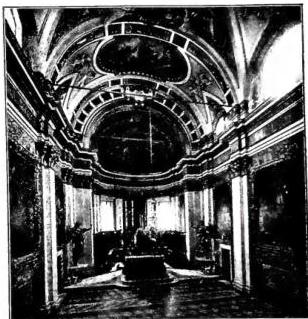
(fot. Alinari)
UMBRIA - Chapel of the Most Holy Sacrament. Architecture and part of the frescoes by G. Giorgetti (1663) - Assisi, Cathedral.
Todi, the Vitelli in Città di Castello, the Monaldeschi in Orvieto, while an effective authority of the Church, which attempted to prevail during the 15th century, asserted itself with the intervention of the Borgias and later with the dominion of Paul III. None of the Umbrian condottieri, neither Braccio da Montone, nor Niccolò Piccinino with his sons Jacopo and Francesco who aimed for Perugia, nor Erasmo Gattamelata from Narni, and even less Ascanio della Cornia, established lasting fortunes in Umbria.
The centuries from the 16th to the 18th were a period of tranquility for Umbria under the peaceful dominion of the Church. The French invasion gave rise to new upheavals. In 1809-14, the department of Trasimeno was established with Spoleto as its capital. The restored pontifical government lasted until 1860, when Umbria was united with the Kingdom of Italy, forming a single province with Sabina, to which Orvieto was also added, having been part of the Patrimony for centuries; the capital was then established in Perugia. In 1923, Sabina formed the province of Rieti, while Terni was also elevated to a province.
III. CONCILIAR REGION
It is constituted by the following ecclesiastical circumscriptions, all immediately subject to the Apostolic See: the archdioceses of Spoleto and Perugia; the dioceses of Foligno, Terni and Narni, Todi, Assisi, Amelia, Gubbio, Nocera and Gualdo Tadino, Norcia, Rieti, Orvieto, Città di Castello, Città della Pieve.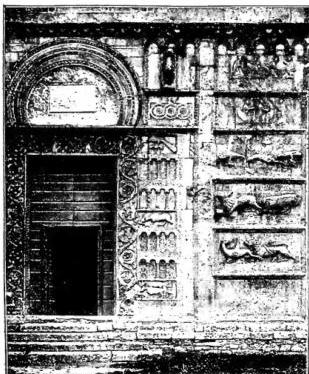
(fot. Alinari)
UMBRIA - Detail of the façade of the church of S. Pietro with sculptural and Cosmatesque decoration from the 12th-13th centuries - Spoleto.
[Poggio Mirteto] cum suo cathedrali Capitolo servato, ita nempe ut deinceps Suburbicarius Episcopus Sabinensis simul et Mandelensis vocetur.
For appeals from first-instance cases, in accordance with can. 1594 of the CIC and the Decree of the S. C. Consistorial of 15 February 1919, the archbishops of Spoleto and Perugia designated the Ordinary of Assisi; the bishops of Terni and Narni, Amelia, Norcia, and Rieti chose the Ordinary of Spoleto, while the bishops of Foligno, Orvieto, Assisi, Gubbio, Nocera and Gualdo, Todi, Città di Castello, and Città della Pieve designated the Ordinary of Perugia. The S. Congr. Consistorial ratified these designations.
For marriage nullity cases, the ecclesiastical tribunal of the region is based in Perugia; and appeals against its rulings are to be lodged either with the Tuscan regional tribunal (Florence) or with the S. Rota (cf. motu proprio Qua cura, AAS, 30 [1938], pp. 410-13).
The episcopal conferences, which are customarily held in Assisi at the Pontifical Regional Seminary, are convened annually at an appropriate time. Presiding, in accordance with the decree of Leo XIII of 24 August 1889, is the dignior vel senior archbishop, or, in his absence, the dignior vel senior bishop.
From 30 September to 7 October 1923, under the presidency of Cardinal Basilio Pompili, legatus a latere of His Holiness Pius XI, the first Umbrian Plenary Council was celebrated in Assisi; its acts were approved by the S. Congr. of the Council on 27 June 1925.
IV. ART
Rich in testimonies of the civilizations that have succeeded one another, this region presents a notable interest for the number and truly essential importance of its monuments.Inhabited since prehistoric times, it preserves precious relics from the Paleolithic, Bronze, and Iron Ages. Etruscan civilization penetrated relatively late, settling on the right bank of the Tiber, and left important works in the hypogea of Bettona, of the Volumni near Perugia, in Perugia itself with the circuit of its walls and its mighty gates, and in the territory of Orvieto, which has yielded remains of temples and painted tombs. This was followed, at the end of the 3rd century B.C., by Roman domination with the creation of garrisons and populous colonies, especially along the Via Flaminia. Of Roman constructions, remarkable vestiges remain in the amphitheater of Terni; in the bridges of Foligno and Narni; in the temple, remains of the Forum, theater, and amphitheater of Assisi; in the other temple and the baths of Bevagna; in the theater of Gubbio; in the walls and amphitheater of Spello; to mention only the most important. Particularly rich in archaeological remains is the territory of Spoleto with its theater, amphitheater, Arch of Drusus, the Temple, and the "Ponte Sanguinario"; and in this same area, the most important early Christian monuments also remain. Although the existence of Christian hypogea is known at S. Vittore, near Otricoli, and near Villa S. Faustino, and of a Christian cemetery on the outskirts of Terni, the basilica of S. Salvatore at the gates of Spoleto, from the end of the 4th or the first decades of the 5th century, and the Tempietto erected near the springs of the Clitunno, also from the early 5th century, are of exceptional importance for the confluence of forms of Roman art and elements arriving from the East.
Still assigned to the 5th century is a Christian necropolis near the church of the SS. Apostoli, again in Spoleto, while Perugia in its S. Angelo offers a fine example of a Christian building from the 5th or 6th century, despite the profound alterations it has undergone. Other early Christian remains are found in Orvieto beneath the church of S. Andrea. In the following centuries, near Ferentillo, the abbey of S. Pietro in Valle, erected in the 8th century and repeatedly restored (though some original architectural and ornamental parts remain), is worthy of note; finally, in Spoleto, the small basilica of S. Eufemia within the bishop's palace (10th century), interesting for the presence of matronea.
It is, however, with the 12th century that architecture asserts itself in Umbria for its own importance, due not so much to an originality of construction methods—its dependence on Rome is well known, for that tendency toward classical reminiscences and its insertion within the common language of central Italy, and for that affinity of styles with the churches of Abruzzo and the Marches; typical are the quadrangular façades—as for the unmistakable character it manages to imprint on some Umbrian cities, which in this and the two following centuries saw their power affirmed and acquired prestige from their beautiful sacred and secular buildings. If the medieval atmosphere is preeminent in Assisi—to recall the most famous example—one may still recall certain corners of Perugia, Todi, Gubbio, Bevagna, etc. Among the most beautiful monuments, in Spoleto, beyond the Cathedral, altered both inside and out, are S. Pietro for its façade enclosed by a classical pediment and richly decorated, and S. Gregorio Maggiore, with a Lombard crypt; in Grugnano in Teverina, S. Maria Assunta; in Assisi, the Cathedral dedicated to S. Rufino, renovated at the beginning of the 12th century by Giovanni da Gubbio (the interior was later modified by Alessi), and S. Pietro, austere and powerful in its interior, whose dome shows Provençal influences. In this building, as already in S. Pietro of Spoleto, there is an elegant decoration of classical taste derived from Rome. Entirely the work of Roman craftsmen is the cloister of the abbey of Sassovivo (1229), by Pietro di Maria. The Piazza della Libertà of Bevagna owes its medieval appearance to the churches of S. Silvestro (by Binello, 1195) and S. Michele Arcangelo (by Binello and Rodolfo, late 12th–early 13th century), as well as the Gothic Palazzo dei Consoli (1270); likewise, in Todi, the Cathedral, begun in the 12th century and completed in the course of the 13th, together with the Palazzo del Popolo and the Palazzo dei Priori that rise beside it, delimits the beautiful Piazza del Popolo. But with these latter buildings, we are already in the Gothic period. The example, especially for sacred buildings, Assisi (v.) with the construction of the double Franciscan basilica begun in 1228: the upper basilica, lofty, serene, and luminous, would become the prototype of Umbrian Gothic churches. One can now speak of a proper originality in Umbrian constructions, where Gothic acquires accents that differentiate it not only from the French prototype but also from the Italian type. In the second half of the 13th century, there was a flourishing of religious and civil buildings where Romanesque reminiscences often persisted alongside Gothic forms.
In Assisi itself, S. Chiara arose in 1257; in Perugia, beyond the Cathedral and S. Domenico, with its single nave, the massive Palazzo dei Priori; in Gubbio, the elegant Palazzo dei Consoli by Matteo Gattaponi, who also worked on the Rocca of Spoleto, the S. Convento of Assisi, the cloister of S. Giuliana in Perugia, and elsewhere; in Spoleto, S. Domenico, with a single nave; in Foligno, S. Salvatore and the Palazzo Trinci.
The S. Francesco of Terni follows the example of the Assisi Basilica; while in Città di Castello, the Palazzo del Governo, attributed to Angelo da Orvieto, and the Palazzo Comunale, by the same architect, are not free from the influences of nearby Tuscany. Tuscan, moreover, is the greatest Umbrian Gothic building, Orvieto (v.), by Lorenzo Maitani; tied to local styles, however, are the Palazzo del Popolo and the Palazzo Papale. So rich in Romanesque and Gothic buildings, Umbria loses importance in the Renaissance from an architectural point of view. The forms that dominate are predominantly Florentine, thanks especially to Agostino di Duccio, who brings to Perugia (Oratory of S. Bernardino, Porta S. Pietro) the art of L. B. Alberti; the palaces of Città di Castello are also linked to perfectly Florentine schemes, and an eclecticism, also tinged with Tuscan modes, prevails in other localities such as Foligno, Spoleto, etc. Distinct from the common current, with clear influences from the other great architect of the Renaissance, Luciano Laurana, is the Palazzo Ducale of Gubbio, attributed by some to the master himself, removing it from Francesco di Giorgio Martini.
The 16th century opens with the construction of the church of the Consolazione in Todi, for which Bramante was named as designer, but which was certainly executed by Cola di Matteuccio da Caprarola; in any case, Bramantesque taste is evident in other Umbrian buildings. At the same time, other artists brought the characteristics of their own art: from Sanmicheli, who worked in S. Domenico and the Cathedral of Orvieto, to Antonio da Sangallo, present in Perugia, Città di Castello, and Terni; from Vignola, active in Norcia, to Vasari, also in Città di Castello.
G. B. Rossi-Scotti, L'Umbria artistica, Perugia 1872; A. Venturi, Storia dell'arte italiana, Milano 1901-1940; P. Toesca, Storia dell'arte italiana, Torino 1927; U. Gnoli, Pittori e miniatori nell'Umbria, Spoleto 1923; id., L'arte umbra alla Mostra di Perugia, Bergamo 1908; G. Urbani, L'architettura delle chiese umbre, Roma 1952; G. De Angelis d'Ossat, Architettura romanica in Umbria, Roma 1953; G. Matthiae, Affreschi medievali dell'Umbria, Roma 1954; per i monumenti romani V. anche Corpus Inscriptionum Latinarum, XI, Berlino 1888-1926; per l'arte paleocristiana V. Römische Quartalschrift, 1887 ss.; per l'architettura romanica e gotica V. Atti del I Congresso nazionale di storia dell'architettura, Roma 1938; per il Rinascimento V. Rivista d'arte, 1909 ss.; per l'arte moderna V. Bollettino d'arte, 1907 ss.
G. Urbani
While these architects worked in the main cities of Umbria, local artists gained fame beyond the borders of their region: Ascanio Vitozzi was active in Piedmont, Galeazzo Alessi in Genoa and Milan, though his Umbrian works are scarce; the Orvietan Ippolito Scalza, on the other hand, was occupied in adorning his native city with fine buildings. Also worthy of mention is the work of the Perugian V. MARCELLIANI. Even scarcer are the contributions of regional artists in the following centuries, while examples of works by non-local architects continued. For the 17th century, only G. Giorgetti can be recalled, who also practiced painting with honor, born and active in Assisi; for the 18th century, Giuseppe Piermarini of Foligno became known for his works in Milan, just as in the 19th century G. Calderini left his most important works in Rome. In Umbria, the Valadier and Vespignani were then active.
Painting appears less independent than architecture from its earliest manifestations: the remains of a mosaic pavement with geometric designs (6th century) in the underground of S. Andrea in Orvieto; the 7th-century frescoes in the apse of the temple of Clitunno or the gemmed cross in the apse of S. Salvatore in Spoleto (9th century), the other frescoes in the crypt of SS. Isacco and Marzia, also in Spoleto (late 10th to early 11th century), or those in the crypt of S. Rufino in Assisi (mid-11th century) do not present specific or defined characteristics that make them particularly Umbrian. Nor can one speak of distinctly Umbrian traits in the numerous works that flourished at the end of the 12th century. In the common Byzantine language of Italian art of this period, Umbria shows local inflections that do not substantially differ from those of Lazio, with Rome as their center of irradiation. This is the case for the frescoes of the aforementioned abbey of S. Pietro in Valle.
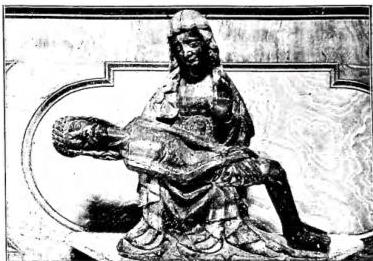
(fot. Alinari)
UMBRIA - Pietà. German terracotta sculpture (ca. mid-15th century) - Assisi. Cathedral.
He, in the last decade of the 13th century, had finished narrating the episodes of the life of S. Francesco on the walls of the Upper Church; the masters who later executed the frescoes in some chapels of the Lower Church and the vaults of the crossing above the altar (once attributed to Giotto himself), approaching his manner more or less closely, would be the only, or almost the only, epigones of his art in Umbria. MARTINO V, PAPA (v.), called to fresco the chapel of S. Martino in the S. Francesco of Assisi (1320), LORENZETTI, AMBROGIO (v.). The refined elegance and pleasing color, nonetheless Sienese, imported by the two and their assistants, even if acquiring Giottesque accents in Assisi, respond more to the strong language
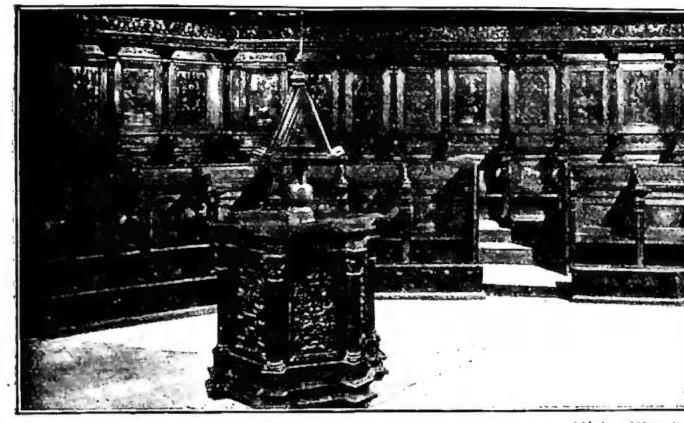
Umbria - Wooden choir with carvings and inlays by Baccio d'Agnolo, perhaps after a design by Perugino (1502-32) - Perugia, church of S. Agostino.
the Florentine taste, to the Umbrian sensibility. The Sienese influence is also evident in Orvieto, where Ugolino di Prete Ilario, Pietro di Duccio, and Cola Petruccioli appear to have been impressed not only by Lorenzetti but also by the presence of the Sienese Luca di Tommè; it is equally strong in Gubbio, where illumination flourishes, and in Perugia. There are preserved paintings by Duccio da Buoninsegna and his pupil Meo da Siena; indeed, distinctly Duccesque styles are revealed in Marino da Perugia, followed by other local artists throughout the 14th century. To strengthen these ties, at the end of the century two other Sienese painters, Bartolo di Fredi and Taddeo di Bartolo, are found in Perugia—by then poised to become, even in the artistic field, the most important center of Umbria. In the following years, until well into the 15th century, the influx of artists and works from Siena into the region continues. However, already in the first decades of the 15th century, artists of Florentine birth or culture also begin to arrive in Umbria, leaving an increasingly notable imprint. From Masolino (Todi) to Domenico Veneziano, from Fra Angelico (Perugia and Orvieto) to Benozzo Gozzoli (Orvieto, Foligno, Montelaco), to Lippi, to Ghirlandaio (Narni), to Piero della Francesca (Perugia), a succession of artists introduces the latest innovations and Florentine artistic taste to Umbria. Moreover, Siena had also been drawing closer to Florence and had transmitted its artistic forms to Umbria; additionally, at the turn of the two centuries, new forms had already been sensed in the International Gothic movement, NIELLO (v.) adhered, while Gentile da Fabriano, one of its foremost representatives, left a painting in Perugia and a fresco in Orvieto.
The renewal is already evident in the best artists of the first half of the 15th century, among whom Niccolò Alunno stands out in Foligno, alongside Mezzastris, an artist who came into contact with the Florentine world both indirectly through Siena and directly with Gozzoli. What matters most is that with him, for the first time, one can speak of an Umbrian school: Umbrian artists had always sought to interpret ideas and motifs from outside, but only in the 15th century did an Umbrian school of painting distinguish itself by its own autonomy amid the influences of other schools. Meanwhile, in Perugia, where, in addition to the Florentines, the Rimini artist Giovanni Francesco and especially Giovanni Boccati da Camerino (paintings in the Pinacoteca) had worked, BUON, FAMIGLIA (v.), Caporali (v.), Fiorenzo di Lorenzo (v.) come to the fore. These three also derive from Benozzo and approach other great artists from time to time, yet manage to express themselves in an individual and coherent manner. With them, the second half of the century is reached, which sees the affirmation Perugino (v.) Pinturicchio (v.). This is the apogee of Umbrian painting. From his earliest works, Perugino synthesizes the characteristics of Umbrian art, bringing it to such formal perfection that it in turn influences the very Florentine environment to which Umbria had been tributary; alongside him, Pinturicchio, in rendering the world around him in a manner both analytical and poetic, entirely personal, distinguishes himself even in collaborative works: foremost among these is the "Niche of St. Bernardino," a pictorial complex of the utmost importance for understanding Umbrian art in the second half of the 15th century.
The two masters are joined by painters of the new generation. Among Perugino's pupils, in addition to Raphael (v.) Ingegno (v.), were Sinibaldo Ibi, Eusebio da S. Giorgio, Domenico Alfani, G. Batt. Caporali, and others; Tiberio d'Assisi and Antonio da Viterbo, known as il Pastura, at a certain point align themselves more closely with Pinturicchio, while both Giannicola di Paolo and Lo Spagna, the best of Perugino's followers, in their more mature works reflect the style of the young Raphael. The same is true of Francesco Melanzio, Bernardino di Mariotto, Dono Doni—later drawn into the Michelangelesque orbit—and Orazio Alfani. SIGNORELLI, LUCA (v.), who was very active in Umbria at the same time as Perugino (so much so that he is considered Umbrian by many scholars) and left paintings in Città di Castello, Perugia, Orvieto, Umbertide, and Morra, was scant among Umbrian painters; Rosso Fiorentino (v.), active in Perugia, or Giovanni Antonio Pordenone and, later, Aliense, who had imported a reflection of the flourishing Venetian painting. Meanwhile, Mannerist taste, of a Michelangelesque Mannerism, had been asserting itself through the work of Vasari (in Perugia and Città di Castello), Raffaellino del Colle, Cristoforo Gherardi, and Cola dell'Amatrice, among others, and Umbria itself could boast a modest Mannerist in Michelangelo Carducci. But another pictorial movement soon opposed it, led by Federico Barocci, who introduced to Perugia (Deposition in the Cathedral) the formal elements of the most genuine Emilian Mannerism; adhering to it were Felice and Vincenzo Pellegrino, Silla Pecennini, and two Sienese artists active in Umbria, Francesco Vanni and Ventura Salimbeni.
The autonomy of Umbrian painting, in any case, ends in the second half of the 16th century. The 17th and 18th centuries saw only weak personalities working in the wake of the better-known painters whose works were present in Umbria, from Baglioni to Pietro da Cortona, from Calvaret to Sebastiano Conca, from Domenichino to Sacchi, and others.
The flourishing of architectural and pictorial works is not matched by equal richness in the field of sculpture. The few oldest examples are tied to the decoration of buildings, such as the façade of the Oratory of S. Giovenale in the cathedral of Narni (6th century) or some ornamental parts in the abbey of S. Pietro in Valle (8th century), where there is also an antependium signed "Ursus," datable to 739-40. Contemporary are the ciboria of S. Prospero in Perugia and S. Giuliano delle Pignatte near Umbertide.
In the Middle Ages, local sculptors primarily worked in wood. There is record of a very rich production (which is not always possible to clearly distinguish from that of neighboring regions, the Marches and Abruzzo), of which relatively few examples remain today. Among these, the oldest is the Madonna and Child (first half of the 12th century) preserved in the Museo della Parrocchiale of Spello, a prototype for subsequent works. Alongside some groups that reach artistic heights, it is not difficult to encounter others that are the product of a very active and traditional craftsmanship, to the point that works of still Romanesque character were executed in the 15th or even 16th century. Such is the case of the Virgin and Child in the church of S. Maria in Camucia in Todi. Naturally, alongside these woodcarvers, there were also marble workers who, in the 12th and 13th centuries, left traces of their activity in the decoration, sometimes excellent, of church interiors and façades: S. Maria Assunta in Lugnano Teverina, S. Pietro in Spoleto and in Assisi have already been mentioned; V. also there.
The façade of San Rufino and the Loggia del Monte Frumentario, San Felice and Sant'Anatolia di Narco, and numerous others are also noteworthy. These works predominantly feature geometric decorations of Oriental taste or floral motifs of classical derivation, with rare symbolic figurations. In 1270, Fra Bevignate, by commissioning Giovanni and Nicola Pisani to execute the Fontana Maggiore in Perugia, fostered the orientation of sculptural taste toward Tuscany. Arnolfo di Cambio followed, present in Perugia with several statues in the Museum (a follower of his or of Lorenzo Maitani is attributed the monument to Benedict XI in San Domenico) and the author of the monument to Cardinal de Braye in the San Domenico of Orvieto. There, L. Maitani, with Pisan-Sienese workshops, had splendidly decorated the four pillars of the Cathedral façade with bas-reliefs and had left three masterpieces in the crucifixes of San Francesco and the Cathedral. Despite the example of these and other masters who came to Umbria in the 14th century, a local school failed to form, nor did it succeed in the following century, when the influx of sculptors and sculptures from other regions continued.
Agostino di Duccio adorned the exterior of his San Bernardino with elegant figures; Mino da Fiesole, Francesco di Simone, and Francesco di Giorgio Martini are well represented in Perugia; the Della Robbia in Città di Castello; and in San Gregorio of Spoleto, there is a fine tabernacle by Benedetto da Rovezzano. In the 16th century, alongside the usual "foreign" artists, the Perugian V. Danti, also active in Florence, and in Orvieto the aforementioned Ippolito Scalza, asserted themselves. In the 17th and 18th centuries, non-local artists continued to work in Umbrian territory for sculpture as well.
The minor arts were cultivated in every era: Gubbio has already been mentioned as an important center for illumination, to which even great artists such as Perugino and Pinturicchio dedicated themselves. In Orvieto (reliquary of the Corporale by Ugolino di Vieri), Città di Castello (paliotto of Celestine II), Perugia, and especially Assisi (Treasury of the Basilica of San Francesco), excellent examples of silverwork are preserved, often showing a marked adherence to Sienese taste.
Notable specimens of ecclesiastical furnishings adorn many churches: among the most famous in Perugia are the choirs of San Pietro, begun by Bernardino Antonibi da Perugia, and of Sant'Agostino, executed by Baccio d'Agnolo based on designs attributed to Perugino; less known is the fine 12th-century faldstool preserved in the Cathedral of Perugia. However, truly original characteristics can be spoken of for the ceramics produced in the two centers of Gubbio and Deruta and for the typical Perugian embroideries.
V. FOLKLORE
In regions with a broad cultural substratum, such as Tuscany and Umbria, where innate poetic genius and artistic taste have undergone remarkable developments, folkloric research must aim to uncover the original foundation and meaning of popular traditions, tracing their historical process in reverse; to highlight the forms of popular poetry and art that prepare and explain the birth of cultivated art and poetry, of which they in turn preserve memories; and finally, to determine what is genuinely indigenous and characteristic.An example of the confluence of elements from diverse cultures and civilizations in a folkloric event is offered by the Festa dei Ceri in Gubbio. It takes place in mid-May and exhibits a pronounced agrarian character (the offering of earth’s products to the deity from whom protection is sought), which, along with its date, it shares with various festivals held in neighboring folkloric areas: the Barabbata, in honor of the Virgin, in Marta near Lake Bolsena, and the Festa dei Pugnaloni, in honor of Mary in Acquapendente and in honor of St. Isidore, patron of farmers, in Allerona. Of ancient origin, as—
(photo: Gab. fot. naz.)
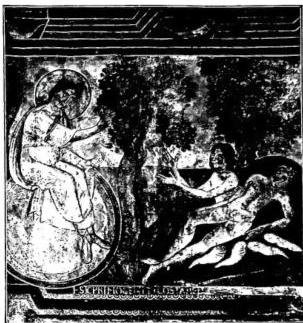
UMBRIA - The Creation of Eve. Fresco from the late 12th century. Ferentillo, Abbey of S. Pietro in Valle.
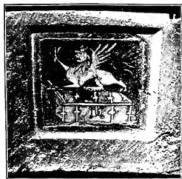
Umbria - Maiolica panel with the coat of arms of the Collegio del Cambio. Detail of the archivolt of the Collegio del Cambio's door, work by Lodovico di Antonibo (1452) - Perugia.
Religious poetry and the products of rural craftsmanship then offer two notable fields of observation, which partly explain the intense literary production of mystical inspiration that has marked the region's history, and the flourishing of the "Umbrian school." Objects for personal adornment, furnishings for domestic animals, household and agricultural tools, and amulets in the vast variety of types and forms provide precious documentation of genuinely popular ornamental motifs, in which the echo of higher artistic forms can be recognized. The ornamentation holds a particular ritual function in the distaff (spindle) and the bust stick, called the dono del cuore (gift of the heart), which suitors, even today in the territories of Valfabbrica, Gualdo Tadino, Nocera, and Fossato di Vico, bring to their beloveds on May 1st or on the feast of St. John, as solemn pledges. The engravings are patiently executed on alder branches and sometimes, with greater difficulty, on reeds, by humble shepherds during the long hours of tending the flock, using knife tips, nails, and knitting needles. They depict various scenes: hearts with palms, vases with leaves and flowers, and the so-called "knot of Solomon," symbolizing the bond of love. However, it is not uncommon to find religious symbols on the bust sticks, such as the cross and the name of Mary. The richer the ornamentation on the distaff or bust stick, the more well-off the young man who gave II.
The finest example of all Umbrian popular religious poetry is a song about the Passion of Christ, one of the most important versions of which was collected by Mazzatinti at the end of the last century. He noted that "the Umbrian peasant still recites it on the evening of Good Friday. The narrative part is mostly delivered by the eldest in the family; when dialogue is required, the others in the household take part. This Canto, as the Umbrian peasants call it, is, according to their testimony, extremely ancient." The frantic search of the Mother, shrouded in a black mantle, her encounter with John, the foretold announcement, the Mother's heartbreak, and finally the dialogue between the Son and the Mother at the foot of the Cross reach moments of touching humanity and rare poetry in this song, closely recalling Jacopone's Pianto della Madonna.
Numerous religious songs are also inspired by hagiographic legends, featuring St. Lucy, St. Barbara, St. Catherine, St. Alexius, St. Julian, and others, in philologically significant versions that preserve archaic motifs and simple forms. Comparing these with those spread in other Italian regions identifies Umbria as the creative center, or at least the radiating hub, of this embryonic Italian religious epic. However, to determine the region's folkloric heritage, one must also consider the forms of adaptation or assimilation of tradition. From this perspective, the old Perugian Carnival was characterized by the masks of Bartoccino and his faithful Rosa, who performed in popular Carnival plays called *bartoc-
che, which would compete in height with the others. An interesting vestige of the tradition of covata impropria* (improper brooding) is also detectable in the practice, reported in Gubbio, of placing the husband's trousers on the parturient woman's belly. According to another version, the husband is sent to the church bell tower to grasp the bell rope with his teeth and ring it three times.
Popular literature, especially
Various customs can be noted: both Bartoccino, as the mask of the peasant or rustic, and the bartocciate themselves, which develop the obligatory theme of peasant weddings, find parallels elsewhere, with variations in names and details: the Lombard bousade, the Bolognese narcisate, the Tuscan bruscelli themselves, and the southern farces. Moving to the realm of human life, the remedy against cravings, to which the pregnant woman resorts in the territory of Assisi—bending down and touching the earth to transfer the craving to it—is applied elsewhere to various illnesses and corresponds to the magical principle of transferring evil to the earth, whose antiquity is attested by an archaic Roman incantation. In the first week of May, the game of verde is played, which in Romagna, for example, is traditional during Lent: "All the little boys arm themselves with a sprig of boxwood and, upon meeting, shout: Fuori verde!—Whoever does not have it is subjected to a small fine or various penalties." Widespread, particularly in Pomonte, is the comparatico established between two girls, with the reciprocal gift of a bouquet of flowers on the days of St. John and St. Peter: still on St. John’s Day, propitious for the public announcement of engagements, there is an exchange of flowers between lovers. Zanetti reports the custom whereby a young man who wishes to reconcile with his beloved would violently remove a flower or handkerchief from her, and if she did not protest, peace was made: this custom, which in a reduced form still exists in the territory of Bettona, where the young man does not take anything from the girl but merely asks her for something in an imperious tone, is nothing more than an adaptation to the theme of reconciliation of the scappiata rite, well known in Italian folklore. To overcome any obstacle to marriage, the normal means is instead flight. Among the engagement gifts, one called della mietitura (of the harvest) is singular: the fiancé suddenly places in a furrow, for his girlfriend, a sheaf of wheat standing upright, with a flask of wine and a headscarf in the middle; the young woman, amid everyone’s cheers, discards the old scarf, dons the new one, and serves drinks to the whole group. In Poggio Inferiore, in case of a broken engagement, cloves of garlic are sent to the girl. In Bettona, it is a good omen for the wedding procession to pass along a road already trodden by a pair of yoked oxen, as the oxen’s yoke symbolizes the marital yoke. In the territory of Cascia, the wedding procession takes the form of a cavalcade and recalls the corsa della rocca in Gallura. The tradition is observed that during the wedding ceremony in church, after Communion, a hem of the bride’s dress remains under one of the groom’s knees, as a sign of the woman’s submission, but above all so that no envy may come between the two. The use of the parata or sharra is widespread, though in the district of Assisi it has lost, with the element of the "knot," the related meaning of an obstacle placed by the community, as a demand for tribute, to the passage of the spouses. Indeed, in the area of Bastia, it is more properly called a banquet: a vase of flowers, a bottle of wine or liqueurs, and biscuits are placed on a table and offered as the procession passes. The ancient traditional dances, some of which are specifically nuptial, are rapidly disappearing: the manferina, the saltarello or trescone, the dance of the broom or ladle, the dance of the serpent, and the dance of honor. The marriage of widows is ordinarily celebrated at night, often disturbed by the scampanata, which should regularly last nine days. Immediately after death, the windows of the room where the decease occurred are generally opened, with the idea—at least in Pomonte—that this leaves the soul a free path to heaven; in the mountainous area of Assisi, however, they are closed, fearing that the owl, the crow, or the cat might enter, as the latter, jumping onto the corpse, would call the capo-gatto, considered a mysterious disease. In Capodacqua and various hamlets of the plain, the two beliefs are reconciled by opening the windows but placing a metal net in front of them. In Bettona, the funeral procession is made to follow a path where a cart pulled by oxen has passed (note the analogy with the already described wedding custom), because the figure of the cross formed by the shafts of the plow is considered the best suffrage for the deceased. In the streets and fields where someone has died, a stone cross is placed: the practice is widespread, as is known, over a vast area, varying only in the material used to form the cross. The cross, in general, is considered the most powerful talisman against demonic powers: therefore, it is hung outside the house door, fixed in the middle of the crops in the field, used as an infallible remedy against illnesses, and the shepherd of the upper Tiber Valley marks the ashes in a cross, pronouncing the incantation against fire: "Croce Badia / el Signor ci venga, e 'l Diavol vada via." Among the various saints, finally, protectors of men and animals, alongside those of the calendar (St. Catherine, for unmarried women, St. Barbara against lightning, etc.), there are some in the upper Tiber Valley of popular and local creation. - Vedi tavv. LXXIII-LXXVI.