
RENAISSANCE. - The concept designated by the word "Renaissance" (or rinascita) is commonly applied to the period of Italian history spanning roughly from the last decades of the fourteenth century to the first half of the sixteenth century.
I. CONCEPT OF THE RENAISSANCE - Among the men who lived between the 15th and 16th centuries, this term implies the meaning of a more or less clear opposition between this age and the preceding time. For the most part, according to this concept, the Renaissance epoch signifies a return to the sources of ancient knowledge and classical art, and marks a revival of studies abandoned during the millennium that elapsed between the fall of the Roman Empire and the 15th century. This period, which would later be called the "Dark Ages," is characterized by the men of the Renaissance as a time of darkness and ignorance. For L. Bruni, the beginning of cultural decline can be traced back to the loss of civil liberty under the Caesars, the transfer of the imperial capital to Constantinople, and the subsequent barbarian invasions. The same vision is found in M. Palmieri and F. Biondo. Lorenzo Valla, for his part, directs his criticism particularly against medieval jurists (such as Accursius, Baldus, and Bartolus of Sassoferrato), who, with their intricate commentaries, their verbosity, and the useless distortion of texts, have supplanted
(by courtesy of Mons. A. P. Frutaz)
RINASCIMENTO - Interior of a Renaissance library: the Malatestiana Library (15th century) - Cesena.
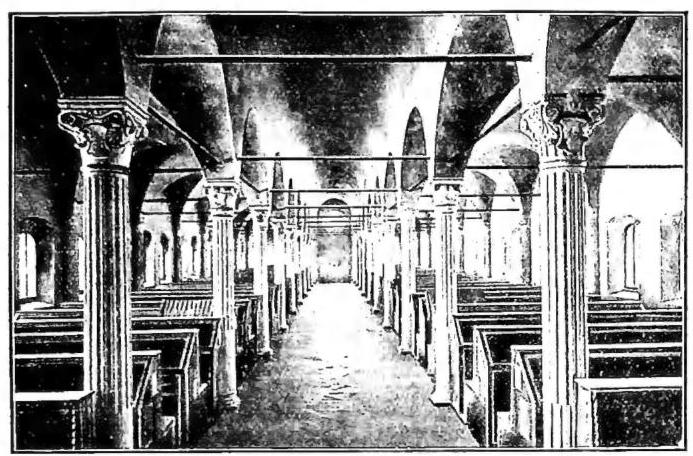
This apology for antiquity is never separated in these men from an emotional exaltation of their own age and from proud confidence in their own strength, from the fierce awareness of being able not only to imitate but to surpass the proud models handed down by the ancients. C. Salutati declares his master Petrarch superior to Cicero and Virgil themselves, for having reached the heights of perfection in both prose and poetry. L. Valla likewise hails his own century as one in which all studies have been reborn to a better life, and F. Biondo proceeds in step. No less enthusiasm for the "golden age," in which he lives and works, is found in M. Ficino. That all these men attributed no less weight to their own personality and to the power of their own intellect is demonstrated by the pseudo-Manetti (Vita di Ser Filippo Brunellesco), who recalls that it would have been of no use to his hero to have discovered and studied ancient monuments in Rome, had he not been aided by divine inspiration and his own ready and fertile spirit, which suggested to him the creation of new, powerful, and original works, rather than pale, petty, and sterile imitations of the ancients. It should be added that many men of the Renaissance were not so entirely devoid of critical sense as to fail to distinguish, even amid the dense darkness in which the "Middle Ages" were enveloped, different epochs, and they were indeed able to recognize the slow progress of civilization accomplished between the restoration of the Empire by Charlemagne and the first timid resurgence, after the year 1000, of urban life.
II. FORTUNE OF THE RENAISSANCE
The further one moves from the living sources of the first humanism, the more the concept of the Renaissance tends to rigidify into certain infallible canons and dogmas, aesthetic and literary, and the less one perceives the ties of this age with the Middle Ages, which thus fell into profound disdain until the 19th century. From the work of Vasari onward, Raphael and Michelangelo are regarded as the highest peaks of the Renaissance, while all their precursors are viewed with a somewhat contemptuous indulgence, for they still bear the stigmata of a Gothic and barbaric age. According to this criterion,the artistic Renaissance is judged by Leandro Alberti (Descrittione dell'Italia, 1553), by R. Borghini, and by late 16th-century architects such as S. Serlio and V. Scamozzi (L'idea dell'architettura universale, published only in 1616). A philologist, Chr. Keller (Cellarius), sees in Bruni, Guarino, Poliziano, and others the true restorers of the Latin language, corrupted and disfigured during the Middle Ages (Dissertatio de fatis latinae linguae, ed. 1706), while a historian of philosophy, G. Horn, asserts that Christian doctrine, having become barbaric in the period from Albertus Magnus to Ockham, was rescued from its decline by the Florentine Platonists, an effort later continued by Erasmus, L. Vives, P. Ramus, Fr. Patritius, and others. The 18th century's enthusiasm for the Renaissance stems primarily from that century's blind faith in the imminent triumph of the lights of reason. This thesis, though varying from writer to writer and from nation to nation, remains unchanged in essence among figures such as Montesquieu, Voltaire, Condorcet, Gibbon, Abbé Lansi, S. Bettinelli, L. A. Muratori, Robertson, W. G. Tennemann, and J. Brucker. Well-known,
finally, are Goethe's Renaissance sympathies (Italienische Reise, preface to the Life of B. Cellini), his admiration for Lorenzo the Magnificent and Palladio, and his aversion to "Gothic barbarism." A more serene evaluation of the Renaissance emerged only in the 19th century with the work of J. Burckhardt (The Civilization of the Renaissance in Italy, 1859): the Basel historian was the first to attempt to reunite the diverse manifestations of this era into an organic and unified vision. The greatest flaw in his work, however, was his overly rigid opposition between the Middle Ages and the Renaissance, so much so that one of his critics, E. Gebhardt, rightly observed that the connection between the two appears "barely visible." This connection was later believed to have been discovered by Henry von Thode (Francis of Assisi and the Dawn of the Renaissance, Michelangelo and the Decline of the Renaissance) and then by C. Burdach, who traces the true origins of the Renaissance not only to the medieval period (Dante, St. Francis, Joachim of Fiore, etc.) but also to the early Christian era and certain mysticosophical religions of the first centuries.
It must be said that this discussion around the "concept of the Renaissance" continues even today: an attempt has been made—though not a new one—to call the 12th and 13th centuries, rather than 15th-century Italy, the "Renaissance," where, especially in France and the Low Countries, one indeed notes an awakening of the natural sciences and philosophy (C. J. Haskins, Fr. Funk-Brentano, J. Nordström), as well as artistic flourishing (Gothic cathedrals, etc.). Following in the footsteps of L. Courajod, who believed he saw in the Renaissance an age of contamination of genuine French and Northern art, several writers from beyond the Alps have striven to locate the "true Renaissance" in France rather than Italy. Alongside these nationalistic tendencies, a current has also emerged in Italy that, rightly rejecting the rationalism, skepticism, etc., attributed to Renaissance figures by Burckhardt, sees in their cultural work nothing but a reaction of Catholic orthodoxy against the "heretical" and "Averroistic" 14th century and the triumph of learned pietas—a renewed Catholicism permeated by the classical and ancient spirit. If some Catholic and non-Catholic writers (Chesterton, Berdyaev) have sought to exalt the spiritual values of the Middle Ages while viewing the Renaissance as a source of moral perversion and the beginning of a disastrous scientific individualism (J. Maritain also dislikes the Renaissance for the same reasons), G. Papini, on the contrary, sees in the Renaissance the "return to the Father" and the triumph of true and more complete Christianity over the "abstract" Christianity of the Middle Ages (for an overview of these disagreements, one may consult the collection of studies: Pensée humaniste et tradition chrétienne aux XVᵉ et XVIᵉ siècles, Paris 1950; the most complete bibliography on the subject is found in C. Angeleri, cited in the bibliography). Some German writers (L. Woltmann,
C. Neumann) have sought to interpret and explain the Renaissance phenomenon through the infiltration of "fresh Germanic blood" (invasions, etc.) into the withered veins of ancient Mediterranean civilization; some even went so far as to offer a "physiological" demonstration of this thesis, exhibiting "Nordic" silhouettes of Dante, Michelangelo, and others. To all this, it may perhaps be added that, according to a distinguished French historian still living (L. Febvre), there never was an "Italian Renaissance," and what is classified under the name of various Renaissances depends on subjective considerations, illusions, and the whims of different writers, who clothe under this name phenomena quite dissimilar from one another (according to L. Febvre, it was especially J. Michelet [v.] who invented the myth of the Renaissance).
Now, taking due account of what has been acquired in this field by various historians, philosophers, and men of letters of the past, while discarding exaggerations, inaccuracies, and errors of perspective into which more than one of them has fallen, it can be held that the Renaissance was certainly not a "miracle," as if sprung from nothing (as Vasari would have it), nor an epoch in some way "privileged" and standing apart (J. Burckhardt), but neither was it a mere continuation of the idea and form of life that preceded II. If one agrees to frame the Renaissance within certain chronological limits and to make its principal theater a specific country (Italy), rather than treating it as a mere abstract concept outside of time and varying according to epochs, places, persons, etc., one must first seek its historical origins.
III. THE IDEAL WORLD OF THE RENAISSANCE — While Italy had been throughout the Middle Ages the seat of the Empire and the Papacy, the "chosen land" of both pillars of Christendom, and also the first victim of their perennial discord, by the 15th century it was practically a land of none, left to itself—or rather, to the initiatives, enterprises, and cupidities of individual princes, cities, and republics. If in other countries, until the end of this century, national and feudal struggles continued to rage, and dynastic unity increasingly gained the upper hand over medieval "separatism," if even Spain was engaged in an unrelenting struggle against the Infidel (the Reconquista)—reviving the sense of national, religious, and territorial unity—Italy knew nothing of this dynastic, warlike, fanatical "nationalism," which lent an air of actuality to epic and "romantic" survivals. Italy devoted itself to problems of local and regional interest, such as expanding territory, despoiling a restless neighbor, and extending its commerce, all while maintaining that political "equilibrium" in the Peninsula which would only be achieved with great difficulty after the Peace of Lodi (1454) and the arbitration of Lorenzo de' Medici (who, as Guicciardini said, then held "the needle of the balance"). All the Italian wars of the 15th century, aimed at this precise objective, had the character of small skirmishes and guerrilla actions, never producing decisive results (including the famous Battle of Fornovo), and regularly returned, at regular intervals, to restore the status quo ante. And since none of the Italian city-states was strong enough to impose its will on all the others, let alone unify the Peninsula under its own aegis (the failure of Cesare Borgia in this regard would be noted with bitter disappointment by Machiavelli), the advantage for all of them lay precisely not in waging war, but in negotiating—not so much in the use of the art of war (which had by then become the special task of mercenary militias) as in that of diplomacy. To this end, prudence, political foresight, patience, cunning, and above all the art of oratory were required: the gift of refined, calculated, persuasive, "elegant" speech, which presupposed infinite resources of a ready wit, capable of embracing the most diverse and tangled situations.
Lacking any monarchical, national, or other tradition, and any principle of "legitimacy," these "new men" were forced to seek in the resources of their own intellect and strength the foundations of their power and the guarantee of its duration. And here, at least in part, lies what Burckhardt called the "individualism" of the Renaissance. Not that powerful individualities were lacking in the Middle Ages: yet the sense
(from L. De Gregori, La stampa a Roma nel sec. XV, Rome 1932, tav. 19)
RINASCIMENTO - Frontispiece of an incunabulum, with geometric symbols and candelabrum frieze. Ed. Freitag, Rome. 1492-93. Exemplar from the Biblioteca Alessandrina - Rome.
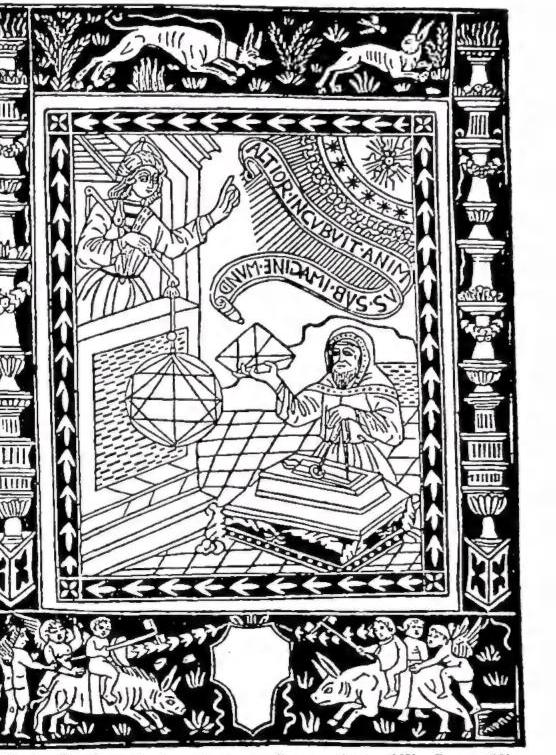
One might ask to what extent the accusations of immorality leveled against the Renaissance were justified. Certainly, this era does not lack even overly crude examples of moral unscrupulousness, but ultimately, it could be said that it was neither more nor less immoral than any other. If one sets aside certain flamboyant figures of notorious scoundrels (B. Visconti, C. Borgia)—who, however, have their counterparts even in the full Middle Ages (Ezzelino da Romano, Foulque d'Anjou)—one also finds in the climate of the Renaissance many pious people and even those of austere morals, exemplary mothers, devoted children, faithful friends, etc. (it suffices to mention a Lucrezia Tornabuoni, an Alessandra Macinghi-Strozzi, and later the virtuous Elisabetta Gonzaga), not to mention the Catholic Reformation (v.).
Some have sought to link the Renaissance's "moral laxity" to the presumed intrusion of paganism, but often the pagan vein was nothing more than rhetorical exercise, a bookish phraseology, a display of mythological erudition. Classical culture was, in the Renaissance, the privilege of a tiny minority of wealthier and more educated citizens in Florence, Venice, etc., while the masses of artisans and merchants found their spiritual nourishment especially among popular preachers (s. Bernardino di Siena, Roberto di Lecce, etc.), who, of course, tuned their sermons to the needs of the new times.
(from C. Hülsch, La Roma antica di Ciriaco d'Ancona, Rome 1887, tav. 3)
RENAISSANCE - Palatium Caesaris. Architectural drawing by Ciriaco d'Ancona (15th century) - Parma, Biblioteca Palatina.
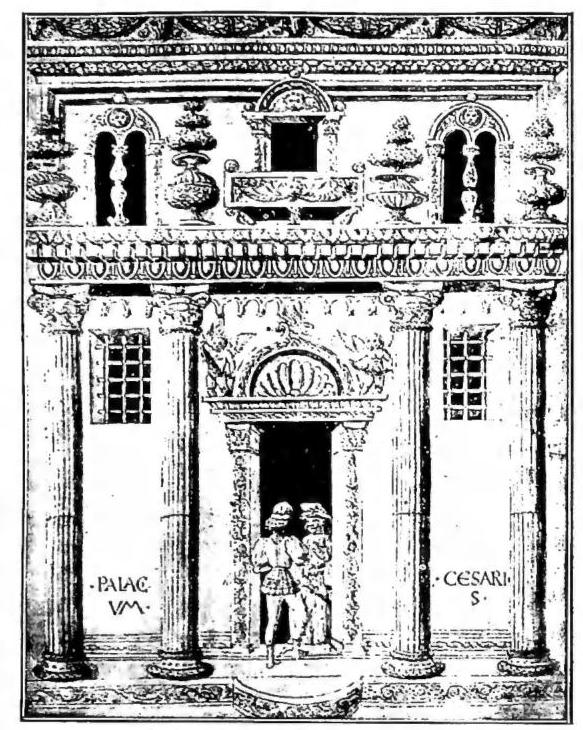
Yet the eternal joy and serenity attributed, for example, to the Renaissance by Goethe are nothing but a "myth": reality is more complex than these facile models; neither absolute pessimism nor absolute optimism are the prerogative of an era. Renaissance poetry exhibits a variety of attitudes, expressions, and inspirations: alongside those painful regrets and stifled anguish, there is the breath of a spring breeze in Poliziano’s chambers, the enchantment of Boiardo’s wondrous tales. Marsilio Ficino exalts (De Theol. Plat.) in man a revived Daedalus; Pico della Mirandola (De Hominis dignitate) extols the marvelous power of the human being, superior, by virtue of his protean nature, even to the angelic mind, and the same is said by B. Fazio, G. Manetti, and even N. Machiavelli, who relies on human "virtù" to combat the blind world of "fortuna." However, all these apologies have nothing to do with various modern exaltations of the "superman," the inimitable life, etc., since this superior capacity of man is strictly linked to his sense of the divine, and if man is made to dominate nature, it is because he is a "son of God" ("...l'uomo fattura tua meravigliosa": Altercazione by Lorenzo de' Medici).
Now, the culture of the Renaissance is not exhausted by literary and stylistic exercises, nor by vain astrological beliefs and superstitions, and the same "Ciceronianism" is but a secondary aspect of the new humanism, whose fortunes are tied to the discovery of ancient codices, thanks to the intelligent encouragement of some popes (such as Nicholas V) and some wealthy patricians (Cosimo de' Medici, Palla Strozzi, etc.). One of the most important discoveries of the era was that of the Greek manuscripts of Plato and Plotinus (the latter was entirely unknown in the Middle Ages, while of the former only a few unreliable versions, distorted by medieval glossators, were available). The discovery of Plato would not, however, have had such importance in itself, had Renaissance thinkers not raised various metaphysical problems concerning the relationship between man, nature, and God. And it was precisely the controversies of different Councils (1430 and 1439) that gave impetus to such speculations. Thus, Cardinal Cusanus takes his cue from the dispute over the supremacy of the Pope and the Councils to develop his doctrine on "complicatio et explicatio" (De docta ignorantia), which, however, had very little resonance in Italy.
Instead, the disputes between Greeks and Latins at the Council of Florence (1439), regarding the respective merits of Plato and Aristotle, provoked a great effervescence in the city, leading Cosimo the Elder to found the so-called "Platonic Academy." The dominant thought of Ficino is to prove, with the aid of Plato and Plotinus as well as various pre-Christian theologies, the fundamental unity of faith and "reason founded on Mosaic revelation," whose esoteric meaning would be revealed and confirmed, according to Pico, in the Cabalistic books. The doctrine of the "double truth" also circulates in Renaissance thought, already propagated by Paduan Averroists and upheld by P. Pomponazzi, a follower of the "true Aristotle," rediscovered by E. Barbaro. Alongside these "innovators," some conservatives are also noted, partisans of St. Augustine and St. Thomas, enemies of every kind of paganism (G. Dominici, St. Antonino, and Cardinal Adriano da Corneto, etc.).
Renaissance historiography decisively abandons the old medieval schemes, turning its attention to the origins and development of individual Italian cities and republics and to the fortunes of various princely dynasties. Rome, while retaining its prestige, no longer stands, for example, at the center of the concerns of a L. Bruni or a Poggio Bracciolini: it is their city, Florence, which, though a younger daughter of Rome, is now called to renew culture and to transmit to posterity illustrious works, whose decorum and style are no less than their doctrine and moral content.
In various manifestations of the Renaissance, there is also a tendency toward harmony, reconciliation: harmony between faith and reason (Ficino, Pico), between contemplative and active virtue (C. Landino, De disputationibus Camaldulensis), between the plastic beauty of a work of art and its divine eurhythmy in the same cosmic creation (L. B. Alberti, L. Pacioli), between love of creatures and love of the Creator in Ficino’s doctrine of "Platonic love," later propagated by B. Castiglione’s Il Cortegiano, Leone Ebreo’s Dialoghi d’Amore, P. Bembo’s Asolani, in short, between divine and human things (as Cardinal Sadoleto says). For the last time, the equilibrium of the Renaissance will be illustrated, under the pontificate of Leo X, by Raphael (Stanze of the Vatican). By the mid-sixteenth century, another era begins, an era of dramatic tension and acute conflicts, an era that will imprint a new form of religiosity, a new direction in art, a new sensibility in literature—in brief, a new style and a new civilization.
For Renaissance philosophy, in addition to individual authors, V. ARISTOTELISMO; PLATONISMO. V. ITALIA. V. Letteratura; UMANESIMO.
IV. ART
The definition of the Renaissance from the perspective of the figurative arts and the determination of the limits within which it is legitimate to speak of a Renaissance are subject to the same uncertainties that emerge in the history of thought and culture. As in these fields, the term "Renaissance" has undergone the most diverse definitions in the realm of art as well.Regarding the possibility of tracing its origins, scholars are divided into two main camps: some see the Renaissance emerging as early as the thirteenth century and link the phenomenon of the rebirth of the arts to the rise of the Communes or to the great French civilization of the thirteenth century, which imparted a vivid impulse through architecture and sculpture to all artistic production. Others, more justly, by assigning to the concept of Renaissance a precise historical as well as qualitative value, recognize that only with the beginning of the fifteenth century—and more precisely with fifteenth-century Florence—do those conditions of particular harmony between the arts and between them and the cultural world emerge, conditions that made possible the strong and singular creative thrust and the formation of the new concept of artistic autonomy, which spread throughout Europe for at least two centuries and had profound repercussions in the world up to the threshold of the modern era.
1. Characteristics. - If one wishes to assign to the term "Renaissance" the meaning that humanists and artists of the time or immediately following the development of the new ideas consciously gave it, one must consider the art and artistic culture of the fifteenth century as something new, albeit produced by the increasingly intense and free artistic creation of the preceding centuries and, above all, by the high awareness of the phenomenon of art witnessed by Dante, Giotto, and Petrarch. To understand the novelty of that era, it would suffice to read some of the pages written by those artist-humanists who, in addition to working actively as architects, sculptors, and painters, were driven by intellectual curiosity and the maturity of their culture to adopt that attitude of self-awareness and theoretical demand that is typical of the Renaissance. See, for example, the dedication to Filippo Brunelleschi prefaced to the treatise De pictura by L. B. Alberti, the great humanist architect who, arriving from his exile in Venice, perceives with astonishment precisely that "new time" which we call the Renaissance. He fully grasps its universal value, and his pages, in which the major artists of fifteenth-century Florence are cited, should be considered the "Manifesto" of the Renaissance. In them, he not only recognizes the creative originality of those artists but also regards them as exemplary of the new generation that, in comparison with the ancients, does not result in a continuation or subsequent development of classical art but rather places itself "on par" with ancient art while preserving the full autonomy of artistic creation. Hence, in Alberti's words, the definition of the Renaissance as an "autonomous" age vis-à-vis the ancient world—a concept to be kept firmly in mind to avoid falling into the cultural error of seeing the Renaissance merely as a rebirth of classical art. Even if the term, coined in humanist circles, primarily indicates a new flourishing of classical art, what matters most is to understand this classicism as a polemical stance against medieval art and (as would later be said in the sixteenth century) "barbaric" art.
Moreover, if one wished to trace the fortune of classical art before the Renaissance, one would arrive (through subtle but clarified paths in modern criticism) at classical art itself, since the tradition of classicism never truly faded, though it shifted its ground across the centuries. It is more reasonable, therefore, to consider the Renaissance as the attainment of a particular and rare harmony among the arts and between them and scientific and philosophical speculation, which mirrored itself in Greek and Roman civilization, recognizing itself and thus clearly defining its own speculative and expressive character.
To further clarify the value of the Renaissance in relation to the medieval tradition, one may consider what the Florentine artists of the very early fifteenth century found before them, immediately preceding or contemporary to the
RINASCIMENTO - Exterior of the church of S. Maria dei Miracoli (15th-16th century) - Brescia.
Their new speculations confronted the late 14th century and the first decades of the 15th, which had witnessed the flourishing of a fantastical exuberance, whence the term "flamboyant Gothic," aptly describing the aspects of the late Gothic style.
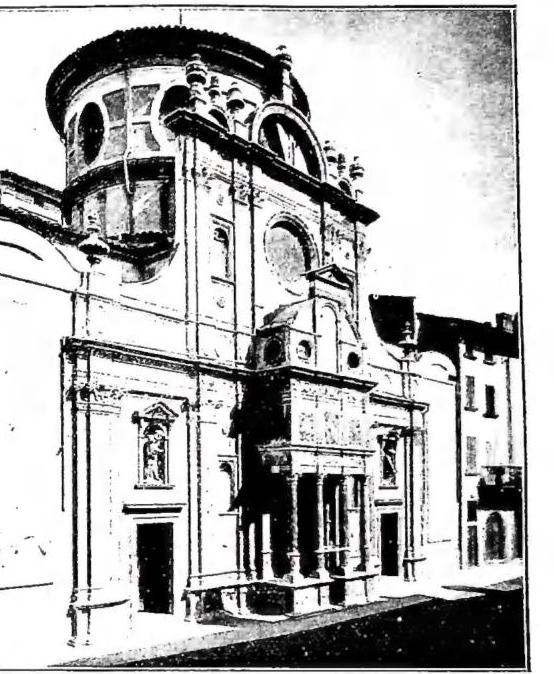
2. The Value of Perspective. - Many factors contributed to the "discovery"—or rather, rediscovery—of the optical and geometric laws governing perspective, and it should not be believed that the Middle Ages were devoid of any notion of perspective. Giotto, as demonstrated by certain details in the frescoes of Assisi and, even more so, Padua, had tackled and resolved some problems of illusory vision, which enhances the spatial effect of the environment in which one paints. However, it was not until the early 15th century, and specifically Filippo di Ser Brunellesco, that we encounter a full awareness of the rules of perspective in use.
RINASCIMENTO – Physiognomic studies. Pen drawing by A. Dürer (1513) – Berlin, Kupferstichkabinett.
for the representation of reality according to a clear organization, preferably following the "central perspective."
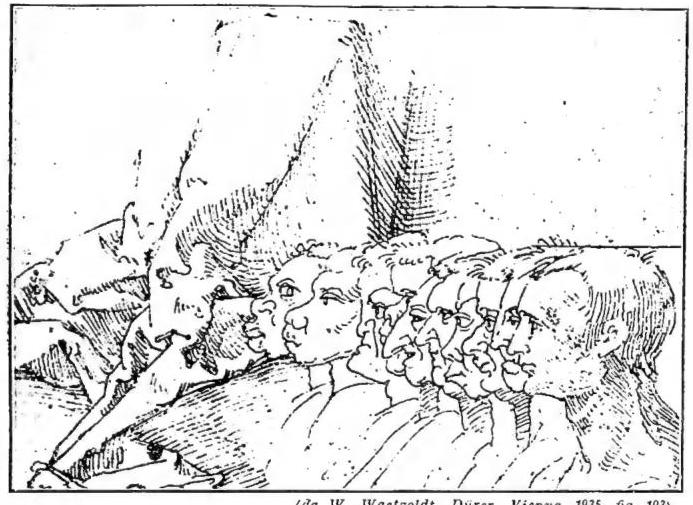
To understand the fundamental speculative value of the perspective conception, it must be remembered that it is not merely a figurative fact but the expression of a total vision of the world in relation to man, arising from the possession that man himself takes of the surrounding reality from his "point of view," considered autonomous and central. Hence the exaltation of individual personality and the need to achieve a synthetic vision of reality entirely mastered by man: as philosopher, as politician, as man of action, as artist. Such a conception was foreign to the Middle Ages because it was opposed by the immanent transcendence of the world; thus, the Middle Ages did not know perspective in the Renaissance sense, that is, as a dominant and centralizing element of vision.
Perspective informed the character of the figurative arts of the Quattrocento, despite the simultaneous persistence of the veristic-decorative tradition of the International Gothic, and had a tremendous impact on the development of the Renaissance even outside Italy, through the multiplication of treatises on the arts or the translations of famous Italian treatises. To confirm this faith in perspective and in the proportional rules of things, and especially of man, came the opportune and fruitful study of classical treatises, sometimes interpreted with intuitive freedom, but always invoked as an example of the coherence and rationality of the classical spirit.
This singular attitude, which tends to rationalize artistic intuition and establish principles beyond the rules formulated in the pages of treatises on art, is symptomatic of the Renaissance spirit, even if, since the early Middle Ages, some principles of technique and style were collected for the use of painters. The difference between these compilations or summae and the true "treatises" of the Renaissance lies in the entirely different spirit with which the task of compiling such collections was approached. Until Cennino Cennini’s Libro dell’Arte, still largely medieval in its mixture of theoretical principles and practical advice (often of touching naivety), such publications concerned the didactics of art and, in a sense, the conceptual world of the artist in close relation to the religious themes he addressed. With the treatises of the Renaissance, of which the most singular examples are offered by L. B. Alberti, of exquisitely humanistic and pedagogical nature, one moves onto a distinctly different plane where the artist is at once creator and investigator of subtle geometric and mathematical speculations, and where, for the first time, the relationship between the arts, poetry, music, and philosophy is extensively discussed.
Another distinctive characteristic of the artist’s personality in the Renaissance is that of his versatility, not to be confused with eclecticism. There is no doubt that even in the Middle Ages there were artists who practiced various activities in the figurative field simultaneously, and the example of Giotto—painter, architect, and designer of plastic models for the sculptures of his bell tower in Florence—suffices. However, if this arose from the native unity of artistic expression (all the more valid the more original and autonomous), in the Renaissance, the frequent phenomenon of the versatile artist is understood as a sign of the completeness of personality, while it is undoubtedly stimulated and nourished by the tendency to bring back to theoretical principles, equally valid for all the arts, the singularity of artistic expressions. Brunelleschi (architect and sculptor), Donatello (sculptor and architect), Leon Battista Alberti (architect, sculptor, painter, treatise writer), Piero della Francesca (painter, architect, treatise writer), and others up to Leonardo da Vinci, who reaches the maximum complexity in the relationships between art and thought, and Michelangelo himself are just a few examples, among the greatest, of the versatility of the Renaissance artist, even if each then practiced one of the artistic activities he knew in a particular way.
From this, which might seem merely a consideration of the inner richness of such artistic personalities, arises the important conclusion that the artistic Renaissance, in its vital dialectic between naturalism and idealism, between experience and theory, between art and science, achieved that rare equilibrium, almost unknown to other artistic civilizations (perhaps excepting ancient Greece), precisely because in the same artist the expressive problems proper to the individual manifestations of art itself were elaborated and found their solution: whence the conviction, for example, that, as Michelangelo said, one cannot understand architecture without understanding anatomy.
Having premised that, in attempting to define the typical characteristics of the individual arts in the Renaissance, one performs an act of generalization and abstraction in the face of the vital consistency of artistic personalities, some constant aspects of the arts in the Renaissance can nonetheless be indicated to contribute to the knowledge of this artistic period.
3. The arts in particular. – Architecture reacts against the planimetric and decorative complications of Gothic, which had reached its decadence, but inherits from it the constructive spirit and the subtle technical experience, bringing volumes and surfaces back to a geometric yet lively simplicity, benefiting from the passionate study of ancient buildings.
Even if the Middle Ages had knowledge of antiquity and often interpreted some of its characteristics brilliantly, this cannot be compared to the conscious enthusiasm and depth of research with which the new architects of the Renaissance approached the study of ancient monuments, measuring them, tracing their proportional relationships, and mastering decorative modules with far greater coherence and rationality, precisely because they were already prepared, in their ideals of harmony and proportion, to exploit the experience of antiquity as an operative element in their imagination. The natural desire for simplicity and measure, which polemically opposed the latest complications of Gothic architecture, favored
the acceptance of decorative modes and precious details that Roman architectural decoration had partly inherited from Hellenistic architecture and Greek classicism: elegant and clear cornices reappear around round arches, delicately carved brackets and marble dentils return beneath the overhangs and cornices of buildings, and along the extended surfaces, simple or fluted pilasters and pillars stand out, crowned by capitals of the most refined taste.
Among the highest examples of this new architectural style are the buildings designed by Filippo di Ser Brunellesco, Michelozzo, Leon Battista Alberti, Luciano Laurana, Il Cronaca, and Giuliano da Sangallo.
In sculpture, building upon the experiences of the mature Trecento—which, particularly with Andrea Pisano, had brought formal simplification into contact with classical art to achieve a level of the highest style (see the panels of Giotto’s bell tower and the compartments of the first door of the Baptistery of Florence)—the new artists, drawing from the Gothic that spirit of intimate vitality which also offered vital lessons in architecture, reapproach the human figure with a greater desire for plasticity and compositional breadth: man, especially man in the perfection of his nudity, interests artists more than florid decoration. Even the surrounding environment, in bas-relief, reflects a more acute and rational naturalistic experience through perspective, used in different but simultaneous ways by artists such as Lorenzo Ghiberti and Donatello.
The individuality of the artist, exalted as a source of autonomy in creation, gives rise to that "spirit of competition" which will be typical of the Renaissance world, while new motifs, also born from the civilization of the R., stimulate the imagination of sculptors. The "Portrait," for example, already reappearing in the Trecento through funerary or commemorative sculpture, or even in painting, but in a humble and modest guise, assumes fundamental importance in the Quattrocento: from Donatello to Francesco Laurana, to Mino da Fiesole, to Desiderio da Settignano, and onward to Il Pollaio and Verrocchio, portrait busts enter homes, placed beside the living person who takes pleasure in transmitting their likeness to posterity, often in polychrome terracotta for a greater effect of truth. Simultaneously, the rare examples of equestrian statues from the Middle Ages, tied to the chivalric and heraldic spirit (consider the Scaliger tombs of Verona), are replaced by a new plastic and humanistic ideal: the "Equestrian Monument," also erected for commemorative reasons but with an entirely different spirit and closely linked to the art and ideals of classicism. The idea of raising an equestrian monument in a square to a condottiero, later to a prince or sovereign, marks the rebirth of that exaltation of military glory (or more generally of "glory") which had led the ancients to the parallel conceptions of the triumphal arch and the equestrian monument.
Bronze, a ductile and noble material also according to the Renaissance conception, is used enthusiastically to cast the equestrian statues later raised on marble bases in the antique style, and the highest examples of this art will remain, albeit in two different conceptions, the monument to Gattamelata by Donatello in Padua and that of Bartolomeo Colleoni by Verrocchio in Venice.
Naturalism and classicism intertwine throughout Renaissance sculpture until the powerful, heroic, and dramatic effort of Michelangelo interrupts its lively dialectic: often the two tendencies merge in the same artist (Donatello) and in the same work, since even Hellenistic-Roman sculpture provided admirable examples of the full elaboration of both attitudes. In new ways, with an elegance almost Hellenic, wall funerary monuments flourish in close collaboration between architecture and sculpture, while from great art to the various expressions of the so-called "minor arts," the medieval craftsmanship, refined and culturally far more profound, spreads and develops a "Renaissance taste" tied to common ideals that extends to the threshold of modern civilization.
Painting, starting from the increasingly clear concept,
(from S. Serlio, Libro II di prospettiva, Venice 1866, p. 26)
RINASCIMENTO - Street with buildings, constructed according to Serlio's rules - Exemplar from the Vatican Library.
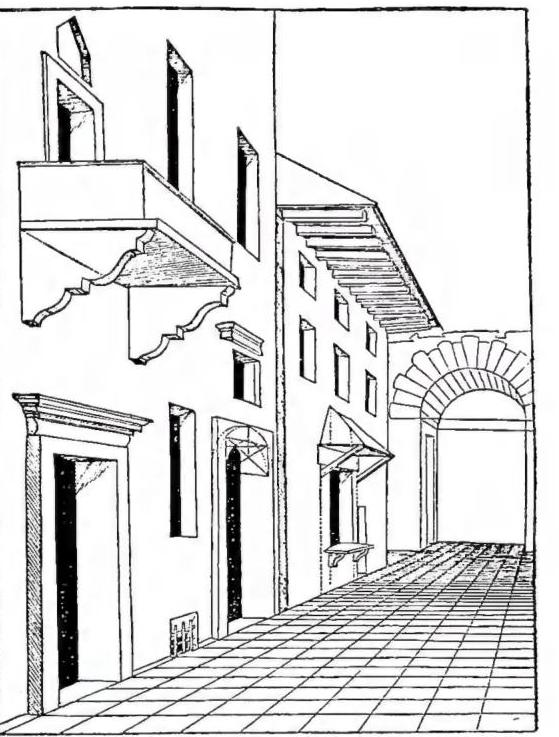
However, perspective should not be understood as a "applied" science to the arts in support of them (and of which one could write a history apart from pure mathematical or geometrical science). The perspective of Renaissance artists, born from a figurative and spiritual need, assumes as many aspects as there are artists who recognize its necessity for their own representation. After the examples of an allusive perspective offered by the painting of the International Gothic, the illusionistic perspective of the fifteenth century must have seemed a revelation: the enthusiasm with which artists mastered it is clear testimony. But while perspectival effects were immediately adopted by decorative painting, preparing the scenographic illusionism of the late Renaissance, the truest painters used them in strict relation to their own stylistic demands: thus in Masaccio, who, through his association with Brunelleschi, could refine his natural plastic need into a broader spatial breath, there emerged a supreme example of perspectival measure by which human action does not dissipate but rather intensifies in the perfect collaboration between the relief of forms and the depth of the environment (see the scenes of the deeds of St. Peter in the Brancacci Chapel, at the Carmine, in Florence). Masaccio then offered a further interpretation of perspective and foreshortening according to new principles in the fresco of the "Trinity" in Santa Maria Novella, also in Florence.
A supreme example of the new Renaissance vision and the need for an intimate relationship among the various arts is the personality of Piero della Francesca, architectural advisor to Federico da Montefeltro for the Ducal Palace of Urbino, a painter of the most absolute purity in the perfect union of geometry and poetic intuition of reality, a severe treatise writer on perspective and the geometry of bodies following Euclid's footsteps. See his De prospectiva pingendi, in which even the human body and its various parts are considered in proportional and perspectival relation like architecture, a concept that would be developed, through Luca Pacioli's treatise, beyond the borders, reaching the emergence of analogous phenomena even where the Gothic had dominated for much of the century, for example, in Germany, with Albrecht Dürer.
Nevertheless, the richness of developments in Renaissance painting in Italy cannot be limited by the perspectival taste; it indeed informs much of the new artistic civilization, but parallel to it, different attitudes appear, some of which seem to reconnect with the International Gothic tradition: after the generation of painters of the first half of the century, for whom perspective assumed a dominant character, artists such as Filippo Lippi, Sandro Botticelli, Antonio Pollaiolo, and Andrea del Verrocchio brought back into vogue the expressive line of movement and relief, placing the perspectival problem in the background or even avoiding II. From the pictorial narrative of Filippo Lippi arises the musically poetic style of Botticelli, interpreter of the humanistic ideals of Lorenzo the Magnificent's court and the pagan fantasies of Poliziano, yet equally original in the creation of an extremely sensitive, sensual, and yet acutely illustrative world. Through the evolution of his style, which, under the influence of Savonarola's preaching, bends painfully to interpret religious spirituality, one can follow the trajectory of Botticellian art into the sixteenth century, which in many ways coincides with the developments of Renaissance figurative art itself. But at the end of the century, when even Luca Signorelli seemed to return to the medieval vision in the scenes of the Antichrist (Orvieto, Cathedral, Chapel of San Brizio), while pictorial narrative, after Benozzo Gozzoli and embodied by Ghirlandaio, turned to the documentary illustration of contemporary civilization, the great individualities of Leonardo, Raphael, and Michelangelo emerged.
The pictorial Renaissance developed variously according to local traditions: the new perspectival intuitions combined with the scrupulous Flemish naturalistic attention passed into northern Italy, from where, from the Paduan center, the humanistic and heroic conception of Andrea Mantegna radiated simultaneously; in Venice, the opposition to the florid Gothic was alive, carried out by the Bellini, especially Giovanni, with the intervention of Antonello da Messina and contacts with Paolo Uccello, while in southern Italy, Antonello himself was at the center of the new pictorial vision founded on the geometry of bodies and the conception of a naturalism sublimated by perspectival synthesis.
In the reflections that the Flemish brought beyond the Alps, acquiring the sense of measure and perspective no longer merely optical but spatial, one can understand how fruitful the teachings of Italian Renaissance painting were, just as in the architectural and sculptural fields, the relations with foreign courts, commercial exchanges, military enterprises, and the increasingly frequent travels of foreign artists to Italy produced a vast and profound reflux movement that, from Italy, reached all of Europe, more or less effectively, bringing into contact with local traditions the new figurative language and the new artistic culture.
In the early years of the sixteenth century, with Bramante, Leonardo, Raphael, and Michelangelo, artistic problems, based on the fifteenth-century Renaissance, assume the value of individual synthesis and, at the same time, already betray demands for renewal that will lead to "Mannerism," a prelude to the "Baroque."
For this reason, and due to the progressive abandonment of those proportional ideas, those plastic and pictorial principles founded on measure, rhythm, and proportion, many critics see in the sixteenth century a moment distinct from the true Renaissance of the previous century and call it the "second Renaissance." But, apart from the fragility of such divisions, it seems absurd to exclude these towering personalities, who are nonetheless the fruit of Renaissance research (and, indeed, crown it in an exemplary manner) from the true Renaissance; perhaps it is more just to mark around the middle of the sixteenth century a growing complexity of spiritual, cultural, and artistic problems that signals the progressive exhaustion of the Renaissance, whose ideas, however, in many cases, continue to inform great works of art: suffice it to think of the architecture of Andrea Palladio and the classicism of his art, which not only stamps the end of the century but, transplanted through Inigo Jones into England, gives rise to a humanistic current so valid as to reach Neoclassicism, imprinting it with its own character.
BIBL.:
G. Vasari, Le vite de' più eccellenti pittori, scultori e architettori, ed. Milanesi, Florence 1878-1885; J. Burckhardt, Die Kultur der Renaissance in Italien, Basel 1860 (trad. it., Florence 1952); H. Wölfflin, Die klassische Kunst, Munich 1899 (trad. it., Florence 1943); B. Berenson, The Italian Painters of the Renaissance, London 1930 (trad. it., Florence 1936); R. Longhi, Piero della Francesca, Rome 1927; id., Officina ferrarese, Rome 1934; L. Venturi, Storia della critica d'arte, Turin 1938; E. Panofsky, Die Perspektive als symbolische Form, Leipzig 1927 (trad. it., Milan 1961); id., Studies in Iconology, New York 1939 (trad. it., Turin 1975); A. Chastel, Art et humanisme à Florence au temps de Laurent le Magnifique, Paris 1959; F. Antal, La pittura fiorentina e il suo ambiente sociale nel Trecento e nel primo Quattrocento, Turin 1960; M. Salmi, La pittura del Quattrocento, Novara 1961; A. Blunt, Artistic Theory in Italy, 1450-1600, Oxford 1940 (trad. it., Turin 1966); J. Pope-Hennessy, The Portrait in the Renaissance, London 1966; L. Grassi, Il problema della prospettiva nel Quattrocento, Rome 1956; G. C. Argan, Storia dell'arte italiana, Florence 1968; F. Zeri, Pittura e controriforma, Turin 1957; E. Battisti, L'antirinascimento, Milan 1962; C. de Tolnay, Michelangelo, Princeton 1943-1960; R. Wittkower, Architectural Principles in the Age of Humanism, London 1949 (trad. it., Milan 1964); A. Hauser, Sozialgeschichte der Kunst und Literatur, Munich 1953 (trad. it., Turin 1956); E. Garin, L'umanesimo italiano, Bari 1952; id., Medioevo e Rinascimento, Bari 1954; G. Weise, L'ideale eroico del Rinascimento e le sue premesse umanistiche, Naples 1961.
G. C. Argan
In this second phase of the Renaissance, as Aretino had already keenly observed, everything tends toward grandeur and an appearance greater than reality, just as human actions are viewed through a heroic lens: the measure of man, the meter and proportion of events and representations in the Quattrocento, no longer suffices, and art strives for the colossal. The comparison between the Palazzo Medici-Riccardi or the Palazzo Rucellai in Florence and the Palazzo Farnese in Rome, just as that between the tomb of Sixtus IV by Pollaiolo and Michelangelo’s projects for the tomb of Julius II, or the one between the fifteenth-century decoration of the Sistine Chapel and the ceiling of the same chapel painted by Buonarroti, serve quite well to indicate the markedly changed taste and the longing for the gigantic in the sixteenth century. Leonardo, who embodies the greatest sum of scientific and artistic values of the Renaissance, is a "modern" man due to his relentless pursuit of research and his full faith in experience as opposed to theoretical principles assumed as infallible documents. Yet the miraculous balance between science and art, speculation and intuition, would not have been achieved in this genius had he not rooted himself in the era of Brunelleschi, Alberti, and Piero della Francesca. In architecture, Bramante, educated in the Renaissance taste in Urbino and arriving in Rome after his Lombard experience laden with superhuman dreams, marks a fundamental epoch in the history of Renaissance civilization with his design for the new St. Peter’s. His idea of a centrally planned building with an immense hemispherical dome laid the foundations for what Michelangelo realized in the second half of the century, though shifting Bramante’s spatial conception into a plastic plane of towering mass. Sacred and civil buildings profoundly reflect the sixteenth-century conception inaugurated by Bramante, through Baldassarre Peruzzi, Antonio da Sangallo, up to Giacomo della Porta and Vignola.
As for sculpture, it is dominated by the ideal of Michelangelo, who, starting from Donatello and Jacopo della Quercia, quickly arrived at a far different dramatic expression. In his work, the Renaissance principles of beautiful form and "characteristic" form undergo a radical transformation, evolving into heroic idealism that transcends man in his everyday appearance, sublimating the nude to the expression of universal sentiments and concepts. In the final phase of his art, the plastic Renaissance had already waned under the impetus of a profound religious exigency.
Raphael, on the other hand, in the brief season of his most genuine work, which culminates in the fresco of the Mass of Bolsena in the Vatican Stanze, exalts to the utmost the values of pictorial Renaissance, grounded in an innate contemplative serenity that transfigures reality into regular, harmonious, yet vibrantly alive forms, achieving a perfect fusion of plastic and pictorial problems miraculously balanced. However, the collaboration of a broader school, which the master himself deemed valid almost as a new gathering of talents modeled on ancient Greece of Pe-
ricles, led to a decline of his inimitable principles and initiated the worst eclecticism.
In this aspiration to surpass the limits of human proportionality, sixteenth-century painting also tends to transcend architectural spaces and create illusions of spatial depths greater than reality. In this regard, Correggio’s work, which begins with Mantegna and reaches the threshold of the Baroque, is among the most significant. While his acute sensitivity as a great, refined sensual storyteller dictated masterpieces such as the Danae (Galleria Borghese) or Io (Vienna) and ingenious fantasies like the decoration of the "Camera di San Paolo" in Parma, his longing for spatial illusion drove him to the grand compositions of the domes of San Giovanni and the Cathedral of the same city, which already stand in opposition to the spatial concept of the Renaissance.
Meanwhile, the Venetian pictorial reform, founded on "tone" (that is, the consideration of color in its luminous intensity and its relationships with other colors), embodied by Giorgione (though prepared by Giambellino and Carpaccio) and carried forward through the fervent and grandiose work of Titian, opened new possibilities for painting. By the end of the great master’s life, it had already become "impressionistic." Venetian painting, through the perilous yet dramatic luminism of Tintoretto and the exalted compositional and chromatic exuberance of Paolo Veronese, avoided the temptations of Mannerism and reached the threshold of modern colorism, surpassing drawing in favor of open-air light and tonal color. The development of painting in the Venetian hinterland, with fewer demands for compositional novelty, led to a fresh and renewed approach to nature in its rural episodes. The Bassano family is a typical example of this abandonment of Mannerism and an uninhibited approach to truth. Precisely from the Venetian tradition established in the provinces, painting gained new consistency, giving rise to the art of Savoldo and Moretto, from which Caravaggio’s modern conception would emerge.
Beyond these developments, one can only note the exceptional and symptomatic manifestation of El Greco, who, departing from the Byzantine tradition, nourished by the free colorism of Venice and refined by the conceptualities of Mannerism, arrived in Spain, bringing to its ultimate development the painting of pure color. In himself, with his tragic, hallucinatory apocalyptic visions, he exhausted those Renaissance principles that had dominated Europe for over two centuries. - Vedi tavv. L-LI.