PERUZZI, BALDASSARRE. — Architect and painter, born in Siena on 6 March 1481, died in Rome on 6 January 1536. At the age of twenty, in Siena, he collaborated with Pinturicchio on the decoration of the Chapel of S. Giovanni in the Cathedral, but two years later he was already in Rome, the field of his greatest achievements.
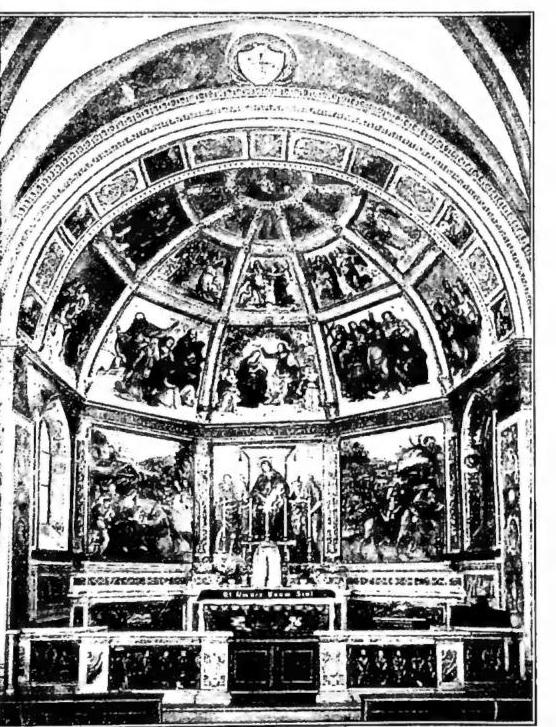
In 1509, after having worked as a painter—according to some scholars also in the apse of the church of S. Onofrio, but certainly in a Nativity in the church of S. Rocco—he began in Rome the construction of the Palazzo of Agostino Chigi, later called the Farnesina, and left there, in the loggia, in a ground-floor room, and in the great hall
on the first floor, notable examples of his painting as well. In 1516 he adorned the Ponzetti Chapel in S. Maria della Pace with paintings; then, in 1520, he was appointed architect of the Fabbrica di S. Pietro, an appointment confirmed in 1530 after, following the sack of Rome in 1527, during which he had been captured and held for ransom, he had taken refuge in Siena, where he was received with great honor by that Republic. And to Rome, after five years spent in Siena, where he worked chiefly as a military architect and painter (a panel in the church of Fontegiusta, with Augustus and the Sibyl, and frescoes in the Castle of Belcaro), he returned in order to direct the works of the Fabbrica di S. Pietro and to build, between the end of 1532 and 1536, what is his masterpiece: the Palazzo Massimo alle Colonne.
A painter initially attached to Pinturicchio-like and Peruginesque modes, but soon in Rome inclined toward Raphael-like forms and consequently toward Lombardizing accents, which he was able to come to know through Sodoma, who arrived in Rome precisely in 1515, P. owes his greater fame to his activity as an architect. Initially following in the footsteps of Francesco di Giorgio Martini, during his stay in Rome he was drawn into Raphael’s cultural orbit and, like the Urbinate, knew how to understand and reinterpret the forms of ancient art in his own accents, with freedom and spontaneous grace. This is apparent in the Palazzo della Farnesina, which Vasari says was “executed with that grace one sees, not built but truly born,” in the completion of the Raphael-like dome of S. Eligio degli orefici, and in other minor works attributed to him. But in the Palazzo dei Massimo, the still timid grace of those buildings gives way to a new and vigorous sense of Renaissance forms. Here, within a confined space—in the curved façade, the deep ground-floor portico, the entrance hall, and the courtyards—the refined linearism of P.’s early constructions yields before a new chiaroscuro taste. This is achieved through the sharp contrast of shadows and lights, the free play of perspective and scenographic effects, and the ostentatious heaviness of certain elements drawn from antiquity, set beside others still nourished by subtle fifteenth-century elegance.