
RAPHAEL SANZIO (original form SANTI, family originally from Colbordoli). — Painter and architect, b. at Urbino on 6 Apr. 1483 (probable date), son of Giovanni Santi, a modest painter and versifier (d. 1494), and of Magia Ciarla. D. at Rome on 6 Apr. 1520 at the age of 37, he was buried in the Pantheon, where his tomb, adorned with a Latin distich attributed to Tebaldeo, may still be seen.
Having learned the rudiments of art from his father (pupil and friend of Melozzo da Forlì), R. was soon placed in the workshop of Pietro Vannucci (called Perugino) in Perugia, soon becoming the best collaborator of that then much sought-after artist (frescoes of the Cambio, Perugia, 1499). About 1500, R., now a “magister,” began to work independently. Principal and certain works of these early years are: the small panels of the Dream of the Knight (London, National Gallery, where the cartoon is also preserved, c. 1500), those of the Three Graces (Chantilly, Musée Condé, same date), of St. George (Paris, Louvre; drawings in Florence, Uffizi, c. 1500–1502), and of St. Michael (ibid., same date), as well as the Madonna of the Book (Leningrad, Hermitage, same date) and another St. George (Washington, National Gallery). In these paintings, of a still timid grace, the Umbrian formal language seems to vanish like a chrysalis under the inner pressure of the figures it clothes, unable to express all the ideal realism to which the Raphaelesque vision tends and in which the Renaissance saw the most difficult secret of the restored ancient art.
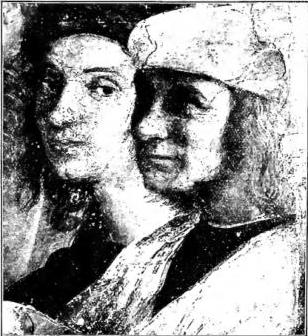
(Int. Gall., Vatican Museums)
RAFFAELLO SANZIO - Self-portrait, with Sodoma to the right. Detail from The School of Athens - Vatican, Raphael Rooms.
(Vatican, Picture Gallery, 1503) with its predella of even more evolved and individual style; the Crucifixion (London, National Gallery, signed, same date), for S. Domenico in Città di Castello, and the masterpiece of his youth: The Betrothal (Milan, Brera, signed and dated 1504), a free interpretation of a scheme by Vannucci (The Betrothal in the Caen Museum), “corrected” by R. in the vivacity of the figures, in the balanced grace of the composition and in the harmony of the architectural background, so as to make abundantly clear how the genius of the pupil took its departure from the limit barely reached by the talent of the master.
Of essential importance for the spiritual formation of R. and for that intuitive understanding of the humanistic world which he would reveal in the frescoes of the Segnatura, was his stay in Urbino, where he had returned in 1504 and where he frequented the court of Guidobaldo di Montefeltro, a literary cenacle in which some of the finest minds of the time gathered, such as Bembo, Bibbiena, Sadoleto and above all Baldassare Castiglione, who celebrated those meetings in his Book of the Courtier and became one of the most faithful friends and advisers of Sanzio.
At the end of 1504, the young artist was in Florence, where he had a revelation of the new Cinquecento style before the famous cartoon drawings of the Battles drawn in competition by Leonardo and Michelangelo in Palazzo Vecchio. His fundamentally and genially eclectic nature absorbed and amalgamated the teaching of the magical “sfumato” of Leonardo and the sculptural painting of Michelangelo and sought to make its own the serene rhythm of the altarpieces of Fra Bartolomeo. The first work of R.’s “second manner,” born of this new experience, is the Deposition (Rome, Borghese Gallery, signed and dated 1507; the predella with the Theological Virtues is in the Vatican Picture Gallery), commissioned from him by Atalanta Baglioni for the church of the Franciscans in Perugia. This panel was completed on R.’s return to that city, but had been begun much earlier and shows in the kneeling woman supporting the Virgin a clear reminiscence of Michelangelo’s Madonna in the Doni Tondo. It is interesting to note how the cold composure of the scene betrays R.’s slight inclination to treat tragic subjects. From the Florentine period date some of the most universally celebrated works of R., such as the portraits of Angelo and Maddalena Doni (both in Florence, Pitti, c. 1505), where in the latter the evident influence of Leonardo’s Mona Lisa appears, the so-called Pregnant Woman (ibid., same date) and some of his most gentle Madonnas: the hieratic one of the Grand Duke (ibid., same date), that of the Goldfinch (Florence, Uffizi, same date), idyllic, and finally the one known as the Beautiful Gardener (Paris, Louvre, signed and dated 1507), “a free application of the teaching of Leonardo and the example of Michelangelo” (Fischel).
The most important date in R.’s life, that of his coming to Rome, is now certain thanks to a document discovered by C. Cecchelli and published by V. Golzio (R., Vatican City 1936, p. 270). It is a receipt for payment for the frescoes of the Segnatura, dated 13 Jan. 1509. R. was therefore in Rome from the last months of the previous year. Introduced by his fellow townsman Bramante, architect of the Apostolic Palaces, to the court of Julius II, he was judged according to his worth by this great connoisseur of geniuses. Although he was barely twenty-five years old and, as Giovio says, nec adhuc stabili authoritate, he was appointed writer of the Briefs (4 Oct. 1509) and entrusted with the commission to fresco, ad praescriptum Julii Pontificis (Giovio), the Rooms or halls of the Pope’s new apartment in the very years in which Michelangelo, almost in competition with him, was painting the ceiling of the Sistine Chapel. In the Stanza della Segnatura (1508–11), originally intended to house Julius II’s library, as shown by the subjects of the paintings, R. represented in historical form (in the wall frescoes), allegorical form (in the small panels of the ceiling) and symbolic form (in the medallions) the three supreme Ideas of the True (theological or revealed in the Disputation, philosophical or rational in the School of Athens), of the Good (in its subjective principle, the Cardinal and Theological Virtues, and in its objective manifestation: canon law in the fresco of the Decretals, beside the Disputation, and civil law in that of the Parables, beside the School of Athens) and finally of the Beautiful (in the Parnassus), according to the concepts of Christian Platonism then in vogue, especially through the work of Marsilio Ficino.
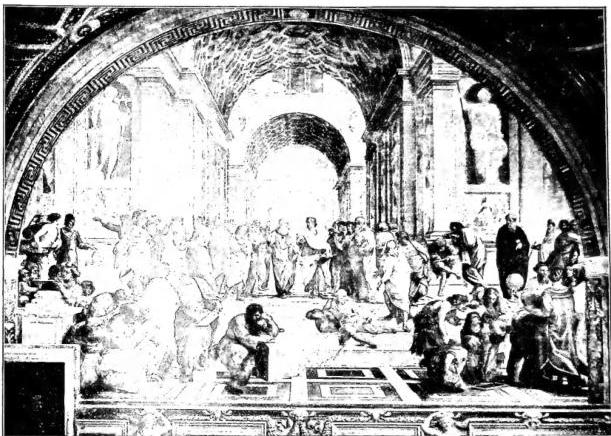
The School of Athens (on the opposite wall) shows an ideal gathering of the most famous philosophers and scientists of ancient Greece, gathered around Plato and Aristotle, the two greatest representatives of classical thought (and Plato is on the right), under the arches of a vast basilica designed by Bramante, almost prefiguring the interior of the new Vatican Temple then under construction. In the brief interval of time between this and the preceding fresco, R. succeeded in achieving, even in the difficult technique of mural painting, complete mastery.
RAPHAEL SANZIO — The School of Athens — Vatican, Raphael Rooms.
He had freed himself from the “Tuscan manner,” eliminating every trace of uncertainty from his style. Here too there are many portraits: Plato is Leonardo da Vinci, Euclid is Bramante, in the right-hand corner Raphael himself can be seen beside Sodoma; Francesco Maria d’Urbino is the youth in white, and Federico Gonzaga the curly-haired boy. Particularly noteworthy is the portrait of Michelangelo, seated alone in the foreground under the guise of the pessimistic Heraclitus, a powerful figure in Michelangelesque manner derived from the Isaiah of the Sistine vault, which had been partially uncovered in August 1511 and added to the already finished fresco. To place artists among the seekers of Truth is an idea not Platonic but typical of the Renaissance, and certainly due to Raphael’s initiative. On the neckline of Bramante-Euclid’s tunic the signature of Sanzio appears in golden letters: R.V.S.M., i.e., Raphael Urbinas Sua Manu.
The Parnassus shows Apollo at the center, playing the lyre, with his arm resting on the sacred hill of the Muses, who stand beside him together with the three Graces and the most famous poets of antiquity and the Renaissance: Sappho, Petrarch, Ennius, Dante, Homer, Virgil, Castiglione, Boccaccio, Tebaldeo and others. Here Raphael’s genius brings to life in art a theme which neo-Latin versifiers of humanism rarely succeeded in rendering in poetry. He does so with a confidence and nonchalance “of the cinquecento” that suggests a date later than the School of Athens but earlier than the lunette of the Cardinal Virtues, where Michelangelesque influence, manifest in the interpolated figure of Heraclitus, is much more pronounced.
The cardinal virtues of Strength, Prudence and Temperance (Justice, according to the thought of Plato later taken up by St Augustine, is depicted above in the medallion as the sum and guide of the other three), together with the theological virtues of Faith, Hope and Charity (the little angels, according to Wind), symbolize the moral content, or subjective principle of the Law, represented in the two scenes on either side of the window: St Gregory IX Receives the Decretals from St Raymond of Peñafort (the Pope is a portrait of Julius II) and Tribonian Delivers the Pandects to Justinian, two rather mediocre frescoes, the first largely executed by Raphael’s assistants, the second painted by Guglielmo di Marcillat (Donati).
Each Idea is depicted twice on the vault, in increasing degrees of abstraction: first in an episode of transparent allegory (in the small squares at the corners) and then in its symbolic personification (in the roundels), almost to recall the Platonic itinerary of the spirit from the phenomenal world to the empyrean of pure ideas. Corresponding to the Disputation are the small square with the Fall of Man and the medallion of Theology (inspired by Dante’s Beatrice); to the School of Athens correspond the Primum Mobile (a gigantic female figure moving the sphere of the Ptolemaic universe) and Philosophy; to the Cardinal Virtues the little scene of the Judgment of Solomon and Justice, still almost Peruginesque; and to the Parnassus the story of Apollo and Marsyas (perhaps by the hand of Peruzzi) and Poetry. The progress Raphael made in painting this room is prodigious: if in the Disputation traces of Umbrian quattrocentismo can still be seen, in the other frescoes his style has already attained that perfect maturity, that balance between truth and poetry, that “classicism,” in short, which makes it the mirror of the Renaissance aesthetic ideal. In the concept here illustrated—the reconciliation of ancient philosophy and theology, of the ancient world and the Christian world—this cycle admirably expresses one of the essential aspects of humanism and makes the Stanza della Segnatura a sanctuary of Western culture.
(Int. Alinari)
The fresco of the Expulsion of Heliodorus, who came to steal the treasure of the Temple and was driven from the sanctuary by three scourging angels, is a composition made entirely of turmoil, where the real protagonist, the spirit of God, is invisible: it seems to descend from the gilded domes above the altar, whence it then bursts forth, clearing a path for itself and hurling the angels of vengeance upon the fallen profaner. Here R. tackles for the first time the pictorial problem of violent motion, rendered all the more vivid by the richness of the colours. The painting alludes to the policy of restoring the temporal rights of the Church so tenaciously pursued by Pope della Rovere (“Drive out the barbarians”), who appears in the left corner carried on the sedia gestatoria, in a superb triumphal portrait.
In the Mass of Bolsena R. brilliantly solves an extremely difficult spatial problem, illustrating a miracle that occurred in 1263, when the consecrated Host exuded drops of blood during Mass celebrated by a priest tormented by doubts. To paint his story he had at his disposal the space of a lunette, reduced and made asymmetrical by the void of a large cross-vaulted window shifted to the left. R. overcomes the difficulty by tilting all the figures on that side to the right and extending the architrave of the window to make it a step of the altar, placed at the centre of the lunette, while on the other side all the figures form stable masses. In doing so, he not only corrects the defect of the space, but turns it into an asset, inasmuch as the restless figures of the faithful behind the celebrant suggest doubt, while the Pope (a portrait of Julius II) and his court, on the other side of the altar, signify in their immobility the certainty of Faith. The famous group of the Swiss Guards (below, to the right) is preserved in a marvellous and extraordinarily “Venetian” colouring, giving an idea of how the frescoes of the Rooms must have appeared to contemporaries. In this little band R. imitates, as never before in his work, the style of the Venetians in order to appropriate their secret of chromatic magic, just as in the Heraclitus he had imitated Michelangelo to conquer the plastic power of his design. Julius II was most devoted to the renowned relic of the Corporal of the miracle (preserved in the cathedral of Orvieto), which partly explains the choice of the theme, unusual in sacred iconography.
The Liberation of St Peter from prison, depicted exactly according to the text of the Acts of the Apostles, anticipates Rembrandt and marks the entry of light as the principal protagonist in a painting in European art, bringing to bear (as Vasari had already noted) the backlight from the window below to intensify the dazzling effect of the scene. The luminous effect of the central episode is heightened by the stark contrast of the black bars of the grating behind which the scene unfolds, with the radiance of the angel. The choice of subject clearly alludes to the title of St Peter in Chains, borne by Julius II when he was a cardinal.
The Encounter of Attila with St Leo the Great, a composition well balanced in the movement of the masses but cold when compared with the others, marks the beginning of the overwhelming collaboration of the pupils in the master’s work, and here one can particularly sense the heavy hand of Giulio Romano. During the execution of this fresco Pope della Rovere died, so his successor, Leo X de’ Medici, was substituted for him; thus making him appear twice in the same painting, where he had already been portrayed as a cardinal in the Pope’s retinue. The allusion to the battle of Ravenna could also apply to the Medici Pope, who had been present at it in 1512. The vault shows, in four segments of false roundels, the frescoed episodes of the Burning Bush, the Sacrifice of Isaac, the Ladder of Jacob and the Lord’s Appearance to Noah before the Ark, frescoes designed by R. but executed by Guglielmo di Marcillat, all in symbolic relation to the corresponding compositions on the walls.
In the Room of the Fire (c. 1514–17), the last to be decorated, there is very little of his own hand, beyond the designs and perhaps, at least in part, some cartoons. The execution in fresco is due to the pupils, especially Penni and Giulio Romano. The programme proposed to Sanzio aims to exalt the Church by recalling memorable events of two great Roman popes, Leo III and IV, in homage to the reigning Leo X: the Fire in the Borgo, which gives its name to the Room and perhaps