
LAZZARO, the BEGGAR. – He is mentioned by Jesus in the parable of Lc. 16:19–31. Tertullian, St. Ambrose, St. Jerome, St. Irenaeus, St. Bonaventure, C. a Lapide, and others consider L. and the account historical. St. Cyril of Alexandria believes that L.’s person is historical, but not the account; so too Theophylact, Euthymius, Maldonado, and L. Fonck. The majority of modern scholars, together with L.-C. Fillion, J. Knabenbauer, M. Sales, M.-J. Lagrange, D. Buzy, and J.-M. Vosté, consider both the name and the account fictional.
Not everyone agrees on the doctrine taught in the parable. Buzy, followed by Marchal (in La Ste Bible,
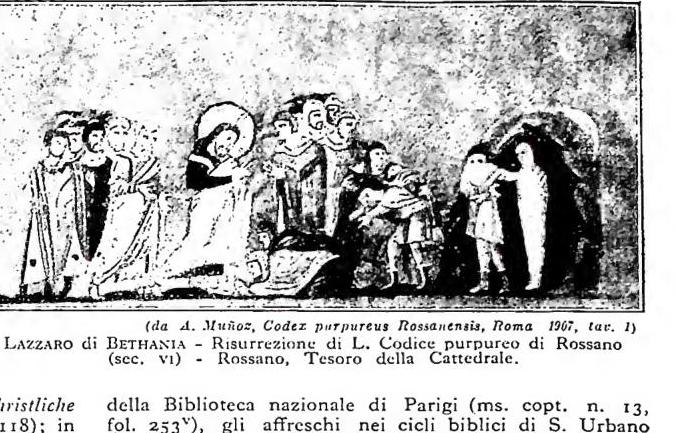
The parable was also depicted in a Greek manuscript in the National Library of Paris and in the Hortus Deliciarum; in the 12th century it appears at Moissac, Avila, Aosta, etc. In England, at Northampton Castle, a fresco dated 1252 shows L. being driven away by the rich man. At Winchfield, in Hampshire, at the end of the 15th century, the story of L. and the rich man was painted. The latter, seated at table with three ladies, has L. driven away as he begs for alms at the door, while a dog licks his sores. Beside this was represented L. dead, whose soul, depicted as a child, an angel gathers up; it is received into heaven by a majestic haloed figure, while below flames surround the rich man.