
AMBROGIO, saint. — Bishop of Milan and Doctor of the Church.
SUMMARY:
I. Chronology
II. Life and works: historical and theological significance
III. The writer
IV. The theologian and moralist
V. The hymnographer
VI. The epigraphist
VII. Iconography.Ambrogio is one of the most important and imposing figures among the bishops of the late fourth century. Small in stature and frail in body, he was animated by a clear-sighted and practical spirit, by an irresistible strength of will and powers of persuasion, and by a heart of noble and profound sentiments. It was a singular providence that this great spirit, without seeking it, should find the place and time best suited to display the full richness of his gifts: namely, the period of the legislative Christianization of the Roman Empire, and the episcopal see of Milan, residence of three emperors—Graziano, Valentiniano II, and Teodosio.
I. CHRONOLOGY
The date of his death is established by the ancient biographer Paolino (Vita, 32 and 48), and it was the vigil of Easter in the third year after the death of Teodosio, hence 4 April 397. His episcopal consecration, according to the explicit testimony of his contemporary s. Girolamo (Cronaca, ed. Helm, pp. 247, 16–18), took place in the tenth year of Valentiniano I, reckoning from the first consulship of the new emperor (1 January 365), hence in 374, not 373, as has been stated most recently. Together with the year, the traditional day is also confirmed, 7 December, accepted by the martyrologies and menologies (Martyr. Romanum, p. 570), which in 374 was a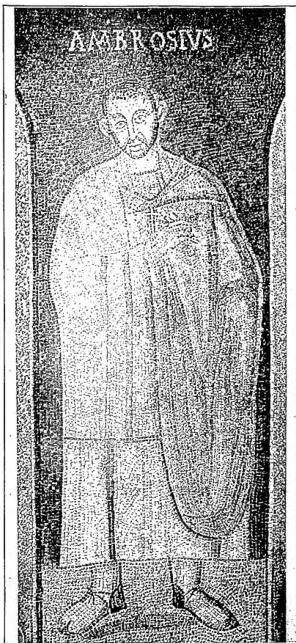
II. LIFE AND WORKS. HISTORICAL AND THEOLOGICAL SIGNIFICANCE.
- 1. Family. Youth, state career (334–74). - A. was probably born at Trier, where his father seems to have been a high official in the administration of Gaul (Vita, 3). The senatorial and Christian family of the «gens Aurelia» (De Rossi, Inscriptiones christianae Urbis Romae, II, pt. 1, Rome 1888, p. 177; id., in Bullettino di archeologia cristiana, 1st series,
2 [1864], p. 76 and 3 [1865], p. 15; id., Roma sotterranea, III, Rome 1877, p. 24; H. Delehaye, in Analecta Bollandiana, 1st series, 48 [1930], p. 193) was of Greek origin, as may be conjectured from the names Ambrosius, Uranius Satyrus (his brother), and Sotheris (a relative, a martyr of the Diocletian persecution). It had, however, long been resident in Rome, where it ranked among the wealthiest and noblest families, probably related by marriage to the Symmachi (De excessu fratris, I, 32–34 ff.; Symmachus, Epistolae, I, 63; III, 30–37; Basil, Epist., 197, 1). It seems that his father died a few years after A.’s birth. His mother therefore returned to Rome with her three children, Marcellina, Satyrus, and A., who was the youngest (De excessu fratris, I: PL 54; Vita, 4), and who received the education of a Roman nobleman in grammar, Roman and Greek literature, rhetoric, and law. Nor were the circus and theater lacking (Expl. Ps., 40, 24). But behind that profane exterior of the paternal home (perhaps S. Ambrogio della Massima, near the Theater of Marcellus) lay the profound religious education of the catechumen. Although, according to the custom of the time, he had not yet been baptized, he seems already, as a layman, to have written a commentary on the four books of Kings and a free translation of Flavius Josephus’s De bello iudaico, the so-called Hegesippus (ed. by V. Ussani, in CSEL, 66, Vienna 1932). The only date that can be established with some probability for A.’s Roman life is Epiphany of 353 or 354, when his sister Marcellina received the veil of the sacred virgins in St. Peter’s from the hands of Pope Liberius (cf. De virginibus, III, 1; Vita, 4), with whom A. always felt himself united by bonds of profound veneration.
When his studies were completed, he left Rome—at an unknown date—for Sirmium, where he began his state career as an advocate at the court of the praetorian prefecture. Sextus Petronius Probus, praetorian prefect (12 March 368–3 December 374), appointed him a member of his council, and after a few years, perhaps in 370, consularis, that is, governor of the provinces of Liguria and Emilia, with his seat at Milan (Vita, 5). Legal practice thus brought him into contact with the most diverse classes of the people, amid the varied affairs of public life. A.’s residence in Illyricum and that of the Arian bishop Auxentius in Milan (355–74) enabled him to become thoroughly acquainted with the disruptive effect of Arianism in the Roman Empire. The designs of Providence then began to emerge for the «consularis», whose popularity, combined with extraordinary integrity, prepared the way for the future bishop.
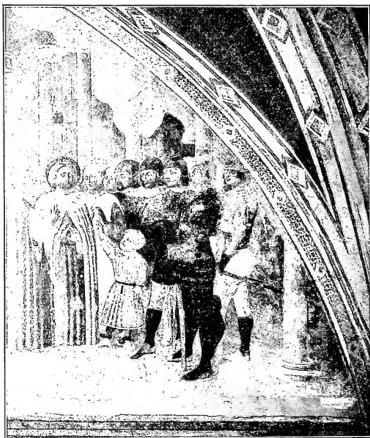
2. The bishop’s early years. The ascetic (374–78). - At the death of Auxentius, A. was forty years old. In the election of his successor, the conflict between Arians and Catholics threatened to compromise public safety. The governor had to intervene to calm the rioting people, and he did so with such effectiveness that the opposing parties united in electing the peacemaker himself, a representative of the imperial policy of religious neutrality, a man beloved by all. That a child took the initiative by crying out: A., bishop! is already regarded as a legend by Paulinus (Vita, 6; cf. Rufinus, Hist. eccl., II, 11; Socrates, IV, 30; Sozomen, VI, 34; Theodoret, IV, 6). The various attempts to escape the unexpected office are entirely credible in the case of a catechumen and high Roman official (Vita, 7–9; Ep., 21, 7; Ep., 63, 65); the emperor’s consent was also required. He not only gave it, however, but also guaranteed the peace of the city (Vita, 9; Ep., 21, 7). A. then accepted, recognizing in the marvelous universal agreement the will of God. He prepared for Baptism, received it, as had been agreed (Vita, 9), from a Catholic bishop (30 November 374), and, having received the other Orders during the following week, was consecrated bishop on 7 December 374. The consent of all the bishops, notwithstanding canon 2 of the Council of Nicaea against neophytes, was fully justified by the extraordinary circumstances (Ep., 63, 65).
Although the new bishop immediately manifested his distinctly Catholic character by bringing from Cappadocia certain relics of his last Catholic predecessor, St. Dionysius (Basil, Ep., 197), for the moment he prudently avoided dogmatic controversies, studying the most intricate questions thoroughly under the direction of the presbyter Simplicianus, and devoting himself above all to the internal reform of the clergy (cf. De Off., I, 1–22) and to the promotion of the ascetic life. His preaching on the ideal of virginity provoked a religious movement throughout Italy and as far as Mauritania (De virginibus, I, 57, 59), and the books De virginibus and De viduis, with which he inaugurated his activity as an ecclesiastical writer (377), increased its impact. He himself, by renouncing his possessions in favor of the Church of Milan and through the ascetic life of his family, gave
a splendid example (Vita, 38). Fasting, constant prayer, reading, and meditation characterized his private life, while his room was accessible to all in need of spiritual or bodily assistance, and his sermons, with their inner fire and perfection of form, attracted everyone (Augustine, Confess., V, 13; VI, 4). The thought underlying his asceticism is Greek, deriving from Athanasius, Origen, Philo, and later also Basil; but his life, dress, and moderation are Roman, and everything is permeated by a highly personal interiority, which has so far been studied too little. His works De paradiso, De Cain et Abel, and De Noë also seem to belong to that contemplative period of his early years.
In the summer, Pope Damasus summoned him, in all probability, to the Roman Council held against the accusations of the antipope Ursinus and the Jew Isaac. The synodal letter to the emperor Gratian, Et hoc gloriae (P. Constant, Epist. Rom. Pont., I, Paris 1721, pp. 523–29), betrays in its ideas and language the inspiration of the bishop of Milan. This was perhaps A.’s first contact with Gratian, who at that very time asked him for a brief summary of the Trinitarian faith. In the final months of 378, A. replied with the first two books De fide, with which he inaugurated a new phase of his life: the open refutation of Arianism and relations with the emperors.
3. First phase of the anti-Arian and anti-pagan struggle (379–84): A. and Gratian; the theologian. - As in asceticism, so too in theology A. derived his ideas from the great Eastern theologians already mentioned, and in Trinitarian theology especially from Didymus of Alexandria. But comparison with Hilary readily demonstrates the Roman and personal character of a clarity far more persuasive and definitive than that of his models: an extremely important merit in those times of turbulent dogmatic disputes, although achieved at the cost of almost completely sacrificing the profound speculation of the Greeks. For the emperor, this theology without problems signified the conver-
(phot. Enc. Cutt.)
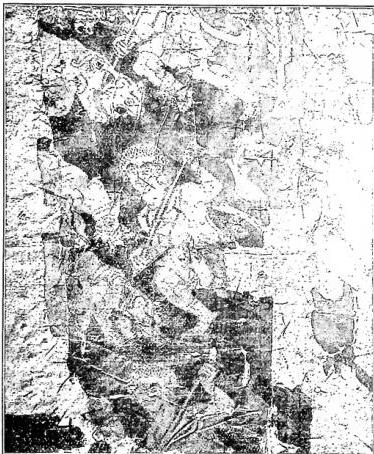
AMBROGIO, santo - So-called dalmatic of St. A. Fabric with hunting scenes (4th–5th centuries), found in his sarcophagus - Milan, Basilica of S. Ambrogio, Textile S. 7 B.
conversion to a new religious policy: he recalled the Catholic bishops banished by Valens (d. 9 August 378), continued to tolerate the moderate Arians, but from that time proscribed the extremist Arians, that is, the Eunomians (Socrates, V, 2; Sozomen, VII, 1; Theodoret, V, 2), and a personal meeting with A. in the summer of 379 led to the law Onnes vetitae, which prohibited public worship by all heresies (Codex Theodosianus, XVI, 5, 5). Theodosius, taken on as colleague by Gratian on 19 January 379, followed his example and established the Catholic faith of the Roman Church as the empire’s sole public religion (Cunctos populos, of 27 February 380). Under A.’s influence there followed a series of laws not only against heresies but also against public pagan worship.
Thus, almost all at once, A. became the foremost champion against Arianism and against ancient paganism. But opposition was not slow to appear: the Arian bishop Palladius
of Ratiaria wrote against the first two books of De fide; Julian Valens of Poetovio, in alliance with the antipope Ursinus, incited the Milanese themselves against him. A. defended himself in a long series of sermons, published in 380 (De fide, III-V) at Gratian’s request. Toward Easter 381 the emperor transferred his residence from Trier to Milan, where increasingly close collaboration with A. now developed. The treatise De Spiritu Sancto, an exhaustive proof of the divinity of the third divine person, seems to have been presented to the emperor precisely at this time.
to the Dissertatio Maximini, and to the Apollinarians, who had by then appeared in northern Italy, but at the same time a new attack on Constantinople I for its primatus honoris in canon 2: this is the meaning of De Incarn., 32 ff.
The same close contact with Damasus is evident in the anti-pagan polemic of 382-83. Gratian, under the inspiration of A., who from this time onward attempted to realize, with logical consistency, the ideal of a Christian empire, abolished the imperial title Pontifex Maximus (Zosimus, IV, 35 ff.), removed the Altar of Victory from the curia of the Roman Senate, abolished the priestly colleges and the exemptions of the Vestals, whose revenues were confiscated. Two delegations came to Milan, one led by Symmachus, prefect of the City,
AMBROGIO, santo - Scene of the child crying out that A. is bishop. Fresco by Masolino - Rome, basilica of S. Clement.
to the emperor to protest and request the withdrawal of the decrees, the other from Pope Damasus to A., in the name of the Christian senators. The former was not even received by Gratian, since A. had already presented him with the ecclesiastical position (Epist., 17, 10; Relatio Symmachi, 20).
The violent death of the emperor, which occurred shortly afterward (25 ff. 383), seemed to destroy everything. The court of the twelve-year-old Valentinian II was under the influence of his mother Justina, an Arian. But the need for the moral authority of the bishop of Milan soon became apparent. The usurper Maximus, under the guise of a protector, had invited Valentinian to come to the court at Trier. Courteously, Justina asked A. to undertake a diplomatic mission to Trier, in order to gain time and lay a trap for the bishop. Instead, he immediately recognized the opportunity to bind the young emperor to himself for the advantage of the Church and accepted. Without questioning the usurper’s sovereignty over Britain, Gaul, and Spain—a sovereignty recognized by Theodosius himself—he succeeded in inducing Maximus to desist from his plan for the time being (Epist., 24, 4-7). In the summer of the following year (384), the mission produced its first fruits. Against the unanimous consent of his consistory, Valentinian decided in favor of A.’s judgment, when Symmachus advanced his new and celebrated petition against the anti-pagan legislation of the deceased Gratian (Epist. 17 and 18 of A.; Relatio Symmachi; cf. De obitu Valentiniani, 19).
4. Definitive victory in the struggle against Arianism (385–87): the baptism of St. Augustine. — Justina’s reaction against A.’s growing influence was not long in coming. A certain Mercurinus, an Arian bishop of Durostorum in Moesia (?), deposed under the Theodosian legislation, came to Milan (probably toward the end of 384), perhaps summoned by Justina herself. The change of his name to “Auxentius” (Sermo contra Auxentium, 22) signified a programme. Justina requested a basilica for him from A. (spring 385). But when the crowd learned that A. had been summoned to court for this matter, it flocked en masse before the palace, so that in the end the bishop himself had to be asked to calm II. He did so, and on this occasion obtained the withdrawal of the request (Sermo c. Aux., 29). But a law of 23 January 386 (Codex Theodosianus, XVI, 1, 4) threatened the death penalty for anyone who dared to obstruct freedom of worship for the supporters of the semi-Arian creed of Rimini, and shortly afterwards the request of the preceding year was repeated. A. decided to oppose it without making any concession. Forming a synod with the neighbouring bishops, he shut himself in with them and with the faithful in the requested Basilica Porziana and the adjoining buildings, and sent a clear refusal to the court. The bishop was invited to reach a compromise; A. refused it (Epist., 21). A long siege of the Basilica followed. To maintain the people’s enthusiasm, A. had them sing his hymns and psalms in two choirs (cf. St. Augustine, Confess., IX, 6–7; Vita, 13; Sermo c. Aux., 34), and addressed to them his tireless message: the Sermo contra Auxentium, and probably also the De Iacob, belong to those days. During Holy Week, the court’s demands and pressures were doubled. But passive resistance carried the day: on Good Friday (3 April) the troops withdrew, and the demands were withdrawn with them (Epist., 20). The unexpected change had yet another reason: Maximus had begun to present himself as the liberator of the Catholic Church against the court of Milan (cf. Collect. Avellan., in CSEL, 35, nos. 39–40), and had complained of being deceived by Valentinian, announcing that he was coming to Italy with his troops. What would A. think of it? To keep him away from Milan for a considerable time, and also in the hope of thereby taking the wind out of Maximus’ sails, Justina offered him a second diplomatic mission. A. saw through the manoeuvre, but the religious cause had to be freed from the usurper’s political friendship: only in this way can it be explained why he accepted on this occasion as well. Indeed, he took advantage of his meeting with Maximus (summer 386) at Trier to reproach him for all his sins and to break off all relations with him openly. Expelled from Trier, he immediately sent his report to Valentinian, foreseeing the imminent war (Epist., 24). Did the embassy therefore fail? Perhaps so, in Justina’s sense, though not in the bishop’s, for he detached his cause from both political parties. He now openly threatened divine vengeance against the killers of Gratian (Exp. Ps., 61) and the usurpers (Apologia Davidis, I, 6, 26 ff.); he proposed to Valentinian the example of the penitent David (IV, 1–20), and dedicated that Apologia to Theodosius (summer 387).
5. A. and Theodosius. The Christian emperor (388–95). — In the spring of 388 Theodosius decided to move against Maximus, defeated him near Siscia and Poetovio (28 August), and established himself at Milan. The bishop requested and obtained from him a broad amnesty for the usurper’s followers (Epist., 40, 25). But Theodosius avoided overly close relations, perhaps already conscious, since 381, of the conflicts between ecclesiastical and political views. In other words, setting aside his private and convinced adherence to the Catholic Church, he considered himself entirely independent of it in his government; whereas A., while likewise recognizing the emperor’s independence in the non-religious sphere, also regarded him as a member of the Church, which expected from him a guarantee of the bishops’ full freedom within their sphere: positive, though never violent, assistance against the enemies of truth, and observance of the moral law and ecclesiastical discipline even in his activity as emperor (Sermo c. Aux., 36; Epist., 10–14, 17, 18, 21, etc.).
Theodosius had issued a decree obliging the bishop of Callinicum on the Euphrates to rebuild a synagogue destroyed by Christians. A. first opposed it in a letter (Epist., 40), and then publicly in a sermon, since he had not been admitted to the audience he had requested; he did not begin Mass until after the emperor had formally declared that he would withdraw the rescript (Epist., 41: to Marcellina). Theodosius clearly felt that A. had exceeded the limits of the deference owed to the emperor, and from the end of 388 until 390 he expressed his principle of complete independence through a series of laws certainly unwelcome to the bishop (Codex Theodos., XII, 1, 121; XVI, 2, 27; 3, 1), while the latter, perhaps conscious of having drawn the bow too far, withdrew and took advantage of his free time to present the Church with a series of his most important books: De officiis ministrorum (389–390), exhortations to the clergy, arranged according to the design of Cicero’s work of the same name; Expositio Evangelii secundum Lucam (ca. 390), Sunday sermons from many years; Expositio Psalmi CXVIII, sermons from 389; De Paenitentia, two books against the Novatians (ca. 388–89); De Ioseph, sermons from 388; De Helia, De Tobia, De Nabuthe, three sermons against the misuse of wealth (389?).
The end of 390 brought a complete change. In August, against A.’s opposition, Theodosius had ordered a three-hour massacre among the population of Thessalonica, in retaliation for the killing of the imperial commander during a riot. Seven thousand people were indiscriminately slaughtered. In his admirable Epist. 51, A. made the emperor understand, with the utmost delicacy, that he would not dare celebrate the divine sacrifice in his presence unless he first performed public penance for the grave sin. Only after some hesitation did the emperor acknowledge A.’s reasons, accept the penance, and receive reconciliation from A. at Christmas 390. This is the history. Paulinus’ rhetorical account (Vita, 24) gave rise to Theodoret’s legend (V, 17 ff.) of the bishop stopping the emperor beneath the cathedral portal—a legend “less great than the history,” which marked the most memorable victory of moral and religious thought over every human greatness. From that moment the friendship between Theodosius and A. was sealed. The year 391 produced laws against every gathering for pagan worship and against heresies (Codex Theodos., XVI, 10, 10; 11; 5, 20). A. calmly devoted himself to the publication of contemplative works: in the De patriarchis, he sees the patriarchs’ blessings fulfilled in the Church that opens to all nations and to all wanderers the safe harbour of salvation; in the De Isaac et anima, he traces the soul’s path toward union with the divine Word; in the De bono mortis, he describes its longing for the heavenly homeland; in the De mysteriis (prepared on the basis of the stenographic record De Sacramentis preserved for us), he publishes the catecheses delivered to the neophytes.
But in the following year he was once again involved in highly delicate affairs: the Antiochene schism and the consequences of the death of Valentinian II. A council at Capua (winter 391–392), probably convened at the suggestion of A., attempted in vain to settle the dispute between Evagrius and Flavian of Antioch (Epist. 56). Valentinian summoned A. to Vienne in Gaul to be baptized, but even more to be freed by him from the guardianship of the general Arbogast, imposed upon him by Theodosius after the victory over Maximus. Arbogast forestalled A.’s arrival by having the emperor killed (15 May 392). The bishop was left with the delicate task of delivering the funeral oration, given in August after negotiations with Theodosius (Epist. 53) and published in September under the title De obitu Valentiniani. Meanwhile Arbogast proclaimed the Catholic Eugenius emperor (22 August 392), and Eugenius vainly sought the support of the bishop of Milan (Epist. 57; Vita, 27, 31). For almost a year (autumn 393–August 394), A. imposed a voluntary exile upon himself in Bologna and Florence (Epist. 61, 62), in order to avoid any contact with the new usurper. After Eugenius was defeated at the Frigidus (6 September 394), Theodosius approved A.’s attitude toward Eugenius and granted the amnesty he had requested for the usurper’s supporters; but shortly afterward he fell ill and died at Milan on 17 January 395. In the funeral oration De obitu Theodosii, A. delineated in the person of the deceased the ideal of unity between priesthood and empire, anticipating a fundamental idea of the Middle Ages.
6. The Last Years (395–97). The Metropolitan. - Surrounded by the veneration of all, even of distant pagans (Vita, 25, 36), A. continued his apostolate of the pen until his death: De institutione virginis (392), Exhortatio virginitatis, and De fuga saeculi (394), as well as Explanatio in XII psalmos, over which he was to die (Vita, 42), are his final works. Perhaps he himself also published a large number of his letters during those years (cf. Epist. 48, 7). Another broad field of activity, besides the care of his diocesan flock, was his relationship with the many bishops of northern Italy, where he exercised the functions of metropolitan, founding
new dioceses and ordaining bishops (cf., for example, Epist. 63). His zeal for that una et intemerata fidelium communio (Epist. 12, 3) also extended beyond his metropolitan province, especially to Thessalonica and Illyricum (Epist. 15, 16), and even to the schisms of the East (Epist. 12–14, 56). His participation, however, in a certain Synod of Sirmium, mentioned by Theodoret (Hist. eccl., IV, 7, 6–9, 9), whose date remains uncertain, must already be excluded on the basis of the Trinitarian terminology of the synodal acts, which is certainly not Ambrosian. The ordination of Anemius of Sirmium carried out by A. (between 375 and 380) is the only act that could be called quasi-metropolitan outside Upper Italy; but it is neither known to us nor even probable that A. carried it out of his own accord.
After the election of the new bishop of Pavia, A. returned ill (Feb. 397), and after a few weeks the physical strength of that frail body, sacrificed for the internal unity of the Church and the Empire, faded away. A. died at dawn on Holy Saturday, April 4, 397, immediately after receiving Eucharistic communion (Vita, 47). The Church, however, celebrates the day of his episcopal consecration (Dec. 7). For the Ambrosian basilica, V. MILANO.
III. THE WRITER
In his first work, Ambrose himself reveals the purpose of his literary activity: «necessitas maxima eloquia Dei credita populi funerare mentibus» (De virginibus, I, 1, 1), that is, the sense of responsibility for the divine talent entrusted to him. Thus, nearly all his works are published sermons. And Ambrose seems to emphasize this particular character of his writings by leaving in the text of his books certain traces of the living word, such as «hodie, fratres, audistis» and the like. On the other hand, where such traces are absent, one cannot immediately conclude that a given book does not consist of delivered sermons. In two of his letters, likely published by himself (Epist. 47, 1-3; 48, 1-3), he describes the process of editing his works; and the De mysteriis, compared with the De Sacramentis, completes this information. Based on an outline or a shorthand record of his sermons, Ambrose retains what he deems suitable for publication, but extensively modifies the expression, dictating to his notary or, especially at night, writing himself; he then has it transcribed in a fair copy, sometimes sends it to a friend for a kind of censorship, and finally publishes II. Yet, whether dictating or writing, he always has before him his sources, primarily Sacred Scripture, to which, even without citing it, he alludes almost continuously; then the aforementioned Greek theologians, whom he utilizes either by freely translating them or by following only their thought. His extraordinarily fertile memory yields recollections of classical authors, especially Virgil, Sallust, Cicero, and many others. Thus, Ambrose’s pages sometimes appear like multicolored mosaics. Yet they are no less attractive or personal for this, for his concise, lively style, full of maxims, metaphors, antitheses, and allegories that swiftly shift from one to another—always inflamed by the inner fire of his enthusiasm for Christ and His Church—constitutes, according to Erasmus, a genus dicendi aliis inimitabile. And this style is the secret of his literary success, despite the severe critic Jerome (Latin version of Didymus’s treatise De Spiritu Sancto, Praefatio: PL 23, 108; Epist. 84, 7: CSEL, 55, p. 130, 8; De viris inlustribus, 124: PL 23, 751), and despite his bold allegorism (discussed by J. B. Kellner, Der heilige Ambrosius... als Erklärer des Alten Testamentes, Regensburg 1893; P. de Labriolle, Saint Ambroise et l'exégèse allégorique, in Annales de philosophie chrétienne, 155 [1908], pp. 591-602).Here now is the list of his works according to the traditional division:
a) Exegetical (concerning mostly the Old Testament): Hexaemeron libri sex; De Paradiso; De Cain et Abel; De Noë; De Abraham libri duo; De Isaac et anima; De Iacob et vita beata libri duo; De Ioseph patriarcha; De patriarchis; De interpellatione Iob et David; Apologia prophetae David, ad Theodosium Augustum; Enarrationes in XII psalmos Davidicos; Expositio in ps. 118; De Tobia; De Helia et jejunio; De Nabuthe; Expositionis evangelii secundum Lucam libri decem. The Commentarii Esaiae are lost.
b) Moral and ascetic: De officiis ministrorum libri tres; De virginibus, ad Marcellinam sororem libri tres; De viduis; De virginitate; De institutione virginis et de s. Mariae virginitate perpetua; Exhortatio virginitatis.
c) Dogmatic: De fide ad Gratianum Augustum libri quinque; De Spiritu Sancto; De Incarnationis dominicae sacramento; De paenitentia libri duo; De Sacramentis libri sex; Explanatio symboli ad initiaudos; and the fragment of the Explanatio fidei, reported by Theodoret (PG 83, 181-88).
d) Rhetorical: De excessu fratris sui Satyri I. duo; Sermo contra Auxentium, de basilicis tradendis; De obitu Valentiniani consolatio; De obitu Theodosii.
e) Letters (of which only 91 remain).
f) Hymns (discussed separately below).
(photo: Ist. d'arti grafiche)
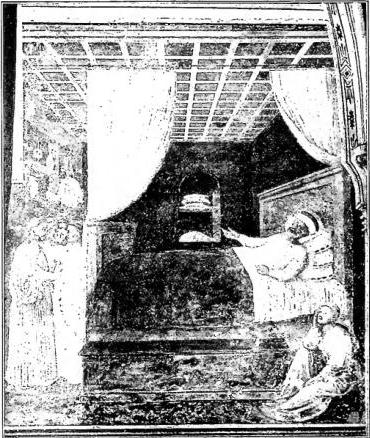
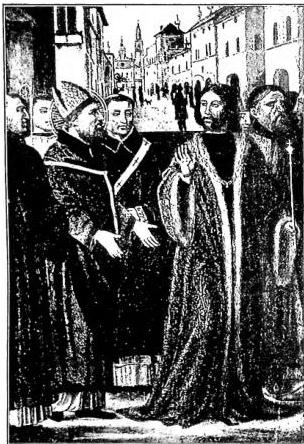
AMBROGIO, saint - Meeting of St. Ambrose with Emperor Theodosius.
Panel by A. Bergognone (15th century).
Bergamo, Accademia Carrara.
IV. THE THEOLOGIAN AND THE MORALIST
A. never wished to be a theologian, for the simple reason that a Latin theology did not yet exist, and to create one A. had neither the time nor the talent. Yet in Trinitarian theology, which had only just elaborated the relation between the Father and the Son, the Ambrosian contribution is considerable: with the clarity and constancy of his terminology he surpasses by far all previous Latin authors, especially Hilary, and prepares the definitive formulas of Augustine. In the theology of the Holy Spirit there is a true advancement in A., who repeatedly alludes to the procession of the Spirit from the Father and the Son ("Filioque": cf. De Spiritu Sancto, I, 119-20; II, 12. 133-34, etc.). Through Ambrosian hymns, Trinitarian formulas were deeply imprinted in the soul of the people. Through Roman religious legislation, which he strongly influenced, the Council of Nicaea became the faith of the Empire. In Christology, A. is the first Western writer to oppose Apollinaris of Laodicea, whose writings he studied, as the critical edition of De Incarnatione in the CSEL will clearly demonstrate. His expressions on the two perfect natures united in the divine person of Christ were so felicitous that they were repeated by the Councils of Ephesus and Chalcedon, by Leo the Great, and by many writers even in the East (cf. G. Galbiati, Della fortuna letteraria ecc., in Ambrosiana, Scritti di storia ecc., pp. 43-73). Expressions such as ex persona hominis, said of Christ, according to a common linguistic usage also found in Hilary, mean nothing other than "as man." In the doctrine of redemption and grace, A. is often cited by the Doctor of Grace, Augustine (cf. Opera, ed. P. A. Ballerini, I, pp. xxix-xlii). He does not yet distinguish between original sin itself and its consequence, concupiscence—a deficiency particularly evident in De mysteriis, 6, 32 ("lotio pedum"). But this distinction was not made by theology before Augustine. His theory, however, on the origin of moral evil in the free will of man already recalls the speculations of his great disciple. As for sacramental theology, still so little developed in his time, testimonies to the sacrificial character of the Eucharist are very frequent (cf. S. Lisiecki, Quid s. Ambrosius de S.ma Eucharistia docuerit, Breslavia 1910, p. 85 ff.).Sacramental penance appears as public in works of penance imposed by the bishop following a secret confession (cf. De paenitentia, I, 16, 90; II, 10, 91-97). This unique sacramental penance is permissible only once in a lifetime (De paen., II, 10, 95). His baptismal theology is most beautiful and profound (cf. De mysteriis, De Sacramentis), in which he insists, among other things, on the value of baptism of desire (De obitu Val., 51-53). Regarding his eschatology (J. Niederhuber, Die Eschatologie des hl. A., Paderborn 1907), it should be noted that he set aside with the finest tact every trace of Origenism; the same seems true of his angelology, which, like his theory on the veneration of saints and relics, would still require particular study (the work of Dudden, Life and Times etc., I, p. 305-20, is insufficient). Finally, his ecclesiology is pervaded, as we have already mentioned, by a most vivid sense of the internal unity of the venerable communio of all Churches, which he sees guaranteed in their union with the Roman Church (Epist. 11, 4; De excessu fratris, I, 47; Epist. 42, 1, 12; Epist. 56, 7; De Sacr., III, 1, 5; Explan. in ps. XII, 40, 30 etc.; cf. B. Citterio in S. A. nel XVI centenario della nascita, Milano 1940, pp. 31-68).
As a moralist, A. is truly in his element and at times displays a mastery similar to that of St. John Chrysostom in castigating the moral diseases of his time, particularly avarice and lust. He insists on the administrative character of private property (De Nab., 12, 53; De off., I, 28, 132). He opposes the weakness of the many with the attractive and comforting example of the voluntary virginity of the few; he links this ideal sacrifice with the thought of its satisfactorial value for others: "Virgo Dei donum est, munus parentis, sacerdotium castitatis," "Haec parentes redimat, haec fratres" (De virg., I, 7, 32; II, 2, 16). And this thought is based on the more general conception of the corpus Christi mysticum (e.g., De Cain, I, 9, 39; De paen., I, 15, 80-81; Exp. Luc., V, 92). A moral system is not found in his works. Even in the De officiis ministrorum (the title to be retained with the best manuscripts), A. does not intend to provide one, but, following Cicero's De officiis freely, he arranges a series of exhortations to his spiritual sons and "ministers" of the altar (De off., I, 7, 24), and admits from Stoic morality whatever is of universal human value, elevating it—not always with full consistency—to the sphere of Christian humility and charity (cf. R. Thamin, S. Ambroise et la morale chrétienne au IVᵉ siècle, Paris 1895; F. H. Dudden, Life etc., II, pp. 502-54).
V. THE HYMN WRITER
The hymns that St. Hilary had already attempted to introduce into the liturgy (cf. CSEL, 65, p. 207 ff.), perhaps in opposition to Arian propaganda, were so unpopular that only a few traces of them remain. Thus, Ambrose became the first and most effective hymn writer of the West. His meter of (eight?) strophes of four lines in iambic dimeters, the "metrum ambrosianum," served as a model for the following centuries (Isidore of Seville, De eccl. off., I, 6). However, this designation of his meter caused great confusion between the hymns actually composed by him and others that merely followed his style.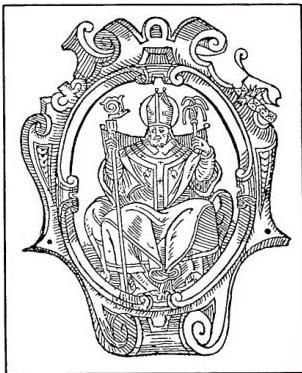
(photo: Enc. Cutt.)
AMBROSE, saint - Woodcut reproduced in the Institutes of Vigevano (1608).
12) Grates tibi Iesu novas (PL 17, 1182, n. 19); 13) Agnes beatae virginis (PL 17, 1210-11, n. 65); 14) Victor, Nabor, Felix, pii (Biraghi, op. cit., pp. 74-80; Steier, op. cit., p. 655). Probably not authentic are: 15) Nunc Sancte nobis Spiritus (PL 17, 1184, n. 21: two strophes); 16) Rector potens, verax Deus (ibid., 1189, n. 22: two strophes); 17) Rerum Deus tenax vigor (ibid., 1185, n. 23: two strophes); 18) Iesu, corona virginum (PL 17, 1221, n. 80: four strophes). Nor does it seem that the two poetic texts treated by G. Mercati (Studi e Testi, 12, Rome 1904, pp. 17-36) belong to Ambrose: De ternarii numeri excellentia, and a strophe of a Paschal hymn, cited by Alcuin and Hincmar (cf. C. Weyman, Beiträge zur Geschichte der christlich-lateinischen Poesie, Munich 1926, pp. 43-46), nor the Advent hymn Eu clara vox redarguit (cf. J. B. van Bebber, in Theologische Quartalschrift, 89 [1907], pp. 373-84). The Te Deum appears to be by Niceta of Remesiana (cf. O. Bardenhewer, Gesch. der altkirchlichen Literatur, III, Freiburg im Breisgau 1923, p. 604).
The poetic form of the authentic hymns, full of objective grandeur and that "sobrie ebrietas" of the Roman saint, "was perfectly suited to be popular: easy, fluid, clear, agile. At times, theory and theology weigh it down, and the hymn loses its tone, but elsewhere the inspiration remains vivid and warm, the sensation universal; simplicity then becomes synonymous with pure perfection" (A. Paredi, S. A. e la sua età, Milan 1941, p. 413). The time of their composition remains problematic. However, it seems certain that some predate the siege of the Basilica in 386 (cf. G. Lazzati, in S. A. nel XVI centenario etc., pp. 307-20).
BIBL.:
In addition to the works cited in the text: F. J. E. Raby, A History of Christian-Latin Poetry, Oxford 1927, pp. 39-56; J. Szövérffy, Die Annalen der lateinischen Hymnendichtung, Berlin 1964, I, pp. 45-60; C. Blume, Analecta Hymnica Medii Aevi, Leipzig 1886-1922, L, pp. 1-14; M. Simonetti, Studi ambrosiani, Milan 1955, pp. 101-120; J. Fontaine, Naissance de la poésie dans l'Occident chrétien, Paris 1981, pp. 123-145.
P. G.
VI. THE EPIGRAPHIST
No ancient remains of Ambrosian inscriptions on stone have been preserved. However, there is no doubt that Ambrose composed them. The Lorsch sylloge (Vatican Palatine Codex 833, 9th century) preserves a collection of Christian inscriptions made at the end of the 8th century, among which are three Milanese epigrams by Ambrose (cf. G. B. de Rossi, Inscriptiones christianae urbis Romae, II, part I, Rome 1888, pp. 162, 5; 161, 3, 2; [p. xxxv ff. «Pauciora, sed meliora Damasianis, sunt carmina Ambrosii...»]): the epitaph for his brother Satyrus in the Basilica of San Nazario (Uranio Satyro supremum, frater, honorem etc., 2 distichs), the dedicatory inscription of the same Basilica of San Nazario (Condidit Ambrosius templum Dominoque sacravit etc., 5 distichs), and the inscription of the baptistery of the Basilica of Santa Tecla (Octachorum sanctos templum surrexit in usus etc., 8 distichs).Lejay’s doubt (DACL, I, col. 1386) regarding the third epigram is unfounded; the words non expers ullus aquarum sanctus (cf. mss. 13-14) express a thought very familiar to Ambrose (De Abrah., II, 11, 81: «omnis aetas peccato obnoxia et ideo omnis aetas sacramento idonea»; De paen., I, 2, 13: «omnes homines sub peccato nascimur, quorum ipse ortus in vitio est»; Exp. in ps. 118, 8, 30: «nemo sine sorde peccati»; cf. 16, 32; Expl. ps. 43, 78, etc.; cf. also F. J. Dölger, Zur Symbolik des altchristl. Taufhauses, in Antike und Christentum, 4 [1934], pp. 153-87).
Furthermore, there are 21 «Tituli», first published by Fr. Juretus in M. de la Bigne’s Bibliotheca Patrum (VIII, Paris 1589, col. 1195 ff.), from an ancient codex, now lost, under the title: Incipiunt disticha s. Ambrosii de diversis rebus quae in basilica Ambrosiana scripta sunt. (The best edition is by S. Merkle, Die ambrosianischen Tituli, in Römische Quartalschrift, 10 [1896], pp. 185-222). These are 21 double hexameters, which were to be inscribed beneath as many representations of scenes from the Old and New Testaments. L. Biraghi, S. Merkle (loc. cit.), and C. Weyman (op. cit., pp. 35-42) defend the authenticity of the «tituli»; L. Traube (in Hermes, 27 [1892], p. 159) has shown that they already existed in the 9th century, though attributed to Prudentius. The «ex silentio» arguments advanced by some art historians against the Ambrosian origin of the images do not seem capable of overcoming the very strong internal arguments in favor of the epigrams: thoughts, language, and style are entirely Ambrosian.