
ANIMALE. –
1. IN NON-CHRISTIAN RELIGIONS
In all natural religions, both primitive and advanced, worship has been rendered to certain animal species or to particular individuals of a species. The origin of this veneration lies in the fact that the animal displays special prerogatives of strength, dexterity, sure instinct, and keenness of the senses of sight, hearing, and smell, as well as unfailing powers of orientation: all features which, in the eyes of primitive people, manifest in it the presence of a particular power or force (mana), making it worthy of veneration or inspiring terror.The animals to which human beings have rendered worship are those with which they have come into contact either through hunting or through domestic breeding. The species therefore vary according to geographical regions or stages of civilization. Thus the bear, venerated and offered in sacrifice since the prehistoric Quaternary period, still receives special demonstrations of respect from the peoples of the Asian polar or subpolar regions; the ox was pre-eminently sacred in ancient Persia and remains so in modern Hindu India; ox, pig, and sheep, the animals dear to the farmer, have always been chosen among the Romans and Greeks as welcome sacrificial victims; the same may be said of the horse among the Indo-Germanic peoples, both in Vedic India, where it is the solemn victim of the animal sacrifice offered by the king, and in ancient northern, Slavic, and Germanic Europe, where it also had divinatory functions.
The divinatory function, revealing special sacred prerogatives, is attributed among the peoples of ancient Italy especially to birds, in the religion of the Umbrians (Tables of Gubbio) and in the Roman priestly college of the augurs. The pre-eminent divinatory birds are the woodpecker and the raven.
It is scarcely necessary to recall the extent to which the worship of animals (crocodile, jackal, hippopotamus, ibis, cat, the Apis bull) developed in ancient Egypt.
The worship of animals is either directed toward a single animal, which is regarded as the protector of a given individual (v. NAGUALISMO); or it refers to an entire species considered the mythical ancestor and protector of a whole group, in which case totemism (v.).
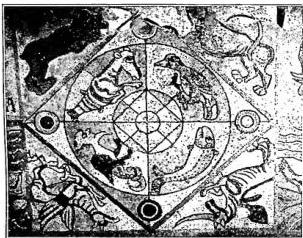
The more primitive human beings are, the more disposed they are to project human qualities and passions into the animal and to regard as not absurd the transition from the human form
(propr. A. P. Frutes)
ANIMALE — Real and fantastical symbolic animals (12th–13th centuries).
Floor mosaic of the presbytery — Aosta, Cathedral.
to the bestial form and vice versa: this explains the enormous mass of myths that have an animal as their protagonist or at least as an associate. In the mystery religions, some of these myths rise to the status of myths of salvation, insofar as, through the sacrificed animal, people believe they bring about the sacred union of the individual with the divinity.
In the higher religions, the animal, by now having disappeared from worship and myth, may remain as an ornamental motif or as a symbol of moral ideas or of sacred persons or things.
Nicola Turchi
II. ANIMALS ACCORDING TO NATURAL AND REVEALED ETHICS.
- 1. Animals cannot be subjects of any right. Right, in fact, is the free will to perform or omit an act, to demand or prohibit another’s act, without anyone being able reasonably to oppose II. None of this is found in animals, which possess neither an understanding of the universal good nor the free will to strive toward it in various ways, but only an instinct determined toward such and such acts and no further. Animals may be compared to machines constructed by divine creation with their own specific movements; yet, unlike material machines, they are capable of knowing the object toward which they tend and of tending toward it by intrinsic virtue. «Brute animals do not have rational life, by means of which they might guide and move themselves; rather, they are always moved as if by another natural impulse; and this is a sign that they are naturally servants and made for the use of others» (Sum. theol., 2a-2ae, q. 64, a. 2, ad 2ii).
Such, indeed, is the disposition of the Creator. From the beginning God himself assigned to Adam, and later to Noah, herbs, fruits, and animals as sustenance for them and their descendants (Gen. 1, 29-30; 9, 2-3). Not only this; he also gave man full and absolute dominion over nature: «O God, who hast created all things by thy word and formed man in thy wisdom so that he might rule over the creatures made by thee...» (Sap. 9, 1-2). «Thou hast placed (man) over the works of thy hands; thou hast put all things beneath his feet: sheep and oxen, and also the beasts of the field, the birds of the air, and the fish of the sea» (Ps. 8, 7-9). Science, for its part, discovers every day a great many services that animals can render or instinctively render to humanity, and, joined with industry, supplies man in his countless needs.
2. But although one cannot speak of the rights of animals with respect to man, one can nevertheless speak of man’s obligations toward them. That is, man must make use of animals, as of every other creature, according to the Creator’s intention in assigning them to human service; this obligation does not bind him to the animal as a duty corresponding to a relative right of the brute, but binds him to Him who is the sovereign Lord of all and disposes of everything with full right. Now, the right use of dominion over animals can be reduced to this simple formula: it is lawful to make use of them according to their natural aptitude for human needs and convenience. Abuse is therefore forbidden: for example, destroying them or making them suffer out of vain caprice, torturing them for mere pleasure. All the more because they are endowed with sensibility and consequently suffer pain; moreover, the act, and still more the habit, of abusing animals inclines the soul, by a psychological law easily leading to practice, to abuse one’s fellow human beings as well.
For this reason we find in the Bible indications of gentleness even toward animals. «Thou shalt not muzzle the ox when it treadeth out the corn» (Deut. 25, 4), so that, having food before its eyes, it might not suffer hunger doubly. «For six days thou shalt labour, and on the seventh day thou shalt not work, that thine ox and thine ass may rest» (Ex. 23, 12). «A just man regardeth the life of his beast: but the tender mercies of the wicked are cruel» (Prov. 12, 10).
3. Consequently, Societies for the protection of animals are to be approved insofar as they aim to remove cruelty toward beasts; but not insofar as they sometimes base their activity on erroneous principles (attributing rights to them; or fostering toward them a mawkish and sentimental love, which is then easily denied to one’s fellow human beings; or claiming a duty of charity, which in the Christian sense cannot exist).
4. Likewise, vivisection (that is, the performance of painful experiments on living animals) is lawful whenever scientific ends are pursued: increasing the store of knowledge, discovering the laws and functions of organs, and deriving methods and norms useful for possible application in the treatment of human beings. It is likewise lawful to inject animals with even deadly microbes in order to observe their course and study remedies. One must, however, avoid inflicting greater pain than necessary. All this is because animals are means given to man for his service.
5. Sometimes, by way of excusing a certain morbid attachment to animals or a veiled exaggeration in protecting them, the example of certain saints is brought forward: for example, s. Francesco di Assisi’s compliments to Brother Lamb and Brother Wolf; s. Francesco di Paola’s compassion for slain animals; and the canaries to which s. Giuseppe Cottolengo gave, besides their usual seed, little biscuits and sugar cubes, etc., so that they might often sing praises to Our Lady, before whose image the cage hung. Even the example of the Lord is cited, who boasts of feeding the raven’s young and the beasts of the forest and «the young lion that, roaring, asks God for food» (Ps. 103, 21).
The answer is that these latter words, by which the Lord demonstrates his affectionate providence extending over all his creatures, reveal only the constancy of the divine act of preserving them after having created them. They also serve to stimulate and maintain in men confidence in him, who, provident as he is even toward beasts, will show himself still more provident, benevolent, and generous toward creatures made in his image (cf. the expressive words of Jesus in Mt. 6, 24-34). The saints, moreover, by these and other examples of gentleness and kindness, demonstrated only that they saw in every creature a work of God, a symbol that recalled and raised them up to him, or reminded them of some particular virtue (the dove, the lamb, the pelican); but they are never found to have crossed into any exaggeration of sentimental love, nor to have neglected the sick, the poor, and the abandoned, reserving their affection and solicitude for animals; still less did they leave them heirs to all or part of their possessions, an extreme both reprehensible and unjust toward one’s fellow human beings and society.
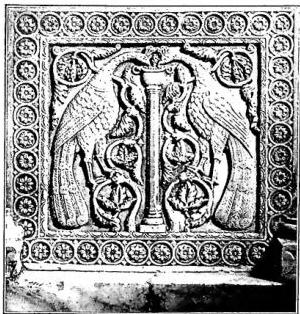
III. A. IN CHRISTIAN SYMBOLISM. — With regard to Christian art, it is first and foremost the authority of Sacred Scripture that determines the symbolic and allegorical value of individual animals. Thus, for example, the lamb could replace, as occurred from the end of the fourth century in the apse mosaics of early Christian basilicas or on sarcophagi of the late Roman period, the image of the Savior, pointed out by St. John the Baptist as “the lamb of God who takes away the sins of the world.” Thus the dove became, once and for all, the symbol of the Holy Spirit, who appears in the New Testament exclusively with this meaning; moreover, thanks to the simplicity ascribed to them by the comparison used by the Savior (Mt. 10:16), doves became, in the age of the catacombs, symbols of Christian souls, as in the baptistery of Al-
(Alinari photograph)
ANIMALE - Peacocks on a pluteus of the iconostasis (11th century). Torcello, Cathedral.
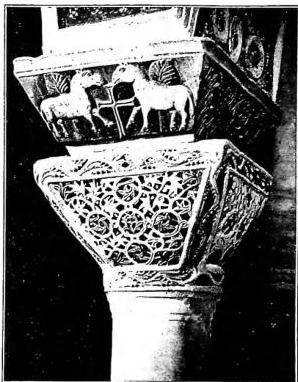
inviolatae virginis Mariae. From all this it follows plainly that fabulous animals, only exceptionally named and described in Sacred Scripture, were particularly suited to enriching Christian iconography, which, in representing them, relies not so much on the Physiologus itself as on medieval vernacular adaptations, the so-called bestiaries, extensively exploited by theological treatises. Thus, for example, the illustrators of the Psalter depict the wicked in the image of the asp stopping up its ear (Ps. 57:5–6), to which is connected the Christological prophecy “ super aspidem et basiliscum ambulabis, conculcabis leonem et draconem ”, already represented in the early Christian period; but to enter monumental sculpture with this representation, it required the explicit allegorical interpretation of Honorius of Autun (statue at Amiens, 13th century). The phoenix, a fabulous bird that rose again from its ashes, enjoyed extraordinary popularity; from the 6th century onward it appears in the mosaics of Roman basilicas as a symbol of Christ’s resurrection. With equal ease, the pelican, which tears open its breast to nourish its brood with its own blood, presented itself as a symbol of Jesus: Giotto was perhaps the first to place it together with the Crucifix. Among the subjects chosen by painters of allegory is, finally, the unicorn, untamable except when fascinated by the presence of a virgin. Already a symbol of chastity in Eastern myth, in the late German Gothic period it occasioned numerous representations: a hunter (that is, the archangel Gabriel) with four dogs (Truth, Justice, Mercy, and Peace) pursues the unicorn, which takes refuge beside the Virgin, seated in the enclosed garden.