
I. GEOGRAPHY.
Egypt (Misr according to the local Arabic denomination) comprises the Nile Valley north of the second cataract (Wadi Halfa), along with the adjacent territories of the Libyan and Arabian deserts.
Egypt covers an area of 994,300 km². However, nearly its entire population (19.1 million inhabitants) is concentrated with high density (up to over 800 inhabitants per km²) on just 1/30 of this surface (35,000 km²), consisting of the narrow valley through which the river flows, its delta, and a few oases.
The utilization of the Nile’s waters, perfected and expanded through modern irrigation systems, has enabled Egypt—a predominantly agricultural country—to turn toward profitable industrial crops: cotton (of high quality), prevalent in the delta region, and sugarcane in the upper river valley, alongside which cereals retain importance, though insufficient for domestic consumption.
Industry is modest in scale, and mining production is also limited overall, yielding small quantities of petroleum, manganese, tungsten, and, above all, phosphates. Among industries, sugar refining, textiles, milling, and food processing are the most developed, partially meeting domestic demand.
The population consists of 98% Egyptians, considered descendants of the ancient Hamitic ancestors, whose characteristics have been preserved both among the Muslim fellahin (peasants) and the Coptic merchants of Upper Egypt, who remained faithful to Monophysite Christianity (approximately 1/10 of the indigenous population). There are also numerous Greeks (50,000), Italians (52,000), English (34,000; mostly Maltese), French, and others. The Jewish population numbers around 65,000. The capital, Cairo (2.1 million inhabitants), is the most populous city on the African continent; the principal port is Alexandria (928,000 inhabitants).
II. HISTORY OF ANCIENT EGYPT.
I. PREHISTORIC EGYPT
While the Bible, in enumerating the descendants of Noah’s sons (Gen. 10:6, 13), merely mentions among those of Cham’s lineage also Misrajhu, the name by which the Hebrews usually designated the land of Egypt, recent discoveries allow us to know with greater precision the most remote events of the country and its people.In accordance with geology, which demonstrates how the Nile carved its way toward the Mediterranean through the lands and rocks of ancient Egypt and shaped the valley into terraces, progressively lower, excavations have revealed the presence of early man along both banks of the river. In the most distant millennia, he inhabited the higher grounds, then gradually descended to lower ones, following the riverbed in its slow downward movement—a vital factor of fertility and life for both land and people. Thus, traces of Lower Paleolithic man have been found on the heights of el-Qurnah, in the Theban district, while Upper Paleolithic men, in the characteristic African facies of the Capsian, left their mark at Sabil above Kóm Ombe, approximately 40 km north of Aswan. The Neolithic, in contrast, is particularly represented at el-'Omarí (south of Cairo), at Beni Salámah (Merimde), and elsewhere in the Delta. This is followed by the Metal Age, which lasted over 2,000 years and was also called the "Predynastic" period. During this time, Egypt already attained a high degree of civilization, evidenced not only by more refined stone and ceramic work, the discovery of leather tanning, glassmaking, and ivory carving, but also by the invention of writing and the calculation of the calendar. el-Badári near Asyut is one of the oldest sites of this prehistoric Egyptian facies; others are found at el-Ballás, Naqadah, Armant, and elsewhere. These advancements demonstrate a highly advanced civil organization, though debate persists as to whether it resulted from African or Asian (i.e., Semitic) influences, or rather from a form of civilization that arose spontaneously in the Delta. In any case, at the dawn of history, two kingdoms already appear as long-established in Egypt: one in Upper Egypt, with its capital at Nben (Gr. Hierakonpolis, Arab. Kóm el-Aḥmar), and the other in Lower Egypt, with its capital at Seb'eve (Arab. Tell el-Farā'in).
II. BEGINNING OF HISTORY AND SUBSEQUENT PERIODS
The history of Egypt begins with the victory of the kings of Lower Egypt and the unification of the country under a single monarch, Mène, who wears the two crowns of Upper and Lower Egypt.From that time onward, the sovereigns are classified in our tradition into 30 dynasties, following the indications provided by the now-lost work of a Greco-Egyptian priest, Manetho of Sebennytos (3rd century B.C.). Their chronology, especially that of the earliest among them, has been the subject of lengthy scholarly debate, but today, based on more solid foundations, it is approximately established as follows:
Old Kingdom, dynasties I-II, capital
Thinis (This) 3340-2821 B.C.
dynasties III-VI, capital Memphis 2820-2386 B.C.
First Intermediate Period: dynasties VII-XI (first half) ca. 2385-2160 B.C.
Middle Kingdom, dynasties XI (second half)-XII, capital Thebes ca. 2160-1869 B.C.
Second Intermediate Period, dynasty XIII 1868-1786 B.C.
Invasion and domination of the Hyksos; dynasties XV-XVII 1785-1575 B.C.
New Kingdom, dynasties XVIII-XX, capital Thebes 1575-1101 B.C.
Third Intermediate Period, dynasty XXI, capital Tanis 1100-950 B.C.
dynasty XXII, capital Bubastis 950-730 B.C.
dynasty XXIII, capital Tanis 817-730 B.C.
dynasties XXIV-XXV: Ethiopian and Assyrian dynasties 730-664 B.C.
Late Period, dynasty XXVI, capital Sais 663-525 B.C.
Persian domination, dynasties XXVI-XXX 525-332 B.C.
III. ANCIENT KINGDOM
During this period, the high degree of civilization and progress of the predynastic age develops further; during the first two dynasties, the capital is Thinis (This) near Abydos, approximately on the 36th parallel. However, the foundation of the "White Fortress," where Memphis later became the capital beginning with King Djoser (Zoser), first of the III Dynasty (2821 B.C.), is already attributed to Menes. The Ancient Kingdom marks one of the most glorious ages in Egyptian history.The Bible makes no explicit mention of it; but many centuries later, tradition finds ample space in the histories of Herodotus (II, 124 ff.). The state appears orderly and peaceful, and peacefully produces great wealth. Military expeditions are instead carried out in Sinai and Nubia, resulting in the removal of foreign invasion threats and the acquisition of abundant spoils. Finally, imposing constructions such as the tomb of Djoser at Saqqara and the great pyramids of Meidum and Dahshur and those in the vicinity of Memphis (Cheops, Chephren, and Mycerinus), the Sphinx (Chephren), and temples, like that of the Sun at Abu Sir,
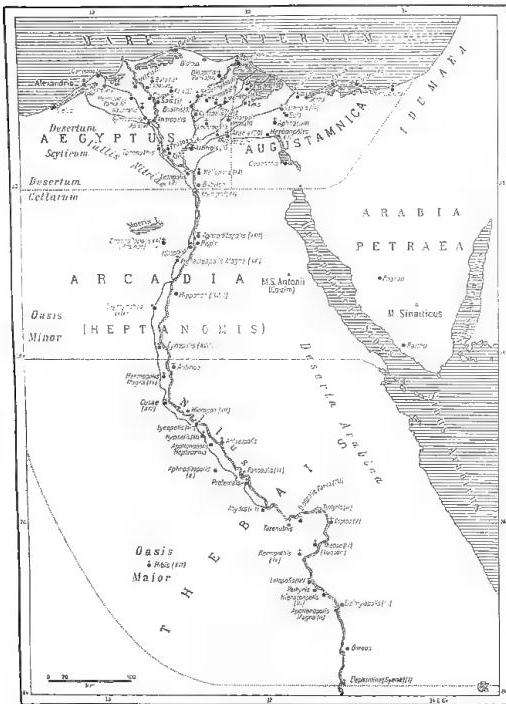
EGYPT - Historical map with the Augustan division; the nomes of the Greco-Roman era in Lower Egypt (Arabic numerals) and Upper Egypt (Roman numerals); the bishoprics at the time of the Council of Ephesus (431) and the principal monastic centers.
preserve for millennia the tangible memory of the art of that remote age. Thought, particularly religious thought, is preserved above all in the numerous inscriptions of the tombs of kings and their favored officials; among the most precious are the Pyramid Texts, discovered at Saqqarah in pyramids and other tombs of the V and VI dynasties, spanning approximately 2,000 rather lengthy lines. On the other hand, the mathematical and mystical fantasies that have arisen among some moderns regarding the Great Pyramid, in relation to the Bible and the traditions of the Hebrews, have no foundation.
The dynasties between the VII and XI would mark, according to
the arts and letters and new prosperity to the people. The best-known sovereigns are those whose names indicate their religious preferences, bearing the names of the gods Mont, Amon, and Wôre, deities characteristic of the new capital, Thebes: Menthôtpe (Menthôtppe) IV, Amenemhè I, and his son Zenwôre (Senwôre) I (perhaps the Sesostris of the Greeks). With the XIII dynasty (1868 B.C.), Egypt rapidly lost all its prosperity, probably because power passed into the hands of inert princes who, both internally and externally, caused the decline of what had been the pride of the preceding dynasties. Thus, around 1785, Egypt was opened to invasion
a very probable interpretation, two centuries of decline in royal power and the rise of a kind of feudalism, which has led some moderns to call this era the Egyptian Middle Ages. A famous papyrus (Leiden no. 334) even speaks of a true popular revolution, partly perhaps only imaginary; but there is no doubt that the political activity of the people began to assert itself, preparing the advent of new dynasties and new centers, such as that of Heracleopolis, which would provide the sovereigns of the IX dynasty. Toward the end of this period of Egyptian history, the biblical account of the patriarch Abraham’s migration to Egypt is probably to be placed, according to the narrative in Gen. 12:10-12, from Bethel to the Negeb, a migration caused by famine. In Egypt, Sarah was taken to the court of the Pharaoh and later restored to Abraham, who, with his still-nomadic tribe, limited himself to a temporary stay in the country and returned to his place of origin as soon as living conditions permitted.
IV. MIDDLE KINGDOM
During this period, Egypt resumed its tradition of power and civilization, asserting its military strength and prestige from Nubia to Somalia, expanding its commercial interests with overseas lands such as the island of Crete, and giving new impetus to [...].Hyksos (v.), who, from the poorly guarded frontier of Pelusium, penetrated the country, spreading through the Delta and even further south, establishing their capital at Avaris, in a northeastern locality of the Delta not yet identified, while in Upper Egypt and at Thebes the descendants of the ancient dynasties survived.
V. NEW KINGDOM
The XVIII dynasty that followed included some of the most powerful sovereigns of Egypt, who from Thebes ruled the entire country and several foreign territories. Through successful and victorious expeditions, they increased the prosperity of their citizens and left posterity with grand monuments and abundant written testimonies on papyri and inscriptions.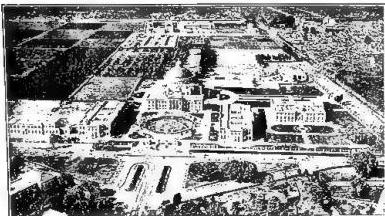
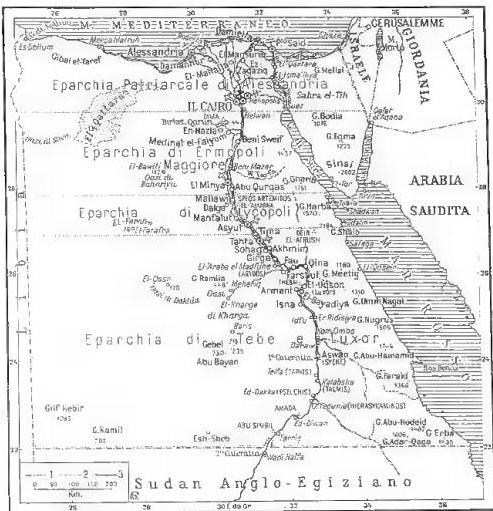
EGYPT - 1) State Borders; 2) Ecclesiastical Circumscription Borders; 3) Railways.
the tomb discovered in 1922, restored Egyptian prestige, until Haremhôse energetically inaugurated the XIX dynasty. Among these sovereigns, one of the most illustrious is undoubtedly Sétôpe (Seti) I, victorious in an initial clash with the Hittites at Qidsa (Qadês), a city on the Orontes, where, a few years later, in 1294, his son and successor, Ramessêse (Rameses & Ramses [v.]) II, resumed the struggle against an entire coalition of states to the detriment of Egypt, in the manner celebrated in a surviving poem in the Sallier III papyrus. The peace conditions between the Hittites and the Egyptians are recorded in surviving treaties, both from the Hittite and Egyptian sides. One of the daughters of King Hattusil marries Ramses II, who is also famous for his numerous and imposing constructions. In such constructions and reconstructions, the king would have employed foreign workers, including, among others, the Hebrew tribe of Goshen, descended from Jacob and welcomed there in the time of the Hyksos. The Bible (Ex. 1:11) explicitly states that the Hebrews, under a king who was no longer mindful of Joseph’s benefits, supervised by implacable overseers, were forced to erect «the city of tabernacles, Phithom and Ramesses» (perhaps the first in Wâdi et-Tumejât and the other at Tanis) and were subjected to a series of hardships, partly justified by the growth of the original tribe, which could have been prejudicial to the state’s security in the event of a conflict with the neighbors of Palestine. Thus, over perhaps more than 100 years, discontent grew, along with the ever more ardent desire of the Hebrews to return to the Promised Land. This occurred (Ex. 1:14) under the leadership of Mosê (v.), exposed to death on the Nile by order of a pha-
EGYPT - View of Fu'ad I University - el-Gizah.
The pharaoh, a persecutor, had ordered him to be exposed to death on the Nile; saved by a princess, he was then welcomed among the king's courtiers. After killing an oppressive Egyptian overseer, he fled to Midian, southwest of the Dead Sea, from where he returned to Egypt resolved to free his brethren. He then asked the pharaoh for permission to depart with his people, but was refused; this was followed by the wonders connected with the departure of the Hebrews and the crossing of the sea—or rather, the marshes in the vicinity of the Bitter Lakes and Lake Timāh.
This exodus likely occurred (though conflicting theories exist: one placing the exodus in the age of the Hyksos, another in the time of Amenhōtpe IV, and another during the XX dynasty) during the period of disorder corresponding to the reign of Meneptāh (d. 1211 B.C.) and the assault on Egypt by the "Sea Peoples," an echo and reflection of the Indo-European invasion toward the west, whose repercussions are clearly felt in all the countries of the Mediterranean. In this regard, a passage from a stele of the king, discovered near the Colossi of Memnon and now in the Cairo Museum (P. Lacau, Stèles du Nouvel Empire, in Catal. génér. du Musée du Caire, Cairo 1909, no. 34025 v.), is noteworthy. It states that the victorious king boasts of having "destroyed Israel, so that his seed no longer exists. Syria has become a widow for Egypt." The document, dated to the fifth year of Meneptāh's reign, demonstrates that the Hebrews were then settled in Syria and that the exodus from Egypt had already taken place.
At the beginning of the XX dynasty (1210), King Ramses III fully restored the prestige of the state, reacting against adversaries both abroad and at home. Abroad, his advance into Syria is notable, while Palestine was occupied by the Philistines, from whom the region derives its name. At home, Ramses III and his successors had to struggle primarily against the priests of Amān, who ultimately triumphed over them.
VI. LATE EMPIRE
The XXI dynasty marks the beginning of a new period of decline, during which kings of Libyan or Ethiopian lineage also prevail: among others, the Libyan Šešonk (v. SESAC) of the XXII dynasty, who renews ties with Palestine after King Solomon (975-935) marries a daughter of the king of Egypt and receives the city of Gezer as dowry (I Kings 3:1; 9:16); this would be Psusennes I, son of Smendes, the second sovereign of the XXI dynasty in the Delta. From then on, relations between Egypt and Palestine appear to become more frequent, whether in the dealings of Solomon (I Kings 10:28-29), who acquires chariots and horses in Egypt, or when Jeroboam, pursued by Solomon’s wrath, takes refuge there (I Kings 11:40), as Adad had done in the time of David (I Kings 11:17-22). In 927, King Šešonk directly intervenes in the affairs of Syria, sacks Jerusalem (I Kings 14:25-26), and then invades the kingdom of Jeroboam, his protégé. A stele on the façade of the pylon of the great temple of Amenrā at Karnak preserves the names of the cities conquered during this campaign of Šešonk I. The Bible speaks of a defeat inflicted by Asa, king of Judah (913-837), upon the Ethiopian king Zerah (II Chronicles 14:9-12), who may have been Osorkon I (925-889) of the XXII dynasty. Conflicts between the kings of Nubia, with their capital at Napata, and the kingdom of Egypt followed, with alternating fortunes, until at the beginning of the XXIV dynasty, King Bocchoris, renowned for his justice, ascended the throne.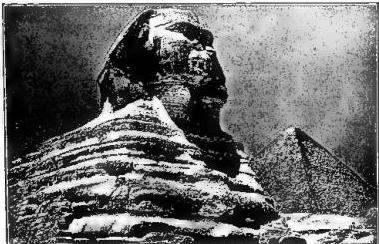
VII. THE SAITE KINGDOM
The Saite kingdom inaugurates an era of resurrection for Egypt with Psammetichus I (663-610), Necho (609-595), and Psammetichus II (594-589), who, from their capital of Sais in the Delta, restored order to the country in a relatively short time. Under Necho, Egypt is allied with Assyria at a time when the latter is rapidly yielding under the blows of its eastern adversaries; and when Necho rushes to the aid of his ally (609), King Josiah of Judah dares to oppose the march of the Egyptians and is defeated at Megiddo (II Kings 23:29) and killed. The new king Jehoahaz was deposed and taken prisoner by Necho, who replaced him with his brother Eliakim, and the country was subjected to a heavy tribute. Subsequently,EGYPT - The great sphinx near Cairo.
With the fall of Nineveh, while many Jews leaned toward an increasingly close alliance with the kingdom of Egypt, with which such good relations had been maintained since the time of their ancestors, the victory of Nebuchadnezzar of Babylon at Karkemish against Necho (604) radically changed Egypt's situation, including its relations with Palestine, as it confined Egypt within its borders and left Jerusalem, with intervals of greater and lesser tension, at the mercy of the Chaldeans, until 525, when Psammetichus III was defeated at Pelusium by the Persian king Cambyses, who thereby established Persian rule in Egypt, inaugurating the XXVII dynasty.
VIII. PERSIAN DOMINATION; THE PTOLEMAIC DYNASTY
Direct Persian rule was exercised during the XXVII dynasty (until 404 B.C.), when a national movement in Egypt brought Amyrtaeus to the throne with the XXVIII dynasty. The most interesting problem concerning the period of Persian domination in Egypt is both the relations between Egypt and the Jews and that of the Jewish colony at Elephantine, which some passages in Herodotus (II, 30-31) and the so-called Letter of Aristeas (XIII) had already indicated and which a fortunate discovery of papyri and ostraca on the site has recently extensively illustrated.This was a military colony established at Elephantine, probably already under Psammetichus I, the Egyptian ruler who enlisted numerous foreign mercenaries for the reconstruction of Egyptian authority, a colony subsequently reinforced by the influx of other loyal Jewish elements and thus respected, indeed favored, by Cambyses and his Persians. The Jewish soldiers had their families with them and had built a temple, in which they performed their rites. In 412 B.C., that is, under Darius II, as anti-Persian movements began throughout the country, the indigenous inhabitants of the surrounding area, perhaps instigated by the priests of the ram-headed god Khnum—so that any sacrifice of lambs in the nome's territory was sacrilege, while the Jews offered them to Yahweh, particularly at Passover—attacked the temple and destroyed II. The temple was perhaps rebuilt, with restrictions on the use of sacrifices, and the colony survived at least until 400 B.C., that is, under the national king Amyrtaeus, after which it is likely that the garrison was dispersed by nationalists and the Jewish center at Elephantine destroyed.
Indeed, the XXVIII dynasty was followed by another national dynasty, the XXIX, until 341, when Artaxerxes III Ochus resumed the offensive against Egypt, rebellious and a hotbed of rebels, and resubjugated the country to his scepter, inaugurating Manetho's XXX dynasty.
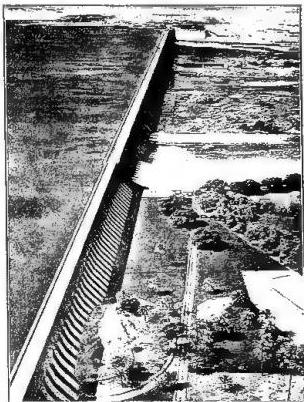
EGYPT - The great Aswan Dam.
from Ptolemaic to Seleucid rule, and with the systematic attempt at the Hellenization of Judaism initiated by the kings of Antioch, the Jews increasingly felt drawn toward the Egyptian kings, whom they regarded as their natural protectors. Egypt thus became ever more the refuge and hope of orthodox and nationalist Jews, to the extent that, around 170 B.C., a priest from the dissident line of the Tobiads, Onias IV, founded a new Jewish temple at Leontopolis, which remained standing until the time of Vespasian. Moreover, Ptolemaic Egypt witnessed, at the initiative of the Ptolemies in the 3rd century B.C., the translation of the Bible into Greek (v. SEPTUAGINT) and served as one of the principal channels for the diffusion and propagation of Judaism. It contributed to binding the Jews of the diaspora to the Greek language, distancing them from the use and tradition of the original Hebrew.
IX. ROMAN RULE
Following the fall of the kingdom of Cleopatra VII Philopator after the Battle of Actium (30 B.C.), Egypt came under the direct dominion of Octavian, who replaced the Ptolemaic dynasty with a personal power that must have appeared to the natives no different from that of his predecessors: absolutism is its hallmark; the exploitation, as extensive as possible, of the country’s resources is its aim. The expansion of dominion beyond the first cataract of the Nile at the expense of the kingdom of Napata, and the development of trade even into the interior of Africa, are its most notable manifestations.To the age of Augustus must also be attributed the arrival in Egypt of the Virgin Mary with Jesus to escape the decree of Herod the Great against the newborns of Bethlehem (Mt. 1:13): it was probably 3 B.C., but their stay in Egypt must have lasted only a few months, and we do not know where, because the Angel ordered Joseph to return to the land of Israel (Mt. 2:20).
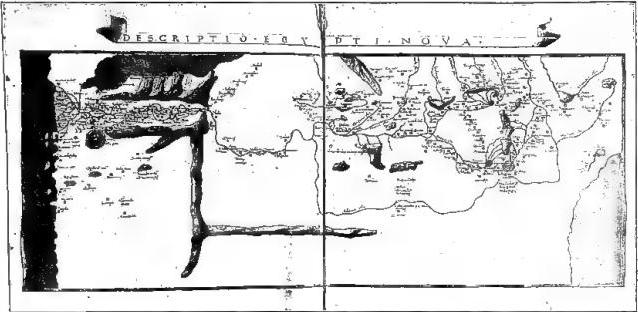
EGYPT - Map of Egypt by Giacomo Angelo Fiorentino (1472) - Vatican Library, Urb. Lat. 277, f. 125°-129.
Vespasian, as soon as he was acclaimed emperor, moved from Alexandria toward the throne of Rome. The struggle he initiated against the Jews of Jerusalem also had repercussions in Egypt, where under Trajan, despite the protection of Plotina, an open war and a true bloody persecution erupted. Hadrian, an admirer of the Museum and the Alexandrian Library, traveled through Egypt as a tourist and peacemaker and lost his favorite Antinous there. During the 3rd and 4th centuries, revolts by the Blemmyes and attempts by usurpers, as well as reflections of external events, agitated the country and worsened its material and moral conditions.
X. CULTURE AND CIVILIZATION OF EGYPT DURING ANTIQUITY
To characterize the level of culture and civilization of ancient Egypt, the study of religion (v. below) undoubtedly serves, constituting one of the most profound and enduring expressions of Egyptian life and thought; intimately connected to it are two other significant manifestations: literature and art.Literature, entrusted to hieroglyphic writing in its varieties—hieratic, demotic, and Greco-Coptic—is certainly the oldest surviving in the Eastern world. The great temple and tomb inscriptions, the numerous papyri, ostraca, and wooden tablets have preserved a considerable portion of these literary works, which date back to the Old Kingdom, though they have reached us in transcriptions from the Middle or New Kingdoms. These consist of narrative compositions, moral teachings, of which Egyptian literature appears particularly fertile; there are also epic and love songs, satires, hymns to the gods and sovereigns, books of mathematics and medicine, with the Middle Kingdom considered the age of classical literature, later held as a model in the schools of the New Kingdom. Few are the names of authors: Prince Zedefhor, Imhòtpe, and Ptahhòtpe in the Old Kingdom, Nefri in the Middle Kingdom, and others. The oldest text is that of the Teachings of Ptahhòtpe from the Fifth Dynasty, preserved in the Prisse Papyrus of the Louvre and others in the British Museum. Among the narrative texts, the Adventures of Sinuhe, the Tale of the Shipwrecked Sailor, the Tale of King Cheops and the Magicians, the Tale of the Two Brothers, the Voyage of Wenamón, and the Adventures of Seton Haemecós (v. AMEN-EM-OPE; AGNI) are characteristic. There also exists an ancient Egyptian fable tradition; famous are the Rhind mathematical papyrus and the medical papyri Ebers, Smith, Chester Beatty, and many others, varied and numerous. No less important was the tradition of sound scholarship, which, already under the first Ptolemies, surrounded Greco-Egyptian culture with the founding of the Museum and Library of Alexandria, continued into the Roman era and pursued by Gnostics and later by Christians in Roman and Byzantine Egypt.
Art in Egypt, preserved not only in the great remains of architectural monuments—pyramids, mastabas, temples—but also in statues, bas-reliefs, and paintings, has left us, in funerary furnishings, abundant examples of every kind of small objects, which scholars can still examine in the major museums of Cairo, London, New York, Paris, Turin, and the Vatican. The characteristics of this art seem inspired by the idea of durability, that is, the desire, on the part of the artist and the patron, that the work should endure into the most distant centuries; moreover, they aim at respect for tradition, so that Egyptian art appears to consist of a uniformity that is more apparent than real, and an immobility that disappears upon careful observation by scholars. Nor is the bold and revolutionary parenthesis of the art of el-'Amàrnah (v.) under Amenhòpte IV lacking. Justly famous are the pyramids or the hypostyle hall of Karnak, with 124 columns, some as tall as 21 meters, or statues such as the Scribe of the Louvre or the Sheikh el-Beled of the Cairo Museum, or the statue of Rahòtpe and Nòfre, also in the Cairo Museum, or like the lady Takušit in Athens or Queen Nefertiti in Berlin, or the bas-reliefs and paintings, for example, of the tomb of Šej, or the alabaster vases of Cairo and the gold ones of Zaqāzīq, or the golden crown of Twosre from Bab el-Mulūk, or the jewels of Dahshur, or the diadems of the Cairo Museum.
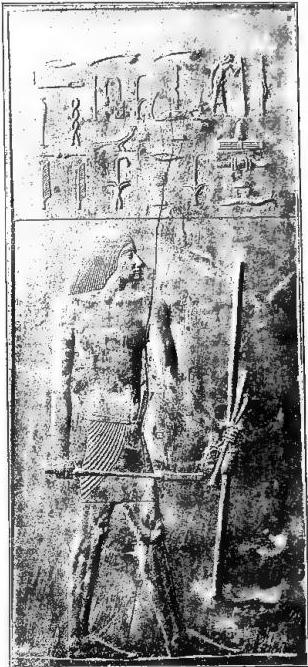
(da Encyclopédie photographique de l'art. La Marie du Caire, Parigi 1918, fasc. 6)
III. RELIGION OF ANCIENT EGYPT
I. OVERVIEW OF HISTORICAL DEVELOPMENT
Despite the abundance of religious texts and documents spanning over thirty centuries of history, it is impossible to trace a gradual and logical development of religion, as not all individual phases of transition and the causes of change are known to us.The oldest religious documents, some of which date back to the predynastic period (vase and wall paintings), already attest to one of the concepts that would remain fundamental in the history of Egypt’s religion: that of the numen loci, whereby each deity was strictly tied to a specific place of worship. Indeed, each territorial district (nòmo) possessed from antiquity a religious standard topped by the representation, more or less stylized, of the object of worship. The use of these standards, carried in procession on certain occasions, persisted even after the country’s unification. Depicted on them are both inanimate objects (e.g., a shield with two crossed arrows, a scepter, a tree, etc.) and animals (a falcon, a crocodile, a jackal, etc.). These sacred symbols of the nòmi were interpreted by some scholars as an indication of earlier animistic beliefs, by others as a remnant of totemic cults; in any case, they are the oldest religious documents, though they should not be divorced from a political significance.
At the beginning of the historical age, profound innovations are observed in iconography and religious conceptions. The ancient divine symbols were replaced either by anthropomorphic deities bearing (usually on their heads) the former object of worship, or by theriocephalic deities (in homage to the sacred animal). Another important novelty was the presence of cosmic deities (also depicted anthropomorphically), whose primitive forms remain unknown. In many cases, due to a syncretistic process common in Egypt’s religion, cosmic deities merged with enchoric ones and sometimes even supplanted them. Furthermore, since in every place,
alongside major deities there were minor ones, a spontaneous desire for synthesis led to the establishment of kinship relations among them, creating various divine families, mostly triads (a couple of parents with a child). Over time, some deities acquired specific attributes that modified and emphasized certain aspects; for example, some gods were venerated as propitious to the dead, others as protectors of a particular social category, and this occurred even outside the center of their cult. Nevertheless, in the epithets by which they are
invoked, there always remains a reference to their place of origin.
A determining factor in the evolution of religion was undoubtedly historical events. Indeed, even in the struggles preceding Egypt’s unification, the local deities of a victorious sovereign prevailed over those of the defeated sovereign, so that while some deities gained greater diffusion and fame, others nearly disappeared. Even after unification, the favor enjoyed by certain gods, to the point of assuming an almost national character, was due to their being the official deities of the place of origin of a ruling dynasty. Thus, Hòro, from the pre-Thinite age, became the par excellence dynastic god, and sovereigns were called precisely "servants of Hòro"; subsequently, Prah of Memphis rose to great importance, and then, with the advent of the V dynasty originating from Heliopolis, the solar god Râ'.
With the fall of the Old Kingdom, Amôn, a secondary deity of Thebes, was destined to attain the highest honors, as he enjoyed the favor of the sovereigns of the XII dynasty, who restored order and peace in the country. Amôn was soon assimilated to the solar god Râ', and Amôn-Râ' remained the dynastic and national deity par excellence until the Saitic period, Hyksos (v.) and IV (v.). Naturally, the fame of these dynastic gods did not erase that of the various local cults, which continued to exist in parallel.
Two other factors determined significant developments in the religious sphere: theological speculation and divine legends. The former, due to the priests of the most famous sanctuaries, aimed to establish a divine hierarchy based on cosmogony. At the head stands the original deity, from whom the others derive in more or less direct filiation. Thus, the most famous cosmogony, the Heliopolitan one, was formed by an ennead with Atum at its head, who in turn was born from Nûn, the primordial
(from M. Gorse R. Mortier, Histoire générale des religions, Paris 1948)
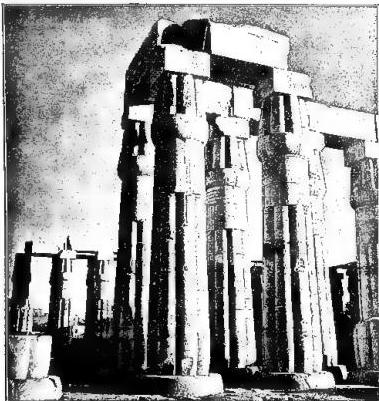
EGYPT - Detail of the colonnade of Amenophis III (1408-1372 B.C.) in the temple of Amôn at Luxor.
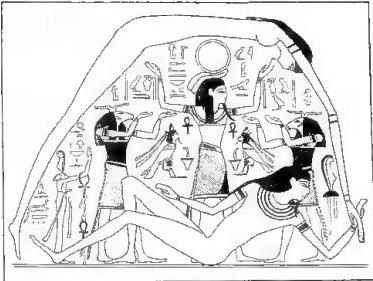
EGYPT - Cosmogonic scene with the lifting of Shu (air) and the separation of Geb (earth) from Nut (sky). From a sarcophagus at the Louvre Museum - Paris.
The perpetual renewal of nature. At the same time, Osiris had risen to become the symbol and guarantee of human immortality, so that he represented for the Egyptians the prototype of the deceased reborn to the afterlife.
In the final period of Pharaonic civilization, no great innovations occurred in the religious sphere, but in many cases, there was a return to ancient forms of worship, such as theriolatry. The god Amun almost completely lost his influence, while the goddess Neith, protector of the new capital, Sais, rose to great importance. The advent of the Ptolemaic era marks further syncretism in the religious sphere, as the Hellenistic rulers, while respecting and honoring the ancient deities, favored their assimilation with Greek ones (Amun = Zeus; Horus = Apollo; Isis = Aphrodite, etc.). Under Ptolemy II, the god Serapis then rose to national importance, soon identified with Osiris and Zeus. The expansion of the cult of Serapis and Isis in the great cities of the Mediterranean, already begun in the Ptolemaic era and continued in the Roman era, marks the decline of Egypt's religion. The Isiac mysteries, like other Eastern mysteries in general, represented for the Hellenistic-Roman world an attempt at spiritual renewal through new religious experiences rich in esoteric meaning.
II. PRINCIPAL DEITIES.
The major deities can be distinguished into: a) enchoric, b) cosmic.
Belonging to group a) are: AMMONIO (v.) or Amôn. - Anubî (v.). - Atum (v.). - Baste, the cat-goddess venerated at Bubastis; she possesses the character of a joyful deity, protector of music and dance. - Hathôr, goddess depicted with the head of a cow or with a human head surmounted by bovine horns between which the solar disk stands out (the latter being an indication of assimilation with a cosmic deity); the principal sites of her cult were Aphroditopolis and Dendêra. - Hôro (v.). - ABSIDE (v.). - Gnum, the ram-god, particularly worshipped at Elephantine. - Min, the Priapus of the Egyptians, represented ithyphallic and with the flagellum raised in the act of striking: a local deity of Coptos. - Mût, the vulture goddess, later becoming the wife of Amôn. - Nephrys (Nb.t-ḥt.t = "The lady of the palace"), goddess who bears on her head the hieroglyph of her own name, venerated at Diospolis Parva; in the legend of Osiris, she appears as the sister of Isis. - Neith, a warlike goddess whose emblem consisted of two crossed arrows above a shield; the center of her cult was Sais. - Osiride (v.). - Ptah, the principal god of Memphis, considered one of the primordial deities and depicted as a crude archaic idol, with hands protruding from his belly. - Sahme (or Sahhmis = "The mighty"), the lioness goddess venerated at Memphis and in a locality of the Delta. - Seth, god appearing in the form of an animal not well identified (perhaps an okapi or a greyhound, in later times mistaken for a donkey), originating from Ombos, who from the earliest times appears as the adversary of Hôro and Osiris. His character as an evil deity is due primarily to the role he plays in the legend of Osiris. - Sobeh, the crocodile god, proper to the Fayyûm and Kôm-Ombô. - Thot (Dḥwtj), the ibis god venerated at Hermopolis Magna but originating from the Delta; assimilated to a cosmic deity, he also became the god of the moon. Patron of scribes and accountants, he sometimes assumes, for unknown reasons, the appearance of a baboon.
The principal cosmic deities b) are: Géb (pron. Gheb), the god of the Earth (masculine in Egyptian), personified; he was imagined lying supine. - Ḥa'pî, the god of the Nile. - Nûn, the primordial ocean from which all things were born and which surrounded the earth. - Nût, the goddess of the Sky (feminine in Egyptian), personified, wife of Géb; she was depicted with her feet and the fingers of her hands resting on the earth and the rest of her body arched above her husband. - Râ', the sun god, the greatest among the cosmic deities, who, in addition to the two hypostases of Atum and Ḥeru (the scarab god), was assimilated with a large number of enchoric deities: suffice it to recall Amôn-Râ'. It was imagined that Râ' traversed the sky in two barques, one for the day and one for the night, accompanied by a retinue of minor deities. - Su, the god of the air, that is, of the space between Géb and Nût.
Among the minor deities, the goddesses Maâ' and Seta are to be remembered, abstract personifications the first of Truth, the second of Writing; among the sacred animals, the famous bull Api (Ḥp), considered an incarnation of the soul of Ptah; among the demigods, Imhotep, who in later times became the god of medicine. The people also venerated a plethora of minor deities such as Bês, Tuaris, Nefertum, etc.
Finally, a factor of the utmost political importance, the pharaoh himself was considered a god as the continuator of the lineage of Hôro, the first god-king who had reigned over all Egypt. In the case of the succession of a dynasty that had no direct ties with the preceding one, curious theogamic legends were elaborated to authenticate divine descent.
III. PRIESTS AND CULT
The god, considered in his own city as a sovereign, resided in the temple built of the most solid stone. The archaic temples, however, must have been, according to the depictions that have come down to us, made of very fragile material. Those that still today inspire awe for their grandeur belong to the New Kingdom (Luxor, Karnak) or to the Ptolemaic era (Dendéra, island of Philae, Kôm-Ombo, etc.). The "house of the god," from the XVIII dynasty onward, essentially consisted of a vast courtyard preceded by a propylon, a hypostyle hall or vestibule, and the sanctuary proper, which enclosed a labyrinth of rooms dedicated to the various needs of the cult, and the Sancta Sanctorum containing the naos or tabernacle, the seat of the god's statue. Access to the sanctuary, always shrouded in semi-darkness due to the absence of skylights and windows, was reserved solely for the sovereign and the priests: the people could not proceed beyond the vestibule.The priestly hierarchy was based on three classes: the "pure," tasked with the most humble duties; the "lectors"; and the priests proper, or "servants of the god," all under the direction of a high priest representing the pharaoh, who was the pontifex maximus. In many temples, there were also priestesses dedicated to dance, music, and song. Each day at dawn, the high priest, having opened the Sancta Sanctorum, sprinkled the god's statue, then proceeded to anoint it, adorn it with cosmetics, and clothe it in new garments. Subsequently, he placed solid and liquid foods on a table designated for this purpose, then withdrew so that the deity might refresh itself. Sacrifice and holocaust were foreign to the cult. This daily rite was performed while reciting a formulary that has come down to us. During great solemnities, the god's statue was shown to the faithful from the terrace of the sanctuary or carried in procession (by means of a boat containing the naos) to a chapel near the temple, where it received solemn and public offerings. Under the New Kingdom, these religious festivals reached a spectacular splendor.
IV. THE DEAD AND THE AFTERLIFE
One of the most distinctive aspects of Egyptian religion, already noted with astonishment by writers of classical antiquity, was the constant solicitude toward the dead. This stemmed from the concept that the human soul (ba [v.]), though it abandoned the body, could not survive its decomposition, so indissoluble was the bond uniting the two. Hence the constant concern to preserve the corpse as long as possible through mummification processes and to render it inviolable by means of an inaccessible tomb. Moreover, the dead continued to be subject to the various material necessities of the life they had left behind.Naturally, over the course of Egypt’s millennial history, these needs were addressed in different ways, depending on the era and the social conditions of the individual deceased. In the prehistoric age, a simple pit received the corpse wrapped in skins, with knees and arms bent. At the beginning of the historical age, the corpse was often pre-dried in the sun and wrapped in mats or the like, while a pile of stones was raised over the tomb, built of bricks, to prevent access by wild beasts. The type of tomb with a superstructure of squared limestone blocks persisted throughout the Old Kingdom in the forms of the pyramid and the mastaba, with considerable development of the underground portion as well. From the New Kingdom onward, hypogea carved into living rock were used. As for mummification, though the first attempts date back to a very remote age, perfection was not achieved until the New Kingdom. The viscera and brain were removed from the corpse, which was then immersed in a bath of resinous substances in a soda solution, and finally entirely wrapped in a thick layer of long bandages impregnated with myrrh and aromatics. The funerary furnishings, consisting of one or more sarcophagi, the deceased’s personal objects, various kinds of furniture, vessels, statues, and common-use utensils, were extremely rich in every period.
Regarding beliefs about the afterlife and the related moral concepts handed down to us in the Pyramid Texts, the Coffin Texts, and the Book of the Dead, V. DER[T]; LIBRO DEI MORTI.
Sergio Bonicco
IV. CHRISTIANITY IN EGYPT
The Gospel spread in Egypt as early as the apostolic era. Well-founded tradition holds that St. Mark the Evangelist preached it in those lands where he was martyred (62-68).
The country’s geographical and political structure favored the development of a central ecclesiastical government, with the natural seat becoming the capital, Alexandria. On Christianity in the first centuries and the rise of the Alexandrian patriarchate, V. ALESSANDRIA d'E.: 3. History of the patriarchate of A.; 4. The Councils of A.
In Alexandria, as early as the 2nd century, the famous school functioned, one of the most important theological centers of the Church (v. ALESSANDRIA d'E.: 2. The School of A). The Church in Egypt enjoyed a certain peace during the first two centuries, while persecution raged elsewhere. In the 3rd and early 4th centuries, violent persecutions also broke out in Egypt, under Septimius Severus (202 ff.), Decius (250), and Diocletian (264).
Egypt is the cradle of Eastern monasticism, with its centers at Thebes, Scetis, Nitria, and its splendid figures such as Paul, Anthony, Pachomius, Shenoute, and many others (v. MONACHISMO). Arianism (v.) originated in Egypt and disrupted its life for nearly the entire 4th century. The fiercest opponent of that heresy was St. Athanasius (v.), bishop of Alexandria (328-73). Nestorianism, which did not take root in Egypt, found its most strenuous debunker in St. Cyril of Alexandria (v.). With its approximately one hundred dioceses, its monasteries and convents, and its illustrious array of Fathers, Egypt represented in the first four Christian centuries the most important sector of the East for the development of Christianity.
The heresy opposed to Nestorianism, Monophysitism, professed by Dioscorus, bishop of Alexandria, caused a schism in Egypt that persists to this day. This heresy gave rise to the Coptic Church (v. COPTI), which is schismatic. Only a small minority remained Catholic. Even this minority of Melkites later fell into schism, dragged along by the example of Constantinople, at a time difficult to determine.
A unionist movement of some significance began among the Copts only in the last century. Catholics of the Byzantine rite and Arabic language in Egypt were in 1773 subjected to the Melkite patriarch of Antioch, who in 1838 obtained the personal privilege of bearing the title of patriarch of Alexandria. Thus, there are in Egypt four Christian communities originating from the country itself: the Monophysite Copts, the dissident Greeks ("Orthodox"), the Catholic Copts, and the Catholic Melkites. Other communities of immigrant groups in Egypt are added: Armenians, Chaldeans, Syrians, Maronites, and Latins.
STATISTICS
Non-Catholics:
| Copts | 900,000 |
|---|---|
| Greek Orthodox | 110,000 |
| Protestants | 70,000 |
| 1,080,000 |
Catholics:
| Armenians | 7,000 |
|---|---|
| Chaldeans | 1,600 |
| Copts | 65,000 |
| Melkites | 25,000 |
| Latins | 116,000 |
| Maronites | 11,000 |
| Syrians | 3,500 |
| 227,100 |
Here are the various ecclesiastical circumscriptions of Catholics in Egypt: Armenians: bishopric with a titular bishop of Alexandria; Chaldeans: patriarchal vicariate in Cairo; Copts: patriarchate, seat in Cairo; Melkites: general vicariate, Cairo; Latins: apostolic vicariate of Egypt (Alexandria), of the Nile Delta (Heliopolis, Cairo), of the Suez Canal (Port Said); Maronites: bishopric, Cairo; Syrians: patriarchal vicariate, Cairo.
Egypt remains a predominantly Muslim country (ca. 13 million). After ancient periods of persecution, Egypt was the first Muslim country to establish diplomatic relations with the Holy See.
In August 1947, the Egyptian government made an official request. Pope Pius XII, on 23 August 1947, appointed his former apostolic delegate as internuncio in Egypt. Reciprocally, on 17 October 1947, the Egyptian prime minister plenipotentiary presented his credentials to the Pope.
The situation in Egypt is relatively good. However, concerns and strong protests have been raised by the fact that the government recently seeks to suppress more or less the special legislation of Christian communities in matters of family and marriage law.
V. EGYPT
The history of Muslim Egypt can be considered divided into two great periods by the French occupation (1798-1801), which marks the beginning of European intervention and the movement for national independence.
In the first period, from the Arab conquest to the French occupation (640-1798), Egypt is governed successively by: 1) the governors of the caliphate (640-868; 905-35); 2) dynasties formally or substantially autonomous, together—except for partial or total intervals—with Syria (868-905; 935-1517); 3) the governors (pashas) of the Ottoman Empire (1517-1798). In the second period, from the French occupation to the present day, the progressive phases of Egyptian independence are marked by the government of the dynasty of Muḥammad ʿAlī with the successive titles of: 1) pasha (1805-67); 2) khedive (1867-1914); 3) sultans (1914-22); 4) kings (from 1922 onward).
I. FROM THE ARAB CONQUEST TO THE FRENCH OCCUPATION
1. The governors of the caliphate (640-868; 905-35)
The Arab conquest of Egypt took place under the command of 'Amr b. al-'Aṣ. Pelusium fell in 640, Babylon capitulated in 641, Alexandria in 642 (later rebelling, it was retaken in 646). The Pentapolis was conquered in 643. The successor of 'Amr b. al-'Aṣ, 'Abdallāh b. Sa'd (645-56), extended the conquest to the south, reaching as far as Dongola (652).The conquest was initially organized militarily, centered around the camp of al-Fusṭāt, the future Cairo; the indigenous population was left with its own administration, while tributes were exacted. Gradually, however, the country became ethnically and linguistically Arabized, and in parallel, Islam progressively asserted itself.
From the conquest until 868, Egypt was ruled by governors appointed by the caliphs. During the civil war between 'Alī and Mu'āwijah, 'Amr b. al-'Aṣ conquered it for the latter (658). The anticaliph 'Abdallāh b. az-Zubajr occupied it in the years 683-84.
After the Ṭūlūnid dynasty (v. below), there was a brief return of caliphal governors (905-35), and then the series of autonomous dynasties resumed.
2. The autonomous dynasties (868-905; 935-1517)
These arose in Egypt, as in the rest of the Islamic world (v. ISLĀM: historical expansion), as a consequence of the fragmentation of the caliphate. They were founded by governors or military leaders. With the exception of the Fāṭimids, they paid formal homage to the 'Abbāsid caliphs; the Mamluks welcomed their descendants to Cairo after the killing of the last caliph of Baghdad (1258).a) Ṭūlūnids (868-905). The founder of the dynasty is the Turk Aḥmad b. Ṭūlūn, who managed to assert his autonomy Syria (v.). The Ṭūlūnids reached their peak under his son Ḥumārawāḥ, then declined amid internal strife until their extinction.
b) Ikhshīdids (935-69). After the brief return of the caliph’s governors, Muḥammad b. Tughj founded the new Ikhshīdid dynasty. He was succeeded by two sons, under the guardianship of the Abyssinian eunuch Kāfūr, who later became sovereign himself. The Ikhshīdids ruled over Egypt and Syria, where they constantly fought against the Ḥamdānids. They were overthrown by the Fāṭimids.
c) Fāṭimids (969-1171). This is a Shī'ite dynasty of the Ismā'īlī branch (v. Islam), originating in North Africa in 909. The Fāṭimids assumed the title of caliphs, in opposition to the Sunnī caliphate of Baghdad. In 969, Jawhar, general of the Fāṭimid caliph al-Mu'izz, conquered Egypt, founding Cairo. Mecca and Medina, Palestine (v.), and southern Syria were also conquered; the conquest of the north was slower and more contested. Meanwhile, the Fāṭimids lost North Africa (972). Internally, they organized the persecution of Sunnism, culminating under al-Ḥākim (996-1021), who was also known for his patronage of culture. Thereafter, decline set in. The Mirdāsids became independent in Aleppo (1023); the Seljuk conquest of Damascus ended Fāṭimid rule in Syria; Crusades (v.) ended it in Palestine. Internal discord led to the intervention of the Kurdish general Shīrkūh, sent by the ruler of Damascus, Nūr ad-Dīn. His son Ṣalāḥ ad-Dīn (Saladin, v.) deposed the dynasty in 1171, restoring Sunnism and formal homage to Baghdad, and inaugurating the new Ayyūbid dynasty.
e) Mamluks (1250-1517). They are divided into two branches, Baḥrī (1250-1390) and Burjī (1390-1517). They constituted a military oligarchy, only intermittently with a dynastic character. The most notable sovereigns were Baybars, Qalā'ūn, an-Nāṣir, Barqūq, and Qā'itbāy. The main events of their rule: the victory over the Mongols ('Ayn Jālūt, 1260), which kept the latter away from Egypt; the definitive expulsion of the Crusaders (1291). The Mamluk period was prosperous for Egypt, which became the trade route between Europe and India. With the victory at Marj Dābiq (1516), the Ottoman Empire overthrew the Mamluks and reduced Egypt to a province (1517); however, the Mamluks remained an important and powerful class in the country.
3. The Ottoman governors (1517-1798)
The Ottomans sent pashas to Egypt, frequently replacing them and balancing their authority with that of the Mamluks. In later times, the latter managed to secure pashas of their liking. Apart from the revolt of 'Alī Bey (1771), who briefly seized Egypt and Syria, there are no notable events in this period. Egypt progressively declined.II. FROM THE FRENCH OCCUPATION TO THE PRESENT DAY
The French occupied Egypt from 1798 to 1801. Expelled by the Ottomans and the English, Egypt returned under Turkish rule. In the internal struggles that followed between Turks and Mamelukes, the Albanian commander Muḥammad 'Alī emerged, who in 1805 was recognized as pasha by the Ottomans.4. The Pashas (1805-67)
Muḥammad 'Alī (1805-49) overthrew the power of the Mamelukes (massacre of 1811); he waged war in support of the Ottoman sultan against the Wahhabis (v.), successfully concluding it (1819), and intervened against Greece (1823-27). He conquered Sudan (1820-23). Then, believing he had not been justly compensated by the Porte, he declared war on it (1831), repeatedly defeating the Turks in Syria (1832, 1839). The intervention of the European powers induced him to accept the Jīraddī of 1841, by which he received hereditary rule over Egypt. Internally, Muḥammad 'Alī modernized the state with the help of Europeans, established a national army, carried out irrigation and cultivation works, and promoted public education. His successor 'Abbās I (1849-54) was hostile to European advisors, but under Sa'īd (1854-65) English and French influence resumed, consolidating under Ismā'īl (1863-79), who in 1867 obtained from the Porte the title of khedive and later (1873) powers that were in some respects sovereign.5. The Khedives (1867-1913)
Ismā'īl extended the state southward and continued Muḥammad 'Alī's modernization efforts on a large scale. In 1869, the Suez Canal was opened. Such undertakings caused an economic crisis and the consequent intervention of England and France in administration and government. In 1879, at the instigation of these powers, the Porte deposed Ismā'īl. He was succeeded by Tawfīq (1872-92), under whom the nationalist revolt of 'Arabī Pasha erupted in 1881. This event, along with the massacre of Europeans in Alexandria in 1882, justified England's intervention, which occupied Egypt (1882) and restored Tawfīq to power. Meanwhile, Sudan had rebelled under the leadership of the Mahdī (v. 1881-85); it was reconquered in 1896-98 and placed under Anglo-Egyptian condominium (1899). The English declared their occupation of Egypt temporary; Ottoman sovereignty and the rule of the khedives remained in theory. In practice, the English consul Lord Cromer (1883-1907) and his successors controlled Egypt. In a 1904 convention, France agreed not to demand an end to the English occupation. Tawfīq was succeeded by 'Abbās II (1892-1914). During this period, the anti-British nationalist movement was organized by Muṣṭafā Kāmil Pasha (d. 1908).6. The Sultans (1914-22)
At the outbreak of the First World War, England declared a protectorate over Egypt and appointed a high commissioner. Ḥusayn Kāmil was placed on the throne with the title of sultan. He was succeeded in 1917 by Fu'ād. At the end of the war, the nationalist party (Wafd), led by Zağlūl Pasha, demanded independence. Lengthy negotiations, revolts, and repressions followed. In 1922, England recognized Egypt's independence, though maintaining occupation until the following issues were resolved: security of English communications; defense of Egypt; protection of foreigners and minorities; Sudan. Fu'ād assumed the title of king.7. The Kings (from 1922)
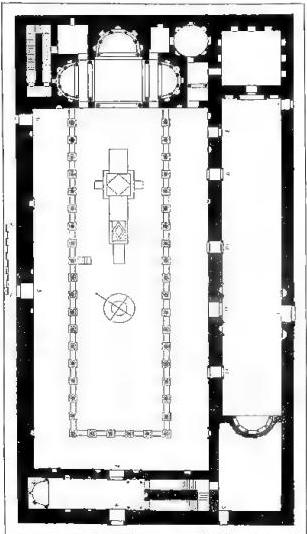
In 1923, the new constitution was promulgated, modeled on the Belgian one: parliament consisted of the Chamber of Deputies, elected by universal suffrage, and the Senate, also elective except for two-fifths of EGYPT - Plans of the White Monastery (reconstruction).During the reign of Fu'ād I (1922-36), ministries of various tendencies alternated; however, the Wafd always maintained predominance, and the constitutional amendment approved by the king in 1930, intended to reduce the power of parliament, was subsequently withdrawn (1934). Negotiations with England on unresolved issues led in 1930 to the MacDonald proposals: withdrawal of British troops to the Suez Canal; British dominion in Sudan. The Wafd rejected the proposals. In 1936, Fārīq ascended the throne. In the same year, a treaty was concluded with England based on the following points: end of the occupation and appointment of an ambassador; a twenty-year alliance to be renewed; permanence of British troops on the Suez Canal until Egypt was recognized as capable of ensuring its defense; condominium in Sudan. In 1937, the Montreux Conference sanctioned the end of the capitulatory jurisdiction for foreigners in Egypt, with a transitional period of 12 years. During the Second World War, Egypt placed its territory and bases at England's disposal, in accordance with the alliance; in 1945, it declared war on Germany, gaining entry into the United Nations Organization. In the same year, the Arab League was established in Cairo, promoted by Egypt, an important body for coordination among the Arab states of the Near East. From 1946, Egyptian governments (in which the nationalist movement played a less dominant role than during Fu'ād's period) readdressed the issue of relations with England, demanding the evacuation of the Suez Canal and sovereignty over Sudan. The problem, brought before the United Nations Organization in 1947, has not yet been resolved. Meanwhile, the British had fostered an autonomist movement in Sudan (al-Ummah) and issued constitutional reforms (1948). In 1949, the capitulatory jurisdiction for foreigners ceased, as scheduled.
In general: S. Lane-Poole, A history of Egypt in the Middle Ages, London 1904; C. H. Becker, Beiträge zur Geschichte Aegyptens unter dem Islam, Strasbourg 1902; Précis de l'histoire d'Egypte: II. H. Munier-G. Wiet, L'Egypte byzantine et musulmane, Cairo 1932, pp. 107-114; III. E. Combe-J. Bainville-E. Briault, L'Egypte ottomane, l'expédition française en Egypte et le règne de Mohamed-Aly, 1817-1849, ibid. 1933; IV. A. Sammarco, Les règnes de l'Abbas, de Sa'id et d'Ismaïl (1848-1879), Rome 1935 (fundamental); G. Hanotaux, Histoire de la nation égyptienne, IV-VII, Paris 1934-40; C. H. Peathas, Histoire de l'Egypte depuis la conquête ottomane, ibid. 1948.
U. Monneret de Villard, Les couvents près de Sohag, I, Milan 1915, (pl. 12)
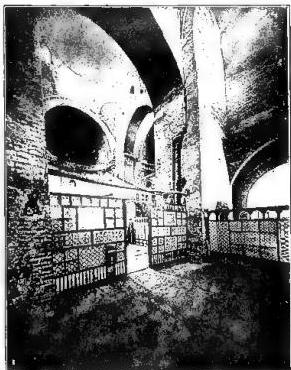
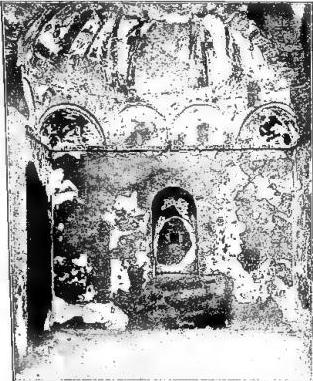
EGYPT - Interior of the Church of the White Monastery.
See U. Mauseret de Villard, Les couvents près de Sabéy, I, Milan 1915, (pl. 12)
VI. CHRISTIAN ART IN EGYPT
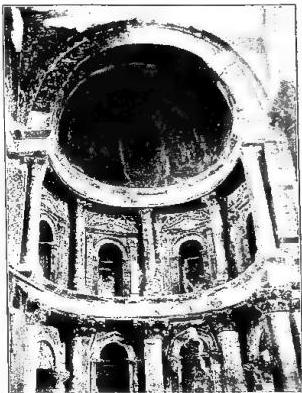
The development of Christian art in Egypt is shaped by several fundamental conditions that must always be kept in mind. The first is the existence of Alexandria, Alexandria ad Aegyptum or ἡ πρὸς Αἰγύπτῳ, which does not mean it was considered part of Egypt: on the contrary, it was officially separate from II. Alexandria was a city of fully Greek culture, pagan, prosperous through trade, and the cradle of an art that belongs to the Hellenistic cycle of the great Eastern metropolises. This art had its own distinct evolution, quite different from that observed in the Nile Valley, except in certain localities where the Greek element prevailed and perpetuated—until the 6th century, alongside a paganism slow to die—the traditions of a culture and an art very different from that reflecting the tendencies and visions of the indigenous population. This persistence of paganism, which only ended in the time of Justinian, must always be borne in mind; moreover, the characteristic that Christianity in Egypt soon assumed with its spread must also be considered. The southern apse of the Church of the Red Monastery.
(from D. Mannaret de Villard, Les couvents près de Sohāg, I, Milan 1852, fasc. 72)
EGYPT - Plan of the church of Bur Bū Rekha.
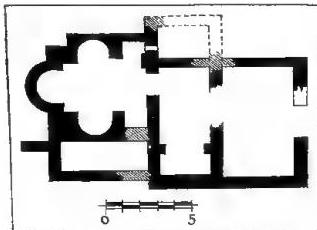
The division into periods of Christian art in Egypt is quite simple. An initial Paleo-Christian period, represented by some catacombs in the Alexandrian region, has no peculiar characteristics but belongs to the great Mediterranean cycle. Egyptian Christian art proper can be divided into two periods, with essentially different features. The first extends from its origins to the Muslim conquest (640–42), the second from that moment to the present day.
After the aforementioned catacombs, the oldest Christian monuments in Egypt are perhaps some tombs in the cemetery of Oxyrhynchus (al-Bahnasa), which present the type of small single-naved churches with an apse, and the mausolea of the necropolis of Baqawat in the al-Khārga Oasis. The former were built in stone with Hellenizing structures, while the latter were executed in raw bricks according to traditional indigenous methods, mostly with a square plan covered by a dome—a structure entirely un-Hellenistic. Already in these early examples, the aforementioned conflict is evident. These tombs of al-Khārga (whose greatest interest lies in the paintings decorating their walls) also feature the use of the ovoid three-centered arch, clearly of Asian tradition, and short, thick columns following a model far removed from the classical one. Leaving aside the great basilica built in the time of Emperor Arcadius (345–408) over the tomb of St. Menas in Mareotis—a Mediterranean import— the current of late Syrian Hellenism manifests itself in the great church of the White Monastery (Deyr al-Abyaḍ) near Sohāg, built around 430 by the Byzantine count Caesarius for the monastery of the great monk Shenoute. It is a three-naved basilica with a narthex and a sanctuary in the form of a tricora, that is, with three apses arranged in a trefoil, a structure characteristic of Syria, where it was used not only in churches but also in the great halls of palaces, as in Boṣrā or in the palace described in the Acts of St. Thomas, a text of undoubted Syrian provenance. This form of sanctuary is found in the same period in the church of the Red Monastery (Deyr al-Aḥmar), not far from the White Monastery, and in the one built in front of the façade of the Temple of Hathor at Dendera. Belonging to the same Hellenistic current is the basilica that once stood near Armant, destroyed at the beginning of the 19th century but fortunately preserved in the records of the French scholars of Napoleon’s Egyptian expedition. This basilica had two opposing apses, one at each end of the central nave, a type repeated in the basilica of the baths near the sanctuary of St. Menas and in the Byzantine constructions of Marsa Matrūḥ. All these churches are generally built in carefully squared stone, with tall monolithic columns and a very wide nave (that of the White Monastery spans 12.50 meters), requiring large timber for roofing. This presupposes considerable economic resources, especially for timber, which had to be imported from Syria, as Egypt lacked large trees suitable for construction. It is thus understandable that these were foundations of great Byzantine lords, who must have called architects from their own milieu rather than from the indigenous one. To the same group of monuments, though with more modest programs, belong the church of Deyr Abū Ḥinnis (Monastery of St. John) near Antinoöpolis and that of the Monastery of St. Apollo at Bāwīṭ near Deirāt. All these buildings have interior walls richly decorated with niches of intricate forms and with colonnettes whose shafts are adorned with geometric ornaments—a characteristic also derived from Syria, where the finest examples are perhaps those colonnettes reused in the Muslim period for the construction of the
(from D. Mannaret de Villard, La Nubia meridionale, I, Cairo 1855, fasc. 1)
EGYPT - Ruins of the eastern church of Philae (mid-6th century).
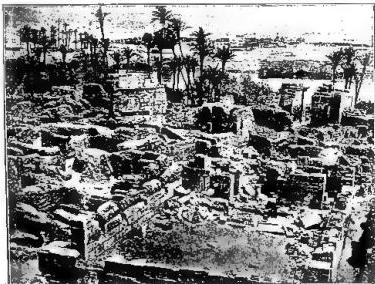
A far less ambitious program is the one to which the indigenous environment adhered. From the earliest Christian times, numerous hermits populated the Egyptian desert, and most often they established their residence in ancient tombs from the Pharaonic era: they transformed these not only into residences but also into chapels, constructing or carving niches that were to serve as apses. Examples of such building activity are scattered throughout the Nile Valley, but perhaps the most interesting and most easily accessible are among the tombs of Beni Hasan and Mir near al-Qusiya, a tomb at es-Seikh Sa'id not far from Mallawi, the tomb of Penchse at Tell al-'Amarna, that of Ramses IV at Bibân al-Mulûk, and those numbered 84, 95, and 97 at Sheikh 'abd el-Qurna in the Theban necropolis. Further south, a tomb near Esna is noteworthy for the paintings that decorate its walls, unfortunately still unpublished. Around these hermitages, small monasteries gradually arose, where the tomb transformed into a church served as a sanctuary for the community: cells and storerooms were built
in the surrounding free space, and later the whole was enclosed by a wall and equipped with a tower (gausaq) for defense against desert raiders. One of the most complete examples of this type of monastery is that of Epiphanius at Sheikh 'abd al-Qurna: but from a liturgical point of view, the most important is that of the Valley of the Queens (Bibân al-Harîm). Here, a second church was built in the courtyard in front of the cave: it is square in plan and was covered by a dome; the apse was constructed inside an ancient Christian tomb with a barrel vault in bricks, probably the tomb of the founder, and thus directly above his body, clearly marking the character of a tomb-altar.
Most often, however, they built their churches ex novo on free land. The most interesting examples prior to the 6th century, moving from north to south, are the church of
Taposiris in Mareotis, that of Tebtunis (Tell Umm el-Breigât) in the Faiyûm, the small basilicas in the monastery of S. Geremia at Saqqâra, that of Dayr Abû Fânâ north of Ašmunein, the church in the dromos of the temple of Medamûd, the basilica west of the temple of Luqṣôr, a small basilica at Sheikh 'abd al-Qurna in the Theban necropolis, the church near the fortified gate of Ramses III at Medinet Habû, that of Tûd, and the eastern church of Philae, one of the rare monuments dated epigraphically, having been built under Bishop Theodore between approximately 525 and 578. All these churches always lack an atrium but almost always have a narthex, sometimes decorated with niches, as at Medamûd. The entrance doors are generally on the façade, but in some cases
the entrance is opened in the side walls (Bâwît, western church of Philae, Sheikh 'abd al-Qurna), following a disposition characteristically Syrian and Mesopotamian. The apse is never free and projecting (except in the clearly Byzantine case of Abû Mînâ) but is always concealed behind a flat wall. Such an apse presents various forms: at Bâwît, it consists of a rectangular room occupying the entire width of the church. The most widespread type is that of a semicircular apse
enclosed between two square or rectangular rooms, which seem to have served as sacristies, as in Syria. At Philae, the southern room serves as a staircase well, and at Tûd, there are instead two rooms on either side of the apse, which is preceded by a rectangular bay of the type found in Syria at Qalb Lauzeh and Qanawât. At the small basilica of Sheikh 'abd al-Qurna, there is instead a rectangular apse enclosed between two square chambers, another characteristically Syrian structure. At Taposiris, there is a semicircular apse placed between two square chambers and a narrow, long rectangular room behind the apse, communicating only with the northern chamber: a structure that connects with several Mesopotamian examples from the Tûr 'Abdîn and is found later at the monastery of S. Simeon near Aswân. A development of this structure is seen in the basilica of the baths at Abû Mînâ, where the corridor truly connects the two rooms flanking the apse: examples are found in Syria at Hûsan Nîha and at the so-called tomb of Aaron on Mount Hor, and it will be one of the characteristics of Christian architecture in Nubia. In churches with side entrances, the western wall has a large rectangular niche in the center, which seems to be a memory or an atrophied form of an apse opposite the eastern one. A unique and most interesting case is given by the basilica of Luqṣôr, where, based on some surviving elements and old surveys, it is perhaps possible to restore a type of apse with an ambulatory. The body of the church is generally divided into three naves by two rows of columns: but in some cases (funerary basilica of Abû Mînâ, two basilicas at Saqqâra, Dayr Abû Fânâ, the two basilicas of Medinet Habû, eastern church of Philae), in addition to the two longitudinal rows of columns, there is a third running parallel to the façade wall, so that the side aisles also extend around the central nave toward the west. This is a type that will persist in the late Middle Ages in the churches of Old Cairo. All these churches were covered with wooden roofs.
The problem of the baptistery in Egypt is quite difficult
Christian architecture in Egypt after the Arab conquest (640-42) has left us many monuments, of which only a small part has so far been studied in such a way that we can speak of them with certainty. In any case, two characteristics clearly emerge: the first is the abandonment of the old Hellenistic basilical type, the second is the renunciation of wooden roofs for churches, replacing them with vaulted coverings. The basilical structure and wooden roofs are preserved only in the churches of Old Cairo (Babylon of Egypt), particularly in that of S. Barbara and that of S. Sergio, which today appear in a form they received in the 12th-13th centuries, but which most likely is nothing more than the reconstruction of earlier buildings dating perhaps to the 5th-6th centuries and which has preserved their planimetry and roofing method. These churches have matronea, which confirms their connection with Hellenistic-Byzantine prototypes.
Another group of monuments with common characteristics and topographically compact is formed by the monasteries of Wādī en-Naṭrūn, namely Deyr Suryāni, Deyr Amba Bīšūi, Deyr el-Barāmūs, and Deyr Abū Maqār. The most important is the first, rebuilt after the sack and destruction of the year 817: tradition attributes the new construction to two monks from Takrit in Mesopotamia, Mattai and Abraham. There are two main churches in the monastery: the smaller one, dedicated to the Virgin, reproduces a type of monastic church characteristic of the Tūr 'Abdīn, consisting of a rectangular narthex covered by a barrel vault, a choir also rectangular with a north-south axis, likewise covered by a barrel vault, and a triple sanctuary formed by three rectangular chambers, the central one of which is covered by a dome while the other two have barrel vaults whose axis is perpendicular to that of the choir and narthex vaults. The large church of the monastery, also dedicated to the Virgin, is a basilica whose body consists of a wide nave flanked by two aisles that also run along the western wall, all covered by barrel vaults. This is followed by a rectangular choir with a north-south axis, divided into three bays, the central one of which is covered by a dome and the two lateral ones by two semi-domes, reproducing a structure found in the church of the Virgin at Ḥāḥ in Mesopotamia: the sanctuary is analogous to that of the small church.
At the southern extremity of Egypt are two churches, that of the monastery of S. Simeone at Aswān and that of cā-Sēkhān, which share very similar characteristics, insofar as the sanctuary is trilobed, with a dome at the center and semi-domes on the three arms, and the central nave is covered by two domes in the first case and by a single dome in the second. These are two monuments probably dating from the late 10th or early 11th century. A final building of singular importance, datable to the early Middle Ages, is the small basilica located about fifty meters north of tomb no. 25 of Qurnet Mur'ai in the Theban necropolis: it is of the type called "église cloisonnée," that is, having the division between the nave and the aisles made by solid walls in which only small doors open. It is the only example of this type so far known in Egypt. Among the secondary monuments, the church of Deyr al-Šuḥadā (Monastery of the Martyrs) near Esna and a group of buildings in the region of Naqāda and Qamūla should be mentioned, particularly those of al-'Adra and Mārī Girgis at Deyr al-Magmā', the latter of which shows a system of parallel vaults on transverse arches according to a type from Sasanian Persia. But the most widespread structure in the late Middle Ages is that of a rectangular building divided by arches, predominantly supported on pillars, into many squares, each of which is covered by a dome: they even reach the number of 29 in the church of Amba Pakhām near Medamūd. The most beautiful example is perhaps that of Deyr al-Maḥarraq.
Sculpture in Christian Egypt was conceived as a decorative aid to architecture and not as having a life of its own: statuary therefore disappears completely. The art of working hard stones (diorite, porphyry, etc.), which had been a specialty and a glory of the country, also disappears: the only material now used is limestone, except for columns and capitals for which syenite is still cut. A notable and characteristic feature of Egypt is the extensive use of wood sculpture in the decoration of monuments.
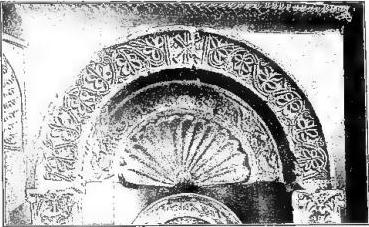
For an initial period, the most interesting examples of sculpture are a series of niche basins with curiously scalloped pediments and human figures treated in high relief with a distinctly chromatic use of strong contrasts between voids and solids, with a skillful balancing of masses and interplay of light and shadow in a decidedly Baroque vision. These were found mainly at Ahnâs al-Madina, the ancient Heracleopolis, but interesting examples also come from other localities, particularly al-Bahassa. These are sculptures almost all with pagan subjects and must therefore be linked to those wealthy and powerful aristocratic groups that dominated Middle Egypt, of Hellenistic culture and hostile to the new religion. Stylistically, these sculptures are nothing more than the derivation of a characteristic Syrian school and connect with others from the Nabatean region, particularly those found at Khirbet et-Tannur. With the end of the 5th century and probably with the extinction of these pagan groups, this school disappears. Even the most important examples of wood sculpture up to the 5th-6th centuries, some pieces from Bâwît and especially the beautiful wooden door of the primitive church of S. Barbara in Old Cairo (now in the Coptic Museum), are in the purest Hellenistic tradition of the art of Alexandria or Antioch.
Sculpture in ivory, of which we have so many magnificent monuments from the workshops of Alexandria, has left us very few that can be attributed with relative certainty to Egypt proper, with a predominance of monumental style over Hellenistic picturesqueness. The most notable are the one in the Louvre depicting S. Marco enthroned among his successor patriarchs and the five-part diptych from Murano, now in Ravenna, which Strzygowski considers a product of monastic art from Upper Egypt. Sculpture proper to Egypt, poor in figurative monuments, assumes instead an extraordinary richness and inventiveness in decorative works: capitals, friezes, incrustation slabs, and even funerary stelae. The repertoire of motifs is so abundant as to defy any classification: decoration covers every element, with an evident tendency toward that horror vacui which is one of the peculiar characteristics of Oriental art.
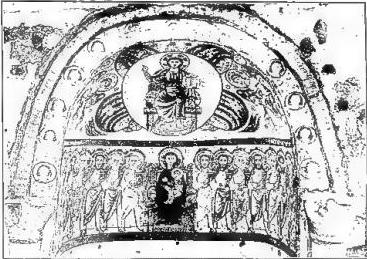
the very broad use of frontality, the symmetrical arrangement of figures, a static representation generally on a single plane, without any hint of background or environmental details—what is generally referred to as "monumental style," characteristic of Asian expression and whose example dates back to the paintings of Dura-Europos. The greatest Egyptian examples of this style are given by the pictorial cycles of Bâwît and Şaqqâra. Here, even if some Hellenistic traces remain in the decorative friezes, the ornamental and symbolic part fades increasingly to make way for historical painting, and the landscape treatment disappears to be replaced by monumental representation. Another characteristic clearly appears: the taste for portraiture, whose tradition dates back to the 2nd-3rd century, that is, to that school of craftsmen who executed the funerary tablets of the Fayyum in full Hellenistic style, but translated into monumental forms. This tendency toward portraiture, which leads to the personalization of every figure, when applied to the representation of sacred personages, also confers an individual character to the ideal images of the Savior, the Virgin, the Apostles, and the Evangelists, and tends to crystallize their type. It is well known how these artistic tendencies would have a profound influence on Byzantine art itself, and one could say that the impetus came from Egypt. Iconographically, Egyptian painting of the early Middle Ages already shows from that time some characteristics that it would preserve for centuries: for example, the custom of representing almost all local saints on horseback, almost as victorious warriors over the spirits of evil.
After the great paintings of Bâwît and Şaqqâra, which represent, to the best of our current knowledge, the moment of greatest splendor of Egyptian painting in the early centuries, we are poorly documented until around the 11th century, when a new influence emerges, that of Armenian art. A large, wealthy, and powerful colony of Armenians had then formed in Egypt: among them were also artists. It was to an Armenian painter that the decoration of the great apse conch of the White Monastery is attributed. Seemingly localized only to the monastery of the Syrians in Wâdî an-Naţrûm (Deyr Suryânî) is a current of Syrian painting, of high artistic value and still insufficiently studied. In the southern apse of the choir are represented the Annunciation and the Nativity, and the inscriptions are in Syriac, except for the name of Joseph, which is written in Greek: in the western apse, at the end of the nave, is the Assumption, with the names of Jesus, the apostles Andrew and Simon Peter, the Sun and the Moon written in Syriac, while the latter is also reproduced in Coptic: in the northern apse of the choir is represented the Dormition of the Virgin, with the name of Christ written in Syriac. It is thought that these paintings may be dated to the time of the monastery's superior, Moses of Nisibis (907-44), to whom perhaps the stuccoes of the sanctuary in Mesopotamian style are also due. Egyptian painting of the late Middle Ages no longer has any artistic value, nor does the painting of icons, the oldest of which known to us do not date from before the fifteenth century.
Miniature painting is also an art widely diffused in Egypt. Initially, its great development was given by Alexandria with a magnificent series of manuscripts known to us, if not all in originals, at least in very ancient copies, which show the greatest triumph of the Alexandrian picturesque style: but already with the various copies of the Topography of Cosmas Indicopleustes, one sees the monumental style penetrating. Conversely, Egypt, with the papyrus fragments of the Alexandrian Chronicle, perhaps from the beginning of the 5th century, has left us a work of a very different tendency, where the indigenous character, imbued with ancient Oriental traditions, is more clearly shown. And it is these that definitively triumph when, at the end of the 6th century, one can say that the Hellenistic art of Alexandria disappears. We possess a numerous series of illustrated manuscripts that allow us to follow exactly the development of Egyptian miniature painting, as they are mostly dated, with subscriptions of scribes and painters, and in most cases, it is quite easy to determine the place of execution. Thus, one can clearly follow a characteristic tendency, that is, to gradually abandon the technique of true painting in favor of that of pen drawing filled with colors. The masterpiece of properly indigenous Egyptian miniature painting is given by the Coptic manuscript 13 of the Bibliothèque Nationale in Paris, with strong Mesopotamian influences, from the 12th century. But in the same period, we see forming another school of artists who are strongly influenced, especially in decoration, by contemporary Muslim art: the masterpiece of this tendency is that tetraevangelion in two volumes, one of which is preserved at the Catholic Institute of Paris and the other at the Coptic Museum in Cairo. It is this school that takes precedence and will last until the 17th century, though with increasingly declining works. The history of Egyptian miniature painting has yet to be written.
In the minor arts, the one that has left us the greatest number of documents is the decoration of fabrics, of which the dry Egyptian sands have preserved most interesting examples. Those with woven wool decoration are executed with a technique identical to that of the Franco-Flemish arsezi, which is documented in Egypt from high antiquity, examples of which are the fragments with the name of Amenhetep II (ca. 1500 B.C.) and Thutmosis IV (ca. 1466 B.C.), a technique analogous to that of some fragments found in Greek tombs in the Crimea from the 11th or 19th century B.C. In Egypt, the sites of the most abundant finds (Saqqida, Arsinoe, Akhmim, Antinoe, Armant, Hawārah, etc.) are scattered throughout the country, which shows the diffusion of always similar procedures. The decoration generally consists of bands, clavi, and square or round inlays, rota. Christian weaving is thus technically nothing but the unaltered continuation of pagan weaving, the only difference being in the motifs represented. In a relatively advanced period, however, some technical variation is observed, approaching that of...
Fabrics, however, are also decorated using completely different techniques: these are linens in which the ornamentation is achieved through dyeing, following a process (already mentioned by Pliny) that closely resembles that of batik. The linen with Bacchic scenes found by Gayet at Antinoe is the finest pagan example, dating no later than the 4th-5th century, while that with Daniel in the Berlin Museum is the most notable among the Christian ones. There are also linens decorated with motifs printed using carved wooden blocks. Finally, one must mention the examples of silk weaving found in Egyptian tombs, particularly at Akhmim and Antinoe, some of which are certainly products of local workshops, while others prove to be imports from Syria, Sasanian Persia, and perhaps even Central Asia.
A specifically Egyptian industry is that of ivory inlays in wood: the doors of the Syrian monastery at Wadi en-Naṭrūn perhaps offer the finest example. The ceramics of Christian Egypt, while interesting, never rose to the level of true art.
VII. EDUCATIONAL SYSTEM OF EGYPT
The Ministry of Public Education, the Ministry of Social Affairs, and the Ministry of War and the Navy have undertaken to collaborate in eliminating illiteracy, the greatest scourge hindering the organization of political and cultural life.
Education is made compulsory from ages 12 to 18 for boys and from 12 to 15 for girls. There are 1,949 boys' schools and 728 girls' schools, as well as numerous compulsory courses for members of the police and armed forces. Various private organizations and individuals have established small schools called maktab, where boys and girls are taught to read the Qur'an, writing, and mathematics. Employers are legally obliged to provide education for their employees. In addition to the fight against illiteracy, the Egyptian government is concerned with the formation of the ruling class, and to this end, it has reduced the teaching of foreign languages, elevating, from the year 1950, the teaching of the Arabic language, which is the official language. In all schools, Pan-Arab sentiment and Islamic religiosity must be cultivated. In private schools, it is forbidden to teach students religious doctrines different from their own religious convictions. The teaching of Arabic is not compulsory in those private schools (English, French, Italian, and Greek) where the number of Egyptian students is less than 15%.
Egyptian education comprises kindergartens; elementary schools called kuttāb (divided into government-run, private under direct government supervision, and foreign under indirect government supervision); secondary schools; and universities. The Islamic University of al-Azhar, founded on 21 June 972 by General Gawhar under the Fāṭimids, imparts religious and political spirit to the entire Islamic world; the Fu'ād I University, founded in Cairo in 1908; and the Farūq I University, founded in Alexandria on 2 August 1942.
There are also the schools of the Coptic Church, which include 12 boys' schools and 4 girls' schools, wholly insufficient for 850,000 faithful. The United Coptic Church has, in the three dioceses of Alexandria, Hermopolis, and Thebes, 31 boys' schools, 1 girls' school, 1 Petit séminaire, and 1 Theological Seminary for 20,000 faithful. - Vedi tavv. XI-XIV.
Miroslav Štumpf