
GEREMIA (Heb. Jirméjâh[â] = “Jahweh raises up or establishes”).—The second of the four major Hebrew prophets.
SUMMARY:
I. Life of G
II. Book of G
III. Iconography—IV. Letter of G
V. Paralipomena of G.I. LIFE OF G
His life is known through his book, which often assumes a sincere autobiographical form, of great psychological value. Born into a priestly family, G. spent Anathoth (v.), a village 3 or 4 miles northeast of Jerusalem. He must have been born around 650 B.C., since in 626—when he began his prophetic mission—he describes himself as a “young man” (Heb. na'ar, which, however, could also indicate a mature youth).Nothing is known of G.’s youthful activity, but from his confessions it may be concluded that he lived in the tranquillity of Anathoth, far from the political life of Jerusalem. Pathetic allusions to the beauty of family life (cf. Ier. 6:11; 9:20; 16:9; 25:10; 31:4-5, 20; 48:33) and the psychological struggle provoked in him by his prophetic vocation allow us to glimpse his gentle disposition, alien to facile enthusiasms. It has been said that G. was the most “bourgeois” of all the figures of any importance in the Old Testament. The divine vocation (1:5), by which he was proclaimed a “prophet to the nations,” was accepted reluctantly; but supernatural strength triumphed over the pacifist character of the bourgeois of Anathoth, and he then undertook the grave task of being Jahweh’s herald. He feels a “fire” consuming his bones, which he can neither resist nor intends to resist (20:9). When the difficulties of his mission multiply, when he experiences nostalgia for a tranquil family life, which he had had to renounce at God’s command, G. protests vehemently, though not without lyricism (15:10; 20:14-18); he speaks of “seduction” and “violence” on Jahweh’s part (20:7), but for this reason does not abandon his vocation. G.’s prophetic call took place in the 13th year of Iosia, king of Judah, that is, in 626 B.C. While the final years of Jeremiah’s activity are known very well, almost nothing is known of its beginnings. One would expect, for example, that G. had been consulted on the occasion of the reform begun in the 18th year of Iosia (621 B.C.).
This silence poses a problem that has long been debated. What was G.’s attitude toward such an anti-idolatrous and centralizing reform? Some make G. an ardent advocate of the reform; others an obstinate opponent, because he condemned every exaggerated legalism to the detriment of the religion “of the spirit”; still others posit an evolution in the prophet’s mind. From being a supporter, he would have become, if not an opponent, at least indifferent to the reform because of its meagre results and deviations (thus J. Skinner; W. O. E. Oesterly-T. H. Robinson, in Introduction to the books of the Old Test., Londra 1934, pp. 305-307; R. Pfeiffer, Introduction to the Old Test., Nuova York 1941, p. 495). The second hypothesis must be rejected outright, since it is based on an overvaluation of certain texts (7:21, 22; 8:8; cf. W. Rudolph [V. BIBLICA.], p. 53) and on the arbitrary elimination of others (11:1-14; 17:19-27), attributed to a tendentious revisionist school, called “Deuteronomistic” after the book which, having been discovered or composed at that time, would have determined Iosia’s reform. On the other hand, it does not seem legitimate to derive from the few texts akin to Deuteronomy the profile of a G. who enthusiastically supported the new movement. The last hypothesis appears somewhat complicated and based more on inferences, more or less probative, than on objectively convincing arguments. From the whole picture it seems possible to conclude that G., who for unknown reasons was not directly involved in deciphering the discovered book, must have welcomed sympathetically every effort aimed at eliminating idolatrous cults, awakening a religious revival of true Jahwism, and promoting greater social justice. But in his prophetic mission he did not bind himself to any legalistic or authoritarian initiative. Rather than appealing to the precious “discovered” text, G. based his activity on the direct inspiration of God. When, with the death of Iosia (609 B.C.), the official reforming action came to a standstill, G. continued to communicate that “fire” which he could not contain in his breast and to call for the nation’s sincere return to God.
There is only one allusion in G.’s book (22:11) to Ioachaz (or Sellum), elected king after Iosia but soon deposed by Pharaoh Nechao, who sent him prisoner to Egypt and replaced him with his elder brother Eliacim, to whom he gave the name Ioakim. The reign of the latter, characterized by a skeptical, fickle, and brutal temperament, was marked by profound religious indifference and continual political vacillation, determined by the greater or lesser predominance of either the pro-Egyptian party or the party favorable to an understanding with the Babylonians. After the defeat of the Egyptians along the Euphrates (609 B.C.; according to others, at Carchemis in 605), when Palestine passed, at least theoretically, under Babylonian sovereignty, the pro-Egyptian party lost ground for fear of reprisals; but it quickly recovered, drawing the King as well into progressive opposition to Babylon. G.’s activity at this time was intense, as is shown by the fragmentary documentation of his book. G. inveighs against the idolatrous worship that was once again spreading (11:13; 12:16; 13:10; 16:18; 25:6) and against vices (21:12; 22:13, 14; 23:14), without sparing the sensitive political sphere. Following his thesis, by then traditional in prophetism, G. sets forth the logical consequence of the Jewish theocracy. The small Kingdom of Judah, strong in its religious idea, must trust solely in Jahweh, not in precarious political alliances (2:36). In particular, G. attempts to check the pro-Egyptian movement, which would inevitably have led to a clash with Babylon, by then exceedingly powerful as far as the Mediterranean. His vision, including its political dimension, was far more realistic than that of the exalted nationalists and pro-Egyptians who, through their obstinacy, brought about the collapse of the Kingdom. G.’s warning remained a voice lost in the wilderness. The prophet was obstructed in every possible way. They even resorted to a conspiracy against him (11:18-23). Nevertheless, G.’s influence was so great that no one dared take extreme measures against him. Ioakim, in his skepticism, would vent his contempt by consigning one of G.’s books to the flames (36:23), but he would not dare silence Jahweh’s illustrious herald forever. Once the prophecy of
(from H. Omont, Peintures de l'ancien Testament dans un sac syriaque, in Fondation Piot, Monuments et Mémoires 1969, vol. 7, 9)
GEREMIA — G., the divine hand and the «Virgo vigilans». Miniature of Cod. Syriac 341 (7th–8th century) — Paris, Bibliothèque nationale.

G.’s activity, on the other hand, appears to have been very intense during the reign of the vacillating Matthania, the last son of Iosia. Having come to power under the name of Sedecia at the behest of Nabuchodonosor, he soon revealed himself to be the plaything of his courtiers and of scheming politicians. Despite the growing influence of the anti-Babylonian party, peace lasted in Jerusalem for a decade (598–588). The policy of neutrality pursued by Nechao and Psammetichus II in Egypt contributed to this state of affairs. When the young Ephree (Hebrew Hophra') became pharaoh, the policy of non-intervention was abandoned, and thus the hopes of the many Palestinian nationalists were rekindled, since they saw Egypt as the decisive factor against Babylonian supremacy. A league of several small states on the Mediterranean coast and in Transjordan formed around the Pharaoh. When hostilities began in 588, Nabuchodonosor responded with determination and speed. Establishing his headquarters at Ribla on the Orontes, he immediately attacked the Kingdom of Judah. Soon only a few fortresses remained (Jerusalem, Lachis, where the celebrated letters were found, and Azecha). During the siege of Jerusalem, which lasted eighteen months with a brief interruption, G. lived through his most dramatic hours. Repeating almost monotonously his prophecies against the insane policy of the pro-Egyptian party, he never ceased to advise timely negotiations with the Babylonians. For this reason he was repeatedly imprisoned by his opponents and treated inconsistently by the vacillating king. In the conversations Sedecia had with G., whom he had expressly summoned from prison without the knowledge of his courtiers (37:17–20; 38:14–26), the prophet insisted on his grim prophecy concerning the fate of the cowardly king and the unfortunate city; Sedecia hesitated, raised objections, and promised better treatment to the prisoner; but he soon fell again under the influence of the extremist nationalists. Yet even in the darkest days G., in his prophetic mission, showed the people a light of hope through a symbolic action: while the Babylonians were conquering the Judean positions one by one, he concluded a contract of purchase for a piece of land in the village of Anathoth, because «houses and fields and vineyards shall again be bought in this region» (32:5 ff.).
After the city fell in the eleventh year of Sedecia (587), G. was treated with consideration by the Babylonians. But he too was then chained and taken to Ribla, to the headquarters. There the king, who had certainly been informed by the Jewish deserters about G.’s activity, gave him the choice of his future: to go to Babylon with the deportees or to remain in Judea wherever he wished. G. Godolia (v.), who at Maspha was attempting to begin the arduous moral and material reconstruction of Judea (40:4 ff.). There he hoped to carry out his work of shaping the new Israel, which would inherit the new Covenant (cf. chs. 30–31). But after the Babylonians had withdrawn, fanatical nationalists—already scattered or having taken refuge in neighboring kingdoms—regained the upper hand in Palestine. Ten of them, led by a certain Israele, assassinated Godolia after only two months. Then, in a state of agitation caused by fear of Babylonian reprisals, they pressed G. to reveal to them the divine will concerning the future. The
If during his lifetime G. was a continuous “sign of contradiction,” always opposed and persecuted, a Cassandra whom no one, or almost no one, followed, after his death he grew ever more highly venerated among that people which stoned the prophets but also hastened to erect mausoleums to them (cf. Mt. 23, 37). Already in Eccl. 49, 8-9, “he who was consecrated a prophet from his mother’s womb” is remembered with honor. His memory is even more venerated in the Maccabean period (II Mach. 2, 1 ff.; 15, 14-16). In the time of Jesus Christ, it was thought possible that the Messiah would be none other than a risen G. (Mt. 16, 14). Indeed, there is no lack of resemblances between the tormented life of the prophet of Jerusalem’s ruin and that of the “man of sorrows” (cf. Is. 53, 3). Among the Fathers of the Church, the comparison between the life of G. and the Passion of Jesus Christ constitutes almost a commonplace, applying the exegetical rule of type and antitype (cf. Cornelius a Lapide, Commentarius in 4 prophetas maiores, Paris ed. 1866, pp. 8-10).
II. THE BOOK OF G
The Judaeo-Christian tradition recognizes G. as the author of the book bearing his name. G.’s work “is not a book in the ordinary sense of the word... Today it is called a ‘book’ as a practical convention, but strictly speaking it ought to be called a ‘collection of writings’” (G. Ricciotti [V. BIBLICA.], p. 39).For this reason, it is difficult to give a brief summary of the book of G. Generally, in addition to a prologue (ch. 1), five parts are distinguished: 1) 2:1–20:18: oracles against Judah pronounced between the 13th year of Iosia (626) and the 4th year of Ioakim (605); 2) 21:1–29:32: oracles concerning the disastrous end of Jerusalem and Judah; 3) 30:1–33:26: the future restoration of Israel; the messianic age; 4) 34:1–45:5: a historical-biographical narrative of the siege of Jerusalem, its fall, the activity carried out by G. in Palestine and then in Egypt among the group of fugitives after the assassination of Godolia; 5) 46:1–51:64: oracles against the nations (Egypt, Philistia, Moab, Ammon, Edom, Damascus, Cedar and other Arab kingdoms, Elam, Babylon); finally, a historical epilogue (ch. 52) concerning the capture of Jerusalem and the various deportations carried out by the Babylonians. Many commentators on the prophet of Anathoth have attempted to indicate the progressive accretion of the various passages, to identify their seams, and to establish the authorship of the individual parts. In so delicate a field, subjective elements, principles, or prejudices may intervene and lead to conclusions that are very different, if not opposed. For several years the case of B. Duhm caused a sensation: by applying his metrical system rigidly and detecting interpolations and additions everywhere through his Stilgefühl (“sense of style”), he believed himself authorized to reduce Jeremianic authorship to barely one-fifth of the traditional book. Duhm did not achieve the success he had hoped for. Even among independent critics, a symptomatic return toward tradition has become apparent. Nevertheless, even among Catholic scholars there is greater willingness to recognize the presence of different strata, not all of which can be attributed with equal certainty to the prophet of Anathoth.
Among the more recent investigators of the composition of the book, Th. Robinson (in Zeitschrift für die alttestamentliche Wissenschaft, 42 [1924], pp. 209–21; cf. W.O.E. Oesterley–T. H. Robinson, op. cit., pp. 299–307) distinguishes three great sections: 1) oracular poetry; 2) biographical or historical prose; 3) autobiographical prose and literary poetry. The three sections, recognizable by the presence of the various literary genres, are said to have been united not by juxtaposition but by intimate interpenetration, so that traces of the three original genres may be found within one and the same chapter. The first and second sections would be of “different dates” and the work of “various hands,” which aimed to deal with the life and fortunes of the prophets. Only the third section, although it reached us after undergoing the intervention of editors, could be regarded as the original book (Baruch’s roll) and accepted in substance as “the work of G. himself” (loc. cit., p. 221). Rudolph, in his recent commentary, partly following the complicated genealogical framework proposed by O. Eissfeldt in his Einleitung (Tübingen 1934, pp. 390–411), likewise proposes three principal sections, which he calls: 1) the oracles (Sprüche) of G.; 2) biographical narratives (the work of Baruch); 3) the speeches (Reden) of G., reworked by the Deuteronomistic school. He also indicates several spurious passages (unechte) and quite a few late glosses. Thus, for Rudolph too, the strictly Jeremianic portion is confined to the first section (somewhat more extensive than Robinson’s third). Whereas for Duhm several passages would belong to the Greek or Maccabaean period, for Rudolph “the redaction took place during the exile.” Only a few verses (23:34–40; 33:14–26) would constitute small subsequent additions ([V. BIBLICA.], p. XIX).
Among Catholics, Podechard (Revue biblique, 37 [1928], pp. 181–97), followed especially by Nötscher and Gelin, studied the composition of the book of G. He too distinguishes three principal parts which, unlike what occurs in Robinson and Rudolph, almost coincide with three successive sections by chapters (1 = chs. 1–25; 2 = chs. 26–35; 3 = chs. 36–45). The first part would consist predominantly of first-person oracles; the second, of similar oracles interspersed with biographical information in the third person; in the final part there would be a kind of biography arranged in a certain chronological order. The change in method would suggest a chronological succession of the three sections. Podechard supposes that the first part substantially contains what was written in the “scroll” of 605 (fer. 36, 1 ff.). The oracles against the nations would be absent from it, while the final chapters would result from two later additions (chs. 18–20 and 21–24). The intrusion of these seven chapters would have led to the transposition of the oracles against the nations to the end of the volume. Even for this first part, however, some alteration “at different dates and to varying degrees” (p. 190) must be admitted, following the introduction of more recent prophecies. The third part would be “Baruch’s true book about Jeremiah,” together with some prophecy by the master. It too did not escape “various additions” (p. 192). The second part, more similar to the first than to the third, would be less an organic composition than “a collection” of writings (p. 192). “All the narratives in this second part were written while G. was still alive; indeed, they were dictated directly by him... But the definitive redaction is not earlier than the ruin of Jerusalem” (p. 193). Thus “the three parts were united at a date which we cannot determine, but which certainly precedes the translation of the Septuagint” (p. 194; cf. J. Göttsberger, Einleitung in das Alte Testament, Freiburg im Br. 1928, p. 300).
The scholar is prompted to undertake such investigations—provided they are not the product of a fancy enamored of novelty—both by the chronological disorder of the various parts of the book and by the considerable number of repetitions (about thirty, generally of two or three verses). Moreover, the book itself seems to indicate, or at least to presuppose, a multiplicity of sections brought together at a later time. In the opening verses (1:1–3), in fact, there is a chronological indication embracing almost the whole of G.’s activity (up to the fall of Jerusalem and the deportation of the Jewish notables); in 40:1 we find a new supplementary indication (introducing the events after the deportation); in 44:1 the chronological notice introduces G.’s activity in Egypt. Finally, an evident sign of displacement, or of the existence of small separate collections, appears in 45:1–5, where a brief oracle is dated to the fourth year of Ioakim—that is, it is chronologically connected with ch. 36—while in practice it is placed at the end, after G.’s activity in Egypt.
Another serious reason for such investigations of textual and literary criticism is provided by comparison of the Masoretic Hebrew text with the ancient Greek version of the Septuagint (v.). No other biblical book presents so many question marks after such an examination. First of all, there is the fact of the considerable quantitative difference. According to careful calculations, the Greek version is one-eighth shorter than the Masoretic text. Are these omissions by the translator, or expansions by later editors in the Hebrew text? It should be noted, however, that the difference is more material than conceptual. Many of the words or expressions omitted consist of very common terms, such as “prophet,” “of hosts,” “oracle of the Lord,” etc., which in no way alter the content of the book. Nevertheless, the problem remains and must be resolved with great caution in individual cases. For this reason, the positions of those who systematically always give preference either to the Hebrew text or to the Greek version must be declared critically untenable. An even more serious difference between the two texts is found in the arrangement of the material. Leaving aside some minor differences of negligible importance, the most striking is that of the oracles against the nations, which in the Hebrew text occupy chaps. 46-51, whereas in the Greek they appear after V. 25, 13. Nor is this all; the order of the oracles also differs. Of 9 cases, there is agreement in only 2 (the oracles against Edom and against Cedar). This difference in internal arrangement can plausibly be explained by observing that the Greek version seems to follow a certain hierarchical order, or order of importance, among the various nations, whereas the Hebrew relies rather on a geographical arrangement, from south to north.
Various ways have been devised to account for the displacement of this section of the book. In general, it is now customary to admit the hypothesis, already more than a century old (Movers), of two recensions circulating independently: one with the oracles in chap. 25, where they appear in an appropriate context, and another that had relegated the chapters in question to the end. The Greek version would have derived from the first recension, and our Masoretic text from the second. This is the most common opinion, with varying and more or less marked nuances, among Catholic scholars (R. Cornely, A. Condamin, I. Höpfl, G. Ricciotti, E. Podechard, F. Nötscher, A. Gelin, etc.). Independent critics who admit the general authenticity of the oracles (such as O. Eissfeldt and Rudolph) do not see the necessity of this hypothesis (cf. Rudolph, loc. cit., p. xix). From his philological examination of the Greek version, Thackeray (v. BIBLICA) concluded that at least two different individuals translated G. into Greek. Specifically, one would have translated chaps. 1-28 (= 1-25, 13 = 46, 50, 51 of the Masoretic text), and the other chaps. 29-51 (= 25, 15-45, 47-49 of the Masoretic text). This fact, together with the gloss at 51, 64, “Thus far the words of G.,” perhaps corroborates the hypothesis of the two recensions; but it is undeniable that a certain haze still envelops the extremely delicate problem of the textual criticism of the book of G.
So far, chap. 52, which closes the book, has not been mentioned, for the simple reason that it constitutes an epilogue, added to show how the prophecies of G. had come to pass. It is taken almost wholesale from II Reg. 24-25.
All this editorial work must have been carried out in part already during the lifetime of G., as may be deduced from the symptomatic case described in chap. 36. Much must have been done in the years immediately following his death, making particular use of the work of Baruch and collecting the various membra desiecta of the oracles. During the Greek period, some uncertainty still prevailed, as can be seen from the existence of two different redactions in the arrangement of the material and, to some extent, also in its extent. But the alterations during that period must have been minimal.
The book of G. presents many literary genres, among which the oracular discourse, with all its nuances determined by the subject matter treated, poetry, likewise divided according to its various themes, and autobiographical or biographical narrative predominate; the epistolary genre is not absent either (cf. 29, 4 ff.). Some writers, such as P. Volz, have exaggerated G.’s qualities as a writer, proclaiming him the greatest biblical poet. It is certain that this honor remains with Isaiah; but all recognize in the Jeremianic poems an exceptional psychological element and pathos, which make them highly pleasing and elegant. G. is less successful in his prose, which tends toward prolixity with its numerous repetitions; this is characteristic of Eastern style in general. The language is generally pure and is still considered to belong to the classical period of Hebrew. Nevertheless, several Aramaisms are already noticeable.
G.’s theological teaching is perfectly consistent with that of the other biblical writers: the existence and oneness of God, creator of all things; divine Providence toward human beings; the nothingness of pagan mythologies. Jahweh is the true architect of history. He announces his oracles against the various nations, which, willingly or unwillingly, carry out his designs. In a particular way he cares for Israel, with whom he maintains intimate relations, symbolized by the union of human marriage (1, 16; 7, 17-18; 31, 2; 44, 7 ff.), as in Cant. and Os. 6, 7; 8, 1.
Constant in G. is the insistence on the value of a sin-
Critical studies: F. C. Movers, De utriusque recensionis vaticiniorum Ieremiae... indole et origine commentatio critica, Hamburg 1837; A. Scholz, Der masorethische Text und die LXX Übersetzung des Buches Jeremias, Regensburg 1875; H. St. J. Thackeray, The Greek translators of Jeremiah, in Journal of Theological Studies, 4 (1903), pp. 245–66; S. Mowinckel, Zur Komposition des Buches Jeremiah, Oslo 1913; P. Volz, Studien zum Text des Jeremia, Leipzig 1920; Th. H. Robinson, Baruch's Roll, in Zeitschrift für die alttestamentliche Wissenschaft, 42 (1924), pp. 209–21; E. Podechard, Le livre de Jérémie, Structure et formation, in Revue biblique, 37 (1928), pp. 181–97; W. Rudolph, Zum Text des Jeremia, in Zeitschrift für die alttestamentliche Wissenschaft, 48 (1930), pp. 272–86; H. Bickeland, Zur Kompositionsfrage des Buches Jeremia, in Le monde oriental, 31 (1937), pp. 49–62; G. R. Driver, Linguistic and textual problems: Jeremiah, in The Jewish Quarterly Review, 28 (1937–38), pp. 97–120, Angelo Penna
III. ICONOGRAPHY
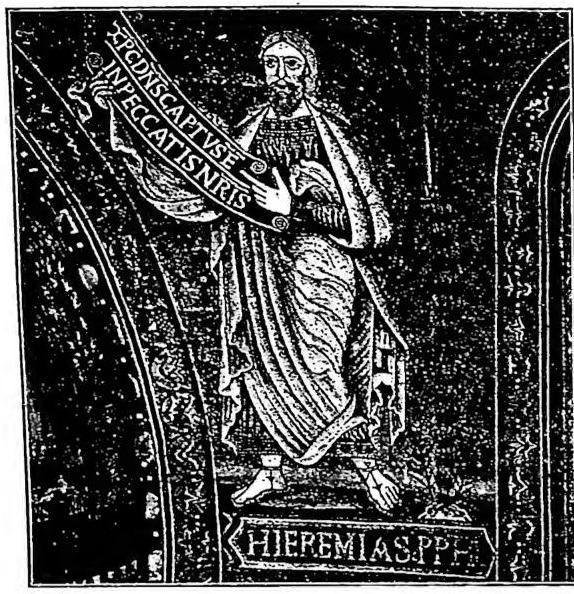
In the mosaic biblical cycle of the Basilica of S. Ambrogio in Milan, the prophet G. was represented as seeing the apparition of the angel in the form of a lamb, as is learned from the illustrative distich (v. Forcella, ed. E. Seletti, Iscrizioni di Milano anteriori al sec. IX, Codogno 1897, no. 227).Also in mosaic is the haloed image of the prophet in the Basilica of S. Vitale in Ravenna (sixth century). The prophet is likewise depicted in a miniature of the eighth or ninth century in the codex of Cosma Indicopleuste (C. Stornaiolo, Le miniature della topografia cristiana di Cosma Indicopleuste, cod. Vat. greco 699, Milan 1908, pl. 38), and in Syriac manuscript 341 of the Bibliothèque nationale in Paris (seventh-eighth century); there, to the right of G., the divine hand rises upward, while below is represented the “watching rod” (Jer. 1:11).
The prophet is also represented in the mosaic on the front of the apse of the Basilica of S. Clemente in Rome (twelfth century; Wilpert, Mosaiken, p. 522) and in that, likewise Roman, of S. Maria in Trastevere (G. B. De Rossi, Musaici cristiani delle chiese di Roma anteriori al sec. XV, Rome 1899, pl. 30).
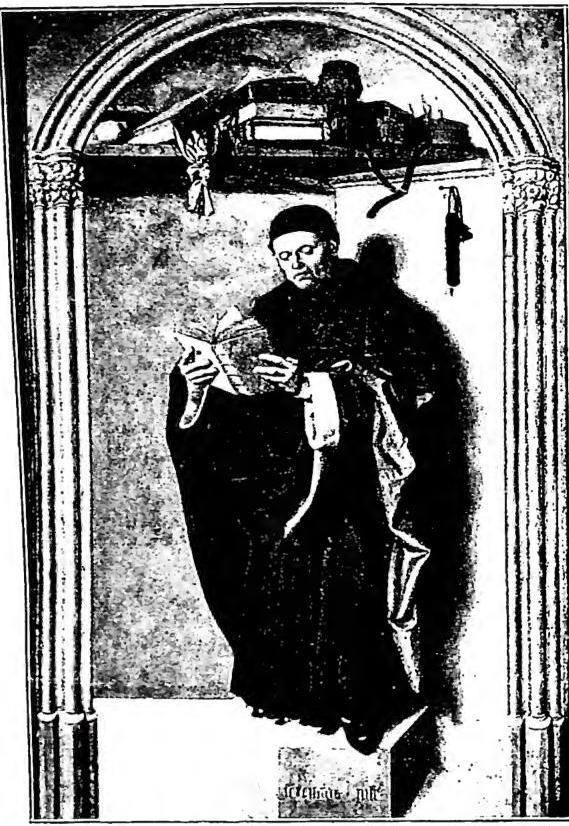
After being introduced, together with the effigies of the other prophets, into the iconographic program of monumental Gothic portals, from the beginning of the thirteenth century his image was individualized by the addition of his name and of some passage from his prophecies. Among the individual representations, in the field of sculpture, there should be mentioned the statues by Claus Sluter (Dijon, Well of Moses), by Donatello (Florence, bell tower of the Duomo), and by Andres Sansovino (Loreto, Holy House); in that of painting, besides the canvases of Perugino and Moretto, first and foremost Michelangelo’s unforgettable figure in the Sistine Chapel, Rembrandt’s painting (Moscow, formerly in the Stroganoff collection), and, in the modern age, a painting by Lesser Ury (Berlin 1897), in which G. is collapsed on the ground beneath the starry sky. As regards the cyclical illustrations of the Bible, the only one to adorn the entire text of the book of G. with miniatures, from his invocation to his stoning, was the Catalan Bible of S. Pere de Roda (ca. 1000). — Vedi tav. VII.
IV. LETTER OF G
An exhortation against idolatry in 72 verses, absent from the Hebrew canon, which in the Greek Bible is found after Lamentations, with the title Ἐπιστολὴ Ἱεραμίου. In the Vulgate it appears as the final chapter (6th) BARÙ (v.). In a realistic, at times witty manner, it describes the worthlessness of idols. The pressing admonition would be, as the Greek subtitle explains, addressed by G. “to those who will be led captive to Babylon.”Its authenticity is denied not only by the Jews, but also by all modern rationalists. Generally, they regard it as an apocryphal work originally written in Greek (a fairly elegant Greek) during the Ptolemaic period (W. Naumann, E. H. Gifford, E. S. Artom).
For Catholics, the canonicity of the Letter of G. is readily demonstrated by the allusion in II Mach. 2:1–3, by the work’s presence in the Septuagint version, and by its use by the Fathers. Internal reasons in favor of great antiquity and probable Jeremian authorship are: 1) the Greek text presupposes a Hebrew original, as independent critics also acknowledge (Naumann, Artom, O. Eissfeldt); 2) the accuracy with which Babylonian idolatry is described is difficult to reconcile with an origin later than the disappearance of the Babylonian Empire; 3) a certain stylistic resemblance between the letter and the book of G. Nevertheless, while canonicity is defined dogmatically, the question of literary authenticity remains open. It was already denied by St. Jerome (In Ieremiam prol.: CSEL, 59, p. 3) and more recently by A. Robert.
The subject of the book is very simple. As the catastrophe of Jerusalem approaches, G. receives the order to hide the sacred vessels and then proceed to Babylon with the deportees. During the preparations, Abimelech (the name is derived from the Ethiopian Abdemelech of Jer. 38:7) falls asleep and remains in a state of lethargy for 66 years. Finally, Baruch, by divine command, announces to G. the restoration of Jerusalem with the return of the deportees. The booklet reveals the customary anti-Samaritan spirit: it asserts that Samaria was founded by Jews who resisted the divine law, especially with regard to the prohibition against marrying foreign women.