
NEW COVENANT. — Jewish sect, of which an incomplete Hebrew codex gives notice, discovered in the winter of 1896–97 and published in 1910 by S. Schechter, today commonly called the « ṣādhōqite document ». Founded by the « Teacher of Righteousness », under the guidance of the « one Messiah », it emigrated from Jerusalem to Damascus, apparently because of internal conflicts within the priestly class, from which the sect arose, and as a result of which the new community, while retaining the priesthood, came to be directed by laymen. The leader of the opponents of the « n. a. » is a « man of falsehood », who is reproached with seducing the people into avarice, lust, and profanation of the Sanctuary. For the « end of days » another « Teacher of Righteousness » is expected. The adherents, called « penitents » and « sons of Ṣādhōq », are required to observe various practices that regulate their lives in minute detail: observance of the Sabbath, feasts, fasts, monogamy, etc.
The origin of the sect, and its chronological and ideological place within the Israelite world, remain open questions. The data offered by the document itself (1, 5 ff.), which would place its foundation in 196 B.C. (« 390 years after the destruction of Jerusalem » in 586 B.C.) and the emigration to Damascus in 176 B.C., in the midst of the Hellenistic period, are the most commonly used, at least as a general indication; some scholars, however, regard them as purely literary data (especially in relation to Ez. 4, 5), lacking documentary value. Some think generally of the Seleucid period (P. Kahle), others more specifically of the Maccabean age (B. Reicke), and others of the age of Christ (R. Eicler; J. Schonsboe). In different ways, connections have also been made with the currents known from religious history: Sadducees, Pharisees, Dositheans, Karaites.
A new complication in the problem has been introduced by the Hebrew texts of the « apocryphal » type discovered in the cave of 'Ajn Fešḥah, first of all the one entitled Guerra dei figli della luce contro i figli delle tenebre and the collection of Hymns, both partially edited by E. L. Sukenik. Between these two documents and the ṣādhōqite one, notable points of agreement have been found in expressions peculiar to them, which led J. Tournay (v. BIBLICA., pp. 216 ff., 226, 232 f) to affirm their common origin (« a literary corpus belonging to the same sect », p. 232) and to advance the hypothesis that, in placing it within history, one should think of a Jewish insurrectionary movement from the period of the Roman penetration (the Kittim) into Syria-Palestine, which at particularly grave moments, close to military actions (Pompey’s conquest; Titus’s war), strengthened its intentions of armed resistance, or at least of isolation in defense of its spiritual heritage. Only the complete publication of all the documents and a thorough study of them will be able to shed light on the subject.
Giovanni Rinaldi
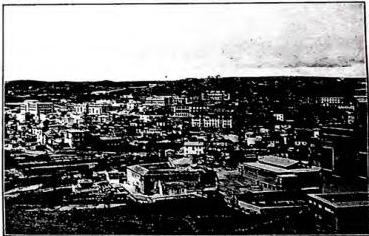
NUORO, DIOCESI di — Panorama of the city.
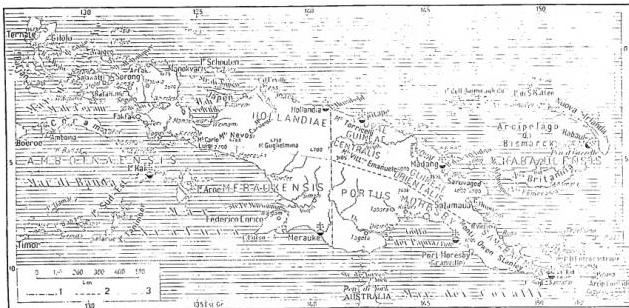
NUOVA GUINEA – 1) Boundaries of a state or colony; 2) boundaries of a territory of the Australian Confederation or of a trust administration; 3) boundary of an ecclesiastical jurisdiction.