
JERUSALEM. - Principal city of Palestine, religious capital and center of biblical history.
SUMMARY:
I. Ancient history
II. The patriarchate of J
III. The Council of J
IV. Hagiography and liturgy -V. Archaeology
VI. Art.I. ANCIENT HISTORY.
SUMMARY: I. From the origins to David’s conquest (3000-1000 B.C.). - II. From David’s conquest to the destruction (1000-587 B.C.). - III. From the rebuilding by Nehemiah to the destruction of 70.
I. FROM THE ORIGINS TO DAVID’S CONQUEST (3000-1000 B.C.). - The opinion, common until half a century ago, which placed the origins of J. on the western hill, traditionally known as Mount Zion, no longer has any supporters. It is now an uncontested fact, established by historical and archaeological scholarship, that primitive J. arose on the eastern hill, precisely on the southern spur conventionally called Ophel. To the natural defense afforded by this hill’s steep slopes, clearly bounded by the deep valleys of the Cedron to the east and the Tyropaeon to the west, by an impassable escarpment to the south, at the confluence of the two valleys, and by a natural depression, easily reinforced, to the north, there was added the vital advantage of proximity to the city’s only spring, the biblical Gijon (v. : today called ‘Ajn Sitti Marjom’, “fountain of Our Lady Mary,” or Umm ed-Dereg, “mother of the steps”).
In the caves adjoining this spring, the indigenous inhabitants took shelter for centuries, from the Lower Paleolithic period until historical times, until they were supplanted or absorbed by a population of higher culture, acquainted with metal, which invaded Palestine in the course of the fourth millennium B.C. and which the Old Testament later calls, in a term more geographical than technical, Canaanite. The abundant series of stone tools and pottery collected in the burial caves of Ophel, classified from the end of the Chalcolithic age through the beginning and the whole duration of the Early Bronze Age, constitutes concrete evidence of the primitive urban nucleus on the hill during the third millennium. The so-called “execration texts,” composed in Egypt around 1900 B.C., revealed that the Canaanite city already bore the name Uridalem (“foundation of the god Salem”). The great ethnic movements of the second millennium also had repercussions in J., and the change observed in the technique of pottery and construction attests to the settlement of a new ethnic element.
The Amorite clan of the Jebusites, recognizing the importance of the Gihon spring, settled on the hill above it, extending farther north, and added to the natural defenses a powerful circuit of walls, strengthening the weakest, northern section with towers, just south of the present wall of el-Haram es-Serif. In the center of the hill, on the acropolis, called Zion by its indigenous name, it established the royal palace and the Sanctuary, and provided a water supply in case of siege by constructing the secret passage (the Ophel tunnel) which, from within the city, made it possible to draw water from the Gihon spring.
It was here that Melchizedek, priest of the Most High, exercised his sovereignty, according to a Jewish tradition (Fl. Josephus, Antiq. Ind., I, 10, 2), at the time when Abraham was traversing Palestine as a nomad (Gen. 14, 17).
After falling under Egyptian influence with the victory of Thutmose III, the Jebusite Urusalim (thus called in the el-Amarna letters, ca. 1400 B.C.) had a mixed population (Ex. 16, 3: “your father was an Amorite and your mother a Hittite”) and was governed by vassal princes of the Pharaoh. The Hittite prince ‘Abd-Hiba, from atop his fortress, asked the Pharaoh for help in defending Bit Sulman, the capital, against the assault of raiders. At the time of the Israelite invasion, King Adonizedek, having placed himself at the head of a confederation of Amorite kings, attempted to oppose the enemy’s advance. Although defeated and put to death by Joshua (Ios. 10, 26), he left the capital sufficiently strong to withstand (Ios. 15, 8.63) and keep the conquerors at a respectful distance (Indc. 19, 12) until the year 1000.
II. FROM DAVID’S CONQUEST TO THE DESTRUCTION (1000-587 B.C.). - David (v.) decided to unite the various divisions of the people, the independence of Urusalim, isolated among the neighboring tribes of Judah and Benjamin (Ios. 15, 8; 18, 16), was jeopardized by the fact that it occupied the site most suited to becoming the political and religious center of the Kingdom. The well-fortified city could have resisted David’s army’s siege for a long time had the secret passage (sinnōr), which connected the spring with the city, not provided the route by which Joab was able to enter and capture the city by surprise (II Sam. 5, 8; I Par. 11, 5). The victor’s first concern was to repair the walls around the hill (a tower and a strengthening of the wall above the Gihon spring are identified as Davidic works), and with the materials and workers sent by King Hiram of Tyre he created the royal palace in the center of the acropolis of Zion, which, having become his property, was called “the city of David” (II Sam. 5, 9). But what contributed to making J. the capital was the transfer of the Ark of the Covenant from Cariathiarim to Zion and the erection of an altar on the threshing floor of the Hittite Ornan, where the angel had appeared on the occasion of the plague (II Sam. 24, 16).
But the Davidic city, still confined within the Canaanite perimeter, could not satisfy Solomon’s ambition. He therefore shifted its center northward, to Moriah, by creating the vast platform of the present-day Haram eš-Šerif, on which workers sent by King Hiram of Tyre built the magnificent Temple (I Reg. 5-8). Almost at the center of this area, the “dome of the rock” (the mosque of ‘Omar) now covers the bare rock on which “the altar of burnt offerings” was placed; somewhat farther west stood “the house of Jahveh,” amid vast courtyards (I Reg. 6, 36; Ier. 36, 10). South of the esplanade where the el-Aqṣā mosque now rises were the royal palace, the palace for Solomon’s daughter, the government quarter with its administrative offices, and the judicial court (I Reg. 7, 12).
By means of a great embankment or millō' (I Reg. 11, 27), the city of David was joined to the new city, and by a new wall (called “the first wall” by Fl. Josephus, Bell. Iud., V, 4, 2), the new dwellings that had arisen on the slopes of the western hill were incorporated into the city. The “first wall,” whose foundations remain visible, especially in the eastern section, ran north of the present Jaffa Gate as far as the entrance to the Haram eš-Šerif called Bāb es-Silsileh, and encircled the entire city (called in Hebrew phonetics Jērūšālajim) along the ridge of the hills overlooking the valleys of the Cedron and the Hinnom.
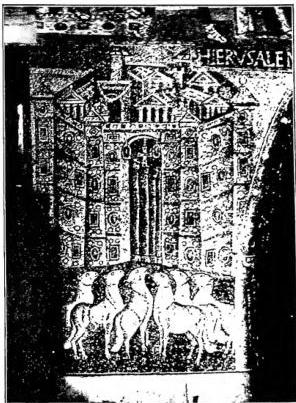
In 842 the impious Athaliah usurped the throne and exterminated the Davidic line (II Reg. 11, 4); Joash, who escaped her, gave himself over to idolatry, while Hazael, king of Syria, invaded the city and did not withdraw until he had received the abundant riches of the Temple treasury and the royal palace (II Reg. 12, 17-18).
At the beginning of the eighth century, under Amaziah, King Joash of Israel breached the northern wall over a length of 400 cubits
(Ist. Enc. Cutt.)
GERUSALEMME — The city of G. with the symbolic sheep. Detail of the mosaic of the triumphal arch of the basilica of S. Maria Maggiore (432–40) — Rome.
north gate “between the gate of Ephraim and the corner gate,” and carried off to Samaria the gold, silver, and precious vessels of the Temple (II Reg. 14, 13–14). King Azaria (782) undertook the restoration of the walls, equipping with towers “the corner gate and the valley gate” (II Par. 26, 9), but an earthquake again devastated G. (Am. 1, 1; Zach. 14, 15), and the desolation would have been complete had Ioatham (738) not seen to the fortifications, already begun by his father, especially in the area of Ophel (II Reg. 15, 35; II Par. 27, 2–3).
King Achaz (736) once again impoverished the city, purchasing with lavish gifts the assistance of the king of Assyria against the king of Damascus and the king of Israel, who had conspired against Judah (II Reg. 16, 5). On this occasion the prophet Isaiah confronted the King “at the end of the aqueduct of the upper pool,” uttering the famous prediction of the 'almāh (Is. 7, 3–14).
After Samaria fell in 721, the capital received many refugees, who increased the population of the mišneh quarter, or new city, 'ir mišneh (II Reg. 22, 14; II Par. 34, 22; Neh. 11, 14), which had begun to form outside the city walls. On the eve of Sennacherib’s invasion, Ezechia (716) protected it by creating a new circuit of walls (“the second wall”) which extended from the Gennat Gate, near the Jaffa Gate, Antonia (v.) and left the hill of Golgotha outside it (II Par. 32, 2–5). But this King’s principal work was the excavation of an aqueduct approximately 550 m. long through solid rock, to carry the waters of the upper Gihon to the pool of Siloam, thereby depriving the Assyrian invaders of access to the city’s water supply. The tunnel, a truly considerable undertaking for the seventh century, is still functioning. An inscription found in 1889 at the outlet of the aqueduct describes this hydraulic work.
His successor Manasse (687) likewise repaired the city’s fortifications (II Par. 33, 14–16), especially in the region of Ophel and along the Temple’s north-eastern front “as far as the Fish Gate.” But all these precautions proved useless in the face of the attack launched in 587 by the troops of Nabuchodonosor, who put the city to fire and sword, deporting the king and most of the inhabitants to Babylon.
III. FROM NEHEMIAH’S REBUILDING TO THE DESTRUCTION OF 70
After the liberating edict of Cyrus (538), the Jews who had returned to their homeland repaired the altar of burnt offerings and, on the foundations of Solomon’s Temple, rebuilt “the house of the Lord,” or Second Temple (Eid. 3, 1–13); in 444, under the direction of Nehemiah, the city walls were rebuilt (Neh. 3, 1–32). Under the authority of the high priests and the Persian satraps, although the city regained the extent of the ancient one, it was sparsely populated and had little political importance. In 331 Alexander the Great conquered it; after his death G. passed under the protection of the Lagids and was subsequently subject to the Seleucids.In 168 IV (v.) Epiphanes plundered the city, profaned the Temple, suspended its sacrifices, and established himself with his garrison in the citadel, Acra (v.), probably to the north-west of the Temple (I Mach. 1, 20–58); the Hellenization of the city would have been complete without the Maccabean reaction. After three years of bitter struggle, Judas Maccabeus (165) regained control of the Temple, which the style of the period honored with the title of Mount Zion (I Mach. 10, 1–8), and to the north-west built the Baris fortress to defend the Temple area. Jonathan, his successor (160), taking advantage of internal conflicts in Syria, reoccupied part of the city and repaired the quarters plundered by Antiochus (I Mach. 6, 18–62), while Simon completed the fortification works and in 142 reduced the Syrian fortress, the Acra, to silence (I Mach. 13, 49).
During the Hasmonean reign, “G. the holy,” as it is inscribed on the shekel of Israel, enjoyed a period of prosperity, later disturbed by the internal struggles between Aristobulus II and Hyrcanus II, which brought about Roman intervention. In 63 Pompey made G. tributary to Rome, and in 37 Herod (v.) the Great, with the support of Augustus, seized the kingdom. Of the many transformations the city had undergone, none was more profound than that carried out by this monarch. The general plan reflected that of Nehemiah, but the buildings were conceived according to Greco-Roman inspiration: an agora, a theatre, an amphitheatre, and a hippodrome were constructed.
On the western hill, or “upper city,” the royal palace was built, defended on the north by a high wall and flanked by three very tall towers, which Herod named Hippicus, after one of his friends; Phasael, in memory of his elder brother; and Mariamne, in remembrance of the unfortunate wife whom he had loved so greatly. The magnificence of these constructions can still be admired in the foundations of the so-called “Tower of David,” or citadel, brought to light in the excavations of 1934–39.
On the eastern hill, or “lower city,” at the north-western corner of the Temple, Antonia (v.) was built on the foundations of the Hasmonean Baris, in honor of the Roman triumvir Antony. Surrounded by a formidable moat, it was a vast palace with porticoes and gardens, whose plan has been identified by recent excavations, especially the large paved floor believed to be the Lithostrotos (Io. 18, 25), where Jesus was condemned by Pontius Pilate.
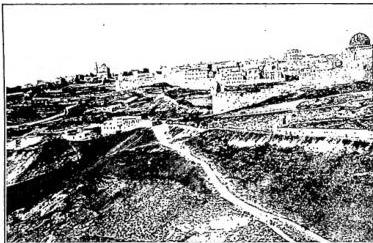
After Herod’s death, his son Archelaus reigned for a few years with the title of ethnarch, but because of the bloody suppression of the Jewish revolt, which cost more than 3,000 victims, he was recalled to Gaul.
(courtesy of Msgr. A. P. Frutuc)
GERUSALEMME - South-east side of G. with the valley of the Cedron.
Government returned under the Roman procurators, and G. even lost its status as capital, which passed to Caesarea (v.) of Palestine. In A.D. 25 the emperor Tiberius appointed Pontius Pilate (v.) procurator; he condemned Jesus in order to please the Jews, who nevertheless came to hate him because he had dared to display the Roman standards and to withdraw from the Temple treasury the sums needed for the construction of the aqueduct which brought water to G. from the springs of Ethan. Among the places mentioned in the Gospel, the pool of Siloc (Io. 9, 7) and that of Bezetha (v. Io. 5, 1) are certainly known. The garden of Gethsemani and the Cenacle are guaranteed by ancient tradition; but the site of Jesus’ religious trial in the palace of Caifa and of the civil trial at the praetorium still remains uncertain.
Golgotha, a rocky knoll outside the walls near a gate of the city, where Jesus was crucified and then buried nearby, is today within the city, because in 44, under the reign of Herod Agrippa, the city, having expanded into the region of Gareb and Bezetha, was enclosed on its northern side by the “third wall,” which followed approximately the direction of the present wall.
In 1925–27 certain archaeologists thought they had rediscovered the “third wall” much farther north than the present one; but, as H. Vincent observed, the poor technique of the construction, using reused material, seems to bear the imprint of hasty work and does not correspond to the description given by Flavius Josephus.
At the death of Herod Agrippa, G. was again governed by Roman procurators, but the rapacity of Gessius Florus (64–66) caused the terrible conflagration to flare up by which G. was to be destroyed.
To quell the revolt Nero sent Vespasian, who, having become emperor, entrusted the continuation of the undertaking to his son Titus. The first attacks (31 March 70) were directed against the third wall on the western hill defended by Simon of Gerasa; then the second wall defended by John of Giscala was attacked, where, after five days of siege, a breach was opened. The population, with the enemy at the gates and civil war within, suffered the horrors of famine, but the army continued to resist vigorously; finally, after a few weeks, the fortress of Antonia having been stormed, the Romans took possession of the Temple hill and subsequently of the upper and lower city. The Temple, against Titus’ wishes, was set on fire, and all the rest of G., except for the towers of Hippicus, Phasael, and Mariamne, was destroyed (Aug. 70).
In memory of that triumph, immortalized in Rome by the arch of Titus, a coin was struck bearing the inscription ludaea capta.
On 15 May 1948 the Jews again proclaimed the State of Iraele in Palestine, with G. as its capital.
II. THE PATRIARCHATE OF G.
SUMMARY:
I. From the beginnings to the Arab invasion (638)
II. From the Arab invasion to the conquest by the Ottoman Turks (638–1516)
III. From the Turkish conquest to the present day
IV. The Greek-Catholic or Melkite patriarchate
V. The Latin patriarchate
VI. The other Christian communities.I. FROM THE BEGINNINGS TO THE ARAB INVASION (638)
Although G. was the cradle of Christianity, the patriarchate of G. nevertheless did not attain the importance of the other Eastern patriarchates. It arose last and took and retained the last place among the others.The first bishop of G. was St. James the Less, the “brother” of the Lord. His successor Simeon witnessed the destruction of the city by Titus (70). Until the second destruction, in the time of the rebellion of Bar Kocheba, thirteen more Jewish-Christian bishops are counted. In the pagan city of Aelia Capitolina, founded in 135, Christians of pagan origin apparently settled at an early date. That Church was subject to Caesarea of Palestine as its metropolis. Bishop Narcissus, at the Council of G. held in 190 over the question of Easter, occupied second place immediately after the metropolitan of Caesarea. During the long period of peace in the third century, pilgrimages to the Holy Land had already begun. G. acquired greater importance after the peace granted by Constantine to the Church. Canon 7 of the Council of Nicaea recognizes for G. a primacy of honour, while nevertheless insisting on the rights of the metropolitan of Caesarea. Emperor Constantine had the basilica of the Resurrection built. The Holy Places attracted many pilgrims and monks, and G. became a centre of monasticism. The liturgy of the Holy City exercised a very extensive influence. In the fourth century G. was involved in the Arian disputes. The most eminent bishop of that time was St. Cyril (351–76). The Origenist disputes and the controversy concerning Pelagianism reached G. in the time of Bishop John II (387–417). The struggle over Origen divided St. Jerome and Rufinus, who had then settled in the vicinity of the city.
Bishop Juvenal (422–58) obtained at the Council of Chalcedon (451) that G. should be separated from Antioch and declared an independent patriarchate; Palestine was subjected to it, but not Phoenicia or Arabia. Rome protested in vain against this decision of the Council. The disputes over Monophysitism also affected Palestine, but did not cause there a lasting division as they did at Antioch and Alexandria. It was largely owing to St. Sabas that orthodoxy was maintained in Palestine. G. relied against its powerful neighbours (Antioch and Alexandria) upon Constantinople, following the faith of that city. This drew it into the Acacian schism in 482–518. The monks of the monasteries of G. and its surroundings took an active part in the Origenist disputes, which led to the condemnation issued by the third Council of Constantinople (553).
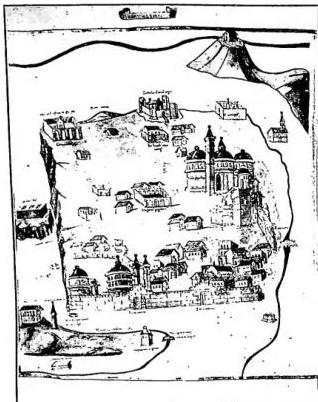
II. FROM THE ARAB INVASION TO THE CONQUEST BY THE OTTOMAN TURKS (638–1516)
S. Sofronio had to negotiate with the Arab conqueror ‘Omar, who granted G. a relatively favourable treaty. The distrust of the conquerors toward the orthodox adherents of the faith of the Byzantine Emperor prevented the election of a patriarch for 68 years. The Church was then administered by vicars, who maintained relations with Rome or Constantinople. At that time Rome made great efforts to ensure the continuity of the hierarchy of G. and to protect it against monothelitism. In the controversy over iconoclasm G. remained faithful to Rome and to the true faith. The most strenuous champion of the veneration of sacred images, s. Giovanni Damasceno, lived as a monk in the convent of s. Saba in the vicinity of G. Patriarch Teodoro I condemned iconoclasm at the synod of 763, together with the patriarchs of Antiochia and Alessandria. Carlo Magno appears to have acquired a right of protectorate over the Holy Places of G. In his time a Latin convent was founded on the Mount of Olives, whose inhabitants disputed over the Filioque with the Greek monks of the Convent of s. Saba. At the Ecumenical Council of Constantinople of 869, the delegate of the patriarch of G., Teodosio (862–78), declared that the latter would never recognize Fozio. The victories of the Byzantines in the latter part of the 10th century worsened the situation of the Christians of G. In 966 the Arabs plundered the church of the Resurrection and killed Patriarch Giovanni VII. The plan of Emperor Giovanni Tzimisces to conquer G. failed. Persecution reached its height under the Fatimid Hâkim (1005–20). The church of the Resurrection was destroyed in 1010. The Byzantine emperors obtained permission through negotiations to rebuild it, and the reconstruction was completed in 1048.In the period of the schism of Michele Cerulario, relations between Constantinople and G. were excellent, since the Christians of the Holy City relied upon the aid they were to receive from the Byzantines against the Muslims. It is difficult to establish exactly what the attitude of the patriarch of G. was toward the schism of Constantinople. The capture of G. by the Seljuks (1071) worsened the situation of the Christians. The crusaders, who conquered G. in 1099, behaved toward the Greeks with less prudence, although much of what is said against them is exaggerated. The election of a Latin patriarch while the Greek Simeone was still alive, and the extensive Latinization of the patriarchate, were bound to embitter the Greeks. During Latin rule in G., the Greek patriarchs generally resided in Constantinople and were appointed by the emperor; this proves that at that time they were schismatics. Within the patriarchate, however, clergy and people were officially regarded as Catholics. After the Muslims under Saladino retook G. in 1187, the Greek patriarchs returned there, and from that time onward the patriarchate was undoubtedly schismatic. Even at the time of the Council of Lyon (1274), the patriarch of G., Gregorio, showed himself opposed to the Union. Under the rule of the Mamluk sultans, the condition of Christians in Palestine was very harsh. At the Council of Florence (1439), Patriarch Gioacchino of G. was represented by Dositeo di Monembasia, who signed the act of Union. But, as it appears, the patriarch repudiated that Union already at the Synod of G. of 1443.
(fol. Vatican Library)
GERUSALEMME - Perspective plan of the city drawn by Jacopo Angelo Fiorentino (1472) - Vatican Library, cod. Urb. lat. 277, f. 132v.
III. FROM THE TURKISH CONQUEST TO THE PRESENT DAY
The Ottoman Turks, who conquered Palestine in 1516, completely subjected the patriarchate of G. to that of Constantinople. They favoured the Greeks, whereas the Mamluks had pursued a policy hostile to them. Since the 16th century, the Church of G. has been dominated by the Greek Brotherhood of the Holy Sepulchre, composed of monks from the principal monasteries. Almost the entire people and lower clergy, however, are Arabic-speaking.Elsewhere there is discussion of the dispute concerning the Holy Places between the Greeks and the Custody (v.) of the Franciscan Holy Land. An important patriarch in the 17th century was Dositeo (1669–1707), known for his struggle against Protestantism (condemned at his initiative by the Synod of G. in 1672) and for his Confessio Fidei, strongly influenced by Latin theology.
The more recent history of the patriarchate is marked by growing Russian influence and by continual disputes concerning the Holy Places. In the 19th century Protestants too established themselves in G., beginning in 1833. In 1840, King Frederick William IV of Prussia, in agreement with the British Crown, established a Prussian-Anglican bishopric in G. This hybrid organization did not last long. In 1888 the English founded a bishopric of their own. More recently the YMCA has carried on intense and harmful activity.
The Orthodox patriarchate, especially in recent decades, suffered serious internal difficulties. The old opposition between the Greek leadership of the Church and the Arab people became more acute at the beginning of this century. In 1908, after the Young Turk revolution, the Arabs insistently renewed their demands, requiring the abolition of Greek privileges. Patriarch Damiano, who
showed himself ready to make concessions, was deposed by the Holy Synod, but ultimately remained in office. After the First World War, the patriarchate of G., owing to the loss of Russian subsidies, found itself in a very precarious situation. The British Mandatory government had to settle the dispute between the Arabs and the Church leadership, publishing in 1938 a Church Constitution intended to replace the fundamental law of 1875. Although the Constitution takes account of Arab aspirations, it is nevertheless rejected by them as insufficient. The present patriarch, the Greek Timoteo Themelis, elected in 1935, was recognized by the Mandatory government only in 1939 and still encounters opposition among the Arab faithful.
The patriarchate of G. has six metropolitan sees and eight archbishoprics, now for the most part merely titular. It comprises the territory of Palestine and Transjordan; it has 40,000 faithful in Palestine and 20,000 in Transjordan. The lower clergy are poorly educated, and the care of souls is greatly neglected.
IV. THE GREEK-CATHOLIC OR MELKITE PATRIARCHATE
Since 1763, Catholics of the Byzantine rite in Palestine have been subject to the Melkite patriarch of Antiochia. In 1838 Pope Gregorio XVI conferred upon Patriarch Massimo III Maglüm the personal title of patriarch of G. In fact, the present patriarch also uses such a title. He is represented in G. by a vicar. Apart from the patriarchal diocese, there is another bearing the title of S. Giovanni d'Acri, with Caifa as the episcopal residence. In 1932 the diocese of Filadelfia was erected in Transgiordania, with its see at 'Ammân. For the formation of the clergy, the Seminary of S. Anna, directed by the White Fathers, exists in G. The number of faithful is about 20,000 in Palestine and 4,500 in Transgiordania.V. THE LATIN PATRIARCHATE
It was founded after the conquest of the Holy City by the Crusaders (1099). Since the Latins were masters of the country, it is understandable that they wished to have a Latin patriarch, although this measure was not very well suited to winning the sympathy of the Greeks. When in 1187 G. was conquered by Saladin, the Latin patriarch had to leave his post. From 1191 until 1291, 'Akkâ (S. Giovanni d'Acri) was the seat of the Latin patriarchate, except for the period between 1229 and 1244, when the patriarchate was able to reside in G., recovered by Federico II. In 1262 the bishopric of 'Akkâ became the patriarch’s own diocese. After the fall of the city, however, the patriarch took refuge in Cyprus. From the 14th century the patriarchate became purely titular.In 1847 Pio IX, by the apostolic letter Nulla celebrior of 23 July, re-established the Latin patriarchate of G. To understand this decision better, it should be noted that the Melkite Catholics were not in a position to work effectively for the conversion of the schismatics in Palestine, and that it was desired to give an appropriate title to the head of the Latin Church in G.
The Latin patriarchate has a well-trained and zealous clergy, largely indigenous. It numbers 21,000 faithful in Palestine and 6,000 in Transjordan. It also has a veritable army of religious men and women, numbering approximately 1,770. The island of Cyprus likewise belongs to the Latin patriarchate. The total number of faithful throughout the patriarchate is around 40,000. The patriarchate is now subject to the Congregation for the Eastern Church.
Various Catholic centres for biblical and archaeological studies should be mentioned: the Ecole biblique et archéologique française
of the Dominicans of the Convent of S. Stefano, who publish there the Revue biblique; the Pontificio istituto biblico of the Jesuits; the Istituto biblico of the Franciscans and that of the Spanish Benedictines of Monserrato; the Oriental Institut of the « Görresgeschellschaft ».
Alongside these, it is fitting to recall others, although of a different religion, for their excellent work and costly research: the Deutsches evangelisches Institut für Altertumshunde des hl. Landes; the American School of Oriental Research, the British School of Archaeology, the Palestine Jewish Exploration Society, the Palestine Oriental Society.
VI. THE OTHER CHRISTIAN COMMUNITIES
The Holy Places attract all Christians without distinction. The Monophysite Jacobites have had a bishop in the city since the end of the sixth century; there they subsequently acquired the Convent of S. Marco, with a celebrated library rich in manuscripts and a printing press.The Syrian Catholics, the Chaldeans, the Armenian Catholics, and the Maronites have their own patriarchal vicar in G. A Coptic bishop has resided in the city since the eleventh century. He is now superior of the Coptic convent near the Holy Sepulchre, where there is also an Ethiopian monastery. Since 1175 the dissident Armenians have had an archbishop residing in the Convent of S. Giacomo on Mount Sion. In 1311 this archbishop assumed the title of patriarch. The Russians possess several convents in G. and, outside the gates of the city, a cathedral, as well as a hospice for pilgrims (recently, Russian properties situated in the Jewish zone have passed into the hands of the Soviet government). The Anglicans have a bishop there who governs the entire « diocese of G. » established by them (cf. C. Crivelli, La « diocesi » anglicana di G., in Civ. Catt., 1943, iv, pp. 159-65; 235-41).
### III. IL CONCILIO DI G.
Around 49-50 the Apostles and presbyters gathered in Jerusalem to decide Judaizers (v.). They demanded that the pagans converted during Paolo’s first apostolic journey be subjected to circumcision and to the obligation of observing the Mosaic law (Act. 15, 1).
Paolo and Barnaba were sent from Antioch to Jerusalem to deal with the question. The account of their mission filled those assembled with joy, but the supporters of circumcision did not lay down their arms. At the public session, Pietro, recalling the conversion of the centurion Cornelio, declared Gentile Christians exempt from the yoke of the Mosaic law. Giacomo confirmed this position and proposed a compromise subsequently drafted into a decree: converted pagans were to abstain only from blood, from meat offered to idols (« idolotiti »), from that of animals killed by strangulation (« soffocato »), and from fornication, which, according to several exegetes, denotes certain marriages between relatives forbidden by the Mosaic law.
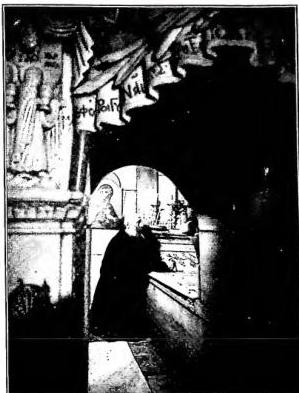
In Gal. 2, 1-10, a passage parallel to Act. 15, Paolo adds several clarifications: he says that he went up to G. as a result of a revelation (which does not exclude the mission of the Church), that he took Tito with him and obtained that he should not be circumcised, and that there was a private session between him and the pillars
(phot. The Associated Press)
GERUSALEMME - Chapel of the Angel, situated at the entrance to the Holy Sepulchre.
of the Church (Giacomo, Cefa, Giovanni), concluded with an agreement for the division of the field of the apostolate.
BIBL: Besides the Commentaries on Acts and Galati, A. Lemonnier, in DBs, II, cols. 113-17. Pietro De Ambroggi
### IV. HAGIOGRAPHY AND LITURGY.
The apostle and martyr Giacomo, first bishop of G., was laid to rest near the Temple, and Egesippo indicates that in his time his stele was still to be seen (Eusebio, Hist. ecc., II, 18). Eusebio reports that in the fourth century his episcopal chair was displayed (ibid., VII, 19), which was later transferred to the church of Sion (Itinera Hierosolymitana, ed. B. Geyer, in CSEL, 38, p. 108). The discovery of the relics of St. Stefano took place at Caphargamala following a dream experienced by the presbyter Luciano. The bishop of G., Giovanni, solemnly deposited the relics of the protomartyr in the church of Sion (BHL, 7850-56; Epistula Luciani, 2-9: PL 41, 809-15). Martirio, bishop of G., on 7 May 483 deposited beneath the altar of the monastery of S. Eutimio relics of the martyrs Taraco, Probo, and Andronico (Vita s. Euthymii: BHG, 647).
In G., even in the sixth century, on the date of 25 Dec. the Nativity of Christ was not celebrated, but rather the commemoration of King David and of the apostle Giacomo, first bishop of the city; thus the presbyter Esichio of G. calls Giacomo the brother of the Lord (Fozio, Bibliotheca, cod. 275: PG 104, 241). When the calendar of G. was reformed, their commemoration was transferred to 26 Dec., the martyrdom of St. Stefano to 27 Dec.; the apostles Pietro and Paolo, moreover, to 28 Dec.; according to the testimony of Sofronio (BHG, 1496), on the 29th came the commemoration of the apostles Giovanni and Giacomo (H. Goussen, Über georgische Drucke und Handschriften..., München-Gladbach 1923, pp. 5-6). In the Martirologio geronimiano, the deposition at G. on 5 Jan. is recalled
of the patriarch Simeone, which in some codices also recurs on 2 Feb.; on 25 March, the martyrdom of the apostle and bishop Giacomo; that is, on the day on which the same Martirologio records the death of the Redeemer; on 1 May, the feast of the bishop Giuda, called Ciriaco, (BHL, 7023-25), who reappears in the account of the discovery of the Holy Cross celebrated on the following day (ibid., 4169-75); on 3 Aug., the finding of the body of St. Stefano; on 30 Sept., in the territory of G., in the fortress of Bethleem, St. Girolamo.
Although it falls, from the liturgical point of view, within the Syrian type, the liturgy of G. displays certain distinctive characteristics. Some ceremonies that were subsequently adopted in all churches originated at G., such as, for example, the procession on Palm Sunday. The most important text for reconstructing the liturgy of the Church of Jerusalem is undoubtedly that of the Peregrinatio Egeriae. At Rome the stational liturgy took place
at the tombs of the martyrs, as attested by the Sacramentario leoniano; at G. the stations were held at the very places sanctified by the presence of the Redeemer; they thus had a markedly topographical character; all the events of the Lord's earthly life that had taken place in G. were recalled and, as it were, liturgically relived, also through the reading of those passages from the Gospels that recounted them. Cassiano, St. Cirillo of G., and Egeria provide information concerning the chanting of the Salmi; the cantor recited or sang the psalm alone, and the choir of the faithful repeated one of its verses or a portion of II. The antiphons consisted in the alternate chanting of the psalm verses by two choirs.
The psalms were all selected as appropriate to the time and place, so as to recall the different mysteries of the Life, Passion, Death, Resurrection, and Ascension of the Lord.
In the basilica of the Anastasis, at the vigiliae celebrated there on almost every day of the year, monks and consecrated virgins were obliged to attend. Wednesday and Friday were days of Eucharistic synaxis, station, and fasting, also for catechumens; the Office of None was celebrated in the church of Sion, all the others at the Anastasis.
On Sundays there were no Offices of Sext and None. Other modifications occurred on the Sundays of Lent and at Pentecost.
The bishop, clergy, and people of G. went to celebrate Christmas on 6 Jan. in the church of the Nativity at Betlemme, 6 miles distant from G. After the chanting of the vigiliae, they returned to G.; the monks on foot, chanting the Benedictus qui venit. At dawn they entered the church of the Resurrection.
The feast of the Purification was solemnly celebrated in the Ana-
stasis, like Easter. For the ceremonies of Holy Week, V. voce.
The « encenie », as the feast of the dedication of the Anastasis, celebrated on 13 Sept., was called, was a very solemn feast, attended by bishops and faithful from Syria, Egypt, and Mesopotamia on pilgrimage.
Enrico Josi
V. ARCHAEOLOGY.
Christian monuments. — The systematic destruction of the settlement of G. carried out by the troops of Tito in A.D. 70 and later, again by the Romans, in order to suppress the revolt of Simeone bar Kôkhêba in 132, causing the disappearance of imposing and celebrated monuments, certainly did not halt before far humbler buildings, such as those in which the first Christian community could then have celebrated its services
(fot. The Associated Press)