
ISRAELE. - Official designation assumed by the independent Jewish State that replaced the British mandate over Palestine in 1948.
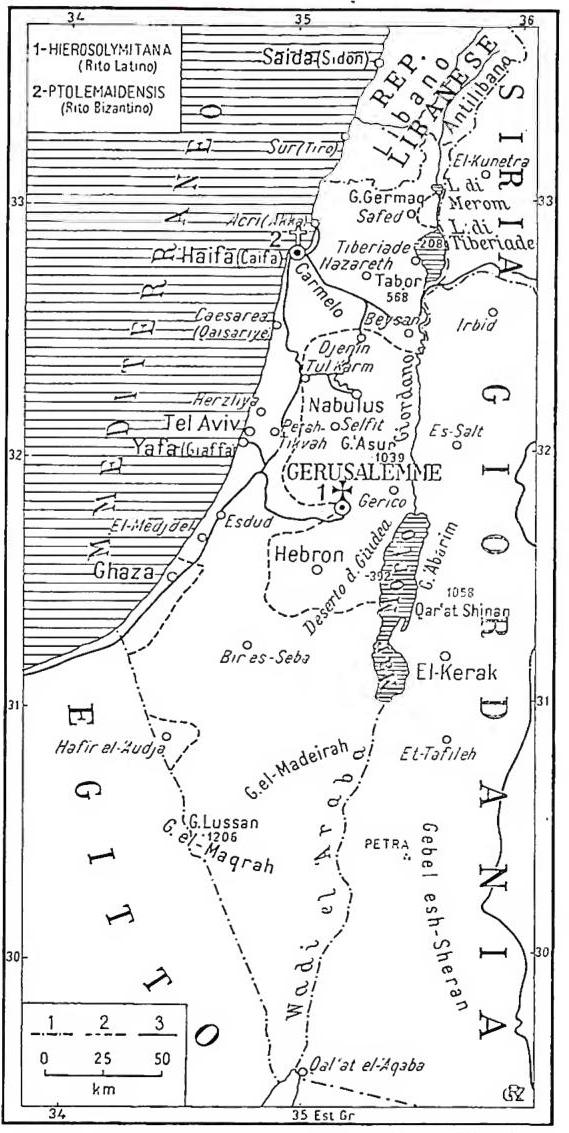
ISRAEL - 1) State boundaries; 2) limits of the Arab occupation zones; 3) railways.
I. GEOGRAPHY
Located in Western Asia, along the Mediterranean, between Lebanon, Syria, Transjordan, and Egypt, this State has an area of 27,000 sq. km. (including 704 sq. km. of inland waters; less than Piedmont) and consists of a slender coastal plain upon which a plateau, or calcareous tableland, slopes gently down, cut by fractures and erosion gorges and poor in surface waters. The plateau, with an average elevation of 600-800 m. (highest peak Mt. Jarmaq, 1199 m.), which continues through the arid Negev to the Red Sea, looms on the E. over the Jordan trench (el-Gōr), which also extends, with the Dead Sea and the Wādī el-'Arabah, down to the Gulf of ‘Aqabah. The climate gradually loses its maritime and Mediterranean character as one moves eastward; precipitation, generally scarce and concentrated in the winter months, increases with altitude, but also decreases toward the E. and S. Nevertheless, the country is much more varied than its modest extent would suggest, and anything butdesolate: wherever water is found (rivers, artesian wells) the soil lends itself well to various kinds of cultivation. The rivers are few and short, the only important one being the Jordan (approx. 300 km.), which flows into the Dead Sea (915 sq. km.), situated 392 m. below sea level and 399 m. deep; a lake characteristic for its exceptional salinity (20%) and the high specific gravity of its waters, as well as for the absolute lack of fish fauna.
The population (1.9 million inhab.: 72 per sq. km.) is very diverse in race, language, religion, and aspirations: the most numerically significant groups are the Muslim, the Jewish, and the Christian; there are also minorities of Druzes, Syrians, Armenians, Greeks, Egyptians, etc., as well as approx. 60,000 Bedouins. Although augmented by continuous, intense immigration, the Jewish element does not yet have an absolute majority of the population, except in one of the three territorial units (Arab State, Jewish State, city of Jerusalem which the settlement plan assigns to the Jews), that is, in a large part of the coastal zone, in eastern Galilee, and in the Negev. The urban population has grown considerably in recent years: in addition to the capital, Jerusalem (164,000 inhab.), three populated centers now exceed 100,000 inhabitants (Jaffa, Haifa, and Tel Aviv, which with its 183,000 inhab. surpasses them all).
Palestinian economy is based on agriculture, which yields cereals (wheat, barley), tobacco, sesame, fruit, etc., but above all wine, oil, and citrus fruits (the latter being the main export item). Income from livestock is fair (characterized by Mediterranean features, but also well-supplied with cattle; poultry farming and apiculture are flourishing); mineral resources are modest (sulfur, rock salt, potash, bromine), though supported by good hydroelectric resources (Jordan) and the outlet for Iraqi oil, which terminates in Haifa. Industries are in promising development, especially in centers where the Jewish element predominates, but are still of modest scale (petroleum and tobacco manufacturing are notable). Land traffic is directed toward the N., especially after the completion of the connection between the Palestinian network (600 km.) and the Lebanese network; maritime traffic takes advantage of the ports of Jaffa and Haifa (both modernly equipped): the latter has now become the most important port in the Levant Sea.
II. LEGAL STATUS OF THE CATHOLIC CHURCH
When the partition of Palestine was established (Nov. 29, 1948), provision was made for the respect and safeguarding of Christian, Jewish, and Muslim Holy Places with all their annexed institutions.In the Proclamation of Independence of the State of I., issued on May 14, 1948, it was declared that there would be "full social and political equality of all its citizens, without distinction of race, religion, or sex; a guarantee of full freedom of conscience, religion, education, and culture; and the safeguarding of the sanctity and inviolability of the shrines and holy places of all religions."
The government organization includes the Ministry of Religious Affairs which, among various sections for religious affairs in general, also contains one for Christian communities. Nevertheless, the first Constituent Assembly (Keneseth), elected on Jan. 25, 1949, which holds its sessions in Tel Aviv, has not yet taken a definitive stance on the matter.
In the State of I. there are currently four main Christian confessions: Catholics (Latin, Greek-Catholic, Maronite); Greek-Orthodox (with Russian Pravoslavs); Protestants (Anglican Episcopal Church, both Arab and English; Arab Evangelical Congregation, and other branches represented by missionaries in the main cities); and Monophysite Orthodox (Armenians, Copts, Syrian-Jacobites, Abyssinians). It appears that the State will have to confront the potential issue of Christians of Jewish origin.