
ISLAM. - The religion founded by Muḥammad (q.v.) in Arabia in the 7th century A.D. The term islām in Arabic means “submission” to God. From it derives islamismo, while from the participle muslim (“one who professes islām”) comes, through the Persian plural muslimān and the Turkish müslimān, the word musulmano.
The spread of Muḥammad’s religion followed the military expansion of the state he founded. Islam is therefore not merely a religious phenomenon but also a political and juridical one. It regulates, under divine law, every aspect of the believer’s life, unlike Christianity, which distinguishes between spiritual and temporal power. Moreover, the political events that led Islam to great expansion beyond the borders of Arabia gave it a supranational character that historically distinguishes it from Judaism.
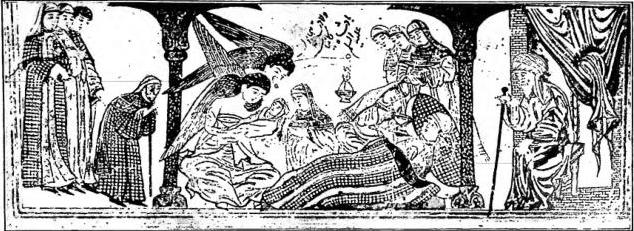
(from M. Gorce - R. Mortier, Histoire générale des religions, IV, Paris 1917, p. 32)
ISLAM – The Birth of Muḥammad. Miniature from the Arabic ms. Gāmiʿ at-Tawārīḥ, Edinburgh, University Library.
(q.V. ARABIA). In its development, moreover, non-Arab religious and cultural elements were assimilated, albeit to a limited extent, through conquest.
In its history, the religion of Islam presents an elaborative phase lasting about three centuries, followed by a progressive crystallization of doctrine. The elaboration proceeds along three parallel lines: legal theology (fiqh), dogmatic theology (kalām), and spiritual theology (taṣawwuf). The extensive, ancient development of religious law lends Islam a certain formalistic character. The demands of interior life occupy rather peripheral positions.
OUTLINE:
I. Historical Expansion
II. Legal Theology
III. Dogmatic Theology
IV. Spiritual Theology
V. Islam.I. HISTORICAL EXPANSION
OUTLINE:
I. Limits and Characteristics of Muslim History
II. The Orthodox Caliphs (632–661)
III. The Umayyads (661–750)
IV. The ʿAbbāsids (750–1258)
V. Autonomous States up to Ottoman Hegemony
VI. The Period of Ottoman Hegemony
VII. European Colonial Expansion and Nationalist Movements.I. LIMITS AND CHARACTERISTICS OF MUSLIM HISTORY
The military and political history of Islam a priori includes the events of all peoples and all Muslim States. It therefore embraces both those who were the bearers of the religion of Muḥammad (Arabs) and those who adopted it or to whom it was imposed (Persians, Turks, Indians, Berbers, etc.), from the moment they embraced it until the moment they abandoned II. Geographically, the historical sphere of action of Islam extends from France and Spain, across Africa and Asia, to China and the Malay Archipelago; to the north it touches southern Russia and the Balkans, and to the south, East Africa.
Moreover, the effective unity of the Muslim world was concretely realized only in the first phase of the caliphate, until around the 9th century. This was followed by a period of fragmentation which, although fundamentally altered by the rise of large States of Turkish or Mongol origin, never again resolved into a general unification. It is therefore legitimate, on the basis of ethnic and political criteria, to refer for the details of Muslim history to the treatment of individual peoples and regions. Here it will be appropriate to focus in particular on the events of the unitary caliphate, which approximately cover the period in which Islam as a religious phenomenon was formed and structurally defined. Thus, one will have a synthesis of the broad outlines of the long historical struggle through which the peoples of the Muslim faith have arrived at their current political and geographical situation in the world.
II. THE ORTHODOX CALIPHS (632-61)
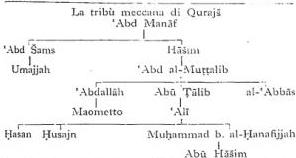
The death of Muḥammad left Arabia almost completely unified under the new State. This union, however, was notably precarious, since outside the zone centered on the cities of Mecca and Medina it was based on agreements between the Prophet and the Arab tribes; most of these tribes considered these agreements dissolved after Muḥammad’s death. Moreover, the absence of testamentary dispositions left an open dynastic question which, initially dormant, was later to resurface and become a determining element of crisis throughout the course of Islamic history.
It was the merit of ʿUmar to establish the first administrative organization of the conquest: the Muslims settled in the conquered regions in military nuclei governed by commanders, receiving as fighters a fixed salary and a share of the spoils, one-fifth of which went to the State. The unbelievers were subjected to a tax, collected mostly through their own administration and compensated by the protection of the conquerors. This system had a twofold positive effect: it initially preserved the Arabs from assimilation, keeping their military energies intact, and it satisfied the new subjects, making them tolerate domination quite willingly.
The caliphate of ʿUthmān (644-56) marks the progress of the conquest, which extends to Persia and advances into North Africa, while preparing at sea for the struggle against Byzantium; but the nepotism of the caliph toward members of his family (the Umayyads, belonging to the Meccan aristocracy of the Quraysh tribe) arouses the discontent of the Prophet’s old companions. When ʿUthmān is killed in Medina, they elect as his successor the cousin and son-in-law of Muḥammad, ʿAlī (656-61).
Around the figure of ʿAlī pivotal events for the political and religious history of Islam revolve. After suppressing a revolt led by ʿĀʾishah, the Prophet’s wife, he finds himself facing the Umayyad Muʿāwiyah, governor of Syria. They come to battle at Ṣiffīn on the Euphrates (657), with an uncertain outcome. Muʿāwiyah proposes and obtains an arbitration. At this point, a part of ʿAlī’s army breaks away from him, refusing to adhere to this decision, and forms the dissident group of the Kharijites, who, although bloodily defeated by ʿAlī at Nahrawān (658), survive and develop. The arbitration comes to nothing. Meanwhile, Muʿāwiyah secures control, in addition to Syria, of Egypt and Arabia. In the meantime, ʿAlī falls by the dagger of a Kharijite. Thus, with Muʿāwiyah, the Umayyad dynasty comes to power, while the main politico-religious currents of Islam take shape: orthodox, Shiʿite, and Kharijite.
III. THE UMAYYADS (661-750)
These very facts open serious problems that follow and determine the course of events: the legitimacy of the family of the Prophet is reconstituted and strengthened, coupled with religious rigorism in judging the Umayyads as temporal usurpers; the succession crisis recurs periodically, in the play of ambitions within the family.
Other problems, no less serious, the Umayyad caliphate inherits from the previous historical situation. The Bedouin tribes, the determining element of the conquest, had indeed found in Islam the force of propulsion, but had not thereby been durably amalgamated; their rivalry, especially acute between the northern and southern groups, resurfaced from time to time despite the conciliatory policy of the caliphs, undermining the military solidity of the Empire from within. Moreover, the problem of relations between conquering Arabs and subject peoples resurfaced after the establishment of ʿUmar’s system: the increasingly frequent conversions deprived the Muslims of sources of tribute, as the remaining communities dwindled, while the process of Islamization of non-Arab subjects began, which was to merge into the composite ʿAbbasid civilization.
Despite all this, the Umayyad caliphate succeeded in strengthening the internal organization of the State and extending its conquests; it resolved into some great figures of sovereigns the elements of friction into substantial unity; it brought the Arabs to their greatest political expansion, while the elements of the religious system developed in fruitful travail. The negative judgment of later Muslim tradition, which reproached the Umayyads above all for having transformed the theocratic State into an Empire of essentially political character and aims, must therefore be received with extreme caution. Such in fact was the Umayyad caliphate; and it was “Arab Empire,” as Wellhausen defined it (das arabische Reich): but criticism has no reason to see in this, within the broader framework of Muslim history, elements of negative judgment.
The first great personality of the Umayyad dynasty was Muʿāwiyah (661–80). His agreement with Ḥasan b. ʿAlī and the skillful policy of his governors in ʿIrāq shielded him from the ʿAlids. Thus he was able to continue military expansion, extending the empire toward India and the Atlantic. He besieged Constantinople twice, though without success. He pursued a skillful policy of tribal reconciliation while managing to impose, through the recognition of his son Yazīd as successor, the dynastic principle.
Under Yazīd, the ʿAlid revolt broke out: the son of ʿAlī, Ḥusayn, fell in 680 at Karbalāʾ, sowing fresh seeds of rebellion. More prolonged and militarily far more dangerous was the revolt of ʿAbdallāh b. al-Zubayr in Mecca. Only the fifth caliph, ʿAbd al-Malik (685–705), succeeded in suppressing it (692). At the same time, the Shiʿite insurrection of al-Mukhtār was quelled, the empire returned to peace, and the path to conquest reopened with a new push into North Africa; it
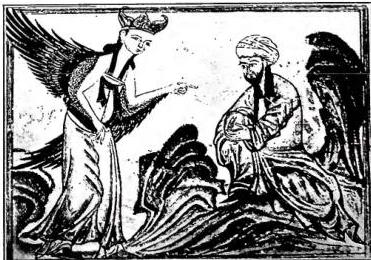
(Ja M. Gores - D. Mortier, Histoire générale des religions, IV, Paris 1917, p. 259)
ISLĀM – Muḥammad and the Angel Gabriel, miniature – Edinburgh, University Library, Arab ms. no. 20.
extended under his son al-Walīd (705–15) with the landing in Spain (711) and the occupation of almost the entire peninsula, while from the opposite direction Muslim armies invaded Sind and Transoxiana.
The Umayyad Empire thus reached its greatest extent. Of the later caliphs, ʿUmar II (717–20) distinguished himself for his religious piety and economic reform, based on extending the land tax to Muslims to address the emerging crisis. Under Hishām (724–43), the Muslims penetrated deeply into Gaul, where they were halted by Charles Martel (Battle of Poitiers, 732); yet at the same time a Berber revolt endangered control over North Africa.
The following years marked the beginning of the crisis. Brief and ephemeral caliphates succeeded one another amid the ravages of tribal strife. Only the last Umayyad, Marwān II (744–50), managed for a time to regain control of the situation. Meanwhile, however, in the East the long ʿAlid legitimist propaganda was maturing, into which had been inserted the line of the descendants of al-ʿAbbās, claiming to have received investiture from Abū Hāshim, son of Muḥammad b. al-Ḥanafiyyah, son of ʿAlī. The movement drew together Iranian national energies, hostile to Arab rulers, and was invigorated by their internal discord. The revolt overwhelmed the Umayyads. The ʿAbbāsids managed to forestall the ʿAlids and assumed the caliphate.
IV. THE ʿABBĀSIDS (750–1258)
The beginning of the ʿAbbāsid dynasty marked the return of power to the family of the Prophet; not, however, to that branch, the ʿAlids, which had the strongest claim by kinship and had most actively promoted the insurrection. Their renewed opposition left the question of dynastic legitimacy open and, so to speak, unchanged in its broad outlines: the ʿAlids and the Khārijites renewed in the ʿAbbāsid period the periodic revolts and agitations of the previous caliphate.The other grave problem of the Umayyad period, that of tribal dissensions, was greatly attenuated by the revolution. The ʿAbbāsids had come to power with predominantly Persian troops: they thus had no ties of dependence toward tribal chiefs; on the contrary, their policy required a supranational levelling in which all subjects, foreign and Arab alike, stood on the same footing before the authority of the caliph. The founding of the new capital at Baghdad (Mesopotamia) under al-Manṣūr marked a process of rapprochement with Iranism, which would later flow more broadly into Islamic civilization.
At the same time, the disappearance of control exercised over the caliph by tribal chiefs led to an ever-greater personal absolutism. Tribal militias were replaced by regular mercenary troops, in which Persian and especially Turkish elements increasingly asserted themselves. These praetorians, in a situation analogous to that of the Roman Empire, would progressively strip the sovereign of power.
This new absolutism was reflected in the splendor of the court, typically Oriental. The Umayyad sovereign, far more democratic and tied to Bedouin tradition, was transformed into an increasingly inaccessible and remote despot. The figure of the vizier appeared to direct the concrete affairs of state. Certain great figures, such as those of the Barmakid family, gave this office particular prestige. The organization of the state expanded and was refined.
The ancient rudimentary taxation system evolved according to criteria of real, not personal, taxation, clearly distinguishing between movable and immovable property. Road networks and the postal service expanded, facilitating trade. Thus, at the outset of the ʿAbbāsid era, the apex of Islamic civilization was reached: within the vast empire, economic prosperity burst forth into cultural cosmopolitanism. Greek and Iranian elements penetrated Islamic civilization, of which the Arabic language remained the common denominator.
This golden age of Islam corresponded to a relative stagnation at the frontiers. The driving force, with few exceptions, may be said to have been exhausted, and periodic raids did little to alter the situation. Moreover, the disintegrative forces, already discernible, had not yet assumed large proportions. It was the age of the highest culture and of the greatest sovereigns.
Among others, the work of the second caliph al-Manṣūr (754–75) was outstanding. To him is owed the rigorous and prudent administration that enabled the grand splendor of his successors. A hard and shrewd man, a true symbol of the Machiavellian prince, he rid himself of all those, enemies and friends alike, who might cast a shadow over his power. Thus Abū Muslim, the organizer of the ʿAbbāsid insurrection, was assassinated on his orders. This act provoked a series of extreme Shiʿite revolts, suppressed under him and under his successor al-Mahdī; al-Manṣūr also quelled dangerous Shiʿite insurrections in Medina and Baghdad (762–63). Under him also appeared the first signs of the phenomenon of fragmentation within the Muslim empire. The Umayyad ʿAbd al-Raḥmān, having escaped the massacre of his family, took refuge in Spain, thereby withdrawing that region from ʿAbbāsid control thereafter. al-Mahdī (775–85), more generous and liberal, continued his father’s work, also suppressing the zandaqah, a heretical movement of Iranian inspiration. But the apogee of the ʿAbbāsid caliphate was reached under Hārūn al-Rashīd (786–809), the sovereign immortalized in The Thousand and One Nights.
A succession struggle, a canker of the ʿAbbāsid caliphate no less than of the Umayyad, broke out between the two sons of Hārūn al-Rashīd, al-Amīn and al-Maʾmūn. The latter (813–33), the victor, inaugurated a new period of great flowering in letters and the arts. He also attempted a reconciliation with the ʿAlids, though without success. It was in his time that the Muʿtazilite theological school (v. infra) reached its peak prestige, its thesis of the createdness of the Qurʾān being declared a state dogma by al-Maʾmūn. Later, orthodoxy reasserted itself under the caliph al-Mutawakkil (847–61).
With the successors of al-Ma'mūn there begins the process of decline of the 'Abbāsid caliphate. The Turkish praetorians gain ever greater importance and soon become the arbiters of the fate of the caliphs. Their commanders-in-chief (amīr al-umarā) dominate the government. Meanwhile, the various provinces progressively detach themselves from central authority under local dynasties; only a formal homage, when the States are not hostile, binds them to the sovereign. In 945 the Buwayhids absorb the last territory remaining to the caliphs, that of Baghdad. The caliphs, however, maintain their court and their nominal authority; after the wave of Seljuk Turks they even recover some territory. But the Mongols overwhelm them: in 1258 the last 'Abbāsid caliph is killed in Baghdad. Some descendants of the family, it is said, transferred themselves to Egypt to the Mamluks, legitimizing with their title the government of these latter. Finally, in 1517, even this branch ended with the Ottoman occupation of Egypt; the last caliph was deported by Selim I to Constantinople.
Already for many centuries the 'Abbāsids had ceased their direct action in historical events. These must be taken up again from the end of the 8th century, with the history of the autonomous States, in which Islamic unity is fragmented and to which only the Turkish dynasties will bring periodic unifying impulses.
V. AUTONOMOUS STATES UNTIL OTTOMAN HEGEMONY
The formation of autonomous states, which began after the mid-8th century, developed rapidly until it eliminated, with the Buwayhid occupation of Baghdad in 945, every trace of direct 'Abbasid domination. Thus the great Empire of the caliphs shattered, as the central authority progressively weakened, while from the periphery there arose differences and local particularisms. One reason for the phenomenon was the very supernationalism of the 'Abbasids, which had brought about the decline of Arab hegemony over the Empire by introducing into the ruling class elements of various nationalities. The religious bond, the only one remaining alongside the Arabic language, could not restrain the centrifugal forces that were undermining the state.The phenomenon of fragmentation did not, for the most part, occur rapidly or violently. Rather, it was the governors of the individual provinces who slowly detached themselves from the central authority to establish their own dynasties, which continued to pay formal homage to the caliph of Baghdad. Naturally, the 'Alid dynasties were exceptions; the greatest of these, the Fāṭimids in Egypt, assumed the caliphal title for themselves. Another situation arose in Spain; there, too, the authority of Baghdad was not recognized, and the Umayyads likewise proclaimed themselves caliphs (929).
The crisis of the caliphate was also and above all a crisis of Arabism. The ethnically Arab dynasties that formed in various regions had no propulsive efficacy. Great and periodic impulses toward unity instead came from new converts: on the one hand the Berbers, who created strong dynasties in North Africa; on the other, above all, the Turks, who, having become Muslim, left their imprint on the history of this period, from the predominance of the Seljuks to that of the Ottomans. It would be these latter, in the 16th century, who would reconstruct under their hegemony the unity of much of the Islamic world.
Since it is therefore impossible to treat this period from a comprehensive point of view, the events must be grouped by regions, or groups of regions, that at least at times display a certain historical unity.
1. Spain
Occupied in 755 by the Umayyad 'Abd al-Raḥmān, Muslim Spain reached great splendor under his dynasty. The greatest sovereign was 'Abd al-Raḥmān III, who in 929 assumed the title of caliph. At the beginning of the 11th century the caliphate of Spain declined and fragmented into small dynasties, which were succeeded by the rule of the great Berber kingdoms of North Africa, the Almoravids beginning in 1090 and then the Almohads from 1145. On them see below. The decline of Almohad rule in the 13th century gave rise to local dynasties, which progressively fell under Christian reconquest. The last to fall were the Nasrids of Granada (1492).2. North Africa
Before the formation of the Almoravid and Almohad kingdoms, in the North African zone from the Atlantic to Egypt various local dynasties arose. In Morocco the Idrīsids ruled from 788 to 922, after which Berber tribes followed. Algeria and Tunisia became autonomous under the Aghlabids (800-909), who also conquered Sicily, which remained under Muslim rule until the Norman period; they then passed under the Fāṭimids, an 'Alid dynasty that established itself in Egypt, and from 972 to 1148 under the Zīrids. During this last period Algeria passed to the Ḥammādids (1007-52).By this time, however, the Berber dynasty of the Almoravids (1056-1147) had already established itself in Morocco, extending its rule from Spain to part of Algeria. Even more extensive was the conquest of the Almohads (1130-1269), also Berbers, who occupied Tunisia as well, reaching Tripoli and thus unifying the entire region from Spain to Egypt under their rule.
After the Almohads, North Africa again fragmented into local dynasties: the Marinids and Waṭṭāsids (1195-1350) in Morocco and later also in Algeria; the Zayyānids (1235-1303) in Algeria; the Ḥafṣids (1228-1334) in Tunisia.
To the south of these states, from the 10th century onward the majority of the rulers of central Africa converted to Islam. The movement developed in the following centuries along two routes: from North Africa toward the interior and from the Arab coast toward the opposite shore of the Red Sea and the Indian Ocean, reaching as far south as the island of Madagascar. To this second type belongs the Islamic penetration into Ethiopia, which by the 14th century had taken concrete form with the establishment of a Muslim state in Ifāt.
3. Egypt and Syria
For much of Muslim history these two regions had connected histories. They achieved independence under the Turkish dynasty of the Ṭūlūnids (868-905), then returned for a short time to the 'Abbasids before passing to the Ikhshidids (935-69). These gave way to the great Shi'ite dynasty of the Fāṭimids, who had long dominated in nearby North Africa. This dynasty lasted overall from 909 to 1171, though losing North Africa in 972, while at the beginning of the following century Syria also became a center of independent dynasties. It was reunited with Egypt by Ṣalāḥ ad-Dīn (Saladin), the founder of the Ayyūbid dynasty (1171-1250); the two provinces remained together under the Mamluks (1250-1517), until the Ottoman conquest.4. Arabia
This region too suffered the dismemberment that followed the collapse of the caliphate. Local dynasties succeeded one another in Yemen from the 9th century until the occupation by the Ayyūbids (1173-1228), who came from Egypt. They were succeeded by the Rasūlids (1229-1454) and the Ṭāhirids (1446-1517). In the last period of these, the Mamluks temporarily occupied the region, later ceding place to the Ottomans. Further north, in Bahrain, the Qarmatian movement (extreme Shi'ites, on which see below) was notable; it came to dominate in the 10th-11th centuries almost all of Arabia.5. Mesopotamia, Persia, Transoxiana
The history of these regions was cut in two by the invasion of the Seljuk Turks, who occupied them completely. Before that there were separate dynasties. Mesopotamia passed from the Ḥamdānids (929-1003) to the Buwayhids of Persia, then fragmented into small Arab dynasties. In Persia the first to become autonomous were the Ṭāhirids (820-73) in Khurāsān, then the Ṣaffārids (867-903) and the Sāmānids, who starting from Transoxiana annexed the entire region (874-999). Their power divided into dynasties, among which the Buwayhids (932-1055) prevailed in the west and the Ghaznavids (962-1183) in the east; under the great sovereign Maḥmūd they carried out the conquest of Hindustan.The Seljuk Turks, Islamized Turks, accomplished in the 11th century a gigantic revolution in Islamic history. Under the leadership of great chiefs (Ṭugrīl Beg, Alp Arslān, Malik Shāh), they overran Transoxiana, Persia, and Mesopotamia, reaching Syria and Asia Minor. The union of these regions under their rule was one of the most decisive reasons for the launching of the Crusades (q.v.). The Seljuks were supplanted in the 12th century by dynasties of their officers (atābegs): among these are to be noted the Zangids in Mesopotamia and Syria (1127-1250). The Khwārazm-Shāhs prevailed in Persia and Transoxiana (ca. 1077-1231). In Asia Minor, however, the Seljuks survived until 1300, then yielding to the Ottoman Turks.
In the 13th century a new great invasion advanced from the east: the Mongols, under the leadership of the famous Chingiz Khān, occupied all the territory between China and Mesopotamia. The empire was subsequently divided among the sons of the conqueror; of the western regions, Persia and Mesopotamia went to the Ilkhānids (1256-1353), whose leader, Hulāgū, killed in 1258 the last caliph of Baghdad; Transoxiana to the Chagatai Khans (1227-1358).
ISLÂM. – Religion founded by Muḥammad (q.v.) in Arabia in the 7th century A.D. The name
The decline of Mongol power led in Mesopotamia and Persia to the formation of independent dynasties. Among these the most important was that of the Ġalā’irids (1336–1411) in Persia. In Transoxiana the Mongol Tīmūr Lang (Tamerlane) founded the dynasty of the Tīmūrids (1369–1500), which rapidly extended its conquests westward into Asia Minor, where it defeated the Ottomans (1402), and eastward into India. After the 15th century they left their mark only in Afghānistān, where their descendant Bābur founded a new great Mongol dynasty.
6. Afghānistān and India. – Afghānistān was permanently occupied by the Ṣaffārids of Persia. They were succeeded by the Sāmānids and then by the Ghaznavids, who extended their conquest as far as Hindustan. The Ghaznavids were succeeded by the Gūrids (1148–1215) and then by the sultans of Delhi (1206–1554), by whom the Deccan was also conquered (1322). Toward the end of their rule they began to break up into small dynasties, until the Mongols of Bābur invaded the territory (16th century). The conquest of the Deccan was completed later.
VI. THE PERIOD OF OTTOMAN HEGEMONY
The Turks’ predominance in the Islamic world reached its peak with the Ottoman Empire, which, by uniting the vast territory between Morocco and Persia, could justly claim the political heritage of the caliph; indeed, advancing decisively into the Balkan peninsula as far as the walls of Vienna, it renewed and surpassed the aggressive power of earlier rulers. Islam thus reconstituted itself as a unity, though excluding some more peripheral provinces. Within this aggregate, however, its constituent elements were profoundly altered: Arabism was in crisis, and the centre of gravity of the Empire had definitively shifted to the seat of the new dominators, Asia Minor. Culture bent to the new order.Meanwhile, on the periphery of the Ottoman Empire, several strong national States were forming, particularly in Persia and India. In sum, the period of Ottoman hegemony marks for the history of Islam a more unified phase than the preceding one, under the banner of dynasties and peoples “barbarian” who had long since supplanted the Arab conquerors in predominance.
The Ottomans arose in Bithynia around 1300 and gradually extended their power inland. In the fifteenth century, after the interruption of Tamerlane’s invasion (1402), their empire already included Asia Minor and the Balkan peninsula. This conquest was chiefly the work of two sovereigns: Murād II and Mehmed II. The following century saw further great enterprises. Selīm I (d. 1519) annexed Syria, Egypt and Arabia. Süleymān the Magnificent (d. 1566) invaded Hungary and besieged Vienna (1529); nearly all the North African coast as far as Morocco was also conquered. In the seventeenth century Murād IV occupied Mesopotamia (1638). By the century’s end the Ottoman Empire had reached its maximum expansion. The failed siege of Vienna in 1683 marked the beginning of its decline.
The first stages of the crisis were the losses of Hungary, Transylvania and Podolia in 1699. In 1783 the Crimea and surrounding territories passed to Russia. In 1829 Greece became independent. Algeria, already for some time practically autonomous under its deys, was occupied by France (1830). By 1878 Romania, Serbia and Montenegro had become autonomous; Bosnia and Herzegovina went to Austria; Bulgaria became an autonomous principality and soon afterwards, in 1885, a kingdom with the annexation of Eastern Rumelia. Meanwhile Tunisia, also long autonomous under its beys, had passed to France (1881). In 1882 it was Egypt’s turn, occupied by England, though Ottoman sovereignty there remained theoretical until 1914. Italy occupied Libya in 1912. Then came the First World War, which sealed the collapse of the Ottoman Empire: Egypt became a British protectorate; Palestine, Iraq and Transjordan became States under British mandate, the first with a special regime arising from the Zionist question; Syria was divided into States under French mandate. Of the ancient Empire only Turkey remained, which established itself as a national State (1922).
Outside the Ottoman Empire, Morocco remained under local caliphal dynasties until the French conquest, begun by slow penetration at the end of the nineteenth century and completed in 1912; part of the region was ceded to Spain.
In southern Arabia, the expulsion of the Ottoman Turks (1633) brought Ṣan‘ā to be the capital of the Zaydī State, which had existed for centuries. In central Arabia, from the beginning of the nineteenth century, a Wahhābī State (see below, the religious section) progressively asserted itself and later became the Kingdom of Saudi Arabia under Ibn Sa‘ūd (1932).
Persia established and maintained itself as an autonomous State under various dynasties of āhs, the first and most prosperous of which was that of the Ṣafawids (1502–1736). Shī‘ism became the State religion. There was no lack of expansive policy, which in 1738, under Nādir Shāh, reached Delhi.
Transoxiana, after the Tīmūrids, was governed by the Šaybānid dynasty, likewise Mongol, and by others related to it, until the Russian occupation (1868–72).
Afghanistan and India remained under the Mongol dynasty of Bābur. In the eighteenth century decline began, with Afghanistan and the Deccan passing to autonomous dynasties; meanwhile the conquest by the English East India Company advanced, until in 1858 India passed under the British crown. Afghanistan, through long struggles with the English, remained independent.
From the standpoint of peaceful penetration, Islam established itself from the fifteenth century, and especially towards the end of the eighteenth, in Russian Turkestan, leaving there strong Sunni communities.
VII. EUROPEAN COLONIAL EXPANSION AND NATIONAL MOVEMENTS
The decline of Turkish hegemony over the Islamic world has been paralleled, since the last century, by the progressive rise of European colonialism. Western action, by intensifying contacts and exchanges on the cultural level, has brought about a general awakening in the Muslim world, and especially in the Arab world, from what may well be called its medieval slumber. This awakening has taken concrete form on the religious plane in the phenomenon of modernism, while on the historical plane it has rekindled the heritage and national aspirations of dormant Arabism against the dominant Turks. It is true that the intrusion of infidels into Muslim lands has given rise to unifying and pan-Islamic tendencies, which the Turks themselves did not fail to exploit toward the close of the 19th and the beginning of the 20th centuries; yet ultimately the national and federalist currents among the Arabs have prevailed.As we have seen, the First World War marked, with the success of the Allies’ nationalist propaganda, the emergence of nation-states with limited autonomy. The subsequent period has been characterized by the progressive consolidation of such autonomy, cemented by the pan-Arab organization (the Arab League was founded in 1945). Western predominance is gradually receding from political forms to privileges of a commercial nature.
Thus the recent era, an age of crisis and evolution, represents within the broader framework of Islamic history the return of Arabism to the forefront after centuries of decline and stagnation.
In North and Central Africa, Muslim populations remain today under colonial rule. Egypt, formally recognized as independent in 1922, has progressively loosened its ties with Britain. In Asia, independent states include Turkey, Saudi Arabia, Yemen, Persia (after having been occupied during the last war by British and Russian troops), and Afghanistan. The British mandate in Iraq ended in 1932, replaced by an alliance treaty. In 1946, Transjordan was declared an independent kingdom, and France granted independence to Syria and Lebanon. In 1948, the State of Israel was proclaimed in Palestine. In British India, the independent states of Pakistan and India were established in 1947 under dominion status. Britain maintains protectorates in Arabia and Malaya. The Dutch East Indies gained independence on 27 December 1949.
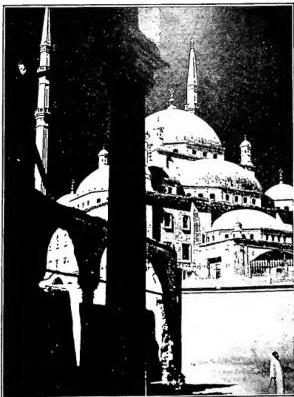
II. LEGAL THEOLOGY.
OUTLINE:
I. Concept and elements of legal theology (fiqh)
II. Formation of religious law. The orthodox schools. — III. Theory of sources (uṣūl). Juristic methodology. —IV. Prescriptions of worship ('ibādāt)
V. Other religious prescriptions
VI. Festivals.I. CONCEPT AND ELEMENTS OF LEGAL THEOLOGY (fiqh)
Fiqh is the Islamic legal theology, that is, canon law. Its object is the study of the divine law (sharīʿah), namely the regulation by God of human actions. On the principle that every action depends on God, fiqh encompasses not only the prescriptions relating to worship and to properly religious life, but also the norms of all law: personal, familial, commercial, penal, administrative, political, and military.The divine origin of the law confines human reflection and elaboration to a wholly subordinate role: it is not intended to establish ex novo and on rational bases the legal norms, but rather to deduce them as far as possible from the revealed and traditional patrimony. Nor does the supreme political and religious authority, in theory, constitute a source of law: it exercises an executive, not a normative, function.
Of the various parts of Muslim legal theology, those concerning worship and properly religious life are of particular interest here.
II. FORMATION OF RELIGIOUS LAW. THE ORTHODOX SCHOOLS. — When Muḥammad died, he left behind only the broad outlines of a religious legislation, as well as specific solutions to a series of cases, but without any systematic or complete structure. It was the task of the immediately succeeding generations to integrate and systematize religious law, under the pressure of problems that periodically arose in the life of the community. At the beginning, political authority itself exercised juridical functions, drawing essentially on the model and memory of the Prophet, without excluding a greater or lesser degree of personal interpretation. However, the secularization of the caliphate under the Umayyads, and even earlier the formation of currents hostile to ʿUthmān and ʿAlī, led to a progressive differentiation between political authority and the interpreters of the law, who often rose against it in defense of tradition. The activity of these jurists was first directed toward deriving from the Qurʾān and the Prophet’s custom—which was subjected to study and collection—the norms of religious and social life; but it soon had to address new problems through individual reasoning (raʾy), whether in its more moderate form, such as analogical reasoning (qiyās) applied to cases resolved by tradition, or even reaching free judgment. It was evident that the dominant Islamic traditionalism had to react against the followers of raʾy: the result was a greater or lesser restriction of this criterion, which, however, became a vital leaven in the progressive development of the law.
The intense elaboration of juridical material led, as early as the 2nd century of the hijrah, to the formation of various rites or schools (madhāhib), differing in the proportion and manner in which they employed the various juridical sources. Many of these schools, which were established around centers of rich tradition and intense cultural life, soon disappeared; only four survived within the orthodox tradition, coexisting with mutual recognition of rights. One was founded in Medina by Mālik ibn Anas (d. 795; V. MĀLIKITE, RITE), characterized by a strongly traditionalist tendency, which did not, however, repudiate the criteria of the consensus of the community (ijmāʿ), analogical reasoning, and even the so-called istislāḥ, i.e., the principle of general utility. Around the same time, Abū Ḥanīfah (d. 767; v.) founded another school in Kūfah, distinguished by the broader use of analogy and, in general, of reasoning, extending not only to the criterion of general utility but also to that of subjective preference (istihsān). More respectful of tradition and with a systematic and conciliatory tendency, al-Shāfiʿī (d. 820; V. SHĀFIʿITE, RITE) rejected istislāḥ; he was the first to systematically formulate a doctrine of the roots of fiqh: the Qurʾān, sunnah (Prophet’s tradition), consensus, and analogy. His doctrine, with some minor modifications, became the official theory of orthodoxy regarding the foundations of the law. A fourth school was founded in Baghdad by Ibn Ḥanbal (d. 855; V. ḤANBALITE, RITE); it carried the conservative tendency to its extreme, rejecting the use of raʾy and severely limiting qiyās.
The great elaborative effort in law lasted approximately three centuries of the hijrah. As the forms progressively crystallized, a theory emerged that, from that time onward, direct elaboration (ijtihād) could be considered concluded. Subsequent jurists were left with only limited elaboration, namely the application of the masters’ principles to unresolved questions; beyond this, there was only imitation (taqlīd).
The application of this principle, combined with the very nature of juridical discipline, led in the following centuries to a casuistic stagnation of fiqh. Within the schools, direct examination of the sources was increasingly abandoned and replaced by reading recent manuals; judges limited themselves to applying the doctrine or the prevailing opinion within their school, resorting in new cases to muftīs, who issued legal opinions. Moreover, the practical authority of traditional law was repeatedly violated by political power, which, through other means, also addressed the anachronism of much religious legislation by introducing state ordinances and courts. This phenomenon intensified in modern times, in connection with European influence and the progressive emergence of new problems and needs.
III. THEORY OF SOURCES (uṣūl). JURIDICAL METHODOLOGY. — The cessation, after a few centuries, of the direct use of sources in the elaboration of juridical material naturally reduced interest in their study. Nevertheless, after al-Shāfiʿī’s initial formulation, many works were devoted to defining the uṣūl, as well as the rules for their employment.

2. The tradition (sunnah). — The determination to inspire the entire life of the Muslim community by the law and example of its founder could not find sufficient material in the Qurʾān, since Muḥammad had not concerned himself in any way with leaving an organic and complete code. It was therefore necessary to seek the norms of the law, in addition to the sacred text, in the manner of acting (sunnah) of the Prophet, as it resulted from his deeds, sayings, and tacit approvals. The Qurʾān itself commands the faithful to follow the example of Muḥammad. The sunnah is thus a non-explicit revelation, alongside the explicit revelation of the Qurʾān. Its value is not inferior to that of the sacred book; indeed, it completes it and in some cases may abrogate its provisions.
The sunnah consists of oral traditions (ḥadīth), which are composed of two parts: the chain of transmitters of the report (isnād, lit. “support”)—which goes back to the first witness and constitutes, according to Muslims, the essential criterion for evaluating the ḥadīth—and its text (matn). The collection of traditions, transmitted orally during the first generations, was later progressively codified into several major compilations, among which those of al-Bukhārī (d. 870) and Muslim (d. 875), known as “the two Ṣaḥīḥ,” i.e., “the two genuine,” predominate in the 3rd century of the hijrah. In these works, the arrangement is by subject matter (muṣannaf), whereas in other collections it follows the order of transmitters (musnad).
As for the authenticity of the traditions, Muslims themselves exercised a critique, which will be discussed in connection with the rules for the interpretation of the sources. It is worth noting here that this critique is essentially external, based primarily on the evaluation of the isnād; European criticism, on the other hand, has focused on the content of the ḥadīth, noting how many of them are piae fraudes, i.e., forgeries created a posteriori in defense of one or another political or religious ideology. The formation over time of the Muslim tradition and its content, crystallized in the major compilations, must therefore be approached with great caution for an objective reconstruction of Islamic religious life, even as it constitutes a phenomenon of considerable interest for the psychological understanding of II.
3. The consensus (iḡmā'). — Divine assistance to the Muslim community cannot permit it to fall unanimously into error. This principle, together with the Qur'anic exhortations not to depart from the path of the faithful, constitutes the foundation of the third source of legal theology, namely the general consensus of the community on a given question.
(from M. Gorce - R. Mortier, Histoire générale des religions, IV, Paris 1897, p. 555)
ISLAM — Muslims at prayer in the desert.
and at a specific time. This consensus, like the sunnah, may be verbal, practical, or tacit, though the latter form is much contested.
By “consenting community,” as regards elementary and fundamental precepts, is meant the entire body of believers. In more difficult and complex matters, however, the community is concretely represented by its particularly competent members. These were, in the first place and in the earliest phase, the companions of the Prophet; then their followers and the followers of the followers. Subsequently, according to the Mālikites, consensus belongs to the scholars of Medina; according to the other schools, to scholars in general.
Parallel to the consensus ecclesiae, the iǧmāʿ constitutes, in conservative and traditionalist Islam, a source of controlled and limited evolution. Structurally dynamic, in contrast to the static nature of the Qurʾān and the sunnah, it is the means by which innovations such as the cult of the Prophet, belief in his miracles, the veneration of saints, and more recently practical innovations such as tobacco and printing have been introduced.
4. Analogy (qiyās). — Different in nature from the three preceding sources is the fourth, which consists in the application of analogical reasoning to resolve juridical cases not explicitly provided for. It is thus a source constituted not by divine word or inspiration, but by a human means: this explains the hostility it encountered and the greater or lesser limitations placed upon its use.
The qiyās may consist in assimilating, by affinity, an unresolved case to one that has been resolved; or it may also involve resolving a new case on the basis of the principle underlying an existing law. This second type of qiyās is naturally the most contested.
With the qiyās, the series of sources of fiqh is concluded. Muslim treatises therefore examine the methodological rules governing their employment. These rules concern, in the first place, the critique of such sources, which is naturally not applicable to the Qurʾān but to the sunnah. Muslims apply their critique especially to the isnād, studying the reliability of transmitters, the possibility of contacts between them, and the independent channels through which a ḥadīth has been transmitted. This gives rise to a classification of traditions into “sound,” “good” (i.e., acceptable), “average,” “weak,” and “false.” A second aspect of juridical methodology is the hermeneutics of the sources. It aims, first of all, to establish the exact meaning of the law and, so to speak, its juridical force: on this basis, actions are classified as obligatory, recommended, permitted, disapproved, or prohibited. The obligation may be individual or collective: the latter can be fulfilled only by a part of the community; such is, for example, the holy war against unbelievers. Furthermore, hermeneutics must resolve contradictions that may exist within a single source or between different sources.
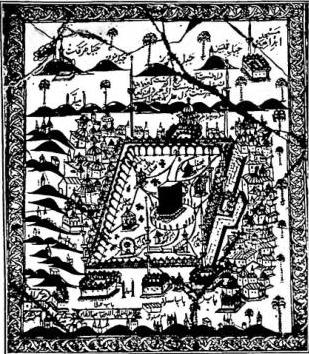
IV. PRESCRIPTIONS OF WORSHIP (ʿibādāt)
Once the sources of religious law have been established, its practice centers on five fundamental prescriptions (arkān) of worship: the profession of faith, prayer, legal almsgiving, fasting, and the pilgrimage.1. The profession of faith (fahādah). — It consists in pronouncing the formula “There is no god but God, and Muḥammad is His messenger.” The importance of this formula is indicated, among other things, by the fact that it constitutes the means of conversion of non-Muslims to Islam. The rites of admission consist precisely in reciting the fahādah, in taking a Muslim name, and in circumcision; Jews must additionally acknowledge Christ as a prophet, and Christians must deny His divinity.
2. Prayer (ṣalāh). — Ritual prayer, already established in the Qurʾān, was defined in detail by the sunnah of the early period. All pubescent and sane Muslims are obliged to perform II. The elderly, the sick, travelers, and men in danger are exempted for as long as their condition of impossibility lasts.
A preliminary condition for prayer is the state of purity of the place and persons. This is achieved through washing. For persons, it is prescribed to wash the face, hands, forearms, feet, and head. Cases of major impurity require washing the entire body. In the absence of water, sand may be substituted. Another condition for prayer is decent covering of the body.
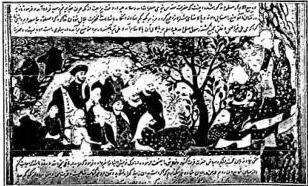
On Friday at midday, there is a particularly solemn prayer in the largest mosque of every city or district. This prayer is preceded by a sermon (khuṭbah), a moral address accompanied by a blessing upon the political authority; this has over time assumed particular importance as recognition of the reigning sovereign.
Alongside ritual prayers, there exist private and extraordinary prayers; but the law insists, as in other points, on the external and formal aspect: a typical example in this sense is the regulation of the preliminary intention (niyyah), an interesting instance of the psychology of Islamic religious law.
3. Legal almsgiving (zakāh). — Frequently recommended in the Qurʾān alongside prayer, almsgiving became, even in the time of Muḥammad, a legal prescription, that is, practically a tax intended to constitute a national fund. The imposition of it upon the Bedouin tribes, carried out by Abū Bakr through a bloody struggle, sanctioned its stability after the death of the Prophet. According to juridical theory, zakāh is levied on cereals, fruits, livestock, silver, gold, and merchandise. It begins at a minimum taxable threshold and consists of about one-tenth of the harvest, from one-sixtieth to one-hundredth of livestock, one-fortieth of silver, gold, and merchandise. The Qurʾān (9:60) defines the beneficiaries of almsgiving: the poor, the needy, tax collectors, those engaged in religious propaganda, slaves to be redeemed, insolvent debtors, warriors for the faith, and travelers.
These provisions have for the most part only theoretical value. In practice, taxation in Muslim states has increasingly moved toward modern systems, through the extension of fiscal obligation to non-Muslim subjects and the generalization of taxable objects. Even with regard to beneficiaries, it is the state that absorbs the taxes, allocating them according to freer criteria.
Alongside legal almsgiving, there exists voluntary almsgiving (ṣadaqah), to which every good Muslim is exhorted, and which generally flows toward pious foundations and charitable purposes.
6. The Fast (sawm)
A characteristic example of the development of Muslim preceptive law is the fast, which Muḥammad at first established at Medina in the same form and on the same day as the Jewish yom kippūr ('āfūrā'). Later, as relations with the Jews deteriorated and Islam progressively defined itself as an independent religion, the yom kippūr remained only as a supererogatory practice and was replaced by the obligation of fasting during the month of Ramaḍān. All sane adult Muslims are bound to fast; the elderly, the sick, travelers, and women in particular conditions are exempt. The exemption lasts only for the duration of the impediment, after which the fast must be made up. The elderly and the chronically ill are required to make a compensatory alms-giving. Breaches of the fast due to culpable acts are expiated by alms-giving of varying amounts according to the gravity of the sin committed. The fast consists in complete abstinence from food, drink, tobacco, perfumes, and sexual intercourse from dawn to sunset throughout Ramaḍān. At night, all prohibitions are lifted. Besides this fundamental fast, the law also contemplates other extraordinary or supererogatory fasts on the occasion of certain events or solemnities.7. The Pilgrimage (ḥajj)
Just as the fast is a characteristic example of Islam’s development in relation to Judaism, so the pilgrimage is an example of its relationship with ancient pagan tradition: its rites are largely drawn from pre-Islamic paganism, but adapted to a monotheistic significance. Muḥammad owed much of his success to this skillful policy of synthesis. The Kaʿbah, the cuboid structure in Mecca that had been an object of pagan worship and contained the Black Stone in its eastern side, was regarded by Muḥammad as an ancient sanctuary established by God, restored and purified by Abraham and Ishmael. In the last three years of the Prophet’s life, the first great pilgrimages were performed; in the final year, unbelievers were excluded and the principal rites were defined.All sane, free, adult Muslims who possess the means are bound to perform the pilgrimage at least once in their lifetime. Some schools permit a substitute to perform the ḥajj on behalf of another.
The pilgrimage begins at Mecca on the 7th of Dhu al-Ḥijjah. Pilgrims arrive by great caravans or by sea and, upon reaching the boundary of the sacred territory, enter a state of consecration (iḥrām), which consists in wearing two seamless garments, usually white, leaving the feet, hands, and head uncovered. The Kaʿbah is also draped in a special covering. The state of consecration obliges one not to shave or cut the nails, to abstain from sexual relations and from hunting. Upon arrival in Mecca, the pilgrims perform seven circumambulations around the Kaʿbah, touching the Black Stone, and then make a ritual run between the hills of Ṣafā and Marwah. After listening to a sermon in the Great Mosque of Mecca (on the 7th), they depart on the 8th for the plain of ʿArafāt (a four-hour camel ride); they remain there on the 9th. In the evening, they begin the return journey and, with a torch-lit procession, reach the valley of Muzdalifah; then another procession proceeds to Minā, where they arrive at dawn on the 10th.
Here each pilgrim throws seven stones at a heap (a pagan rite adapted to Islam as the stoning of Satan) and a solemn animal sacrifice is performed. The pilgrims may then cut their hair and nails, but complete desacralization occurs only after a return to Mecca, with further circumambulations of the Kaʿbah and the run between Ṣafā and Marwah. This is followed by three days of festival at Minā (11th–13th), and then departure after further circumambulations of the Kaʿbah as a farewell. It is recommended to complete the ḥajj with a visit to the tomb of the Prophet and other illustrious figures in Medina.
A lesser pilgrimage is the ʿumrah, which may be performed at any time and consists of the same ceremonies as the ḥajj, excluding those rites pertaining to the suburban sanctuaries.
ISLĀM — Muḥammad proclaims ʿAlī his successor — London, British Museum, Chester Beatty Collection, ms. Rawāḍat aṣ-Ṣafāʾ.
V. OTHER RELIGIOUS PRESCRIPTIONS
A sixth pillar is often added to the “five pillars,” namely, holy war (ğihād). According to Muslim doctrine, all territory not under Islamic rule is dār al-ḥarb, “zone of war.” It must be conquered by war, which can only cease when the whole world is subjected. This theory has had to yield much to the realities of the situation, though it still exists in juridical terms and thus constitutes a phenomenon of considerable interest.The obligation of holy war is collective, not individual: in other words, it suffices that part of the community fulfills II.
Among unbelievers, only possessors of Sacred Scriptures—Jews, Christians, and also Zoroastrians—are permitted to live in Islamic lands while retaining their religion. They are subject to a special statute, under which they pay a tribute and are subject to certain limitations in public life, while in return receiving protection and the guarantee of free worship.
Within the limits of religious law, other prescriptions are also to be noted. Among these are circumcision, already in use in pre-Islamic Arabia; abstention from certain foods, such as pork and in general animals not ritually slaughtered, and from certain drinks, namely intoxicants. Men are forbidden to wear jewelry or silk garments, as well as to use precious vessels for ablutions. Rigorists also forbid music. Gambling, usury, and interest are not permitted (though legal artifices have been devised to maintain these elements of modern commercial life). Well known is the prohibition of images, which, like the dietary laws, reflects the direct Jewish influence in the formation of Muslim ritual. The imposition of the veil on women, once so strict, has been relaxed since the First World War, especially in Turkey, Egypt, and Lebanon.
VI. FESTIVALS
There are two canonical festivals in Islâm (q.V. BAJRAM): the “Little Festival” at the end of the ramadān fast, lasting three days, and the “Great Festival” from the 10th to the 12th of dū ’l-ḥiğğah, coinciding with the culminating rites of the pilgrimage.Popular usage has introduced other festivals, such as the Prophet’s birthday (12th rabī‘ al-awsal), the mi‘rāğ, i.e. the fanciful nocturnal ascension of Muḥammad into heaven (between the 26th and 27th of rağab), the Night of Mid-ša‘bān, when it is said that God fixes destinies for the coming year, and the lajlat al-qadr, the night of the first revelation to Muḥammad (between the 26th and 27th of ramadān).
Friday is the Muslims’ festive day. It does not, however, entail abstention from work, and this practice is only now being introduced in imitation of Western countries.
### III. DOGMATIC THEOLOGY.
OUTLINE:
I. The formation of dogmatics (kalām)
II. Sources
III. God
IV. Propheteology
V. Soteriology and eschatology
VI. Ecclesiology.I. THE FORMATION OF DOGMA (kalām)
The conditions under which dogmatic reflection developed were analogous to those of jurisprudence: upon certain Qur’ānic elements the reflection of the first generations was exercised, aimed at resolving the great problems of faith that naturally arose. Essentially autonomous and original, especially in its origins, this reflection, as its solutions took shape, drew in some measure on comparisons and developments from contact with Christian thought and Iranian religions, as well as with Greek philosophy. From its origins it was typically bound up with the political events of the community, according to a convergence of elements that is both a doctrinal principle and a dialectical force of evolution.The struggle between Mu‘āwiyah and ‘Alī and the separation of the Khārijites following the arbitration at Ṣiffīn brought three distinct groups face to face within less than thirty years of Muḥammad’s death. Their disagreement over the right to the caliphate entailed a first theological problem: must a sovereign considered illegitimate because he is a sinner still be respected? More generally: does the sinner remain a Muslim? It is the problem of faith and works. The Khārijites demanded, in addition to faith, works as well, condemning sinful Muslims to eternal punishment like unbelievers. Orthodox tendency, by contrast, inclined toward faith, deferring (whence the name murji’ites) to God’s judgment the guilt or innocence of believers, and consequently justifying Mu‘āwiyah and the Umayyads.
Alongside the problem of faith and works, the question of free will emerged as early as the Umayyad period. Its rise was probably not unrelated to contact and debate with the Christians of Damascus. Based on opposing Qur’ānic passages, two groups took shape: the Qadariyyah, advocates of free will, and the Jabriyyah, supporters of predestination. Official doctrine was increasingly inclined toward the latter theory.
Other questions meanwhile came to the fore: among them the problem of the divine attributes, which one naturally hesitated to interpret in the anthropomorphic sense suggested by the Qur’ān; and the problem of the eternity of the Qur’ān, which orthodoxy would affirm together with its definition as the “Word of God,” giving rise to difficult questions in relation to the Christian doctrine of the logos. Like the preceding issues, these received great impetus and decisive formulation on the dogmatic plane with the rise, toward the close of the Umayyad era, of the Mu‘tazilite school, with which kalām definitively entered a phase of systematization.
The name Mu‘tazilah (“those who withdraw”) derives from the neutral position taken in the question of the sinful Muslim mentioned above: between the two extremes they define him as fāsiq (“culpable”), an intermediate state between believer and unbeliever, which entails in the next life eternal punishments, albeit less severe than those of unbelievers. This solution was accompanied by a series of others that together addressed the principal problems of dogmatic theology. First, the Mu‘tazilites were steadfast upholders of God’s unity and transcendence. They denied any distinction between His attributes and His essence; the Qur’ān they regarded as created. They combated every form of anthropomorphism through allegorical interpretation (ta’wīl). They asserted God’s justice, thereby supporting the Qadari thesis of free will as a condition of just retribution. It seems established that it was among them that the atomistic theory was first formulated—according to which the laws of nature are the result of successive creations by God in every atom of time and are therefore nothing more than habits—which later dogmatics would develop extensively.
At the root of Mu‘tazilite thought, as can be seen, was a rational exigency. Made into a method, the school may be said to be the true founder of kalām. Its historical fortunes were mixed: having attained power under al-Ma’mūn, it suffered definitive defeat under al-Mutawakkil (d. 861). Yet its method was to flow into the decisive reform that, though in the name of orthodoxy and against Mu‘tazilism, an erstwhile disciple of the school, al-Ash‘arī, instituted in kalām at the close of the 3rd century of the hijrah.
Al-Ash‘arī’s reform was carried out by appealing to that Ibn Ḥanbal who, as head of a conservative juridical school, was likewise the leader of a parallel tendency in dogmatics. With some tempering, perhaps due in greater part to his disciples, traditional theses returned to honor with al-Ash‘arī: the existence of God’s eternal attributes, though not identical with human attributes; the eternity of the Qur’ān; rejection of allegorical interpretation, while refraining from comprehending the exact nature of the Qur’ān’s anthropomorphic expressions; predeterminism, i.e. the creation of human acts by God, though with man’s intervention as responsible executor. From the Mu‘tazilites al-Ash‘arī accepted and developed the occasionalist insights, extending them into a theory that well suited divine omnipotence and the absence of autonomy in man. He also, and above all, accepted their method, upholding the necessity of reason in the elaboration of dogma.
The Ash‘arite formulation, paralleled by another analogous one, that of al-Māturīdī (d. 945), marks the crystallization of Muslim dogmatic reflection. The two schools divide the Muslim world between them: the first prevails among the Shāfi‘ites (q.v.) and Mālikites (q.v.), the second among the Ḥanafites (q.V. ABU ḤANĪFAH). Here too, for centuries, the gate of ijtihād was closed, and dogmatic travail exhausted itself in secondary casuistry. Two facts remain to be examined in this crystallization: the confluence of mystical experience into dogmatics through al-Ghazālī (q.v.) and the persistence of an autonomous Ḥanbalite current.
Al-Ghazālī (d. 1111) is certainly the most remarkable figure in Islam after Muḥammad. A master of legal and dogmatic theology, he felt the aridity of both without the intervention of feeling and the heart. He therefore strove to bring about a harmonious synthesis in which the elements of asceticism and mysticism were integrated into the framework of theory and religious practice, achieving forms of eclecticism in which, for the first time since Muḥammad, it may be said that the great currents of Islamic religious thought were reunited in a mature synthesis. Opposed was the position of the Ḥanbalites, rigid traditionalists whom the introduction of the rational method by al-Ash‘arī kept at a distance. Positive rather than speculative theologians, they have in recent times given rise to the rigorist movement of the Wahhābīs (q.v.), represented in the political sphere by the kingdom of Ibn Sa‘ūd in Arabia.
The Wahhābism now brings us to the threshold of the contemporary era: and it is here that one discerns the ferment and phenomena of the awakening of the Muslim world, generally indicated under the name of modernism, which take root in the progressive intensification of relations with the West. Movements often political in character, they also have dogmatic aspects: thus the so-called neo-Mu'tazilism, founded in India by Aḥmad Ḥan Bahādūr, advocates a rationalistic interpretation of Islamic theology, in order to adapt it to recent scientific advances. A similar aim, but of a very different character, is pursued by Egyptian modernism, inspired by the most rigid respect for tradition (whence the name of salafījah): in the Qur’ān and in the sunnah it seeks, by rational methods, the source of the most recent discoveries. To this suggestive reconciliation the figure of Muḥammad 'Abduh gave prestige.
The long history of dogmatic theology, in its evolution from the Qur’anic root through the natural defining of problems and the arising of influences, thus appears to pivot on an antithesis: the confrontation between tradition, personified by the ḥanbalites, and the original rationalism of the Mu'tazilites. The syntheses of al-Ash'arī and of al-Māturīdī, between the 3rd and 4th centuries, reach a basic stalemate. It is chiefly to these, taking into account also the permanent ḥanbalism, that the exposition of dogmatic theology here presented in summary must conform. In the order of exposition it is advisable
II. THE SOURCES
They are the same as those of fiqh, with the exception of the last, qiyās, since the analogical method cannot be applied to dogmatic norms.III. GOD
In Muslim dogmatic treatises, the treatment of the doctrine of God is often preceded by an exposition of general notions of metaphysics and philosophy, inspired by the distinction between substance and accident and by the principles of atomism. As for the doctrine of God, it consists of three parts: essence, attributes, and works.1. Essence. — God, who reveals Himself to men both through His messengers and by direct communication to the heart and reason, is essentially demonstrated by causal proofs, namely as the author of the existence of beings, of their nature, and as the first element of the becoming of the universe, since the concept of infinity is inconceivable to Muslims.
By His essence, God is neither corporeal substance nor accident, does not occupy any determined place, and is invisible except to the blessed in paradise (thus the orthodox view against heterodox beliefs). The unity of God is affirmed with great vigor, and the denial (irk) of this principle is a grave sin. In polemic against Christian Trinitarianism, it is affirmed that God has neither wife nor children. To Him belong «the most beautiful names», as the Qur’anic epithets are called, which are innumerable in themselves and then further increased by tradition. Their totality reveals a strongly transcendent conception of the deity, in which absolute power and dominion prevail over every other characteristic.
2. Attributes. — From the epithets, theology has selected the attributes of God, classifying them into two main groups: the first includes existence, being without beginning, being without end, dissimilarity from all that is created, self-sufficiency, and unity (the last five called negative attributes); the second group includes life, knowledge, power, will, hearing, sight, and speech. The Māturīdites add to these the attribute of creation. These attributes, in opposition to the Muʿtazilite theory, are eternal and distinct, yet not separate from God («neither Him, nor other than Him, nor a part of Him»). They must be understood, along with the anthropomorphic expressions of the Qurʾān, in a real, not figurative sense, but in a manner different from the human, which man must admit without being able to define (bilā kayf, «without how»).
If the attributes are eternal, so too is the Qurʾān, the word of God. Its reproduction and recitation, however, are not eternal.
3. Works. — The works of God are His acts of creation, by which He establishes and maintains the universe and its components. On the subject of creation, theology has collected and elaborated Qur’anic data, which in turn stem from the Jewish-Christian background. Emphasizing the power of God as the direct author of all things, it has given rise to an atomistic and occasionalist cosmology: God creates the atoms (substances) with their accidents, and recreates them at every instant, thus bringing about their continued existence. This existence is therefore merely a habit, which can be broken by the simple interruption, even partial, of the successive creative acts. A reciprocal causality of natural phenomena, subject to the will of God, is instead admitted by the Ḥanbalites.
Among created beings, a category superior to men is distinguished, consisting of angels, demons, and jinn. Angels are subtle substances, created from light, normally invisible, without sex or vegetative life. Their function is to serve and exalt God. Among them are distinguished: Gabriel, the bearer of Revelation; Azrael, the angel of death; Israfil, who sounds the trumpet on the Day of Judgment. Satan is a fallen angel, for having refused to worship Adam; he is the seducer of Adam and Eve and commands a host of demons. A typical belief of Arab paganism, accepted by Muḥammad, is that of the jinn, invisible and shape-shifting sprites, yet endowed with sex and vegetative life. They are partly good and Muslim, partly evil.
God is the creator of man, from earth, in the most beautiful form and for the purpose of serving Him. The conception of original sin is present in Islam, but it has neither received broad nor organic development. Besides man himself, God also creates, at every moment, his acts, in harmony with the cosmology mentioned above. This doctrine automatically raises the problem of predestination, which was long debated in the history of kalām. As has been said, the Ashʿarites incline decidedly toward predestination, leaving to man only the execution of acts predetermined by God. The Māturīdites, to a relatively greater extent, grant man the possibility of inclining toward good or evil. And the Ḥanbalites, hostile to philosophical subtleties, consider God the creator of human will and power, yet these are responsible for the direction they choose, albeit within the broadest framework of providence and constant divine assistance. It has also been rightly noted that the theologians continually urge action, in accordance with divine prescriptions: this serves to correct a superficial, though rooted, idea of Muslim fatalism that has spread in the West.
IV. PROPHETOLOGY
God sends prophets from time to time to individual peoples to admonish them and recall them to the faith. This sending, according to orthodox dogma, is gratuitous, that is, not owed by the divinity as the Muʿtazilites maintained on the basis of the criterion of justice. The prophets are mortal men and, as such, can sin; their mission, however, ensures the veracity of the message they transmit: they are responsible for it only in the transmission. The “signs” with which they present themselves to men are the revealed books. Muḥammad mentions as such the Pentateuch, the Psalms, the Gospel, and finally the Qurʾān: these are all successive manifestations of the word of God and progressively confirm one another, even though the possibility of some innovations and abrogations remains. Muḥammad accuses Jews and Christians of having falsified their Scriptures, especially to remove the announcement of his future mission. The Qurʾān is the definitive revelation, containing the exact word of God. Other “signs” of the prophets can be miracles.The prophets are very numerous. The Qurʾān names twenty-five, giving some of them the additional title of “messengers” (rusul), which, according to some theologians, implies a higher rank connected with the communication of a religious law as well as the admonition of peoples. Most of the Qurʾānic prophets are distinguished figures from the Old and New Testaments: Adam, Noah, Lot, Abraham, Isaac, Jacob, Ishmael, Joseph, Moses, Aaron, David, Solomon, Elijah, Elisha, Jonah, Job, Zechariah, John the Baptist, Jesus. Others belong to the legendary Arab heritage: Shuʿayb, Hūd, Ṣāliḥ. The identification of some is less certain: Idrīs (Enoch), Dhū ’l-Kifl (Ezekiel?). As regards the biblical figures, it is interesting to note that almost none of them are prophets in the Holy Scriptures, while the principal prophets are missing. Muḥammad’s sources were probably mainly post-biblical and apocryphal, as is evident from the content of many narratives. The stories about the prophets are modeled on the example of Muḥammad, with the aim of showing the incredulity of ancient peoples and the punishments they suffered for II.
Among the various figures, that of Jesus is the object of particular veneration. Muḥammad denies that He is God or the Son of God, though he acknowledges Him as the “Word,” and does not accept the dogmas of the Incarnation and the Redemption. He narrates, however, His miraculous birth from Mary (confused moreover with Miriam, the sister of Moses), says that He was assisted by the Holy Spirit, and recounts His miracles, some of which clearly derive from apocryphal sources. Notable is the account of the descent from heaven of a table spread with food, a curious disguise of the Eucharist. The Qurʾān denies the death of Jesus on the cross, asserting that one of His enemies was crucified in His place (docetism).
After Jesus, the last great prophet is Muḥammad. In the Qurʾān he insists on his human and mortal nature, indeed asserting that his only miracle is the revealed book he brings to men. Later tradition, however, emphasized the Qurʾānic account of the nocturnal journey from Mecca to Jerusalem and attributed to Muḥammad the splitting of the moon in two. His preeminence over the other prophets consists in his being the last and definitive one (“the seal”), sent to transmit the exact word of God and to restore His religion, which, after Abraham, Jews and Christians had corrupted.
V. SOTERIOLOGY AND ESCHATOLOGY
The problem of the future life (eschatology), to which the question of the conditions required for it (soteriology) serves as an introduction, is framed by the Muʿtazilites under the title “God’s promise and threat” and developed by later dogmatics.Islamic soteriology, as has been seen, crystallized after prolonged controversy over the criterion of saving faith. Only the unbeliever, guilty of kufr (“infidelity”) or shirk (“polytheism”), is condemned to eternal punishment. The sinful Muslim (fāsiq), provided he does not outwardly renounce the faith and observes its legal precepts, remains a believer; if he is the head of the community, obedience is likewise due to him, while God reserves judgment on his works. Even if adjudged guilty, these Muslims will undergo only temporal, not eternal, punishment. Various questions are debated concerning faith: its value in one who accepts it on another’s authority, its possible gradations, and other problems. The decisive value of faith for salvation has reduced the function of penance in orthodox dogmatics; even here, questions arise, such as whether God is free to accept or reject repentance.
Muslim eschatology is almost entirely defined already in the Qurʾān: the announcement of the universal judgment is a dominant motif from the first preaching, so that dogmatic theology and later tradition have only elaborated details in this matter. After death, the body is buried and immediately subjected to the interrogation of the two angels Munkar and Nakīr concerning faith and works. For unbelievers and sinful Muslims, mention is made of a “torment of the tomb.” Prophets and martyrs of the faith, however, go straight to heaven. The fate of the soul until the resurrection is disputed: some theologians hold that it dies and rises again with the body, while others maintain that it survives uninterruptedly.
The universal judgment takes place on a day known only to God. Various signs will precede it, such as the sun rising in the west, discord in the world, the appearance of a “beast of the earth,” and the coming of the Antichrist. Jesus will reappear and slay him. Popular masses, more than theologians, insist on the mahdī, a messianic restorer of justice; his conception was developed and rendered heterodox by sects.
The first blast of the trumpet of Isrāfīl will bring about the end of the world; at the second, the dead will rise and gather on the plain of judgment. God will appear among the angels, and Muḥammad will intercede for souls. Each person’s deeds will be weighed on the scales; the righteous will receive the book of their works in their right hand, the wicked in their left. Then souls will cross a bridge as thin as the blade of a knife, stretched over hell (jahannam = Gehenna). The wicked will fall; the righteous, passing through the “basin of the Prophet,” will reach paradise (firdaws = rasāśasavā).
The representation of the otherworldly realms is notoriously materialistic. Hell is a fiery valley where the damned suffer torment of hunger, smoke, and chains. It has seven gates, and popular tradition attributes to it seven concentric circles (cf. E. Cerulli, Il «Libro della Scala» e la questione delle fonti arabo-spagnole della Divina Commedia, Città del Vaticano 1949).
Paradise, by contrast, is an expanse of gardens and meadows through which flow streams of water, milk, wine, and honey. Great lotus trees cast shade. The blessed, wearing precious garments and jewels, recline on rich divans adorned with cushions and carpets. They partake of delicious foods and drinks and are attended by ḥūr (houris), most beautiful maidens whose virginity is ever renewed. The only spiritual note in this picture is the vision of God.
VI. ECCLESIOLOGY
An important chapter of dogmatic theology concerns the community of believers and the imām, that is, its head. The famous decree promulgated at Medina by Muḥammad first defined the new concept of community: it replaced the tribal bond with that of faith, making believers into a family of equals under the direct jurisdiction of Allāh.In this organism, teaching authority belongs to God, through the Qur’ānic revelation. In Islām there are no divinely instituted bodies intended to preside over dogmatic development and to sanction definitions in this matter; there are no counterparts to the Papacy and to Catholic councils. Islām has only interpreters of the divine magisterium, the learned men ('ulamā', fuqahā'), among whom, moreover, there is no organization of clergy or caste.
The ministry reflects a similar situation: there is no organized priesthood, just as there are no sacraments to administer. Furthermore, the legalism typical of Islām almost entirely ignores the believer’s internal forum, or at least does not consider it an object of this matter; instead, it translates problems into the external forum, transforming them into judicial cases to which judges (qāḍī) give daily solutions.
A third aspect of the life of the community is the empire, that is, political direction. Here the controversy was bitter at the beginning of Islām, and from it sprang the division into sects. According to the original orthodox theory, the head, who cannot be lacking and must be one, must meet the following fundamental conditions: be free, male, adult, sound, endowed with moral qualities and sufficient knowledge of the law. It is naturally necessary that he be a Muslim, belong to the Quraysh tribe, but not necessarily to the family of the Prophet. His designation is made by the most authoritative citizens, possibly on the indication of his predecessor. His prerogatives are the direction of prayer, the pilgrimage, holy war, and a control over religious and social life. He can be deposed only for failure to fulfill his obligations.
This theory, fairly democratic and bearing the mark of pre-Islamic Arab tradition, has almost never been put into practice. The institution of the caliphate, which became hereditary with the Umayyads and the 'Abbāsids and was thus progressively stripped of its powers through ever-increasing absolutism, underwent periods of fragmentation and alternation, culminating in its transfer to the Ottoman Turks and its eventual suppression.
IV. SPIRITUAL THEOLOGY.
OUTLINE:
I. Origins of spiritual theology (taṣawwuf)
II. Historical elements
III. Doctrinal elements.I. ORIGINS OF SPIRITUAL THEOLOGY (taṣawwuf)
Islām is not by nature much inclined toward asceticism and mysticism. It is in fact a religion of a predominantly legal and formalistic character; moreover, because of its adequacy to human nature and its balance between earthly and heavenly goods, it lacks that powerful impulse toward earthly renunciation which, in Christianity, arises from the absolute and revolutionary preeminence of spiritual values. Having said this, it is also true that there are in the Qur’ān seeds of ascetic and mystical life. The very absolute transcendence of the Divinity and His unlimited power prompt confident refuge in Him; nor are there lacking passages in which appear the presence of God in the human heart, His teachings to it in the form of parables, and even the idea of degrees and higher states in the life of the spirit. On the other hand, these Qur’ānic seeds are connected with the powerful impulse of the Christian example, whose monasticism Muḥammad himself loved and held up as an example. And it is undoubtedly to Christianity that Muslim asceticism and mysticism owe much of their most genuine tradition, even if it is not easy to trace the direct lines of progressive influence; whereas the cultural and philosophical heritage of Neoplatonism and Gnosticism, which penetrated Islamic spiritual theology at a later stage, will be responsible for many of its deviations. Scant and peripheral must be considered the action, sometimes invoked, of Indian mysticism.II. HISTORICAL ELEMENTS
Massignon has astutely revealed elements of asceticism, and even of mysticism, in the earliest Muslim generations, even before any effective influence of external currents could be determined. Among the companions of the Prophet, Abū Dharr and Ḥudhayfah are especially cited for their condemnation of sinful rulers and for precepts and sayings of spiritual life. Some of these early ascetics led public lives and engaged in preaching; others preferred solitude. In general, the dominant element of the earliest Muslim spiritual life was the fear of God’s threats, rooted in the Qur’anic announcements of the imminent Judgment. The first centers formed in the great cities: prominent among them, at the end of the 1st century, was the figure of al-Ḥasan al-Baṣrī in Baṣrah, author of sermons on the inner life of souls; he was also known for having, in the name of the community’s good, defended the legitimacy of the Umayyad family against the ʿAlids and Khārijites, while not concealing its defects and faults. In him there appears a first tendency toward systematizing the ascetic-mystical vein and reconciling it with other parts of theology, which would later find ample development.The 2nd century of the hijrah marks the progressive definition of asceticism and mysticism. The name ṣūfī appears, whence taṣawwuf or Ṣūfism, from the woolen mantle (ṣūf) worn by adherents of these currents. The term Ṣūfism would henceforth serve to define spiritual theology. The concept of the fear of God is integrated with a clearer sense of love for Him, which finds lofty expression in the mysticism of Rābiʿah (d. 801–802). Other principal figures are Rabāḥ (d. ca. 800) and ʿAbd al-Wāḥid ibn Zayd (d. 793), founder of the first Muslim monastery.
The 3rd century brings Ṣūfism to its highest level, both in practice and theory of the ascetic-mystical path. al-Muḥāsibī of Baṣrah (d. 857) and the Egyptian Dhu ’l-Nūn (d. 856) are among the preeminent figures of this period. Yet the clarification of the ascetic-mystical path already reveals to the Ṣūfīs its extreme degree. With Abū Yazīd al-Biṣṭāmī (d. 874), the concept of union and identification with the Divinity emerges, which would later inspire the famous al-Ḥallāj, who died on the cross in Baghdad in 922 for having claimed to be God.
In the definition of the spiritual path, the influence of Christianity, Greek philosophy, and Gnosticism is already apparent. This influence, by bringing Ṣūfism more fully onto the doctrinal plane, accentuates its contrast with orthodoxy, already embryonic in its early phases. The affirmation of al-Ḥallāj was but the final step in a process that could not but offend the guardians of divine transcendence and absolute sovereignty.
Under the impact of philosophical ideas, the ascetic-mystical current thus begins to fragment: on one hand, it receives from them a theorizing force that, inspired by principles of moderation, progressively tends to align it with the dogmatic and legal theory of orthodoxy; on the other, somewhat later, emanatism and Neoplatonic-Gnostic monism drive it ever further from the religion of the community. It is certainly not in this second current, nor perhaps in the first, that the most genuine and authentic tradition of Ṣūfism is to be found; this must always be sought in the earliest generations.
In the 4th and 5th centuries, the theorization of asceticism and mysticism is illustrated by the treatises of al-Makkī (d. 996) and al-Qushayrī (d. 1074). Shortly afterward, the work of reconciliation—or rather, of introducing the ascetic-mystical vein into orthodoxy—reaches its most definitive expression in the work of the aforementioned al-Ghazālī. His fundamental writing, Iḥyāʾ ʿulūm al-dīn (The Revival of the Religious Sciences), is a constant exhortation to experience and the heart’s adherence to religious life.
The conciliatory action of al-Ghazālī fostered in the Islamic world the organization of the Ṣūfīs, of which the brotherhoods (ṭarīqah) are a manifestation—congregations that hold periodic meetings for the practice of ascetic and mystical exercises, often accompanied by music, chanting, and dance. They do not imply monastic life and have varying degrees of affiliation. The brotherhoods saw great development and are now very numerous in the Muslim world. One of the most well-known is that of the Sanūsīs. Many of their leaders have received the halo of sanctity, a conception foreign to primitive Islam and developed only later through the specific action of Ṣūfism.
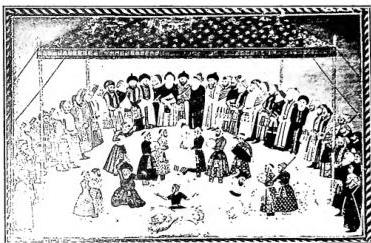
(from M. Garçon – R. Martin, Histoire générale des religions, IV, Paris 1917, p. 269)
ISLAM — Dance of the Dervishes. Miniature — Cambridge, Bodleian Library.
III. DOCTRINAL ELEMENTS
Ṣūfism has a technical terminology that defines the successive elements and degrees of asceticism and thus of mysticism. Notable correspondences with the concepts and terms of Christian spiritual theology are readily discernible.Whoever follows the ascetico-mystical path is first a mubtadī “beginner,” or murīd “aspirant”; then a sālik “progressive,” having attained the ascetic degree; ṭarāsīl “arrived” or kāmil “perfect,” having attained the mystical degree.
Asceticism, which has a propaedeutic function to mysticism, is called ṭarīq “way” or muǧāhadah “struggle.” In it the practitioner is guided by a muršid “guide.” The successive stages of asceticism are called maqāmāt “stations.” Their classification varies; however, the first of these is penitence and the last, through the various degrees of renunciation, is conformity to the divine will (riḍā).
To the “stations” of asceticism there correspond in mysticism the “states” (aḥwāl). Their classification is also manifold; at the foundation stands love (maḥabbah) of God, at the summit union (tawḥīd) with Him. There are three kinds of union, of which only the first is admitted by orthodoxy: ittiṣāl “conjunction” (cf. συνάφεια); ittiḥād “unification” (cf. ἔνωσις); ḥulūl “infusion” (of God into the soul of the mystic: cf. ἐνόλησις or κατόλησις). Of this last form al-Ḥallāǧ was accused. To union with God are linked the concepts of fanāʾ and baqāʾ. The former is the disparitio potentiarum, the momentary annihilation of the mystic in the deity; the latter expresses instead “permanence” in the state of union
and constitutes the highest and exceptional limit of
mystical experience (cf. the “transforming union”).
Many mystical schools distinguish union with
God’s actions, with His attributes, and with His essence.
Others limit themselves to union with Muḥammad.
V. ISLAM.
OUTLINE:
I. The sects
II. Origin and development of the Iīʿah
III. Doctrinal elements of the Iīʿah
IV. Other sects.I. THE SECTS
Heterodox Islâm, in its political, dogmatic and legal elements, is flanked by a series of sects, to which the absence of a hierarchical church and of councils, together with the religious and philosophical traditions with which Islâm came into contact in the course of its historical development, granted ample scope for genesis and growth.The essential original element of these heterodox currents lies in the historical events that centred around the figure of 'Alī. Šī'at 'Alī («party of 'Alī»), or more simply šī'ah, is the name given to that complex of sects, by far the most important and numerous (ca. 20 million), which recognises the right to political and religious government over the Muslim community solely in 'Alī and his descendants. Opposed to the 'alīdīs are the hāriğites (ca. half a million), who separated from 'Alī when he accepted arbitration with Mu'āwiyah and remained opposed to him and his enemies. Finally, if the hypotheses formulated especially by Guidi are correct, tendencies favourable to the Umayyads were carried to excess and thus fell into heterodoxy, by sects that deified members of that family and especially Yazīd I (Yazīdīs). The phenomenon of Yazīdism is practically severed from the body of Islâm, just as are many extremist sects that historically developed from the šī'ah: all these movements will therefore be discussed in greater detail under their respective headwords.
Some heterodox movements also arose independently of the events that centred around 'Alī. Such is the Ahmadiyyah in India at the end of the last century.
The theocratic character of the Islamic community automatically transferred political opposition onto the religious plane.
II. ORIGIN AND DEVELOPMENT OF THE Ī'AH
The origins of the Ī'ah go back to the very beginnings of Islamic history, to the strong groups of believers who disapproved of the election to the caliphate of Abū Bakr, 'Umar and 'Uṯmān, considering the rights of 'Alī, the Prophet’s cousin and son-in-law, to have been gravely infringed. The subsequent government of 'Alī brought this tendency to temporary victory; the advent of the Umayyads definitively relegated it to opposition, initiating a periodic cycle of insurrections and repressions that was to continue for centuries. Of the two sons of 'Alī and Fāṭimah, al-Ḥasan and al-Ḥusayn, the former died in private life, probably corrupted by Mu'āwiyah; the latter fell at Karbalā' in 680. Thus began the fragmentation of the Ī'ah into sects, according to the successors to whom the right to the imāmate — i.e. supreme political and religious authority — was attributed. The 'alīdīs almost always lacked a strong unitary organisation and suitable leaders, which was the principal cause of their defeats.The history of the Ī'ah is not merely a periodic political cycle; it is also a history of intense religious evolution, in which successive elements from the surrounding environment — among which stand out the gnostic religious-philosophical experience and the Iranian tradition of Manichaean and Mazdakite movements — are grafted onto the original Islamic trunk. Elements which, tempered in the tendencies of greater moderation, ended up instead prevailing in the extreme Ī'ah, carrying it far from Islâm.
The development of šī'ism is extremely intricate and complex. Its successive elements are given by the appearance of the various imāms, often many at the same time and even in conflict with one another. An element of clarification and guidance can be provided by the distinction, within the Ī'ah, of three great groups or tendencies, according to the varying degree of assistance or divine nature attributed to the imām: moderate, middle and extreme Ī'ah.
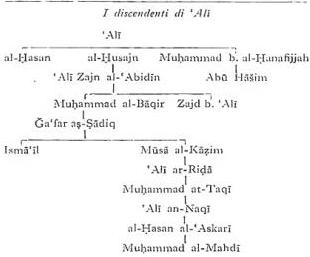
8. Moderate Šī'ah
This is constituted by the Zaydīs, so called because they are followers of Zayd b. 'Alī, who died in 740 while rising up against the Umayyad caliph Hišām. According to the Zaydīs, the imāmate belongs to those descendants of 'Alī who can prove their merit for II. For them, the imām has no divine prerogatives, but is merely assisted by the Divinity. The Zaydīs founded at the beginning of the 10th century a state in Yemen, which still exists today. They number ca. 1 million.9. Middle Šī'ah
This is represented by the Imāmītes or Twelvers, so called because they believe in 12 imāms, namely 'Alī, al-Ḥasan, al-Ḥusayn, and then in the line of descent 'Alī Zayn al-'Ābidīn, Muḥammad al-Bāqir (and not the younger brother Zayd, from whom the Zaydīs derive), Ġa'far aṣ-Ṣādiq, Mūsā al-Kāẓim (instead of the elder brother Ismā'īl, who predeceased his father; to him, however, the Ismā'īlīs, extreme šī'ites, are linked), and then his successors up to Muḥammad al-Mahdī. The latter is considered to have disappeared and is awaited as the mahdī, the saviour at the end of time.The Twelvers affirm the immanence in the imām of a particle of divine light, which renders him an infallible interpreter of revelation. Some dynasties adhered to this tendency, the most important of which are those that reigned in Persia from the 16th century to the present day. The Persian šāhs are considered to be the representatives of the hidden imām.
Groups of Imāmītes are currently to be found also in India, Mesopotamia and Syria (Mutawālī). Altogether, the Twelvers number ca. 17 million and are by far the largest šī'ite group.
From the Twelver šī'ah there separated, at the beginning of the last century, two movements of religious reform, strongly influenced by doctrines of an extreme tendency. The first is the Bābism, founded by 'Alī Muḥammad of Shīrāz, who proclaimed himself bāb, i.e. «gate» between the faithful and the twelfth imām during his absence, and later also nuqṭah, i.e. the locus of manifestation of the divine revelation. He upheld emanationist doctrines of an Ismā'īlī type.
ISLAM - Title page of codex B, the second of the two codices containing the complete edition of the Corpus Juris of Saīd Ibn 'Alī. Naskh script with miniature - Milan, Ambrosian Library, Arabic-Yemeni Collection G. 11 (11th century).
Ilita and a singular complex of cabalistic principles (based on the number 19), legal reforms and progressive norms of life. From the Bābism movement there derived another movement, the Bahā'ī Faith, founded by Bahā'ullāh, who proclaimed himself a manifestation of God Himself, developing the progressive principles of Bābism into a religion of universal brotherhood with freedom of worship and liturgy.
3. Shī'ah extremist (ghuluww, “excess”). - It consists of a series of sects that have in common the belief that the imām is either God or a prophet. Some of these sects trace their lineage to al-Ḥusayn, others to Muḥammad b. al-Ḥanafiyyah. Among the extremist Shī'ah movements, the most important is that of the Ismā'īlīs, which arose on a Sevener basis, i.e., by halting the line of the imāms at the seventh: from Ja'far aṣ-Ṣādiq the succession passed to Ismā'īl, and since he died before his father, the title of imām went to his son Muḥammad. The Ismā'īlīs are also called Bāṭinīs because of the esoteric character of their doctrines, which is in fact common to the extremist Shī'ah in general. Within the framework of Ismā'īlism there arose—and belong to it—the greatest movements of extremist Shī'ah: the Qarmaṭians, the Fāṭimids, the Druze, and the Assassins.
The Qarmaṭian movement, founded in the 9th century by 'Abdallāh b. Maymūn and developed in Syria and Mesopotamia until the 11th century (remnants now remain in Arabia), brings the Ismā'īlī doctrine to explicit definition, consisting in a monistic emanationist system of Gnostic type, based on the number 7. From God emanate the universal intellect, the universal soul, prime matter, space, time, and the terrestrial world. Time has 7 cycles, each with a “speaking” prophet, assisted by a series of 7 imāms, of whom the first is the “silent” one (also called the “base”), who disseminates the doctrine esoterically. The sixth cycle has as its speaking prophet Muḥammad, and as its silent imām 'Alī; the seventh has as its speaking prophet Muḥammad b. Ismā'īl, and as its imām 'Abdallāh b. Maymūn himself. A marked feature of the Qarmaṭian movement in the social sphere was its communism, through which the influence of Mazdakism is evident.
From Qarmaṭianism, to which a series of bloody revolts against the 'Abbāsids is attributed, there developed the Fāṭimid dynasty, which ruled Egypt and Syria from the 10th to the 12th centuries, claiming descent from the seventh imām through a series of hidden successors. Under the Fāṭimids, Ismā'īlism became the official religion, assuming a more moderate character. The only exception to this was the brief reign of the sixth caliph al-Ḥākim (996–1020 A.D.), who proclaimed himself the definitive incarnation of the deity. His followers took the name Druze from the propagandist ad-Darazī, who spread the movement in Syria, where it still exists. The Druze emanationist system, outlined by Ḥamzah b. 'Alī, is similar to that of the Ismā'īlīs, with modifications in favor of al-Ḥākim and Ḥamzah.
Further Ismā'īlī groups formed after the death of the Fāṭimid caliph al-Mustanṣir: followers of his son al-Musta'īl, who prevailed in the succession, were the Musta'īlīs, of whom remnants now exist in Yemen and India under the name Bohōrā; followers instead of the other son Nizār were a group led by al-Ḥasan b. aṣ-Ṣabbāḥ, who, having moved to Persia and Syria, formed the sect of the Assassins (so called from the intoxicating herb ḥashīsh). Remnants of them are found in Persia, Afghanistan, and especially in India, where they are known as Ḥōǧah. Their leader is the Āghā Khān.
Among the extremist Shī'ite sects not connected with Ismā'īlism, mention should be made, in the earliest phase of Islamic religious history, of the group centered on Muḥammad b. al-Ḥanafiyyah, known as the Kaysānites. Some held that this son of 'Alī had disappeared and awaited him as the mahdī. Others transferred the imāmate from him to his son Abū Hāshim, and from him various branches arose. The most important of these is the 'Abbāsid branch, which, asserting the testamentary transfer of the imāmate from Abū Hāshim to the 'Abbāsid family, provided theoretical justification for their rise to the caliphate.
Today there remain some sects of extremist Shī'ah, in addition to those of Ismā'īlī derivation. Among them are the Nuṣayrīs or 'Alawites of Syria, originating in the 10th century, who assert a trinity composed of 'Alī, Muḥammad, and Salmān, the Persian slave who became a companion of the Prophet. Another living sect is that of the 'Alī-ilāhīs, who deify 'Alī, spread since the 17th century in Asia Minor, Mesopotamia, Persia, and Transcaucasia. In Persia there have survived since the 14th century the Ḥurūfīs, characterized by a complex symbolic system based on the letters of the alphabet. The doctrines of the Ḥurūfīs influenced the Sufi brotherhood of the Bektaşīs (v. BEKTĀSHIYYAH), in which numerous beliefs proper to extremist Shī'ism are found.
III. DOCTRINAL ELEMENTS OF THE SHĪ'AH
The doctrinal content of the Shī'ah, whose multifaceted development has been traced above, is shaped by the conception of the imām, which is decisively different from that of orthodoxy: the imām must belong to the family of 'Alī, and the assistance or indwelling of the deity in him, according to the various tendencies, renders him infallible. He thus possesses an authority far greater than that of the orthodox caliph, who is merely the guarantor of religious practice; consequently, the sources of dogmatic and legal theology are devalued in comparison with his living magisterium (ta'līm).
The theory of the imāms and the mahdī is complemented in extremist Shī'ah by complex emanationist doctrines of Gnostic type. To these are added pronounced allegorism, intended to uncover the inner meaning (bāṭin) of the Qur'ān and the traditions, esotericism, and the secretive character of the sects (according to the doctrine of taqīyah, the Shī'ite must conceal his faith for its own good).
This complex of doctrines directly links ghuluww to the Gnostic heritage; other elements, such as, for example, the communism of many extremist sects, reveal the influence of Iranian religious movements, essentially Mazdakism and Manichaeism, which in turn were linked to Gnosticism. It is undeniable that extremist Shī'ism developed within the sphere of non-Arab currents, which carried it far from primitive Islam and often made it the expression of Persian revolt against the conquering Arabism. These same non-Arab currents progressively attenuated their influence on moderate and middle Shī'ism, leaving greater room for positions closer to orthodoxy.
With these general characteristics of the Shī'ite currents in mind, their dogmatic and legal theology, while differing in some points from that of orthodoxy, is not in its entirety very dissimilar from II. In dogmatic theology, moderate Shī'ites essentially follow the Mu'tazilite system, as do the middle Shī'ites, who, however, do not accept eternal punishment for unrepentant Muslims. The emanationist doctrines carry extremist Shī'ites beyond even this dogmatic system.
In legal theology the Zaydites follow the rite of that name, which they trace back to Zayd b. 'Alī and which closely resembles the orthodox rites. The Imāmīs and also the extremist Shī'ites follow the Ja'farite system, so called from the sixth Imām Ja'far aṣ-Ṣādiq. The main divergence of this rite from the others is the admission of temporary marriage (mut'ah).
The Shī'ites have their own cities and shrines, to which they make pilgrimages. The most important centre is Karbalā', where the tomb of Ḥusayn is located. The Shī'ites celebrate with rites of mourning the anniversary of his death on the 10th of muḥarram.
IV. OTHER SECTS
10. The Ḥāriǧites
These are the followers of 'Alī who separated from him when he accepted the arbitration at Ṣiffīn, holding that judgment belonged to God alone. The name is explained as “those who go out from the camp” or, according to a recent hypothesis by Guidi, “those who go out into the field.” The Ḥāriǧites opposed both the Shīʿites and Muʿāwiyah, and as such continued their struggle during the Umayyad dynasty and the early period of the ʿAbbāsid dynasty. One of their branches, the Ibāḍites, moved to North Africa, where they founded small states and still survive today. It is essentially to them that we owe our knowledge of Ḥāriǧite dogmatic and legal theology.The essential thesis of Ḥāriǧite dogmatics, linked to the origins of the movement, concerns the problem of faith and works: a Muslim guilty of a grave sin thereby becomes an unbeliever. For this reason, the Ḥāriǧites recognize as caliphs only Abū Bakr, ʿUmar, ʿUthmān up to the seventh year of his reign, and ʿAlī up to the arbitration. Membership in the Quraysh tribe or in the Prophet’s family is not necessary for the caliph: any Muslim may be caliph, provided his works are upright; when he falls into sin, he must be deposed. In the remaining points of dogmatic theology, the Ibāḍite treatises follow the Muʿtazilite theses, except for that of free will, on which they agree with the Ashʿarite orthodoxy.
In legal theology, the Ibāḍites have their own rite, which is largely similar to the Sunnite one.
11. The Yazīdīs
They number several tens of thousands of people of Kurdish origin and language, with a main nucleus near Mosul and others in Mesopotamia, Syria, Armenia, the Caucasus, and Persia. They believe in a supreme God from whom seven angels emanate. The first is the peacock angel, Melek Tāʾūs, a fallen angel who later repented and thus became a principle of good. He is the regent of the world; he is incarnate in Yazīd and then in Ṣaḥj ʿAdī, a Muslim mystic saint who became the central figure of this sect. The other six angels also have incarnations. The doctrine of metempsychosis is present among the Yazīdīs, along with other Gnostic and Iranian elements (remnants of dualism). In their rites, there are strong Christian and Jewish influences. Their worship centers on the annual pilgrimage to the sanctuary of Ṣaḥj ʿAdī near Mosul.12. The Aḥmadīyah
A sect founded by Ghulām Aḥmad of Qādiān (d. 1908) in India. He maintained that Christ had died in India at the age of 120; declared himself the Messiah and Mahdi; affirmed the spiritual nature of holy war and, in the particular case of India, respect for British rule. After his death, the sect divided into the Qādiānī and Lahore groups. — See pl. XIX.For Islamic art: V. MUSULMANA, ARTE, ARTE.
History. General bibliography: J. Sauvaget, Introduction à l'histoire de l'Orient musulman. Éléments de bibliographie, Paris 1946 (extremely useful).
General works: C. Brockelmann, Geschichte der islamischen Völker und Staaten, Munich and Berlin 1939 (updated translations: English, New York 1947 and 1949; French, Paris 1949); P. K. Hitti, History of the Arabs, 4th ed., London 1949 (up to the period of Ottoman hegemony excluded). Excellent genealogical and chronological tables in E. de Zambaur, Manuel de généalogie et de chronologie pour l'histoire de l'Islām, Hanover 1927. The great encyclopedic works begun by L. Caetani remain incomplete: Annali dell'Islām, 10 vols., Milan 1904–26 (translation or summary of sources and critical analysis, up to the year 40 of the Hegira); Chronographia islamica, Paris 1912–22 (collection of sources for each event, up to the year 132 of the Hegira), continued in the Cronografia generale del bacino mediterraneo e dell'Oriente musulmano, fasc. 1, Rome 1923 (up to 144 of the Hegira).
On the Umayyads: J. Wellhausen, Das arabische Reich und sein Sturz, Berlin 1902. Also a series of studies by H. Lammens and F. Gabrieli (see the references in J. Sauvaget, op. cit., pp. 119–20).
On the ʿAbbāsids: G. van Vloten, De Ophouw der Abbasiden in Charan, Leiden 1890; A. Mez, Die Renaissance des Islām, Heidelberg 1922 (on the ʿAbbāsid civilization of decline).
For specific bibliography from the period of autonomous states onward, see the entries on individual peoples and regions; also J. Sauvaget, op. cit., pp. 129 ff. On recent events: M. V. Seton-Williams, Distant and the Arab states, A survey of anglo-arab relations, 1930–48, London 1948; cf. also the journal Oriente moderno, 1 (1921) ff.
Religion. General works: I. Goldziher, Vorlesungen über den Islām, 2nd ed., Heidelberg 1925 (French trans. by J. Arin, Le dogme et la foi de l'Islām, Paris 1920); H. Lammens, L'Islām, croyances et institutions, 3rd ed., Beirut 1944 (Italian trans. by F. Gabrieli, Bari 1940); G. E. von Grunebaum, Medieval Islām, Chicago 1946; M. Guidi, Storia della religione dell'Islām, in P. Tacchi Venturi, Storia delle religioni, II, 3rd ed., Turin 1949, pp. 303–337. Modern Islām: R. Hartmann, Die Krise des Islām, Leipzig 1928; H. A. R. Gibb, Whither Islām, I, London 1932; id., Modern trends in Islām, Chicago 1947. Anthologies of texts: J. Schacht, Der Islām mit Anschluss des Qaʿdān, Tübingen 1931; A. J. Wensinck, The Muslim creed: its genesis and historical development, Cambridge 1932.
Legal theology: Th. W. Juynboll, Handleiding tot de kennis van de mohammedaansche wet volgens de leer der sjafeïtische school, 3rd ed., Leiden 1925 (Italian trans. by G. Baviera, Milan 1916); D. Santillana, Istituzioni di diritto musulmano malichita con riguardo anche al sistema sciafeita, 2 vols., Rome 1926–43 (fundamental); J. Schacht, G. Bergsträsser's Grundzüge des islamischen Rechts, Berlin and Leipzig 1935.
Dogmatic theology: A. S. Tritton, Muslim theology, London 1947; L. Gardet and M.-M. Anawati, Introduction à la théologie musulmane. Essai de théologie comparée, Paris 1948 (comparative study with Christian theology).
Spiritual theology: R. A. Nicholson, The mystics of Islām, London 1914 (Italian trans. by V. VEZZOLANO, Turin 1925); id., Studies in islamic mysticism, Cambridge 1921; L. Massignon, Essai sur les origines du lexique technique de la mystique musulmane, Paris 1922; id., Recueil de textes inédits concernant l'histoire de la mystique en pays d'Islām, ibid. 1929; A. J. Wensinck, Oostersche mystica, Amsterdam 1930; M. Smith, Studies in early mysticism in the Near and Middle East, London 1931.
Heterodox Islām. The best introduction, with bibliography, is found in the entries of the aforementioned Handwörterbuch des Islām. Also A. S. Tritton, op. cit. Shīʿites in general: D. M. Donaldson, The shi'ite religion, London 1933. Zaydīs: R. Strothmann, Der Kult der Zaiditen, Strasbourg 1912; id., Das Staatsrecht der Zaiditen, ibid. 1912. Twelvers: R. Strothmann, Die Zwölfer-Schia, Leipzig 1926. Ḥāriǧites: J. Wellhausen, Die religiös-politischen Oppositionsparteien im alten Islām, Berlin 1901; F. Gabrieli, Sulle origini del movimento dāʿī, in Rend. R. Accademia d'Italia, Scienze morali e storiche, 7th series, 3 (1941), pp. 110–17; M. Guidi, Sui Ḥāridžiti, in Riv. degli studi orientali, 21 (1944), pp. 1–14. For the other sects, see the relevant entries.