
ROMANIA. - It is the southernmost of the Danubian-Carpathian states and the easternmost among the Neo-Latin nations; situated between Hungarians and Slavs, at the boundary toward the Balkan and Russian worlds. The war of 1915-1918 doubled its size compared to 1914 (295,000 km²), while the war of 1939-1945 reduced it to 238,000 km², stripping it of Bessarabia, northern Bucovina (ceded to the U.S.S.R.), and southern Dobruja (ceded to Bulgaria). From December 1947 onward, Romania, having become a "People's Republic," entered the orbit of Soviet communism.
I. GEOGRAPHY
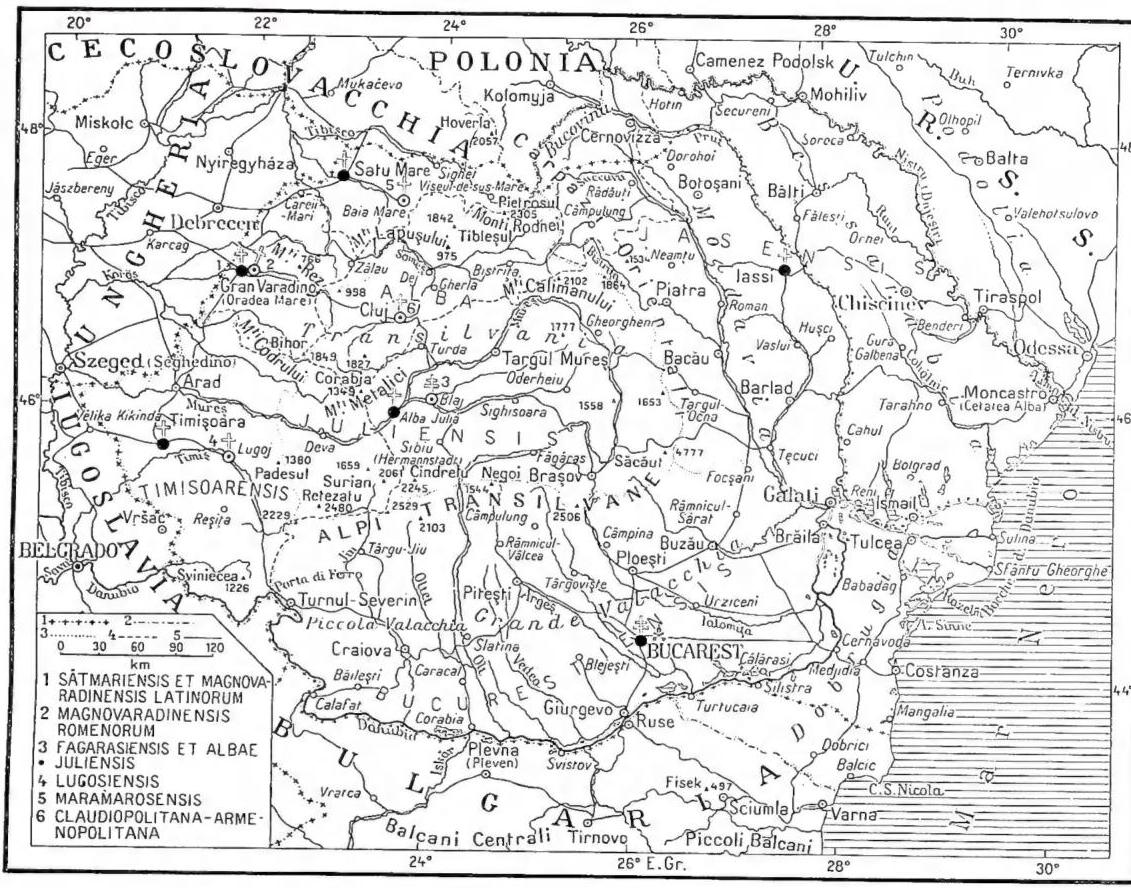
The territory of Romania has an almost circular shape, delimited for a large stretch by rivers (the Danube and the Prut) and for the rest by conventional borders, which between the Banat and Maramureș separate it from Yugoslavia and Hungary. The landscape is varied, alternating more (Wallachia) or less (Banat) extensive plains with hilly zones (Transylvania, Moldavia) and mountainous areas (the Carpathians, Transylvanian Alps); its only outletROMANIA - 1) Current state border; 2) state border in 1939; 3) ecclesiastical circumscription border of the Latin rite; 4) ecclesiastical circumscription border of the Romanian rite; 5) railways.
Despite its vast territory, the country’s only outlet is the short coastline on the Black Sea south of the Danube’s mouth. Although predominantly agricultural—over two-thirds of the population lives off the land, which also ensures a substantial surplus of cereals (wheat) for export—the country has sought to strengthen its economy by exploiting its abundant mineral resources, capable of providing a decisive impetus to its industrial development. More than fossil fuels (lignite) and iron ore (Banat, Transylvania), its rich oil fields in the Carpathians and Transylvanian Alps, the largest in Europe, along with abundant methane gas, have secured ample energy supplies and fostered favorable trade development. Industry has recorded progress in recent years across many sectors, particularly in textiles, machinery, milling, and paper production.
The territory of present-day Romania, particularly Transylvania, constituted in the 1st century B.C. the center of the Kingdom of Burebista, who had succeeded in unifying the various Dacian tribes and peoples under his scepter. Upon the death of this sovereign, which occurred around the mid-century, the state formation disintegrated, but during the 1st century A.D., Decebalus managed once again to establish in Dacia, north of the Danube, a powerful state that gave the Romans much trouble.
During the time of Emperor Domitian, Rome, in order to avoid the raids of the Dacians into the territories it occupied, obliged itself to the payment of an annual tribute, a tribute that was later indignantly refused by Trajan. The latter, in 101 A.D., indeed initiated a war against Decebalus, crossed the Danube, forced the king to peace, and practically reduced Dacia to a Roman protectorate. Four years later, Decebalus, desiring to free himself from the Roman yoke, rebelled, but his attempted defection was bloodily repressed, and he himself, taken prisoner, committed suicide, preferring death to the prospect of being an object of mockery in Rome during the imperial triumph. Dacia, reduced to a province of the Empire, became an important military bastion for the defense of Roman positions in the Balkans and was intensely colonized. However, faced with the pressure of barbarian populations, Aurelian decided in 271 to evacuate Dacia (v. DACIA), whose inhabitants, for the most part, moved south of the Danube, probably into regions of present-day Serbia. From then until the 13th century, when historical documents speak of the existence of a "Vlach" or Romanian population, there is only scant information on the ethnic continuity and the events of the Daco-Romans. The lack of sources and valid data for the reconstruction of Romanian history in that period has favored disparate interpretations, not always characterized by rigorous scientific seriousness, but rather tending to provide juridical-historical support for the political ambitions of individual nationalisms. The Romanian-Hungarian polemic over Transylvania has indeed led to the formulation of two diametrically opposed hypotheses to solve the enigma of the historical continuity—or lack thereof—of the Daco-Romans during the early Middle Ages. Romanian historians, who consider Transylvania the cradle of their people, claim to descend directly from the Daco-Romans, since the transplantation south of the Danube in the time of Aurelian would have been, according to these scholars, only partial and not total, and many colonists, having taken refuge in the valleys of the Carpathians during the invasions of Goths, Avars, Bulgars, and other peoples, would have ensured the Daco-Roman ethnic continuity until the 13th century, when they themselves descended into the plains and took the name of Vlachs. Hungarian historians, on the other hand, reply that the abandonment of Transdanubian Dacia was total, that the Romanization of the province was insignificant, that colonization had been entrusted largely to non-Italic elements, and that the persistence of many Slavic terms in the current Romanian language would demonstrate that the Romanians should descend from the Balkan Romans of Cisdanubian Dacia, who arrived in Transylvania in the late Middle Ages. These, in brief, are the respective positions of Romanian and Hungarian historians, both guided in their reconstructions by the desire to affirm their own country's right to the possession of Transylvania: the Romanians through the demonstration of a supposed ethnic-historical continuity of their nation since the time of imperial Rome; the Hungarians through the proof of a very late immigration of the ancestors of present-day Romanians, subsequent to the occupation of the country by the Magyars.
The first historical records of the voivodeships of Wallachia and Moldavia, established beyond the Carpathians by the initiative of Romanian nobles desiring to escape the sovereignty of the kings of Hungary and conversion to the Catholic faith (the Romanians were "Orthodox"), date the genesis of the principality of Wallachia to the 13th century and that of Moldavia to around the mid-14th century, when Bogdan, having rebelled against Louis the Great of Anjou, king of Hungary, crossed the Carpathians and founded the new independent principality in the plain of the Moldavia. The events of the two voivodeships were subsequently closely tied to those of neighboring states: Hungary, Poland, and Turkey. Wallachia, initially in a relationship of vassalage toward the crown of St. Stephen, found itself in the 14th century alternately subjected to the sovereignty of one or another of the aforementioned three states. In the 15th century, Turkish sovereignty became predominant there, clearly and explicitly affirmed after the Battle of Mohács in 1526. Moldavia, in the same period, recognized Polish suzerainty, but it too was forced, after Mohács, to pay an annual tribute to the sultan, who in the second half of the 16th century significantly strengthened his dominion in this voivodeship as well. Toward the end of the 16th century, the election of Michael the Brave as voivode of Wallachia in 1593 marked a brief respite in the long night of Turkish domination. This prince, perhaps guided in his complex political designs more by ambition than by a strong sense of indignation toward the exactions of the sultan's tax collectors, after agreeing with the voivode of Moldavia, on a prearranged signal, had all the Turks residing in the two principalities massacred. He then occupied Dobruja and, to successfully counter Ottoman attempts at reconquest, recognized the suzerainty of Sigismund Báthory, prince of Transylvania.
Subsequently, he himself managed to obtain the title of prince of Transylvania and also conquered Moldavia. His sudden political fortune, however, alarmed the Habsburg general Basta, who on 19 August 1601...
Mihail the Brave, who was the first to unite the regions of Romania (Transylvania, Wallachia, Moldavia, Dobruja, Bukovina, and Bessarabia—the latter two then integral parts of Moldavia) into a single territorial entity, marked the beginning of the darkest period of Ottoman domination with his death. Until then, the princes had enjoyed a certain, albeit vague, internal independence, guaranteed by the election of native rulers. From the seventeenth century onward, the voivodes became mere instruments of the sultans, who appointed and deposed them at will. Forced, in order to retain their positions, to maintain relations with influential courtiers in Constantinople—who charged dearly for their favor and intercessions before the Ottoman court—the voivodes introduced an increasingly oppressive fiscal system in the principalities to meet their financial obligations. Any attempt at independent policy was rendered impossible a priori. Nevertheless, in both Moldavia and Wallachia, the princely dignity continued to be held by indigenous nobles. From the second half of the seventeenth century, however, Greek influence grew steadily, and the voivodates themselves gradually became the prerogative of the highest bidder. Thus, by the early eighteenth century, former diplomatic advisors and Greek interpreters of the sultans had permanently established themselves in the two principalities: Moldavians and Wallachians no longer even had the meager consolation of being exploited by native voivodes. This so-called Phanariot period (from Phanar, the diplomatic quarter of Constantinople) lasted until 1821. In Wallachia, 23 princes succeeded one another, and in Moldavia, 24; some governed multiple times and moved with indifferent ease from administering one voivodate to the other. Among them were also men of worth, cultured and intelligent, but they could do nothing against the omnipotence of the sultans. The Phanariot regime ended only in 1822, when the Turks, in response to the stance taken by the voivodes in favor of Alexander Ypsilanti’s pro-Greek movement, decided to restore the government of the two principalities to native voivodes.
Meanwhile, in Transylvania, under the influence of the Hungarian and German national revivals, Romanians had also begun to acquire a sense of their national identity during the eighteenth century. In 1791, they appealed to the regional Diet to recognize them, alongside the Magyars and Saxons, as a "nation." This request, presented in the Supplex libellus Valachorum, was not granted. In 1829, with the Treaty of Adrianople, the two principalities, while remaining tributaries of the sultan, came under Russian protectorate, which remained in force until 1856. In that year, the Treaty of Paris replaced the Russian protectorate with a collective guarantee by the great European powers, one of whose commissions, based in Bucharest, proceeded to revise the laws in force in the two principalities. Following the vote of the assemblies of the two voivodates, constituted under the Treaty of Paris, Alexandru Cuza was elected prince of Moldavia and Wallachia in January–February 1859. Thus, the union of the two voivodates, recognized by the great powers in 1861, became a fait accompli. Cuza remained in power until 1866, when he was forced to abdicate following a conspiracy. His frankly liberal policies were characterized above all by the agrarian reform law, which abolished serfdom. He was succeeded by Carol of Hohenzollern-Sigmaringen, who reigned as Carol I until 1914. During his long reign, the Kingdom of Romania was proclaimed on March 25, 1881, comprising at that time, in addition to Wallachia and Moldavia, northern Dobruja (Bukovina and Bessarabia had been incorporated into Austria in 1774 and Russia in 1812, respectively). During the First World War, Romania initially remained neutral; it then entered the war in August 1916 on the side of the Entente but was quickly occupied by the Central Powers and forced to cede southern Dobruja, conquered during the Second Balkan War of 1913, to Bulgaria. The collapse of Austria—
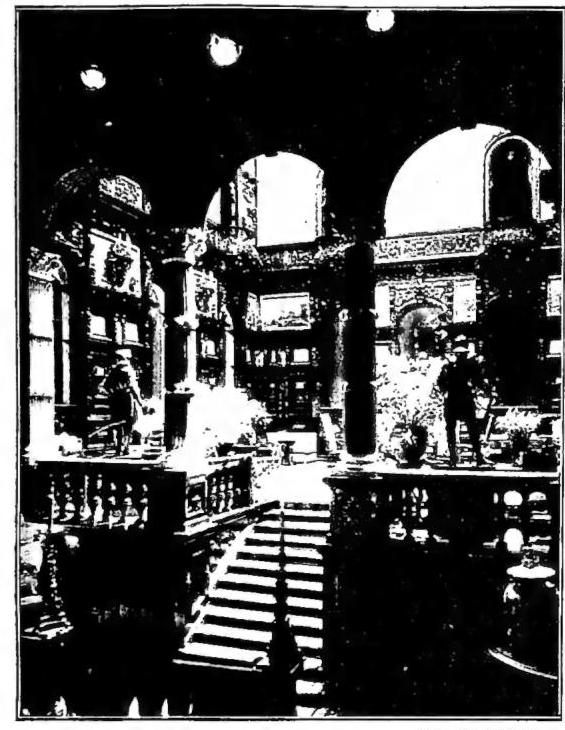
ROMANIA - The interior of the magnificent Sinaia Castle.
During the Second World War, Russia took advantage of Romania’s diplomatic isolation to secure the cession of Bessarabia and Bucovina in June 1940; Bulgaria to acquire southern Dobruja (21 Aug. 1940); and Hungary to obtain much of Transylvania (30 Aug. 1940). Having then entered the war against Russia in 1941 alongside Germany, the new King Michael, after the coup d’état of 23 Aug. 1944, signed the armistice with the Soviet Union and joined the anti-German coalition. The Peace Treaty restored Transylvania to Romania but not the other regions ceded in 1940. On 30 Dec. 1947, the Romanian People’s Republic was proclaimed.
III. ECCLESIASTICAL HISTORY
In Romania, Christianity first penetrated the Danubian part of theRoman Empire, Dacia (v.). The Romanians of the north, in the Middle Ages, remained in contact with the "Olahi Romani" and the monasteries of Mitrovija, the ancient Sirmium, capital of Illyricum and birthplace of St. Demetrius ("Dmitrovija"), the great saint of the Romanians and all the Balkans.
Contact between Dacia and the Christian world could certainly not have been interrupted by the invasions. On the right bank of the Danube there was a series of Latin bishoprics. The barbarians made their usual incursions into the Empire; the legions—of Constantine and Justinian—recrossed the river in pursuit. Especially the Goths, Slavs, and Avars carried off many prisoners, among whom were not a few Christians, perhaps even priests. The Goths, who were then also masters of the future Romanian lands, had martyrs in what would become Wallachia and bishops: the famous Ulfila (d. 391) also preached in Latin.
In Transylvania, Christian inscriptions (Zenovius) dating after Constantine and from the early 5th century have been found. Romanian Christianity, predating that of the Slavs and without special dependence on Greek Christianity, emerged directly from the Christianity of the Balkans during their Latin period. It seems that, distant from Rome and dependent on Byzantium, the Romanized populations of the Balkans and the Danube—for whom the Byzantines, the "Romei," adopted not the name of Vlachs, which the Slavs had received from the Germans (Vlachs = Welsh, Welsch, Walloon, etc.)—lost, along with the ancient episcopal cities destroyed by the barbarians, their Latin clergy and accepted the Greek liturgy, especially after eastern Illyricum came under the patriarchate of Constantinople (732). With the conversion of the Bulgarians and their submission to the Greek patriarch (870), the Romanians, who also politically depended on them, were finally compelled to accept the Slavic rite. Only at the beginning of the 18th century were they able to definitively introduce the Romanian language in churches. In 1860, the Latin alphabet replaced the Cyrillic one.
After the terrible defeat of the Bulgarians, Basil II placed all the Romanians of his Empire under the archbishopric—then of Greek hierarchy—of Ohrid (1018). Almost immediately afterward, a bishop of the Romanians (τῶν Βλαχῶν) is found in a location of uncertain position, Vreanons. The Greek schism of 1054 also involved the Romanians, due to their geographical position and political circumstances, in the Byzantine sphere. The union with Rome, made by the great "emperor" Ionitza (v. MACEDONIA) in 1204 for his Romanian and Bulgarian subjects, was broken in 1235 by his nephew John Asen II.
North of the Danube, before the foundation of the principalities, the Romanians had only wooden churches, and the clergy consisted solely of priests of peasant origin, consecrated without selection by more or less canonical "hierarchs" who lived in monasteries (or came from Bulgaria) in the manner of those "pseudo-bishops" mentioned in a brief of Gregory IX from the early 13th century (Iorga). The founders of the principalities sought to endow the new countries with a particular ecclesiastical organization as well.
Wallachia. - The Romanians of Wallachia turned to the bishops of Vidin, Silistra, or Vicina for their religious needs. Bishop Iakint of the latter see was requested by Prince Nicolae Alexandru, son of the "founder" Basarab, in 1359, and the patriarch of Constantinople granted him as metropolitan of Wallachia or Ungro-Wallachia, with residence in Curtea de Argeș; the see was transferred in 1508 to Târgoviște and, toward the end of the 17th century, to Bucharest. In 1370, a bishopric was established in Severin, later moved to Râmnicu-Vâlcea. A third bishopric was founded in 1508 in Buzău. The last bishopric established in Wallachia (or Muntenia) was that of 1794 in Curtea de Argeș. Ancient monasteries: Vodița, Tismana (14th century), Cozia, Cotmeana, Snagov, Glavacioc, Dealul, Brădet (first half of the 15th century).
Moldavia. - At the time of the foundation of this principality (1359), the Moldavian Romanians turned to the metropolitan of Halicz (Galicia) or the bishop of Cetatea Albă, on the Black Sea. Only in 1401 was recognition obtained for a Romanian metropolitan, Iosif, with residence in Suceava, the country's capital. In 1564, the capital and the metropolis were transferred to Iași. The bishoprics of Roman and Rădăuți were founded in 1401 and 1402. Other bishoprics were established in Huși (1595) and Hotin (1713). The metropolis of Brăila or Proilavia (Wallachia), founded toward the end of the 16th century for the Christians of the Turkish "raias," occasionally placed its residence in Galați, Ismail, or Căușani (Moldavia) or even in Dubăsari, beyond the Dniester; after 1812, it remained a metropolis only of Brăila and Silistra and was definitively suppressed in 1829. After the annexation of northwestern Moldavia (Bukovina) by Austria, the bishopric of Rădăuți was transferred to Cernăuți (1781) and elevated to the rank of metropolis of Bukovina and Dalmatia (1873), while the bishopric of Hotin, moving its residence to Chișinău (Kishinev) following the annexation of eastern Moldavia (Bessarabia) by Russia, became an archbishopric in 1813.
Ancient monasteries: Neamț (14th century), Bistrița, Moldovița, Căpriana, Vărzărești, Horodnic, Humor (early 15th century), Putna, Volovaț, Voroneț, Dobrovaț (late 15th century), Pobrata, Slatina, Sucevița (16th century).
In Moldavia, in 1401, the relics of St. John the New were transferred from Cetatea Albă to Suceava; in 1641, Prince Vasile Lupu had the relics of St. Parascheva brought from Ismail to Iași.
Transylvania. — The Romanians of Transylvania, cradle of the other two principalities, remained under the Hungarians and initially had no ecclesiastical hierarchy but turned either to Halicz or to the bishoprics of Bulgaria, then to those of Serbia, Wallachia, or Moldavia. In the 15th–16th centuries, bishops are sporadically found in Hunedoara (Hunyade), Maramureș, Feleac, Geoagiu, Silvaș, and Ineu. Stephen the Great of Moldavia (1457–1504) wanted a bishopric for eastern Transylvania in Vad, whose titulars were consecrated in Suceava and obeyed the metropolitan of Moldavia. In the Treaty of May 20, 1595, between Michael the Brave of Wallachia and Sigismund Báthory, it was decided that all Romanians of Transylvania, under their own bishop, would depend on the metropolitan of Târgoviște. Ioan of Prislop was the first metropolitan of all Romanians of Transylvania.
After 1700, when the vast majority of Transylvanian Romanians, together with their bishop, reunited with Rome, the non-united "Orthodox" remained without bishops for over sixty years and subsequently received them from the Serbs. Only in 1811 did they again receive Romanian bishops. Under Andrei Șaguna, the "Orthodox" bishopric of Transylvania acquired the title of metropolis in 1863, with residence in Sibiu and as suffragan the bishopric of Caransebeș, then created, and the older one of Arad.
Ancient monasteries: Peri, Prislop (14th century), Rămet, Geoagiu, Vad, Feleac, Hodoș-Bodrog (15th century). In the 13th century (1216), the "metochia" dependent on the Palestinian and Macedonian monastery of Beria reached the Romanian regions at Mitrovitza (Sirmium) and at Satu Mare.
In 1859, Wallachia and Moldavia formed the state of Romania. The vast landed estates of the monasteries were confiscated by the state in 1863. The law on ecclesiastical organization of 1872 established that bishops and metropolitans were to be elected by Parliament and chosen only from among Romanians. In 1884, the Faculty of Theology was established at the University of Bucharest. The bishopric, founded in 1864 in Ismail, was transferred to Galați in 1878 following the cession of southern Bessarabia to Russia. The patriarchal tomos of April 25, 1885, granted autocephaly to the Romanian Church.
BIBL.:
N. Iorga, Istoria bisericii românești, 2 voll., Vălenii-de-Munte 1908–1909; Id., Istoria românilor prin călători, 2 voll., București 1928–1930; M. Păcurariu, Istoria Bisericii Ortodoxe Române, 3 voll., București 1980–1981; A. Elian, Istoria Bisericii Românești, București 1980; I. Rămureanu, Istoria Bisericii Românești, 2 voll., București 1987; Acta et diplomata res Albaniae mediae aetatis illustrantia, ed. L. Thalloczy, C. Jireček, E. de Sufflay, 2 voll., Vindobonae 1913–1918; Fontes historiae Daco-Romanae, ed. V. Pârvan, I, București 1934; Documenta Romaniae Historica, București 1967–; Biserica Ortodoxă Română, București 1874–; Mitropolia Olteniei, Craiova 1949–; Mitropolia Ardealului, Sibiu 1956–; Mitropolia Moldovei și Sucevei, Iași 1925–; Studii Teologice, București 1949–. Mircea Păcurariu
After the First World War, Transylvania—along with its western appendages (part of the Banat, etc.) and northern Maramureș—Bessarabia, and Bukovina were incorporated into Romania. The organization of the entire Romanian "Orthodox" Church was then unified on the basis of the Statute of Saguna (1925). New bishoprics were established in Oradea, Cluj, Satu-Mare (with the title of Maramureș), Hotin, Constanța, Cetatea Albă, Timișoara, and a military bishopric in Alba Iulia; the bishopric of R. Vâlcea was promoted to the metropolis of Oltenia, while the metropolitan see of Bucharest became, in 1925, a patriarchate. Another Faculty of Theology was created in Chișinău (Bessarabia). In Cernăuți, Bukovina, one had existed since the time of Austrian rule. In Transylvania, in addition to the Theological Academy of Sibiu, three others were founded in Arad, Oradea, and Cluj.
Catholics. — After the founding of the principalities, a small number of Catholics are found in the main cities of Wallachia: Argeș, Câmpulung, Târgoviște. They are more numerous in Moldavia, where their mass—formed by the "Ciangăi," a population possibly of Cuman origin, Magyarized and then Romanianized—also lives in the countryside, especially in the districts of Roman and Bacău; at the beginning of this century, there were approximately 80,000. In Transylvania, the Catholic element was represented by Hungarians, Szeklers, and Saxons living there. When the majority of these passed to Protestantism, the main support of the Catholic Church was the "Swabians," German colonists of the Austrian era.
The first known Catholic missionary activity in the principalities was carried out by Dominican preachers after 1222 for the conversion of the Cumans. Bishop Theodoric, installed in 1227 at Milcov, depended directly on Rome. With the Mongol invasion of 1241, the bishopric disappeared and survived only as an honorary title for about three centuries. Equally ephemeral were the bishoprics of Severin—where a bishop is found in 1246 and another in 1380—of Siret (1370), of Argeș (1381), and of Baia (1413). That of Bacău functioned for about two centuries, although its titulars mostly resided in Poland. Also in Akkerman (Cetatea Albă), there is mention of a Catholic bishop under Stephen the Great until the conquest of the city by the Turks (1484). From the 17th century onward, the care of the faithful was entrusted to the bishop of Nicopolis, in Bulgaria, the apostolic visitors, and prefects.
On 27 April 1883, Leo XIII founded the bishopric of Iași, with Giuseppe Camilli, and that of Bucharest, with Bishop Paoli.
In 1700, the near-totality of Romanians in Transylvania, led by their bishop Atanasie, united with Rome, preserving the Eastern rite. The episcopal residence was transferred in 1721 from Alba Iulia to Făgăraș, then, under Innocent Micu (Klein), to Blaj (1737), which, with its schools, was to be a center of national revival for all Romanians. On 6 June 1777, Pius VI created a new bishopric for the Uniates in Oradea. Pius IX established two more bishoprics on 26 November 1853, in Gherla and Lugoj, and subjected them, along with that of Oradea, to the bishopric of Blaj, elevated on the same date to an archbishopric or metropolis with the title of Alba Iulia and Făgăraș.
Following the Concordat of 10 May 1927—ratified in 1929—between Romania and the Holy See, Pius XI, with the bull Solenni conventione of 5 June 1930, created the bishopric of Maramureș—with its see in Baia Mare—subject to the same metropolis, while the bishopric of Gherla was transferred to Cluj, the civil capital of Transylvania. With the same bull, the Latin-rite Church was organized, subjecting the Latin dioceses of Alba Iulia, Timișoara, Satu-Mare, and Iași to the archbishopric of Bucharest; for the united Armenians, an apostolic administrator was appointed, residing in Gherla (or Bucharest) and dependent directly on Rome.
Regarding religious Orders, while for the Latins there are many of their rite, the Uniates have only the Basilians (since 1747) with monasteries in Bixad, Moisei (1933), Nicula (1936), and Prislop; the Sisters of St. Mary of Blaj (1921); an Eastern branch among the Assumptionists (1923) and the Jesuits (1927).
The 1930 statistics found in Romania: "Orthodox": 13,067,000 (72.2%); united Catholics: 1,350,000 (7.3%); Latin Catholics: 1,200,000 (6.5%); Calvinists: 717,000 (3.9%); Lutherans: 360,000 (8.2%); Israelites: 984,000 (5.5%); Muslims: 234,000 (1.6%).
With the advent of the communist regime, the Uniates had 5 dioceses, 1,834 priests, 2,588 churches, 9 religious Orders and congregations, 28 houses with 424 religious, 34 educational institutes with 6,152 students, 220 associations of Marian congregations with 24,600 members, 20 periodicals with 252,000 copies.
The Latins: 5 dioceses, 1,086 priests, 1,220 churches, 22 religious Orders and congregations, 158 houses with 1,690 religious, 126 schools and educational institutes with 31,696 students, 120 associations of Marian congregations with 6,000 members, 1 daily newspaper with 35,000 copies, and 23 periodicals with 338,000 copies (Esposizione Vaticana 1950, sez. Attività cattolica).
Petre Vălimăreanu
IV. LEGAL STATUS OF THE CHURCH
The first official act of the new communist regime against the Church, preceded by a systematic campaign of defamation, was the unilateral denunciation of the Concordat of 1927 (without the six months' prior notice to the other party, as stipulated in Article 23), decided by the Council of Ministers on 17 July 1948 and made public on the 19th of the same month.Once the legal instrument that, by its very nature, constituted too conspicuous an obstacle to the persecutory plans against the Church had been removed, the government easily proceeded to implement them. On 4 August 1948, the Monitorul Oficial published the decree on the "General Regime of Religious Cults," which dealt an incalculably grave blow to religious freedom in general, and in particular to the organization of the Catholic Church in Romania. It suffices to recall Article 22, which regulates the establishment and operation of dioceses, reduced from ten to four; Articles 40 and 41, which infringe upon the universality of the Church in Romania and its dependence on the Roman Pontiff; and Articles 44-45, concerning the formation of the clergy, subjected to such extensive state control by a subsequent decision of the Ministry of Cults, issued on 13 November of the same year, that the ecclesiastical authority deemed it inadvisable to request permission for the opening of the sole theological seminary provided for by law. The struggle against Catholic schools was violent and radical. In 1947, the Ministry of National Education, with Decree 117, began to strip bishops of the right to appoint professors in said schools, proceeding itself to appoint morally unfit individuals, often belonging to another religious creed. Furthermore, the use of school textbooks was imposed, in which statements contrary to Catholic faith and morals were found, and Marxist teaching was made compulsory in Catholic schools. Finally, Article 27 of the new Constitution sanctioned the total suppression of denominational schools.
A few months later, this fundamental law was supplemented and specified by Decree 175, whose Article 1 establishes that education "is organized exclusively by the State on the basis of structural unity" and has a "secular character." Article 35 reaffirms "that all denominational and private schools of every category become State schools." Another decree of 3 August 1948 declared State property "all movable and immovable goods that belonged to Churches, congregations, religious communities, private associations, with or without profit-making purposes... and that served the functioning of the schools of education, transferred to the State, in conformity with Article 35 of the law on public education." It is superfluous to say that in State schools, teaching is imbued with the crudest materialism, nor can it be thought that the religious instruction of the State school might constitute an antidote to such poison. Already in 1948, in secondary schools, the time allotted to it was halved, and in the last two classes of such schools, as well as in all those of industrial, technical, and professional schools, it was entirely excluded. The Catholic press fared no better. All periodical publications were suppressed.
Particularly painful was the fate of the Greek Catholic Church, officially suppressed by the regime in October 1948, with the open favor of the prelates of the dissident Church. The Greek Catholics numbered approximately 1,500,000, grouped into six ecclesiastical circumscriptions. In September, the government deposed all Greek-United bishops, except Monsignor Hossu of Cluj. Then, through fraud and terror, signatures were collected first from priests and later from the faithful for the "spontaneous" passage to Orthodoxy. On 21 October, the 250th anniversary of the union of the Greeks with the Catholic Church, in Alba Iulia, the Greek-United metropolis, the return of the people to the Orthodox Church was celebrated. The six Greek-United bishops, who had refused to lead or follow their flock on the path of schism, were arrested and interned pending trial. Four Catholic cathedrals were immediately transferred to the dissidents, and a series of Catholic hospitals were seized. Finally, on 2 December, in the Monitorul Oficial, a decree of the Presidium of the Grand National Assembly declared the dioceses, religious communities, and all other institutions of the Greek Catholic Church dissolved, and their assets confiscated, except those of the parishes, which, along with others to be specified, were assigned to the Orthodox Church.
Meanwhile, the situation of Latin-rite Catholics grew increasingly grave. In the same month of September 1948, in application of Article 22 of the decree on the "General Regime of Religious Cults," which reduced dioceses to one for every 750,000 inhabitants, a decree established only two ecclesiastical circumscriptions for the approximately one million Latin-rite Catholics. Three of the five dioceses were thus arbitrarily suppressed, and their respective bishops deposed. The following January, the Ministry of Cults took a step to attempt to obtain from the Catholic hierarchy at least implicit recognition of the accomplished fact, subordinating the payment of salaries to the clergy, to which they were entitled, to the submission of the names of priests distributed in the only two diocesan centers recognized. Faced with such a demand, which meant formally recognizing the reduction in the number of dioceses, the episcopate and clergy decided to temporarily renounce their salaries, and the sums that the government had nonetheless sent were rejected, in the hope that the clergy would not accept the bishops' proposal. On 10 May of the following year, the government decided to deprive the two recognized bishops and 135 priests of their salaries. In the following June, the two bishops were arrested, so that within less than a year, the entire Catholic hierarchy of both rites had been eliminated.
Nor have the government's attempts been lacking to give life to a schismatic movement, which should accept the Statute of the Catholic Cult, a necessary condition for the Church to continue to exist legally, according to Article 14 of the decree of 4 August 1948. This was prepared by the government, which drafted it after rejecting the one presented by the bishops, first, and, after their deposition, by the vicars general, in which an attempt had been made to safeguard the exigencies of divine and ecclesiastical law.
The ecclesiastical authority, however, has always refused to accept it, because this would amount to sanctioning all the anti-ecclesiastical laws and the government's interference in the affairs of the Church.
To circumvent this obstacle, the so-called Catholic Action Committee, composed of pro-communist priests, excommunicated, and the Status Catholicus Transilvaniae, should serve. Originating in the 18th century—the first official recognition was in 1653—the Status was nothing more than a representation of Catholics in the Diets, without any autonomy from the ecclesiastical authority, with which it had to proceed in agreement and subordination for the protection of the interests of Catholics in the Transylvanian region alone. Today, it is sought to restore it, conferring rights it never had, extending its competence to the entire Republic, and making it an instrument to accept all the government's demands and, above all, the Statute and a vicar exclusively dependent on II. In other words, the revived Status should have the task of governing the Catholic Church in Romania independently of the Holy See, in accordance with the spirit of the resolution approved at the Congress of the Status itself in Cluj on 15 March 1951.
The last Apostolic Nuncio, Monsignor Andrea Cassulo, was recalled by the Holy See as a person no longer welcome by the new regime, and replaced in February 1947 with Monsignor Geraldo O'Hara, Bishop of Savannah-Atlanta in the United States, in the capacity of regent of the Apostolic Nunciature of Bucharest. On July 4, 1950, the Ministry of Foreign Affairs communicated to the regent that the presence of the pontifical representative and his collaborators was no longer desirable in R., and they were warned to leave R. within three days. Pietro Palazzini
V. RITUALE ROMANO
This is the Byzantine rite according to the usage of the 'Orthodox' Church and the Catholic Church in Romania. Today, it is celebrated in modern Romanian, more Latinized among Catholics and more Slavicized among dissidents. It exhibits particularities in the calendar, sacred music, church ornamentation, and in some—relatively few—liturgical texts and offices, e.g., the proscomidia.
Following the establishment of the principalities of Wallachia and Moldavia in the 14th century, a new Church began to organize, whose rite remained for a long time particularly close to that of Halicz and Kiev, with which it had many contacts in the 17th century. The language used was Church Slavonic, until the introduction of the Romanian language in liturgical books, carried out in Transylvania under Protestant influence by the deacon Coresi (Vangeliorio, 1561; Liturgicon and Psalter, 1570; Apostolos, 1588), gradually took full effect in the 18th century. The growth of a distinct civilization made the separation from Slavonic increasingly marked, and the Greek influence during the Phanariot era could not divert it from its natural course. Only in the 19th century, thanks especially to the united Church of Blaj, was the Cyrillic script replaced by the Latin alphabet in Romanian liturgical books.
Editions of these books are numerous among both Catholics and dissidents.
VI. LITERATURE
Shaped by folklore, Eastern currents (Byzantine, Slavic), and Western influences (Italian, Polish, French), and driven by the aspiration to express moral humanitas (Rom. omenie), the bonds between man and nature, and national events, Romanian literature—popular until the 15th century, then predominantly ecclesiastical and historical, and from the 19th century onward modeled on Western genres and trends—is characterized by a marked orientation toward realism. Hindered in its development by Slavism, it was restored to significance and originality by the promoters of classicism (Cantemir, Odobescu, Pârvan), critics (Rusu, Kogălniceanu, Maiorescu, Ibrăileanu, Lovinescu), and historians and philologists (Maior, Hasdeu, Iorga, Densusianu). The publication of Elementa linguae Daco-Romanae sive Valachicae (1780) by Micu and Șincai and of the Romanian grammar (1787) by Văcărescu marks two literary epochs: an ancient one, dominated by the country’s geographical and political situation, in which the Cyrillic alphabet was used and the Latin alphabet only sporadically; and a modern one, vigorously oriented toward Latin spirituality and Western culture, in which the Latin alphabet, gradually introduced, became officially mandatory (1860).Historical and philological research has also defined a period of origins. The four dialects (Daco-Romanian, Aromanian, Megleno-Romanian, and Istro-Romanian), which remained without mutual contact after their separation before the year 1000, offer not only archaic linguistic data but also ancient literary elements for reconstructing the past.
Beginning with the laws in verse sung by the Agathyrsi of ancient Transylvania (Aristotle, Problemata, IX, 28), the probable traces left by the exile Ovid (Ex Ponto, IV, 13) in certain folk songs, the chartae (Martial, IX, 35), and the fungus (Dio Cassius, LXVIII, 8, 14-17) on which King Decebalus sent his Latin messages to the Romans, the study of the earliest period must clarify the meaning and historicity of that sweet folkloric lyric called doină (of Dacian origin, according to Cantemir and Hasdeu), the development of the complex specific sentiments dor (nostalgia, melancholy, desire, joy; derived from Lat. dolere) and urât (tedium, spiritual emptiness, anguish; from Lat. horrescere), and finally the value of Latin inscriptions and the importance of the writers of Dacia, Upper and Lower Moesia, and Pannonia for Romanian culture. St. Niceta, Bishop of Remesiana (365-420), teaches the Dacians and Bessi to laudare Christum corde Romano (St. Paulinus of Nola), and in his writings he shows consideration for the aesthetic factor in education when he asserts that song penetrat animum, dum delectat. Significant is the Latin origin of folkloric literary terminology: viers or ghiers (melody), cântec bătrân or bătrânesc (ancient, ancestral song), descântec (incantation), colindă or cărind (Christmas carol), bocet (funeral lament), etc. The poem known as Miorița (The Little Ewe), which has correspondences in Aromanian (according to Odobescu and Caracostea), a song of amor fati et artis, of a sad resigned lyricism, evokes ancient mysteries. Only incidentally does Theophanes the Confessor, in the 7th century, provide the first Romanian gloss for the year 587: τῶρα, τῶρα, τῶρα (torna in the local sense, still alive, of "to overturn"). Despite Slavic pressure, the awareness of Roman origin persists among the people, devoted in the first millennium to the Byzantine or Frankish emperor, and tenacious in its law and tradition (lex romana, ius valachicum - legea românească). The 15th-century attestation, still unpublished, by Pietro Ranzano is decisive: Valacchi igitur se Italorum esse posteros affirmant. The Transylvanian Corvins (Hunyadi), who derive their name from Corvinus, emphasize the sense of origin, which, through the humanist historian and poet Nicolaus Olahus (1493-1568), later through the Renaissance historians Grigore Ureche and Miron Costin and the Enlightenment figures Constantin Cantacuzino and Cantemir, and by means of the Transylvanian School, leads to the modern Risorgimento.
Ancient Era. - It begins with the translations (the Acts of the Apostles and the Psalms) of the 15th century, preserved in 16th-century copies, and is characterized by a strong Slavic, "Orthodox" influence, in conflict with the humanism coming from Italy and Poland (Catholicism) or from Bohemia (Hussitism). The first private letter dates to 1521 (the epistle of Neacșu). The beginnings of printing activity present an interesting aspect. While princes published the first Slavic books (1508, 1510, 1512, 1545, 1547), the Transylvanian Reformers printed a Lutheran catechism in Romanian (1544, 1559), and the deacon Coresi, alongside his Slavic printing activity, reworked, for Lutheran propaganda and according to the speech used between Târgoviște and Brașov, the religious translations in circulation and printed ten books in Romanian at Brașov (1557-83). Thus, the foundations of the literary language were laid. The annals written in Romanian have been lost, and only those in Slavic survive; likewise, the Political Norms of Neagoe Basarab (1512-21), initiator of the "Curtea" Cathedral of Argeș (1517). From that era dates the tragic popular poem
Romania is the southernmost of the Danubian-Carpathian states and the most eastern. The ballad Meșterul Manole (Master Manole), compiled from various oral sources, fantastically recounts the construction of Neagoe’s cathedral and how the master builder’s wife is fatally walled up alive: a symbol of human sacrifice for any perfect work. A Latin revival is attempted by Despo Vodă (1561-63) and Petru Cercel (1583-85), the latter also a poet in Italian (Iuno a Dio), who dream of reconstituting ancient Dacia, a dream briefly realized by Michael the Brave (1593-1601). The Renaissance, a consequence of this ideal and cultural moment, is promoted by the voivodes Vasile Lupu (1634-53) and Matei Basarab (1632-54). The Moldavian metropolitan Varlaam fights against Calvinism (1645) and, in his sermons (Carte românească de învățătură, 1643), contributes to literary development, while the Transylvanian metropolitan Simion Ștefan, in the preface to his Noul Testament (1648), argues for the preference of generally used words over merely regional ones in written language. At Govora (1640), Iași (1646), and Târgoviște (1652), law codes translated from Greek and Italian are printed. The statesmen Grigore Ureche (1590-1647) and Miron Costin (1633-91), more than chroniclers as they modestly define themselves, are authentic historians and memoirists, educated in the Jesuit schools of Poland, who vigorously affirm the Latinity of the Romanian people. The metropolitan Dosoftei (1624-93), while fighting for the introduction of the Mass in Romanian, significantly enriches literature with Pultirea în versuri (1673) and Viața și petrecerea sfinților (1682-86). With the classicizing odes of Mihail Halici (1674), the love songs of Nicolae Petrovai of Petrova and the Saxon Valentin Franck von Franckenstein, and the poem Viața lumii (The Life of the World) by Costin, alongside the religious Calvinist songs of Transylvania, the Dosoftean psalms reveal the need for an elevated form adhering to local color. The Jesuit Gavril Ivul (1619-79) composes philosophical writings in Latin. Of the Franciscan Ioan Kajoni Valachus de Kis-Kajon, who writes in Latin and Hungarian, the Codex Kâjoni remains, containing also Romanian verses, including Cântecul voivodezei Lupul (The Song of Princess L.). In Rome in 1677, a Catholic catechism translated into Romanian by Bishop Vito Piluzio appears in Latin characters. The pereruditus Moldavian Nicolae Milescu (1637-1708), translator of the Old Testament, defends in Latin the dogmas of the Catholic Church against the Calvinists (1669) and recounts his journey to China as ambassador of the Tsar. The Bible of Șerban (1688) imposes Romanian in the liturgy and completes the unity of the literary language. In the time of Brâncoveanu (1688-1714), promoter of the architectural style bearing his name, the Academy founded in Bucharest in 1679 by Șerban revives, with teaching in Greek and Latin. Relations with Italy intensify, and the need to concretely affirm a consciousness that is both Roman and Romanian becomes ever more pressing. With Dimitrie Cantemir and Constantin Cantacuzino, the era of the first Enlightenment begins. In the 17th century, Miron Costin differentiated the concepts of historical reality and fantasy; in the 18th century, rationalism seeks to give consciousness to reality and reality to consciousness. It is not enough to feel Roman: one must behave in a Roman manner; it is not enough to call oneself Christian: one must act as a Christian and fight solidly against pagans. This explains why the politics of Brâncoveanu and Cantemir abandon the Ottomans and side with Austria and Russia, and why the Transylvanian Church unites with the Catholic Church (1700) in the name of Mother Rome. Dimitrie Cantemir (1674-1723), voivode of Moldavia (1710-11), polyglot and polygraph, observes, anticipating Vico in a certain way, that all things have a growth (incrementum) and a decline (decrementum) predestined by a universal rhythm, and that man, made in the image of God, is the creator of his civil world (culture, institutions, art). The distinction between natural facts (God’s creation) and ethical ones (human work), already preconized in Divanul sau gălceava înțeleptului cu lumea (The Tribunal or the Dispute of the Wise with the World, Iași 1698)—a true catechism of the Romanian Enlightenment—is later developed in Istoria ieroglifică (ms. 1703), a transfigured memorial complex, and in the metaphysical work Sacrosanctae scientiae indepingibilis imago. In Hronicul vechimii Romano-Moldo-Vlahilor, Cantemir demonstrates that—through customs, language, and popular literature—the Romanians continue Roman spirituality and affirms the existence of an ethnic classicism. A Byzantine humanist and Latinizing orientalist, he gives the language an elaborate mosaic structure, in which fresh popular expressions rhythmically cadence and easily rhyme with learned Ciceronian modulations in a highly varied cursus, also present in the Istoria Țării-Românești of Constantin Cantacuzino (1650-1716), who studied at the University of Padua. The complex Cantemirian style, however, remains isolated, while the simple and restrained style of Ion Neculce (1672-1746), the most spontaneous writer of old literature, prevails. Separating legendary and anecdotal facts from historical truths, equally important for his epic intuition, Neculce in his chronicle outlines characters and events with lively rapidity, establishing himself as the founder of Romanian artistic narrative.
With the Elementa linguae Daco-Romanae sive Valachicae (1780), the second Enlightenment begins. The ideas of Cantemir and his disciple C. Cantacuzino become more operative thanks to the action of the Catholic Church, which creates schools and sends the united Romanians to study in Vienna and Rome. In contact with Leibnizian and Wolffian philosophy, with the humanitarianism of Joseph II, Lessing, and Herder, with the studies of Muratori, with ancient and Christian Rome, scholars gather historical material, compare languages and customs, and reflect on the relationship between the essence of things and their external appearance, concluding that the Romanians are destined to a Latin fate of faith, language, and history. Thus, a militant cultural movement arises, a scientific and Enlightenment school called the Transylvanian or Latinist School, whose main promoters are Samuel Micu (1745-1806), Gheorghe Șincai (1754-1816), Petru Maior (1760-1821), and Ion Budai-Deleanu (1760-1820). Their common program is to replace the Cyrillic alphabet with the Latin one, to study history and language and elevate the nation’s prestige, to purify the language of non-Latin elements, and to create a worthy science and literature. Despite theoretical exaggerations, largely derived from the passion animating them, in practice they produce sober works of capital importance: Micu, Istoria, lucrurile și întâmplările Românilor (1806); Șincai, Cronica Românilor și a mai multor neamuri (1853); Maior, Istoria pentru începutul Românilor în Dachia (1812), Istoria bisericii Românilor (1813), Lexicon... de Buda (1825).
BIBL.:
Per la letteratura romena antica: G. Ibrăileanu, Istoria literaturii române, I, Iași 1909; N. Iorga, Istoria literaturii românești, I, Vălenii-de-Munte 1901; G. Călinescu, Istoria literaturii române de la origini până în prezent, București 1941; I. Bianu, Bibliografia românească veche, I-IV, București 1903-1944; A. D. Xenopol, Istoria românilor din Dacia Traiană, I-VI, Iași 1888-1893; P. P. Panaitescu, Introducere la istoria culturii românești, București 1930; G. Pascu, Istoria literaturii române vechi, I-II, București 1954-1955; V. CANTACUZINO, CANTEMIRO, COSTIN, DOSOFTEI, NECULCE, VARLAAM.
Per la Scuola transilvana: N. Iorga, Istoria românilor prin călători, I, București 1908; A. D. Xenopol, Les Roumains au moyen âge, Paris 1885; R. W. Seton-Watson, A History of the Roumanians, Cambridge 1934; I. Lupaș, Școala Ardeleană, Sibiu 1943; V. anche MICU, ȘINCAI, MAIOR, BUDAI-DELEANU.
A. CISTELLINI
Modern Era. — With the first leaders of the Latinist School (Micu, Șincai, Maior), the Wallachian Ienăchiță Văcărescu (1740-1800), a traditionalist and at the same time fervent enlightener, with his Observații sau băgări de seamă asupra regulilor și orânduielor gramaticii românești (Observations or Investigations on the Rules and Norms of Romanian Grammar, 1787) and his sensual lyrics echoing Metastasian, Neo-Greek, and folkloric elements, constitutes a bridge toward modern literature. The last Transylvanian enlightener, Ion Budai Deleanu, in whom reminiscences of learned and popular, ancient and modern, Italian, French, English, and German poetry converge, inaugurates the new era, which represents stylistic secularization and the conscious affirmation of spiritual peculiarities. His mock-heroic epic Țiganiada (Gypsy Epic) is a veiled comparison between the Roman ideal and the miserable political reality, which he plastically and satirically contemplates and reduces to the triviality of nomadic gypsies. With Gheorghe Lazăr (1779-1825) and Gheorghe Asachi (1788-1869), founders of academies and promoters of culture, animators of the masses, narrators, and versifiers, the Risorgimento (Deșteptarea națională — National Awakening) begins, marked in 1821 by the revolution of Tudor Vladimirescu. Apart from the representatives of the Latinist current (Cipariu, Laurian, Bărnuț, Massim), who excessively apply Transylvanian ideology, creating a laboratory language, the Romantics (Iancu Văcărescu, Conachi, Cârlova) modernize the traditional language in a love and patriotic lyricism that describes nature and glorifies the past. Worthy of mention are Ion Eliade Rădulescu (1802-72); Mihail Kogălniceanu (1817-91): historian and short-story writer, statesman defender of the peasants, who gathers around his journals Dacia literară (1840) and Propășirea (1844) the most distinguished writers of the time; Grigore Alexandrescu (1812-1885), elegiac, satirical, and meditative fabulist, of profound insights and musical expressive inventions; the historian Nicolae Bălcescu (1819-52), scholar of social institutions and biographer, fighter for freedom and national unity, fervent leader of the Wallachian Revolution of 1848, evocator of the deeds of Michael the Brave; Costache Negruzzi (1806-68), creator of the modern historical and social short story; Alecu Rusu (1817-59), the first modern critic who evaluates the lyrical beauties of popular poetry and draws the attention of Latinists to the realities of the country, contemporaneity, and common sense, opposing their abstractions with the living popular art in which he finds a hidden Dacian classicism; Vasile Alecsandri (1841-90), lyricist of love and nature, civil and national bard, witty storyteller, light-hearted comedian, and dramatic poet, skilled in finding the fitting word, the expression, and the right syntactic harmony, alongside his own creation, monumentally elevates his collection of Poezii populare ale Românilor (1852, 1866), completed with vigilant aesthetic spirit, though he introduced personal elements and elaborations; Ion Ghica (1816-97): statesman and economist convinced that through science and organization the fatherland can progress, he is an incisive and evocative memoirist. Complex personalities are the three spiritual guides of the nineteenth century: the archaeologist and classicist Alexandru Odobescu (1834-95), the philologist Bogdan Petriceicu-Hasdeu (1836-1907), and the critic and philosopher Titu Maiorescu (1840-1917). Odobescu revives the ideas of Cantemir and Rusu and, explaining the ethnic classicism founded on the disciplined Roman activity and the Dacian spiral of ancient terracottas, surviving in rustic decoration, postulates an original courtly artistic creation, a synthesis of folklore and classicism. A stylist of broad scope, Odobescu delivers the final blow to the Latinist glottological exaggerations entrenched in the Romanian Academy, founded in 1867. Hasdeu, linguist, historian, short-story writer, playwright, and poet, notes in natural and human events the law that moves them, the spirit that animates them, and thus reveals an ignored Romanity and humanity in acts judged by others as barbaric. Maiorescu stands against valueless production, empty rhetoric, and the intoxication of words, promoting the ideal of art for art’s sake, under whose banner he founds the literary society Junimea (Youth), with the journal Convorbiri literare (1867-1944). In the atmosphere they create arises the golden age of Romanian literature, with Mihai Eminescu (1850-89), Ion Creangă (1835-1889), and Ion L. Caragiale (1852-1912), members of Junimea and contributors to Convorbiri literare. Eminescu introduces into his pessimistic poetry a dramatic vision and, at the same time, one of religious contemplation, in conflict with the unstable urban world. Creangă turns to the peasant world of his childhood and discovers therein inexhaustible moral and aesthetic energies, memories that become the object of his contemplation. Childhood assumes a decisive significance for the formation of the mature man, identifies with the village, and this becomes the expression of the original Romanian life. The narrator does not collect but selects data and particular moments of rural life in their genuine expression, purified of excess and regionalism, condensed in sayings, proverbs, and petrified structures that form the concision and classicism of his art. The playwright Caragiale reduces to the essential and maximizes the agitations of an unconscious bourgeoisie in formation, which enters into ridiculous contrast with modern democratic institutions. Gestures, speech, institutions, and environments spring picturesquely from the facts and language of his corpulent heroes, who, even in their names—as in Ghica’s memoirs—wave the banner of their own destiny: citizens loving their country and progress, yet driven by ignorance and petty interests to enthuse over empty forms and abstractions, clumsily colliding with reality. The neoclassical poet and novelist Duiliu Zamfirescu (1858-1917) and the rustic short-story writer Ion Slavici (1848-1925) emphasize the...
Romania is the southernmost of the Danubian-Carpathian states, and the most eastern in its literary development. Realistic tones are accentuated along the lines of the three great founders by the neoclassical poet and novelist Duiliu Zamfirescu (1858-1917) and the rustic short-story writer Ion Slavici (1848-1925). The epic and idyllic George Coșbuc (1866-1918) discerns in the ethnic spirit particularities and expressions worthy of ancient classicism. Together with the poet Alexandru Vlahuță (1858-1919), in 1901 he founds the journal Semănătorul (The Sower), inaugurating a new literary orientation that calls writers to a deeper knowledge of the rural language and tradition, of the ethnic spirit and national history—a directive dynamized by the critic Ilarie Chendi (1872-1913) and especially by Nicolae Iorga (1871-1940), a polygraphic and polyglot humanist who postulates the condemnation of Parisian aesthetic fashions and the inspiration drawn from ethnic contingencies. The journal Viața Românească (Romanian Life, 1906), directed by the critic Garabet Ibrăileanu (1871-1936), emphasizes the principle of national character and aesthetic-historical selection, constituting the poporanist (populist) current. Expressions of these contingencies include Octavian Goga (1881-1938), poet of peasant sufferings and energies, of Magyar oppression and the First World War; Ștefan O. Iosif (1875-1913), patriarchal lyricist; the meditative poet Panait Cerna (1881-1913); Ion Alexandru Bătescu-Voinesti (1868-1946), concise and profoundly humane short-story writer, psychologist of a delicate bourgeois world and solitary people; Mihail Sadoveanu (b. 1880), short-story writer and novelist of atavism and elementary human forces, singer of nature. In antagonism with sămănătorism and poporanism, an urbanistic, modernist current emerges, informed by Parnassianism and Symbolism, led by the acerbic poet Alexandru Macedonski (1854-1920) and promoted by the criticism of Ovid Densușianu (1873-1938), glottologist and literary historian, scholar of folklore, and by the impressionist and classicizing critic Eugen Lovinescu (1881-1943), with poets such as the decadents Ștefan Petică (1877-1904) and Mihail Săulescu (1888-1926), the elegant Dimitrie Anghel (1872-1914), the erotic Ion Minulescu (1881-1944), the melancholic Gheorghe Bacovia (b. 1881), the Catholic Ion Rașcu (b. 1890), delicate poet and sensitive critic. In the two decades of national and spiritual integrity (1918-1940)—amid the antagonism of Lovinescu’s modernist journal Sburătorul (The Elf, 1919), Ibrăileanu’s poporanism, Iorga’s historicism, and the Byzantinizing traditionalism of gândirism (promoted by the journal Gândirea, Thought, 1921-44) by Nichifor Crainic (b. 1889) and Lucian Blaga (b. 1895)—ever greater emphasis is placed on ethnic humanism and humanism, on popular stylistics (Ibrăileanu, Leca Morariu) and classicism (Ștefan Bezdechi, Gheorghe Murnu, Nicolae Herescu, Dan Botta), interpreted in the Cantemirian and Odobescian sense by the archaeologist Vasile Pârvan (1882-1927). It is an era of rich literary efflorescence: poets such as the pluralistic visionary Tudor Arghezi (b. 1880), the bucolic Ion Pillat (1891-1945), Aron Cotruș (b. 1891), poet of working-class sovereignty, the mystical poet-essayist and dramatist Lucian Blaga, the hermetic Ion Barbu (b. 1895), and narrators like Liviu Rebreanu (1885-1944), Sadoveanu, Matei Caragiale (1885-1936), Gib Mihăescu (1894-1936), Cezar Petrescu (b. 1892), Ionel Teodoreanu (b. 1897), the playwright George Ciprian, the humorists George Topîrceanu (1890-1937) and George Brăescu, all impose themselves, including on the world’s attention. From 1933 to 1948, all the various currents find common ground in the Revista Fundațiilor Regale. From 1940, and especially from 1944, when Soviet oppression imposes tendentious and alien principles on the national spirit (accepted by Sadoveanu, Beniuc, Camil Petrescu, Toma, etc.), a literature unfolds that finds profound and original accents in the souls of clandestine or exiled writers (M. Eliade, B. Munteanu, N. Herescu, Al. Busuioceanu, P. Ciureanu, Al. Gregorian, Vintilă Horia, Caranică, Rossigno-Menchinelli, Const. Virgil-Gheorghiu, Posteuca, Stamatu, Baciu), among whom the figure of Aron Cotruș, poet also in Spanish, dominates.
VII. ART
Recent archaeological discoveries in the ancient territory of Dacia have brought to light several characteristic values of provincial Roman art in Romania, whose traces, along with those of the Byzantine monuments from the 5th and 6th centuries in Dobruja, were not entirely obliterated by subsequent barbarian invasions. Nevertheless, the history of Romanian art proper can be said to begin only with the Romanesque period. It developed with distinct characteristics in the three major regions of Muntenia, Transylvania, and Moldavia until, in the 19th century, the more intense relations of modern Romania with all other European nations conferred a new character upon the art of the entire nation.During the Romanesque period in Muntenia, architecture, based on a persistent Byzantine influence, also shows connections with the artistic culture of Central Europe; this is evident in the small church of St. Nicholas at Curtea de Argeș, in the two small churches of Turnu Severin, and finally in the larger princely church, with a Greek cross plan, of the same Curtea de Argeș. Moreover, while in the princely palace of the same center Gothic elements are also evident, in other constructions there is instead a clear influence from nearby Serbia and the intense artistic center of Mount Athos, from which other elements derive, evolving in various degrees until the 16th century. This is seen in the princely church of Târgoviște, in that of the Dealu Monastery, and finally in the episcopal church of Argeș. Later, in the advanced 16th and 17th centuries, Moldavian influences also appear, recognizable in a greater dynamism of architectural forms and a broader diffusion of Gothicizing elements. However, by the end of the 17th century, elements of Constantinopolitan Baroque and of distant Italian origin also reached Muntenia. These persisted throughout the 18th century, as seen in the Văcărești Monastery and the Stavropoleos Church in Bucharest. In Muntenia, sculpture during this entire period was essentially limited to the work of popular craftsmen who created the decorations for the architecture.
Painting, on the other hand, presents an extraordinary complex in the first half of the 14th century in the fresco decoration of the princely church of Curtea de Argeș, where it is possible to distinguish two fairly distinct groups of painting: one linked to the art of Macedonia and the other to that of the island of Crete. Other paintings, always derived from the great Byzantine stock, still appear during the 16th century in the church of the hospital and the Cozia Monastery, and in the church of the Snagov Monastery, where Italianate elements also seem to appear, as in the later decoration of the church of Săcueni, dating to 1655. In these paintings, as in the later ones of the region, naturalistic elements appear, representing late Renaissance influences, sometimes strangely mixed with those of the persistent Byzantine tradition.
In Transylvania, the oldest ecclesiastical constructions date to the 13th century and, in some cases of buildings with a central plan, recall in their rectangular layout the oldest churches of Curtea de Argeș and Sernu; later, Romanesque elements from Central Europe penetrate the region, as in the cathedral of Alba Iulia, and then Gothic elements, as in the Cistercian abbey of Cârța.
During the 14th and 15th centuries, some elements of German Gothic taste also spread in the region, while Italian Renaissance forms reached Transylvanian soil in the early 17th century, as in the castle of Făgăraș. Later, Baroque elements also arrived in Transylvania, while wooden churches, repeating traditional schemes, remain frequent to this day.
The developments of sculpture and painting in Transylvania are not dissimilar to those of Muntenia, but it is worth noting that in the 18th century a nucleus of popular painting developed in Nicula, in which, on a Byzantine foundation, elements of Renaissance and late-Gothic art from the various southern German schools also converged.
In Moldavia, as in other Romanian regions, the wooden churches that have survived—always dating to after the 17th century—suggest very ancient traditional styles. Meanwhile, those in stone, dating to after the 14th century, show Romanesque and Gothic influences, the latter characterized by the great verticality of constructions originating from Central Europe and arriving via Wallachia (Rădăuți and Baia). In the 16th century, new Byzantine elements, this time derived from Russia, appear in many churches of Moldavia, as in the constructions of the Galata Monastery and Aroneanu. This continued until the beginning of the 19th century. Of notable importance in the region are numerous castles, some reflecting Byzantine architectural influences, others Polish. Between the 15th and 16th centuries, pictorial decorations, both inside and outside churches, are also very numerous. These almost always reflect elements of Asian origin that arrived via Serbia; later, from the end of the 16th century, Russian-derived styles prevail, evident also in the abundant production of icons. This continued until the Baroque elements of Central Europe led to a degeneration of the ancient schemes.
It was during the 19th century that Romanian art, coming into closer contact with the Western world, assumed its most evident characteristics, reflecting in the work of local architects, sculptors, and painters the variety of new trends. Nevertheless, the production of carvings, reliefs, goldsmithing, textiles, and embroidery of a popular character, evolving in the region on motifs derived from the constant Byzantine foundation but elaborated with freedom and imagination, continued to be of interest.
Emilio Lavagnino
VIII. EDUCATIONAL SYSTEM
The new orientation imposed on Romania's social life with the advent of the communist regime also brought several significant reforms to the educational sector.The aim was to spread education and culture even among the lowest popular strata to elevate them and enable them to achieve better conditions. To this end, the following measures were adopted: first, education from ages 7 to 14 was made compulsory, free, and uniform. Four years of elementary education are followed by three years of a unified gymnasium, which replaces all other types of differentiated secondary schools. At age 14, students are selected and directed toward those types of schools best suited to their abilities and aptitudes,
regardless of their economic or social situation. Maximum flexibility is also granted for transferring from one type of school to another, along with constant assistance and broad support for poor students, workers, and children of workers. The implementation of these programs encounters numerous obstacles in daily reality.
As for the various types of lyceums following the unified gymnasium (theoretical, administrative, technical, agricultural, commercial), students are, as far as possible, oriented toward specialized technical tracks to quickly form the cadres of personnel needed to promote the country's industrialization, particularly in the agricultural sector. The theoretical lyceum, on the other hand, was abolished because it "serves rather the exploiters and the bourgeoisie." For this reason, the school must remain as closely tied to life as possible, especially the life of labor. Hence, the contact of students with workshops, agricultural enterprises, construction sites, and compulsory manual labor. Great importance is also given to physical and civic education. Lyceums are followed by two categories of institutions: a) universities and polytechnics, lasting 4-6 years, tasked with preparing the teaching staff for secondary education and, especially, the higher cadres of specialists and researchers in the various branches of science for higher education. The number of students is set annually by the Council of Ministers according to necessity; b) higher education institutes, lasting 3-4 years, with the task of creating the higher cadres of specialists destined for production (engineers, agronomists, etc.) or secondary school teachers.
In broad terms, the current Romanian educational system reproduces the features of the Soviet school. Hostility toward the classical tradition; interpretation of history, philosophy, literature, and art history according to the dictates of historical materialism; a tendency to link education with "life," which often results in the frantic pursuit of immediate practical outcomes and the inscription, within the various branches of culture, of the problems of the day. - See plates LXXVII-LXXVIII.