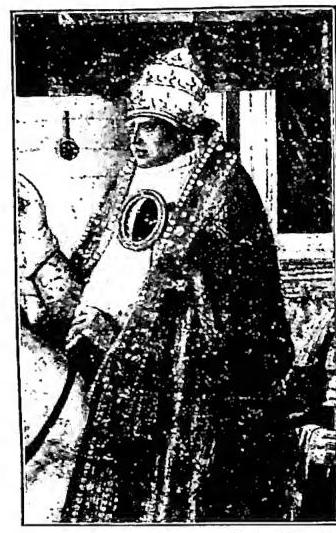
GREGORIO IX, POPE. — Descendant of the family of the counts of Segni, he was born at Anagni (probably in 1170 and not, as many maintain, in 1140) and was named Ugo (Ugolino). He was related to Innocent III “in the third degree” (Vita), and Alexander IV also belonged to his family. Having received his initial education at the episcopal school of Anagni, he continued his studies in Paris (“sacrae paginae doctor,” RIS, III, p. 575) and also devoted himself to the study of law at Bologna, but was never a professor there. The Cistercian Rainerio exerted a particular influence on him, fostering his natural inclination toward contemplation to such an extent that Innocent III mentioned it almost reproachfully (PL 214, 675). Very little, in any case, is known about his youth; certainly, he was not, as was claimed, a Camaldolese.
SUMMARY:
I. Legations
II. Religious action
III. Ecclesiastical policy
IV. Decretals
V. Inquisition
VI. Missions. Ecclesiastical life. — VII. Character and importance.I. LEGATIONS
Shortly after his election, Innocent III appointed G. papal chaplain (auditor of the Rota), and subsequently, in the same year, cardinal deacon; he then sent him in 1199 to southern Italy to Markwald of Anweiler, margrave of Henry VI. After he was made cardinal bishop of Ostia in 1206, he went twice as legate to Germany, in 1207 and 1209.Honorius III likewise recognized his abilities as a negotiator and sent him as legate, chiefly to the cities of northern Italy (the most important legation was that of 1221, for which G. began a register of his own). For there the most flourishing cities (such as Lucca, Pistoia, Parma, and especially Milan) were threatening ecclesiastical liberties or (as in the cases of Imola and Faenza, Aquileia and Treviso) were engaged in conflict with one another, while heresy was also making its appearance; and in many convents the proper spirit needed to be restored.
But the Pope was chiefly concerned with the impending Crusade, which had been proclaimed by the Emperor for August 1221. Frederick, who had serious reservations to express, willingly appointed G. his vicar, without, however, granting him all the powers of an imperial nuncio. G. undertook the task cautiously but firmly: he promulgated in Lombardy the Emperor’s anti-heretical laws and sought to incorporate the new imperial and ecclesiastical laws into the municipal statutes. This legation became a major confirmation of peace; but perhaps G., in Frederick’s view, had done too much for peace and for Honorius, and too little for the Crusade. In any event, the latter did not take place.
II. RELIGIOUS ACTION
From this time onward G. renounced politics and devoted himself entirely to religious action. He assisted the Camaldolese, the foundation of Gioacchino da Fiore, and the Cistercians; in particular, he facilitated the work of s. Domenico and his Order, which had proved effective in southern France against the Albigensians. But his concern for the Franciscan movement is documented far more extensively. G. recognized in the Mendicants the messengers of religious renewal, who at the same time ran the danger of overstepping the boundaries of orthodoxy, and he understood the value of guiding them and giving them strong support. Federico called them the Pope’s “evil angels” (Hist. diplom. Frederici, V. BIBLICA., II, v, p. 1059).G.’s attitude toward the Franciscan Order was censured by several writers, including Sabatier, as having falsified the character of the movement from within. Today, however, this attitude is generally assessed positively, even in non-Catholic circles, and understood more deeply in its particulars, and is consequently appreciated. The Gospel returned once more, and in a fundamental way, to people’s consciences; the imitation of Jesus’ poor life was regarded as the substance of perfection; and the Church’s missionary commitment regained strength through the sending of missionaries and the organization of their activity.
G. played a particularly important role in perfecting the Order of the Poor Clares (to such an extent that he came to be called their founder) and the Franciscan Third Order. For the Mendicant Orders he issued many letters of recommendation and decrees, which later, in their principal provisions, were included in the body of the Decretals (Decr., V, 31 c, 16 ff.): he granted them new privileges, especially the right to preach and hear confessions (Potthast, 8042); he renewed the institution of the novitiate (id., 10959); he suggested to Tommaso di Celano the idea for the Vita I of s. Francesco, in which the latter gave particular prominence to the relations between G. and s. Francesco; he laid the foundation stone of the Saint’s burial church at Assisi and explained in the bull Quo elongati (1230; which would later have particular resonance in the question of the Spirituals) that the testament of s. Francesco had no binding force. Both of the great Mendicant Orders, the Dominicans and the Franciscans, undoubtedly enjoyed G.’s pronounced sympathy from the time he first met s. Domenico and s. Francesco (Florence 1217) and assumed their protection.
III. ECCLESIASTICAL POLICY
The pontificate of G. was characterized by ecclesiastical policy in relation to Frederick II. While the latter, with ever new pretexts, postponed the Crusade, G. threatened him with excommunication, which he announced to Christendom on 10 October in an encyclical (Hist. diplom., cit., III, 24), releasing the crusaders from their oath, some of whom had already undertaken the journey or had died of fever in southern Italy. Frederick, who had not expected the new Pope to employ greater energy than Honorius, out of spite set out for Jerusalem in 1228 and negotiated with the Sultan. The Christian prisoners were freed; part of Jerusalem and some localities passed into Christian hands, in exchange for sufficient liberties granted to the Muslims, even in Christian territory, and Frederick was crowned king of Jerusalem.While the Sicilian troops were invading the Papal March, G. sent troops into Sicily; but, after alternating successes, both sides signed the Peace of Ceprano (28 August 1230). Subsequently Frederick, supported by Piero delle Vigne, created in Sicily, which he held as a papal fief, a new bureaucratic state of an absolutist type, promulgating the Constitutions of Melfi, which in many respects were contrary to communal and ecclesiastical liberties. He would moreover have desired such unity between Church and State that the Pope would excommunicate all those against whom the Emperor had fought. But he was unable to obtain this (Potthast, 9261). When Frederick then, against the express will of G., his feudal lord, married his son Enzo to the heiress of Torres and Gallura and occupied Sardinia, G. excommunicated him again (1239), published an indictment in seventeen points (Hist. diplom., V, 286 ff.), which was to be proclaimed every Sunday or feast day to the sound of bells (Potthast, 10723), and placed the Emperor’s customary residence under interdict. Frederick then produced several writings and appealed to a council. The conflict sometimes reached the level of passionate polemic on both sides: G. reproached the Emperor, whom he had compared to the apocalyptic beast (Potthast, 10766), with the saying of the three deceivers. The latter denounced the Pope as a heretic or even as the Antichrist (Hist. diplom., V, 348). Frederick sought to put an end to the conflict by force of arms, and fortune was not unfavorable to him. For his part, the Pope found in Gregorio da Montelongo, his legate in Lombardy, a skilful advocate of national interests, which were now beginning to become clear. When, however, he actually summoned the Council, Frederick was no longer interested in the matter and took prisoner the prelates who were to make the journey by sea. In Germany the excommunication initially found little response, because at that time the Tartars were stationed on the borders of the Kingdom; and when Frederick was approaching Rome in 1247 with a large retinue, the Pope died. G. had sought the freedom of the Church against a highly skilful and unscrupulous sovereign who employed every means for his own purposes.
IV. DECRETALS
G. had already begun considering, from the outset of his pontificate, the organization of the new papal legislation, which was finally decided upon when Frederick promulgated the Constitutions of Melfi, which in many respects were bound to be unwelcome to the Church. The drafting of the collection was entrusted to Raimondo di Peñafort, who submitted it after three years. It certainly reflects a clear opposition to the Emperor’s Sicilian Constitution, for example with regard to the privilegium fori of the clergy and in civil and criminal matters; but its fundamental purpose was, as the bull Rex pacificus demonstrates, to establish, alongside the private collections of papal edicts, an official and exclusive body of law on the part of the Church as well. Among its characteristics were the preservation of the exemption and other privileges of the Mendicants (165, X, V, 37), and the prohibition against laymen preaching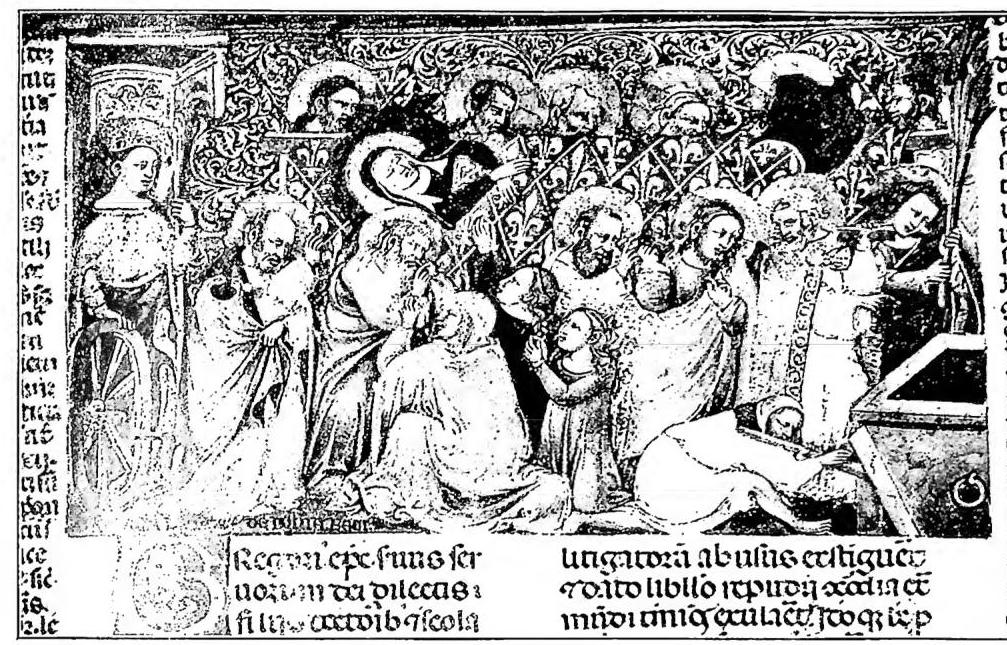
GREGORIO IX, PAPA — Decretals with an illuminated miniature depicting the funeral of the Virgin, a signed work by Niccolò da Bologna (14th century). In the initial G., the portrait of G. IX — Amsterdam, Antiquarian Market, 1929.
(14, X, V, 7), heresy releases the contracting party from the obligations undertaken (2, X, V, 26), blasphemy is to be punished by the secular arm (16, X, V, 7), « nullam in hoc misericordiam habitus ». G.’s later concessions entered, in part, into Boniface VIII’s Liber Sextus (e.g., that every bishop might by himself degrade his own heretical priest and that six bishops were no longer necessary). Even if not theoretically, this book of laws, which was soon translated into the language of the people (Actus, III, 249, 291), signifies a powerful strengthening of papal authority and its influence. In the future, private arbitrations in particular would be prevented by the collections of laws.
V. INQUISIZIONE
Under G. IX the medieval process of the Inquisition was established. In 1224 Frederick had ordered, for Lombardy, that all heretics in the hands of the diocesan bishops be handed over to the secular arm, so that they might be burned or have their tongues torn out (MGH, Const., II, p. 1267). G. then established in 1227 commissions against heretics in Italy (Florence) and Germany; until then, only the bishops had pronounced judgments against them. He made particular use of the Dominicans (Bullarium Ord. Fratrum Praedicatorum, edited by T. Ripoll-A. Bremond, I, Rome 1726, p. 20), without neglecting other Orders or secular priests, such as Corrado di Marburgo, confessor of S. Elisabetta. Entrusting this institution to an Order contributed to its durability. A further step was taken when Frederick’s cruel decree of 1224 was entered in 1230–31 into the papal register (Reg., 535), and promulgated as law (ibid., 539 and following). A final phase came with Frederick’s decree (proper to Norman law) for Sicily (1231) and for the Kingdom (1239), according to which heretics were to be sought out by the forces of the State. The official Inquisition procedure followed upon the denunciation. Alongside the episcopal tribunal, G. established a general papal tribunal (Bullarium cit., I, 47) and appointed the inquisitors himself, since he did not wish to leave the power of investigation solely to the organs of the State. In 1234 the provision was inserted into the Decretals (15, X, V, 7) that heretics who converted out of fear of death were to be held prisoner for life as punishment (Hist. diplom., cit., IV, 301).VI. MISSIONS. ECCLESIASTICAL LIFE. – Already as legate and preacher of the Crusade, G. had worked for the preservation of the Latin Empire of Constantinople, which, under his pontificate, found a new enemy in Bulgaria. The Pope persuaded Giovanni di Brienne, who had fought for him in Sicily and in 1223 had been elected regent in Constantinople for the not-yet-of-age Baldwin II, to assume this office, albeit reluctantly (1231–37), and supported him energetically. In 1232 he sent Aimone di Faversham, the future minister general of the Franciscans, together with several theologians, to the Greek imperial court at Nicaea, but they achieved nothing. Rather, it was thanks to Giovanni di Brienne in 1235 that, after a twofold attack by the Greeks and Bulgarians, Constantinople was saved. When Baldwin himself then went to the West to seek assistance, G. did everything possible to inspire a great Crusade; but it was only in France that he found a willing response and aid. Baldwin, too, was unable to regain the Asian part of the Empire, which definitively came to an end in 1261. The struggle against the Ghibellines was also fatal to the Latin Empire, because Frederick was allied with the Greeks and forcibly prevented the crusader knights from passing through northern Italy.
The difficult missions in eastern Europe—Finland, Lithuania, Hungary, and Romania—where the new Mendicant Orders were working chiefly, have so far received little attention. After Frederick’s Crusade, around 1230, the Teutonic Knights appeared; the Order regarded these territories as lands to be conquered, territories of the Empire assigned to them. In Lithuania G. permitted the preaching of the same Crusade as in Europe (Bullarium cit., I, 32), and introduced the Premonstratensians into Latvia (Potthast, 7886).
With regard to ecclesiastical scholarship, the foundation of the University of Toulouse (30 April 1233) deserves note (Potthast, 9176). At the University of Paris he granted freedom to study the books of Aristotle (Reg., 607).
He advanced religious life through numerous canonizations: Francesco (1228), Antonio da Padova (1232), Vigilio di Salisburgo (1233), Domenico (1234), Elisabetta di Turingia (1235), while he was unable to complete the canonization of S. Ildegarda di Bingen.