
BULGARIA. - A Balkan state bordered by Yugoslavia, Greece, Romania, and the Black Sea.
CONTENTS:
I. Geography
II. Historical outline of Christianity from its origins to the present day
III. The Bulgarian rite
IV. Christian archaeology
V. Art
VI. Literature
VII. Educational system.I. GEOGRAPHY
Autonomous from Turkey (1878), independent as a kingdom (tsar) from 1908, it became a republic on 15 September 1946. The territory (110,842 km²), which has undergone several changes in the last thirty years (after the Second World War it expanded with the reacquisition of Dobruja, ceded by Romania), is divided in two by the Balkan mountain range, which crosses it from west to east, ending at the Black Sea. To the north lies a vast plateau that the Danube isolates from the adjacent Wallachian plain; to the south, a series of intermontane depressions, the largest of which is that of Plovdiv (Philippopolis); beyond these rise other mountainous masses to the west and south (Rila, Pirin, Rhodopes, Strandzha). The country's vocation is agricultural and pastoral, with a prevalence (in terms of economic value) of industrial crops (tobacco, sunflower, roses, strawberries) over cereals and of sheep farming over all other livestock. Poultry farming is of great importance; notable progress has been made in light industry (textiles, milling, rubber), which tends to increasingly utilise national products.The population (7 million inhabitants in 1947; density 63 per km², the highest among the Balkan states) consists of over 4/5 Bulgarians, mostly Orthodox (more than 100,000 are Pomaks or Islamised Bulgarians, who live in the mountainous regions of the south); after them, the most notable ethnic element is represented by the Turks (today less than 10% of the total), concentrated mainly in the northeastern regions. They are followed by the Roma (2%), Romanians, Jews (less than 1%), Armenians, etc. Urban centres (in our sense) are few and small. The capital, Sofia (400,000 inhabitants including suburbs), occupies an eccentric position in relation to the state. Varna (70,000 inhabitants) and Burgas (36,000 inhabitants) are the main ports, Plovdiv (100,000 inhabitants) the largest centre in southern Bulgaria.
Before the proclamation of the republic, the state, while recognising the Greek-Orthodox Church of Slavic rite as national, to which 85% of the population belonged, tolerated all other religions. Muslims numbered less than one million, Catholics over 50,000, settled mainly in southern Bulgaria.
| Districts | Area in km² | Population Census 1934 and 1941 | Density | Capital Population in 1000s |
|---|---|---|---|---|
| Burgas | 13,621 | 554,947 | 41 | Burgas (36) |
| Pleven | 15,380 | 996,686 | 69 | Pleven (32) |
| Plovdiv | 15,840 | 801,755 | 51 | Plovdiv (99) |
| Shumen | 14,689 | 1,020,499 | 69 | Shumen (25) |
| Sofia | 16,921 | 1,152,053 | 69 | Sofia (288) |
| Stara Zagora | 15,552 | 812,633 | 52 | Stara Zagora (30) |
| Vratsa | 11,143 | 739,366 | 56 | Vratsa (16) |
| Dobruja (1941) | 7,696 | 319,551 | 41 | Dobrich (28) |
| TOTAL | 110,842 | 6,397,490 | 60 |
Giuseppe Caraci
II. HISTORICAL PROFILE OF CHRISTIANITY FROM ITS ORIGINS TO THE PRESENT
I. From the origins to the Turkish conquest (864-1393). - Like all autocephalous national Churches, the Bulgarian Church followed the same vicissitudes as the nation. Its geographical extent varied with the borders of the Bulgarian state; its independence and its more or less pronounced subjection to the patriarchate of Constantinople were related to political events.The territory now occupied by the Republic of Bulgaria was evangelized from the earliest centuries. In the 4th century, it was part of the prefecture of Illyricum and depended on the Western Empire. Ecclesiastically, it depended, at least in part, on the Roman patriarchate even after Emperor Gratian, in 379, ceded Eastern Illyricum to his colleague Theodosius, emperor of the East. Not without difficulty did the popes succeed in maintaining their jurisdiction over this region, which they exercised through the archbishop of Thessalonica, who had been invested with the title of vicar of the Apostolic See for this purpose. The patriarchs of Constantinople sought to undermine this jurisdiction surreptitiously and several times attempted to establish their own. They were well satisfied the day when Leo the Isaurian, as retaliation against Pope St. Gregory III who had condemned the iconoclasts, decreed the annexation to the patriarchate of Constantinople of the part of Eastern Illyricum that remained under the Byzantine Empire (732).
Rome did not cease to protest against such violence and to opportunely request from the Byzantine emperors the restoration of its rights over these regions. Its claims became particularly insistent in the second half of the 9th century when the Bulgars, a tribe of Turkic or Finnic origin, after securing an independent kingdom in that region, converted to Christianity.
It was King Boris or Bogaris (852-89) who took the initiative for this conversion. As it seems, he would have initially wished to request Baptism from the Franks, with whom he had stipulated a political alliance in 862 against Ratislav, king of Moravia. But on the point of opening hostilities against the latter, the Byzantines, victorious over the Saracens in Asia Minor and allies of Ratislav, who had requested missionaries from them (the ss. Cyril and Methodius), made hostile demonstrations against the Bulgarian coast. To extricate himself, Boris requested peace from Emperor Michael III and promised to have himself and his people baptized by the Byzantine missionaries, whose dispatch he solicited. And so, toward the end of 864 or the beginning of 865, Boris received Baptism, with Michael III himself as his godfather, whose name he took. Christianity was imposed on the Bulgarian subjects, and those who refused were massacred without pity (F. Dvornik, Les Slaves, Bizance et Rome, au XIe siècle, Paris 1926, pp. 184 ff., 226 ff.).
Thus the Bulgarian Church was born, but in schism, since precisely at that time the Photian schism was in full swing, Photius having been deposed by Pope St. Nicholas I in a solemn form in 863. Boris's conversion to Christianity had been sincere but not disinterested.
The aim of the Bulgarian Khan was to make himself entirely similar to the Byzantine "basileus," giving Bulgaria its political and religious independence. He wanted for his new Church a patriarch who could confer upon him imperial consecration and thus make of himself a true tsar, a true "basileus." But the Byzantines refused to grant him this, and Photius sent him simple priests as missionaries with a pompous dogmatic letter. Displeased with this, Boris then turned to Rome and as early as 866 requested from Pope St. Nicholas I an archbishop and bishops to establish a complete hierarchy in his kingdom; but his desires were only partially fulfilled. The two bishops sent by the Pope to Bulgaria, Formosus of Porto and Paul of Populonia, could only be provisional, since they were already provided with an episcopal see, and in Rome the canon of the Council of Sardica, which prohibited translation, was still strictly observed.
BULGARIA - Ancient and modern ecclesiastical circumscriptions: 1. State boundaries; 2. Boundaries of modern ecclesiastical circumscriptions; 3. Railways.
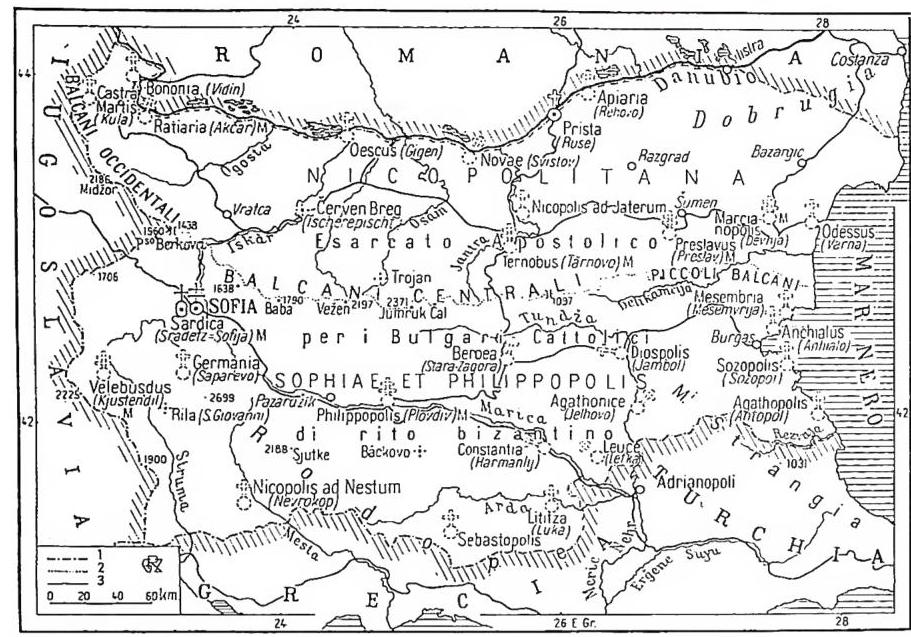
The Bulgarian prince, however, was far from satisfied with the Byzantines, as they consistently denied him not only the patriarch he requested but also the title of tsar for himself. In 886, the disciples of St. Methodius, expelled from Moravia by the German clergy, took refuge with him. He seized the opportunity to rid himself of the Byzantine clergy and introduce the Slavic liturgy into his kingdom.
This was a further step toward complete autonomy, which was ultimately recognized by both Rome and Constantinople: by Rome before 924, under Boris’s successor Simeon (893-927), if we are to believe the Bulgarian king Kaloyan in his letter to Innocent III dated 1202 (cf. A. Theiner, Monumenta historiae Slavorum meridionalium, I, Rome 1863, pp. 15-20); by the Byzantine court in 945, under Tsar Peter (927-69).
Yet the days of the Bulgarian Empire were numbered, as Emperor Basil II, known as the Bulgar-Slayer, turned against II. From 986 to 1018, in five successive campaigns, he annexed it piece by piece. With political independence, Bulgaria lost its religious autonomy. The first Bulgarian patriarch, who had been forced to change residence seven times due to the vicissitudes of war, had finally settled in Ohrid. It was here that Basil II established the center of the new Greek-Bulgarian autonomous archbishopric, incorporated into the Byzantine Church. It endured under this name from 1020 until the Turkish conquest in 1393, though it underwent transformations. The most significant occurred following the restoration of the Bulgarian kingdom (1186-1393) and the creation of the second Bulgarian patriarchate in Tarnovo (1204-1393). Like those of the 10th century and for the same reasons, the Bulgarian princes turned to Rome to obtain the imperial crown for themselves and autonomy for their Church. After laborious negotiations and official union with the Church of Rome, Pope Innocent III granted both to Kaloyan in 1204. The union with Rome was already broken by 1232, and efforts to restore it failed miserably. The principal attempt was made during the Unionist Council of Lyon, under Michael Palaeologus, in 1274. Patriarch Joachim of Tarnovo joined John Bekkos of Constantinople in 1277 to recognize the supreme authority of the Holy See.
2. The Patriarchate of Ohrid (1393-1767). — The Patriarchate of Tarnovo endured until the Turkish conquest (1393). The Bulgarian Church fell back under the religious jurisdiction of the Greeks and was once again annexed to the autonomous archbishopric of Ohrid (v. ACCIDIA), which was adorned with the pompous title of patriarchate and subsequently underwent many transformations and amputations. From the second half of the 17th century onward, the "ecumenical" patriarchate increasingly interfered in the affairs of the archbishopric. The Greeks often supplanted national candidates for bishoprics, and the Hellenization of the region was pursued relentlessly. The prelates sent from Constantinople displayed barbaric zeal in destroying every monument of ancient Bulgarian literature, and only the lower clergy, chosen from the population, remained attached to the Slavonic alphabet. Finally, in 1767, this phantom of Ohrid was officially incorporated into the "ecumenical" patriarchate.
3. Emancipation (1767-1872). — The nationalist excesses of the Phanariot prelates provoked a violent reaction among the Bulgarians at the beginning of the 19th century, when the Balkan nations began to shake off the Turkish yoke. Through books and schools, Bulgarian patriots succeeded in awakening national sentiment within a few years. Their success was rapid, and by 1860 they felt strong enough to directly confront the "ecumenical" patriarchate and demand radical reforms in the administration of dioceses where the Bulgarian population was in the majority. The Turks, arbiters between the two parties—since both Bulgarians and Greeks were their subjects—eventually yielded to the Bulgarians’ demands. An imperial firman of March 11, 1870, created a Bulgarian exarchate independent of the "ecumenical" patriarchate, which, however, vehemently rejected this new regulation.
Attempts to reach an agreement over the next two years proved futile. Unable to use spiritual weapons against the Bulgarians, the Phanar sought to convene a council of the entire Eastern Orthodoxy to condemn the recalcitrants, but only the Greek-speaking autocephalies responded to the call. The Synod met in Constantinople in September 1872 and decreed the separation of the Bulgarians from Orthodox communion, branding them as schismatics and phyletists—that is, racialists (not nationalists, as this term is often translated). The Bulgarians had indeed committed a serious canonical innovation by creating Bulgarian bishops in localities where Greek bishops already existed. Their exarch himself had established his residence opposite the Phanar. From the Church’s origins, the basis of ecclesiastical jurisdiction has been territory, not race or tribe (τῶς). One bishop per diocese—this was the rule the Bulgarians openly violated. Yet it must be said that the Greeks themselves had provoked such illegality by reserving for themselves the majority of episcopal sees where the population was predominantly Bulgarian. Despite this illegality, the decree of the Synod of Constantinople was accepted only by the Greek-speaking autocephalies.
The Slavic Church, the Romanian Church, and the Arabic-speaking Churches of Syria paid no heed to it and remained in communion with the Bulgarian Church. As a result, from 1872 onward, the unity of ecclesiastical communion among the various Byzantine-rite autocephalies disappeared, given that the Bulgarian schism persisted until recent times. It is strange that ecclesiastical communion was maintained between the Greek Churches, which had excommunicated the Bulgarian Church, and the autocephalies that remained in communion with II.
4. The Current Situation. — The organization of the Bulgarian Church did not substantially change immediately after the establishment of the Exarchate in 1870. The organic statute promulgated at that time was reorganized in 1895 and remained in force, although certain provisions were rendered obsolete by subsequent events. Since 1870, the Bulgarians have indeed become a fully independent nation, almost entirely united within the territory of their kingdom, and can no longer be accused of filetism, whereas in recent times several other autocephalous Churches have established filetic bishoprics in various places. The city of New York alone recently counted as many as seven dissident bishops of different ethnicities. The Bulgarian schism was therefore bound to disappear, as its foundation had ceased to exist. Indeed, recent negotiations between the "ecumenical" patriarchate and the Bulgarian Synod to restore unity have met with success. On 22 February 1945, the Holy Synod of Constantinople lifted the excommunication of the Bulgarian Church, recognizing its autocephaly.
The Synod is permanent, composed of five bishops and presided over by the most senior metropolitan, who governs the Church; the four bishops, excluding the president, are renewed every four years. There are eleven eparchies or dioceses, whose titulars are elected by the Synod from two candidates presented by a mixed diocesan assembly. A new organic statute, fully in line with the current political situation, is still awaited. The nominal number of faithful in 1937 was 5,128,298 out of a total population of 6,077,934 inhabitants.
5. The Bulgarian Catholic Church. — The Catholic Church in Bulgaria numbers several thousand faithful divided into two groups: one of the Latin rite and the other of the Byzantine-Slavic rite.
The first, by far the more numerous, consists largely of the descendants of the Paulicians and Bogomils (v.) converted in the 17th century by Franciscans who came from Bosnia, hence their name of Pavlikans. Persecuted for a long time by the Turks, they were able to reconstitute themselves during the 19th century and today form the diocese of Nicopolis (16,500 faithful in 1930) and the apostolic vicariate of Sofia and Philippopolis (24,500 faithful in 1930). Parish service is ensured by the Capuchin Friars Minor, assisted by various Latin religious congregations, both male and female.
The Byzantine-Slavic group originated in 1860 when the Bulgarians began to shake off the yoke of the "ecumenical" patriarchate. The number of conversions at one point rose to 60,000, but this movement was stifled at birth by the secret intrigues of the Russian government, which had the first head of the united Church, the venerable igumen Joseph Sokolski, whom the Pope himself had consecrated (1861), removed. Those who remained faithful to the union were grouped in 1883 into two apostolic vicariates: that of Thrace and that of Macedonia, with respective seats in Adrianople and Thessalonica. An apostolic administrator resided in Constantinople with the title of archbishop as representative to the Turkish government. This organization disappeared after the Balkan War of 1912–13 and World War I of 1914–18. Currently, the Byzantine-rite Bulgarian Catholics, numbering approximately 6,000 and scattered throughout Bulgarian territory, are under an apostolic administrator residing in Sofia. Since 1948, the Bulgarian government, dominated by communists, has subjected Catholics to a harsh regime of persecution.
III. THE BULGARIAN RITE
The rite in use among the Bulgarians is the Byzantine rite; it differs from the Slavic-language rite used in Russia and Serbia only in certain liturgical observances of its own or of Greek origin, and in the celebration of some regional feasts. Its history can be divided into the following periods. When Tsar Boris decided (870) in favor of the Church of Constantinople, the Byzantine rite, already introduced by Greek priests, was definitively established in the country; however, with the arrival of the disciples of St. Methodius, expelled from Moravia (ca. 886), the Slavic language gradually replaced Greek, and at the beginning of the reign of Tsar Simeon (893), St. Clement, the first Slavic-speaking bishop, completed the Slavic translation of the liturgical books.In the 14th century, the significant corrective activity of Patriarch Euthymius of Tarnovo and his school, based on a profound knowledge of Greek, renewed the Slavic text, favoring a language close to that used in Russian lands and thus widely disseminated. In the following period, the rite of the Bulgarian Church, governed by a Greek hierarchy, adopted some particular Greek usages, but from the 17th century onward, it came under the influence of liturgical books printed in Russia. The most recent period, begun a few decades ago, shows greater independence and a bold spirit of adaptation to modern needs: rubrics only in Bulgarian alongside the text of prayers in Church Slavonic,
the celebration of the Divine Liturgy without a deacon as the norm, the abbreviated matrimonial and funeral rites, and the updated and abbreviated baptismal rite.
Alfonso Raes
IV. CHRISTIAN ARCHAEOLOGY
Due to its geographical position, Bulgaria marks an obligatory passage in relations between the East and the West. Consequently, in the past, Bulgaria has been influenced by the various artistic trends that migrated from the East to the West and vice versa. This explains the appearance and simultaneous development in Bulgaria of the most diverse architectural forms found in early Christian architecture.The most fruitful period for Christian constructions, before the descent and stabilization of the Bulgars, spans the 4th to 7th centuries. From the vast and rich collection of early Christian churches and basilicas scattered almost everywhere, one realizes that in Bulgaria all the styles and forms of ancient Christian architecture are represented, with their original pure and mixed elements, forming an ensemble that is more or less pleasing and harmonious.
Classified by type, the early Christian basilicas of Bulgaria present various characteristics with little local uniformity. A form rare for the East is that of the basilica of Klisseé-Kőj (6th century), with a Latin-cross plan, a narthex, and a façade flanked by two rectangular structures, which respectively form the baptistery and the sacristy, the latter equipped with a large atrium.
The Roman type of basilica, with minor modifications, is instead represented by the group of basilicas at Hasar Sindgirlij (4th-6th centuries), some of which have three naves and others one. However, they differ from the Roman ones because they have a narthex instead of an atrium, and some present the form of a polygonal apse externally rather than circular, as is generally the case with Roman basilicas. Types of cruciform basilicas with a dome, three naves, and three apses—the central one polygonal externally—are those of Cervo di Pirdop, Aboba, and Pririnč Tepé. In that of Cervo di Pirdop, the façade is flanked by
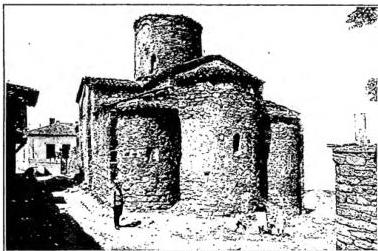
The prototype of the centrally planned basilica is represented by the church of S. Giorgio in Sofia (4th century), but more simply by the so-called Red Basilica of Perustiza (7th century), with a central plan topped by a dome, two opposing semicircular apses, and a double narthex.
A highly characteristic type is the basilical form of the Mesembria group, with three naves and five apses; the most striking example is the Basilica of the Sea. Clearly Hellenistic in its overall design, this basilica—through its architectural forms, and particularly the peculiarity of its apses—exerted a significant influence on later basilical constructions after the Bulgars stabilized in the Balkan peninsula.
In Tropeos, one finds the Syrian basilical form, with its characteristic two towers on the façade, which in Bèlovo are transformed into two prominent domes. Both date to the 6th century.
The Ravennate type of basilica, with an apse circular on the interior and polygonal on the exterior, featuring windows on the various sides of the polygon, is found in S. Sofia in Sofia (6th century), though here the windows are arranged in two superimposed tiers.
Other characteristics of the Early Christian basilica in Bulgaria include the apsidal doors, as seen in Hissar and Mesembria, as well as the projecting arcades on the façade and various sides, as in Pirinč Tepé and elsewhere.
V. ART
Recent discoveries have revealed a flourishing prehistoric civilization in the region, connected with Asia Minor and the Aegean, attested by tumuli—often with chambers under Hellenic influence—idols of Cycladic type, dolmens, anthropomorphic rock drawings (Backo Rivo), and ceramics. The iconography of indigenous deities displays Thracian elements, which persisted into the Roman era; even the figure of the horseman was represented according to Greek artistic modes. From the 6th century B.C., Greek influence became more pronounced (tumuli of the Thracian dynasts of Duvanlij) and continued into the Roman period, with a preference for the Praxitelean style, especially along the Black Sea coasts. With Roman penetration, new cities arose, such as Oescus and Nicopolis, whose remains still bear traces of their former splendor, while the disruption caused by the subsequent decline of Roman power is clearly revealed in the monuments of the 3rd and 4th centuries, particularly the stelae, which increasingly diverged from classical taste.The oldest Proto-Bulgarian monuments (5th century) include the fortified camps of Šumen, Aboba, Preslav, and Pliska, which the Bulgars learned to construct from the Chinese; some palace remains (Madara) showing Sassanid origins, especially in their internal divisions; numerous ceramics; and funerary statuettes of wood and stone, similar to those still found among the Chuvash, Yakuts, and Kyrgyz. Notable is the Madara Rider, a twenty-three-meter-high rock carving, and finely crafted gold vessels known as the "Treasure of Attila" (Vienna Museum). Under Tsar Simeon (897-927), Preslav became a magnificent city, particularly for its great basilicas, and in the "Golden Church," which was decorated internally with mosaics of glazed terracotta tiles, employing a difficult technique of Assyrian imitation and evident Byzantine influence. After a period of decline due to political conditions, art began to flourish again during the reign of the Wallachian king Kaloyan, crowned in 1204: in place of large basilical constructions, single-naved churches with or without a dome, or cruciform churches with a Byzantine-influenced dome, arose, especially two-story structures (Ivan Asen, Boyana, Bachkovo Monastery), where the lower level served as a tomb. Until the end of the 14th century, mural painting was notably cultivated in these churches.
(from C. Gurlitt, Alte Bauten in Bulgarien)
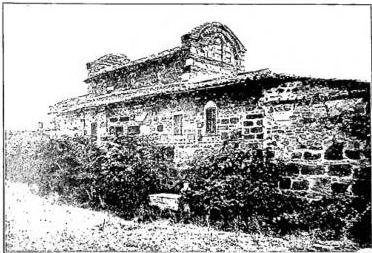
BULGARIA - New metropolitan church (11th century with restorations) - Mesembria.
Religious painting flourished (frescoes of 1259 at Bojana); miniatures, too, often delighted in a naive realism of popular flavor (Gospel of Pop Dobrejko, 13th century, National Library of Sofia), while still following Byzantine models (Moscow Psalter, 14th century; Bulgarian translation of Manasses, 1345, Vatican Library; Gospel of Tsar Ivan Alexander, 1356, British Museum).
With the Turkish occupation (1393-1877) and the resulting isolation, both civil and religious architecture declined, exploiting to the point of extreme conventionalism the forms of monastic art from Mount Athos, and only in painting was there an influence from the early Italian Renaissance (16th-century fresco at Poganovo). After the Peace of Adrianople (1829), churches resumed the basilical type with or without a dome (Rila Monastery, 1834-37), and religious painting flourished in Razlog, Kruševo, and especially in Samokov, where Hristo Dimitrov, who had studied in Vienna in 1770, worked with his sons.
VI. LITERATURE
The origins of Bulgarian literature date back to the second half of the 9th century, to the years when the Bulgarians, through the efforts of Prince Boris, converted to Christianity (865).The earliest texts reflect religious culture and indeed arose in churches and monasteries. For five centuries (9th-14th), this literature remained within an ecclesiastical framework (translations of Sacred Scripture, hagiographies, sermons, prayer books). Byzantinism contributed to the formation of Bulgarian Christian civilization. Ancient Bulgarian literature, in turn, exerted considerable influence on Russian literature (v. RUSSIA). Among the notable works of the time of Simeon (897-927) are usually cited the Sbornik of the same tsar, a didactic florilegium; the Šestodnev [*Six Days, Hexameron] of Joan Exarch, a philosophical-religious compilation; and the polemical treatise O pismenech (On Letters) by the monk Chrabr, a defense of the Slavic alphabet against the attacks of the Byzantine clergy. Also worthy of mention are the presbyter Kozma, Patriarch Euthymius, and his disciple Gregory Camblak. The First Bulgarian Empire was overthrown by Byzantium in 1018, and the Second was destroyed by the Turks in 1393. With the Turkish invasion began a period of oppression lasting five centuries (14th-19th), until 1878: the Bulgarian people languished in the miserable existence of Turkish subjects, having even lost their own name. The Turks, however, lacking their own culture, did not interfere in the spiritual life of the Bulgarians. Nevertheless, popular poetry flourished during these dark centuries: ritual songs (whose content is tied to the primitive religion of the Bulgarians), love songs, laments over slavery, and epic compositions about the haiduti*, generous outlaws who waged a fierce struggle against the Turks and the Phanariotes. During Turkish rule, the Croatian language, especially in its Ragusan forms, exerted an influence on Bulgarian Catholics.
The awakening was announced at the end of the 18th century. The Renaissance took its impetus from the monasteries of Athos (Chilandar and Zografu) and Rila. And the first men of letters were indeed monks, such as Paisij, patriarch of the new culture, author of the famous Slavo-Bulgarian History of the People, Kings, and Saints of Bulgaria (1762). Most monks limited themselves to compilation work. Nevertheless, interesting in this period is the autobiography of Bishop Sofronij, titled Life and Sufferings of the Sinner Sofronij (1804). But more than monastic and Byzantine culture, it was foreign influences and the authority of patriots who had emigrated abroad that awakened Bulgarian literature. Coinciding with the national revival, it retained throughout its first period a patriotic and moralizing tone and a utilitarian character. Writers were concerned with nothing other than rousing the people from their centuries-long slumber. The Bulgarians then faced two problems: ecclesiastical autonomy from the Greeks (achieved only in 1870 with the creation of a Bulgarian exarch in Constantinople) and independence from the Turks (obtained through the revolution of 1866, the Russo-Turkish War of 1877-78, and the subsequent Treaty of San Stefano).
The rather naive and clumsy writings of the early 19th century were replaced in the second half of the century by works with artistic aims, though often modeled on foreign, especially Russian, examples. Before the country's liberation, the major figures, rich in adventurous romanticism with a typically Balkan backdrop,
In the second half of the nineteenth century, works with artistic aims began to emerge, though they often followed foreign—particularly Russian—models. Before the country's liberation, the most prominent figures, imbued with an adventurous Romanticism of distinctly Balkan character, were Georgi Rakovski (1831-67), a revolutionary and publicist; Petko Slavejkov (1827-95), the father of Bulgarian poetry and a collector and scholar of folk songs; and Ljuben Karavelov (1837-79), who, educated in the school of radical Russian writers (Černyševskij and Dobroljubov), presented in his tale Bulgars of Old a portrait of the early nineteenth century, featuring the two caricatured figures of Grandfather Liben and Hadži Genčo. The revolutionary era between 1860 and 1870 found expression in the work of Christo Bůtev (1848-76), one of Bulgaria's greatest poets, though he left behind only about twenty poems in total—significant documents of an epoch and a milieu. Having moved from Russia to Romania to prepare for the uprising, he, together with Ljuben Karavelov, disseminated among the Bulgarian "intelligentsia" the radical ideas he had absorbed from Russian writers. Bůtev celebrated idealized heroes and outlaws while condemning the faint-hearted: his verses exalted the sentiment of the fatherland. Like some of the heroes of his own poems, Bůtev died young: in 1876, at the head of a band of two hundred volunteers, he secretly boarded the Austrian steamship Radetzky from a Romanian port and, as the ship ascended the Danube, seized control of it, heading toward Bulgaria to join the people in revolt. The venture failed, however, and Bůtev was killed.
After liberation, for over twenty years, Bulgarian literature was dominated by the name of Ivan Vazov (1850-1921). He was the author of numerous predominantly realistic short stories (the finest of which is Uncle Yoco Watched), the novel Under the Yoke, translated into many European languages, the lyric collections The Banner and the Gusla, The Torments of Bulgaria, Fields and Forests, Italy, etc., various epic-lyric poems, and an Epic of the Forgotten, intended to glorify the major figures of the national revival. Among Vazov's circle were Konstantin Veličkov (1855-1907), Bulgaria's foremost Italianist and the first translator of Dante; Stojan Michajlovski (1856-1937), who cultivated the ideal of a Bulgaria civilized in the Western manner; and Kyril Christov (1875-1945), a poet of erotic tendencies in the style of Stecchetti and of lyrical landscapes. The first reaction against Vazov's pathetic style came from Aleko Konstantinov (1865-97) in his book Baj Ganju (1894), a comic work in which, with irony often bordering on sarcasm, he sought to ridicule the flaws of the Bulgarian emerging from centuries of servitude.
Meanwhile, the country's Europeanization proceeded at an accelerated pace. Initially, Bulgarians had modeled themselves on Russia: poets drew inspiration from Puškin, Batjuškov, Kol'cov, the Ukrainian Ševčenko, and even Western ideas had penetrated via Russia. Now, however, the Bulgarian "intelligentsia" also turned to France and Germany. In the two decades from 1895 to the First World War, the atmosphere was renewed by three poets gathered around the journal The Thought of Krăstev: Penčo Slavejkov, Javorov, and Todorov. Penčo Slavejkov, son of Petko Slavejkov, drew inspiration from Heine and Nietzsche. He was the author of the collections Dream of Happiness and On the Isle of the Blessed and the unfinished poem The Bloody Song. Under Slavejkov's influence, Peju K. Javorov (1877-1914) emerged as the creator of modern verse in Bulgarian poetry, aligning with the themes of the French Symbolists. Petko Ju. Todorov (1879-1916) published Idylls and several dramas. Javorov and Todorov are considered the initiators of Bulgarian Symbolism, which also includes Todor Trajanov (1888), the singer of Regina Mortua and Hymns and Ballads; Ljudmil Stojanov (1888) with Visions at the Crossroads and Sword and Word; Nikolaj Rajnov (1886) with the Legends of the Bogomils; Dimčo Debeljanov (1887-1916), who fell at Salonica and authored, among other works, the Legend of the Fallen Queen; and Nikolaj Lilev (1885), author of fragile and melancholic verses (Birds in the Night and Moon Spots).
Of the poetry written between the two world wars, we recall the poem September by Geo Milev, a revolutionary close to German Expressionism and Russian Cubo-Futurism, who perished after the 1923 uprisings, and the lyrics of Christo Jasenov, a collectivist like Milev, though his art leans toward intimate confessions. Dmităr Poljanov drew inspiration for his civic verses from the Russian Nekrásov, while E. Bagrjana formally approached the Russian poetess Akhmatova. Among prose writers, K. Petkanov, G. Rajčev, Elin-Pelin, Jordan Jovkov, and G. Karaslavov achieved success. The modern Bulgarian novel oscillates between the historical theme (the era of Turkish domination) and rural realism (sketches of nature, genre scenes, idyllic descriptions of rustic life). In recent years, Bulgarian literature has sometimes expressed aspirations of a distinctly social character. During the Second World War, some writers participated, in its final phase, in the resistance against the Germans. Recent poetic production occasionally reflects the influence of Majakovskij and other Soviet poets. Increasingly, literature is being given rigid directives that should align with the ideological orientations of the new regime.
VII. EDUCATIONAL SYSTEM
Between 1945 and 1948, the Supreme Council of Education implemented a series of school reforms, transforming Bulgarian schools into political centers of the Popular Patriotic Front, from which religious instruction was banned; the nine Catholic institutions attended by over 5,000 students were closed, as were numerous foreign schools, with the exception of those belonging to diplomatic missions, which, however, may not be attended by the children of Bulgarian citizens.Textbooks printed before 9 September 1944 are not permitted and have been replaced by new manuals curated by the "State Publishing Directorate of the Ministry of the Popular Patriotic Front." The educational system of monarchical Bulgaria included the following types of schools: elementary schools divided into three-year preparatory gymnasia and four-year communal schools; gymnasia divided into scientific, semi-classical, and classical.
These three types of gymnasium were later modified into scientific and classical. The regulation of 14 August 1941, abolished by the communist regime, established that school instruction should be apolitical, free, and national. Religious instruction was provided in all types of schools. There was a six-year teacher training gymnasium attended by students pursuing a career in communal teaching; elementary school teachers, on the other hand, had to attend two-year teacher training institutes. Today’s education is divided into preschool and school education.
Preschool education is provided in 738 kindergartens, 926 children’s homes, and 2,300 summer children’s homes.
School education is divided into 6,433 communal schools, 2,800 preparatory gymnasia, and 258 popular gymnasia, which correspond to the old type of scientific gymnasium where Latin and Greek are optional subjects, while Russian is compulsory, in addition to one modern language of choice (Italian, English, French, German). Vocational schools are very numerous.
There are three universities: one in Sofia, founded in 1888; one in Plovdiv, founded in 1946; and one in Varna, founded in 1946.
Since 1946, there has been an ordinary chair of Italian philosophy in Sofia. - See Pl. XIV.