
BRASILE. — The Estados Unidos do Brasil, a federal republic comprising 20 states, 5 territories, and 1 federal district, extend over slightly less than half of the whole of South America (8.5 million sq km), thus ranking among the world’s largest territorial units.
SUMMARY:
I. Geography
II. Ecclesiastical history
III. Art
IV. Literature
V. Educational system.I. GEOGRAPHY
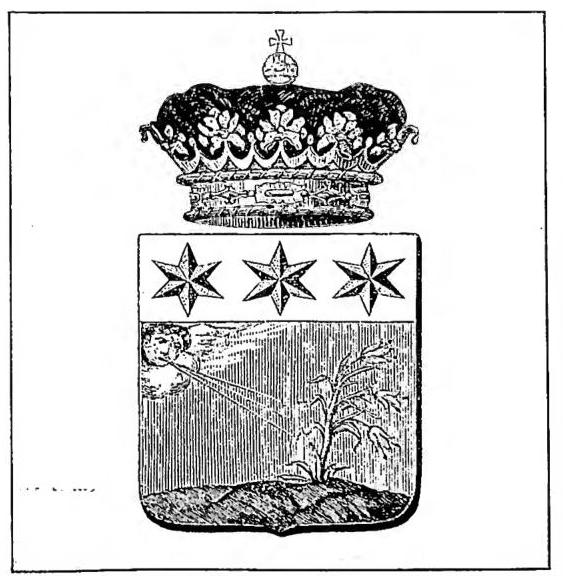
Extending for 40° both in latitude and longitude, B. comprises regions of very diverse character, which may nevertheless be grouped into three great zones. To the N., over more than 3 million sq. km., stretches the Amazonian plain, with a very hot and humid climate, slight thermal variation, and rainfall throughout the year; it is covered by the imposing equatorial forest (selvas) and crossed in every direction by rivers rich in water, constituting a vast network of navigable waterways (50,000 km.; the Amazon can be navigated upstream for 4,100 km.). The central inland zone corresponds to an equally extensive plateau, generally sloping from E. and S. toward O. and N., where low tabular formations predominate (800–1,600 m.). The climate there is less extreme, with a dry season (verão) that becomes increasingly longer as one proceeds southward, and a rainy summer. The vegetation ranges from forest stripped of greenery during the dry period (catingas) to savanna with scattered trees (campos), more or less luxuriant with shrubs (carrascos) and grasses, or even to steppe when rain is absent (serrôa). Along its eastern edge the plateau rises into elevated ridges (serras) that dominate the coastal strip steeply or extend as far as the sea; this is the most populous and richest zone of B. In the NE. and E. (as far as the State of Paraná) the climate remains distinctly tropical, with thermal extremes and heavy rainfall, whereas from Paraná to the Paraguayan border temperatures decrease, summer is the driest season, and conditions become more favorable for human settlement, especially behind the coastal region, locally unhealthy and everywhere covered with luxuriant vegetation (araucarias S. of the Tropic).The population of B. (48 million inhabitants today) consists 62% of Creoles and whites, descendants of ancient colonists (Portuguese) and recent ones (immigrants after 1820; among the latter, who came from every part of the world, the Italians rank first and probably now number no fewer than 2 million), 3% of Amerindians (among the Indios bravos of the Amazon basin there are still groups resistant to every form of civilization), and for the remainder of blacks (imported from the 16th century until 1851 for plantation work) and mulattoes, descendants of former slaves (slavery was abolished in 1888), especially numerous in the tropical coastal regions. The population is very unevenly distributed: four-fifths of it is concentrated in the coastal and subcoastal countries, while vast areas of the country are no less unpopulated than the Sahara (B. could perhaps accommodate as many as 600–700 million inhabitants). Of the 15 cities with more than 100,000 inhabitants, 10 are
As regards religion, no state religion is recognized, but almost the entire population is Catholic.
A federal republic since 15 Nov. 1889, B. received a new constitution, promulgated by the Constituent Assembly on 18 Sept. 1946, in which it is defined as a presidential and federal republic with bicameral representation.
The division of B. into States and Territories underwent changes after 1942; the following table reflects the most recent situation (after 3 Feb. 1947):
| Federal states, territories and regions | Area in sq. km. | Population (census of 1 Sept. 1940) | Density per sq. km. | Capitals (population in thousands in 1946) |
|---|---|---|---|---|
| Amazonas | 1 592 626 | 416 011 | 0,26 | Manáos (116) |
| Pará | 1 216 726 | 923 453 | 0,76 | Belem (223) |
| Guaporé | 254 163 | 21 297 | 0,08 | P. Velho (11) |
| Acre | 153 170 | 79 768 | 0,52 | R. Branco (17) |
| Rio Branco | 214 316 | 12 130 | 0,06 | Bôa Vista (11) |
| Amapá | 137 419 | 21 191 | 0,15 | Macapá (11) |
| Contested between Amazonas and Pará | 3 192 | |||
| Northern Region | 3 571 612 | 1 473 850 | 0,41 | |
| Maranhão | 334 809 | 1 235 169 | 3,69 | S. Luiz (92) |
| Piauí | 249 317 | 817 601 | 3,28 | Teresina (73) |
| Ceará | 153 245 | 2 091 032 | 13,65 | Fortaleza (104) |
| Rio G. do Norte | 53 048 | 768 018 | 14,48 | Natal (59) |
| Paraíba | 56 282 | 1 422 282 | 25,27 | João Pessoa (102) |
| Pernambuco | 97 016 | 2 687 173 | 27,70 | Recife (577) |
| Alagoas | 28 531 | 951 300 | 33,34 | Maceió (98) |
| Fernando de N. | 27 | 1 065 | 39,44 | F. de Nor. (1) |
| Northeastern Region | 972 275 | 9 973 642 | 10,26 | |
| Sergipe | 21 057 | 542 326 | 25,76 | Aracalú (64) |
| Bahia | 563 762 | 3 918 112 | 6,95 | Salvador (315) |
| Minas Gerais | 581 975 | 6 736 416 | 11,58 | B. Horizonte (226) |
| Espiritu Santo | 40 882 | 750 107 | 18,35 | Vitoria (49) |
| Rio de Janeiro | 42 588 | 1 847 857 | 43,39 | Niterói (153) |
| Distrito Federal | 1 356 | 1 764 141 | 1300,99 | Rio de Jan. (2300) |
| Contested between Minas G. and Espiritu S. | 10 137 | 66 994 | 6,61 | |
| Eastern Region | 1 261 757 | 15 625 953 | 12,38 | |
| São Paulo | 247 223 | 7 180 316 | 29,04 | São Paulo (1409) |
| Paraná | 201 288 | 1 236 276 | 6,14 | Curitiba (153) |
| Santa Catarina | 94 367 | 1 178 340 | 12,48 | Florian (50) |
| Rio G. do Sul | 282 480 | 3 320 689 | 11,76 | P. Alegre (295) |
| Southern Region | 825 358 | 12 915 621 | 15,65 | |
| Mato Grosso | 1 262 572 | 420 835 | 0,33 | Cuiaabá (59) |
| Goiás | 622 463 | 826 414 | 1,33 | Goiania (52) |
| Central-Western Region | 1 885 035 | 1 247 249 | 0,66 | |
| TOTAL | 8 516 037 | 41 236 315 | 4,84 |
wicklung, Berlino 1912; A. Bieler, Brasilien, Amburgo 1920; P. Le Comte, L'Amazone Brasilienne, Parigi 1922; B. Brandt, Kulturgeographie von Brasilien, Stoccarda 1922; R. Nash, The Conquest of Brazil, Nuova York 1926; E. Malesani, B., Condizioni naturali ed economiche, Roma 1929; W. G. Mc Creery, M. L. Bynum, The Coffee Industry in Brazil, Washington 1930; F. W. Freise, Brasiliens Bevölkerungskapazität, in Petermann Mitteilungen, 82 (1936), pp. 143-47; F. Maurette, Some Social Aspect of Present and Future Economic Development in Brazil, Ginevra 1937; V. Kelsey, Seven Keys to Brazil, Nuova York 1940; P. Monbeig, Evasios de Geografia Humana Brasileira, San Paolo 1940; S. Zweig, Brasilien, ein Land der Zukunft, Stoccolma 1941; T. Lynn Smith, Brazilian People and Institutions, Baton Rouge 1946. Giuseppe Caraci
II. ECCLESIASTICAL HISTORY
From as early as the fifteenth century, the history of Portuguese and Spanish colonization in America proceeded in parallel with that of Portugal and Spain; later, the well-known changes took place, making it possible to distinguish three clearly separate periods in the civil and religious history of B.: colonial B., imperial B., republican B.1. Colonial B
It may almost be said that the religious history of B. began even before its discovery; and not only because of the maritime crusade undertaken by Portugal alongside Spain, and the bull Inter coetera (4 May 1493), by which Alexander VI divided the world between these two great naval powers; but especially because of the right of patronage that the Portuguese kings, as grand masters of the Order of Christ, exercised over the lands they conquered. It was therefore easy to foresee the religious future of B. when the Portuguese admiral Pietro Alvares Cabral, while sailing toward India, discovered it (22 April 1500), immediately had a Mass celebrated there, and baptized the new conquest with the name Terra de Vera Cruz.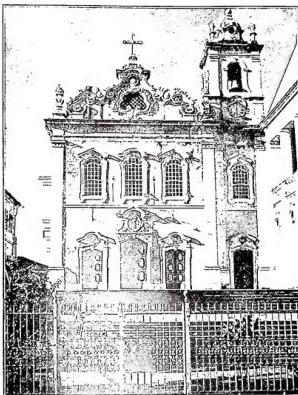
Alongside the Jesuits, the Benedictines (from 1582), the Carmelites (1584), the Capuchins (1612), and others worked effectively in B. Meanwhile, as early as 1551, with the Super specula of Julius III, the hierarchy had also been established: the first diocese of S. Salvador (or Bahia) was erected, from which the dioceses of Rio de Janeiro and Olinda later arose when it was elevated to a metropolitan see in 1676. A year later, the diocese of Maranhão was erected, as a suffragan of Lisbon, like that of Belem do Pará, created in 1719. The dioceses of San Paolo and Mariana, however, created in 1745, belonged to the ecclesiastical province of Bahia, the
(from P. Fuss, Brasil, Berlin-Zurich [1917])
BRASILE - Fascista of Our Lady do Pilar.
Colonial art (18th century) - City of Salvador (State of Bahía).
which extended as far as Angola in Africa. During this colonial period, B. was targeted by the Calvinists; the French attacked Rio de Janeiro (1555–67), while the Dutch attacked the Brazilian northeast (1630–61), aspiring to establish a Protestant state in South America. But these attempts came to nothing, since, after more or less prolonged struggles, the invaders were vigorously repelled by the patriotic fervor and, especially, the religious fervor of the people, wounded in their holiest traditions. An indication of the people’s religious culture is sacred architecture, which flourished in the 17th and 18th centuries in the distinctive colonial style.
Under the government of the marquis of Pombal, the principal author of the suppression of the Society of Jesus and reformer of the University of Coimbra (1772), the Catholic religion suffered a very severe blow. Among the evils that followed, one should note the deficient religious instruction of the people in general and the formation of a high clergy influenced by Jansenism and regalism. Caused above all by the ideas of the period were the separatist revolutions of Minas Geraes (1789) and Pernambuco (1817), in which several priests took part.
The final years of B. as a colony were marked by an event unique in the history of America. After much hesitation, the regent of Portugal, the future Giovanni VI, in order to escape the captivity being prepared for him by Napoleonic policy, chose Rio de Janeiro as the new seat of his court (1808–21). Mons. Lorenzo Caleppi followed him there; by force of circumstances, he became the first nuncio and later (1816) the first cardinal on American soil. The colony, elevated to the rank of a united kingdom, derived great advantages from the administration of Giovanni VI; nor did religious B. gain any less, under the immediate gaze of the representative of the Holy See.
2. The B. empire. - When Giovanni VI was compelled to return to Lisbon because of a constitutionalist revolution, he entrusted the government of B. to his son Pietro, not without anticipating B.’s imminent separation from Portugal. Just one year later, Pietro proclaimed the independence of B. (7 Sept. 1822), declaring himself its first emperor. The beginnings of the new empire were turbulent, nor did the disorders cease when the emperor, abdicating in favor of his son Pietro II, still a minor, entrusted the government to a regency with liberal tendencies. From the beginning of the autonomous regime, Catholicism, the official religion, suffered because of the disturbances, both on account of the regalism of the government, which intensified the patronal rights inherited from the kings of Portugal, and because of the government’s open opposition to the Roman Curia, as well as because of a clergy much engaged in politics and uncertain in doctrine. The priest and statesman Antonio Feijó was the prototype of this state of affairs. During the prosperous reign of Pietro II (1840–1889), on the one hand the Church benefited from the erection of three new dioceses (Diamantina, Porto Alegre, and Fortaleza in 1854, while the prelatures of Cuiabá and Gojaz had become bishoprics in 1826); on the other, it fell victim to the liberalism of the emperor himself and to the Freemasonry of the ministerial cabinets, which promoted the famous “religious question,” whose epilogue was the trial, condemnation, and imprisonment of two heroic bishops, Vitale Maria de Oliveira, bishop of Olinda, and Antonio De Macedo Costa, bishop of Belem do Pará, guilty only of having fulfilled their pastoral duty by defending the freedom of the Church (1873). Toward the end of the empire, the clergy gradually became more learned and more numerous, aided in this also by the arrival of other religious Orders, such as the Jesuits once again, the Lazarists, the Salesians, etc.
3. The B. republic. - A very brief military revolution sent the old emperor into exile and proclaimed the republic of the United States of B. (15 Nov. 1889). In accordance with the liberal principle, the Church was separated from the State (7 Jan. 1890). The Brazilian bishops issued a collective protest, but soon realized that in practice this law brought the Church liberation from the State’s excessively burdensome protection. Leo XIII immediately recognized the new republic (1890), which greatly favored, from that time onward, a mutual understanding that still exists today between State and Church in B. Diplomatic relations with the Holy See were maintained, and while the representation of the Brazilian government at the Vatican was raised to the rank of an embassy, the pontifical representation in Rio de Janeiro was elevated to a first-class nunciature (1909). Among the other expressions of the Brazilian government’s understanding of the lofty mission of the Catholic Church, one should recall the invitation extended to the Holy Father Leo XIII to preside over the arbitration concerning the boundary dispute with Bolivia (1903), the official reception given to the then Cardinal Eugenio Pacelli, papal legate returning from the XXXIV International Eucharistic Congress in Buenos Aires, the official celebrations of the fourth centenary of the Society of Jesus (1939), and those of the fiftieth anniversary of Rerum Novarum.
4. Present state of Catholicism in B
B. currently has 17 metropolitan sees, 64 suffragan dioceses, 25 prelatures nullius, and 2 apostolic prefectures; it should be noted that the last two archbishops of Rio de Janeiro were invested with the cardinal’s purple (1905 and 1930). Thanks to the reform of the seminaries promoted by the Holy See, there is now a more numerous and better-formed diocesan clergy. There are 3 regional major seminaries, 9 metropolitan major seminaries, 34 episcopal minor seminaries, and 7 preparatory seminaries. Since 1934, the Pontifical Brazilian College has operated in Rome, maintained at the expense of the national episcopate. In B., 14 religious orders, 27 congregations, and 3 male religious institutes carry out their beneficial work, assisted by 11 orders, 18 third orders, and 87 female congregations. Religious chiefly devote themselves to education, as well as to parish ministry and missions, both popular missions and those in the prelatures and apostolic prefectures. In the people’s life of piety, the development of the Third Order of St. Francis, the Apostolate of Prayer, youth Marian Congregations, and missionary leagues in Catholic colleges deserves mention. Eucharistic life is fostered through the Eucharistic Crusade and the so-called Pasque of the various social classes, and is encouraged by great manifestations of faith, such as the imposing National Eucharistic Congresses of Rio de Janeiro (1922), S. Salvador (1933), Belo Horizonte (1938), Recife (1939), and São Paulo (1942), as well as by perpetual daytime and nighttime adoration in Rio de Janeiro, São Paulo, Belo Horizonte, and Fortaleza.Catholic works are numerous, such as Brazilian Catholic Action; workers’ circles; the centers of higher culture Dom Vitali; the association of Catholic journalists, with newspapers, periodicals, and publishing houses; the film-censorship commission; Catholic radio stations, or stations that at least broadcast “Catholic hours”; and the charitable activities of the various confraternities, among which the Conferences of St. Vincent de’ Paul hold first place.
III. ART
With the Portuguese occupation, particular art forms cultivated until then in the territory of B. by the Indians, such as mosaics of multicolored feathers, died out; architecture, on the other hand, acquired the greatest importance through religious and military buildings. At first, indeed, it was the military architects who supplied the plans for palaces and churches. In the second half of the sixteenth century, the Jesuits initially transplanted simple architectural forms derived from classicizing Mannerism; later they introduced Italian and Portuguese Baroque, making the latter sumptuous and overloaded, especially in church interiors. The sculptor Diogó Jacome and the architects Antonio Pires, Manuel Fernandes, and Francisco dos Santos, authors of numerous monasteries, worked during this period. The residences of the governors and viceroys possessed no artistic value. In the seventeenth century there were in B. the monk Eusebio de Mattos (1629–92), a skilled painter from Bahia, of whose work nothing has survived, and two Flemings, Franz Post and Van Eckout, who, during the Dutch domination, were the first to paint tropical landscapes from life.In the eighteenth century the principal churches were built: the richest, with gilded wood decoration, were those of Minas Geraes. In 1735 Sà-e-Faria drew up the plan for the cathedral of Bahia and the church of the Militari. In 1751, commissioned by the governor Gomes Freire de Andraze, the Carioca aqueduct, with a double tier of arches, and numerous fortresses were constructed. In 1760 João Batista Primoli erected the church of S. Michele.
Antonio José da Silva, called l'Alejandinho (born around 1750 at Sabara Minas), directed the construction of many churches of S. Juan del Rey and sculpted in steatite twelve statues of prophets for the church of N. S. di Maltonsinhos at Congonhas do Campo. Other eighteenth-century sculptors of Rio were Domingo da Conceição, Simão da Cunha, Gaspar Ribeiro, and, later, Valentin de Fonseca y Silva, born in Minas Geraes (1750–1813), who was also a distinguished goldsmith and exerted great influence: in Rio, works of his that remain are a Passione (church of the Militari), the altar of S. Francesco with its magnificent lamps, the interiors of the churches of S. Bento and S. Rita, completed by Martinho de Brito, two medallions, and a small bronze tree which, placed in the public park, contributed greatly to his fame. His pupils were Francisco de Paula Borges, José Carlos Pinto, A. J. Vallasques, and the Jesuit Teofilo.
The painter José Joaquim da Rocha frescoed the church of the Concezione in Bahia: from his school emerged Franco Vellasco (1778–1833), known for his portraits, and Chagas, called Cabra, who sculpted statues on religious subjects imbued with profound and human sorrow.
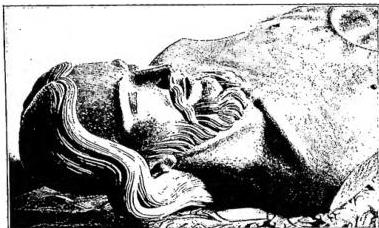
(from P. Fava, Brasil, Berlino-Zurigo 1937)
BRASILE - Wooden Crucifix by an unknown artist (18th century). Church of S. Francesco d'Assisi - City of São João d'El-Rey (State of Minas-Geraes).
The Ground Truth image displays a single, solid horizontal line. According to Rule 2 (UNDERSCORE & LINE RULES), this is a stylistic or background line, not a placeholder underscore. Therefore, the OCR result must ignore it and output nothing or only meaningful text. The provided OCR content is "____", which consists of four underscores. This is an incorrect interpretation of the line as a placeholder, violating the rule that stylistic lines must be ignored. The OCR has hallucinated underscores where none should exist based on the GT's visual context. Hence, the OCR result is inconsistent with the Ground Truth.
…tico viceregal palace, the Cathedral, the church of S. Francesco della Penitenza, and the dome of the imperial chapel, and influenced Francisco Muzzi, the friar Francisco Solano, Leandro Joaquim (portraits and sacred works, including the S. Cecilia of the church of the Parto), the prolific Juan de Sousa (cloister of the Carmelites), and the effective Manuel da Cunha, a freed slave who completed his studies in Europe and died in 1809 (Deposition in the imperial chapel, S. Andrea in the church of S. Sebastiano, decorations of numerous chapels in Rio, and a portrait of the count of Bobadella).
Manuel’s disciples were the mulatto Ray Mundo da Costa y Silva (Last Supper), who was also an architect; José Leandro Carvalho, who died in 1846 at Angrados Reis (portraits of Giovanni VI, S. Anna, and Our Lady of Carmel with the imperial family); and his son, a painter of flowers, who died in 1838; Antonio Alves; Domiciano Pereira Carreto; and the versatile Manuel Dias de Oliveira Brasiliense (d. 1831), nicknamed the Roman because he had studied in Rome. Also worthy of note in this period are the miniaturist M. S. Gentil and F. P. Amaral (d. 1830), a pupil of Leandro Carvalho (frescoes of the castle of Boa Vista and of the library).
With the establishment of the Portuguese court in Rio de Janeiro (1808), the arts received a new impetus and a vital renewing influence, especially because, in 1816, Giovanni VI, on the advice of the count of Barca and Baron von Humboldt, wishing to establish a school of Fine Arts, invited French artists to B., led by J. Le Breton (d. 1819). In 1831 the Academy was closed and resumed its activities only in 1837, on the initiative of the minister Vasconcellos; from 1816, however, French influence is apparent in almost all the painters. A little later Roman influence began; the first to reflect it were Enrique José de Silva, the portrait painter Claudio Brandier (d. 1857), Correia de Lima, Simplicio Rodrigues de Sá Correa, Luna, and Manoel de Aranjo Porto Alegre (1806–76), famous for their historical paintings. Whereas earlier artists had drawn their principal inspiration from episodes of the Bible, mythology, ancient history, the exploits of the first colonizers, and the life of the Italians, following B.’s victory over Paraguay the epic genre and the struggles of the homeland also offered a rich source of inspiration.
Pedro Americo, born in Parahiba in 1845 and deceased in 1905, may be regarded as the first great Brazilian artist. He studied in Paris, was a friend of Gide and Lefebvre, preferred religious subjects—especially biblical, allegorical, and patriotic ones. Several battle paintings, as well as a self-portrait (Uffizi), are in Italy.
The entire new generation of painters studied in Paris, Rome, and Munich: Oscar Pereira da Silva, Estebanda, Firmino Monteiro, Rodolfo Amoedo, a disciple of Cabanel (Jacob, Jesus at Capernaum), Decio Villares, a dazzling colorist and also a sculptor (subjects drawn from the Holy Scriptures and portraits of women in the Venetian manner). Italian influence is clear in the paintings—including watercolors and pastels—of Enrico Bernardelli, whose coloring is attractive and luminous and whose technique is original.
Zeferino da Costa’s principal work consists of the frescoes in the church of the Candelaria in Rio (biblical scenes), influenced by the Italian painters of the Renaissance.
Among the notable sculptors are Manuel Chiaves Pinheiro (1822–84), a disciple of Ferrez (statues of Pedro II, S. Sebastiano, and plaster groups), who counted among his pupils Rodolfo Bernardelli, the painter’s brother, who completed his first important work in Rome (the imposing Christ and the Adulteress); to his interest was due the construction of the Fine Arts building and the National Gallery in Rio.
Architecture, influenced by that of the great European metropolises, has had practitioners such as Souza Agmar, Francisco Bicalho, and Carlos Samparo. Since 1936, the «Serviço do Patrimônio Histórico e Artístico Nacional» has been established; besides creating numerous museums, it seeks to direct the country’s art toward genuine and spontaneous forms.
Relics of ancient Brazilian religious art are carefully preserved in the diocesan museums of S. Paulo, Salvador, Campanha, and Mariana. Contemporary sacred art in B. takes pride in the gigantic statue of Christ the Redeemer, erected in Rio de Janeiro, overcoming various technical difficulties, on the summit of Corcovado at an altitude of 700 meters, by the engineer Heitor da Silva Costa (in 1931). The statue, which rises upon an 8-meter pedestal, is 30 meters high and measures 28 meters with its arms outstretched; it dominates the abysses, the forest, the city, and the sea, and has become a worthy symbol of Catholicism in B.
IV. LITERATURE
Only toward the end of the first quarter of the sixteenth century did B. become the destination of widespread activity, not only of exploitation but also of enlightened colonization; this was carried out above all by the Society of Jesus, which, through its fervent preaching of the Gospel and its teaching, contributed greatly to the formation of the Brazilian national spirit.Indeed, among the first writers of B., although wholly adherent to the forms of Portuguese culture, there were quite a few Jesuits, such as the Lusitanian Father Anchieta (1530–97) (v.), a noble humanist and delicate poet, the earliest writer of B., and Fernão Cardim (1540–1625), whose Narrativa epistolar de una viagem e missão genitica pela Bahia, Ilhéos, Porto Seguro etc. usefully complements, together with the precious collection of geographical, historical, economic, etc. observations transmitted by the Tratado descriptivo do Brasil (1587) of Gabriel Soares de Sousa (d. 1591), those celebrated Diálogos das grandezas do Brasil, in which the life of the young colony is reflected in every detail; their author, Bento Teixeira Pinto, is also responsible for a dramatic Relação do naufragio que fez... Jorge de Albuquerque Coelho and a mediocre Prosopopéa (1601), in the style of Camoens. Amid the struggles gloriously sustained against the Portuguese, the English, and the Dutch, the spiritual physiognomy of B. was finally taking shape: the concept of nationality was by then clearly asserted in the Historia da Custodia do Brasil (the oldest history of B.), written by Friar Vicente do Salvador (1627), in which the expression «B.» no longer had merely a geographical content, but possessed its own new historical and social significance.
The intense cultural flowering with which Bahia was by then becoming increasingly adorned is attested by the progress made by prose, notably in the work of Manoel de Moraes, Diogo Gomes Carneiro, and Eusebio de Mattos (1629–92), a learned and eloquent Jesuit; it finds its first truly Brazilian accents in the poem dedicated by Manoel Botelho de Oliveira (1626–1711) to Ilha de Maré; in the multifaceted songbook of Gregorio de Mattos (1623–96), for the most part satirical and moralizing in tone, and therefore an extremely useful aid to knowledge of contemporary society and life, poetry finally acquired a distinctly personal imprint. The development of the economy, especially as a consequence of the degree of perfection attained by the extractive industry, was accompanied at the beginning of the eighteenth century by more widespread cultural activity; and while the Academies (of the esquecidos, the felizes, the selectos, the renascidos, etc.) multiplied, more or less ephemerally, through which poetry was reduced to an idle exercise of
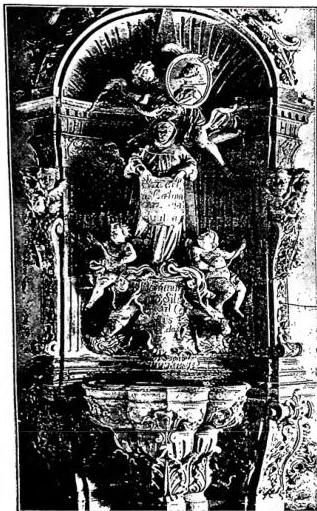
(from P. Fuss, Brasil, Berlin–Zurich [1937])
BRASILE - Lavabo in stone by Antonio Francisco Lisboa, known as Aleijadinho (18th century). Sacristy of the church of St. Francis of Assisi - City of Ouro Preto (State of Minas Gerais).
subtleties and puns (suffice it to mention the ponderous poem Eustachidos by Friar Manoel de S. Maria de Itaparica (1704-81), in which the poverty of imagination is matched only by the poor taste). Prose, on the other hand, offers us, in the allegorical tale by Nuno Marques Pereira (1652-1728), a narrative whose moralizing background is interspersed with numerous observations of folkloric and picturesque character, in which, precisely, lies the greatest interest of the work. Meanwhile, in the acute Reflexão sobre a vaidade dos homens by Mathias Aires Ramos da Silva de Eça (1705-96), it presents an elegant book of philosophical-moral content, whose value, however, was only understood much later. Finally, in the Historia da America portuguesa (published in Lisbon in 1730), despite the almost total absence of critical sense and geographical precision, it provides concrete testimony of a notable and sincere effort at coordination. It should not be forgotten that an Alexandre de Gusmão (1695-1753) reveals himself in the same era as an ingenious imitator of Molière, and that Brazil is the birthplace of Antonio José da Silva, nicknamed o judeu (born in Rio on 8 May 1705 and died in Lisbon on 19 October 1739), a skilled creator of a brief but delightful comic theatre.
The high level of culture achieved, at the same time, particularly in the region of Minas Gerais, is reflected in the flourishing of poetry from the school that takes its name precisely from that region, the "mineira" (whose members almost all met a tragic end, swept up in the conspiracy of the Inconfidência, 1789), and is embodied in the names of José Basilio da Gama (1741-95) and José da S. Rita Durão (1722-84), both epic poets. The former is the author of Uruguay (1769), a poem of remarkable spontaneity of inspiration and vividness of colour, while the latter wrote Caramurú, a more classical poem in tone, rich in intense and broad Camonian reminiscences, and written in a more copious and brilliant language. Also notable are Claudio Manoel da Costa (1729-80), author of an epic poem (Villa Rica) that is cold and colourless, but a skilled Arcadian versifier and admirer of Camões and Petrarch; Thomaz Antonio Gonzaga (1744-1810), the greatest lyric poet of his time, sincere author of the finest love songbook ever written in the Portuguese language (Marília de Dirceu), and, very likely, also of the anonymous and celebrated Cartas chilenas, a refined satirical poem directed against the governor Luiz da Cunha Menezes (partially published in 1845 and in full in 1863); José Ignacio Alvarenga Peixoto (1744-93), more superficial but with a facile and colourful imagination; and Manoel Ignacio da Silva Alvarenga (1749-1814), the last representative of the "mineiro" group, an elegant Arcadian, yet also sensitive to the beauties of the Brazilian landscape. Nor should we forget the spontaneous and popular muse of Domingos Caldas Barbosa (1740-1800), author of a poetic collection A viola de Lereno (Arcadian name of the author), which was warmly received, as well as Domingos Vidal Barbosa, Bento de Figueiredo Tenreiro Aranha, and a few others.
However, it was only in the 19th century that Brazilian culture entered a decisively national phase, to whose formation both political events (the transformation of the colony into a kingdom, first, and the proclamation of its independence, later, with the consequent upheavals and reforms) and greater commercial and economic contacts with abroad contributed extensively. Poetry, it is true, still remained faithful to the by then overused Arcadian forms (and only a few names are worthy of mention, such as Fr. Antonio Pereira da Sousa Caldas [1762-1814]), of painful and almost Romantic sensibility, finally placated in complete abandonment to Catholic faith; Fr. Francisco de S. Carlos (1763-1829), notable orator and author of a cumbersome poem on the Assumption of the Virgin; and José Eloy Ottoni (1764-1841), a facile and elegant Arcadian poet, also translator of the Proverbs of Solomon and the Book of Job; and, finally and principally, José Bonifacio de Andrade de Silva (1765-1838), a multifaceted intellect—scientist, orator, active politician, vigorous poet, and fine moralist—who, to the predominant memory of Juvenal, often knew how to juxtapose that of Anacreon. Prose writers worthy of mention, among others, include José da Silva Lisboa (1756-1836), a learned and skilled writer on politics and economics, among whose works, important in content and size, one may recall the Historia dos principais successos políticos do Império do Brasil (1818), the Constituição moral ou deveres do cidadão (1825), and the Causa da religião e disciplina eclesiástica do celibato clerical (1828); Mariano José Pereira da Fonseca (1773-1848), author of a collection of maxims and reflections (published in 1837), which more than once brings to mind La Rochefoucauld; José Feliciano Fernandes Pinheiro (1774-1847); and, in particular, Francisco Mont'Alverne (1784-1850), an eloquent preacher to whom belongs the merit of having introduced the study of European philosophy in Brazil; and Hippolito José da Costa Pereira Furtado de Mendonça (1774-1832), the first notable journalist of Brazil, a lively polemicist and ardent advocate of national independence. These are leading names, surrounded by those of other worthy, though less widely known, representatives of Brazilian thought during the period of struggles for independence, such as Fr. Francisco de S. Thereza de Jesus Sampaio (1778-1830), a good orator; Fr. Joaquim do Amor Divino Caneca (1779-1825), orator, poet, and journalist; Balthazar da Silva Lisboa (1776-1840), historian, jurist, and naturalist; Manoel Ayres do Casal, notable geographer and historian; Antonio de Moraes Silva (1775-1824), eminent lexicographer; and many others.
Poets generally termed "transitional," such as Maciel Monteiro (1804-68), of refined lyrical taste and translator of Homer and Virgil, and Salomé Queiroga (1810-78), with bucolic predilections, immediately precede the greatest exponents of the first Brazilian Romanticism, namely José Domingos Gonçalves de Magalhães (1811-82), Viscount of Araguaya, a serene and optimistic poet sustained by a firm faith, whose two collections of lyrics Suspiros poéticos and Saudades (1836) announce—though in emphatic and oratorical forms—the new orientation of poetry, and are rich and varied in meters and rhythms, animated by a sincere religious and patriotic fervor. To these were added, beyond the tragedy Antonio José, too faithful to old classical schemes, the Confederação dos Tamoyos (1856), marked by a strong local color, a short poem Urania, etc.; Porto Alegre (1806-1879), whose youthful poem A voz da natureza (1835) displays new forms of thought and style, while the Brasilianas (1863) are weighed down by religious and patriotic concerns, and from an unbridled imagination sprang the 40 cantos of the poem Colombo (1866). Antonio Gonçalves Dias (1823-64) is, finally, the first true Romantic poet, a sincere singer of the Brazilian land, which he exalted in delicate and limpid verses of genuine pantheistic intonation, and to whose resigned and nostalgic spiritual attitude contrasts strangely the soft and restless tone of Manoel Antonio Alvares de Azevedo (1831-52), whose Lyra dos vinte annos inaugurates a refined and imaginative poetry, sorrowful and ironic, interweaving a thousand influences from Byron to Musset, to Heine. Close on his heels follow Laurindo J. da Silva Rabello (1826-1864), rebellious and pessimistic, of moving sincerity, and L. José Junqueira Freire (1832-55), a tormented and restless spirit but of fine lyrical sensibility, and Casimiro de Abreu (1837-60), sincere and sentimental, who in his limpid and colorful verses reveals an anxious longing for a calm and never-attained happiness; finally, Antonio de Castro Alves (1847-71), a declaimer and magniloquent, whose voice knew how to rise high and noble to vindicate human rights and strike at cruel social prejudices, and who thus profoundly influenced national poetry. Many other names, though to varying degrees, are likewise not deserving of oblivion.
The emergence of the Naturalist tendency in poetry, though attested in more than one case (Martins Junior, Lucio de Mendonça, Celso Magalhães, Augusto de Lima, etc.), did not find in Brazil a deep adherence, so that it was soon overshadowed by the Parnassian virtuosity of Gonçalves Crespo, of Luis Guimarães, measured and refined, admirer of Lamartine and Musset, as of Heine and Vigny, of Carducci as of Stecchetti; of Machado de Assis, discreet and nostalgic in his precise realistic inspirations, expressed with metrical and rhythmic freedom; of Theophilo Dias, an elegant and eloquent lyricist, whose art gathers Romantic reminiscences in recherché and precious forms, yet always concerned with an exact correspondence between thought and form (Cantos tropicaes, Fanfarras, Lyra dos verdes annos); and even more so of Raymundo Correa, a keen investigator of psychological motifs but at the same time a refined and aristocratic describer of natural impressions, of soft sensibility and timid delicacy; and finally Alberto de Oliveira, one of the greatest, who in colorful and imaginative verses, permeated with subtle melancholy, portrays the face of the Brazilian landscape (Canções românticas, Meridiones, etc.), and Olavo Bilac, of Epicurean and sensual accent but of refined simplicity, and Luis Delfino and Luis Murat, a Romantic epigone of Victor Hugo-esque verbosity and grandiosity.
Yet against Parnassian composure, even in Brazil, the Symbolist wave breaks in the last years of the century with the contradictory and obscure, but deliriously humanly emotional poetry of Cruz e Souza, with that of B. Lopes, of Romantic and Parnassian education, in a first phase clear and picturesque, but destined to lose himself in sonorous affectation. The same artistic direction is followed by E. de Menezes, F. Pacheco, A. de Guimarães, and finally Mario Pederneiras, at last capable of freeing art from artifice, and singing sincerely with elegant simplicity the sweetness of intimate life, the enchantment of tropical nature, all daily reality in a form free of emphasis and ornament.
A kind of Brazilian Balzac may, in a certain sense, be considered Manoel Antonio de Almeida (1830-61) for his Memorias de um sargento de milicias (an exact portrait of the middle bourgeoisie at the beginning of the century), while Bernardo Joaquim da Silva Guimarães (1827-85) turns a keen and loving eye to the vast countryside of the country's interior.
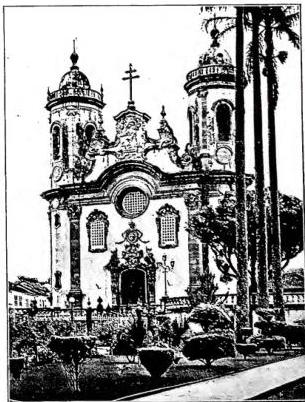
(da P. Fuss, Brasil, Berlino-Zurigo [1937])
Church of St. Francis of Assisi. Architect Antonio Francisco Lisboa, known as Aleijadinho (late 18th century) - City of São João d'El-Rey (State of Minas Gerais).
(Maurício, Escrava Isaura, O ermitão, etc.) following a trend that becomes increasingly pronounced in the work of Franklin Távora (1842-88), almost entirely inspired by rural life (O cabeleira, Casa de palha, Lourenço, etc.), and in the more refined and restrained work of A. Escragnolle Taunay (1843-99), whose rich and lyrical imagination finds its greatest expression in Retirada da Laguna and in the measured, contained forms of Inocência.
Depth of thought, finesse of psychological intuition and observation, sobriety of form, and subtle irony make Joaquim Machado de Assis (b. 21 June 1839, d. 29 September 1908), despite his Romantic education, the most significant representative of the Naturalist movement. His preoccupation with the human document, viewed through the eye of a humorist, leads him to a pessimistic vision of life, which faith in human goodness at least partially mitigates, while his art gradually ascends from the still uncertain forms of Contos fluminenses (1870) and Ressurreição to the perfection of Memórias póstumas de Brás Cubas (1880) and Dom Casmurro (1900). More superficial, Aluísio Azevedo, from Uma lágrima de mulher to O Mulato (1881), his first success, to Casa de pensão, O homem, and O cortiço, renders in Impressionist forms, though with fine coloration, the tumultuous and complex popular life, with its coarse vices and violent passions. A delicate sensibility, sometimes expressed in beautiful poetic notes, is revealed by Júlio Ribeiro in Padre Belchior de Pontes and Carne; restless and moved by the fatality of destiny is Raul Pompeia (1863-95), who proved himself in Atheneu (1888) an original and precise observer. Disciples of these major figures are their contemporaries, from Coelho Netto to Medeiros e Albuquerque and Xavier Marques, who with greater penetration and precision continue the work of the Romantics from Alencar to Taunay: among them, Afonso Arinos and Coelho Netto observe with keen attention the humble life of the countryside, while Euclides da Cunha and Graça Aranha passionately study ethnographic problems.
Now a few words on scientific prose. In the field of history and erudition, A. de Varnhagen (1816-78) had already carried out conscientious work based on precise archival research, from Florilégio da poesia brasileira to História geral do Brasil and História da Independência, useful contributions to the history of colonial Brazil. Instead, little more than a sincere but historically imprecise popularizer is the bombastic Pereira da Silva (1817-98), while the already mentioned Joaquim Norberto de Souza Silva is distorted by a misguided sense of patriotism. João Francisco Lisboa (1812-63), on the other hand, in pure language and subtly ironic forms, treated political, ethnographic, and social problems with acuity. Historians also include Alexandre de Mello Moraes (1816-82) and Joaquim Caetano da Silva (1810-73), the latter a good scholar of philosophy and medicine as well. But it was only around 1870 that Brazil truly entered the sphere of international culture with that select minority of minds responsible for the so-called Recife movement: just as the abolitionist campaign stands at the center of a more assured study of political and social problems, so criticism refines its methods and aims in the penetrating work of Tobias Barreto, in the lively polemics of Sílvio Romero, critic and poet, philosopher and politician of European culture, and in those of Araripe Júnior, a disciple of Taine, acute and paradoxical but capable of subtle criticism, as well as in José Veríssimo, a disciple of Sainte-Beuve and Brunetière, scrupulous but unable to achieve a comprehensive vision. In the hands of Joaquim Nabuco, a refined humanist and clear thinker, history takes on plastic and brilliant forms in the rapidity of vision and the persuasive force of eloquence. A reactionary journalist, Eduardo Prado, known as the author of A Ilusão Americana, demonstrates in elegant and assured essays a full understanding of the Brazilian political and social problem, intimately linked to the ethnic question, and openly challenges North American expansionism.
The significance of Brazilian theater is minimal. Born, one might say, with Antônio José de Gonçalves de Magalhães (1838), of purely historical value, it gradually improved its technique with L. C. Martins Pena (1815-48), a prolific author of dramas, comedies, and tragicomedies, and was cultivated, though without notable results, by França Júnior, Agrário de Menezes, and Augusto de Castro. Later, it declined into frivolous and light forms of outright French imitation (Valentim Magalhães, Moreira Sampaio, etc.), and only with Arthur Azevedo did it adopt traditional Romantic forms with an easy and spontaneous humor; refined comedies are due to Machado de Assis.
V. SCHOOL SYSTEM
The Brazilian constitution of 18 September 1946, taking into account the 1940 census which revealed between 40 and 72 percent illiteracy, established that primary education was compulsory and to be imparted in the national language, prescribing that industrial or agricultural enterprises maintain free primary education.Religion constitutes an optional subject of instruction and corresponds to the religion of the pupil (Brazilian Constitution 18, IX, chap. 5). Schools depend either on the federal Union, or on individual States, or on federal districts, or on municipalities.
Private schools are permitted. Primary schools ("Escuelas de primera enseñanza") are divided into 11,342 state-run, 2,532 municipal, 3,421 private, 302 Italian primary schools, 1,200 primary schools of other ethnic groups, and 17 missionary primary schools. To these must be added the 10,000 detached classes in which, since 1947, primary education has been imparted to those enrolled between the ages of 15 and 25. Secondary schools ("Escuelas de segunda enseñanza") are divided into 2 federal, 24 state-run, 3 municipal, 298 private, 8 Italian, and 1 missionary. Normal schools, regulated by decree-law no. 8530 of 2 January 1946, are divided into the "Course for Regents of Primary Education," which provides for the training of primary school teachers and lasts 4 years; the "Course for the Formation of Primary School Teachers," which lasts 3 years; and the "Course of Specialization and School Administration." Classes are divided by sex or may be mixed. There are 24 state-run and 15 private normal schools.
There are also vocational schools divided into 6 federal, 38 state-run, 7 municipal, 46 private, and 2 missionary; industrial-artistic schools divided into 2 federal, 7 state-run, 4 municipal, and 15 private; craft schools divided into 2 federal, 2 state-run, and 8 private; 3 agricultural schools; 2 federal nautical schools; 9 commercial schools; 94 various military schools; and 17 primary schools of the navy, divided into 14 pure primary schools and 3 model schools.
Higher education is imparted at the federal university (Universidade do Brasil) and at the state universities of Recife, Bahia, Belo Horizonte, and Porto Alegre. Famous are the two Catholic universities, the first administered by the Jesuits in Rio de Janeiro and the second administered by the Benedictines in São Paulo. The latter is affiliated with a Faculty of Philosophy, Sciences, and Letters of the Augustinian Canons Regular. In addition to complete universities, there are various university institutes (faculties) of jurisprudence in Rio, Recife, Ceará, São Paulo, Goyaz, Pará, Bahia, Belo Horizonte, and Porto Alegre; of medicine in Rio, Bahia, Belo Horizonte, Juiz de Fora, Porto Alegre, and São Paulo; of pharmacology in Ouro Preto and Pará; polytechnics in Rio, Ouro Preto, São Paulo, Bahia, Recife, and Porto Alegre. Catholic university institutes, besides the aforementioned universities, include: the Faculty of Philosophy "Paula Frassinetti" of the Sisters of St. Dorothy in Recife, the Faculty of Philosophy of the Jesuits in Recife, and the Faculty of Philosophy of the Marist Brothers in Porto Alegre. There are also the "Escuela nacional de bellas artes" in Rio, a "Escuela de música de maranon" in Tarã, Academies of Fine Arts in Pará, Bahia, Paraná, and São Paulo, where there is also a Conservatory. A "School of Social Service" exists in Rio and Recife. - See Pl. II.