
GIULIO III, POPE. — Giovanni Maria Ciocchi del Monte, born in Rome on 10 September 1487, died there on 23 March 1555. He studied literature under the guidance of Raffaele Lippo Brandolini, and law at Perugia and Bologna. Archbishop of Siponto, twice governor of Rome under Clement VII, vice-legate of Bologna under Paul III, auditor of the Apostolic Camera, cardinal (22 December 1536), and Paul III’s representative at the Council of Trent, he possessed a broad culture and extensive experience.
After a lengthy Conclave, made difficult by the conflicting interventions and numerous exclusions imposed by Charles V and Henry II of France, he was elected (7 February 1550) through an agreement among the factions, as politically neutral and not unwelcome even to the party seeking a reform of the Church. At the outset he showed himself inclined toward peace and desirous of reform. After lengthy negotiations with the Emperor and the king of France, he reconvened the Council at Trent for 1 May 1551 and appointed Cardinal Crescenzi, one of the best men available, as its first president. The Council, unrecognized by France and subject to imperial and Spanish interference, nevertheless continued its work until the threat posed by Maurice of Saxony and the Protestants compelled the Pope to suspend it (15 April 1552).
Meanwhile war had broken out in Italy. Ottavio Farnese, to whom G. had restored Parma, had joined forces with France, disregarding the Pope’s briefs, because the Emperor refused to grant him Piacenza and was also threatening Parma; G., both by inclination and because he needed imperial support against the Protestants, was leaning toward Charles V. In order to crush that “poor worm,” G. was forced to place himself in the Emperor’s hands, despite the threat of a French schism; he declared Ottavio deprived of his fief (22 May 1551), and, when the Farnese and the French invaded Romagna, he took Castro from the former. But an expedition against Parma and Mirandola, commanded by Ferrante Gonzaga, governor of Milan, failed: Rome itself yearned for peace. An armistice was concluded between the Pope and the French, with the restoration of Castro (29 April 1552). G. then returned, as “father of Christendom,” to thoughts of peace; while remaining, on the whole, favorable to Charles V and Cosimo de’ Medici, he assumed the role of mediator in the war of Siena.
He also continued to display considerable activity in the defense and propagation of the faith and in the work of reform. He confirmed the Roman Inquisition, but jealously kept it free from interference by secular princes and was rather inclined toward leniency: there were few executions of heretics, and absolution was granted even to those who recanted secretly. He worked to preserve Poland in the Catholic faith; he promoted and celebrated England’s return, under Mary Tudor, to obedience to Rome, and granted the legate Cardinal Pole the broadest powers to regularize the position of those possessing ecclesiastical property confiscated during the period of the schism.
He took an active interest in the evangelization of America and the Indies, facilitating the beginning of the missionaries’ work and establishing bishoprics, although the imprudence of religious, and still more the greed and corruption of laymen, prevented the hoped-for successes. He succeeded in bringing the Nestorians of Chaldea back into union with the Roman Church and attempted to reunite the Copts of Abyssinia. For the reform, he established commissions of cardinals, including distinguished men among them and taking part in their work; he prohibited unjustified transfers of benefices; he proposed (16 September 1552) an extensive program and, after much study, had a bull prepared concerning the pope and prelates, the secular and regular clergy, ecclesiastical benefices, the Segnatura, the Penitentiary, preaching, and indulgences: death prevented him from publishing II. Almost at the beginning of his pontificate, he had confirmed the constitutions of the Society of Jesus (21 July 1550); he later established the Collegio Germanico and entrusted it to the Society for the education in Rome of young Germans, future champions against heresy (31 August 1552).
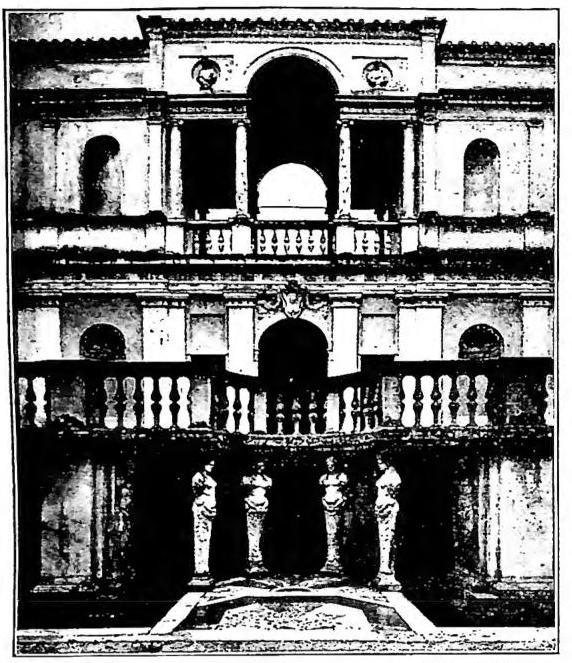
Despite financial constraints, he supported learned men, the Roman University, and the Apostolic Library. He received praise that was not disinterested, and dedications of works from Giovio, Aretino, and Condivi; from Palestrina, whom he had appointed choirmaster at St Peter’s, he received the dedication of a volume of Masses for four voices. He bestowed honors and a high stipend on Michelangelo, whom, despite opposition, he confirmed as chief architect of St Peter’s; he had Vignola and Ammannati build his magnificent “Vigna di papa Giulio” outside the Porta del Popolo; he had Vignola restore the palace later known as the Palazzo di Firenze; and he commissioned Vasari and Ammannati to design and decorate the funerary chapel in S. Pietro in Montorio.
Vigorous and tall in stature, but somewhat coarse in appearance, learned, eloquent, pious, and tireless, G. III lacked firmness and tenacity. Mild in character and free from pride, he was nevertheless prone to fits of anger, sudden enthusiasms, and discouragement. He loved jokes, festivities, banquets, revelries, and gambling to excess; he attended performances of questionable propriety; one of his medals celebrated the “hilaritas publica.” He showed excessively generous favor to his nephews, though he did not go as far as the great nepotism.
GIULIO ROMANO, GIULIO DI PIERO PIPPI DE' GIANNUZZI, so called. — Painter and architect, born in Rome in 1499, died in Mantua on 10 November 1546. At a very young age he entered Raphael’s workshop, becoming his favorite and most active pupil; before the age of twenty he collaborated on the Vatican Stanze, the Hall of Psyche at the Farnesina, and above all the Loggias.
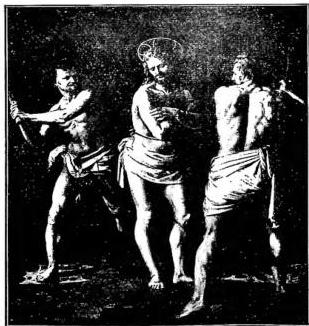
Already in these and in the other paintings completed in Rome (Flagellation in S. Prassede; altarpiece in S. Maria dell’Anima; Stoning of s. Stefano in S. Stefano of Genoa, etc.), he departed from Raphael’s balance and rhythm, strengthening the plastic effect by loading the surfaces with smoky shadows, and already revealing that scenographic taste which would become more pronounced later. After Raphael’s death, together with Penni he inherited the completion of the works left unfinished (The Transfiguration), the commissions (the Monteluce altarpiece), and the direction of the decoration of the Hall of Constantine and the Villa Madama at Monte Mario. Meanwhile his activity as an architect began (Villa Lante on the Janiculum; Palazzo Alberini; Palazzo Cicciaporci). In 1524 he went to Mantua, summoned by Federico Gonzaga, who first entrusted him with the construction of the Palazzo del Tè and then with the supervision of all the city’s building projects. There he directed work on the Palazzo Ducale, followed by the renovation of the nearby monastery of S. Benedetto di Polirone (1539) and that of the cathedral (1544). As a painter during this period, he worked chiefly in fresco on the immense decorations of the Palazzo del Tè, but he also produced numerous easel paintings (Nativity for S. Andrea of Mantua, now in the Louvre, etc.). In 1543, in Bologna, he supplied a design for the façade of S. Petronio, where he is also rightly credited with a work of sculpture, namely the terracotta group of the Madonna and Child on the tomb of Ottaviano Castelli. He died in Mantua while preparing to return to Rome, summoned by Paul III to direct the building works of St Peter’s.
(phot. Alinari)
GIULIO ROMANO, GIULIO DI PIERO PIPPI DE' GIANNUZZI, so called — The Flagellation — Rome, church of S. Prassede.
More than in the Roman works, in which he still does not depart from Renaissance schemes, it is in the Palazzo del Tè that his genius as a creator of sumptuous settings and his character as a classicizing scenographer are fully revealed—qualities that would influence the architecture of mainland Veneto.
BIBL. Venturi, IX, II, p. 338 ff. and XI, I, p. 267 ff.; F. Filippini, Opera di G. R. in Bologna, in Boll. d'arte, 9 (1929–30), p. 198 ff.; F. Hartt, Raphael and G. R., in The art bulletin, 26 (1942), p. 67 ff.; J. Hess, On Raphael and G. R., in Gaz. des beaux-arts, 32 (1947), p. 73 ff. Emma Zocca