
CLEMENTE VII, POPE. — Giulio de’ Medici, born in Florence on 26 May 1478, one month after the Pazzi conspiracy, of which his father Giuliano had been a victim; the latter had fathered him by a certain Fioretta, who later, during the pontificate of Leo X, sought to pass herself off as his secret consort. His uncle, the magnificent Lorenzo, had the boy educated alongside his own sons; he was particularly close to Giovanni, later a cardinal, and followed him into exile from Florence (1494). He returned there after the restoration of the Medici (1512), but, apart from the priory of Capua in the Order of the Knights of St John, he did not yet hold any office of significance. From Giovanni, who had become Pope Leo X, he received the archbishopric of Florence (9 May 1513), followed by the cardinalate (23 September 1513), the office of vice-chancellor (9 March 1517), and a large number of bishoprics and benefices, in Italy and abroad, among which he held for the longest periods the archbishoprics of Narbonne (1515–1523) and Eger (1520–23). He was thus able to amass great wealth, although he was so frugal as almost to verge on avarice.
His religious activity during these years was not negligible: as archbishop of Florence, he convened a synod (1517–18) to implement the decrees of the Fifth Lateran Council; he was the driving force behind the Roman proceedings against Luther, which ended with the bull Ecsurge, although neither he nor the Pontiff seemed fully to realize the gravity of the threat to the Catholic faith. Also noteworthy was the charitable work he undertook, founding in Rome (1519) the Company of Charity to assist the poor, visit prisoners, and bury the dead.
Even then, as a man of sound culture and refined taste, he appeared as a friend and patron of learning and art. He had Aleandro as his secretary and Bembo among his closest friends; he obtained commissions for Machiavelli, though modestly remunerated; he commissioned from Raphael the Transfiguration and the design for the “Vigna di monte Mario,” later called Villa Madama; from Sebastiano del Piombo, the Resurrection of Lazarus; and he played an active part in the negotiations between Leo X and Michelangelo concerning the construction of the façade and the new sacristy of S. Lorenzo.
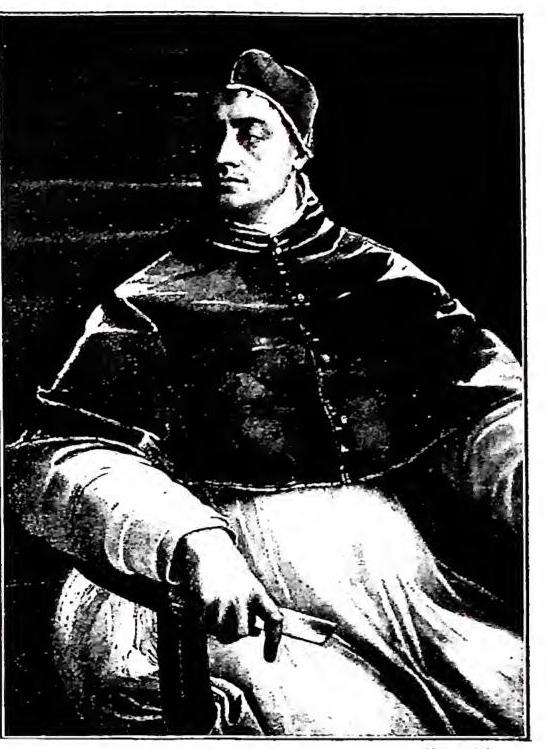
(photo Alinari)
CLEMENTE VII, pope — Portrait by Sebastiano del Piombo (1526) — Naples, picture gallery.
He played the principal role in concluding the alliance between Leo X and Charles V, and was legate with the Hispano-papal army in Lombardy (30 September 1521).
In the Conclave that followed the death of Leo X, he was leader of the imperial faction: unable at that time to obtain the tiara or to have one of his own protégés elected, he proposed, perhaps as an electoral maneuver, the name of Adrian of Utrecht. Under the new Pope Adrian VI, whose outlook was so different from the political and worldly orientation of the Medicean papacy, he initially seemed to have lost all authority and withdrew to Florence. When Cardinal Soderini’s intrigues in favor of France were uncovered through his efforts, he was recalled to Rome, once again became supremely powerful in the Curia, and contributed to the defensive alliance of the Pope and the Emperor against France, joining it himself in the name of the Florentines. After the death of Adrian VI, Giulio actively sought his own election; he still had the support of the imperials, but through skilful promises he succeeded in winning over his opponents and, after fifty days of Conclave, was elected pope by unanimous vote (19 November 1523), taking the name of C. VII. His election was greeted with joy, for he was praised for his dignified bearing, upright conduct, sobriety, tireless activity, and extensive experience in ecclesiastical and political affairs.
But the circumstances of the time were extremely difficult. The bitter struggle between Charles V and Francis I had Italy as its principal stake. C. had an Italian heart because of his homeland, which was exposed to losing the last remnant of its freedom, and he understood that defending Italy against complete enslavement to a foreigner was at the same time a defence of the independence of the papacy; but he could scarcely distinguish between the duty of a pope and the role of a prince. He could not remain closely allied with Charles V without risking the subjection to him, together with the Papal States and Florence, of the papacy itself; nor could he take the field against him without exposing himself to an extremely costly and bloody war of uncertain outcome, or remain neutral at the risk of being abandoned by both contenders and made to bear the costs of their discord. On the other hand, the revolt against the Church was gaining ground in Germany and threatened to overflow beyond its borders: to stop it, there could be only two courses, either to proceed resolutely with a reform of the Church or to resort to force. But a reform of the Church seemed difficult amid such a clamor of arms and presented the danger of opening the way to limitations on papal authority and to the encroachments of princes, especially the emperor; recourse to force was impossible without relying on him and thereby increasing his already excessive authority. And while the Pontiff strove to free himself, the Church, and Italy from the pressure of Charles V and relied on France, which was interested in keeping Germany divided, he indirectly became an ally of those innovators whom, in the spiritual sphere, he had to and wished to combat. From the East there loomed the Ottoman threat; but there was no hope that the attempt, already unsuccessful under Pius II, to unite Christendom in a supreme defensive effort would now succeed; and assistance to those most exposed to the threat meant assistance to the already tottering House of Habsburg. To these difficulties, which could scarcely have been overcome even by a man of entirely different mettle, there was added the Pope’s impressionable and uncertain nature, prone to illusory hopes and depressing fears, extremely slow to decide, and ready, because of new ideas, to reject what he had previously desired. There was also his inability to set aside the purely political interests of the temporal state or of his own house, or to subordinate them to broader and worthier interests befitting a pope. Thus the times in which C. reigned and his own qualities combined to make his pontificate one of the most unfortunate. At first, C. sought to remain neutral between the two great rivals, in the illusion that he could restore peace and promote concerted action against the Lutherans and the Turks. After Francis I entered Milan, he hoped to obtain advantages for the Church and for the Medici from the apparent victor, and joined him and the Venetians (December 1524–1525).
“He remained dead” after the defeat of the king of France at Pavia; and, frightened by the triumph of Charles V, the progress of the Lutherans, and the advance of the Turks, he allied himself with the imperial forces; but he did not obtain from Charles V what he had hoped for. Disillusionment, fear of Charles’s omnipotence, and the counsels of Giberti, his datary, led him to take part in—or rather, to a considerable extent, promote—that attempt to rally Italy against the “barbarians,” which first manifested itself in the unfortunate Morone conspiracy and then in the League of Cognac, the second Holy League (22 May 1526). But the discord and slowness of the allies, the French and Venetians; the violence of the Colonna, on the imperial side, which went so far as to sack the Vatican and S. Pietro (20 Sept. 1526); and the people’s discontent over the gravesse, which the Pope, short of money, was compelled to impose for the war, forced C. into an armistice with the imperial forces, when the Spanish and Italian troops of Bourbon and the lansquenets of Frundsberg were already advancing. Yet he could not halt the terrifying wave that descended upon Rome (6 May 1527). Charles V was at least conniving; France was inactive; the Pope’s own allies were occupying the cities of the Papal States; Florence, having overthrown Medici rule, was restoring the Republic. Having barely escaped to Castel S. Angelo, the Pope remained there “buried alive” for several months, while the troops horribly sacked the city, without his efforts succeeding in freeing II. Finally reaching an agreement with the imperial forces on onerous terms (26 Nov. 1527), he withdrew first to Orvieto and then to Viterbo, amid hardship and danger; and he did not return to Rome until 6 Oct. 1528.
Once again he tried to remain neutral, while insisting that the occupied cities be restored and the Medici reinstated in Florence. In the end, with fortune already turning decisively in Charles V’s favor, he concluded the Peace of Barcelona with him (29 June 1529), in which he obtained from Charles, who was concerned by the threat posed by the Turks to Vienna, better conditions for the papacy and his own family than could have been hoped for. This was followed by the Peace of Cambrai (5
Aug. 1529), in which Francesco I abandoned the Pope and Italy to Charles V; by the negotiations at Bologna, conducted personally by the Pope and the Emperor; and by the league between them and most of the Italian states, including the Duchy of Milan, which C., with unusual tenacity, had succeeded in preserving for Francesco Sforza (23 Dec. 1529). Charles V was crowned emperor at Bologna on 24 Feb. 1530. Meanwhile, the imperial troops turned against Florence. The Pope perhaps still hoped for the city’s peaceful submission, but he wanted it restored to the Medici at all costs, also because this was the only means of preventing it from falling into the emperor’s hands. The Florentines did not yield (12 Aug. 1530) until after a desperate defense, which cost C. an enormous sum: the city returned to the Medici, and from 1531 Alessandro, whom they said—probably falsely—was the Pope’s natural son, was nominally its ruler; in fact, the Pope remained its master.
Having achieved his objective, C. once again turned toward France and made arrangements for the marriage of Caterina, daughter of Lorenzo di Piero de’ Medici, to Enrico, the king’s second son (1531). He then returned to plans for peace; at Bologna, he held a second conference with the emperor, from which emerged a secret pact between the two and a second Italian league (Feb. 1532). But the following year he accepted the invitation of the king of France to a conference at Marseille (Oct. 1533), where he blessed Caterina’s marriage to the future Enrico II and entered into secret agreements with the king, without, however, abandoning his intention of reconciliation. And in his conduct, perpetually—but perhaps necessarily—wavering, he remained until his death.
Amid such a tangled and painful course of events, his work as a temporal ruler could not be outstanding, although there were no shortage of sound measures to improve the condition of Rome and raise it up again after the wretched sack, and to fortify the cities of the Papal States, one of which, Ancona, was then brought under the direct rule of the Church (1532).
Even less adequate to the needs of the times was his activity in the religious sphere. He was not, in truth, forgetful of his duties as pontiff. In promoting the Jubilee of 1525, he exempted those who took part in it from the obligation of almsgiving; he issued a bull against dueling (13 Feb. 1524); he prescribed observance of the reforms decreed by the Lateran Council (21 Nov. 1524); and he prohibited the natural sons of ecclesiastics from succeeding to their parents’ benefices (30 May 1530). He consented, but only with many reservations, to the establishment in Portugal of an Inquisition modeled on the Spanish one, and defended the converted Jews against the king; he was also lenient toward those who had not converted. He resisted as far as he could the encroachment of the state in religious matters, although circumstances compelled him to make frequent and dangerous concessions. He approved the foundation of the Theatines (24 June 1524) and, despite fierce opposition, received them under the direct dependence of the Holy See (7 March 1533). He protected in its difficult beginnings that highly fruitful branch of the Franciscan Order which came to be called the Capuchins, granting them the new habit, the beard, and a life of poverty (13 July 1528), although he did not always prove firm and consistent in the face of opposition from the Conventuals. He also approved (18 Feb. 1533) the congregation of the Sons of S. Paolo, later called the Barnabites. He promoted missions in the Spanish and Portuguese colonies and established a hierarchy there.
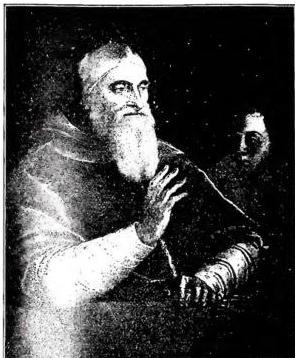
CLEMENTE VII, PAPA - Portrait of C. VII (after 1527), unfinished painting by Sebastiano del Piombo - Parma, Pinacoteca.
He granted tithes and indulgences for the defense of Vienna; he gave and, on a much larger scale, promised money. He obtained from Charles V that Malta be ceded to the Knights of Rhodes, a Christian bulwark in the Mediterranean (1520); he gave ships to Andrea Doria for his operations in the Ionian Sea. But the vast projects exceeded the Pope’s possibilities, since he lacked forces and money, and remained dependent on the unattainable agreement among the Christian powers and on the changing relations of the Pope with Charles and Ferdinand of Habsburg.
These relations also partly determined C.’s conduct in the face of the grave questions of the Lutheran heresy and the convocation of the council. It is right, however, to acknowledge that, although he often allowed himself to be guided by political motives and displayed his habitual irresolution, he also showed notable prudence, so as not to make the religious division irreparable so long as there remained some, however illusory, hope of avoiding II.
The dispatch of Cardinal Campeggio (8 January 1524) as legate to Germany seemed to herald the implementation of reforms, of which the cardinal was a convinced supporter; after the deliberations of the Diet of Nuremberg (1524), the Pope, while opposing the convocation of a German national council, threatening to the unity of the Church, appeared to support Charles V’s plan for an ecumenical council and promised to accept at least some of the gravamina of the German nation. But precisely when the Diet of Speyer (1526) showed itself tolerant toward the innovators and left each State the dangerous power to determine its own religious position, C. was engaged in the struggle with Charles V, with the result that the formation of the Lutheran state churches in Germany continued undisturbed. When the innovators, dissatisfied with the decisions of the new Diet of Speyer (1529), although so largely favorable to them, formulated the famous protest, C., at Bologna, promised the emperor that the council would be convoked, prepared also to make very broad concessions to the Protestants, with the aim of preventing the emperor himself from setting himself up as judge. Yet, deceived, also by the apparent moderation of the Augsburg Confession, concerning the innovators’ real intentions, he required them to accept the council and also required the king of France to accept it, since he could counterbalance imperial interference. The convocation of the council was announced as imminent in an encyclical of 10 December 1531, while Aleander, nuncio in Germany, was to attempt prudently to reach an agreement with the Protestants. And even when, in the face of the conclusion of the Schmalkaldic League and the growing threat from the Turks, the emperor concluded the religious Peace of Nuremberg with the Protestants (1532), tolerating the Augsburg Confession until the council met, C. raised no objections, leaving the impression that he had approved the agreement. At the second meeting in Bologna, he renewed his commitment to convoke the council, and in fact sent briefs in January 1533 to the Christian princes to obtain their consent; but Ugo Rangoni, his nuncio in Germany, tried in vain to obtain the Protestants’ submission to the decisions of the future council; the king of France then made clear his opposition to the convocation; and C., who expected no useful outcome from it, was induced to postpone it (March 1534), provoking fierce protests, not all of them justified, not only at the imperial court but also among the most ardent Catholics of Germany.
In the face of the apostasy from Catholicism of Albert of Brandenburg, grand master of the Teutonic Knights (1525), and the measures that led to the progressive separation of Denmark and Sweden from Rome, C. displayed his usual conciliatory tendency, deceiving himself that the rupture could easily be avoided or repaired. In Switzerland he was unable either to provide timely reforms or to assist the Catholics effectively, and he vainly hoped that the heretics would return to the unity of the faith.
When Henry VIII, king of England, in order to contract a new marriage with Anne Boleyn, raised conscientious objections concerning the validity of Julius II’s dispensation for his marriage to Catherine of Aragon, and at the same time requested the annulment of that marriage and a dispensation from the impediment of affinity with Anne because of his previous relations with her sister, C., then confined in Castel S. Angelo, did not wish to give an immediate and open refusal. At that terrible moment the king was almost the only friend he had left; moreover, there was too much reason to fear that this former defensor fidei might now seek to exploit the anti-Catholic elements existing in England and drag the country, following the example of Germany and the northern lands, outside Roman obedience. C. therefore sought to temporize, and from Orvieto (17 December 1527) granted a dispensation for marriage to Boleyn, in the event that the marriage to Catherine should be declared null. But he categorically refused to place the decision in the hands of Cardinal Wolsey, who favored the annulment; he delegated judgment of the matter to Legate Campeggio and Wolsey himself, without, however, committing himself to confirming their sentence; and while, yielding to Wolsey’s solicitations, he granted a decretal that gave hope of, or perhaps promised, the annulment, he stipulated that it was to be shown to the king only to strengthen the cardinal’s wavering position, but was not to be used for any other purpose, nor was judgment to be based upon it, and he refused to proceed to further and definitive concessions. Certainly, the fear of gravely offending Charles V, who had made Catherine’s cause his own, was not unrelated to this unusually resolute conduct; but it is also true that, even when he was in conflict with Charles, he did not consent to sacrifice the sanctity of marriage, not even in the face of the danger of schism and the advantage that might have come to the interests, including the religious interests, of the pontificate from a closer union with the king. Then, when by the Peace of Barcelona he became certain of Charles V’s support, C. accepted Catherine’s appeal and brought the case before the Roman Rota, where in England it would have been concluded to his disadvantage (16 July 1529). He wavered again and allowed the proceedings to be prolonged; but he forbade the king to contract a new marriage until the case had been judged (1531 and 1532). Neither the opinions of the French universities, skillfully solicited by Cranmer, nor the threat of withholding the “annates” and of severe measures against anyone who remained faithful to Rome, succeeded in moving him. The king secretly married Boleyn (25 January 1533), had Cranmer, intruded as archbishop into the see of Canterbury, declare his marriage to Catherine invalid, and insisted that Anne be crowned.
The Pope declared the new marriage null and excommunicated Henry unless he separated from Anne and took Catherine back (11 July 1533). And to the decrees of the English Parliament, which detached the Church of England from Rome and subjected it to the king (January 1534), he responded with the definitive sentence declaring the validity of the first marriage (24 March 1534). It may well be that C.’s prudent slowness gave Henry VIII hope of a decision favorable to his passion for Boleyn and thus encouraged him to persist; but it is also very doubtful whether more resolute conduct on the Pope’s part could have prevented the crisis, rather than accelerated it, and whether C. should not therefore be credited with having done everything within his power to avert so grave a loss to the Church.
The conditions of the times and the horrific sack, which brought splendid Renaissance Rome to an end, prevented C. from fulfilling the hopes that men of letters and artists had placed in a Medici pope. Nevertheless, he favored men of letters, such as Sadoleto, who was his secretary during the early years of his pontificate; Sannazzaro, who dedicated to him the De partu Virginis; Giovio; Berni; and many others who, in other respects, were not all worthy of a pope’s favor. In Guicciardini, whom he made president of Romagna in 1524 and later entrusted with other offices, he certainly rewarded the political man devoted to the Medici rather than the eminent historian; to Machiavelli, who had presented him with his Storie fiorentine, he granted only a modest subsidy; and with Erasmus he maintained friendly relations.
In the field of art, he had the Sala di Costantino decorated by pupils of Raphael, partly according to the master’s designs; he continued the construction of St. Peter’s, entrusted to Peruzzi; and completed the courtyard of S. Damaso and the three streets from Campomarzio to Piazza del Popolo. In Rome he erected the Mint, for which Cellini worked, while Giovanni Bernardi would engrave his splendid medals. At Orvieto he had the Pozzo di S. Patrizio built by Antonio da Sangallo, and at Loreto he had Andrea Sansovino and other distinguished sculptors continue the decoration of the S. Casa. Above all, he deserves credit for commissioning Michelangelo to create the “Sagrestia nuova” of S. Lorenzo with its famous monuments, to erect the Laurenziana library, and, during the final months of his pontificate, to paint the Giudizio universale in the Sistine Chapel.
Frequently ill during his pontificate, he died after six months of illness “cristianamente et quietamente” on 25 September 1534, and was buried in a heavy monument, the work of Baccio Bandinelli, in the choir of S. Maria sopra Minerva. - Vedi Tav. CXV.
BBL.: G. Ehses, Die Politik Klemens' VII. bis zur Schlacht von Pavia, in Histor. Jahrb., 6 (1885), pp. 557-603; 7 (1886), pp. 553-93; R. Grethen, Die politischen Beziehungen Klemens' VII. zu Karl V. in den Jahren 1523-27, Hannover 1887; P. Balan, C. VII. e l'Italia dei suoi tempi, Modena 1887; W. Hellwig, Die politischen Beziehungen Klemens' VII. zu Karl V. im Jahre 1526, Lipsia 1889; Pastor, IV, II (con ricchissima bibliografia); G. Pieraccini, La stirpe dei Medici di Cafaggiuolo, I, Firenze 1924; G. Constant, La réforme en Angleterre: le schisme anglican. Henry VIII, Parigi 1930; E. Rodocanachi, Les pontificats d'Adrien VI et de Clément VII, ivi 1933; Fliche-Martin, Histoire de l'Eglise, XVII, ivi 1948, pp. 22-27.
Giovanni Battista Picotti