
SANGALLO, FAMIGLIA. — Florentine architects who took their name from the Porta S. Gallo of Florence, near which the family’s forebears lived.
GIULIANO (called G. Giamberti). — Born in Florence ca. 1445, died there in 1516. In 1465 he came to Rome. His activity during this period has not been adequately clarified. The attribution of the Loggia della Benedizione in S. Pietro is doubtful, and the part he played in the construction of the Palazzo and basilica of S. Marco is uncertain; considerably better founded, however, are the attributions of the Palazzo for Cardinal Giuliano della Rovere (the future Julius II), and of the design for the villa of Innocent VIII at Magliana, works that reveal a strong Albertian influence.
Returning to his homeland in 1479, Lorenzo il Magnifico entrusted him with numerous civil and military constructions. His first important work of this period was the church of S. Maria delle Carceri at Prato (1485–92), which, in its central Greek-cross plan, seems to realize that ideal
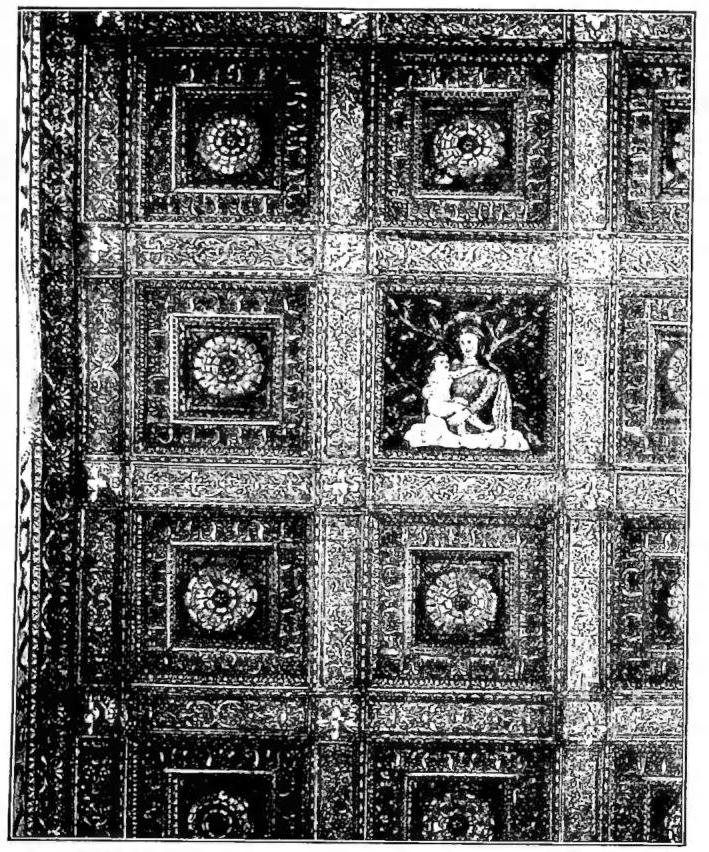
of divine proportion toward which the humanist architects aspired. The theme of the centralized building was taken up again with greater classical sensibility in the sacristy of S. Spirito (1489), inspired by the Brunelleschian model of the Rotonda degli Angeli, to which the Chapel erected at approximately the same time in the convent of Cestello, demolished in 1866, perhaps came even closer. The same conception led G. to the design for S. Maria dell’Umiltà in Pistoia (1492), in which he adopted an octagonal plan preceded by a rectangular atrium. After the death of Lorenzo il Magnifico, G. resumed contact with Cardinal della Rovere, followed him to France, and returned with him to Rome. Alexander VI immediately entrusted him with covering the central nave of S. Maria Maggiore (1494), for which he executed the beautiful ceiling. The same Pontiff then sent him to Loreto (1500) to vault the dome of the Basilica, which, once again following Brunelleschi’s example in S. Maria del Fiore, he succeeded in harmonizing with the Gothic structure. After Giulio II’s elevation to the papacy, G. left Rome, according to Vasari out of disappointment at not having been appointed architect of the Vatican Basilica. In 1503 he was in Florence, where he was executing the Gondi Chapel in S. Maria Novella and was later appointed master builder of S. Maria del Fiore. Only after Bramante’s death was he able to fulfill his long-standing aspiration to direct the work on the Vatican temple, an appointment entrusted to him in 1514, which he held only briefly, however, because, by then old and ill, he returned to Florence the following year.
As a sculptor he left two wooden Crucifixes in the church of the SS. Annunziata in Florence. Although he remained tied to the Brunelleschian tradition, and therefore to the spirit of the fifteenth century, G., through the purity of his proportions and his spatial sensibility, may be regarded as one of the great masters of the Renaissance.
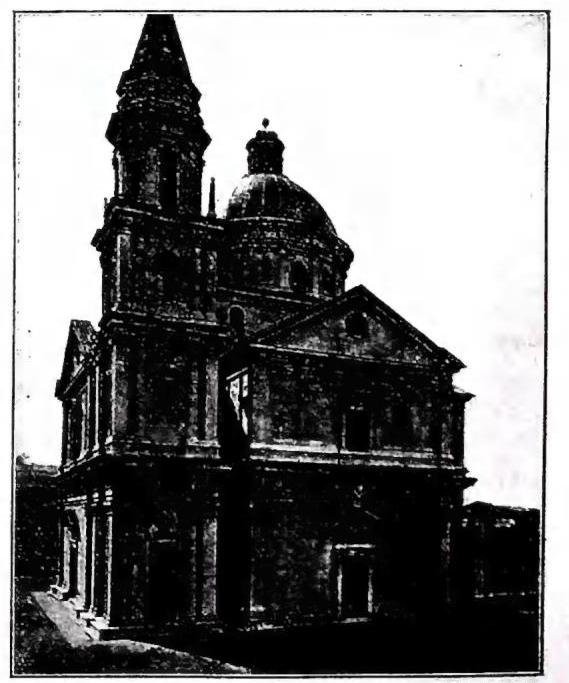
ANTONIO IL VECCHIO (detto A. Giamberti). - Brother of the preceding, he too was born and died in Florence (1463-1534). He followed his brother to Rome, at first as a mere assistant, then receiving commissions directly from Pope Alessandro VI. In 1493 and 1494 he was working in the Vatican Palace and in Castel S. Angelo; the following year he began work on S. Maria di Monserrato according to a plan with a single apsidal nave and simple architectural lines, later altered by the sumptuous decoration superimposed upon II.
He left Rome with his brother after the election of Giulio II, and returned to Tuscany, where he remained until his death, carrying out a broad and multifaceted activity. The church of the S.ma Annunziata in Arezzo belongs to his first period, where he resumed the construction begun by Bartolomeo della Gatta, according to a plan with three naves and a large dome. The church remained unfinished, as did the reconstruction of the thirteenth-century temple of S. Agostino in Colle Val d'Elsa. These works are of little significance; but in his later maturity he created at S. Biagio in Montepulciano (begun in 1518) one of the masterpieces of sixteenth-century architecture. In the Greek-cross plan, at the center of which rises the dome above the tall drum, there is a full adherence to Bramantesque conceptions, through direct inspiration from classical models. In this work, admirable for its complete equilibrium and the perfect correspondence between spatial harmony and plastic sensibility, the personality of A. il Vecchio finally freed itself from every bond with his brother, marking the transition to the full sixteenth century.
His various palaces erected in Montepulciano and the fortress of Civitacastellana are also remembered.