
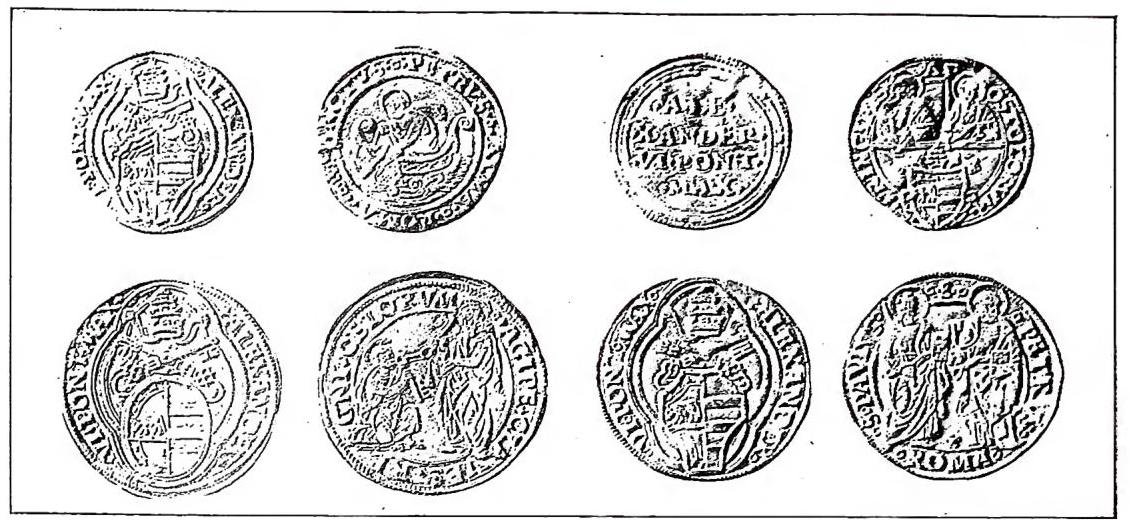
ALESSANDRO VI, PAPA. — Rodrigo Borgia (Borja), born in 1430 or ’31 at Xativa, in the province of Valencia, to Jofré and Isabella, sister of Alfonso, the future Pope Callistus III, held the papacy from 1492 to 1503. We know very little about his early youth, except that his uncle obtained for him a canonry at Valencia and then had him come to Italy to study for a degree in law at the University of Bologna. The elevation of Cardinal Alfonso Borgia to the papal dignity (1455) marked the beginning of his astonishing fortune. In fact, in 1455 he received the cardinal’s hat with the title of S. Nicola in Carcere, which in 1471 he exchanged for the suburban see of Albano and in 1478 for that of Porto. Vice-Chancellor of the Holy Roman Church from 1456, two years later he became administrator of the diocese of Valencia (where, at that time, his family was represented by no fewer than five
bishops), and subsequently took possession of the bishoprics of Cartagena and Majorca (Spain), and of Erlau or Eger (Hungary), together with wealthy abbeys and other opulent benefices. He was thus able to devote himself to a highly lavish life and had several illicit relationships, among them with Vannozza de’ Cataneis, by whom he also had Cesare, Jofré, Giovanni duke of Gandia, and Lucrezia. Although the excellent Pius II rebuked him severely, he did not change his ways. Intelligent, moreover, and an accomplished speaker, he knew how to advance his ambition and energy in affairs with dexterity under Paul II, Sixtus IV, and Innocent VIII, and enjoyed the favor of many reigning princes, who were certainly no more restrained than he, successfully carrying out various legations at their courts on behalf of the Holy See.
A first attempt to obtain the tiara in the conclave of 1484 came to nothing, but in that of 1492, which followed the death of Innocent VIII, he was able, through lavish offers to the cardinals, to obtain the fifteen votes sufficient for election. He was thus proclaimed Pope on 11 August, taking the name A. VI, amid the universal acclaim of the Romans, who were destined to detest him so deeply, and the congratulations of almost all the powers—a clear sign of the political and moral situation of the time. His first acts of government were truly praiseworthy, but nepotism and corruption soon prevailed.
During the eleven years of A.’s pontificate, two periods may be distinguished, but both constantly revolved around the same axis: the exaggerated protection of his sons and nephews. During the first, the dominant feature was the papal league with the Aragonese of Naples against the claims of Charles VIII of France to that kingdom. The second, by contrast, began after the latter’s death in 1498 and was characterized by A.’s alliance with King Louis XII. At first there was no lack of friction between the Pope and King Ferrante, the wily natural son of the great Alfonso; this friction arose in part from the manifest preference that the Aragonese, in clear opposition to Borgia’s candidacy, had shown for the proud and warlike Cardinal Giulio della Rovere, who later became Julius II. Ferrante, however, subsequently feared that, through the intrigues of Ludovico il Moro, Duke of Milan, the investiture of the kingdom of Naples might be granted to Charles VIII; and A., for his part, realizing that the Catholic king, the most powerful of all those then ruling in Europe, had taken up the defense of his house’s interests, and considering above all that close friendship with the latter would be of great benefit to his sons, found it relatively easy to lay the foundations of a solid agreement. Under it, Jofré Borgia became Prince of Squillace and husband of Sancia, the natural daughter of Alfonso II, Ferrante’s successor, while Giovanni, the second Duke of Gandia, married a relative of the sovereigns of Spain. This inclination of the Pontiff toward the Aragonese of Naples naturally produced a violent clash with France, whose king determined to seize the disputed crown by force of arms, asserting the rights of the Angevins, and seeking to frighten A. with the threat of the Pragmatic Sanction and of a council which, following the suggestions of Cardinal della Rovere, would have been expected to depose him if he granted the investiture of Naples to the new King Alfonso II. But A. was by then definitively committed; and so, when in May 1494 Cardinal Giovanni Borgia crowned Alfonso in the capital of the kingdom, he tried in vain to appease Charles VIII by presenting him with the blessed golden rose.
Charles VIII was therefore forced to withdraw precipitously from the kingdom of Naples, which once again fell into the hands of the Aragonese, while A., to escape the king’s vengeance, took refuge in the strongly fortified Orvieto and Perugia, returning to Rome only when Charles emerged battered from the Battle of Fornovo. Having thus reached the height of his political prestige, A. was preparing to enjoy it fully when, in June 1497, his son Giovanni, Duke of Gandia, who had recently received the investiture of the Duchy of Benevento and of the cities of Pontecorvo and Terracina, was stabbed repeatedly while riding on horseback through Rome at night and thrown into the Tiber.
Under the weight of so great a calamity, A. wished to change his life and promote a genuine ecclesiastical reform, appointing for this purpose a special congregation of cardinals and planning to issue a bull against the disorders of the Roman Curia. But the fire was short-lived, for once his good resolutions had vanished, A. returned to his former way of life. And while Savonarola multiplied his invectives against the Curia and the Pontiff himself, the latter was preparing, after a scarcely edifying trial, to dissolve his daughter Lucrezia’s marriage to Giovanni Sforza in order to marry her to Alfonso of Bisceglie, the illegitimate son of Alfonso of Naples; meanwhile Cesare Borgia was preparing to renounce the cardinalate with which his father had invested him in 1493, in order to become the husband of a French princess.
In 1498, which witnessed, on 23 May in Florence, the execution of Fra Girolamo Savonarola, already excommunicated in 1497 by the Pontiff for his irreducible opposition to his person and policy, the second period of A.’s pontificate began. Upon the death of Charles VIII, the last of the Capetians of Valois, Louis XII, founder of the Orléans line, succeeded him; he did not fail to proclaim himself also king of Naples and duke of Milan. To divert him from the temptation of seizing Lombardy, the Pope entered into relations with him, leading him to hope for an improvement in the intricate Neapolitan affair. A further relaxation in relations came with the papal declaration of the nullity of Louis’s marriage to the blessed Giovanna of Valois, daughter of Louis XI, after which the monarch was able to marry the widow of Charles VIII, heiress of Brittany.
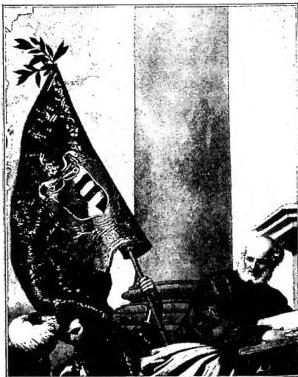
Meanwhile Cesare Borgia obtained the French duchy of Valentinois and at the same time married a princess of royal blood, Carlotta d’Albret, instead of Carlotta, eldest daughter of the new king of Naples, Federico II, as A. had dreamed, as though glimpsing a royal crown. Louis XII, having formed a close alliance with the Pontiff and the Venetians, entered Milan, accompanied by Cesare and other Italian lords. A.’s military and political power had thus reached its peak, and it offered him the opportunity to reconquer the Romagna for that favourite son, while Ludovico il Moro was defeated and taken prisoner in the decisive battle of Novara (April 1500). Cesare received from his father the golden rose and the office of gonfalonier of the Church, while a large part of its territories fell into the hands of the Borgias, and the Romagne lived through days of terror and bloodshed. The partition of the southern fief of the Holy See, approved by the Pontiff, between Louis XII and Ferdinand the Catholic soon collapsed through the action of the captain Gonzalo di Cordova, who definitively placed Sicily and the Kingdom of Naples under Spain’s full dominion.
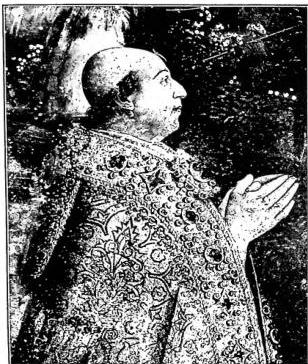
A.’s pontificate witnessed events of the greatest importance, not only political but also religious and cultural; above all, it witnessed the discovery of America, which took place two months after his elevation to the throne, amid the immense excitement of all Europe. The three caravels of the Genoese navigator, sailing towards the New World under the insignia of Spain, entered into competition with the Portuguese ships which, at the same time as voyages along the African coasts, traversed the Atlantic in search of unknown lands to occupy and evangelize in the name of the king of Portugal, on the basis of a concession granted to him by Callistus III. Since the geographical position and limits of the discovered regions were not well known, the danger of a conflict between the two powerful crowns appeared extremely grave. To avert it, recourse was had to A.’s arbitration: with great prudence he traced a line of demarcation running vertically from the North Pole to the South Pole, one hundred leagues west of the Azores. Spain was therefore assigned the lands to the left of the line when looking north, and Portugal those to the right. Shortly afterwards, by the Treaty of Tordesillas (1494), Spain agreed to move the demarcation 270 leagues farther west, to Portugal’s great benefit, enabling it to annex Brazil.
The ever-expanding discoveries and the support of the sovereigns of the two countries greatly advanced the missions, which achieved truly magnificent development also through the Pope’s vigorous contribution; he did not fail to grant extensive privileges to the missionaries of the new Christian communities. Entirely characteristic of A. was also the effort he devoted to defending the purity of Catholic doctrine against the onslaught of heresies, and to effectively protecting the religious Orders, especially the recently founded Order of s. Francesco di Paola. As 1500 approached, he announced the solemnity of the jubilee to the whole world, taking part in many ceremonies and enjoying the spectacle of the great multitudes of pilgrims who had flocked from every quarter. The Via Alessandrina, Borgo Nuovo, now disappeared, as well as numerous building projects, demonstrate his great interest in the urban-planning problems of Rome, while the Borgia Apartment in the Vatican and the rooms of Castel S. Angelo, with the magnificent paintings by Pinturicchio, together with the protection he extended to artists and men of letters, bear witness to his patronage.
The judgment on A. cannot but be properly severe. His pontificate was in many respects the opposite of those of a Niccolò V and a Pio II. The attempt by certain modern writers to present him as worthy of the task entrusted to him has ended in miserable failure, just as the exaggerated accusations scattered through so many writings published between the seventeenth century and our own days cannot withstand the scrutiny of sound criticism.
BIBLI: Johannis Burchardi, Liber Notarum ab a. 1482 usque ad a. 1506, edited by E. Celani, in Rerum ital. Scriptores, XXXII, 1. Città di Castello 1910–11; M. Sanudo, Diario, Venezia 1880; D. Cerri, I Borgia ossia A. VI papa e i suoi contemporanei, Torino 1873–74; A. Leonetti, Papa A. secondo i documenti e carteggi del tempo, 3 vols., Bologna 1880; C. Höfler, Don Rodrigo Borja (Papst A. VI), Vienna 1889; Pastor, III, pp. 320–637; J. Sanchis y Sivera, Algunos documentos y cartas privadas... Notas para la historia de Alejandro VI, Valencia 1919; G. Porti-
gliotti, I Borgia, A. VI, Cesare, Lucrezia, Milano 1921; M. Bellone, Lucrezia Borgia, 7th ed., Milano 1944; G. Pepe, La politica dei Borgia, Napoli 1946. Giuseppe M. Pou y Marti