
AFRICA. - One of the five largest continents. SUMMARY: I. Geography:
1. Africa in general
2. French Equatorial Africa
3. French West Africa
4. South-West Africa
II. Ethnography. - III. Ancient Christian history. - IV. The General Councils. - V. Christian monuments. - VI. Medieval and modern Christian history. - VII. Current state of missions. - VIII. Protestant missions.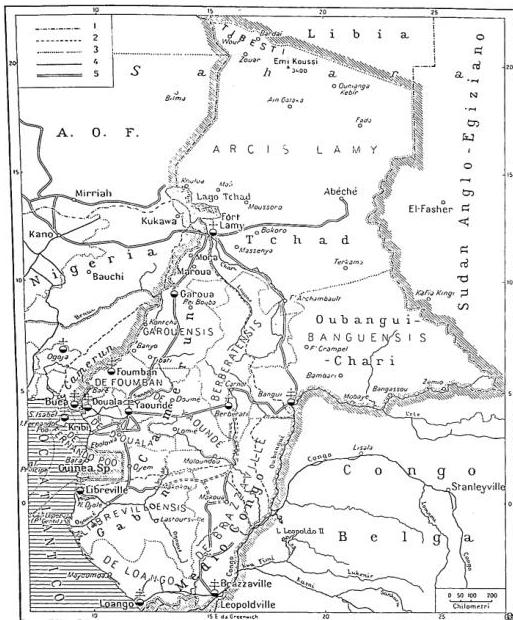
5. AFRICA IN GENERAL
a) Physical geography, relief, inland waters. - Africa extends between the Atlantic and the Indian Ocean, isolated on all sides except to the north, where the Mediterranean brings it close to southern Europe (Strait of Gibraltar, Tunisian Channel) and the Isthmus of Suez, now crossed by an oceanic canal, connects it to Asia, which replicates its characteristics in certain regions (Arabia, India). Of its 30 million km² of surface area (three times that of Europe), barely half belongs to the islands (Canary Islands, Cape Verde, and Madagascar, which alone accounts for nine-tenths). Lacking true peninsulas, Africa is among the continents poorest in articulations: 98% consists of a continental block, where for every 1,000 km² of area there are only 8 km of coastline (32 in Europe, 12 in Asia).Its shape resembles that of a trapezoid, welded along approximately the 5th parallel north to a triangle. Between the two extreme points north (Cape Blanc) and south (Cape of Needles), which lie roughly equidistant from the Equator, there are 8,300 km; the width narrows from a maximum of 7,500 km (Cape Verde-Cape Guardafui) to less than 200 km (on average) in southern Africa. Thus, most of the continent lies in the northern hemisphere.
The simplicity of its outline is reflected in the general uniformity of its relief. The continent’s backbone consists of an immense block of ancient, unfolded rocks, forming vast plateaus that rise from 400-600 m (on average) in the Saharan region to 1,000-1,200 m in central and southern Africa and over 3,000 m in eastern Africa. The plateaus are often incised and fragmented by long fractures that have given rise to several series of lakes (Rudolf, Albert, Edward, Kivu, Tanganyika, Nyasa), or that were invaded by the sea (Red Sea). Mountainous features appear along the edges of these fractures and along the coasts, where the raised rims of the plateaus descend to the sea in steep fronts and spread into more or less extensive terraces. True mountain systems formed by folded rocks can only be spoken of in the Atlas region, or Maghreb (bounded to the south by the line Cape Nun-Gulf of Gabes), where a plexus of reliefs develops that reconnects to the peri-Mediterranean European ranges (Sierra Nevada, Alps, etc.) of similar origin. The highest peaks of Africa generally correspond to volcanic masses: in the east, these rise to approximately 6,000 m (Kilimanjaro), allowing the development of glaciers even below the Equator (Kenya and Ruwenzori).
Africa’s coasts are almost everywhere difficult to access, poorly articulated and harbor-poor, and even where its major rivers flow into the sea with large deltas (Nile, Niger) or estuaries (Congo, Gambia), they cannot be navigated directly from the sea except for limited stretches, interrupted as they are by waterfalls, rapids, and cataracts even in their lower courses. Less than half of Africa’s territory (48%) drains to the sea; two-fifths lack outflow (Sahara, Kalahari), and one-eighth empties into internal basins (Chad). The regime of African rivers is essentially or exclusively pluvial; they are thus subject to seasonal floods: famous are those of the Nile, the longest river on Earth (6,500 km, basin 2.8 million km²), used since remotest antiquity for irrigation (Egypt). The Congo (4,200 km in length), whose basin (3.7 million km²) straddles the Equator, maintains a constant and abundant flow (minimum 50,000 m³ per second) in every season; its numerous and long tributaries (Cuanza, Cunene, Ubangi, Kasai) form an extensive network of waterways in a region (the virgin forest) where communications are particularly difficult. Significant basins and courses are also presented by the Niger (4,200 km, basin 2.1 million km²), the Zambezi (2,700 km and 1.3 million km²), the Orange (1,900 km and 1.0 million km²), the Senegal (1,700 km and 0.5 million km²), etc.
Africa hosts, especially in the intertropical zone, a good number of lakes, among the largest and deepest on Earth. Lake Victoria (68,800 km²) is the third-largest in the world by area; characteristically elongated, as mentioned, are Lakes Nyasa (30,800 km²) and Tanganyika (31,900 km²), the latter with the deepest cryptodepression on Earth (1,435 m) after Lake Baikal. Of the other lakes, the largest (Chad, Ngami) lie in the lowest zones of closed basins, have shallow depths, and exhibit great seasonal variations in level.
b) Climate. - Nearly four-fifths of Africa’s territory (77%)
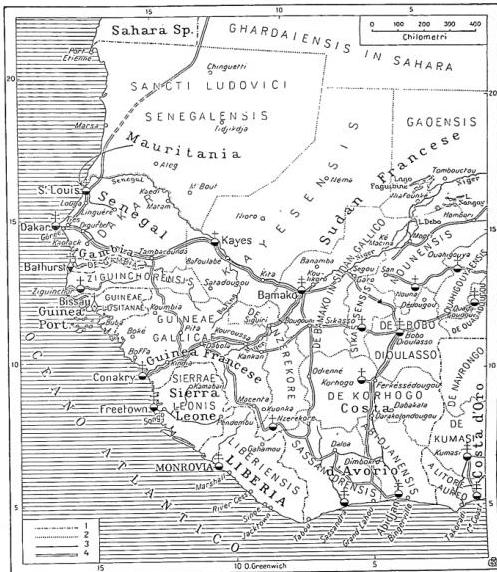
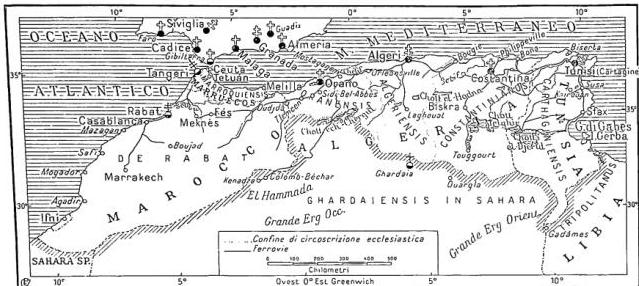
AFRICA - Western A. 1. State or colonial boundaries; 2. Ecclesiastical jurisdiction boundaries; 3. Railways; 4. Roads.
and is in turn replaced by steppe as aridity becomes predominant. The transition then gradually leads to desert steppes and true deserts, of which A. possesses the largest and most typical (the Sahara) on Earth. Subtropical thermal and rainfall regimes (Mediterranean, with winter rains) occur only in northern A. Minor and, to the south (over smaller areas), in the extreme southern tip of the continent.
c) Population. — The population of A. is currently estimated at approximately 175 million inhabitants (a figure that may be excessive). The density, which on average does not reach 6 inhabitants per km², varies within not very distant extremes. Excluding certain islands (Madeira, Canary Islands, Mauritius, Zanzibar, Réunion), the highest concentrations are found in Egypt (almost 500 inhabitants per km²), in A. Minor, in western Sudan, in the Cape region, in Ethiopia, and in some areas of the Lake Plateau, etc.; in general, however, density barely exceeds 15-20 inhabitants per km² over somewhat vast spaces. By contrast, very large regions are entirely or almost entirely uninhabited, not only in the desert but also (for opposite reasons) in the equatorial forest. A highly expressive indicator of the continent's settlement conditions, and of its difference from settlement in, for example, Europe, is the fact that throughout A. the number of urban centers exceeding 100,000 inhabitants is just over twenty (23 in 1940), with only one reaching a million (Cairo): that is, fewer than what occurs in Europe in Italy alone.
More than 5/7 of the African population consists of Africans of the Negroid group, with varieties and crossbreeds no less numerous than among whites and yellows. They inhabit the continent south of the Sahara, while northern A., north of the Senegal River mouth-Juba River mouth line, is populated by Mediterranid and Orientalid Europids (Hamites and Semites of tradition). Among the latter, the Arabs, after conquering the Maghreb in the 7th century, imposed their language and civilization on all of North A. Jews are particularly numerous in coastal centers, where they are typically settled in special quarters. Europeans probably number just over 4½ million, half of whom are in southern A. and slightly fewer in the Maghreb and Egypt (the zones most suitable for white settlement), but nowhere do they hold numerical predominance over indigenous peoples, except in restricted areas or urban enclaves.
Unlike members of other races, Negroes appear divided into a very large number of distinct groups: south of the Sahara, no fewer than 800 different languages are spoken, many of which are used and understood by only a few thousand individuals. Overall, these populations have absorbed and assimilated very little of our civilization: in this regard, A. is the most conservative of continents. The hostility of the natives toward European penetration has, however, almost everywhere given way to more or less peaceful collaboration. Only the Islamized populations of northern A. have taken a distinctly antagonistic stance toward their current rulers.
d) Religious confessions. — Religious contrasts also operate in the same direction: even on this terrain, the reflection of racial differentiations is transparent. Islam, introduced and spread by the Arabs, dominates the Semito-Hamitic environment in the north: Muslims in A. number no fewer than 55 million adherents (35% of the total), and although the area of their predominance stops roughly at the 10th parallel north, they are gaining ground among the mass of
Negro and Negroid populations, the great majority of whom practice animist cults. Christians number around 24 million: of these, approximately 8 million are Catholics, 7 million Protestants, and 9 million Orthodox and Copts. Their area of diffusion corresponds to the marginal territories of European penetration and to the Ethiopian plateau, where Christianity has deep roots and was able to resist the Islamic onslaught. Jews exceed half a million (particularly numerous in the cities of northern A.), and Hindus number around 150,000 (eastern A.).
e) Colonization. — Classical antiquity and the Middle Ages essentially knew only the northernmost part of the continent, this side of the Sahara, and the lower and middle Nile Valley. Beyond these regions, they had vague and confused notions of the rest of A., where (Sudan) Western penetration had been sporadic or occasional. In the second half of the 15th century, Portuguese expansion began along the Atlantic coasts, followed (16th century) by Dutch, French, and English expansion. By the end of the 16th century, the outline of the continent had been entirely surveyed, but since the purpose of the expeditions was essentially trade with the Indies, knowledge and colonization were almost everywhere limited to the coastal zone, where supply stations, ports, and farms were established (on the western coast also for the slave trade). Although Dutch colonists (Boers) had already settled in the most favorable regions of the southern hinterland (Cape) from the early years of the 17th century, the exploration of the interior is, in essence, a 19th-century achievement; thus, the most recent of all continents.
The massive shape of the territory, its difficult penetrability, the presence of an immense desert zone on the southern border of the ancient world, the rapid and fortunate colonization of the New World, and the lengthy disputes for European dominance account for this delay. However, the discovery and occupation of Africa’s interior regions were subsequently favored by the concurrent efforts of the religious fervor of Christian missionaries, the scientific zeal of explorers and scholars, and the interests of commerce, which paved the way for the expansion of European powers. With the disappearance of Holland, the decline of Spain and Portugal, the struggle primarily involved France and England, and later Germany and Italy. The Berlin Conference (1884) regulated the partition of Africa, recognizing the independence of a few states, some of which were later absorbed into the sphere of English (Boers) or French (Morocco) influence, while the nominal sovereignty of Turkey in northern Africa (Libya, Egypt) came to an end. Today, European powers control almost the entire continent. Great Britain and France alone dominate over two-thirds of the territory (32% and 36%, respectively) and of the African populations (38% and 26%); the portion belonging to independent states, reduced to three (Egypt, Ethiopia, Liberia), is minimal (1/14 of the territory and 1/8 of the population). Below is the statistical overview of the continent’s subdivision: it should be noted that the fate of the Italian colonies remains uncertain as of 1948. The territories (former mandates) of Togo, Cameroon (French and English), Ruanda-Urundi (Belgian), Tanganyika (English), and South-West Africa (South African Union) represent the former German colonies lost as a consequence of defeat in the First World War. The form of dependence of colonial territories on the mother country varies greatly: from regions that are integral parts (Algeria for France, the Canary Islands for Spain, the four Libyan provinces for Italy), it descends, by degrees, to mere protectorates. Thus, the political map sometimes reflects legal conditions rather than actual possession.
1) Statistical Overview.
| Territories | Area in km² | Population |
|---|---|---|
| Kingdom of Egypt | 935,300 | 19,090,000 |
| Empire of Ethiopia | 1,120,000 | 10,000,000 |
| Republic of Liberia | 95,400 | 2,200,000 |
| Independent Africa | 2,150,700 | 31,290,000 |
| International Territory of Tangier | 583 | 106,000 |
| Algeria | 2,204,863 | 7,600,000 |
| Tunisia | 125,130 | 2,730,000 |
| Morocco | 398,627 | 8,993,000 |
| French West Africa (A.O.F.) | 4,701,575 | 15,938,000 |
| French Equatorial Africa (A.E.F.) | 2,370,000 | 4,004,000 |
| French Somaliland | 21,963 | 45,000 |
| Madagascar and dependencies | 592,200 | 4,227,000 |
| Réunion | 2,511 | 240,000 |
| Cameroon (mandate) | 422,000 | 2,615,000 |
| Togo (mandate) | 56,500 | 918,000 |
| French Africa | 10,895,369 | 47,310,000 |
| Libya | 1,759,540 | 930,000 |
| Eritrea | 119,472 | 640,000 |
| Italian Somaliland | 506,573 | 1,030,000 |
| Italian Africa | 2,385,585 | 2,600,000 |
| Madeira | 782 | 212,000 |
| Cape Verde Islands | 4,033 | 182,000 |
| Portuguese Guinea | 36,125 | 350,000 |
| São Tomé and Príncipe | 964 | 60,000 |
| Angola | 1,246,700 | 3,738,000 |
| Mozambique | 771,125 | 5,085,000 |
| Portuguese Africa | 2,059,729 | 9,627,000 |
| Canary Islands | 7,496 | 761,000 |
| Presidios | 213 | 120,000 |
| Spanish Morocco | 20,427 | 800,000 |
| Spanish Sahara and Ifni | 285,000 | 65,000 |
| Spanish Guinea | 26,649 | 200,000 |
| Spanish Africa | 339,785 | 1,946,000 |
| Belgian Congo | 2,336,892 | 10,500,000 |
| Ruanda and Urundi (mandate) | 54,172 | 3,800,000 |
| Belgian Africa | 2,391,064 | 14,300,000 |
| Gambia | 10,536 | 205,000 |
| Sierra Leone | 72,362 | 2,121,000 |
| Gold Coast | 203,704 | 3,572,000 |
| Nigeria | 876,654 | 20,900,000 |
| Union of South Africa | 1,223,854 | 11,258,000 |
| Basutoland | 30,344 | 580,000 |
| Bechuanaland | 600,000 | 284,000 |
| Swaziland | 17,366 | 186,000 |
| Southern Rhodesia | 389,384 | 1,777,000 |
| Northern Rhodesia | 751,908 | 1,675,000 |
| Nyasaland | 123,795 | 1,686,000 |
| Kenya | 582,636 | 4,045,000 |
| Uganda | 243,406 | 3,930,000 |
| British Somaliland | 176,113 | 700,000 |
| Socotra | 3,579 | 12,000 |
| Mauritius and dependencies | 2,096 | 425,000 |
| Seychelles and dependencies | 404 | 33,600 |
| Zanzibar and Pemba | 2,642 | 250,000 |
| Saint Helena and Ascension | 210 | 5,000 |
| Togo (mandate) | 30,776 | 391,000 |
| Cameroon (mandate) | 88,266 | 925,000 |
| South-West Africa (mandate) | 822,875 | 318,000 |
| Tanganyika (mandate) | 932,400 | 5,545,000 |
| British Africa | 7,189,000 | 60,823,000 |
| Anglo-Egyptian Sudan | 2,462,925 | 6,591,000 |
| TOTAL AFRICA | 29,875,000 | 174,593,000 |
g) Economic conditions, products, communications. — The recent date of African colonization and its barely incipient development correspond to the stage of its economic evolution: the continent remains, in essence, a reserve of raw materials, whose utilization appears far from its immense potential. The occupations of the indigenous peoples remain, fundamentally, traditional: hunters and gatherers in the forests, herders in the steppes, herder-farmers on the plateaus, and cultivators in the savannas. Fishing is limited to the coasts of Guinea, South-West Africa, Mozambique, and Madagascar. Apart from the Mediterranean and southern countries, all agriculture is still indigenous. Among agricultural products, the only one for which the African market leads is cocoa (65% of the global total, coming almost entirely from the coasts and islands of the Gulf of Guinea); but peanuts (18.3%, from the countries of western Sudan), cotton (9.1%, mainly from Egypt, Sudan, and Uganda), vegetable oils (oil palm, sesame, castor), cane sugar (6%, from the Mascarene Islands), vanilla (40%), bananas, dates, esparto grass, and alfa grass also hold significant importance. The equatorial forest supplies rubber, precious woods (ebony, mahogany, rosewood), copal, copra, etc.; temperate countries provide grapes and wines (10% of global production, mainly from the Maghreb and Madeira), olive oil, fruit, cork, etc.
Among animal products, ivory, which was of great importance in the past, has greatly diminished (elephant hunting); but livestock breeding, widespread in temperate Africa and the Sudan, plays a large role in the continent’s economy, which counts 5 million camels (83% of the global total), 160 million goats and sheep (16%), 67 million cattle (9%; in central Africa, livestock breeding is hindered by the spread of the tsetse fly), etc. The wool produced represents 9.4% of the global total; hides also constitute a major export item.
Though our knowledge of them remains imperfect, mineral reserves are undoubtedly substantial; however, their exploitation is still in its early stages. Certainly, Africa holds, one might say, a monopoly on diamond extraction (99% of the world’s total) and the leading position in gold extraction (65%; both are located in southern Africa). Phosphates (38%; northern Africa), chromium (33%; Rhodesia, South African Union), manganese (20%; South African Union, Congo, Morocco), copper (19%; Belgian Congo, Rhodesia), and tin (13%; mainly Nigeria, Belgian Congo) also yield significant quantities. Production of fossil coal (South African Union), petroleum (Egypt), and iron (Algeria, Katanga, South African Union) is scarce, not least among the reasons—along with unsuitable climate and insufficient labor—why modern large-scale industry is lacking in Africa.
The European commercial dominance is essentially limited to the coastal regions, beyond which it extends inland only along the courses of the major rivers (Nile, Congo, Niger). Africa's share of the global total is modest: imports rose from 3.7% to 5.2% and exports from 2.6% to 4.7% of this total between 1900 and 1937. In the past, the most flourishing trade was that of slaves, whose procurement, organized especially in Sudan, aimed to supply the tropical countries of America with the personnel necessary for the exhausting work of plantations. The slave trade ended in 1889. Internal and external commerce long suffered from the natural obstacles which, as seen, make the development of communication routes difficult in Africa, but especially after the mid-nineteenth century, progress was fairly rapid. Good ports were established in several points along the coast, even where it was less suitable (Dakar, Durban); steam navigation was introduced and spread on rivers and lakes, connecting with other means (tracks, canals, roads) the stretches interrupted by rapids and waterfalls. Railways began around 1860, and moved, as in Asia, from the periphery toward the interior, but in relation to the development of individual regions, thus resulting in independent networks, isolated from one another, and often built with different gauges. Overall, Africa today has 75,000 km of railways, equivalent to just 5.7% of the global network, and 0.2 km of line per 100 km² of territory, which is the lowest value among those of the individual continents. Of the five main groups of lines—the Maghreb, comprising Northwest Africa; the Egyptian-Sudanese; the Western, or of the Franco-British colonies in Western Sudan; the Eastern, or of Kenya, Uganda, and Tanganyika; and the Southern or Austral—the most important is the last, which becomes denser toward the south and extends northward to the Congo Basin. This network, to which the only completed trans-African railway is connected (from Lobito to Beira via Elisabethville and Bulawayo), is supplemented by an appropriate combination of mechanical means (automotive, river, and lake transport), allowing access to the Nile Valley and thus to the Mediterranean, achieving the great trans-African route Alexandria-Cape Town. In recent years, and also as a consequence of the recent conflict, air services have greatly developed, almost all serving European connections (France-England). The railway network is still too sparse, and other means of transport too distant to meet all needs, so traditional systems, which in harmony with the climate and terrain have served the purpose since time immemorial, have not disappeared.
One of Africa's characteristics in this regard is the lack of vehicles, except in the southern regions, where the Boers introduced large ox-drawn wagons. Northern Africa and Ethiopia use horses, mules, and donkeys for transporting goods; Egypt, the Sahara, and Somalia use camels; for the rest, that is, for almost all of equatorial Africa, men and goods are transported on human backs (since none of the usable domestic animals withstands the deadly bite of the tsetse fly), with caravans typically consisting of 40-60 porters, who take turns at determined stages. The spread of automobiles and the multiplication of tracks have somewhat reduced, but not eliminated, these extremely slow and often precarious systems of locomotion.
If Africa may never be, due to its environmental conditions, a territory everywhere suitable for white colonization, a rational enhancement of its vast resources will certainly lead to a more intimate integration into the world economy. The most cautious calculations on its population capacity assign it, as possible, a human load about ten times greater than the current one; and no account has been taken of what the ever-advancing production technology will be capable of achieving.
2. AFRICA EQUATORIALE FRANCESE (A.E.F.)
Formerly French Congo; acquired by France between 1875 and 1916. It is governed by a governor, represented by a military commander in Chad and by a lieutenant-governor in the other colonies:
| Chad | 1,120 thousand km² | 1,902 thousand inhabitants |
|---|---|---|
| Oubangui-Chari | 558 | 1,062 |
| Gabon | 277 | 385 |
| Middle Congo | 415 | 685 |
In total, 2.4 million km² (over four times the metropole) with 4 million inhabitants (fewer than in Paris); the density (1.7 inhabitants per km²) is extremely low. The colony stretches from the Equator to the Tropics, from the Sahara to the Congo, and thus under very different conditions from zone to zone. More than in the landforms, however, the differences are evident in climate and vegetation: from the sparse steppes of Chad and Tibesti, one gradually passes, through the savannas of the Chari Basin, to the great and dense rainforest of Gabon and Middle Congo.
The population consists predominantly of Sudanese in the north and Bantu in the Congo Basin; decimated by endemic diseases (sleeping sickness, typhus, tuberculosis), poor nutrition, and alcohol abuse. Europeans number fewer than 9,000, Catholics 88,000.
The economy is underdeveloped, with scarce communications, mostly riverine (512 km of railways). The most notable products are those of the forests: timber (okoumé), rubber, palm oils and nuts; cotton, peanuts, cocoa, and other crops are in promising development. Copper and gold are extracted from the subsoil; the presence of iron has been confirmed.
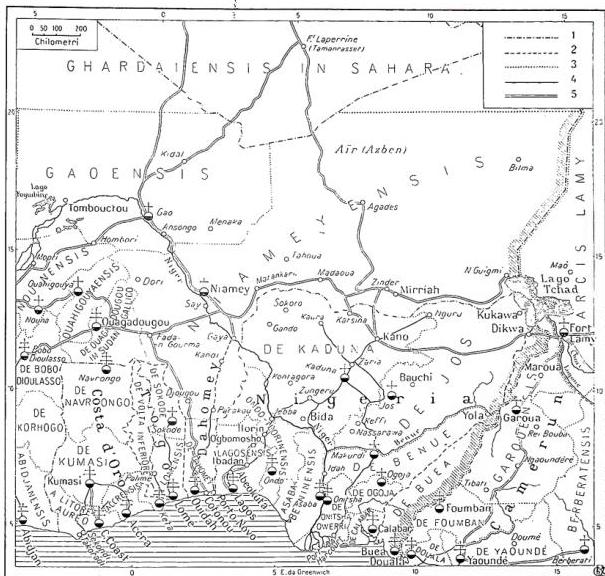
3. FRENCH WEST AFRICA (A.O.F.). — The largest colonial territory of France (4.7 million km², over eight times the metropole); formed between 1855 and 1900. It consists of seven administratively autonomous units, each governed by a governor and dependent on a single governor-general residing in Dakar. It encompasses the two depressions of the Senegal and the Niger and the mountain ranges of Futa Jallon and Atakora, from which one descends to the Gulf of Guinea. The climate transitions gradually from extreme aridity (Sahara) to extreme humidity (equatorial belt); thus, from north to south, parallel strips of desert, steppe, savanna, and virgin forest succeed one another. The population (15.9 million inhabitants), composed of white nomadic races in the north and sedentary Sudanese blacks in the south, is primarily settled in the zones near the coasts (4 inhabitants per km²); the rest, that is, the vast majority of the country, is almost empty. Europeans number over 37,000, three-quarters of whom are French; Catholics exceed 150,000. Communications, difficult and scarce everywhere (40,000 km of tracks, 4,000 km of railways), also due to the limited navigability of the coast, make the exploitation of the varied and considerable natural resources arduous. French West Africa produces and exports primarily peanuts (700,000 tons), palm nuts and oil, timber (okoumé), cocoa, coffee, bananas, and cotton; mineral resources, though not lacking, are still modestly exploited (gold in Guinea).
AFRICA - Western A. 1) State or colonial borders; 2) Mandate borders; 3) Ecclesiastical circumscription borders; 4) Railways; 5) Roads.
Dakar, with over 100,000 inhabitants, has become not only the port of Sudan and Senegal, but also the most important stopover on the route between A. and South America.
Here is the statistical overview:
| Colonies | Area | Inhabitants |
|---|---|---|
| Mauritania | 835,000 km² | 497,000 |
| Senegal | 201,000 | 1,871,000 |
| Ivory Coast | 477,000 | 4,022,000 |
| Guinea | 251,000 | 2,125,000 |
| Dahomey | 112,000 | 1,458,000 |
| Sudan | 1,531,000 | 3,797,000 |
| Niger | 1,294,000 | 2,168,000 |
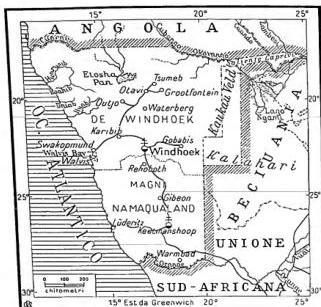
4. SOUTH-WEST A. (SOUTH-WEST A.). - A German colony until 1917; subsequently transferred as a mandate to the Union of South Africa. It is a vast territory (850,000 km²; over 2½ times the size of Italy), bisected by the Tropic of Capricorn, with a rugged and desolate coastline and a steppe-like, almost entirely desert interior. Both are characterized by a typically hot-arid climate.
The population barely exceeds 300,000 inhabitants, of whom approximately 1/10 are Europeans (and of these, 1/3 are German).
Livestock farming predominates in the country (in millions of head: 3.5 sheep; 1.1 goats; 1.3 cattle), which has spurred the development of the refrigerated meat industry and dairy production (butter is exported). Fishing resources are significant (crustaceans and snoek, or southern pike), and mineral resources are notable (copper, silver, zinc, lead, gold, iron, vanadium, tungsten, and especially diamonds [accounting for ½ the value of exports]).
The interior of the country is traversed by a railway that connects it to the nearby Cape Colony; on this line lies Windhoek, the capital (10,000 inhabitants, of whom 5,000 are white). The main port is Walvis Bay.
AFRICA - SOUTHERN A.: Ecclesiastical Circumscriptions.
(Walvis Bay; 2,500 inhabitants; formerly a territory of the Union of South Africa, and since 1922 under the administration of South West A.), which has supplanted the nearby port of Swakopmund.
The so-called Caprivi Strip (10,000 km², 10,000 inhabitants), which provided German South West A. with direct communication with the Zambezi near the famous Victoria Falls, has been almost entirely annexed to the Union of South Africa (Bechuanaland).

II. ETHNOGRAPHY.
1. - Anthropologically, the following are represented in A.: 1) the Pygmy race, which exhibits characteristics of great antiquity: very small stature, mesocephalic, skin color dark red; its current habitat is the equatorial forests; 2) the Khoi-San race, which includes the Khoikhoi (Hottentots) and the San (Bushmen); small stature, dolichocephalic; skin color dark yellowish; typical is the steatopygia in women; its habitat is the western part of southern A.; 3) the Negroid race, which is divided into the groups of Nilotics, Bantuids, and Sudanids; it is of large build; dolichocephalic; has black skin; extends from the easternmost tip of A. to the Equator line, occupying the entire central trunk of the continent, the southern part of western A., and the upper Nile region; 4) the Ethiopian race, corresponding to the linguistic term Semito-Hamitic; it is of large build, reddish-brown in color, and generally of nobler forms; its habitat, with infiltrations below the equatorial line, covers all of eastern A. north of that line, extending to the Mediterranean across all of western A.
2. - Linguistically, mention must also be made of the remnants of a Vetero-Pygmy language, however akin to the Khoi-San language group, Hottentot and Bushman. Following are: the group of Bantu languages, which is the most widespread and also characteristic of current Pygmies; the Nilotic group; the Sudanese group; the Semito-Hamitic group.
### III. ANCIENT CHRISTIAN HISTORY
Throughout the 2nd century, African Christianity has no history until the martyrdom of the Scillitan martyrs, killed for their faith in Carthage in July 180, by order of the proconsul Vigellius Saturninus, the first, according to Tertullian, to draw the sword against Christians. Until then, there had been freedom to organize, and in 197 the African polemicist could speak of the crowds of Christians filling the forum, the senate, the cities, the municipalities, and the countryside. The first bishop mentioned is Agrippinus of Carthage. At the end of the 2nd century, the Christian religion became the object of repressive measures by Roman governors, incited by a hostile popular reaction against Christianity, and a large number of its adherents were imprisoned and subjected to torture. Tertullian encouraged them to endure the struggle (Ad Martyres), while he addressed the pagans to defend the rights of conscience (Apologeticum, Ad Nationes). The victims increased at the beginning of the 3rd century with the edicts of Septimius Severus. The most illustrious are those of Thuburbo, not far from Carthage: Felicitas and her companions, of whom we possess a first-rate document, the acts of their martyrdom attributed by some to Tertullian. After a truce of several years, persecution resumed in 212, partly provoked by the intransigent attitude of some extremist groups within the community, won over by Montanism (v.), which had meanwhile insinuated itself into Africa. Tertullian himself eventually adhered to it, leading him to break his relations with Rome, where Pope Zephyrinus had condemned the Cataphrygian novelties. Meanwhile, other heresies troubled the internal peace of the community: those introduced by innovators such as Hermogenes, Marcion, and Praxeas, against whom Tertullian wielded his pen.
Once calm was restored, the African Church took advantage of the peace lasting until the time of St. Cyprian, elected bishop of Carthage on the eve of the Decian persecution (249), to make new progress. Already the Council of Carthage in 225, convened by Agrippinus, counted 70 bishops from Proconsularis and Numidia; another during the time of Bishop Donatus (236-48) counted 90. The Gospel was preached in the two Mauretanias, not only to the Roman populations but also to the Berber tribes of the Gaetuli and the Mauri. However, the Decian persecution revealed how superficial the faith of many sympathizers who had joined the communities was. Faced with the alternative of renouncing their faith or exposing themselves to the rigors of the law, many Christians preferred martyrdom, others fled, and many apostatized (lapsi). The persecution ended in 251, but the consequences were grave for the principle of unity.
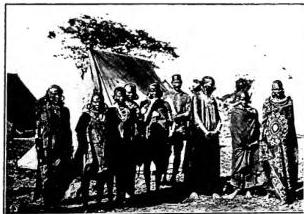
AFRICA - A Maasai woman in hybrid costume in Nairobi (Africa Orientale). Giglioli Collection. Rome, Museo Preistorico Etnografico.
The rupture between Rome and Africa was brought to an end by the death of Pope Stephen and the persecution of Valerian, in which Cyprian (258), several bishops, and a considerable number of Christians ("Massa Candida") fell as martyrs to the faith. The edict of toleration by Gallienus (260) allowed the Church to resume its progress during four decades of relative tranquility, so that by the end of the 3rd century, when the severity of Maximian, aimed at restoring military discipline, claimed some victims among soldiers (Marcellus the Centurion, Fabius the Standard-Bearer, Cassian of Tangier, Maximilian the Conscript, etc.), the number of episcopal foundations had increased by about a hundred. The persecution of Diocletian (303-304) left lasting traces, for while martyrs and apologists bore witness to the faith with blood and word, numerous groups renounced it, including priests and bishops who handed over the sacred books or sacrificed. When the time came to appoint successors to the deceased bishops, the Synod of Cirta (305) revealed the jealousies of the Numidian bishops and the insubordination of the priests, which led to the struggle against Caecilian, bishop of Carthage, initiating the schism of Donatus of Casac Nigrae (v. DONATISMO). During this period, the centrifugal tendency of certain community groups intensified. The rigorous measures of Emperor Constans, who as early as 347 imposed unity by force, did not yield the desired results, for the policy of tolerance of Julian the Apostate (362) allowed Donatism to revive and consolidate under the Parmenian (v.).
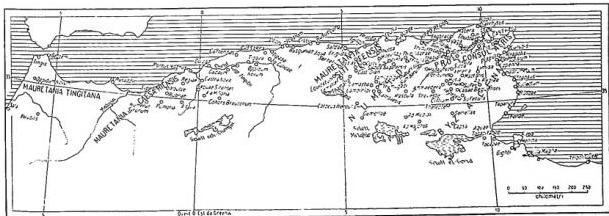
By the end of the 4th century, Catholic Africa was divided into 6 ecclesiastical provinces: Numidia, Mauretania Caesariensis, Mauretania Sitifensis, Proconsularis (Zeugitania), Byzacena, and Tripolitania, over which the primate of Carthage always asserted his supremacy.
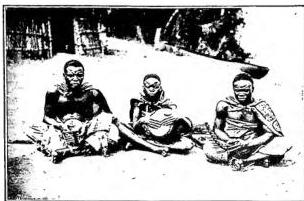
AFRICA - Masai Family in Nairobi (East Africa). Giglioli Collection. Rome, Museum of Prehistoric Ethnography.
The edifice built by Augustine and Aurelius over thirty years was almost destroyed by the Vandals. Led by Genseric, in 429 they landed in A., coming from Spain, spreading terror everywhere. After a fourteen-month siege, Hippo fell; in 435, Carthage suffered the same fate. In the following years, Tripolitania and Mauretania followed. When Genseric died in 477, the Vandals were masters of A. from Ceuta to Tripoli and could enjoy their conquest for nearly a century, until the day Belisarius, sent by Justinian (523), put an end to it in two battles, reducing the Vandals to slavery. During this time, the Church was reduced to a miserable state, and Victor of Vita painted a grim picture of the terrible persecution lasting nearly a century in his Historia persecutionis Africanae provinciae. The interrupted tradition was nevertheless restored under the guidance of the primate of Carthage, Reparatus; but the raids of Berber tribes, which followed Belisarius' victories, did not allow any unified action by the episcopate. The situation was worsened by Byzantium's attempts to subjugate it to its plans, for A., sincerely orthodox, always offered tenacious resistance to Justinian's dogmatic innovations. This was clearly seen in the affair of the «Three Chapters» (v.) (543-55), which marked the beginning of oppressive measures by the Byzantine authority against the recal-
(Gab. Fot. Naz.)
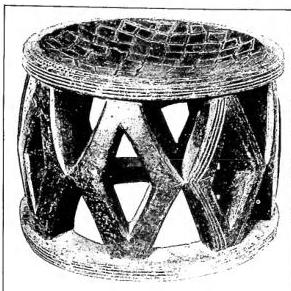
AFRICA - Wooden stool from Central A.
The situation changed with the advent of Justin II, and this state of affairs remained unchanged under his successors. The creation of the exarchate under Maurice (582-602) halted the decline but increased the interference of civil power in ecclesiastical affairs, and the bishops, now devoid of strength, had no other defender than the Pope. This was the time of the providential action of St. Gregory the Great. The Byzantine influence in Africa persisted into the 7th century, although the process of dissolution of those provinces from the Byzantine Empire was underway, accelerated in 638 by the "Ecthesis" of Heraclius, which scandalized the Africans, attached as they were to orthodoxy. The last manifestation of faith occurred in the provincial synods of Africa in 646, in which the episcopate, also spurred by the preaching of St. Maximus (v. MASSIMO), condemned monothelitism (v. MONOTELISMO), introduced by groups of Orientals forced by Muslim invasions to take refuge in Africa.
From this moment, events precipitated the country into a series of disasters: in 643, the Arabs took advantage of the revolt of the exarch Gregory to penetrate Byzacena. Assaults were renewed in the following decades, leading to the fall of Carthage (697) and all of Africa (710) into the hands of the infidels. During the last half-century, destructions and massacres initiated the ruin of that once-flourishing Church, of which only scattered groups remained in the following centuries, almost as a testimony to a faith that never wished to die.
IV. THE GENERAL COUNCILS OF A.
The first two African councils of which we have record are those of 251 and 252, held by St. Cyprian in Carthage to regulate the question of the schism of Felicissimus and that of the lapsi. Bishops from many dioceses, even quite distant from Carthage, participated in them.
During the lifetime of St. Cyprian, Carthage was the seat of three general councils (autumn of 256, spring of 257, September of 257) in which the necessity of baptizing heretics was discussed—a thesis openly upheld by the bishop of Carthage but which met with the resolute opposition of Pope Stephen, who threatened excommunication. Given the intransigence of St. Cyprian, the consequences for communion between the two Churches would have been grave. But the death of the Pontiff prevented any sentence, and unity was not broken.
Council of 349. - A general synod convened in Carthage, under the presidency of the African primate Gratus, in 349 or the year before, to celebrate the end of the Donatist schism and the restoration of religious unity, but above all to confirm the decisions of the various provincial synods that had preceded it with the aim of restoring ecclesiastical discipline, which had greatly declined during the preceding disturbances. Hence
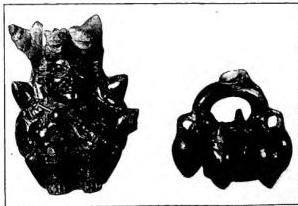
AFRICA - Vases of Central A.
(Gab. Fol. Nac.)
Council of 386. — It seems to be connected with the decisions adopted by the Roman Synod of the same year, in which the question of the Donatist schism was also discussed. The nine canons approved by the synod were communicated by Pope Siricius to the African Church, which adopted them, including canon 8, which imposed that schismatic clerics be reconciled through the imposition of hands.
Council of 646. — Its purpose was the condemnation of Monothelitism. Urged by St. Maximus the Confessor, champion of Dyothelitism, the African bishops of Numidia, Byzacena, and Mauretania gathered at the beginning of 646 in three provincial synods. Shortly afterward, Proconsularis, where the see of Carthage was vacant, also associated itself with the decisions taken by the African episcopate. Of these synods, three synodal letters remain: the first is a collective document from the three ecclesiastical provinces addressed to Pope Theodore, asking him to intervene in Constantinople and persuade Patriarch Paul to abandon the Monothelite error. The second is a letter from the bishops of Byzacena to Emperor Constans II; the third is the synodal letter to Patriarch Paul; lastly, a letter from the newly appointed metropolitan of Carthage, Victor, to Pope Theodore, requesting that the aforementioned synodal letter be delivered to Patriarch Paul.
V. MONUMENTS
The monumental vestiges of Christianity form two imposing groups: places of worship and funerary monuments, both rich in inscriptions. However, none of the places of worship date back to before the Constantinian peace.
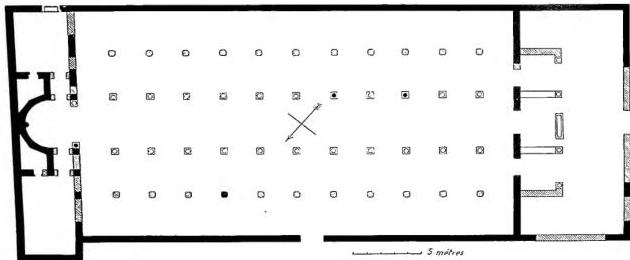
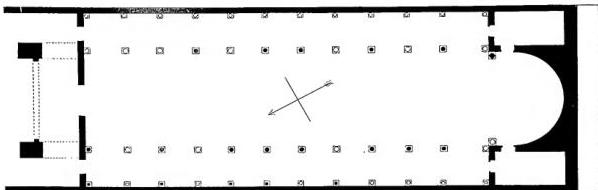
Nothing remains, for example, in Cirta of the domum in qua Christiani conveniebant, containing a triclinium and a library, as revealed by the trial record of the year 303 in the Gesta apud Zenophilum (CSEL, XXVI, pp. 185-97). Nevertheless, African monuments have the merit of having reached us as they were at the time of the Arab conquest, that is, at the end of the 7th century A.D. The places of worship were largely of the usual type: «oblongam habeat quadraturam, lateribus longioribus, brevioribusque frontibus, sicut pleraeque basilicae constituuntur» (Augustine, Quaest. in Heptat., II, 177, 5). However, they presented great variety in their details.
Churches with a single nave are rare (Bir-Ben-Zir in Algeria); most have three naves, but not a few have five (Bir-Oum-Ali, Orléansville, Carthage, Sbiba, Thelepte); some have seven (St. Perpetua in Carthage, one in Tipasa later enlarged) or even nine, such as that of Damous-el-Karita in Carthage. In general, their size and development were facilitated by the low cost of land and labor, or by the proximity of raw materials. Construction is rarely in brick, more often in small-format stones, sometimes in large blocks of local stone.
In some cases, pre-existing structures were converted into places of worship, such as in Maktar, a Punic temple (basilica of Ksar-el-Amar) and the mausoleum of Q. Julius Piso (Bull. arch. du Comité, February 1945, p. xx), or three civil basilicas in Madauros, Tipasa, and Dougga. Usually, the Christian basilicas of Africa do not have a true atrium but a simple vestibule; a true atrium with a portico is found in Tebessa, Ksar-el-Zit, and one of the basilicas of Thelepte. The rear wall
may also end in a quadrangular shape, sometimes semicircular with a diameter as wide as the entire space, even in three-nave churches; one group features an apse with two lateral rooms (prothesis and diaconicon) forming separate parts; in general, the apse is deeper than in Roman churches. The naves were not always divided by columns but sometimes by pillars, or partly by columns and partly by pillars. Access to the presbytery was provided by a single wide staircase, as in Kherbet Guidra, Lambaesis, Sidi Mabrouk, or by two small staircases on the sides, as in Benian, Matifou, Morsott, and Tipasa.
Traces of screens remain on the columns and pillars, and an inscription from Mascula recalls the cancellus virginum. Screens also surrounded the memoriae of the venerated martyrs: «Habent honorabilem locum martyres sancti» (Augustine, Serm. 273, 7). The altar was placed on the tombs of the martyrs or on their relics in the elevated presbytery, usually in the middle of the choir, immediately before the apse or in the apse itself («mensa Christi est illa in medio constituta»: Augustine, Serm. 31: PL 38, 735). The altar was often made of wood (Optatus, De schism. Donatist., II, 21; Augustine, Contra Crescon., III, 47; Conference of 411: PL 11, 1316), and traces of it have been found in the basilica of Morsott and in the main basilica of Timgad.
Crypts or other cavities beneath the altars contained relics, mentioned in inscriptions that often also provide important details about the martyrs themselves. For example, one from Rouffach, near Constantine: «Depositio cruoris sanctorum martyrum qui sunt passi sub preside Floro in civitate Milevitana in diebus turificationis» (CIL, VIII, 1935). Florus was governor of Numidia in 303. An inscription from Ammedera recalls a group of martyrs «qui persecutionem Diocletiani et Maximiani divinis legibus passi sunt» (Bull. arch. du Comité, February 1934, p. xi). Reliquaries are of every kind; among about a hundred found, there are some of silver (G. B. De Rossi, Capsella argentea Africana, Rome 1889), alabaster, stone, clay, and glass. Sometimes they also contain relics of non-African martyrs, especially Roman ones. In Numidia, the formulas Reliquiae and Mensa martyrum are frequent; the latter then spread also to Mauretania Sitifensis and the western part of Proconsularis.
Above the altar stood the ciborium supported by four columns (Sbeitla, Dermech, Siagu). Beneath the apse
there is sometimes a crypt (Gemila, Dougga, Benian, Maktar). There is no evidence of windows in the apses; however, the apses of Announa and St. Salsa in Tipasa show that there were none. In Sicca Veneria, the basilica of Dar-el-Kous, dedicated to St. Peter, features five semicircular niches with respective columns inside the apse.
Upper galleries in the naves have been found only in the inner church within the citadel of Ammedera. At Oum-el-Abnab, there is a basilica with two concentric apses. The walls of the naves were sometimes covered with paintings: indeed, St. Augustine recalls the representation of the martyrdom of St. Stephen (Serm. 316: PL 38, 3434) and of the sacrifice of Abraham, which he says was «tot locis pictum» (Contra Faustum, 22, 73: PL 42, 446), as well as «Petrus et Paulus cum Christo in pictis parietibus» (De consensu Evangelist., I, 10, 16: PL 34, 1049).
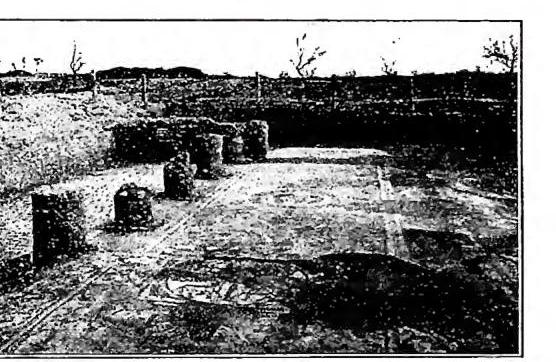
The floors of the basilicas were in some places made of simple packed earth or terracotta and paved with stones; elsewhere, they extended across the entire surface like a rich oriental fabric, entirely in mosaic and with the most vibrant colors obtained using local stones, limestone, and even brick fragments, yet achieving a remarkable effect and freshness, featuring medallions, palm trees, vine tendrils, acanthus clusters, craters filled with flowers and fruit, fish, birds, peacocks, waterfowl, gazelles, deer, crosses, and lozenges. Among the most notable are the floors of the basilicas of Gemila, Orléansville, El Mouassat, Tigzirt, Timgad, Tipasa, Rusguniae, Sidi-Abich, Fourna, and Taparura. A characteristic mural decoration of some Tunisian basilicas was provided by a series of terracotta squares, approximately 0.27 meters per side, with biblical scenes impressed in relief.
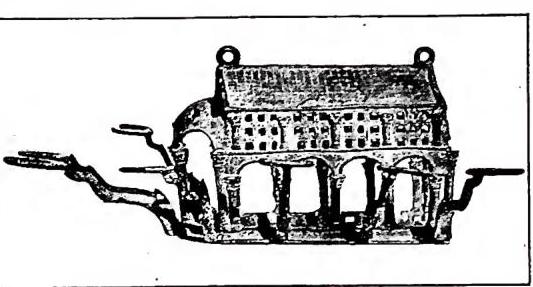
Two representations deserve special mention: that of a basilica (ecclesia mater) in a mosaic from Tabarca (2.20 × 1 meters), and another of the bronze lamp found near Orléansville in 1850, later acquired by the Basilewski collection.
Notable is the series of baptisteries discovered near the churches, with basins of the most varied shapes, accessed by steps, usually three. There are some in the form of a Greek cross, hexagonal, octagonal, rosette-shaped, and others of square form. Of entirely unique shape—that of a ship—is the one near a cer-
in pace, memoria, hic iacet; most are inscriptions from the 5th and 6th centuries. In Numidia, epitaphs with memoria, hic requiescit, and reditio are frequent; memoria and mensa in Mauretania Sitifensis. In Mauretania Caesariensis (corresponding roughly to the present-day departments of Algiers and Oran), Christianity spread first along the coasts, then along the military line not far inland, and finally along the more southern military line established by Septimius Severus.
The eastern part of Mauretania Caesariensis has revealed the oldest Christian inscriptions; these are small cippi made of local limestone. One from Tipasa bears the date 238 (CIL, VIII, 20856). One from Tigzirt is from 299 (Bull. arch. du Comité, 1896, p. 217). The oldest inscriptions discovered in the western zone are those from Altava, dating from 302 to 320.
(from Atti del II Congresso internazionale di Archeologia cristiana)
AFRICA - Thelepte. Basilica located to the north.
Areae was the term used for Christian cemeteries in Africa from the time of Tertullian (Ad Scapulam, 3: PL 1, 701). The place where St. Cyprian was buried was called an area, while that of Cherchell was an area ad sepulchra, containing a cella offered Ecclesiae sanctae by the senator Marcus Antonius Julius Severianus (CIL, VIII, 9585). However, the term coemeterium is also found (Tertullian, De anima, 51: PL 2, 738), as in coemeteria memoriae gentis Lepidiorum (G. B. De Rossi, Roma sott., I, Rome 1864, p. 85), and accubitorium in an inscription recalling how the presbyter Victor «hunc locum cunctis fratribus fecit» (CIL, VIII, 9586).
In these cemeteries, sarcophagi of marble, local stone, and terracotta were used. Some sculpted examples come from Cherchell, Lambaesis, Tipasa, Dellys, Carthage, Philippeville, and Tebessa; other tombs are made of masonry, others of tiles arranged in a gabled roof shape, and still others consist of simple amphorae. Many graves are decorated with mosaics containing inscriptions, portraits of the deceased, biblical scenes, monograms of Christ and symbols, flowers, birds, etc. The most notable examples are found in Tabarka, Uppena, and Thibari; in Hadrumetum, they are also present in underground cemeteries.
Christian funerary epigraphy is impressive in quantity, if not in the antiquity of the inscriptions. In Proconsular Africa, particularly in Carthage, the formulas used are fidelis, fidelis in pace, praecessit (CIL, VIII, 9862, 9885, 21734, 9892, 9855, 9890). Then comes the famous inscription of Renault, from the year 329 (CIL, VIII, 21517), which commemorates a group of four local martyrs, two of whom appear on the same day in the Martyrologium Hieronymianum.
At the Council of Carthage in 411, many bishops from this region were present, both Catholic and Donatist. The sister of one of them was Robba, «caede traditorum vexata» on March 25, 434, in Ala Miliaria (Benian). On her tomb, the Donatists erected a basilica with a crypt.
At the end of the 5th century, in 495, a bishop was buried in Mouzaiaville who, after being exiled multiple times, was killed «in bello Maurorum» (CIL, VIII, 9286), rebelling against Vandal rule. In 508, a certain Masuna styled himself «rex gentium Maurorum et Romanorum» (CIL, VIII, 9835).
Even after the Arab conquest in 683, Christianity in Africa left its monumental traces; small Christian communities retreated inland in both Mauretania Caesariensis and Byzacena. There is record of a bishop in Gafsa as late as the 9th century, and according to Edrisi, a Latin dialect persisted into the 12th century. In Kairouan, in the heart of Tunisia, an epitaph of a lector who died in 1030 was found, possibly contemporary with a previously known fragment attributed to the Byzantine period (CIL, VIII, 23128; Bull. arch. du Comité, 1928, p. 370 ff.).
For Carthage, Cherchell, Gemila, Lambaesis, Madauros, Orleansville, Sbeitla, Sicca Veneria, Tebessa, Tigzirt, Timgad vedi the individual entries.
R. Cagnat - P. Gauckler, Monuments historiques de la Tunisie, Paris 1898; S. Gsell, Monuments antiques de l'Algérie, 2 vols., Paris 1901; J. Mesnage, L'A. Chrétienne, Paris 1912; P. Gauckler, Basiliques chrétiennes de la Tunisie, Paris 1913; S. Gsell, Inscriptions latines de l'Algérie, I, Paris 1922; J. Sauer, Der Kirchenbau Nordafrikas in den Tagen des hl. Augustinus, in M. Grabmann-J. Mausbach, Augustinus Festschrift, Cologne 1930, pp. 243-300; Atti del III e IV Congresso Int. di Arch. crist., Vatican City 1934, pp. 387-427; 1940, pp. 145-244; A. Berthier, Les vestiges du Christianisme antique dans la Numidie, Algiers 1943; A. Merlin, Inscriptions latines de la Tunisie, Paris 1944.
## VI. MEDIEVAL AND MODERN CHRISTIAN HISTORY.
5 metres
(from Atti del II Congresso internazionale di Archeologia cristiana)
AFRICA - Ammaedera. Basilica located at the western extremity.
of Islam (7th century). The Christian Churches of Egypt and Ethiopia, fallen into Monophysite heresy and imprisoned by the Arab-Muslim world, survived in some manner, dragging on until today, but in a state of moral servitude and without any ferment of vitality. Africa was cut off from Christian Europe. In the Middle Ages, there are no traces of Christian life in Africa except along the northern coasts, first with the chaplaincies established there for the spiritual assistance of Italian colonies founded by the maritime republics (Genoa, Pisa, Amalfi, etc.); then with the first attempts at true apostolate directed toward the indigenous peoples, especially in Tunis and Morocco, by the Order of Franciscans, whose founder himself traveled to those missions no fewer than three times. The Dominicans, like the Franciscans, encouraged by the Pontiffs, also took part in these early missions to the Saracens; martyrdom did not deter either order.
It is at the time of the geographical discoveries by Portugal that one can say African missions truly began, though without extending much beyond the coastal regions, no more and no less than colonization; unfortunately, once the route to the Indies was found, the Portuguese turned their covetous commercial ambitions toward it, the primary reason for the failure of that apostolate, which was too superficial and not sufficiently supported by Lisbon. In any case, the missionaries reached all the points touched by Portuguese traders: Guinea and
The mission of Ethiopia, the only mission in a non-pagan but Christian-Monophysite country, had two distinct periods: the first (1557-77), directed by Bishop Oviedo, and concluded with the confinement of the missionaries (Jesuits) to their residence; the other, more successful, directed from 1604 to 1622, the year of his death, by Father Páez, a figure of great worth, who led the mission to triumph. In 1626, King Susenyos made a profession of Catholic faith with much of the nobility and the people. In 1629, Catholics were estimated at 130,000. But King Fasiladas, who succeeded Susenyos in 1632,
AFRICA - Minor Africa: Ecclesiastical Circumscriptions.
And already before, as head of the opposition, incited by the monks and also irritated by the not always prudent tactics of Mendez, successor to Fr. Paez, he exiled the missionaries; everything returned to what it had been before, or nearly so, and for two long centuries the mission could not be resumed.
The general decline of missions, which occurred from around the mid-17th century to the end of the following century, under the influence of various factors (v. MISSIONI CATTOLICHE), also manifested itself in the African missions. Local causes were added to these. Under Gregory XIII, the Jesuits (1382-95) and later the French Capuchins under Urban VIII had attempted the conversion of the Copts of Egypt—1630, in Cairo—followed at the end of that century by others, who reached the mouths of the Nile; while the Friars Minor, from the Custody of the Holy Land, had sent chaplains to the ports of Alexandria and Cairo, from where they also took care of those condemned to the galleys of Suez and Alexandria. The Jesuits, too—end of the 17th century—were present in Cairo. Despite sporadic results (in 1713, the profession of Catholic faith by the Greek patriarch Samuel Capassull), to the extent that Benedict XIV established a bishopric in Jerusalem for the converts, the Copts generally remained hostile to Westerners. From Egypt, encouraged by the Congregation of Propaganda, the Capuchins and the Friars Minor attempted to resume the mission in Ethiopia; but this endeavor failed; of the former, Fathers Agatangelo and Cassiano were hanged in Gondar as soon as they set foot in the forbidden empire (1638), and the Friars Minor, to whom the mission, erected as an apostolic prefecture, was entrusted, did not achieve more encouraging results in their renewed attempts to enter and reside in the country; the difficulty of access, first, then the instability of the kings (of whom only a few seemed favorable) and especially the opposition of the monks rendered those heroic attempts at resumption fruitless until the end of the 18th century. During this same period in Algeria and Morocco, priests and religious (in addition to the Franciscans, also the Trinitarians and Mercedarians) were not lacking, but their activity remained limited exclusively to the care of European merchants and the redemption of slaves, an work to which, in Tunisia, the new congregation of the Lazarists of St. Vincent de Paul also dedicated itself.
In Morocco, various expeditions were attempted with a particularly missionary intent (especially by the Capuchins), but all failed in their purpose. Propaganda attempted to revive the missions of Guinea, Congo, and Angola, which were languishing in the mid-17th century, relying especially on the zeal of the Capuchins; but due to the hostility of Portugal, the insalubrity of the climate, and the persecution by the Dutch, by the end of the 18th century all those missions presented a decline that seemed incurable. Less unfortunate was the fate of the mission in Madagascar, first with the Carmelites, then with the Lazarists, but eventually this too faded due to the discontinuity of missionaries and internal strife; the French Revolution ultimately severed every possibility of overseas apostolate. Thus, by the end of the 18th century, the African Church, despite the attempts made, was in progressive decline and very close to extinction; in addition to the aforementioned environmental and methodological causes, Islam, which Portugal had deluded itself into having outflanked, reappeared and once again manifested itself with increasing arrogance.
The Church in Africa begins its true rebirth only in the first half of the 19th century. Several factors contributed to this revival: the rediscovery (it is fitting to call it so) of Africa, through the initiative of explorers; its colonial division among various European nations; the general awakening of the missionary spirit (v. MISSIONOLOGIA, storia: sec. XIX), which for Africa received a particular impulse from the anti-slavery movement; the flourishing of new missionary institutes, specialized for Africa (Society of the Holy Spirit, Society of the White Fathers, Lyon African Missions in France, Verona and Consolata African Missions in Italy). Science, politics, and faith seemed to assault Africa simultaneously, and the Berlin Conference of 1885 in a way sanctioned this taking of possession, officially opening the African continent to missions, whether Catholic or Protestant. In this way, the evangelization of Africa truly began, extending to all regions and advancing into the most inland areas, among all populations, studying them, elevating them, evangelizing them.
Northern Africa, colonized by France (Algiers was the first gateway to the interior), Spain, and Italy, was thus opened to European immigration, which led to the disappearance of the slave trade and secured citizenship rights for Christianity, which, though it did not eliminate the numerical superiority of Islam, weakened its arrogance. The harshness of the climate, it is true, barred the way inland, but the apostolate did not yield and finally invaded the western-equatorial part (1841), creating the mission of the Two Guineas, which extended from Senegal to the Cape. There worked, in successive waves, distributed gradually into new smaller territorial subdivisions—Sierra Leone, Dahomey, Nigeria, Gold Coast, Ivory Coast, Gabon, Ubangi, etc.—the Missionaries of the Holy Spirit and those of Lyon, who gave rise to the first indigenous Christian communities. Togo and Cameroon, passed to Germany, were evangelized by the Pallottines and the Fathers of the Divine Word, and Congo, having become Belgian, by the missionaries of the metropolis, belonging to various religious societies and congregations, favored by wise colonial legislation.
A nearly identical process unfolded in East-Central Africa, with its starting point in Zanzibar (1868), the slave emporium, which only a few years earlier had an annual movement of 65,000 slaves. Apostles of this difficult region are the Fathers of the Holy Spirit, who created successive centers (Bagamoyo, Kilimanjaro, etc.), among which Kenya, which would later become almost entirely the domain of the Consolata Missionaries. The White Fathers of Lavigerie occupied instead—and still occupy—the region of the Great Lakes: Nyanza, Tanganyika, Nyassa, from which the first missions took their names (1878); a laborious apostolate, also tragic (1886: martyrs of Uganda, v.), but exceedingly fruitful, especially in Uganda itself, and, after the war of 1914-1918, in the farthest mandates of Urundi and Rwanda, which today, along with Cameroon and Madagascar, constitute the most prosperous missions in the world.
In Northeast Africa, with the 19th century, missions resumed the threads of a nearly buried past, as in Egypt and Ethiopia, and attempted the first difficult steps in the barren Anglo-Egyptian Sudan. In Egypt, the apostolate increasingly took on a European character, in accordance with the ethnic makeup of the country, while the indigenous Muslims remained almost inaccessible and only somewhat approachable were the Copts. Ethiopia, following the Italian occupation (1936) and the reorganization of its missionary network, seemed poised for a more intense and coordinated evangelization; but then everything returned to its previous state, and indeed worsened. Sudan—the ancient mission of Central Africa—field of labor for Comboni, still barren in its northern Muslim part, has however given rise to new and more recent offshoots in the south, where the Fathers of Verona gather modest fruits.
The missions of Southern Africa, however, are more backward, both due to the priority of pastoral care demanded by the substantial European immigrant population, and to the preponderance of Protestantism, which had already established dominance in the field, as well as to the not infrequent legislative hostility against the Catholic Church and the acuteness of the social question, given the strong racial opposition. The ostracism against Catholicism only ended in 1868. Nevertheless, through the persistent work of missionaries, particularly the Oblates of Mary and the Fathers of Mariannhill, good results were achieved, and, what matters greatly, Catholicism succeeded in earning esteem and respect.
VII. CURRENT STATE OF MISSIONS.
Currently, the statistics of the African mission report 10 million Catholics, of whom over 7.5 million represent the strictly missionary contribution of this last century of evangelization among the true children of Africa; the remainder is accounted for by regions with ordinary hierarchy and not dependent on the Congregation of Propaganda (Algiers and its suffragans, Carthage and the eastern territorial units). More precisely, in 1939—the last general statistics available—the missions of Propaganda had 7,608,580 Catholics, a total that has certainly increased in recent years; catechumens, still in '39, numbered 2,291,606; missionaries 5,330; lay brothers
(propr. E. Josi)
AFRICA - Mosaic floor of the basilica of Mahares.
(from Gauckler, Incubare des mos.)
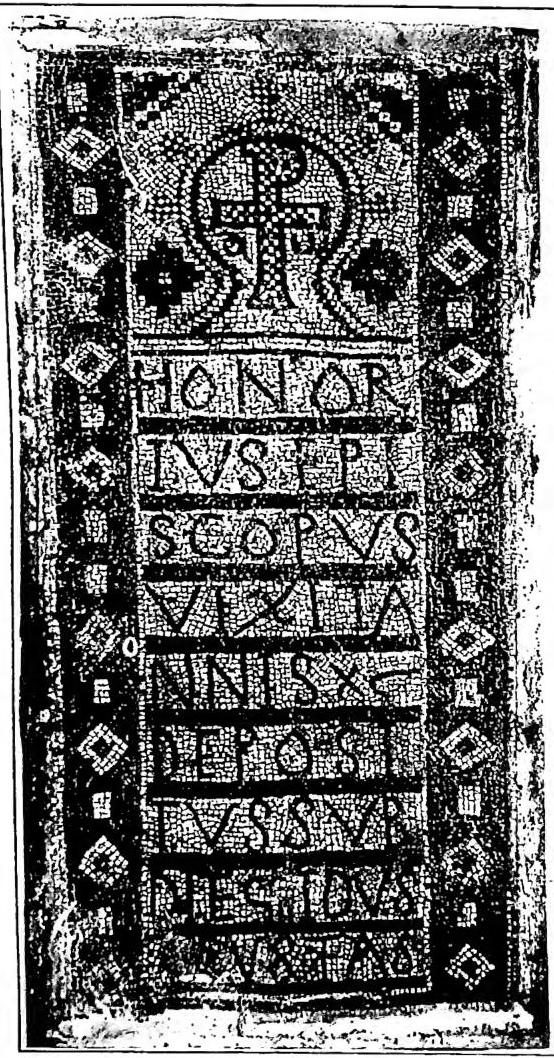
AFRICA - Uppenna. Mosaic tomb of Bishop Honorius.
No general characteristic applies to the entire territory of Africa, as it is not a homogeneous continent. In the absence of a unifying index under which to present the profile of the African mission, it can be noted—so as to understand Africa’s "reaction" to Christian apostolate—that, from an ethno-religious perspective, it is divided from north to south into three zones: the first, extending to the 10th or even the 5th parallel north, consists predominantly of Muslim populations; the second, in the center of the continent, from the 6th to the 10th or even 15th parallel south, comprises indigenous races, generally Bantu, with pagan religions; the third encompasses southern Africa, where ancient European immigration has established, in a certain sense, its racial and religious (Protestant) predominance. From this, it is clear what the greatest difficulties of this apostolate are, namely Islam and Protestantism; another difficulty, of a different nature, is constituted by the policies of colonizing nations, both in the educational sector, due to the endless obstacles opposed to teaching in missions (England and France), and, in many regions, due to exclusivist protectionism (spheres of influence favoring Islam or Protestantism) in British colonies.
All this helps to assess the progress made in recent decades and to explain several aspects of the various provisions implemented by the Holy See for the consolidation of those missions. Among these provisions and these more recent advances, the most significant are: the improved organizational structure of the missions themselves; the creation of the first indigenous ecclesiastical circumscriptions and the enhancement of apostolic efficacy through the first valorization of indigenous artistic elements. Missions are now grouped into three large ecclesiastical units (delegations), each directing a group of missions with a certain homogeneity: these are the delegation of southern Africa (1922), of British eastern and western Africa (1930), and of the Belgian Congo and Ruanda-Urundi (1930), dependent on the Sacred Congregation of Propaganda Fide. These delegations represent a coordinating, directive, and propulsive element, and, although they do not have a diplomatic character, they nonetheless serve usefully, in certain circumstances, as an intermediary between the missions and colonial governments for common interests, such as that of education. The appointment of the first two indigenous apostolic vicars and the first indigenous apostolic prefect (for the apostolic vicariates of Masaka and Miarinarivo and the apostolic prefecture of Ziguinchor), which took place in 1939, was greeted with satisfaction by African Catholics; in Eritrea, in 1930, an indigenous bishop had already been appointed for Catholics of the Coptic Eastern rite. A felicitous agreement between the government and the Holy See reorganized the missions in the African colonies of Portugal. On September 4, 1940, the archdiocese of Lorenzo Marques was erected with the suffragan see of Nampula, and that of Loanda with the suffragan sees of Nova Lisboa and Silva Porto. By Pope Pius XII, the archbishop of Lorenzo Marques was created a cardinal in the consistory of February 18, 1946. The apostolic delegation of Egypt was elevated to an internunciature in 1947.
For individual missions V. the relative entries.
Below is a table of the missions currently (May 1, 1948) existing, indicating for each the ecclesiastical rank (apostolic vicariate [V. A.], apostolic prefecture [P. A.], or mission [M.]), abbey nullius [A. N.], and the location.
 | ABIDJAN (v. A) | Ivory Coast |
|---|---|---|
| ACCRA (v. A) | Gold Coast | |
| ADDIS ABEBA (v. A) | Ethiopia | |
| ALIWAL (v. A) | South Africa | |
| AMBANJA (P. A.) | Madagascar | |
| ANTSIRABE (v. A) | Madagascar | |
| ASABA-BENIN (v. A) | Nigeria | |
| BAGAMOYO (v. A) | Tanganyika | |
| BAHR EL GEBEL (P. A.) | Anglo-Egyptian Sudan | |
| BAHR EL GHAZAL (v. A) | Anglo-Egyptian Sudan | |
| BAMAKO (v. A) | French Sudan | |
| BANGUEOLO (v. A) | Rhodesia | |
| BANGUI (v. A) | French Equatorial Africa | |
| BASANKUSU (v. A) | Belgian Congo | |
| BASUTOLAND (v. A) | South Africa | |
| BAUDOINVILLE (v. A) | Belgian Congo | |
| BENGASI (v. A) | Libya | |
| BENI (v. A) | Belgian Congo | |
| BÉNUE (P. A.) | Nigeria | |
| BERBÉRATI (P. A.) | French Equatorial Africa | |
| BETHLEHEM (v. A) | South Africa | |
| BIKORO (P. A.) | Belgian Congo | |
| BOBO-DIOULASSO (v. A) | Ivory Coast | |
| BOMA (v. A) | Belgian Congo | |
| BONDO (v. A) | Belgian Congo | |
| BRAZZAVILLE (v. A) | French Equatorial Africa | |
| BUEA (v. A) | Cameroon | |
| BUKORA (v. A) | Tanganyika | |
| BULAWAYO (v. A) | Rhodesia | |
| BUTA (v. A) | Belgian Congo | |
| CALABAR (v. A) | Nigeria | |
| CANAL OF SUEZ (v. A) | Egypt | |
| CAPETOWN (v. A) | South Africa | |
| PORTUGUESE CONGO (P. A.) | Angola | |
| COQUILHATVILLE (v. A) | Belgian Congo | |
| GOLD COAST (v. A) | Gold Coast | |
| DAHOMEY (v. A) | French West Africa | |
| DAKAR (v. A) | Senegal | |
| DAR-ES-SALAAM (v. A) | Tanganyika | |
| NILE DELTA (v. A) | Egypt | |
| DERNA (v. A) | Libya | |
| DESSIÉ (P. A.) | Ethiopia | |
| DIEGO SUAREZ (v. A) | Madagascar | |
| DODOMA (P. A.) | Tanganyika | |
| DOUALA (v. A) | Cameroon | |
| EGYPT (v. A) | Egypt | |
| ENDEBER (P. A.) | Ethiopia | |
| ERITREA (v. A) | Eritrea | |
| ESHOWE (v. A) | South Africa | |
| FERNANDO POO (v. A) | Spanish Guinea | |
| FIANARANTSOA (v. A) | Madagascar | |
| FORT DAUPHIN (v. A) | Madagascar | |
| FORT JAMESON (P. A.) | Rhodesia | |
| FORT LAMY (P. A.) | French Equatorial Africa | |
| FORT VICTORIA (P. A.) | Rhodesia | |
| FOUMBAN (v. A) | Cameroon | |
| GAMBIA (M.) | Gambia | |
| GAO (P. A.) | French Sudan | |
| GAROUA (P. A.) | French Cameroon | |
| GHARDAIA IN THE SAHARA (P. A.) | Algeria | |
| DJIBOUTI (P. A.) | French Somaliland | |
| GIMMA (v. A) | Ethiopia | |
| GONDAR (P. A.) | Ethiopia | |
| GREAT NAMAQUALAND (v. A) | South Africa | |
| FRENCH GUINEA (v. A) | French West Africa | |
| PORTUGUESE GUINEA (M.) | Portuguese Guinea | |
| HARAR (v. A) | Ethiopia | |
| HOSANNA (P. A.) | Ethiopia | |
| IPAMU (P. A.) | Belgian Congo |
(from Dancel - Basilewsky, Collection Basilewsky)
AFRICA - Basilica-shaped lamp found at Orléansville.
| IRINGA (v. A) | Tanganyika |
|---|---|
| JOHANNESBURG (v. A) | South Africa |
| JOS (P. A.) | Nigeria |
| KADUNA (P. A.) | Nigeria |
| KAREMA (v. A) | Tanganyika |
| KASSAI SUP. (v. A) | Belgian Congo |
| KATANGA (v. A) | Belgian Congo |
| KATANGA SETT. (v. A) | Belgian Congo |
| KAYES (P. A.) | French Sudan |
| KEIMOES (v. A) | South Africa |
| KHARTUM (v. A) | Anglo-Egyptian Sudan |
| KIGOMA (v. A) | Tanganyika |
| KILIMANJARO (v. A) | Tanganyika |
| KIMBERLEY (v. A) | South Africa |
| KISANTU (v. A) | Belgian Congo |
| KISUMU (v. A) | Kenya |
| KIVU (v. A) | Belgian Congo |
| KOANGO or KWANGO (v. A) | Belgian Congo |
| KODOK (P. A.) | Anglo-Egyptian Sudan |
| KOKSTAD (v. A) | South Africa |
| KORHOCO (P. A.) | Ivory Coast |
| KROONSTAD (v. A) | South Africa |
| KUMASI (v. A) | Gold Coast |
| LAGO ALBERTO (v. A) | Belgian Congo |
| LAGOS (v. A) | Nigeria |
| LA RÉUNION or St.-DENIS (D.) | Réunion Island |
| LÉOPOLDVILLE (v. A) | Belgian Congo |
| LIBERIA (v. A) | Liberia |
| LIBREVILLE (v. A) | French Equatorial Africa |
| LISALA (v. A) | Belgian Congo |
| LOANGO (v. A) | French Equatorial Africa |
| LOLO (P. A.) | Belgian Congo |
| LOMÉ (v. A) | French Togo |
| LULUA and KATANGA C. (v. A) | Belgian Congo |
| LUSAKA (P. A.) | Rhodesia |
| LWANGWA (v. A) | Rhodesia |
| LYDENBURG (P. A.) | South Africa |
| MAJUNGA (v. A) | Madagascar |
| MARIANNHILL (v. A) | South Africa |
| MOROCCO (v. A) | Spanish Morocco |
| MASAKA (v. A) | Uganda |
| MATADI (v. A) | Belgian Congo |
| MBULU (P. A.) | Tanganyika |
| MERU (P. A.) | Kenya |
| MIARINARIVO (v. A) | Madagascar |
| MISURATA (P. A.) | Libya |
| MOGADISCIO (v. A) | Italian Somalia |
| MORONDAVA (P. A.) | Madagascar |
| MUSOMA MASWA (v. A) | Tanganyika |
| MWANZA (v. A) | Tanganyika |
| NATAL (v. A) | South Africa |
| NAVRONGO (v. A) | Gold Coast |
| NDANDA (A. N.) | Tanganyika |
| NDOLA (P. A.) | Rhodesia |
| NEGHELLI (P. A.) | Ethiopia |
|---|---|
| NIAMEY (P. A.) | French West Africa |
| NIANGARA (v. A) | Belgian Congo |
| NILE EQUATORIAL (v. A) | Uganda |
| UPPER NILE (v. A) | Uganda |
| NOUNE (P. A.) | French West Africa |
| NYASSA (v. A) | Nyasaland |
| NYASSA SETT. (P. A.) | Nyasaland |
| NYERI (v. A) | Kenya |
| NZÉRÉKORÉ (P. A.) | French Guinea |
| OGOJA (P. A.) | Nigeria |
| ONDO ILORIN (v. A) | Nigeria |
| ONITSHA (v. A) | Nigeria |
| OWERRI (v. A) | Nigeria |
| OUAGADOUGOU (v. A) | Ivory Coast |
| OUAHIGOUYA (P. A.) | Ivory Coast (French Sudan) |
| OUDTSHOORN (P. A.) | South Africa |
| PERAMIHO (A. N.) | Tanganyika |
| PIETERSBURG (A. N.) | South Africa |
| PORT ELIZABETH (v. A) | South Africa |
| PORT LOUIS (D.) | Mauritius |
| PORT VICTORIA (D.) | Seychelles |
| PRETORIA (v. A) | South Africa |
| QUEENSTOWN (P. A.) | South Africa |
| RABAT (v. A) | French Morocco |
| RUANDA (v. A) | Belgian Mandate |
| RUWENZORI (v. A) | Uganda |
| SAKANIA (v. A) | Belgian Congo |
| SALISBURY (v. A) | Rhodesia |
| ST. LOUIS OF SENEGAL (P. A.) | French West Africa |
| SASSANDRA (v. A) | Ivory Coast |
| SHIRÉ (v. A) | Nyasaland |
| SIERRA LEONE (v. A) | Sierra Leone |
| SIKASSO (P. A.) | French Sudan |
| SOKODÉ (P. A.) | Togo |
| STANLEY FALLS (v. A) | Belgian Congo |
| SWAZILAND (v. A) | South Africa |
| TABORA (v. A) | Tanganyika |
| TAMATAVE (v. A) | Madagascar |
| TANANARIVE (v. A) | Madagascar |
| TANGANYIKA (v. A) | Tanganyika |
| TIGRAI (P. A.) | Eritrea |
| TRIPOLI (v. A) | Libya |
| TSHUMBÉ (v. A) | Belgian Congo |
| TUKUYU (P. A.) | Tanganyika |
| BELGIAN UBANGHI (v. A) | Belgian Mandate |
| UGANDA (v. A) | Uganda |
| UMTATA (v. A) | South Africa |
| URUNDI (v. A) | Belgian Mandate |
| VICTORIA FALLS (P. A.) | Rhodesia |
| LOWER VOLTA (v. A) | Gold Coast |
| WINDHOEK (v. A) | South Africa |
| YAOUNDÉ (v. A) | Cameroon |
| ZANZIBAR (v. A) | Kenya |
| ZIGUINCHOR (P. A.) | Senegal |
Giovanni B. Tragella
### VIII. PROTESTANT MISSIONS.
Protestant missions in Africa do not date back beyond the 18th century. The first missionaries belonged to the Moravian Brethren (v. MISSIONI PROTESTANTI), who attempted their endeavor in South Africa, first in 1737, then more successfully in 1792. They were followed, still in South Africa (1789), by those of the L.M.S. (London Missionary Society), along with the Wesleyans (1815), who worked extensively for the uplift of the oppressed Hottentots (1834, abolition of slavery in South Africa). Instead, Western and Equatorial Africa remained closed to them.
The period of true territorial possession of Africa by the various Protestant societies was the fifty-year span from 1835 to 1885, accelerated after this date not only by the successes achieved by earlier missions but also by the freedom granted to any philanthropic and religious activity at the Berlin Conference. All societies and all denominations entered the fray: the C.M.S. (Church Missionary Society), representing the Low Church, in Uganda, Egypt, Mauritius, etc.; the aforementioned L.M.S., of independent tendency, in Madagascar and the Great Lakes region; the S.P.F. (Society for the Promotion of Faith), representing the High Church, in southern and southeastern Africa and Guinea; the Basel Society (Basler Missionsgesellschaft) in Liberia, Guinea, Gold Coast, etc.; the Berlin Society (Berliner Missionsgesellschaft), especially in southern Africa (Natal, Transvaal, Orange), and the Rhenish Society (Rheinische Missionsgesellschaft) in the southwest; the Paris Society (Missions Évangéliques de Paris) in Gabon, Senegal, the Zambezi, Madagascar, and so on, so that by 1891 Protestant missions in Africa were distributed among 55 societies, of which 22 were English, 14 American, 10 German, and the rest of various nationalities. And their contribution to the civilization of Africa was neither small nor negligible—setting aside any dogmatic evaluation—realized through the spread of education, the advancement of agriculture, and the fight against alcoholism, slavery, and the exploitation of the indigenous population.
Protestant missions were in full development when, due to the World War of 1914-18, the activity of German societies, particularly fervent in the Reich’s colonies, was almost entirely interrupted by the expulsion of German pastors: they were only able to return to the field in 1924-25. It was then that indigenism in African Churches gained greater momentum, with a tendency toward autonomy. In 1925, the World Atlas recorded a total of 1,015,683 communicant Christians, directed by 6,289 foreign missionaries (men and women) and 43,181 indigenous workers, including in the term "missionary" all personnel, that is, evangelizers, healthcare workers, teachers, etc.
By 1938, the date of the last general statistics, 300 missionary societies were active in Africa, of which 253 were European and 47 indigenous or local, with a European staff of 8,447 and an indigenous staff of 81,625; of the latter, 42,455 were engaged in Christian preaching, 38,843 in educational works, and 327 in healthcare assistance. The total number of communicant Christians in 1938 was 2,163,301; including non-communicant baptized individuals, who numbered 1,430,291, the overall total reached 3,593,592 baptized.
Missionary work by various Protestant societies shows progress almost everywhere; special mention should be made of educational activity, which has recorded significant initiatives in the field of secondary and higher education, based on the collective financing of several societies (Fourah Bay College in Sierra Leone, Achimota College in the Gold Coast). However, these results of "cooperation" are counterbalanced by the excessive multiplication of societies or Churches, representing increasingly centrifugal tendencies, which then necessitate mergers. Thus, in 1931, after twenty years of negotiations, the "Wesleyan Methodist Church of South Africa," the "English Methodist Church" of the Transvaal and Swaziland district, and the "Primitive Methodist Mission of the South African Union" merged into a single "Methodist Church of South Africa." In Madagascar, six Churches of different confessions and European nationalities have recently merged into the single "Malagasy Protestant Church." Another characteristic of Protestant missions in Africa is the frequent and sometimes extensive separatist movements on a religious-political basis, such as the famous "Kibangism," whose harmful influence has not yet ceased. Nevertheless, Protestantism today represents in Africa a religious force that is by no means negligible. - Vedi Tavo. XXVII-XXX.