
CIMITERI CRISTIANI ANTICHI. -
I. GENERALITIES
1. Name
From the Greek κοιμητήριον, κυμητήριον (= cimiterium, coemeterium, cymiterium, climiterium), the word cimitero (v. CIMITERO) means a place of rest for sleep, a dormitory; it contains within itself the concept of the Jewish and Christian religion that death is nothing but a sleep awaiting resurrection. In this sense, St. John Chrysostom expressed himself: hic colligimur, ob id ipse etiam locus coemeterium nominatus est, ut discas mortuos et eos qui hic siti non mortuos sed sonno consopitos (In coemeterii appellationem: PG 49, 393).In Africa, the expression area is often used instead as equivalent to cimitero. The remains of St. Cyprian were taken ad areas Macrobii Candidiani (Acta proconsularia s. Cypriani, 5: PL 3, 1498). The same is found in the well-known inscription of Cherchell (CIL, VIII, 9585). Or also accubitorium (ibid., 9586).
The term cimitero appears for the first time in Christian literature in the time of Tertullian (Apol., 37 and De an., 51) and Hippolytus (Apostolica traditio, 34; Philosophumena, IX, 11). The Roman State also knew this term, as it was expressly used in the 3rd century by Aemilianus, governor of Alexandria and later emperor, addressing Bishop Dionysius: non vi sarà mai permesso di tenere riunioni né di entrare in quelli che si chiamano c.: εἰς τὰ καλούμενα κοιμητήρια (Eusebius, Hist. eccl., VII, 11; cf. Acta Cypriani). The proconsul Aspasius Paternus also repeated the imperial decree to St. Cyprian in 257: ne conciliabula faciant nec coemeteria ingrediantur (Acta proconsularia s. Cypriani, 3: PL 3, 1498). Then, in 260, Emperor Gallienus allowed certain bishops to recover the places called c.: τὰ τῶν καλούμενων κοιμητήριων ἀπολαμβάνειν ἐπιτρέπων χωρία (Eusebius, Hist. eccl., VII, 13).
In Rome and in common usage, the word coemeterium meant the entire burial area. In Greece and Asia Minor, however, it meant the single tomb or family grave (CIG, IV, 9298, 9304-9306, 9310-16; C. Bayet, De titulis Atticis christianis antiquissimis, Paris 1878, passim; F. Cumont, Les inscriptions chrétiennes de l'Asie Mineure, in Mél. d'arch. et d'hist., 15 [1895], pp. 366-89; W. Ramsay, The cities and bishoprics of Phrygia, I, II, London 1897, pp. 530, 539, 559 ff., 719 ff., 733); an example of a single tomb is also found in Florence (CIL, XI, 1700).
Today, underground cemeteries are generally called by the term catacombe. This word, however (κατὰ κύμβας = ad specus, near the abyss, near the valley bottom), originally referred to that area of the Via Appia between the Circus of Maxentius and the present Basilica of San Sebastiano. It is therefore solely a topographical designation, and as such it was used from the 4th century to indicate that locality on the Appian Way.
The distinctive character of Christian cemeteries is indicated by the well-known passage in Tertullian’s Apologeticum, where it is stated that in every community the brethren contribute monthly egenis alendis humandisque (39,6). Hippolytus, in the Apostolica traditio, recommends that no heavy tax be imposed for burial in the cemetery, since it belongs to all the poor; rather, the wage of the worker who digs the grave and the price of the bricks should be paid; the bishop should support those who care for this place so that they are not a burden to those who are deposited there (ch. 34). The underground Christian cemeteries further document at every step, with the enormous percentage of tombs closed without inscriptions, how much care Christians took to bury even unknown poor, following the example
(Int. Saphioleud, Scars de Ostia)
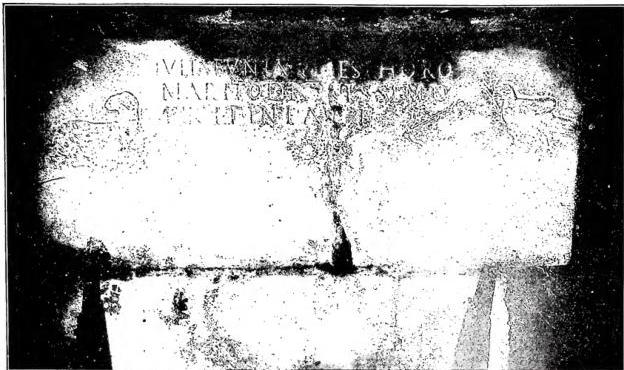
ANCIENT CHRISTIAN CEMETERIES - Christian inscription of a Telesphorus (3rd century), found in situ in the Roman necropolis of the Isola Sacra - Porto.
by Tobia. What is most striking is the large number of small tombs, mostly placed at the corners of the underground galleries for structural reasons, demonstrating how Christians opposed the shameful pagan practice of exposing children in refuse sites with that praetereuns misericordia recalled by Tertullian (Apol., 9, 17) every day.
2. Origins
The oldest Christian burials in Rome, those of the founders of its Church, the apostles Peter and Paul, were in pagan burial areas on the Vatican and Ostian roads. It is difficult today to determine in which year separate Christian cemeteries were established, distinct from pagan or Jewish burials. Only with Tertullian, that is, at the end of the 2nd century, is there explicit mention of areae sepulturarum nostrarum (Ad Scapulam, 3: PL 1, 701); and it is also Tertullian who states vivere licet cum ethnicis, commori non licet (De idololatria, 4). By the mid-3rd century, St. Cyprian deplores Bishop Martial, who had his children apud profana sepulcra depositos et alienigenis consepultos (Ep., 67, 6). However, it is quite difficult to conclude that such separation was always observed, as many examples show how burials originally pagan underwent transformations and adaptations for Christian interments. Particularly significant in this regard is the mausoleum of Marcus Clodius Hermes in catacumbas; there, at a later time, motifs of exclusively Christian meaning were painted above the entrance door (the Good Shepherd, the Banquet of the Multitudes after the multiplication of the loaves, the Miracle of the Gerasene demoniac). Also in the Roman necropolis of the Isola Sacra (near Porto) Christian burials are found; typical is the tomb of a Telesphorus with the symbols of the anchor, the sheep, and the dove with the olive branch (3rd century). Recently, three other examples have been offered by excavations in the Vatican grottoes: the Christian tomb of Emilia Gorgonia in the burial chamber of the Cetenni; the likewise Christian tomb of a deceased woman, with the indication of her deposition, the palm, and the dove, placed in an arcosolium of the mausoleum originally belonging, as it seems, to an Egyptian family; the small mausoleum, initially pagan with the rite of cremation, later transformed into a Christian inhumation tomb with mosaic representations of the Fisherman with the hook, Jonah cast into the sea, and the Good Shepherd. Moreover, sometimes even in Christian cemeteries pagan cubicula, albeit earlier, are found inserted. Finally, it should be noted that St. Ambrose discovered in 392, in a Jewish cemetery, the bodies of the martyrs Vitalis and Agricola (Exhort. virg., 1, 7: PL 16, 338).As for the locations chosen by Christians for their cemeteries, it should be observed that they adhered to the prevailing Roman legal norms, and thus cemeteries were always established extra pomerium, either in ager publicus or on private land, following the Roman custom of family or hereditary tombs. Roman law recognized for all, without distinction, the right of burial (ius sepulchri); even a slave was authorized to gather the necessary means for the purchase of his tomb and, after death, regained civil rights. The right of burial was granted to the remains of the condemned, which the judge could deliver to whoever requested them for burial (Dig., XLVIII, 24, 1, 2, 3; Cod. Iustin., III, 44, 2). The Jews in Smyrna attempted to prevent the Roman authority from granting the body of Bishop Polycarp for burial (Eusebius, Hist. eccl., IV, 15). Christians have always taken the greatest care in burying the dead: Tertullian, as seen, recalls how it was the concern of the Christian community to gather means egenis alendis humandisque (Apol., 39). St. Cyprian admonishes his clergy that maximum est, corpora martyrum aut ceterorum si non sepeliantur, grande periculum imminet eis quibus incumbit hoc opus (Ep., 8: CSEL, III, p. 488). St. Ambrose declared that to meet the necessary expenses for humandis fidelium reliquiis, it is permissible to break, melt down, and sell even consecrated church vessels (De officiis, II, 28, 142). Every tomb was protected by Roman law: at the moment of burial, it became res religiosa and as such res extra commercium. Not the entire area, therefore, even if destined for burial, was bound by legal protection, even if it was indicated in the titulus both in fronte and in agro, but progressively as it was occupied by actual tombs.
Not all Christian burial areas were respected. Tertullian, in fact, repeats the cry: areae non sint of the Carthaginian plebs (Ad Scapul., 3); and that the cry corresponded to facts is demonstrated by what Tertullian himself writes: that in his time « not even dead Christians were spared; even corpses already decomposed were taken from this kind of asylum of death and cut into pieces » (Apol., 37, 2).
Christians have always followed the rite of inhumation, as Caecilius already observed: exsecrantur rogos et damnant ignium sepulturas (Octavius, 11), and Octavius replied: we Christians veterem et meliorem consuetudinem humandi frequentamus (ibid., 34). Unfortunately, however, Christians were often condemned to vivi comburium, as recalled in the same Octavius: non dexteram solum, sed totum corpus uri, cremari (ibid., 37).
Open-air cemetery areas were enclosed by a wall: tombs could be either in simple pits (formae) for one or more burials placed one above the other, separated by tiles or marble slabs; in such cases, the tomb was called biscandens (v. BISOMUS), tercandens, or for many bodies poliandron; or they could be under a portico (sub teglata) or in terracotta sarcophagi, in stone, marble, or in masonry chests, or even in simple amphorae. Lead coffins were sometimes used (the locellus plumbeus was indispensable for translations), and wooden coffins, as found in Spain and North Africa.
It is necessary to clearly understand that Christian underground burial is necessarily limited to those places where the geological configuration permitted it; it responded to a logical principle of space economy, involving the exploitation in depth of a limited surface area, both in fronte and in agro.
The merit of definitively demonstrating that ancient Christian cemeteries were not simple pozzolana quarries reused for burial by Christians, but galleries expressly dug by fossores for the burial of the fratres, belongs to Fr. Marchi (G. Marchi, Monumenti delle arti cristiane primitive nella necropoli del cristianesimo, Rome 1844, p. 7 ff.). Only in some cases are sandstone zones reused, Priscilla (v.), COMMODIANO (v.), in the cemetery called of St. Gennaro of the poor in Naples (v.), and in that called of St. Syracuse (v.).
G. B. De Rossi, Roma sotterranea cristiana, Roma 1864-1877; O. Marucchi, Lezioni di archeologia cristiana, Roma 1900; id., Manuale di archeologia cristiana, Roma 1923; J. P. Kirsch, Die römischen Titelkirchen im Altertum, Paderborn 1918; H. Leclercq, in DACL, III, coll. 1507-1622; P. Testini, Archeologia cristiana, Bari 1958; A. Ferrua, La catacomba di Priscilla, Città del Vaticano 1960; N. Müller, Die römischen Katakomben, Leipzig 1932; E. Josi, Le catacombe romane, Roma 1933; G. Wilpert, Roma sotterranea: le pitture delle catacombe romane, Roma 1903; A. Prandi, L'architettura delle catacombe romane, Roma 1935.
A. Ferrua, S.I.
The legend of dwelling in underground cemeteries is also not earlier than the 6th century. It certainly derives from the Passiones the phrase read in the biography of Pope Caius (283-96): fugiens persecutionem Diocletiani in cryptis habitando (Lib. Pont., I, p. 161). Even in the 6th century, it is said that John III (561-74) retenuit se in cimiterio ss. Tiburtii et Valeriani et habitavit ibi multum temporis ut etiam episcopos ibidem consecraret (ibid., I, p. 305). But the tombs of the martyrs Tiburtius and Valerian were not underground but above ground.
A further legend is that all the martyrs
(photo: Pont. comm. arch. sacra)
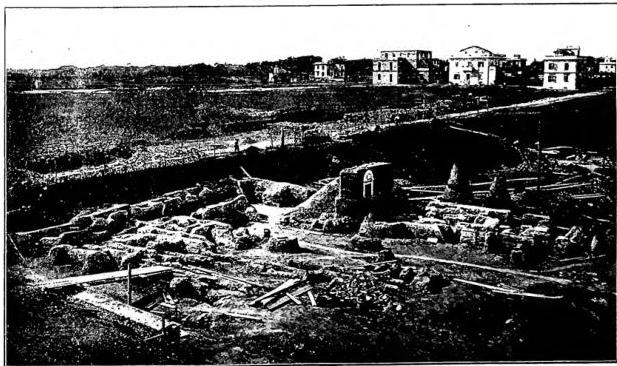
ANCIENT CHRISTIAN CEMETERIES - Open-air Christian burial area (4th century), discovered in 1917 - Rome, Cemetery of Ponziano.
3. Development
The names of the ancient Christian cemeteries of Rome can be partly determined through a singular document of the 4th century known as the Chronographer of the Year 354 (v.), which contains the Depositio episcoporum (v.) and the Depositio martyrum (v.). There, some names of cemetery owners are indicated. They are: Balbina, Bassilla, Callistus, Giordani, Maximus, Pontianus, Praetextatus, Priscilla, and Thrason. These names suggest that these were originally private burial areas, later made available to the fratres. In the same document, other burial areas are indicated either by their characteristic topographical name, such as in catacumbas, or by the name of the consular road on which they were located. Other names are provided by the Martyrologium Hieronymianum, such as the coemeterium maius on the Via Nomentana, the cemetery of Apronianus, etc.; still others in the Liber Pontificalis, which, however, does not always give the original names but those current at the time the biography was written, that is, not before the 6th century: thus, the cemetery of Maximus is called that of Felicity, and the cemetery of Callistus on the Via Aurelia bears the name of Calepodius. Such changes undoubtedly depend on the Passiones, which also provide other cemetery names.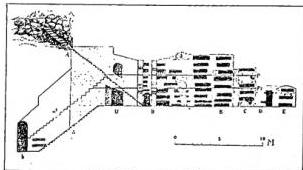
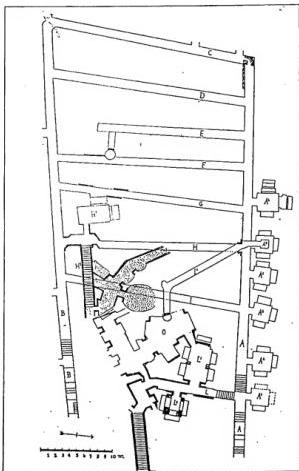
ANCIENT CHRISTIAN CEMETERIES - Cemetery of Callistus. The region with the crypt of the Popes (L. 1), the crypt of St. Cecilia (O), and the so-called Sacrament cubicula (A. 1-6) (3rd century) - Rome.
the pre-Christian hypogeum of Anzio and the problem of the origin of Christian catacombs, in Rendiconti della Pontificia Accademia Romana di Archeologia, 3rd series, 22 (1948), pp. 155-66. Recently, G. B. Frey has argued for the priority of Jewish underground cemeteries over Christian ones, basing his argument on the dating criterion of brick stamps; but this element is far from conclusive, as it can only constitute a terminus ante quem non, while the epigraphic and decorative elements of these Jewish cemeteries (v. JEWISH CATACOMBS) do not at all permit such a remote dating as Frey would have wished (L'ancienneté des catacombes juives à Rome, in Rendiconti della Pontificia Accademia Romana di Archeologia, 3rd series, 12 [1936], pp. 185-98). It must therefore be concluded that those who excavated underground Christian cemeteries, namely the fossores (v. FOSSORES), developed and perfected a known system, as P. Styger rightly observed (Heidnische und christliche Katakomben: Pisciculi, Studien zur Religion und Kultur des Altertums, Münster in W. 1939, pp. 266-75).
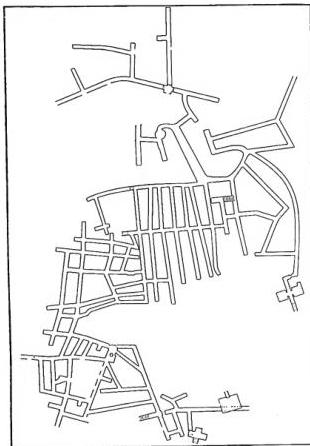
From the small independent regions consisting of a hypogeum equipped with one or more cubicula and one or more galleries, there is a transition in the 3rd century to greater development, as can be seen in the region called the Flavii Aurelii in Domitilla (v. DOMITILLA), in that of the two parallel staircases in Callistus (v. CALLISTUS), or in the other region of the same cemetery called the crypts of Lucina. In all three of these areas, the fossores resorted to the expedient of lowering the levels of the three aforementioned areas delimited on the surface, thus achieving in Domitilla that the primitive cubicula remained at a higher level, or else they lowered them; in Callistus, in the region of the two parallel staircases, they were able, through this lowering, to obtain deeper galleries and excavate the cubicula where the 3rd-century popes and the other of Orpheus were deposited; in the region called Lucina, deepened cubicula and galleries, in one of which Pope Cornelius (d. 253) was laid to rest, having been transferred there a few years later from Civitavecchia. Meanwhile, during the course of this 3rd century, the Christian community of Rome, increasing in number, required greater cemetery development. In the Catalogue of the Popes, called the Liberian Catalogue, inserted in the Chronographer of 354, it is read that Pope Fabian (236-250) multas fabricas per cimiteria fieri iussit; thus, a greater extension of the cemetery networks dates to this period. Styger put forth the theory that underground cemeteries were enlarged by the fossores using a branching system, either palmate or grid-like; it is much simpler to think that the fossores developed the excavation according to the configuration of the surface and the quality of the underground tuff. Indeed, a great variety is observed in the excavation of individual cemeteries, and while, in broad terms, the observations already made by Bonavenia regarding the theory of levels in underground galleries are correct, it must be borne in mind that no constant rule can be established to recognize, for example, the priority of the different levels to which the fossores had to resort, given the limitation of space. In some cemeteries, for example in Priscilla, the level immediately below the surface is the oldest, while the deeper one is later; in Pamphilus, the opposite occurs. In some cemeteries, a depth of about 20 meters is reached in just two levels, while in others, with three levels, one descends to about 25 meters.
(from P. Styger, L'origine delle cripte di Lucina, in Rendiconti della Pontificia Accademia di Archeologia, 3rd series, 2 [1915-15], p. 71, fig. 2)
ANCIENT CHRISTIAN CEMETERIES - Cemetery of Callistus, Section of the region known as Lucina (3rd century) - Rome.
(photo: Pontifical Commission for Sacred Archaeology)
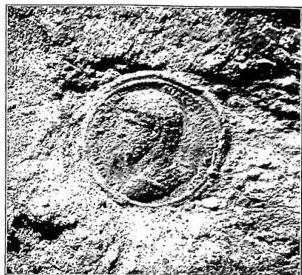
ANCIENT CHRISTIAN CEMETERIES - Medallion of Lucius Verus (161-68), embedded in the lime of a 3rd-century tomb as a recognition sign - Rome, Cemetery of Pamphilus.
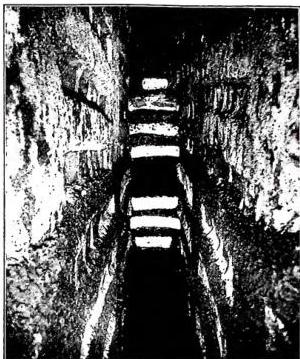
The gallery or ambulatory was called crypta, as indicated by a graffito in the second level of Priscilla: undecima crypta, secunda pila (O. Marucchi, Di alcune iscrizioni recentemente scoperte nel c. di Priscilla, in Nuovo bull. di archeol. crist., 10 [1904], p. 207); often it simply denoted an underground space, e.g.: descendentibus in crypta (O. Marucchi, Di una iscrizione recentemente scoperta, ove è ricordata la tomba del martire s. Lorenzo, ibid., 6 [1900], p. 127). Pila was the vertical wall space containing a series of superimposed tombs; each tomb excavated in the wall was called locus (today generally loculus): it consisted of a rectangular opening, on average six feet long, one and a half feet deep, and one foot high; the depth was greater in the space reserved for the head and lesser for the extremities. The tomb could be for a single body (monosomus), for two (bisomus; v.), for three (trisomus), for four (quadrisomus), or for multiple burials (poliandron). The closure was generally made either by means of tiles joined together with lime or with one or more marble slabs; sometimes a layer of plaster was applied over the tiles; it is not uncommon to find the use of a lime strip for hermetic sealing, to incise the funerary inscription, or to insert a recognition sign, which could range from a simple terracotta fragment to ivory, small bronze, gilded glass, vitreous paste, one or more coins, rings, jewelry, glass or metal cups, terracotta or marble vessels, statuettes, oil lamps, or bells. In some cases, before excavating the loculi, the fossores traced the individual pilae in white, in which they then excavated up to twelve tombs one below the other. A more luxurious tomb was the arcosolium (v.). Family tombs were those excavated in a room or cubiculum, which could be double (duplex); in some cases, there are three or even four interconnected cubicula (Callisto; v.). Sometimes the gallery and the cubiculum (or only the latter) were illuminated by a skylight (luminare), especially when the cubicula opened on both sides of the gallery. Burial needs could lead to the excavation of tombs called formae in the floor; only in the c. Pamphilus (v.) has the case been observed of using the back wall of the gallery for the burial of children. An entirely exceptional type of mass burial is that offered by the series of wells in Commodilla, where a single well can contain about 50 tombs, all anepigraphic, suggesting an epidemic. The architectural forms of the cubicula vary with the development of the cemetery network, and to the older, regular quadrilateral forms are
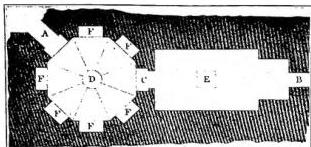
(from G. Marchi, Architettura delle arti cristiane primitive, Rome 1844, p. 175, tav. 21)
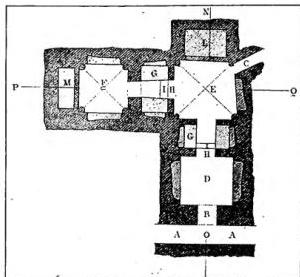
ANCIENT CHRISTIAN CEMETERIES - Double rectangular and polygonal cubiculum (4th century) - Rome, Cemetery of Trasone.
Later, cubicles of polygonal or circular shape were added, imitating open-air mausoleums.
The great expansion of cemetery networks occurred only during the Constantinian peace, that is, during the period of mass conversions, and gradually diminished until excavation ceased in the first decades of the 5th century.
Burial took place in the evening, according to Roman custom. Visits to the cemetery were made on the third, seventh, and thirtieth days, as well as on the anniversary of death—not of birth, as was the pagan custom. Already at the beginning of the 3rd century, Tertullian attests multiple times: oblationes pro defunctis pro nataliciis annua die facimus (De corona, 3; De exhortatione castitatis, 11; De monogamia, 10). St. Cyprian recalls the sacrificium pro dormitionem (Ep., 66). St. Augustine, describing the funeral of his mother Monica, writes: cum afferretur sacrificium pretii nostri, iam iuxta sepulcrum posito cadavere, priusquam deponeretur, sicut illic fieri solet (Confess., IX, 12). Bishop Evodius writes to the same Augustine that for the burial of a lector, per triduum hymnis Deum collaudavimus super sepulcrum. G. B. De Rossi, considering the size of the 4th-century cemetery cubicles, deems it probable that the oblationes pro dormitionem for the deceased buried there were celebrated not only at the time of deposition but also during the commemorations on the third, seventh, and thirtieth days, as well as on anniversaries. Even older and clearly used for such rites is Priscilla (v.). A Christian inscription from 373 regarding psalmody at the tomb states: sanctique tui Manes nobis petentibus adsint ut semper libenterque psalmos tibique dicamus (CIL, XI, 4629).
II. PROPERTY AND ADMINISTRATION
Regarding the administration of Christian cemeteries, the earliest information is provided by the Philosophumena (IX, 11): Zephyrinus (199-217) appointed the deacon Callistus to administer the cemetery on the Appian Way. This cemetery always retained the name of Callistus, even though he was not buried there, having been interred at the third milestone of the Via Aurelia in another cemetery also bearing his name. The cemetery on the Appian Way remained, even at the end of the 3rd century, under the direct dependence of the pope, as demonstrated by the double cubiculum excavated by the deacon Severus for the burial of his family iussu papae sui Marcellini. Between 236 and January 20, 250, Pope Fabian regiones divisit diaconibus et multas fabricas per coemeteria fieri iussit. There were seven deacons for the fourteen regions, assisted by seven subdeacons, as mentioned in the letter of Pope Cornelius to Fabius of Antioch. It is difficult, however, to determine whether cemeteries were administered by deacons at that time or already by presbyters, as appears to have been the case around the mid-4th century, when inscriptions found in individual cemeteries reveal their dependence on the respective tituli and, consequently, the direct jurisdiction of presbyters over them. For example, the cemetery in catacumbas was under the authority of the presbyters of the titulus of Byzantium, later SS. Giovanni e Paolo, while the cemetery of Domitilla was under the presbyters of the titulus de fasciola, later SS. Nereo e Achilleo. Even the purchases of tombs were sometimes made sub praesentia or sub conscientia of a presbyter of the titulus.A wholly new period began with the establishment of the veneration of martyrs' tombs and their annual commemorations. As early as the time of Tertullian, altars were erected over these tombs for oblationes, since he recalls the martyrs sub altari quiescentes (De resurrectione carnis, 28: PL 2, 848). St. Cyprian exhorts his clergy to diligently record the day on which martyrs were martyred so that oblationes ac sacrificia could be worthily celebrated ob commemorationes eorum (Ep., 12: PL 4, 328; cf. H. Delehaye, Les origines du culte des martyrs, 2e ed., Bruxelles 1933, pp. 24-99).
It should not be believed that in ancient Christian cemeteries the witnesses of the faith originally had special tombs. In simple open-air graves were buried, as has been seen, St. Peter at the Vatican and St. Paul on the Ostian Way, as well as the martyrs Valentine, Saturninus, Felix and Philip, Emerentiana, Tiburtius, Abdon and Sennen, etc. In simple loculi in the walls were the 3rd-century popes: Pontian, Anterus, Fabian, Lucius, Stephen, Sixtus II, Dionysius, Felix, Eutychian; in simple loculi: Lawrence, Sebastian, Proto and Hyacinth, Marcellinus and Peter, etc. Only with veneration were their tombs honored; around them, the faithful eagerly sought, even at great cost, to be buried: ad sanctos or retro sanctos. St. Paulinus of Nola posed the question to St. Augustine: utrum proxit cuique post mortem quod corpus eius apud sancti alicuius memoriam sepelitur; the answer was given by Augustine in the treatise De cura pro mortuis gerenda; he concludes: such proximity hoc tantum mihi videtur prodesse defuncto, ut commendans eum etiam martyrum patrocinio, affectus pro illo supplicationis augentur. The archdeacon Sabinus, who preferred with his tomb to be considered almost the doorkeeper of the basilica of St. Lawrence (ianitor esse loci), admonished the faithful that nihil iuvat imo gravat tumulis haerere piorum... corpore non opus est animo tendamus ad illos (G. B. De Rossi, Scoperte nell'Agro Verano e nel sotterraneo c. di Ciriaca, in Bull. di arch. crist., 4e serie, 4 [1886], pp. 16-26). Thus arose adaptations and enlargements of the spaces containing the venerated tombs, leading to the construction of true and proper
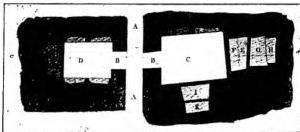
(from G. Marchi, Architettura delle arti primitive, Roma 1844, p. 178, tav. 20)
ANCIENT CHRISTIAN CEMETERIES - Double cubiculum with skylight in the center (late 3rd - early 4th century) - Rome, Cemetery of Callixtus.
But with the Gothic siege and occupation, the funeral buildings and the tombs of the martyrs were devastated (536-37). The damage was repaired by Pope Vigilius and his successors: John III (561-74) restauravit coemeteria SS. Martyrum et institutit ut oblationes et amulae vel luminaria per eadem coemeteria omni die dominico de Lateranis ministrarentur (Lib. Pont., I, p. 305). The funeral basilicas were further restored by Popes Pelagius II and Honorius. Pilgrims from central and northern Europe took turns at the tombs of the martyrs, transcribed the inscriptions in their honor, and guides were compiled to facilitate visits to the venerated sanctuaries (Itineraries: v.).
Later, Gregory III (731-41) disposuit ut in cymiteriis circumquae positis Romae in die natalizorum eorum luminaria ad vigilias faciendum et oblationes de patriarchio per oblationarium deportentur (ibid., p. 421).
The first translation of the bodies of martyrs was that of SS. Primus and Felicianus, transferred by Pope Theodore from the cemetery ad arcus Nomentanos to the basilica of S. Stefano al Celio.
Thus it remained until 1578, when a team of pozzolana diggers stumbled upon a group of cemetery galleries on the Via Salaria, with still-intact tombs adorned with paintings. “On that day,” writes De Rossi, “the science and the name of subterranean Rome were born” (Roma sotterranea, I, Rome 1864, p. 12). Indeed, from that time began the study of Christian antiquities with O. Panvinio (v.), A. Ciacono (v.), P. EUGENIO (v.), and above all with A. BOSONE (v.), his disciple, who rediscovered many ancient underground cemeteries and understood the importance of studying ancient documents for the work of topographical reconstruction; his Roma sotterranea was published after his death by A. Severano in 1634 (the title page bears the date 1632). The work was translated into Latin by Avinghi and enjoyed wide circulation. But Bosio’s studies were not continued, and the underground cemeteries were explored with the intent of finding holy bodies, even removing marbles and sarcophagi. With Mons. M. BOLLANDISTI (v.), the detachment of frescoes also began, not always with successful
(from G. Marchi, Architettura delle arti cristiane primitive, Rome 1911, ch. 23, p. 127)
ANCIENT CHRISTIAN CEMETERIES - Triple cubiculum (4th century). Rome, Cemetery of Trasone.
(photo: Pontifical Commission for Sacred Archaeology)
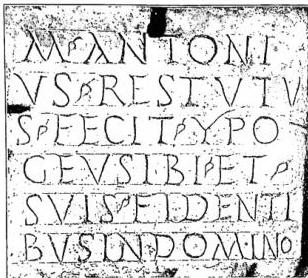
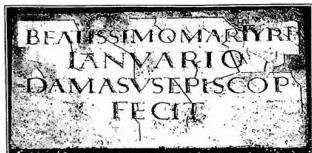
ANCIENT CHRISTIAN CEMETERIES - Dedication inscription by Damasus to the martyr Gennaro (4th century) - Rome, Cemetery of Pretestato.
fortunate. This continued throughout the 18th century until Fr. G. MARCIA (v.), who, appointed by Gregory XVI in 1842 as "conservator of the sacred cemeteries," put an end to the abuses of those tasked with extracting holy bodies. In 1845, he discovered the intact tomb of the martyr Bassilla (v.) and promoted the renewal of Christian archaeological studies, which led to the founding of the Lateran Christian Museum and the establishment of the Commission for Sacred Archaeology, responsible for the exploration and preservation of ancient Christian cemeteries (R. Fausti, Il p. G. Marchi S. I. (1795-1860) e il rinnovamento dell'archeologia cristiana, auspici Gregorio XVI e Pio IX, in Xenia Piana (Miscellanea historiae pontificiae, 7 [Rome 1943], pp. 445-514). His disciple was G. B. De Rossi (v.), the true founder of the science of Christian archaeology through the comparative method between documents and monuments. As early as 1852, he used the former to reconstruct the topography of ancient Christian cemeteries, thus leading to the discovery of an eminent series of martyrs' tombs (historical crypts) with the identification of the cemeteries that contained them. His discoveries and publications attracted around him, especially with the establishment of the Society of Christian Archaeology Scholars (v.), a group of Italian and foreign disciples who carried on his tradition, applying his method in the exploration not only of the cemeteries of Rome and Italy but also in other regions of the West and East.
BIBL.:
In addition to the works cited in the text, see: O. Marucchi, Lezioni di archeologia cristiana, Rome 1900; J. P. Kirsch, Die christlichen Kultusgebäude im Altertum, Cologne 1918; H. Leclercq, Manuel d'archéologie chrétienne, Paris 1907; P. Styger, Die altchristliche Grabeskunst, Munich 1927; G. Wilpert, Roma sotterranea, Rome 1903; id., I sarcofagi cristiani antichi, Rome 1929-1936; A. Ferrua, La basilica e la catacomba di San Sebastiano, Vatican City 1951. For the cemeteries of Rome, see the fundamental work of G. B. De Rossi, Roma sotterranea cristiana, Rome 1864-1877, 3 vols.; and the more recent studies by A. Silvagni, Monumenta epigraphica christiana saeculo XIII antiquiora, Vatican City 1943; E. Josi, Le catacombe romane, Rome 1933; and the publications of the Pontifical Commission of Sacred Archaeology, Inscriptiones christianae urbis Romae, Vatican City 1922 ff. For the cemeteries outside Rome, see: F. Lanzoni, Le diocesi d'Italia dalle origini al principio del sec. VII, Faenza 1927; P. Testini, Archeologia cristiana, Bari 1958; and the numerous monographs on individual cemeteries published in specialized journals such as Römische Quartalschrift, Rivista di archeologia cristiana, Atti della Pontificia Accademia Romana di Archeologia, etc.
III. THEOLOGICAL VALUE OF EARLY CHRISTIAN FUNERARY MONUMENTS
The importance of the contribution made by the study of ancient Christian cemeteries to our understanding of the ethnic and social composition of the earliest Christian communities, their hierarchy, and their organization is such that, together with the entirety of their architectural and artistic monuments, they constitute for the whole Church a veritable archive of the faith of these first generations. Pope Leo XIII, addressing G. B. De Rossi, affirmed that studies on ancient Christian cemeteries "Ecclesiae incunabula illustrantur; lapides ipsi quodammodo et monumenta causam religionis suscipiunt, Romanaeque fidei et auctoritatis diuturnitatem et constantiam testantur" (Leonis XIII Acta, I, p. 153). Pope Pius XI, in his motu proprio of December 11, 1925, defined the value of Rome’s ancient Christian cemeteries as follows: «The early cemeteries of Christian Rome, with their crypts and the tombs of popes and martyrs, and the sanctuaries erected over those glorious sepulchers... the countless series of inscriptions, paintings, and sculptures, the funerary and liturgical furnishings, constitute for the Holy Roman Church a sacred patrimony of unparalleled worth and importance. Indeed, these witnesses are as venerable as they are authentic of the faith and religious life of antiquity, and at the same time, they are primary sources for the study of Christian institutions and culture from the times closest to the apostolic era... The Roman Church... through the discoveries of its most ancient cemeteries and the sanctuaries of the martyrs, has recovered a most significant portion of its earliest heritage, has seen entire pages of its history recomposed, and has brought to light documents and monuments of the highest historical value for demonstrating the antiquity of its dogmas, its faith, and its venerable traditions.»IV. ANCIENT CHRISTIAN CEMETERIES OF ROME
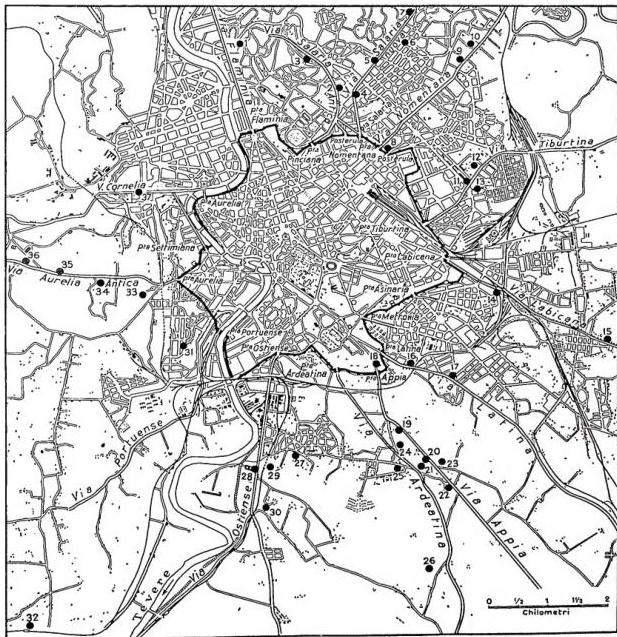
Topographical list of the cemeteries of Rome. - Hypogeum of the Aurelii (v.). Via Flaminia: cemetery known as that of S. Valentino (v.). - Via Salaria vetus: cemetery known as ad septem palumbas (v.); Bassilla (v.) and cemetery of S. Panfilo (v.). - Via Salaria nova: cemetery of Massimo (v.), later known as that of S. Felicita; Trasone (v.); cemetery of the Giordani (v.); Priscilla (v.). - Via Nomentana: cemetery known as that of S. NICODEMO (v.); cemetery known as that of S. Agnese (v.); Major cemetery (Maius: v.). - Via Tiburtina: anonymous cemetery at the entrance of Viale Regina Margherita; cemetery known as that of S. Ippolito (v.); cemetery of S. CIRENAICA (v.). - Via Labicana: cemetery known as that of S. Castulo (v.); cemetery ad to inter duas lauros (v.). - Via Latina: cemetery known as that of SS. Epimaco (v.); cemetery known as that of Tertullino, a martyr known only from the Passio and two Itineraria (E. Josi, C. c. sulla via Latina, in Riv. di arch. crist., 16 [1939], pp. 12-15), unidentified; ADRIANO (v.): to it perhaps belongs the region known as the hypogeum of Trebius Iustus (O. Marucchi, op. cit., p. 308). - Via Appia: hypogeum near the tomb of the Scipios, predating the Aurelian walls (272); anonymous hypogeum between the Appia and the Latina within the same enclosure, with paintings and inscriptions (O. Marucchi, Le catacombe romane, Roma 1933, p. 672); hypogeum known as that of the Hunters (P. Styger, Die römischen Katakomben, Berlin 1933, p. 307); cemetery of Callisto (v.); cemetery of Pretestato (v.); cemetery in catacumbas (v.). - Via Ardeatina: Balbina (v.); cemetery known as that of Basileo (?) or of SS. Marco, MARCELLIANI (v.) DAMASCO (v.); Domitilla (v.). - Via Ostiense: COMMODIANO (v.): tomb of S. Paolo; hypogeum known as that of Timoteo (from the name of the martyr remembered on 22 August in the Depositio martyrum) near the cliff north of the basilica of S. Paolo: cemetery known as that of S. Tecla (v.). - Via Portuense: PONZIO (v.); cemetery known as that of S. Felice (at the third mile the basilica is indicated in the Catalogue known as Liberiano). - Trastevere: S. Onofrio on the Gianicolo (P. Crostaro, C. anonimo a S. Onofrio al Gianicolo, in Nuovo bull. di arch. crist., 4 [1898], p. 231; O. Marucchi, Scoperta di altre gallerie cimiteriali cristiane sotto il Gianicolo, ibid., 8 [1902], pp. 954-58). - Via Aurelia vetus: cemetery known as that of S. Pancrazio (v.); cemetery known as that of SS. Martiniano (v.); cemetery known as that of the two Felici (v.); cemetery of Callisto, Calepodio (v.). - Via Aurelia nova or Cornelia: Tomb of S. Vatican (v.).List of the so-called suburban cemeteries. - Via Aurelia: at the IX
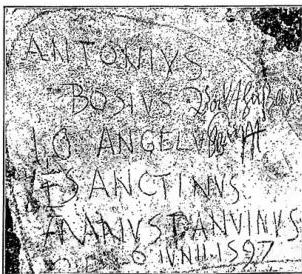
CIMITERI CRISTIANI ANTICHI - Firme autografe di Antonio Bosio, di Angelo Santino, Mario Panvinio (6 giugno 1597). Roma, c. di Domitilla.
miglio: sepolcro delle SS. Rufina e Seconda; al XII miglio: tombe dei SS. Mario, Marta, Audiface e Abacuc (G. P. Kirsch, Le memorie dei martiri sulle vie Aurelia e Cornelia, in Miscellanea Ebrle, II, Roma 1924, pp. 63-100). — Via Trionfale: c. a Monte Mario (G. B. De Rossi, C. sotterraneo di ignoto nome sul monte Mario, in Bull. di arch. crist., 3ª serie, 4 [1894], p. 133). — Via Aurelia: al XII miglio: c. Basilide (v.). — Via Portuense: c. Generosa (v.), PORTA (v.). — Via Ostiense: al VII miglio c. detto di S. CIPRIANO (v.). — Decima, al XV km., località Malpasso: cella sepolcrale con sarcofagi (A. L. Pietrogrande, Ruderi e sarcofagi scoperti sulla via di Decima, in Notizie degli scavi, 1934, pp. 155-68). — Via Ardeatina: al IV miglio, località Nunziatella: ipogeo sotterraneo (G. B. De Rossi, Scoperta di un piccolo c. cristiano adorno
di pitture assai antiche presso la chiesa della Nunziatella al IV miglio della via Ardeatina, in Bull. di arch. crist., 3ª serie, 2 [1877], p. 136; 3 [1879], p. 27; 4ª serie, 1 [1882], pp. 168-70; 3ª serie, 3 [1892], p. 28; Wilpert, Pitture, p. 501); al VII miglio: Felicola, ricordata nel Martirologio gerominiano al 13 giugno e nella Passio dei ss. Nereo e Achilleo (BHL, 6061; cf. M. Armellini, I c. c. di Roma e d'Italia, Roma 1893, p. 596). — Via Appia: ALBANI (v.); Velletri (v.). — Via Latina; al V miglio: ipogeo cristiano (G. B. De Rossi, Ipogeo cristiano al V miglio della via Latina, in Bull. d'arch. crist., 3ª serie, 1 [1876], pp. 32-153); località Tavolato (R. Kanzler, Di un nuovo c. anonimo sulla via Latina, in Nuovo bull. d'arch. crist., 9 [1903], pp. 173-86; O. Marucchi, ibid., pp. 23-282, 301); al X miglio, presso la villa Senni (O. Marucchi, La scoperta
Grossi-Gondi, Conclusione degli scavi ad decimum
della via Latina, presso Grottaferrata, ibid., 24 [1918-19],
pp. 87-94; id., Catacombe tuscolane, scoperta di un'im-
portante iscrizione greca, Grottaferrata 1914); al XXX mi-
glio: c. detto di S. Ilario ad bivium. Devastato; iscrizioni
nel palazzo Doria a Valmontone. - Via Labicana: al VII
miglio si rinvenne il sarcofago di Proses, liberto di
Caracalla, del 217 (G. B. De Rossi, Inscriptiones Chri-
stianae, I, Roma 1857-61, n. 5); al X miglio: c. Zotico (v.). - Via Prenestina: presso Gabi: c. detto di S.
Primitivo (O. Marucchi, Le catacombe romane, Roma
1933, p. 661). - PALESTINA (v.), presso Paliano: c. c. con
iscrizioni graffite dall'a. 341 al 420 (O. Marucchi, Sco-
perta di un antico c. c. al miglio XXXVI della via Prene-
stina, in Nuovo bull. d'arch. crist., 20 [1914], pp. 131-46).
- Via Tiburtina: al IX miglio (E. Stevenson, La basilica
doppia di S. Sinforosa e dei sette suoi figlioli scoperta al
nono miglio della via Tiburtina, in Bull. d'arch. crist.,
3ª serie, 3 [1878], pp. 75-81); al XVIII miglio: basilica
cimiteriale di S. Vincenzo ricordato al 23 luglio nel Mar-
tirologio geronimiano (C. Piccolini e G. Mancini, Gli scavi
della basilica di S. Vincenzo in territorio di monte Celio,
Tivoli 1926). - Via Nomentana: al XV miglio: c. detto dei
SS. Primo e Feliciano ad arcus nomentanos (O. Marucchi,
Le catacombe romane, Roma 1933, p. 664). - Via Salaria:
presso l'antica Fidene: c. anonimo (O. Marucchi, ibid.,
p. 664); presso il XX miglio: c. detto di S. Antimo (cf. loc.
cit.). - Via Flaminia: a 8 km. da Morlupo in territorio
di Leprignano: c. c. con iscrizioni datate tra gli aa. 344-
350 (cf. ibid., p. 665). - Rignano Flaminio (v.). - Via
Cassia: Baccano (v.), Sutri (v.), NEP (v.).
V. ANCIENT CHRISTIAN CEMETERIES OF ITALY
ARGENTO (v.); Albenga (N. Lamboglia, Scoperta di un sarcofago paleocristiano, in Riv. Inguana e Intemelia, 3 [1937-38], pp. 58-61); Amiterno (v.); Anzio (v.); Aquileia; Atripalda (G. A. Galante, Il c. di S. Ipolisto, martire di Atripalda, Napoli 1893; CIL, X, 1188, 1191-95); Avellino (v.); Bazzano (v.); Bolsena (v.); Cagliari (v.); Calvi e Teano (v.); Castelvecchio Subequo (Abruzzi): underground cemetery currently under exploration; Castellammare di Stabia (v.); CATATONIA (v.); CHUS (v.); Civitacastellana (v.); Concordia (v.); Cuma (v.); Ferento (Germano di S. Stanislao, Gli atti ed il c. di S. Eutizio di Ferento, Roma 1886); Massa Martana: underground cemetery (G. Sordini, Di un c. cristiano sotterraneo nell'Umbria, in Atti del II Congresso internaz. di archeol. crist., Roma 1902, pp. 109-21); Milano (v.); MODERATI (v.); Napoli (v.); Nola (v.); Pozzuoli (v.); Siracusa (v.); Salerno (v.); Sutri (v.); TROPO (v.); Terni (v.); Venosa (v.); Vercelli (v.); Malta (v.).VI. ANCIENT CHRISTIAN CEMETERIES IN OTHER WESTERN REGIONS.
D'ORCENTE. - GALLIA (v. FRANCIA): Arles (v.); La Gayole,
cella sepolcrale a sarcofagi (A. Chaillan, in Bulletin archéo-
logique du Comité, 1913, pp. 308-14); Marsiglia (v.);
Narbona (v.); St-Bertrand de Comminges: basilica ci-
imiteriale del sec. IV (R. Lizop, Histoire de deux cités
gallo-romaines: Les Convenne et les Consoranni, Tolosa
1931; F. Benoit, Cimetières paléochrétiens de Provence,
in Cahiers archéologiques, 2 [1947], pp. 7-15; L. Bréhier,
Cimetières d'époque mérovingienne et chapelle funéraire
à Coudes [Puy de Dôme], in Comptes rendus de l'Acad.
des inscript. et belles lettres, 1941, pp. 322-32).
SPAGNA: Cordova (v.); Gerona (v.); Saragozza (v.);
ARAGONA (v.).
GERMANIA: Bonn, Colonia, Magonza (v.); Treviri (v.); Xanten (v.).
PANNONIA: CHIESA (v.); Sirmio (v.).
GRECIA: Atene (v.); Corinto: c. cristiano (F. J. De
Waele, The fountain of Lerna and the early christian
cemetery of Corinth, in The American Journal of Ar-
cheology [1935], pp. 325-50).
ILLIRICO: Dalmazia (v.); Salona (v.); Stobi (v.).
Per l'ASIA MINORE (cfr. W. Schultze, Altchristliche
Städte und Landschaften, Gütersloh 1922, I, Aegai,
p. 119; Amasea, p. 119; Andrapa, p. 141; Cizico, pp. 367-
369; Madrianon, pp. 341-42; Proconneso, p. 396; II. Kleina-
sien: Amastris, p. 214; Ankara, p. 207; Apamea, pp. 456-
460 e W. H. Bukler, W. M. Calder, Monuments and
documents from Phrygia and Caria [Monumenta Asiae mi-
noris antiqua, 4], Manchester 1939); Caria, Schultze,
p. 165; Claudiopoli, pp. 223-24; Eumencio, pp. 463-67;
Frigia (P. Franchi de' Cavalieri, Note agiografiche [Studi
e testi, 49] Roma, 1928, pp. 241-43); Licaonio: c. all'a-
perto (W. Ramsay, Luke the physician, Londra 1908, pas-
sim); Mirapoli, Schultze, pp. 415-17, 427-33; Nicea,
pp. 322-25; Nicomedia, pp. 300-302; Pompeipoli, p. 210;
Prusia e Miplo, pp. 234-35; Soria, 217; Tiesio, p. 230.
AFRICA (v.) DEL NORD: Adrumeto (v.); Benion (S.
Gsell, Fouilles de Benian, Parigi 1899); Cartagine (v.);
Cherchell (v.); CONSTANTINE (v.); Djemila (v.); Lam-
besis (v.); MACARIUS (v.); Mechera Sfa (S. Gsell, Monuments
antiques de l'Algérie, I, Parigi 1901, pp. 34-35); Morvott
(id., ibid., II, p. 234); Mauzaiaville (id., ibid., p. 235);
Setif (v.); Sbeitla (v.); Tabarca (v.); Tenes
Carterina (S. Gsell, Monuments antiques de l'Algérie, II,
Parigi 1901, p. 408); Thaenae, Henchir Thina (G.-L.
Feuille, Les nécropoles de Thaenae, in Bulletin archéol. du
Comité, 1938-40 [1942], pp. 641-53); Timgad (v.); Ti-
pasa (v.).
EGITTO: al-Baqawāt (v.); ALESSANDRO (v.).
LIBIA (v.): Ain Zara (v.); TRIPOLITANIA (v.).
MESOPOTAMIA (v.).
PALESTINA: Gerusalemme (v.); Gerasa (v.).
Per l'epigrafia e l'iconografia V. le rispettive voci.
- Vedi Tavv. CIV-CV.
Berlino 1933; id., Römische Märtyrergrüfte, ivi 1935; A. P. Frutaz, Le antichi di Roma, in Fliche-Martin-Frutz, II, pp. 489-507; A. G. Martimort, La fidélité des premiers chrétiens aux usages romains en matière de sépulture, in Société toulousaine d'études classiques. Mélanges, I, Tolosa 1946, pp. 167-89; L. Hertling-E. Kirschbaum, Le catacombe romane e i loro martiri, Roma 1949; G. Bovini, La proprietà ecclesiastica e la condizione giuridica della Chiesa in età precontaminata, Milano 1949. Per i repertori: Katahomben, in F. X. Kraus, Realencyc. d. christlichen Alterthümer, 2 voll., Friburgo in Br. 1886, pp. 98-136; N. Müller, Könneterien, die altchristlichen Begräbnisstätten, in Realencycl. für prot. Theol. u. Kirche, X, pp. 794-877; H. Leclercq, Catacombes, in DACL, II, II, coll. 2376-2486. Enrico Josi