
DOMITILLA, CIMITERO di. – It is situated on the ancient Via Ardeatina, whose course lay farther west than the present road. The modern entrance is on Via delle Sette Chiese.
The cemetery’s name is derived not from primitive indications, but from a late document known as the “Index of Cemeteries”: “Coemeterium Domitillae Nerei et Achillei ad S. Petronillam via Ardeatina.”
Indeed, in the Cambridgian codex of the Hieronymian Martyrology one reads “in cimiterio eorum,” and in the biography of Giovanni I (523–26) it is said that the Pope “refecit cymiterium beatorum martyrum Nerei et Achillei.”
The Passio relates that these two martyrs were buried in the “praedium Domitillae,” whence the cemetery’s name in the aforementioned Index. Two pagan inscriptions discovered in the area above mention gifts of burial places “ex indulgentia Flaviae Domitillae” or “eius beneficio” (CIL, VI, 16426, 8942).
Two Flaviae Domitillae are known: one was the daughter of a sister of Tito and Domiziano and the wife of the consul Flavio Clemente (Dione Cassio, Hist. Rom., 67,
14; CIL, VI, 948); the other, according to Eusebio (Hist. eccl., III, 18, 4), was the daughter of a sister of the consul Flavio Clemente and was sent into exile on the island of Ponza, where the widow Paola, at the end of the fourth century, still saw the place where D. “longum martyrium duxerat” (S. Girolamo, Ep. 108 ad Eustoch.).
In the area above the cemetery, during the winter of 1926, a pagan burial ground was discovered adjacent to the ancient Via Ardeatina, consisting of columbaria and “formae,” some of them Christian, as had also been found in 1822 (O. Marucchi, Di un gruppo di antiche iscrizioni cristiane spettanti al cimitero di D. e recentemente acquistate dalla Commissione di archeologia sacra, in Nuovo bull. di arch. crist., 7 [1901], pp. 233–56). Beyond the area above, the cemetery extends for more than 12 km. of galleries on two principal levels, formed by ancient autonomous nuclei later connected with one another.
One of the primitive nuclei, which G. B. De Rossi (Del cristianesimo nella famiglia dei Flavi Augusti, e delle nuove scoperte nel cimitero di D., in Bullettino di arch. crist., 1st series, 2 [1865], pp. 17–24, 33–46, 89, 98), followed by Wilpert (Pitture, p. 121) and Marucchi (Roma sotterranea, nuova serie, Monumenti del cimitero di D., I, Roma 1909, p. 92), regarded as the hypogeum of the Flavi and dated to the first century, consists of an entrance adjacent to the Via Ardeatina, with side rooms for meetings, and originally a single gallery cut into the living rock of the hill, containing niches for sarcophagi decorated with frescoes: vine-harvesting putti on the vault, winged putti with garlands, landscapes, and Christian scenes such as Daniel among the lions, a fisherman with a hook, and Noah. But there are no grounds for attributing the hypogeum to the Flavi, nor is its date earlier than the middle of the second century (A. Schneider, Der Eingang zum Hypogaeum Flaviorum, in Mitteilungen des deutsch. archäolog. Instit., Römische Abteilung, 43 [1928], pp. 1–12).
Another ancient area is that which De Rossi called the Flavi Aurelii; its access staircase was destroyed by the foundations of the left perimeter wall of the basilica. The surface of this area was limited, and the owners were forced to lower the floor successively, as in Callisto (v.); Styger distinguished six successive periods here. To the last of these belongs the cubiculum with the still-intact graves of a “C. Iulia Agrippina Simplici dulcia in aeternum,” a “P. Aelius Rufinus,” a “M. Aurelius Ianuarius,” and an “Annius Felix,” all no later than the middle of the third century.
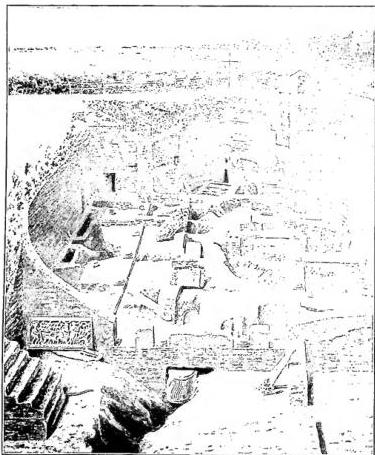
A third area, with its own staircase and a hypogeum containing niches for sarcophagi, is not later than the second half of the third century. In it, the martyrs mentioned in the fourth century were placed in “formae” excavated in a cubiculum; the hypogeum was altered by the construction of a small basilica, oriented opposite to the present one, and subsequently occupied by the large three-naved building with a double order of columns (R. Krautheimer – W. Frankl, Recent discoveries in Churches in Rome, in American Journal of Archaeol., 43 [1939], pp. 397–98). The excavation of the basilica was begun by De Rossi in 1873 in the area purchased by mons.
F. S. De Merode to facilitate excavations for the Pontifical Commission of Sacred Archaeology. De Rossi identified two fragments of the “Damasian poem” in honor of the martyrs Nereo and Achilleo, one of the ciborium’s columns with the scene of the martyrdom of the martyr Achilleo, and a series of inscriptions referring to the clergy of the title of Pasciola, situated near the Thermae Antonianae, on which the cemetery depended.
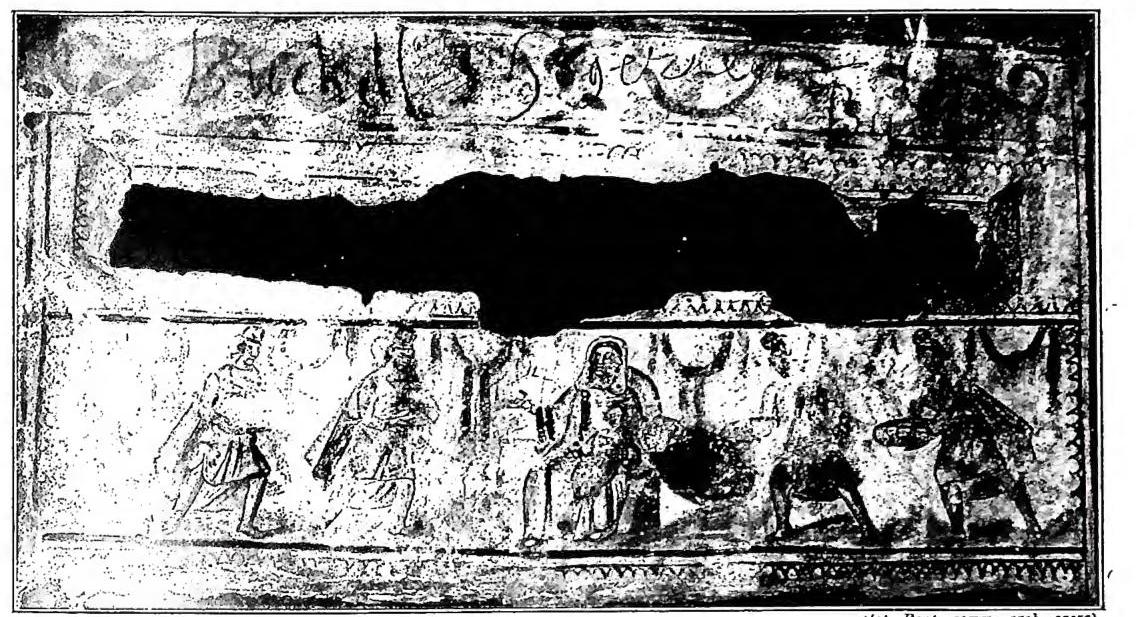
In a cubiculum adjacent to the basilica, the deceased Veneranda is represented being introduced into Paradise by the martyr Petronilla (Petronella martyr), G. B. De Rossi, Scoperta della basilica di S. Petronilla col sepolcro dei martiri Nereo e Achilleo nel cimitero di D., in Bull. di archeologia cristiana, 2nd series, 5 [1874], pp. 5–35; id., Scoperta dell'immagine a fresco di S. Petronilla nel cimitero di D., ibid., pp. 122–25; id., Sepolcro di S. Petronilla nella basilica in via Ardeatina e sua traslazione al Vaticano, ibid.,
3rd series, 3 [1878], pp. 125–46; and ibid., 4 [1879], pp. 5–20; id., Esame critico ed archeologico dell'epigrafe scritta sul sarcofago di S. Petronilla, ibid., pp. 139–60).
A fourth area is called the staircase of Tor Marancia; it was excavated as early as 1854. The staircase originally led to a first level; it was later enlarged and deepened to a very considerable depth. Here the painted crypt with the Good Shepherd was attributed by De Rossi and Wilpert to the first century, whereas it is not earlier than the second half of the third.
(courtesy of Prof. E. Jasi)
DOMITILLA, CIMITERO di – Basilica of SS. Nereo, Achilleo and Petronilla at the time of its discovery in 1885. Watercolor by Gregorio Mariani.
(photo Pont. comm. arch. sorra)
Il Boldetti devastò anche una nona regione situata tra la basilica e l'ipogeo detto dei Fla