
APOSTOLI (Gr. ἀπόστολος “one sent,” from ἀποστέλλω). — Title of the twelve collaborators chosen by Jesus, to whom he entrusted the continuation and completion of his redemptive mission (Mt. 28:18–20; Io. 15:16). Thus Jesus called “the twelve” (Mc. 3:14; Mt. 10:1), whom he chose from among an unspecified number of disciples (Lc. 6:13). “The twelve” was a fixed designation: Mc. 6:7 (Lc. 9:1); Mt. 10:5; 20:17; 26:14, etc.; Act. 6:2; this is proved above all by I Cor. 15:5, where Paul speaks of the appearances of the Risen One to “the twelve.”
This is a tradition that comes from Jerusalem. The fixed number is also evident from Act. 1:15 ff., where the election of Mattia in place of Giuda is narrated, and thus “the eleven” (Mt. 28:16; Mc. 16:14; Lc. 24:9, 33; Act. 1:26) once again become “the twelve.” It is not possible to explain the formation of the group of the twelve as a historical development subsequent to the earthly life of Jesus. Jesus himself intended “the twelve,” chosen, as is clear from Mt. 19:28 (cf. Lc. 22:30).
(phot. Enc. Catt.)
Jesus Himself gave the title of apostles to “the twelve” (Lc. 6, 13; various manuscripts in Mc. 3, 14). Naturally, the choice of “the twelve” does not coincide with their mission as apostles.
Because of their eschatological function, “the twelve” are charged with bearing witness “concerning the twelve tribes of Israel” (Epist. Barn., 8, 3; cf. Mc. 6, 11 and Lc. 9, 5; Mt. 13, 9 and parallels). This primitive concept of the apostle thus remains connected with Israel. The apostle is the herald of the near kingdom of God (Mt. 10, 7; Lc. 10, 9) in Israel (Mt. 10, 5 ff.), sent by Jesus. He participates in the sufferings of the Son of Man in order finally to be glorified with Him. The privations imposed by Jesus upon “the twelve” are the lack of a fixed dwelling, abandonment of the family, and poverty; their sufferings reach their climax in arrest (Mc. 6, 7; Mt. 10, 17; Lc. 9, 1 ff.) and death.
The Catholic conviction, therefore, that the apostle is the model of the ascetic and the martyr is well founded. But the apostle is also the great thaumaturge. According to Mc. 6, 7 (cf.
3, 15), “the twelve” receive power over unclean spirits (Mt. 10, 1; Lc. 9, 1). The nearness of the kingdom of God is expressed not only in proclamation, but also in the defeat of demonic forces in the world; likewise, the simple greeting of peace given by “the twelve” to those who accept their proclamation is transformed into a blessing (Mt. 10, 13; Mc. 6, 10; Lc. 9, 4 ff.). Thus salvation or ruin are linked to the presence of the apostle just as to that of Jesus Himself.
Lc. also knows (10, 1–16) a mission of 70 (72) disciples (v.); the prayer of Jesus addressed here to the “seventy” is instead addressed in Mt. to “the twelve,” as is also clear from Lc. himself in his recapitulation (22, 35).
The position of the 70 (or 72) disciples is not clear; their names are not given; Eusebio, Hist. eccl., I, 12, 1, says that their catalogue has not been preserved. In any case, Lc. does not grant them the name apostle, although one might think that the seventy corresponded to the 70 (72) peoples of the world (Gen. 10), and that through them the mission among the Gentiles was being prepared. The “seventy,” like “the twelve,” go to the Jews, and according to Lc. 22, 47 (cf. Act. 1, 8), the mission among the Gentiles is entrusted to “the twelve,” not to “the seventy.” Later Tertulliano, Adv. Marcion., IV, 24 (ed. E. Kroymann, III, Vienna–Leipzig 1906, p. 499, line 23), calls them “apostles,” whereas it is uncertain whether Ireneo, II, 32, 4, also placed them among the apostles.
The term apostle is therefore connected with “the twelve,” without the two concepts completely coinciding. The expression apostle is more formal, whereas the concept of “the twelve” is rich in associations.
The obligation to give an account of apostolic work (Mc. 6, 30; Lc. 9, 10; 10, 17) is now fixed for the second coming of Christ (I Cor. 4, 4; Phil. 1, 6, 10 ff.). With the ascension of Jesus, the apostles also become Christ’s vicars in a more concrete sense than before (Lc. 10, 16; Mt. 10, 40; Io. 13, 20; 17, 18; cf. I Clem., chap. 42, etc.). They therefore institute deacons (Act. 6, 1–6) and presbyters (Act. 14, 23; cf. 15, 4, 6, 22 ff., etc.). The apostle gathers his presbyters or bishops around him (Act. 20, 17, 28). Some Protestants acknowledge that the apostles.
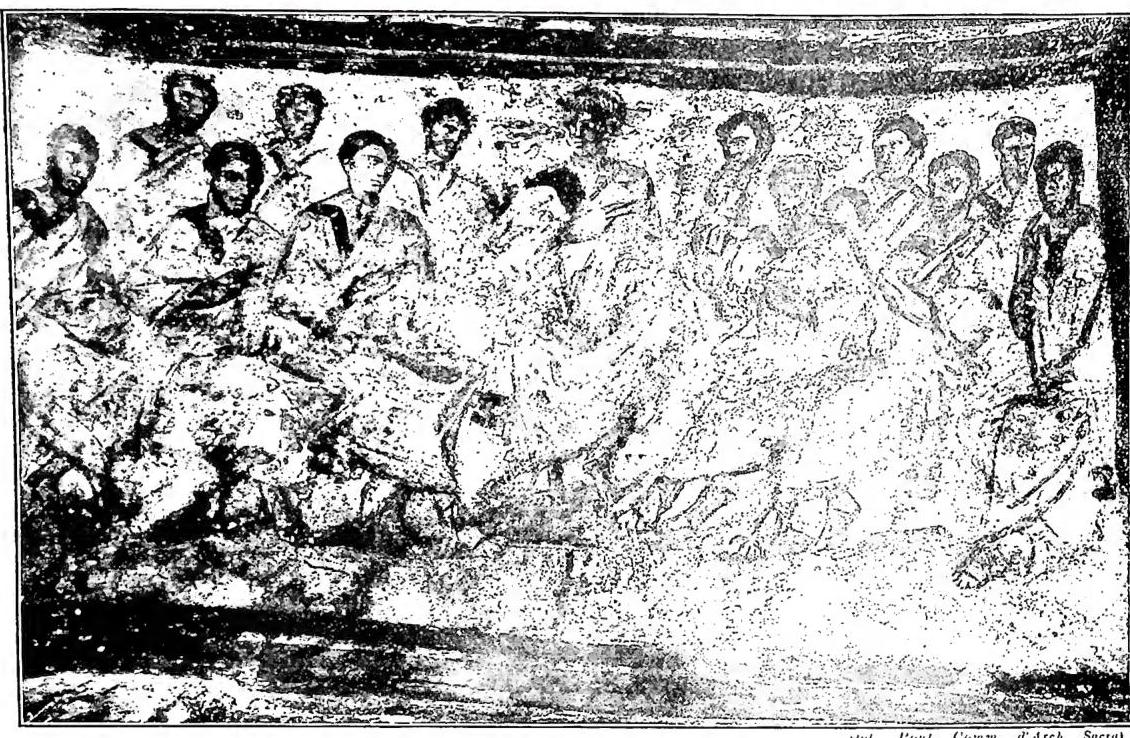
APOSTOLI - Christ among the twelve A. Fresco (4th century) - Rome, Cimitero dei Giordani.
(in: Paul. Comm. d'Arc. Sacra)
are the source of the Church’s hierarchy; for example, W. Mundle, in Zeitschrift für neutestamentl. Wissenschaft, 27 (1928), p. 41, speaks of “apostolic succession,” whereas others (e.g. K. H. Rengstorf) make no mention of II.
Luke, although he too is a disciple of Paul, who was not one of the “twelve,” lays great emphasis on the activity of the latter in the Acts of the Apostles. It is “the twelve” who control the Christian mission from Jerusalem. Peter and John inspect the mission in Samaria (8, 14 ff.); the movement in Antioch is supervised by Barnabas, who comes from Jerusalem (11, 22). Peter (11, 1 ff.; 12, 17 and 15, 22) and Paul as well (9, 26 ff.; 11, 30; 15, 1 ff.; 18, 22; 21, 15 ff.) continually return to Jerusalem. This does not mean that “the college” of “the twelve” always resided in Jerusalem, as K. Holl would have II. Peter and John also carry out their activity outside Jerusalem (8, 14; 9, 32 ff.; 10, 1 ff.; 12, 17); Paul (I Cor. 9, 5) knows not only of the missionary activity of Peter and the other apostles, but also of that of “the brothers of the Lord.”
The number “twelve” was not considered indispensable: after the death of James, the brother of John (Act. 12, 1), no other apostle was elected to replace him. The position of James, “the brother of the Lord,” is not clear to us. He seems to have been in Jerusalem among the apostles (Gal. 1, 19). E. Lohmeyer (Galilaea und Jerusalem, Gotting 1936) holds that he was the leader of those Jewish Christians who had gone from Galilee to Jerusalem, either before or after the death of Jesus.
K. Holl, in his famous inaugural lecture Der Kirchenbegriff des Paulus in seinem Verhältnis zu dem der Urgemeinde (Sitzungsberichte d. Berliner Akademie, 1921, p. 920 ff.; Gesammelte Aufsätze zur Kirchengeschichte, II: Der Osten, Tübinga 1928, p. 44 ff.), maintained the thesis that the community of Jerusalem, under the rule of “the twelve,” possessed a divinely ordained hierarchy (p. 54), and that Jerusalem was regarded as the center of the entire Church
(p. 55 ff.; cf. p. 61 ff.). His thesis has been strongly contested (also by K. H. Rengstorf and W. Mundle), and is untenable from the Catholic point of view. Perhaps Jewish Christianity in Palestine, after the death of Jesus, organized itself by imitating certain forms of ancient Judaism (the Sanhedrin, emissaries to the Diaspora, taxes); but the evangelical concept of the apostolate transcended this organization.
The apostolate created by Jesus was universal and, through apostolic succession, perpetual; in the sphere of doctrine it transmitted the teaching of the Master; after Christ’s ascension, it provided for the governance of the faithful through disciplinary and dogmatic prescriptions (Act. 15).
Alongside that of “the twelve,” the apostolate of St. Paul appears different; Epiphanius (Haer., I, ed. Holl, p. 232, 10 ff.) places Paul outside “the twelve” and outside “the seventy.” In Galatia his right to call himself an apostle was questioned, probably because the Christian community of Antioch had sent him (Act. 13, 1 ff.). Paul replied by stressing that he was not an apostle on the initiative of men, but through Jesus Christ and God the Father, who raised him from the dead (Gal. 1, 1).
Being sent by Christ was a fundamental element in the concept of the apostolate; by adding “and God the Father,” Paul gives his apostolate a distinctive character. He cannot claim to have been with Jesus during his earthly life, as is required of the apostle in Act. 1, 21 ff. (cf. Mc. 3, 14), but he can affirm that he saw Jesus (I Cor. 9, 1) and that, like the others, he was a witness of his resurrection (I Cor. 15, 5-8). Paul was not instructed by other men, but by Christ himself (Gal. 1, 13); nor does he mention Ananias, who baptized him (Act. 9, 18; 22, 16), and neither do the Acts speak of instruction by Ananias. He does not lack the apostles’ miracles (Gal. 3, 5; II Cor. 12, 12; Rom.
15, 18), nor apostolic privations and sufferings (II Cor. 6, 3 ff.; 11, 23 ff.), nor visions and revelations (II Cor. 12, 1 ff.). Paul, then, is an apostle like the others. He and Barnabas were recognized by the Three—that is, James, Cephas, and John—as having the right to go to the Gentiles (Gal. 2, 9), but the text does not directly say that they were recognized as apostles, or rather, in what sense their apostolate was understood.
The designation apostle was added by Jesus to the concept of “the twelve.” Jesus, speaking Aramaic, certainly used an Aramaic word. In the Syriac Church the apostle is called šeliḥā, a word corresponding in rabbinic literature to šaliaḥ (K. H. Rengstorf, p. 414), in Aramaic šeliḥā (cf. St. Jerome, In Gal. 1, 1: PL 26, 335). The rabbis sent from the central authority in Jerusalem to collect alms or to visit the Diaspora were called šeliḥim. Such an emissary (šaliaḥ) was Paul too, when he was sent to Damascus (Act. 9, 1 ff.); but the Jewish missionary never bears this name (Rengstorf, p. 418 ff.).
The assertion that “apostle” was a name designating the “missionary” (so A. Wikenhauser, in Reallexikon für Antike und Christentum, I, Lipsia 1942, p. 554) does not seem well founded. The word “apostle” as a translation of šaliaḥ, “emissary,” is also found in Jewish texts (Wikenhauser wrongly denies this, loc. cit., p. 555): cf. CIL, IX, 648, 6220 (J. B. Frey, Corpus inscriptionum judaicarum, I, Roma 1936, p. 438 ff., n. 611 [Venosa]). The inscription speaks of “duo apostoli et duo rebites.” The Codex Theodosianus mentions in a law of 399 (in XVI, 8, 14) officials, “quos ipsi apostolos vocant, qui ad exigendum aurum atque argentum a patriarcha certo tempore diriguntur.” Eusebius, Comm. in Is., 18, 1: PG 24, 213 ff., knows of Jewish apostles who carry encyclical letters from their authorities, also for the purpose of combating the Christian mission. Eusebius’s information is confirmed by Epiphanius, Haer., 30, 4, 2, ed. K. Holl, CB, XXV, p. 338, 21 ff. (cf. 4, 11), who places them in close relations with the Jewish patriarch (cf. St. Jerome, In Gal., 1, 1: PL 26, 335). J. B. Frey finds it difficult to accept this interpretation for the Venosa inscription (loc. cit., pp. cx and 439), but his skepticism does not seem plausible (Lietzmann’s date: 9th century, does not seem well founded).
For legends and apocrypha: V. apostles; for the names of the apostles, V. CATALOGO DEGLI A.
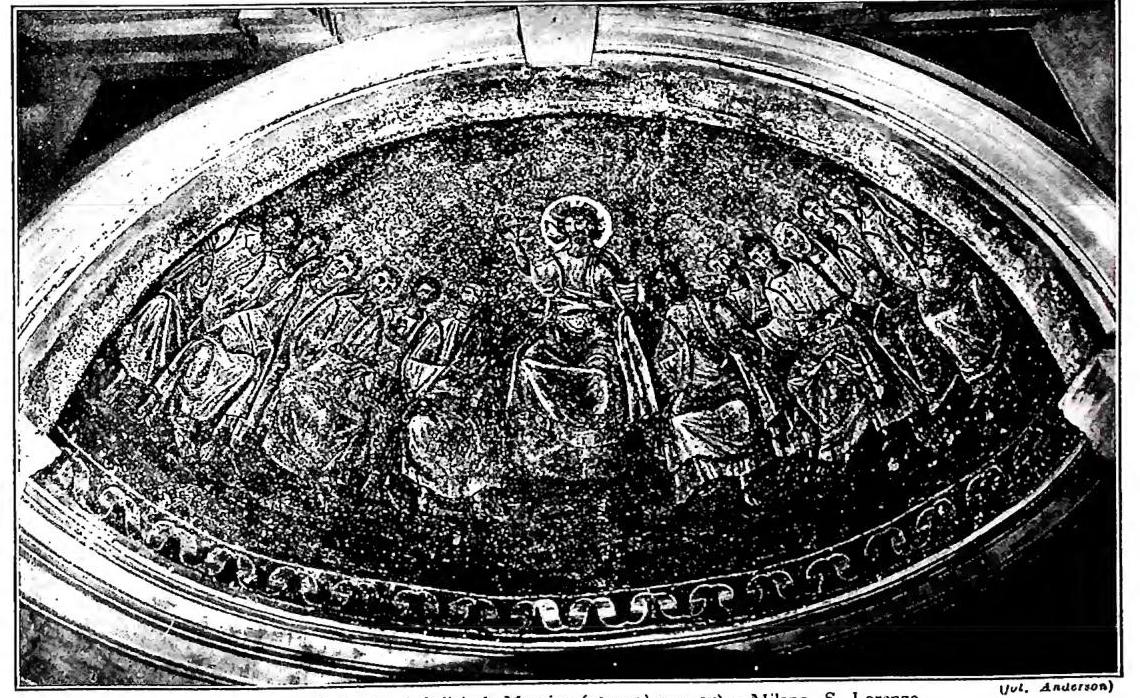
APOSTOLI — Christ among the twelve A. Mosaic (2nd half of the 4th century) — Milan, S. Lorenzo.
(vol. Andersen)
Billerbeck, Kommentar zum N. T. aus Talmud und Midrasch, III, Munich 1926, p. 2 ff. — For the apocryphal narratives and legends concerning the a.: R. A. Lipsius, Die apokryphen Apostelschichten und Apostellegenden, 3 vols., Braunschweig 1883–90; R. A. Lipsius-M. Bonnet, Acta Apostolorum apocrypha, Leipzig, I (1896) and II (in two parts, 1893 and 1903); Th. Schermann, Propheten- und Apostellegenden (Texte u. Unters., 31, 11), Leipzig 1907.
MISSION, PREROGATIVES, POWERS OF THE APOSTLES. — Election and immediate mission by Jesus constitute the first and fundamental requisite for qualification as an apostle. This is clearly demonstrated by many texts of Sacred Scripture: thus, in Mc. 3, 13-14, it is said that Jesus, “having gone up a mountain, called to him those whom he wished... and chose twelve to be with him and to send them to preach”; in Io. 17, 18, the Lord, addressing the Father, says: “As you sent me into the world, so I have sent them into the world”; likewise in Io. 20, 21, where Jesus says to the apostles: “As the Father has sent me, I also send you.”
It is nevertheless debated whether, in addition to this immediate mission, other conditions are required for the apostolate; in particular, whether it is necessary that the apostle have “seen the Lord.” This requirement seems to be demanded by the text of Mc. 3, 13-14 already cited: “he chose twelve to be with him”; furthermore, it seems to be presupposed by St. Peter when, in the matter of giving Judas a successor, he suggested that the latter be chosen from among those who “have accompanied us during all the time that the Lord Jesus dwelt among us, beginning from the baptism of John until the day when he was taken up from us, so that he may be constituted with us a witness of his resurrection” (Act. 1, 21-22); it is precisely this requirement that St. Paul seems to allude to when he writes: “Am I not an apostle? Have I not seen Jesus Christ our Lord?” (I Cor. 9, 1).
Despite this debate, however, many authors incline to the view that election and immediate mission constitute not only the fundamental but also the sole requisite for the apostolate. They therefore claim this requisite both for Matthias (Act. 1, 25-26), and for Paul (Act. 9, 15; 22-15), and for Barnabas (Act. 13, 2-4).
This mission of the apostles is directed toward a twofold office: one extraordinary, which was to cease with the apostles themselves, and which consisted in continuing the work of Jesus by laying, according to the divine plan, the foundations of the Church upon the one cornerstone, Christ Jesus; the other ordinary, which was to be transmitted to the successors of the apostles, and which consisted in being the hierarchical authority in the already founded Church.
The mission of the founders of the Church is illustrated, among others, by the following texts of Sacred Scripture: Mt. 16, 18: “You are Peter, and upon this rock I will build my Church”; Eph. 2, 20: “You are... built upon the foundation of the apostles... Christ Jesus himself being the chief cornerstone”; Apoc. 21, 14, where the apostle John, describing the “new Jerusalem,” says: “The wall of the city had twelve foundations, and upon them the twelve names of the twelve apostles of the Lamb.”
The words addressed by Jesus to the apostles concern, instead, the function of hierarchical authority in the Church: “Whatever you bind on earth shall be bound also in heaven; and whatever you loose on earth shall be loosed also in heaven” (Mt. 18, 18); this function is also indicated in the words that Jesus spoke to Peter and, in union with and under the dependence of Peter, to all the apostles: namely, to feed his lambs and his sheep (Io. 21, 15-17).
Connected with the office of founders of the Church are the prerogatives of the apostles, that is, those extraordinary gifts with which the Lord personally wished to enrich the apostles so that they might be capable of fulfilling the great mission entrusted to them. According to the common opinion of theologians, these prerogatives are: confirmation in grace, whereby, after the descent of the Holy Spirit, the apostles could practically no longer commit either any grave sin or any fully deliberate venial sin; personal infallibility, whereby, in his preaching and teaching, each apostle was immune from error both with regard to the doctrine to be believed and with regard to the rules of moral life to be followed; universal jurisdiction with fullness of powers, whereby every apostle, without prejudice to the primacy of Peter, could found churches anywhere, create bishops, and organize religious life with full authority. Whether the charism of biblical inspiration should also be regarded as a prerogative of the apostle is uncertain: some affirm it, for example U. Ubaldi, P. Schanz, J. M. Lagrange; most deny it, such as I. B. Franzelin, F. Leitner, Ae. Dorsch, H. Hurter, C. Pesch, G. M. Perrella.
Connected with the ordinary office of hierarchical authority in the Church are the powers of the apostles, that is, those faculties which they received as shepherds of the faithful and which they transmitted to the bishops whom they ordained. These concern the power: to teach (Mt. 28, 18, 20); to govern (Mt. 18, 17-18); to sanctify, especially through the administration of the Sacraments (Mt. 28, 19; Lc. 22, 19; Io. 20, 21-23).
How the apostles fulfilled the mission to which they had been destined, employing their prerogatives and exercising the powers given them by the Lord, is brought to light both by the Acts, the Epistles, and the history of the primitive Church.
For the apostles and the deposit of Revelation, V. DOGMA, EVOLUTION.
Francesco Carpinio
THE APOSTLES IN POPULAR LITERATURE. — A series of short legends, in prose and in no fixed form, still circulates in popular tradition; they have grown up around the figures of the apostles, who are generally presented as an indistinct group accompanying the Divine Master. Some concern the apostle Pietro in particular, as well as the mother of s. Pietro. In this fragmentary popular apocryphal gospel, transmitted orally, the various characters are sometimes completely distorted, and the episodes take on an almost fairy-tale character. Elements of a crude and naïve comic quality are even introduced. The figure of one apostle or another also appears in short lyric-narrative songs that develop legendary themes concerning the Holy Family.
Paolo Toschi
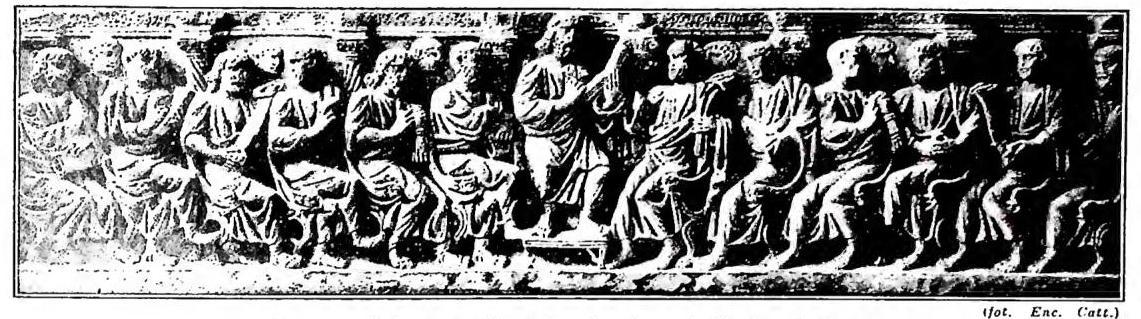
THE APOSTLES IN ICONOGRAPHY. — Their representation was already one of the preferred themes of early Christian art, not only as insignificant accessories to the events of Jesus’ life, but also as actors and principal figures. In this case they appear either individually or in groups. We shall deal elsewhere with the depiction of identifiable individual apostles.
The apostles were often represented collegially from the beginning of the 4th century onward. Jesus is always among them, at times symbolically (cross, lamb), ordinarily in person, either seated on a throne or on the sacred mountain, in the act of instructing them or sending them to evangelize the world (traditio legis, traditio clavium), or in the solemn gesture of the Maestus. They are therefore found either all seated in a circle (catacomb art), or standing upright along a line (the fronts of sarcophagi), and they usually hold the volumen in their hands. More unusual arrangements, dictated by the nature of the available space, are rarer; for example, the apostles arranged in a circle around the bust of Jesus (on the bottom of a glass), or the symbolic representation by means of twelve lambs, doves, and even twelve stars, sometimes joined to the realistic representation of the persons. A marked peculiarity is found in the paintings of the hypogeum of the Aurelii (Rome), both because of their date, considerably earlier than the 4th century, and because the apostles are said to be represented there without Jesus, both as a college and as single individuals.
The apostles, like the other biblical figures, are all presented alike in tunic and pallium, almost always beardless, without any characteristic physiognomic feature, except in the case of Peter and Paul, the two leaders, from the 4th century onward, and not much later Andrew (the tousled hair). When it was desired to distinguish them, each was simply labeled with his name. It then appears that among the twelve Paul was customarily placed in the position of Matthias; at times, however, they also included the two evangelists Mark and Luke, substituted for Thaddeus and one James. This list, already found on a sarcophagus at Arles and later in the mausoleum of Theodoric at Ravenna, subsequently became stereotyped in medieval Greek art, whereas in the West the other list was used, namely that of the Communicantes in the Canon of the Mass.
As the Middle Ages progressed, the ancient themes already mentioned were joined by those of the Ascension, Pentecost, the Last Supper, the dormitio Virginis, and later the Last Judgment and the separation of the apostles, or division of the world; these themes also remained familiar to Renaissance art. A wholly distinctive representation, much used beyond the Alps, is that of the twelve articles of the creed by means of the twelve apostles, often paired with the twelve prophets. The preferred locations for the Apostolic College are arched or concave spaces, such as apses and domes; especially the great portals of Romanesque and Gothic churches.
During the Middle Ages, the personal characteristics of each of the twelve also gradually took shape (under the influence of the apocryphal Acts), so that around the 10th century in the East, and in the 14th in the West, each was by then recognizable within the series. The principal difference lies in the youthful figure that the West gives to St. John, whereas the East sees in him the Great Elder of the Apocalypse.
As regards its extent, the Ethiopic text is longer than the Coptic text, and in the Latin translation chapter 17 follows chapter 13. In the text published by C. Schmidt there is certainly a lacuna between chapters 14 and 15 (cf. H. Lietzmann, in Zeitschrift für neutestamentl. Wissenschaft, 20 [1921], p. 175). The long Ethiopic text exists only in manuscripts from the eighteenth century and is preceded by an Apocalypse of Jesus and the first two books of the Testamentum Domini, a Syriac compilation of di-
La prima parte (l'Epistola) contiene al cap. 2 un'interessante lista dei nomi degli apostoli (cf. K. Lake, in Harvard Theol. Review, 14 [1925], p. 95), al cap. 4 una citazione dell'apocrifo Vangelo di Tommaso (o Ps.-Matteo, cf. C. Schmidt, p. 226 sg.), menziona al cap. 7 Cerinto e Simon Mago, senza però fare chiari accenni alle loro eresie; i capp. 9 e segg. contengono un racconto apocrifo della risurrezione di Cristo (cf. A. Harnack, in Theologische Studien für Bernhard Weiss, Gottlinga 1897, p. 3 agg.; A. Baumstark, Hippolyta und die ausserkanonische Evangelienquelle des äthiopischen Galiläa-Testaments, in Zeitschrift für neutestamentl. Wissenschaft, 15 [1914], pp. 332-35). Nel cap. 11 c'è probabilmente una citazione dal Vangelo degli Ebrei.
Nella seconda parte, il cap. 13 racconta la discesa di Cristo dai cieli in forma di angelo. Durante il suo soggiorno in terra gli arcangeli servono invece di lui all'altare del Padre. Il tema dell'assimilazione di Cristo agli angeli è di origine gnostica (cf. Jos. Barbel, Christos Angelos, Bonn 1941, p. 236 agg.), ma fu introdotto da Origene nella teologia della Chiesa. Era Cristo che, secondo il cap. 14 appariva a Maria sotto la forma di Gabriele. Il cap. 15 racconta
come un apostolo è liberato dalle carceri per mezzo di Gabriele - questa volta distinto da Cristo - per poter assistere alla commemorazione della morte di Gesù. Si tratta probabilmente del racconto di Act. 12, 2 sgg., ma così modificato, che sembra doversi supporre un apocrifo (diversamente Schmidt, p. 247), forse i vecchi Atti di Pietro. Il cap. 17 reca: il Padre (!) ritornerà dopo 120 anni. L. Gry ha provato (Revue Biblique, 49 [1940], p. 86 sg.) che l'indicazione «fra Pasqua e Pentecoste», come la data «120 anni», vengono da fonti giudiziche. Una datazione giudaica della fine del mondo è adottata per dature il ritorno di Gesù; ma per una fissazione cronologica dell'Epistola ciò non dà nessun contributo. Le varie domande dei discepoli, che seguono, sono di minore interesse: traspare la mentalità del cristianesimo egiziano, come prova anche una frase liturgica (cap. 21) che si trova nella liturgia di s. Marco. Questi capitoli riflettono un'epoca più recente; ad es., gli Apostoli, e non Anania, battezzano Paolo dopo la sua conversione (cap. 31): difficoltà giuridica (Anania non aveva il diritto di battezzare) che è espressa in Constit. apost., VIII, 46, 17 (ed. F. X. Funk, Didaccolia et Const. apost., I, Paderborn 1905, p. 562, r. 21 sgg.).
Si trova dunque materiale antico nella prima parte, mentre la seconda è più recente. La prima parte deve risalire a prima del sec. v, in quanto si tratta soltanto di citazione; l'intero scritto è compilazione molto più recente. La fisionomia letteraria del compilatore non è riconoscibile.