
VESCOVO. – He is the successor of the Apostles in the ordinary governance of the individual Churches (v. DIOCESI) under the authority of the Roman Pontiff (CIC, can. 329 § 1).
Bishop (ἐπίσκοπος, from ἐπίσκοπος = to look over, to watch over) is equivalent to inspector, superintendent, guardian, observer, and is used in this sense in common language; in the first and second centuries B.C., the public officials of the island of Rhodes were called V. (cf. F. Prat, Evēques, in DThC, V, cols. 1658–59). In the translation of the Septuagint, this name is applied to governors (Iude, 9, 28), prefects (II Esdr. 11, 9), magistrates (Is. 60, 17), royal ambassadors (II Mach. 1, 46), and God himself (Iob. 20, 20; Sap. 1, 6). In the New Testament, the word ἐπίσκοπος is used only five times, four of them to indicate the superiors of the Christian community (Act. 20, 28; Phil. 1, 1; I Tim. 3, 4; Tit. 1, 7), and once to signify Jesus Christ (I Pt. 2, 25: «episcopus animarum nostrarum»). In patristic literature it came into common use from the beginning of the second century, to indicate the head of individual Christian communities.
I. DIVINE ORIGIN OF THE MONARCHICAL EPISCOPATE
It is historically established that from the beginning of the second century onward, everywhere the monarchical episcopate prevailed as a constitutional norm founded on the will of God (jure divino).1) Monarchical episcopate. — St. Ignatius of Antioch (d. in 107) attests that all the Churches to which he wrote his letters were provided with a single v., as their recognized and venerated head, whose name he also recalls: Onesimus in the Church of Ephesus (Eph. 1, 2), Damas in the Church of Magnesia (Maga. 2, 1), Polybius in the Church of Tralles (Troll. 1, 1), Polycarp in the Church of Smyrna (Ad Polye, prologue); the V. of Philadelphia is mentioned (Philadel. 11, «quem episcopum cognovi»), though his name is not given; Ignatius himself presents himself as the sole bishop of Antioch (Rom. 2, 2, 9, 1), and indeed holds that in every part of the world, wherever a Church has been founded, there is a V. (Eph. 3, 2; V. ORDINE E ORDINAZIONE). Around the middle of the second century, catalogues of V. were drawn up, indicating the succession of a single head for each Church. According to the testimony of Hegesippus, reported by Eusebius (Hist. eccl., IV, 22, 1-3: PG 20, 378-79), the Churches of Corinth, Rome, and all the others whose succession of bishops he recalls in general terms were monarchical (è in singulis autem episcoporum successionibus et per singulas urbes eadem manent, ibid.). At the same time St. Irenaeus drew up the catalogue of the bishops of Rome (Adv. haeres., III, 3, 3: PG 7, 849 sgg.); and he attests the monarchical succession of the bishops of the Church of Smyrna (ibid., III, 3, 4: PG 7, 851) and of all the other Churches of the world (ibid., III, 3, 1: PG 7, 848). Shortly afterward, in the well-known controversy over the celebration of Easter, clear testimonies emerge concerning the monarchical constitution of all the Churches that took part in the debate (Eusebius, Hist. eccl., V, 23: PG 20, 491-94): Caesarea in Palestine (Theophilus), Jerusalem (Narcissus), Pontus (Palmas), Lyons (Irenaeus), Corinth (Bacchylus), Rome (Victor). In his letter to Pope Victor, Polycrates, V. of Ephesus, recalls various bishops of Asia Minor (each placed over a Church): Thraseas of Eumenia, Polycarp of Smyrna, Sagaris of Laodicea, Melito of Sardis, and adds that an «ingens numerus episcoporum», among those living in his time, supported the Quartodeciman practice of celebrating Easter (Eusebius, Hist. eccl., V, 24: PG 20, 485-86).
That the episcopate is monarchical by an inviolable norm is a universal conviction emerging from the documents. St. Ignatius, writing to the Romans (chap. 9), states that the Antiochene Church is without a pastor; he would not have asserted this had he believed that a Church could be governed collegially by the presbyters. The same holy martyr urges the faithful to make use of a single Eucharist, not only because there is one Flesh of Jesus and one is his Blood, but also because there is only one V. for each Church (Philadelph., 4, 1). The same conviction appears in the explicit testimonies of St. Irenaeus (Adv. Haeres., III, 14, 2: PL 7, 914), of St. Pope Cornelius (Ep., 49, 2; Eusebius, Hist. eccl., VI, 43, 11: PG 20, 617: ergo ille Evangelii vindex ignorabat unum episcopum esse oportere in Ecclesia catholica) and, above all, of St. Cyprian (De Unitate Ecclesiae, chap. 8).
b) The episcopate is monarchical by the will of God. — St. Ignatius affirms this with particular insistence, in various forms: he demands absolute obedience to the bishops (Eph., 2, 2; Trall., 13, 2; Philadelph., 3, 2; Smyrn., 8, 1), because such is the will of God (Eph., 5, 3; 6, 1; Trall., 2, 1; Smyrn., 9, 1). He therefore warns that nothing can be done in the Church without the V. (Philadelph., 7, 1: «sine episcopo nihil faciatis»; cf. Magn., 4, 1, 6, 1; Trall., 2, 2; 7, 2; Smyrn., 8, 1; Polyc., 4, 1). The same concept is developed by Hegesippus (in Eusebius, Hist. eccl., IV, 11: PG 20, 350), by St. Irenaeus (Adv. Haeres., III, 3, 1; IV, 26, 2: PG 7, 848 and 1055), by Tertullian (De praescriptione haereticorum, 32: PL 2, 52-53), especially by St. Cyprian (Ep., 6, 7 ad Florentium Puppianum), and by the entire Western and Eastern tradition of the following centuries.
Concerning the constitution of the Church in the first century, while the Apostles were still alive, a longstanding controversy continues, determined by the synonymy of the terms προεβύτεροι and ἐκλογοῦσι (Act. 20, 17 and 28) and by the fact that the episcopal monarchy does not appear to have been clearly constituted. Whatever solution one may accept, it remains indisputable from what has been said (v. ORDINE RELIGIOSO) that, before their death, the Apostles established precise norms concerning the monarchical government of the Church and ordained that everywhere there should be heirs and successors to their apostolate.
II. POWERS AND DIGNITY OF THE V
The v., as successors of the Apostles in the ordinary government of the Church, have inherited the three powers conferred by Christ upon the apostolic College when he ascended to Christ: «Go and teach all nations, baptizing them... and teaching them to observe all that I have taught you» (Mt. 28:28), namely, the power to teach (magisterium), to sanctify (ministerium), and to govern (imperium). The V. are «veri doctores seu magistri» (can. 1326), who prolong divine-apostolic teaching through time: «Whoever listens to you listens to me» (Lc. 10:16).The words of the Roman Pontifical refer to the power of sanctification of the v.: «Episcopum oportet iudicare, consacrare, ordinare, offerre, baptizare et confirmare». The iudicare principally concerns the penitential discipline of the ancient Church, in which the beginning (confession), the course (satisfaction), and the conclusion (absolution) of the penance of the faithful were reserved to the v., who later, as pastoral duties increased, obtained assistance from presbyteri paeniteniari (v. PENITENZA).
The consecrare is connected with the consecration of the baptismal font, the holy oils, and churches, which in principle were and are reserved to the v., even though, after the establishment of parishes, some of these functions were granted to ordinary priests.
The ordinare is the v.’s incommunicable function (v. ORDINE RELIGIOSO), the function by which he is essentially distinguished from the priest. The offerre, that is, the celebration of the Eucharist, initially belonged to the V. (cf. s. Giustino, I Apol., 65). The baptizare et confirmare were predominantly episcopal functions, especially the confirmare, of which he has remained the ordinary minister. As for Baptism, although from the beginning deacons (Act. 8:36-38) also exercised these functions, it was nevertheless the proper and ordinary office of the V. (cf. s. Ignazio, Smyrn., 8, 2), that is, of the summus sacerdos (Tertulliano, De Baptismo, 17, who also mentions priests and deacons as subordinate ministers).
The power of jurisdiction (the sacred principate or imperium, to which every form of teaching exercised in the Church by other members of the clergy is subject) is the v.’s most conspicuous power: «Spiritus Sanctus posuit episcopos regere Ecclesiam Dei» (Act. 20:28; although, in its historical context, the text does not refer exclusively to the v., tradition has nevertheless reserved it to them); this power is today regulated by precise norms of Canon Law.
By virtue of the totality of these spiritual powers, the figure of the V. appeared from the very beginning of Christianity clothed in particular dignity and worthy of special reverence. For s. Ignazio di Antiochia the V. is the «image of the Father» (Trall., 3, 1), since he recalls the presence «of the V. invisi-
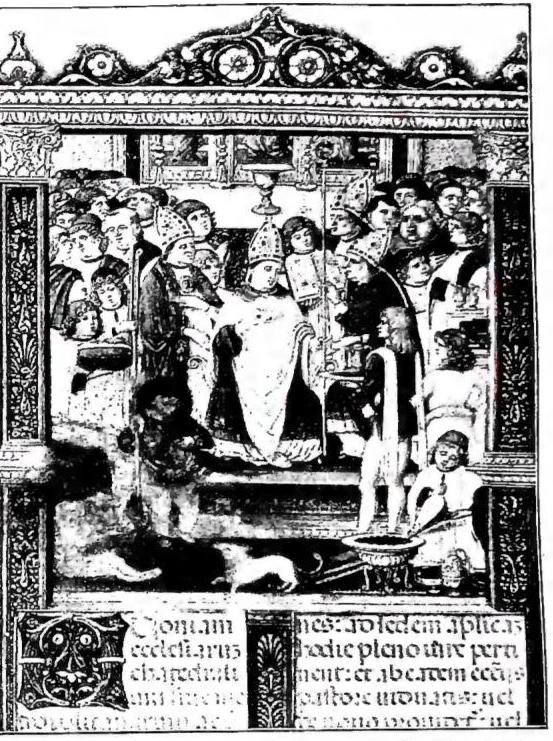
BISHOP — Consecration of a bishop. Moment of the symbolic offerings: torches and focaccia, at the Offertory of the pontifical Mass. Miniature from the Pontificale of Giovanni Vitez, bishop of Vesprimia (1498–1500) — Vatican Library, cod. Ott. lat. 501, fol. 387.
The dignity of the bishop appeared from the very beginning of Christianity invested with particular honor and deserving of special reverence. For St. Ignatius of Antioch, the bishop is the “image of the Father” (Trall., 3, 1), since he recalls the presence “of the invisible bishop, the Father of Jesus Christ” (Magn., 3, 1). In the Didascalia of the Apostles, II, 26, 4–8, the bishop is praised as “the prince of priests, the minister of the Word, the mediator, the teacher, the father before God, he who regenerates through Baptism, the head and guide... he who occupies the place of God.” According to the unknown author of the Adversus aleatores (PL 4, 827), the bishop has received from God “apostolatus ducatum,” “vicariam Domini sedem,” “originem authentici apostolatus,” which “in superiore suo portat.” In the judgment of St. Hilary of Poitiers (Contra Constantium, 11: PL 10, 589), the bishop is Christ himself. According to St. Thomas (IV Sent., d. 24, q. 2, a. 1, qc. 1), the bishop is the “sponsus Ecclesiae” (cf. G. M. Monsabré, Exposizione del dogma cattolico: L'Ordine, XIV, Italian trans., Turin 1929, pp. 148–185).
III. ERRORS AND DEFINITIONS
Aerius ([v.] 4th cent.) was the first to deny any difference between the V. and the priest: «Est enim, amborum unus ordo, par et idem honor et dignitas» (St. Epiphanius, Haeres., 75, 3: PG 42, 509). This error was repeated by Marsilius of Padua (Denz-U, 498), by Wicleff and Huss (ibid., 675), and aggravated by Luther and Calvin (Institutio religionis christianae, IV, 4, 2): indeed, the latter denied the episcopal and hierarchical constitution of the Church (cf. H. Dieckmann, De Ecclesia, I, Freiburg im Br. 1928, pp. 472-80). Modern liberal and rationalist Protestants hold that the episcopate is an institution of purely human origin, arising from the influence of various historical circumstances. On the various theories of Baur, Rothe, Hatch, Harnack, Sohm, and Sabatier, cf. F. Prat, Evêques. Origine de l'épiscopat, in DThC, V, cols. 1694-99. Notable for its apparent simplicity is Renan’s theory, according to which the ecclesiastical hierarchy would be the effect of a threefold abdication: that of the primitive Christian community in favor of the presbyters, that of the presbyters in favor of the v., and that of the latter in favor of the Pope (Les Evangiles, Paris 1877, p. 332).On various occasions the Church has expressed her thought concerning the origin and powers of the V. The Council of Trent (sess. XXIII, chap. 4): «Sacrosanta Synodus declarat... episcopos, qui in Apostolorum locum successerunt, ad hunc hierarchicum ordinem praecipue pertinere» (Denz-U, 960). The same concept is repeated by the First Vatican Council (sess. IV, chap. 3: ibid., 1828). The decree Lamentabili (3 July 1907) condemns the modernist theory of an episcopate constituted for purely practical reasons, independently of its mission to continue the work of the Apostles (ibid., 2050). The anti-Modernist oath explicitly asserts that the V. are successors of the Apostles (ibid., 2147), while the CIC affirms their divine institution (can. 329 § 1).
IV. CANON LAW
Being decorated with metropolitan (v.), of primate, or of patriarch (v.) adds nothing to the V. in the hierarchy of order (v.); the Roman Pontiff himself (v. PAPA) is superior to him only in the hierarchy of jurisdiction. As a rule, he exercises ordinary jurisdiction over a specific territory: diocese (v.) or eparchy, or over a specific population (v. ECCLESIASTICAL CIRCUMSCRIPTIONS); whereas the jurisdiction of the V. Church.1. Election
At first the V. were designated by the Apostles from among persons whom they had directly tested or who had been presented to them as capable; later they were chosen within the individual communities or were called from other communities on account of the good reputation they had acquired elsewhere. The nearest v., or the V. of the chief city of the province, after examining the legitimacy of the choice and the competence of the elected candidate, conferred consecration upon him, generally with the assistance of other V. When, somewhat later, the ecclesiastical provinces were regularly constituted in the East, the election took place in the presence of the metropolitan, who judged the candidate’s qualifications and, above all, his orthodoxy, and conferred consecration upon him; the intervention of the people was thus reduced to an external testimony of approval. In the case of the metropolitan, the comprovincial V. were responsible for electing their superior and notified the other metropolitans of the region of the election as a sign of mutual communion. This ordinary course of events was nevertheless frequently disturbed, from the 4th century onward, by the intervention of the emperors of Constantinople, who imposed the election of persons they favoured, especially to patriarchal sees. In the West, where metropolitan authority became established somewhat later, popular intervention retained greater importance until it was practically suppressed by the intervention of the rulers of the new barbarian dynasties. The canonical principle nevertheless always remained alive in the West that the V. should be elected with the participation of the clergy and the people (like the abbot of his community), under the legitimate assistance of the ecclesiastical superior; and it remained firm even when, feudalism (v.) and the resulting investiture, ecclesiastical relations seemed almost absorbed into public ones, so that sovereigns aspired to transform into a right what was in fact an undue intrusion. Hence the struggle over investitures (v.), concluded by the Concordat of Worms (1122), which restored the genuine ecclesiastical tradition in its essential outlines. In practice, however, according to the law of the Decretals, the election of V. was in fact and almost everywhere assigned to the cathedral Chapters, with which, according to particular customs, the approval of the rest of the clergy and of the principal lay dependants also concurred (v. CANONICAL PROVISION). The Pope had direct control over the sees of peninsular and insular Italy, over which he had been the sole metropolitan until the 10th century; controversial cases concerning the election and deposition of the V. judgment, as to a supreme tribunal and therefore only in extraordinary cases, and he himself then made the relevant appointments whenever he deemed it necessary. During the 13th century he began as a rule to reserve to himself the appointment of V. when certain circumstances obtained; until, in the 14th century, appointments to all episcopal sees became subject to his reservation. This inevitably aroused discontent in the various countries and, after the Great Schism, while in Italy and some other countries the appointment of V. Pope, elsewhere there was a return to the law of the Decretals; this once again afforded sovereigns the opportunity to interfere in appointments within their dominions, especially in cases of disputes or dynastic interests. Particularly in France, once national unity had been restored, such interference became more pronounced, and by the Concordat of 1516 the sovereign obtained the privilege of appointing the v., to whom the Pope granted canonical institution and issued the bulls. This privilege was subsequently carried over into the Concordat of 1801 and served as a model for the other concordats of that period. The right of patronage that canon law recognized for those who founded or endowed ecclesiastical benefices (parishes, canonries, monasteries, simple benefices) was intended to be applied in favour of sovereigns who erected new episcopal sees; this occurred particularly in Spain with regard to the new sees erected under its patronage in the West Indies, and in Portugal with regard to those erected in the East Indies, and continued in Spain until the beginning of the 19th century and in Portugal until somewhat later; elsewhere too (as in the Kingdom of Naples and Sicily), appointment to certain sees was claimed for this reason. Today, except in certain sees in Germany, where appointment is made by the Chapters with numerous restrictions imposed by the civil authority, the V. are as a rule appointed by the Holy See following prior consultations, which vary from place to place. According to the most recent concordats, the Holy See notifies the civil authority of the names of those designated for the episcopate, so that it may state any legitimate objections should the appointment prove unsuitable. The (informative) process for each individual election is prepared by the Sacred Consistorial Congregation; the appointment itself is made by bull and published in consistory.2. Authority
By divine disposition, ecclesiastical jurisdiction is regularly exercised over the faithful through the episcopal body, which derives it, as its proximate and immediate cause, from the Roman Pontiff, as the head on earth of the whole Church (v. CHURCH; IV). It is his responsibility to determine the scope of the authority of the V. and their mutual relations, to assign the territory and the persons over whom that authority is to be exercised, to grant canonical institution, and to withdraw it whenever this should prove necessary for the spiritual good of the individual places.The V. is elected for a particular city; however, at least in the early Middle Ages, he was also elected for an entire region when it had not yet been evangelized and there was no urban or rural centre of any importance in which to establish the cathedral see; thus, in the 7th–9th centuries, in the vast regions beyond the Alps there were wandering and itinerant v., true missionary V. who exercised their ministry more or less dependently upon a residential V. over a territory whose boundaries were quite poorly defined; many
(phot. Landesmuseum)
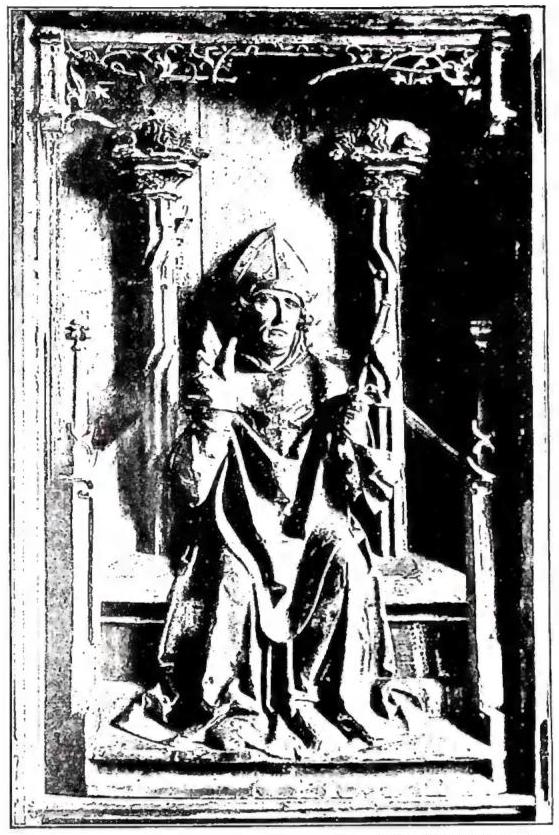
VESCOVO - Bishop seated on a throne. Carved wooden panel by Benedetto Dreyer (c. 1510–20) - Hannover, Museum.
Many of them were of Irish nationality (Scotti) and prepared the foundation of new episcopal sees.
Even the designation of suffragans, which according to law belonged to bishops subject to a metropolitan, was usurped by such bishops, who today are instead called auxiliaries. Coadjutors, on the other hand, are still today those titular bishops who share in the government of the diocese and are assigned by the Holy See with or without the right of succession.
According to the most recent norms, election to the episcopate requires legitimacy of birth, the state of celibacy, an age of at least thirty years, at least five years of priesthood, purity of morals, aptitude for government, zeal, a doctorate or at least a licentiate in theology or canon law, or else recognized genuine expertise in the sacred disciplines (CIC, can. 331). The consecration of the bishop is reserved to the Pope (can. 953), and no bishop may perform it without an apostolic mandate. The person elected is required to receive it within three months of his appointment and to take possession of his diocese within four. It is conferred
during solemn Mass on Sundays and feasts of the Apostles and, as a rule, with the assistance of two other bishops. Taking possession, by which the exercise of the jurisdiction of the diocese begins, entails no liturgical rite. The new bishop does so personally or through a proxy, presenting the bull of appointment to the Chapter in the cathedral church and thereupon taking his seat on the episcopal throne and receiving the homage of the members of the Chapter and of the cathedral clergy. When the elect was consecrated in his episcopal see, he thereby took possession of his office; today he may take possession even before his consecration, provided that he has made the profession of faith and the oath of submission to the Pontiff.
In exercising the power of order, the bishop is bound to follow the liturgical prescriptions of his own rite. He may confer Holy Orders only upon his own subjects and with the required safeguards, and likewise Confirmation; nor may he exercise episcopal functions outside his own diocese unless requested to do so by one who has the authority.
The bishop carries jurisdiction (v.) in the internal and external forum, and sometimes also as a delegate of the Apostolic See; he is bound to observe ecclesiastical laws and may do throughout the entire diocese whatever the parish priest does in his parish. For a just cause, he may grant a dispensation from the observance of general laws in cases in which this is permitted him by the laws themselves; conversely, he may not forbid what the laws themselves permit. By virtue of this ordinary authority he exercises: a) legislative power, by promulgating laws, without depending on others except in those cases in which the canons impose upon him prior consultation or even the consent of the cathedral Chapter, and for synod (v.) according to canonical norms; b) judicial power, by holding a court of first instance in disputes involving his subjects and in matrimonial cases, and also of second instance if he is a metropolitan, with power to pronounce judgment; c) coercive power against the disobedient, whether clergy or people, imposing even temporal penalties, censures, and other punishments. As teacher in his Church, the bishop preaches and regulates the preaching of his clergy, directs religious instruction, especially that of the young, supervises the press, particularly in matters of faith and morals, and reserves to his direct approval whatever his clergy sends to print. He is responsible for the administration of ecclesiastical property, decides on the establishment of ecclesiastical offices and pious institutions, supervises their operation, and above all directs the government of the Seminary. Everything that contributes to the religious and moral progress of clergy and people is the object of his pastoral care. In order to fulfil these duties, canon law residence (v.) in the diocese and particularly in the episcopal city, and at the appropriate time to carry out the pastoral visitation of the diocese itself in the prescribed forms. He submits a written report on the condition of the diocese to the Holy See, especially on the occasion of the periodic visit ad limina Apostolorum (for European bishops, every five years), that is, to the basilicas of SS. Peter and Paul and to the Pope in Rome. For the government of the diocese and the dispatch of business, curia (v.), and he is also permitted to levy moderate tributes (v. CATTEDRATICO) and taxes; he receives the revenues of the mensa for his personal support and that of his household. He also possesses honorary rights, such as that of the portable altar, of the throne with canopy, and of precedence over other prelates, bishops, and archbishops in the diocese (except his own metropolitan and the legates of the Holy See); he grants indulgences of up to one hundred days.
in Coll. Brug., 23 (1923), pp. 203-205, 292-94; J. Warichez, Les nominations épisc. au diac. de Tournai, in Coll. Tournae., 19 (1923-24), pp. 145-64; E. Garnier, Adnotationes ad usum episc., in Per. de re mor. can. liturg., 1924, pp. 99-121; V. Martin, La choix des évêques dans l'Épi. lat., in Rev. de sc. relig., 4 (1924), pp. 221-64; M. G. Carbò, Comment. breve regiminis pastoralis, ecc., Roma 1930; id., Episcopali audientia. L'attività giuridic- stionale del v., Milano 1937; C. Magni, Questioni controverse in- torno allo svolgimento delle elez. episc. in Italia prima della lotta della investiture, in Riv. di st. del dir. ital., 4 (1931), pp. 421-38; U. Mozzoni, I V. nel diritto eccl. ital. concordatorio, Roma 1935; J. Haring, De iure remonstrationis episc. contra iura et mandatu Sedis Ap., in Misc. Vermeerich, I, ivi 1936, pp. 321-26; L. Brag- gales, Die Besetzung der bischöf. Stühle in Deutschl. auf Grund der Konhardate für Reich und Länder, ibid., p. 355 sgg.; E. Ga- rela, El decreto sobre la residencia de los obispos en la tercera asemblea del Conc. Trid., Cadice 1944; R. Adam, Le pouvoir cobritif de l'évêque, Québec 1946; A. M. Franqueau, La consti- tución apostólica acerca los obispos que asisten a la consagración episcopal, in Rev. esp. de el der. can., 12 (1947, II), pp. 209-38; T. Jedin, Il tipo ideale di V. secondo la riforma catt., Brescia 1950; J. Conson, L'évêque dans les communautés primitives, Pa- rigi 1951; M. Crovini, Adnot. ad Decr. de consecr. episcopi sine provisione canon., in Monitor eccles., 5 (1951), p. 221 sgg.; A. De Luca, Jus remonstrandi dei V. Pontefice, in Studi in onore di V. GIUDICE, I, Milano 1953, pp. 243-73; M. Castellano, De decreto episcopali administrativo, in Monit. eccles., 6 (1952), p. 7 sgg.; G. Oesterle, Facultas Ordinariorum ritus latini dispensandi orientales, ibid., p. 105 sgg. Pio Paschini.
V. ARCHEOLOGIA
Christian epigraphy offers a series of sepulchral inscriptions of V. indicating their rank. Among the Greek inscriptions may be recalled those of the V. of Rome in which one reads ΒΙΠΚ(ακος), as, for example, in the epitaphs of Ponziano (230-35), Eutichiano (275-83), Gaio (283-96), or merely ΕΙΠ(ακοπος), as in that of Fa- biano (256-50); the full form is found in the sepulchral inscription of M. Giulio Eugenio of Laodicea, ἐπίσκοπος, from the first half of the 4th cent. (P. Franchi de' Cavalieri, Marco Giulio Eugenio di Laodicea di Licaonia nel sec. IV, in Note agio- grafiche, 3 [Studi e testi, 22], Roma 1909, pp. 59-73). In Latin, the oldest inscription is that of s. Cornelio (251-53), in which the abbreviation EP(iscopus) occurs.Damaso also employs antistes, adding sedis apo- stolicae or Christi (A. Ferrua, Epigrammata Damasiana, Città del Vaticano 1942, n. 4); Damaso himself is thus called in an inscription placed in S. Anastasia (G. B. De Rossi, Inscr. christ., II, 1, Roma 1888, pp. 24-25); Giovanni I (523-26) is called antistes Domini; Giovanni II (533-35), antistes; Ilario of Aeles is called sacrosanctae legis antistes (CIL, XII, 949); Novato of Setif (CIL, VIII, 8634) and Pietro of Sulci (CIL, X, 7533) are likewise called antistes. Antistes Dei is the designation of a bishop of Cesarea, present-day Cherchel (CIL, VIII, 2097). Papa (v.) is the title given to Mar- cellino in the inscription of the deacon Severo, to Liberio in the inscriptions of Euplia (G. B. De Rossi, Roma sott., III, Roma 1877, p. 361 e tav. 29, n. 48) and of Legitima (CIL, XI, 4975), and in the poem attributed to Liberio; Damaso too is called papa by Furio Dionisio Filocalo (A. Ferrua, op. cit., n. 46). For Bishop Scutari the wish is expressed: papa vive Deo (E. Le Blant, Inscr. christ. de la Gaule, Parigi 1856, n. 572).
Damaso employs pastor for Sisto II, who by his sa- crifice numerum gregis ipse tuetur (A. Ferrua, op. cit., p. 124). Pastor recurs in the inscriptions of Bonifacio II and Gregorio Magno; Andrea, bishop of Formia, is called bonus pastor (CIL, X, 6218). “Shepherds” are the bishops Achille of Spoleto and Giovanni of Ravenna (CIL, XI, 301); Celso of Vercelli is called custos gregis oorum Christi (CIL, V, 6725). Bonifacio II is invoked as sancte pater (G. B. De Rossi, Inscr. chr., I, Roma 1861, n. 1029). Very frequent is pontifex; at Sulci, it is said of Antonio: Pontificis ΧΠ (CIL, X, 7533). Celestino I is called praesul apostolicae sedis (G. B. De Rossi, Inscr. christ., II, 1, p. 62, 1); Simplicio too is called praesul (id., loc. cit., p. 55, 12). Again, praesul is written of Gennaro in Carnia, d. 490 (CIL, V, 1858), of Cassio of Narni, d. 536 (CIL, XI, 4164), and of Sabino of Atripalda (CIL, X, 1194). Damaso employs rector as a syn- onym (A. Ferrua, op. cit., nn. 15, 17-18, 25, 40, 42, 44) and also frequently uses sacerdos (A. Ferrua, op. cit., nn. 16, 57, 66-68), a title given to Liberio (summus
sacerdos) in the poem attributed to him, where the expression divinae legis magistrum also occurs (G. B. De Rossi, Inscr. chr., II, 1, Roma 1888, p. 83, 26); to Siricio (ibid., p. 102, 30), and to Giovanni I. + Signifer a Ursus is the designation of the bishop of Ficulea, contemporary of Innocenzo I.
The aforementioned inscription of Eugenio of Laodicea recalls his 25 years of episcopate: εἴκοσι πέντε ὅλοις ἔτασιν τὴν ἐπισκοπήν.
At Torino one finds episcopavit (CIL, V, 7136); sedit is used for Agnello of Ravenna, for Aureliano of Nola (CIL, X, 1366), for Miseno of Pozzuoli (CIL, X, 3229), for Vittore of Capua (CIL, X, 4502), and for Bishop Adeo- dato, buried in 569 in S. Alessandro; sedit episcopatum for Valente of Verona (CIL, V, 3896); of Bishop Arcadio, who died at Chiusi, it is said pontificatum tenens (in Notizie degli Scavi, 1888, p. 487); vivit in episcopatu: Boezio of Carpen- tras (CIL, XII, 1213); Palladio of Tebessa (CIL, VIII, 2009); Rutilio of Mactar (CIL, VIII, 1894); Gallo of Aosta, d. 5 Oct. 546 (CIL, V, 6858); mansit in episcopatu: Silvestro of Besançon (CIL, XIII, 5407); duravit in episco- patu: Silvestro of Rusguniae (in Comptes rendus de l'Acad. des Inscr. et belles lettres, 1900, p. 51); implevit in epi- scopatu: Reparato of Tanarumis near Tipasa (CIL, VIII, 9286).
There are then: vivit in sacerdotio for Spes of Spoleto (CIL, XI, 4967); fecit in sacerdotio for Reparato of Or- leansville (CIL, VIII, 9709); of Nemesano of Ala Mi- liaria it is said that sacerdotium Domini administravit (CIL, VIII, 21570). Of Bonifacio of Caralis one reads that he sedit cathedra (CIL, X, 7753). Among the oldest representations of bishops may be recalled the mosaic portrait (5th cent.) of s. Ambrogio ([v.]; cf. A. Ratti, Il più antico ritratto di s. Ambrogio, in Ambrosiana, Milano 1897, p. 20); from the 6th cent., ss. Sisto II, Cornelio, Cipriano, and Ottato near the tomb of s. Cornelio in Callisto (Wilpert, Pitture, V. in- dice), and s. Massimiano at Ravenna; in the 8th cent., those in the paint- ings of S. Maria Antiqua. In Christian art the V. tunic, paenula, and pallium, and bears the book of the lex christiana. The series of portraits of bishops was customary in ancient churches, as at Napoli, at Rome in S. Pie- tro and S. Paolo; later also at the Laterano, but not before Niccolò III (1277-80).