
AGNELLO di RAVENNA. — Priest of the ninth century, author of the Liber Pontificalis of Ravenna. Born at Ravenna around 805 into a noble and powerful family, at baptism he also received the name of his grandfather, Andrea. As a child he entered among the clerics of the Cathedral; at the age of twelve he obtained, in exchange for money, the monastery of S. Maria ad Blacherna, and later also that of S. Bartolomeo from the abbot Sergio. He distinguished himself among the other priests not only through his wealth but also through his learning—that is, he was the least uncouth of the very uncouth; he knew Greek and had some skill in the manual arts. We do not know when he died.
At the request of his colleagues, he composed the Liber pontificalis Ecclesiae Ravennatis, from its origins to Bishop Giorgio, under whose rule he wrote (835–46), with many interruptions. The work ends with that bishop, with a biography that is a veritable pamphlet; indeed, even earlier the author had not let an opportunity pass to vent his anger against him, since he had tried to deprive him of possession of the monastery of S. Bartolomeo.
A. Liber Pontificalis (v.) of Rome as his model, but did not use it as a source, certainly because it did not suit the taste of one who sought every opportunity to rail against the usurpations of the Roman Curia to the detriment of the freedoms of the Church of Ravenna; indeed, throughout the work one can always discern the intention of setting up a counterpoint to the deeds of the Roman Pontiffs. Many other ancient works appear to have been used and cited sporadically; used with some abundance are only the consular annals of Ravenna, even where he sometimes says that he had instead drawn on the elders, ordinarily padding them out with verbose amplifications. He based the work on the diptychs of the cathedral church; for many of the more ancient bishops, everything else is his personal invention, that is, empty praises and generalities. In addition,
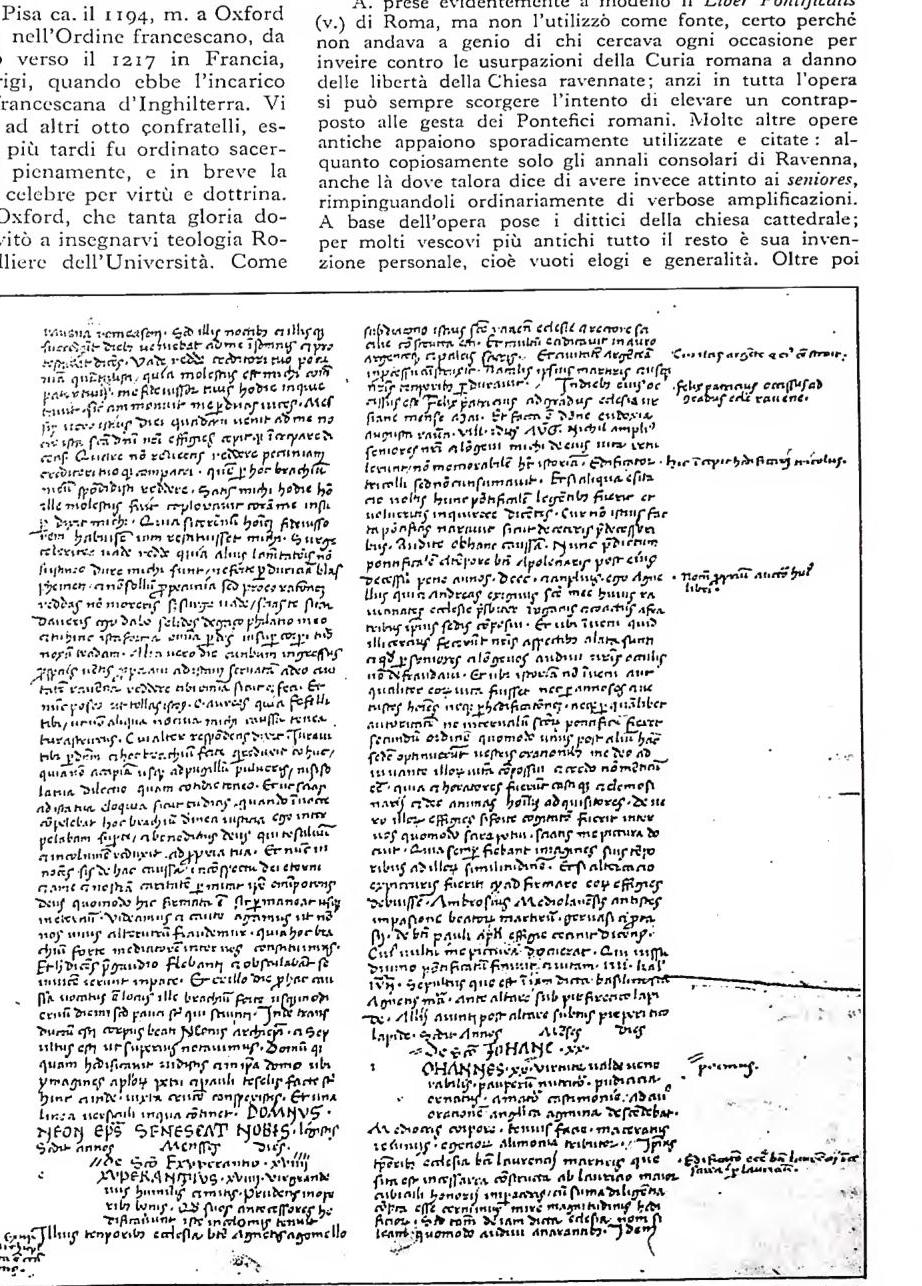
besides popular legends, he also made extensive use of documents from the episcopal archive and of monumental sources. These are the two elements that make his book particularly valuable to us, so that it emerges as a singular mixture of futile fables and firsthand historical information. In essence, it is an uneven, anecdotal compilation, produced without historical sense and according to the narrowest parochial and factional criteria. Like—and even more than—the similar Roman compilation.
A. heartily despises the laws of grammar and deliberately contents himself with the incorrect Latin of the common people, although, depending on the different sections of the work and the different periods in which he wrote, he proves more or less accurate. The style is for the most part careless and full of prolixities, the sentence laborious and disordered, at times almost childish. Yet now and then the tone rises, and A. becomes impassioned, full of warmth and passion, when he rises to defend Ravenna’s autocephaly against Rome, or vents his spleen against Archbishop Giorgio, or must put himself and his affairs on display. For the rest, he adorns himself only with borrowed embellishments, scriptural phrases, and abundant Virgilian reminiscences; perhaps the not few Greekisms and the many ἀπέξ εἰρμένα were, in his view, gems of expression.