
LIBER PONTIFICALIS. — This is the collection of the biographies of the bishops of Rome from s. Pietro to Pio II. Martino Polono was the first to attribute its authorship to Damaso (cf. Chronicon summonum pontificum imperatorumque ac de septem aetatibus mundi, up to 1247, Turin 1477), an attribution subsequently found in certain manuscripts of the 15th century, which bear in the margin, or in the text of the biography of Martino V, the annotation: Liber iste intitulatur Damasus de gestis pontificum. Onofrio Panvinio, in his Fastorum libri V a Romulo rege usque ad imperatorem Carolum V (Venice 1558), held that the biographies of the popes should be attributed to the following authors: to Damaso, those from Pietro to Liberio; to Anastasio il Bibliotecario, those from Damaso to Niccolò I; to Guglielmo il Bi-
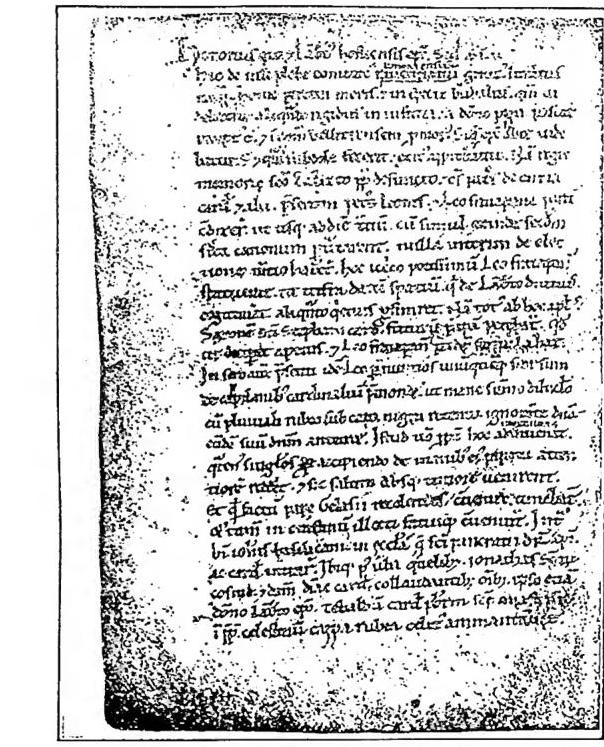
LIBER PONTIFICALIS – Beginning of the biography of Onorio II. Codex Dertusensi, I. 1707 (12th century) – Tortosa, Capitular Library.
the librarian, from Adriano II to Alessandro II; to Pandolfo di Pisa, from Gregorio VII to Onorio II; to Martino Polono, from Innocenzo II to Onorio IV; to Dietrich di Niem, from Onorio IV to Urbano VI; to an unknown author, from Bonifacio IX to Martino V. Bibliotecario, although supported by no manuscript, met with great favor.
I. EDITIONS
The first complete text of the L. P. was published by G. Buys from cod. Vat. lat. 3764: Anastasii S. R. E. bibliothecarii Historiae de vitis Romanorum pontificum a b. Petro apostolo usque ad Nicolaum I, nunquam hactenus typis excussae. Deinde vita Hadriani II et Stephani VI, auctore Guilelmo bibliothecario (Mainz 1602). The edition was added by C. A. Fabrot to the Historia tripartita, in vol. 20 of La Bizantine del Louvre (Paris 1648). Another edition, edited by Fr. Bianchini: Anastasii Bibliothecarii de vitis Romanorum pontificum a Petro apostolo ad Nicolaum I adiectis vitis Hadriani II et Stephani II auctore Guilelmo Bibliothecario (4 vols., Rome 1718–35, extending through the whole of Paul I; vol. V was not printed), in which, after Pope Silverius, the variants of the Farnese manuscript were used. This manuscript is now lost, but was known to Luca Holstenius and reproduced by E. Schelstrate. Bianchini’s text, with some variants, passed into Pl. 127–28; Muratori had already included it in his Rerum Italicarum Scriptores (III, 1, Milan 1723), together with Bianchini’s preface and the dissertations of E. Schelstrate (Antiquitas Ecclesiae illustrata, 1, Rome 1688) and G. Ciampini. The edition of Giov. Vignoli followed (3 vols., ibid. 1724–55), extending through Stephen V.But the truly critical edition is that of L. Duchesne, Le L. P., texte, introduction et commentaire (2 vols., Paris 1886–92), which made use of his preliminary work: Etude sur le L. P. (ibid. 1877), especially with regard to the 125 manuscripts collated by him there. The commentary elucidates historically and critically almost every
sentence, making remarkably effective use of the documentation provided by other literary and monumental sources.
At the initiative of H. Pertz, the MGH society, wishing to include the L. P. in its collection, had begun a series of studies as early as 1822, published in Archiv and Neues Archiv and elsewhere; for example, J. M. Watterich, Pontificum Romanorum, qui fuerunt inde ab exeunte saec. IX usque ad finem saec. XIII vitae ab aequalibus conscriptae (Leipzig 1862) and R. A. Lipsius, Chronologie der römischen Bischöfe (Kiel 1869). But it first entrusted the edition to Pabst and then to Th. Mommsen, who began its publication in the series: Gesta pontificum Romanorum of the MGH: L. P., pars prior (1898). Preceded by a laborious introduction but without a commentary on the text, the volume extends through the entire life of Pope Constantine (708–12); the continuation, entrusted to W. Lewison, has not yet been published.
In 1911 Fr. J. M. March discovered and published in the Chapter Library of Tortosa a manuscript of the L. P. that was older, more complete, and more accurate than Vat. lat. 3764, containing the biographies of the popes through Honorius II: L. P. prout exstat in codice manuscripto Dertusensi textum genuinum complectens hactenus ex parte editum Pandulphi scriptoris pontificii (Barcelona 1925).
Finally, R. Valentini and G. Zucchetti, in Codice topografico della città di Roma (II, Rome 1942, pp. 209–340), reproduced from the L. P. the topographical information relating to the city of Rome, through Honorius II, omitting, however, the topographical indications of the donations attributed to Constantine that are included in the biography of Pope Sylvester.
II. DATE OF COMPOSITION
Duchesne placed the first compilation of the L. P. before 530, probably under Hormisdas (514–23). It is known only through the two abridgements, “Feliciana” and “Cononian,” the former so called because it stops at Felix IV (526–30), the latter because it reaches Conon (686–87). The complete revised text would date from the mid-sixth century (L. Duchesne, Le L. P., I, p. LVII ff.).Mommsen, on the other hand, emphasized the difference between the two epitomes, indicating their derivation from two different texts; he placed the date of a first recension in the first decades of the seventh century and that of a second in the middle of the same century; he held that the author of the life of St. Peter had taken into account Gregory the Great’s letter to the patriarch Eulogius, and found confirmation of his thesis in the silence of Gregory of Tours (538–94) and Isidore of Seville (d. 636), as well as in the attribution to Clement of the pre-Easter fast, whose institution was later than 604. In any case, the date of composition is earlier than the end of the seventh century, to which the Codex Neapolitanus IV, A, 8 belongs. Duchesne replied to Mommsen’s thesis in La nouvelle édition du L. P. (in Mélanges d’arch. et d’hist., 18 [1898], pp. 381–417).
III. SOURCES
As early as the 2nd century, Hegesippus and Irenaeus had before them a list of the bishops of Rome; shortly thereafter Hippolytus also inserted another in his γεονυκῶν; in the 4th century, the Chronographer of 354 contains the Liberian Catalogue, which ends with the election of Pope Liberius (352). In addition to the Liberian Catalogue and those that followed it, the author knew St. Jerome’s De viris illustribus, the Pseudo-Clementine Recognitiones, the Constitutum Silvestri, the Passio Marcelli, the Gesta Liberii, the Gesta Xysti (Sixtus III), the De purgatione; the pseudo-Council of Sinuessa and the Passions of the Roman martyrs; hence the apocryphal notices, to which manifest historical errors are added.Duchesne also examined many later catalogues, and some of them in particular in the article Serge III et Jean XI (in Mélanges d’arch. et d’hist., 33 [1913], pp. 25-55); in an appendix he then gave information about the catalogue of Pomposa or Estense H. 4, 6, because it came from the Este Library in Modena (ibid., pp. 56-64). It breaks off at the life of Hadrian I, but is supplemented by a catalogue extending to the 9th year of Gregory VII (1082).
O. Holder-Egger published the catalogue contained in the Cassinese manuscript, unknown to Duchesne (Neues Archiv, 26 [1901], pp. 548-55); B. Albers published that of ms. Vat. Urbinate 585 (Ein Papstkatalog des XI. Jahrhunderts, in Römische Quartalschrift, 15 [1901], pp. 103-14); B. Pesci discussed the one that Sigeric, archbishop of Canterbury, brought to England in 990 and which extended from John X to John XIV (L'istinerario romano di Sigerico arcivescovo di Canterbury e la lista dei papi da lui portata in Inghilterra, in Riv. di arch. crist., 13 [1936], pp. 43-60).
The anonymous author of the L. P. states in his preface that he knew the Liber Canonum written by Dionysius the Little at the end of the 5th century. Among the sources, Mommsen added the Chronica Italica for the lives of Liberius, Felix II, and John I.
IV. CONTINUATIONS
After Felice IV, according to Duchesne, the lives from Bonifacio II (530–32) to the beginning of that of Silverio (536–37) are the work of a single person who was present at the Gothic siege (537–38), hostile to Silverio and devoted to Dioscoro, Bonifacio II’s rival. The lives from Vigilio to Benedetto I (575–79) were composed during the time of Pelagio II, whose biography was written together with that of Gregorio I, after 604; from Pelagio I to Bonifacio V (556–625), the lives are homogeneous in composition; after Onorio I (625–38), they were compiled by individual authors; but from Adeodato II to Conone (672–87), they again become uniform. The life of Gregorio II (715–31) was written while the Pope was still alive, and Bella was able to make use of it; the lives of Zaccaria and of Stefano II and III (741–757) are genuine narratives; that of Paolo I (757–67) is brief. The life of Adriano I (772–95) was initially composed up to the capture of Pavia (774); for the second part, extensive use was made of the archives of the Lateran patriarchate with regard to donations, the restoration of churches, deaconries, walls, aqueducts, and agricultural estates; it also contains information about the Second Council of Nicaea and the flooding of the Tiber in 791. The life of Leone III (795–816) likewise consists of extracts from archival documents, supplemented by an account of the revolt of 799, the Pope’s flight and return, and the coronation of Carlomagno. The life of Eugenio II (824–27) is extremely brief, and that of Valentino (827) is incomplete. Two versions of the life of Sergio II (844–47) are extant. That of Leone IV (847–55) is arranged chronologically, while the lives of Benedetto III (855–58) and the first part of that of Niccolò I (858–67), differing in conception and style and containing valuable details, are attributed by Duchesne to Anastasio Bibliotecario or to one of his associates. The life of Adriano II (867–72) breaks off at 870; those from Giovanni VIII (872–82) through the whole of the life of Adriano III (885) are missing; the biography of Stefano V (885–91) ends at 886. The lives continue up to Gregorio VII (1073–1085); thereafter the known authors are the Roman cleric Pandolfo (ca. 1137) and Pietro Guglielmo di St-Gilles (1142). Cardinal Bosone continued them, following the model of the ancient biographies, up to Alessandro III (1159–81), but the work remained unfinished because of the author’s death. Isolated biographies follow, from Innocenzo III to Gregorio X (1198–1276). The biographies of Bonifacio IX (1389–1404), Innocenzo VII (1404–1406), and Gregorio XII (1406–15), included in Cod. Vallicelliano C. 79, derive from a chronicle different from that used in the composition of Cod. Vallicelliano C. 25, where differing assessments are found of Urbano VI (1378–89), Bonifacio IX (1389–1404), Eugenio IV (1431–47), and Niccolò V (1447–55), extending to the living Pio II (1458–64).V. CONTENUTO E VALORE
Nella parte più antica il contenuto in generale è uniforme: nome del papa, della sua patria, della sua paternità, durata del pontificato in anni, mesi e giorni, talvolta con il sincronismo degli imperatori o dei re goti d'Italia e le due date consolari estreme del pontificato. Poi i decreti del papa sulla disciplina o liturgia, fondazioni e dotazioni di chiese e avvenimenti storici. Infine l'elenco delle ordinazioni di preti e diaconi per le chiese di Roma e delle consacrazioni di vescovi. Luogo e data della sepoltura del papa.Le notizie, molto brevi all'inizio, cominciano ad ampliarsi nel sec. IV; ma vi sono divergenze sull'ordine
dei papi. Anche le cifre delle ordinazioni nella parte antica sono fittizie: le date obituarie, da Zefirino a Felice III, non concordano con quelle fornite da altri documenti; l'esattezza comincia solo con Anastasio II (496-498). Anche la vacanza della Sede e la sua durata, nel L. P. non corrisponde con quella reale da Ponziano a Giovanni I (514-23). Decreti disciplinari e liturgici in vigore al tempo della redazione vengono distribuiti senza fondamento nelle vite dei papi primitivi e vanno perciò presi con riserva. Sia l'autore della prima redazione, che i continuatori anonimi, appartennero al clero inferiore del patriarchio lateranense ed il loro linguaggio è quello popolare del tempo, come le indicazioni topografiche che risultano però esatte.
Per il periodo seguente il valore storico è vario secondo i diversi autori.
Il Duchesne raffronta l'importanza del L. P. sulla letteratura storica del medioevo con quella del papato nel mondo politico di quel tempo. Pur con i suoi anacronismi, le sue lacune e le grandi imperfezioni resta e resterà sempre come uno dei principali documenti della storia dei papi e soprattutto della storia di Roma nel medioevo, dei suoi monumenti, delle sue crisi interne, delle sue istituzioni religiose e politiche (L. Duchesne, L. P., I, Parigi 1886, prefazione).
VI. «L. P.» DI ALTRE CHIESE. - Il L. P. ebbe una grande diffusione all'epoca carolingia; allora le principali chiese e le più fiorenti abbazie ne vollero possedere un esemplare, anzi esso servì il modello per redigere le Gesta episcoporum o abbatum. Così altre Chiese, a imitazione di quelle di Roma, ebbero le vite dei loro vescovi. Tali sono, p. es., il Liber episcopalis di Auxerre (PL 138, 219), compilato sotto il vescovo Wala (873-79), dai chierici Alano e Rainogala insieme con il monaco Enrico; il Gundecarii L. P. Echitetensis (Eichstätt), scritto nel 1171-1172 (in MGH, Scriptores, VII, pp. 239-53; PL 146, 985); il libro episcopale della Chiesa di Le Mans: Actus Pontificum Cenomannis in urbe degentium, redatto colà nel sec. IX, che va da s. Giuliano ad Alberico (32-57); il Liber episcopalis della Chiesa di Metz, redatto nel 784 da Paolo Diacono: ma interessante solo per le biografie dei santi vescovi Clemente, Autore, Arnolfo e Crodegagno; il Liber episcopalis Napoli (v.), ispirato a quello romano e che si arresta ad Anastasio I (872); il L. P. di Ravenna, redatto ca. 1841 Agnello (v.); il Liber episcopalis Viennensis Ecclesiae, fatto redigere dall'arcivescovo Leodegario (Leger; 1030-70; ed. L. Duchesne, Fastes épiscopaux de l'ancienne Gaule, I, 2ª ed., Parigi 1907, pp. 178-203).
BIBLI. Per le opere di L. Duchesne relative al L. P.,