
Pope St Pontian

21 July AD 230 – 28 September 235

Enciclopedia Cattolica Vol. IX, 1952 Popes & papal documents Popes

Pontian, Pope, Saint, Martyr

PONZIANO, PAPA, SANTO, MARTIRE

Feast day: 19 November

Italian original Cite

Also known as: St. Pontian; Spanish: Ponciano; Latin: Pontianus

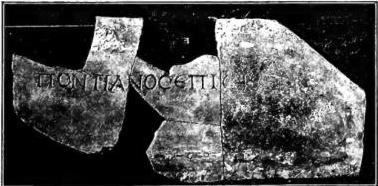
PONTIAN, pope, saint, martyr - Marble epitaph (3rd century) with the monogram Martyr, added - Rome, cemetery of St. Callixtus.

PONTIAN, Pope, Saint, Martyr. - According to the Liberian Catalogue and the Liber Pontificalis, P. was a Roman, the son of a certain Calpurnius; he was pope from 231 to 235, when, together with the presbyter Hippolytus, he was condemned to the mines in Sardinia, where, after having abdicated the supreme pontificate, he died as a result of ill-treatment. His body was transported to Rome and buried in the cemetery of Callistus on 13 August.

On this date he is in fact commemorated in the Depositio Martyrum, and in that cemetery, in January 1909, his epitaph was found in Greek, with the title of martyr. On the same day he is remembered in the Leonine Sacramentary and in the Hieronymian Martyrology, while in the Roman Martyrology he is commemorated on 19 November.

Holding as certain the report of his exile in 235, this must have occurred after 18 March, when Alexander Severus was killed and Maximinus Thrax was elected emperor. The latter (Eusebius, Hist. eccl., VI, 28), out of hatred for the house of Alexander, stirred up persecution against the Christians, limited, however, to the heads of the Church. In execution of the orders, the prefect of Rome (Maximinus, elected in the provinces, never came to Rome) relegated P. to Sardinia. There the Pontiff, in order not to leave the Church without a guide, on 28 September of the same year renounced the papacy. On the following 21 November Anterus (v.) was elected. The year of the translation of his body to Rome is also uncertain, but probably between 244 and 249, that is, during the reign of Philip the Arab. To carry out such translations of corpses, in fact, the permission of the Emperor was necessary, and Pope Fabian may have taken advantage of Philip's benevolence.

No relation exists between P. and the cemetery of the same name on the Via Portuense.

Bibliography5 works
BIBL.: Lib. Pont., I, p. xciv ff., 145 ff.; G. B. De Rossi, La Roma sotterranea cristiana, II, Rome 1867, pp. 73-80; O. Marucchi, Osservazioni sull'iscrizione del papa P., in Nuovo Bull. di arch. crist., 15 (1909), pp. 35-50; Martyr, Hieronymianum, p. 439 ff.; Martyr, Romanum, p. 533.

Agostino Amore

About this entry

By Agostino Amore

How we know signed in print

Translated from the Enciclopedia Cattolica, vol. IX (1952), col. 1756.

Printed pages Open in the page viewer
Page 1052
vol. 9, coll. 1755–1756

More by Agostino Amore: Poppaea (Poppaea Sabina) · Pomponia Graecina · Polyeuto, Saint, Martyr · Polemio, Silvio · Potamiaena and Basilides, Saints, Martyrs

Cite this article

Chicago

Amore, Agostino. “Ponziano, papa, santo, martire.” In Enciclopedia Cattolica, vol. IX, col. 1756. Città del Vaticano: Ente per l’Enciclopedia Cattolica e per il Libro Cattolico, 1952. https://azioneromana.com/article/ponziano-papa-santo-martire.

MLA

Amore, Agostino. “Ponziano, papa, santo, martire.” Enciclopedia Cattolica, vol. IX, Ente per l’Enciclopedia Cattolica e per il Libro Cattolico, 1952, col. 1756. Azione Romana, https://azioneromana.com/article/ponziano-papa-santo-martire.

BibTeX

@incollection{ec9_ponziano_papa_santo_martire,
  author    = {Amore, Agostino},
  title     = {Ponziano, papa, santo, martire},
  booktitle = {Enciclopedia Cattolica},
  volume    = {IX},
  pages     = {1756},
  note      = {Cited by column},
  publisher = {Ente per l’Enciclopedia Cattolica e per il Libro Cattolico},
  address   = {Città del Vaticano},
  year      = {1952},
  url       = {https://azioneromana.com/article/ponziano-papa-santo-martire}
}

One of some 20,000 entries brought back from the twelve printed volumes (1948–54). Spotted something? Help us improve it.

Save for later

Enter your email and we will send you a sign-in link. No password. What you save (articles, verses, chapters, documents) follows you to any device.