
FABIAN, POPE, saint, martyr. — He was elected in January 236 immediately after the death of Pope Antherus. With the death of Maximinus the Thracian, the Church enjoyed a period of tranquility during the reigns of Gordian III and Philip the Arab.
Pope Fabian devoted his care to the community of Rome: to the Augustan division of the city into fourteen regions he substituted an administrative division into seven regions, and to each of these he appointed one of the seven deacons; in the “Liberian Catalogue” it is indeed written: “hic regiones divisit diaconibus.” The biographer of the Liber Pontificalis added that Fabian would also have appointed seven subdeacons and seven regional notaries for the “Acts of the Martyrs,” but this information is not documented, whereas the subdeacons are mentioned by Cornelius in his letter to Fabius of Antioch (Eusebius, Hist. eccl., VI, 43: PG 20, 621) and several times by St. Cyprian (Ep. 8, 9, 29, 34: PL, 4, cols. 246-53; 302-303; 320-24).
This type of organization established by Fabian continued thereafter, growing ever more important in the life of the Church of Rome, as attested by documents and epigraphic monuments. G. B. De Rossi reconstructed the boundaries of the seven regional districts (Roma sotterr., III, Rome 1877, pp. 515-28).
Another activity of Fabian is also recorded in the “Liberian Catalogue”: “multas fabricas per cimiteria fieri iussit.”
The cemeteries were therefore related to the regional division and dependent on the churches of the individual regions.
Fabian sent to Africa Privatus, bishop of Lambaesis, but the text of his letter, like the two exchanged between him and Origen, has been lost (Eusebius, Hist. eccl., VI, 36: PG 20, 397; St. Jerome, Ep., 84, 10: PL 22, 731). Moreover, Fabian obtained from the imperial authority the transfer from Sardinia to the cemetery of Callistus of the remains of the martyred Pope Pontian (Lib. Pont., I, p. 145). The organizational activity of Fabian was so influential that it aroused the wrath of the emperor Decius, who declared that he would rather have a rival in the Empire than the bishop of God in Rome (St. Cyprian, Ep., 55, 9).
Decius unleashed the persecution, and one of the first victims, on January 20, 250, was Pope Fabian, after a pontificate of 14 years, 11 months, and 11 days. His martyrdom was immediately reported to the other communities (St. Cyprian, Epp., 9, 1; 30, 3).
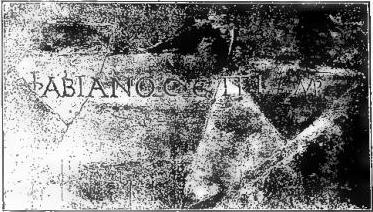
Fabian was buried in the cemetery of Callistus in the same crypt where Antherus and Pontian had been buried; on the closing slab was inscribed in Greek only the name FABIANOS and his dignity of bishop ΕΠΙΣΚΟΠΟΣ; later, his title of martyr was added with the simple ligature of three consonants MPT. The inscription was discovered by G. B. De Rossi in the crypt of the Popes in the cemetery of Callistus in 1854.
His veneration is attested already in the 4th century by the Depositio martyrum: XIII Kal(endas) ian(uarias) Fabiani in Callisti.