
CIMITERO. — This is the place intended for the burial of the dead.
The Christians of the first centuries, conforming to the Roman laws that strictly prohibited burying corpses within the city (Mortuorum reliquia, ne sanctum municipiorum ius polluatur, intra civitatem condi iam pridem vetitum est; Code of Justinian, 3, 44, 12), buried them, as stated above, outside the walls, in specially designated places. Later, observance of these laws gradually weakened, and cemeteries began to arise beside churches, of which they soon became accessory parts. Within the churches themselves were laid the remains of bishops, priests, and certain laymen of outstanding virtue; but little by little the practice arose of burying all
the faithful there (cf. Decree of Gratian, c. 18, C. XIII, q. 2); this led the ecclesiastical authorities to introduce strict limitations.
The matter is now governed in its entirety by the CIC, which permits only the corpses of pontiffs, cardinals, sovereigns, and, within their own churches, residential bishops, abbots, and millius prelates to be buried in churches. Apart from these exceptions, all the faithful without distinction must be buried in a cemetery that has been solemnly or simply blessed according to the rites described in the liturgical books (can. 1205).
Because of the sacred character that unquestionably belongs to the place where the dead rest, it is self-evident that the Church claims for herself the full and absolute right to possess cemeteries of her own (can. 1206 § 1). If this right, as often happens, is violated without hope of restoration, the Ordinaries are obliged to ensure that civil cemeteries are blessed if those who are ordinarily buried there are for the most part Catholics, or that at least a special blessed area is reserved for Catholics (can. 1206 § 2). If not even this can be obtained, the individual graves must be blessed one by one (can. 1206 § 3). Every parish must have its own cemetery, unless the Ordinary has established one common to several parishes. Exempt religious may have a cemetery of their own, distinct from the common one; and the same faculty may be granted by the Ordinary to other juridical persons or to private families (can. 1208 §§ 1-3).
In both parish cemeteries and those belonging to other juridical persons, the faithful may, with prior written authorization issued respectively by the Ordinary and by the superior, have special tombs built for themselves and their relatives and subsequently also alienate them. The tombs of priests and clerics should, where possible, be separated from those of the laity and situated in a more dignified place; if this presents no excessive difficulty, the tombs of priests should be distinguished from those of clerics in minor orders. Separate burials should likewise be reserved for the bodies of infants wherever this can be done without difficulty (can. 1209 §§ 1-3).
The cemetery must be suitably enclosed on every side and carefully guarded (can. 1210). It is the duty of the Ordinaries, parish priests, and superiors to ensure that epitaphs, funeral eulogies, and the adornments of tombs contain nothing contrary to the Catholic religion and piety (can. 1211). For the burial of the corpses of those ecclesiastical burial (v.) can. 1212 prescribes that, if possible, a place other than the blessed cemetery be provided, but likewise enclosed and guarded.
The provisions laid down by the CIC concerning the interdict, violation, and reconciliation of churches (v. CHIESA) also apply to cemeteries (can. 1207); it should be noted that the violation of a church does not entail the violation of the adjoining cemetery, and vice versa (can. 1172 § 2), and that the bodies of the faithful may indeed be buried in a cemetery under interdict, but without any ecclesiastical rite (can. 2272 § 2).
IN ITALIAN LAW. — The regulation of cemeteries is entrusted to numerous provisions of the municipal and provincial law (3 March 1934, no. 383), of the Consolidated Text of the health laws (27 July 1934, no. 1265), and of the regulations on mortuary police (R.D. 21 Dec. 1942, no. 1880). Every municipality must have a cemetery, the construction of which is governed by particular regulations of a hygienic nature. Thus, for example, a cemetery may not be situated less than two hundred metres from inhabited centres; it must have an area at least ten times larger than the space required for the number of dead to be buried each year; it must be established on ground that is friable, permeable, and dry, etc.
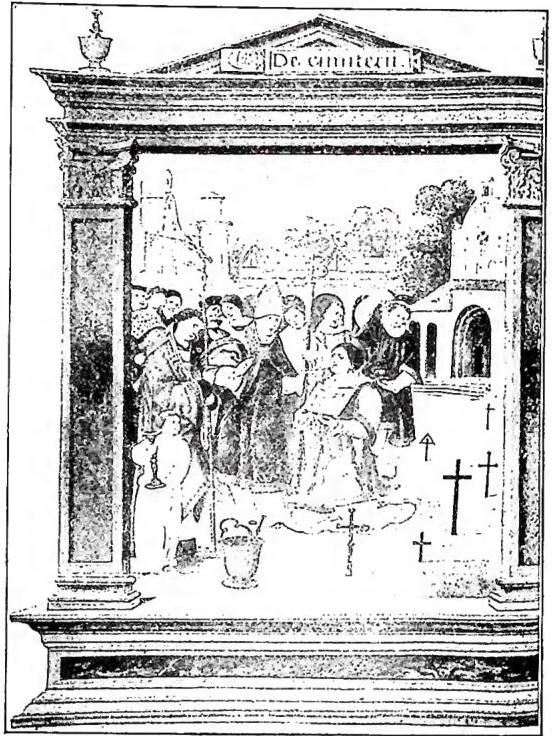
(from V. Leroquini, Les pontificaux mis. des bibl. pub. de France, Parigi 1917, inv. III)
CIMITERO - Blessing of a c. Roman Pontifical (early sixteenth century) - Paris, National Library, ms. lat. 1226, t. 1, f. 22.
The so-called secularization of c., completed at the end of the last century, means that, in addition to burial by inhumation (in graves dug in the ground) and entombment (in tombs or niches), cremation in special furnaces is permitted (v. DEFUNTI), and that, for admission to the c., no distinction whatsoever is made between the corpses of persons entitled to ecclesiastical burial and the corpses of persons deprived of that right.
C. form part of the municipal public domain; but this does not exclude the real and perpetual right that individual concession holders may acquire over niches or plots for the construction of individual or family tombs, or tombs belonging to particular communities.
The provisions of the Penal Code concerning the offences of violating a grave (art. 407) and of desecrating tombs or objects intended for the worship of the dead (art. 408) are noteworthy; these offences are punished respectively by imprisonment from one to five years and from six months to three years.
There are two quite distinct rites, both for the blessing and for the reconciliation of c. The first is pontifical and reserved exclusively to the bishop; the second, simpler, belongs to the priest, even when delegated by the bishop. The first is found in the Pontificale, the second in the Rituale romano.
The principal elements of the solemn (pontifical) rite for the blessing of c. appear between the 10th and 13th centuries; the sprinkling with holy water and the recitation of the litany of the saints are attested in the 10th century, while the erection of the five crosses and the recitation of the seven penitential psalms belong to the 13th century. In the meantime, the other elements were inserted, such as the Miserere, various psalms, etc.
The complete form of the solemn blessing is found first of all in the Pontificale of Durando (ed. M. Andrieu, Le Pontifical romain au moyen âge, III: Le Pontifical de Guillaume Durand [Studi e Testi, 88], Città del Vaticano 1940, pp. 504-18). But the earliest elements are already found in a collection of formulas in cod. 54 of the Civic Library of Bamberg (11th century); cf. M. Andrieu, op. cit. in bibl., p. 63 ff.
If the c. is contiguous with the church, it cannot be considered indirectly or incidentally blessed by the lustral water it receives when the bishop proceeds to the external blessing of the church (P. J. De Herdt, Sacrae Liturgiae praxis, III, Lovanio 1870, p. 290).
Four crosses are planted at the four sides of the c., and one in the center near the large one that is to be erected there permanently. The ceremony begins with an address appropriate to the occasion by the bishop; the litany of the saints is then recited or sung, with three particular final invocations for the purification, blessing, sanctification, and consecration of the place.
The holy water having been prepared, the bishop sprinkles it and incenses the walls of the c. all around, stopping before each individual cross, incensing it and attaching three candles to it, one above and the others on the two arms.
Meanwhile, the penitential psalms are sung, followed by a prayer that summarizes the entire liturgical spirit of the ceremony. After the central cross has been incensed and a penitential psalm sung, the cry of hope and pity is raised once more: an appeal to merciful Christ, who will grant immortality to our bodies. As in all the other solemn rites of the Church, the ceremony ends with an inspired prayer and a Preface that develops the idea underlying all the prayers of the consecration.
The rite of blessing, on the other hand, is simpler and is contained in the Rituale romano, tit. VIII, cap. 29. A cross is planted in the middle of the c., and the celebrant, clothed in sacred vestments, says a prayer and intones the litany of the saints. He then sprinkles the cross and the c. all around while the Miserere is sung.
The blessing of tombs refers to funerary chapels (Decr. S. Congr. dei Riti, nn. 3400, 3524), which, in order for Mass to be celebrated there, must be constructed so that the edge of the altar is at least one meter from the side tombs: no corpse may be buried in front of or beneath the altar (CIC, can. 1202).
When the c. has not been consecrated or blessed, each grave must be blessed with the formula of the Rituale romano, tit. VI, cap. 3, n. 12, before the burial of the corpse.
Thus the first monumental complexes began to arise, and in many cases, especially in large urban centers, by the middle of the nineteenth century architecture had become directly involved in ensuring the greater dignity of these constructions.
Thus in Milan, in the cemetery opened in 1866 after the suppression of the five small existing cemeteries, a notable Famedio (Maciachini) was built to house the ashes of illustrious men. In this structure, one of the noblest examples of such monumental complexes, the decoration fused Lombard and late Byzantine elements into a grandiose and harmonious whole. At Brescia an elegant lighthouse (Rodolfo Vantini) was erected in the middle of the area, while, especially outside Italy, efforts were made to arrange the grounds as parks, which offered a greater sense of serenity and spiritual repose.
Within the large perimeter constructions, smaller structures later arose, intended to accommodate the tombs of a family or of individuals, down to the modest niches or cells for the less well-off.
A typical example is provided by the Verano cemetery near S. Lorenzo fuori le mura in Rome (Vespignani). The original foundation, dating from 1834, was later enlarged and defined by the great four-sided portico with the chapel at its center, the large statue of the risen Christ, and the immense expanse of gardens and hedges beyond the central enclosure. In Naples, the cemetery, built on a slope on the Poggioreale hill, has a monumental neoclassical entrance which, through a broad avenue lined with beautiful tombs and chapels, leads to the so-called « Quadrato degli uomini illustri », with the Mother Church as its backdrop, for funeral ceremonies on the days commemorating the dead. The cemetery of Genoa (C. Barabino and G. B. Resasco), situated in the outlying district of Staglieno at the foot of a hill, unfolds in a large rectangle enclosed by a series of arcades that connect at the center with the great Famedio, reached by an imposing staircase. The abundance of vegetation and marble creates there an especially evocative atmosphere. Also worthy of mention are the cemeteries of Turin, Naples, Messina (Savoia and Fiore), Chiaravalle Milanese, and, outside Italy, those of Cincinnati and Philadelphia, laid out as parks, Père Lachaise in Paris, and that of Barcelona. - Vedi Tav. CVI.
#### CIMITILE: V. NOLA.