
BRESCIA, DIOCESI di. – City of the Cenomanes and later a Roman colony (Brixia), it possesses notable monuments and inscriptions from the early centuries. Declining because of the barbarian invasions, it became the seat of a duchy that gave the Lombards their last kings, Astolfo, Desiderio, Adelchi. Governed by counts (9th cent.) and then by the bishops (10th cent.), it established itself as a commune (12th–13th cents.) of the Guelph party, came under the lordships of the Visconti and the Scaligeri (14th cent.), of P. Malatesta and Venice (1426–1796), and thereafter belonged to the Cisalpine Republic, the Italian kingdom, the kingdom of Lombardy–Venetia (1815–59), and the kingdom of Italy, with noble patriotic traditions.
The diocese is among the largest and oldest in Italy, having already been established at the beginning of the 4th century. The very late tradition (12th–13th cents.) concerning its apostolic origins through the preaching of s. Barnaba, and the obscure legends surrounding its first bishops and martyrs, cannot cast doubt on the existence of the diocese as early as the 3rd century, after a long period of missionary activity. Christianity must have been introduced there either by Jewish merchants, since B. had a synagogue, or by occasional missionaries. The cult of the two local martyrs Faustino and Giovita, even setting aside the negative value of their late legend (BHL, 2836–38), is certainly very ancient, and iconography always represented them, until the 16th century, as priest and deacon, indicating them as the first heads of a local ecclesia subject to Milan. The legend places the two Brescian martyrs in relation to the emperor Hadrian (2nd cent.) and to many other bishops and martyrs of Upper Italy (s. Apollonio of B., s. Marziano of Tortona, s. Secondo of Asti, s. Calocero of Albenga, etc.), demonstrating a very late hagiographical syncretism of no historical value (8th or 9th cents.).
The Brescian ecclesia received its autonomy after the last persecution of Diocletian or in the first years of the Constantinian age. S. Anatalone sent his disciple s. Clateo there as its first bishop, the first name in the Brescian diptychs. It was the first diocese to separate from Milan; consequently, the bishop of B. held the first place to the right of the archbishop in the synods of the Milanese province, and this honor passed to the bishop of Vercelli only in the 11th century, during the disturbances of the Investiture Controversy. The list of the bishops, besides appearing in the liturgical diptychs, was given in the 9th century by a sermon of Bishop Ramperto, which enumerates his predecessors from s. Clateo onward. The fourth is s. Apollonio; the fifth is s. Ursicino, or Ursacio, who took part in the Council of Sardica (343); the seventh is s. Filastrio, who came from Rome to Milan and from Milan to Brescia in the struggle against Arianism, and who occupied the see from 379 to 387. On the basis of these chronological indications, the beginning of Clateo’s episcopate can be fixed at the end of the 3rd century or in the early years of the 4th, with the corresponding dates also assigned to the following bishops, s. Viatore, s. Flavio Latino, and s. Apollonio. Clateo, perhaps a citizen of Brescia, would have been the last priest to govern the Brescian Church, still united with and subject to Milan; and it is not unlikely that he had other predecessors in the same office in the 3rd century, when the hierarchical organization of Christianity in Upper Italy was still in the process of formation. The two great bishops of the 4th century are s. FILOSTORGIO (v.) and s. AUDENZIO (v.), who left important works and records. After s. Gaudenzio, the succession of bishops proceeds regularly, apart from the insertion of a Berticano between Dominatore and Paolo III by Ughelli, who confused a Bertramo, bishop of Mans in France (586–616), falsely attributed to the Cenomanes of B. From the 4th century, all the bishops up to s. Deusdedit or Diodato (680) have been venerated as saints in the local liturgy. In the 8th century, the Lombard dukes, later kings, Astolfo and Desiderio erected new churches and monasteries in the city and diocese. It was perhaps as a reflection of the work of the Brescian Petronace at Monte Cassino (717–50) that the two important monasteries of S. Giulia (753) and Leno (758) were founded, the former a women’s monastery in Brescia, the latter a men’s monastery in the plain toward the Po. Ramperto was the greatest bishop of the Carolingian period; he renewed the monastery of S. Faustino Maggiore with Frankish elements, reviving popular devotion to the relics of the two martyrs Faustino and Giovita; he built a new crypt in the cathedral of S. Maria and transferred there the body of S. Filastrio, thereby restoring the common life of the urban clergy. The bishops of the 9th and 10th centuries held high civil offices and came from powerful families of the local feudal aristocracy. Ardingo was archchancellor of King Berengario (901–922); Goffredo of Canossa, son of the marquis of Tuscany Adalberto Azzo (975–77), donated to the basilica of Canossa some relics of the
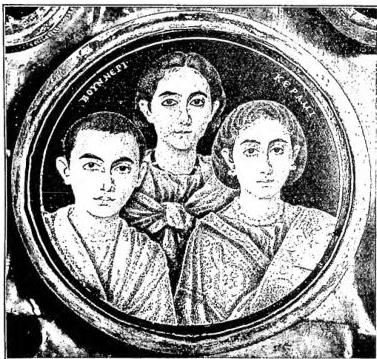
(phot. Alinari)
BRESCIA - Detail of the Cross called that of Galla Placidia.
Brescia, Christian Museum.
the bishop St. Apollonius; his successors Atto, Adalbert, Landulf, and Olderic were imperial vicars of the Brescian contado. Bishop Adelmann of Liège, a disciple of St. Fulbert at the schools of Chartres, certainly owed his election (1059) to imperial interference. Against the Eucharistic heresy of his fellow student Berengar of Tours, he wrote the treatise De Veritate corporis et sanguinis Christi (PL 143, 1290 ff.). Arimannus’s episcopate (1087-1116), cardinal of the SS. Quattro Coronati, was greatly troubled by the struggle between Church and Empire in the time of Gregory VII. He was probably the founder of the Vallombrosan monastery of S. Gervaso del Mella, where he was buried. During the episcopates of his successors Villanus (1116-32) and Manfred (1132-53), the struggle between the two opposing political and religious currents was advanced by the vehement preaching of the cleric, or monk, Arnaldo (v.), whom St. Bernard opposed. After the wars of Frederick Barbarossa and the Peace of Constance, the city expanded; numerous houses of the Humiliati were founded; St. Francis of Assisi and St. Dominic, with their Friars Minor and Friars Preacher, were welcomed into new popular districts; and the craft associations and the disciplines flourished anew. The bishop, Blessed Guala of Bergamo, a Dominican (1229-44), unsuccessfully attempted to bring order and peace between the Guelfs and Ghibellines and to restore episcopal authority, but political discord
In the 14th century, eighteen foreign bishops succeeded one another, almost always absent, governing the diocese through vicars who were likewise foreigners; the diocese was in complete decline.
The new government of Venice, with the humanist and diplomat Pietro del Monte (1442-47), began the long succession of bishops drawn from the Venetian patriciate, lasting until Monsignor Giovanni Nani (1773-1804); the sole exception was the contested appointment of the Brescian Cardinal Duranti (1551-57).
Many bishops received the cardinal’s purple, including the Roman Agapito Colonna (1369), Francesco and Andrea Cornaro (1532-50), Duranti, Morosini (1585-96), nuncio in France, Pietro Ottoboni (1654-1664), who became Pope Alexander VIII, Marco Dolfin (1698-1704), Giovanni Badoaro (1706-14), Gianfrancesco Barbarigo (1714-23), the Benedictine A. M. Quirini (1725-55), munificent founder of the Queriniana Library, and Giovanni Molin (1755-73). The Brescian Arimannus and Otto (11th century), Uberto and Gianfrancesco Gambara (16th century), Giovanni Andrea Archetti and Michelangelo Luchi (18th century) also received the purple.
The diocese does not coincide with the boundaries of the province; it includes Lovere, Costa-Volpino, and Palosco in the Bergamo area, while the Valtenesi, from Lonato and S. Felice to Sirmione and Pozzolengo, although situated in the province of B., is subject to the diocese of Verona. Until the 18th century, it included the territory of the former diocese of Asola and of the marquisate of Castiglione delle Stiviere, which in 1785 was united with the diocese of Mantua.
The diocese now numbers 421 parishes divided into 78 vicariates, with 985 priests and 720,400 souls; it has four diocesan seminaries, numerous male religious houses (Carmelites, Franciscans, Conventuals, Capuchins, Jesuits, Salesians, Marists, Comboni Missionaries, Pavonians, Artigianelli, Giuseppini) with their own seminaries, and many female religious houses, as well as Catholic publishing houses, a weekly newspaper, and numerous religious periodicals. The oldest monasteries were those of S. Benedetto di Leno, of the Salvatore and of S. Giulia, of SS. Cosma and Damiano or monasterium Honorii, of S. Pietro in Monte Orsino at Serle, of S. Eufemia, of S. Faustino Maggiore, of S. Tommaso di Acquanegra, of S. Gervaso al Mella, of S. Maria della Colomba at Manerbio, of S. Maria di Pace, of S. Donnino di Verola, of S. Pietro di Fiumicello, and of S. Vigilio di Masserata, all following the Benedictine Rule. There were numerous Cluniac priories, established in the 11th century and having their central house at Rodengo; likewise numerous were the Augustinian canons and the priories of Augustinian hermits, founded in the 11th century, the houses of the Humiliati established in the 12th century, and the Franciscan and Dominican convents that flourished in the 13th-16th centuries, just as in the 17th and 18th centuries houses and colleges of Jesuits, Somaschi, and Theatines flourished, all dispersed in 1797 by the Jacobin revolution.
The principal archives of the diocese are the archive of the episcopal mensa, the curial archive, and the chapter archive, but they have suffered very serious dispersal, especially in the case of medieval documents, which are almost entirely lacking; ecclesiastical documents are preserved in the State Archive and the municipal historical archive. The archives of the religious corporations suppressed in 1797 were dispersed, and the surviving documents were arbitrarily divided among the State Archive of Milan, the State Archive of B.
and the Queriniana Civic Library. The archives of the Civile and Luoghi Pii hospitals preserve, in part, the documents of the monasteries of S. Eufemia and Rodengo, the convent of S. Domenico, and the Inquisition. P. Kehr, Italia pontificia, VI, part 1ᵃ, Berlin 1913, pp. 307-55, has provided abundant bibliographical indications concerning many archives and unpublished sources for the history of the diocese. B. has two museums: that of the Roman age in the Basilica of Vespasian, and that of the Christian age in the church of S. Giulia. Both are rich in notable monuments and precious relics. The celebrated bronze statue of Victory, unearthed in 1826, is noteworthy; the Christian Museum preserves the diptychs, the lipsanotheca, the cross called that of Galla Placidia, medieval goldwork and sculptures, a rich coin collection, etc. The municipality also has an art gallery, a notable collection of ancient and modern art. Among the numerous and sumptuous churches decorated with precious paintings by the great masters Titian, Tintoretto, Paolo Veronese, Romanino, Foppa, Moretto, etc., the following should be recalled: the Lombard basilica of S. Salvatore (8th century) and S. Maria in Solario (11th century); the Old Cathedral, or Rotunda of S. Maria, the winter cathedral (11th century), modeled on the Holy Sepulchre of Jerusalem; the church of S. Francesco (13th century); the façade of the shrine of S. Maria dei Miracoli, with very fine Renaissance sculptures (15th century); and the New Cathedral (17th-19th centuries), by the Brescian architect Lantana. - Vedi Tav. IV.