
CECILIANO, MOVIMENTO. — Organization of devotees and supporters of ecclesiastical music; it took its name from St. Cecilia, commonly invoked and venerated as the patroness of music. In Rome there are the Accademia di S. Cecilia and the Conservatorio di S. Cecilia, which are two institutions for musical training. The C. movement originated as a reaction against the abuses and profanations in the style and performance of sacred music, which in the 19th century was no longer distinguishable from the secular music of the theater, having completely lost the spirit of the Catholic liturgy. Gregorian chant was either forgotten or poorly performed,
Ancient polyphonic music had given way to new forms of religious music of a lyrical character, with extensive accompaniment by every musical instrument, in a worldly style unworthy of the seriousness of the liturgy and the temple. The French Revolution and the Napoleonic period (1789–1815) dealt the final blow to the classical tradition by destroying monasteries, chapters, and musical chapels, and by contributing to the artistic profanation of the temple.
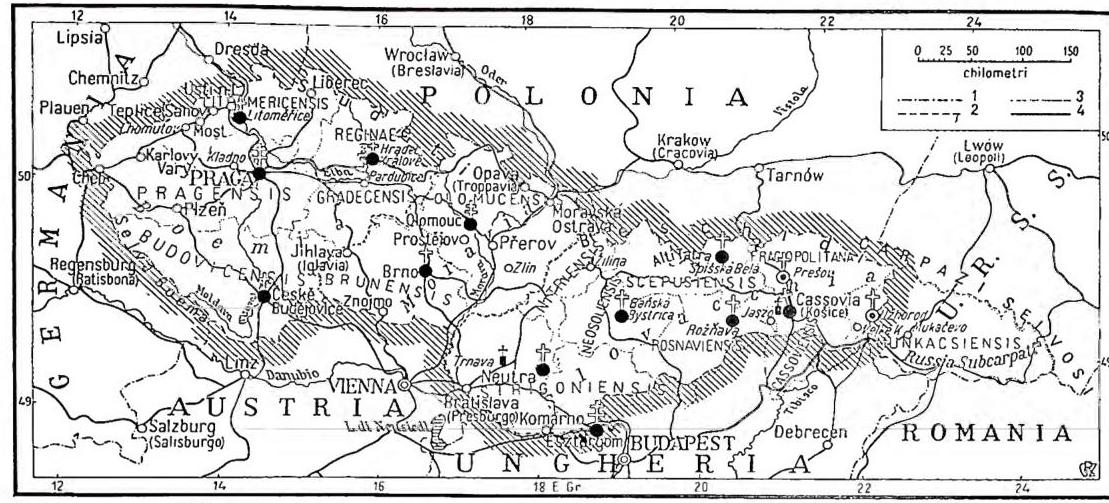
In 1785 the Anglican Coecilion Society had arisen in London, but it was an academy for promoting the appreciation of music through popular concerts. The first Society of S. Cecilia was founded in Munich with the musical school of G. Ett (1788–1847) and G. Aiblinger (1779–1867), which was subsequently continued at Regensburg by C. Pioscke (1794–1861) and his collaborators Haberl, Haller, Renner, etc. From Bavaria the reform movement spread to Austria, Germany, Switzerland, and Belgium, especially through the efforts of F. X. Witt (1834–88), who in 1868 founded the Cäcilien-Verein at Bamberg for the German-speaking countries. The broad programme for the reform of sacred music advocated by these national societies received the full approval of the Holy See, but encountered many serious difficulties; nevertheless, the artistic and disciplinary campaign was advanced through numerous periodical publications, which unearthed and illustrated ancient classical music, provided practical instructions and rules, promoted gatherings and discussions, and disseminated much new music inspired by the dignity and requirements of worship. In Holland, Belgium, England, France, and the Americas, the cecilian movement likewise underwent considerable development, while the revival of Benedictine monasteries brought about a vigorous renewal of studies and practice in Gregorian chant. In this field, the school of the Benedictines of Solesmes (France) distinguished itself by undertaking the critical revision of all the musical texts in the liturgical books. In Italy, the reform of sacred music encountered greater difficulties than elsewhere; its first audacious advocate was the Milanese Ambrogio M. Amelli (1848–1930; v.), a doctor of the Ambrosiana, later a monk (1885) and Benedictine abbot. He advocated reform at the Catholic congresses (1874–77); in 1877 he founded and directed the periodical Musica sacra, and in the same year, together with a few friends, the Italian Association of S. Cecilia, which held its first congress in Milan in 1880 and, in 1882, the famous Congress of Arezzo for Gregorian chant. In 1884 the first Regolamento per la musica sacra of the S. Congregation of Rites was issued, and it became the juridical foundation of the cecilian movement. Amelli, who had become a Cassinese monk, was succeeded by the Jesuit Angelo De Santi (1847–1922), who from 1909 was president of the revived Italian Association of S. Cecilia, whose official organ is the Bollettino ceciliano. In 1910 he promoted the establishment in Rome of a Scuola superiore di musica sacra, now the Pontifical Institute of Sacred Music, as well as the national congresses of Milan, Turin, Bergamo, Vicenza, and Rome, which gave great impetus to the campaign.