
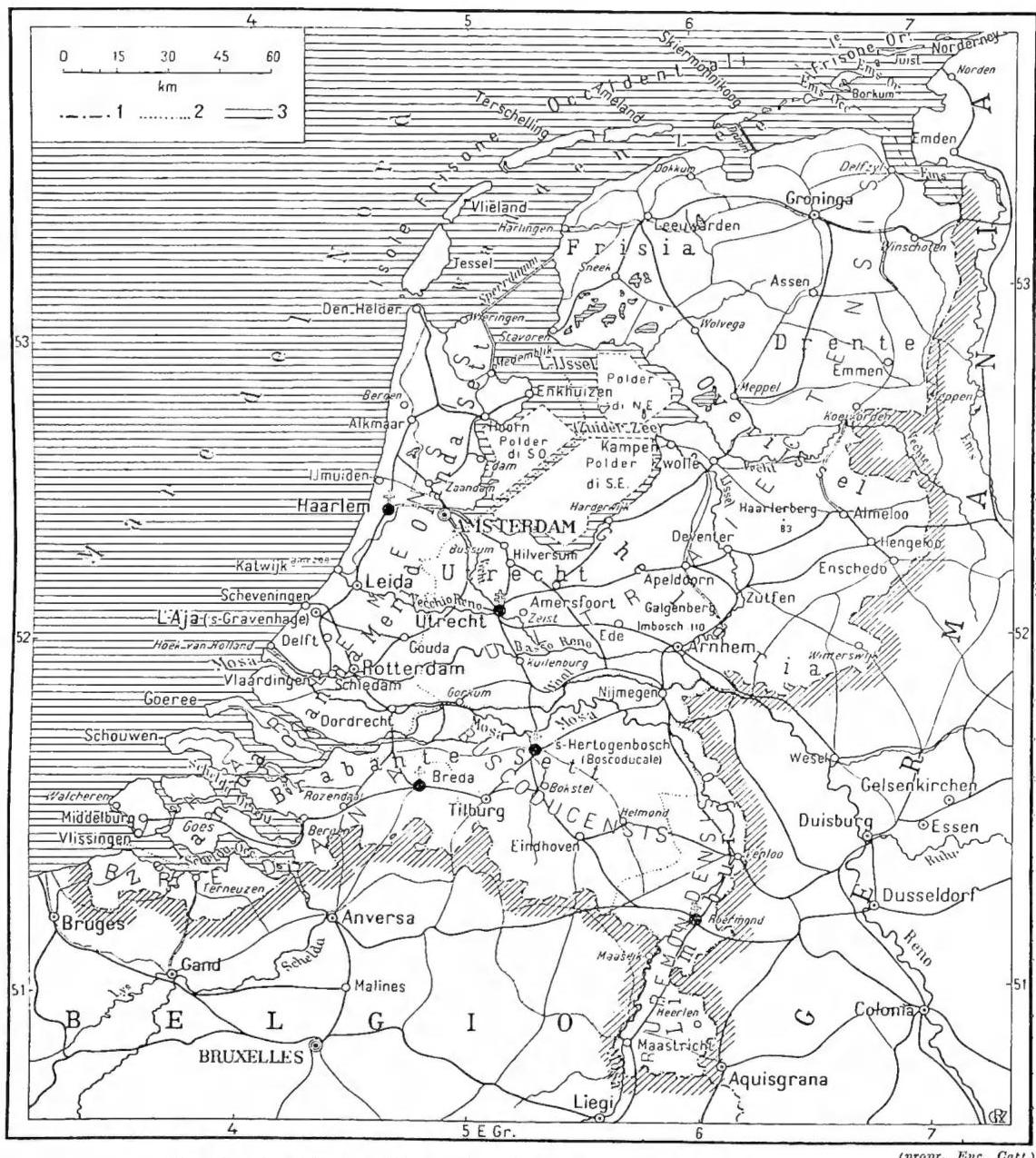
PAESI BASSI. – The P. B. (Nederland), of which Olanda (or Holland) is only the central-western part, correspond to the northwestern margin of the German plain, from the mouth of the Schelda to that of the Ems.
SUMMARY:
I. Geography
II. Civil and ecclesiastical history
III. The juridical condition of the Church
IV. Literature
V. Art
VI. The educational system.I. GEOGRAPHY - The territory is almost entirely flat; indeed, approximately two-fifths lies below sea level, from which it was and continues to be reclaimed (Zuiderzee) through grandiose land-reclamation works (pumping stations, canals) and protective structures (dikes). The climate, temperate oceanic, is extremely humid (fogs), with mild winters and cool, rainy summers. Poor in forests, with approximately one-fourth of its productive surface, the land is occupied to the extent of two-fifths by pastures and one-third by arable fields (the areas nearest the sea are the most suitable for agriculture); inland and in the northeast, heathlands, marshes, or barren expanses of sand predominate. Both cultivation and livestock raising are intensive in character and employ modern management methods. Cereals, potatoes, and sugar beets record exceptionally high yields per unit; the extensive subdivision of land is related to the broad and successful development of horticulture (the Haarlem region). Live cattle, butter, cheeses, eggs, and condensed milk contribute to a flourishing export trade. Fishing, especially maritime fishing (herring), and oyster cultivation (Zeeland) are flourishing. Although hampered by the lack of metallic raw materials, industry, which can rely on the hard coal of Limburg (11–12 million tons of anthracite annually), is varied and widespread: all branches are represented, from textiles (Leiden) to metallurgy (Velzen), from shipbuilding (Amsterdam) to food processing (sugar refining, cocoa). Commerce, especially in relation to the territory and population, is among the most active in the world: the P. B. benefit from their position between Central Europe and England. The Dutch merchant marine is now the sixth largest in the world (2.9 million tons of tonnage). Inland navigation makes use of a magnificent network of canals (7,750 km). With more than 10 million inhabitants, Holland is one of the most densely populated countries in Europe (310 inhabitants per sq. km); ethnically compact (90% Dutch), it shows, from the religious point of view, a slight prevalence of Protestants (43%) over Catholics (39%). There are numerous large population centers: 3 cities exceed half a million inhabitants (Amsterdam, the capital, Rotterdam, and The Hague, residence of the court and government), and 8 exceed 100,000 (Utrecht, Haarlem, Eindhoven, Groningen, Tilburg, Nijmegen, Enschede, and Arnhem).
Holland is organized as a hereditary constitutional monarchy (also through the female line), in the House of Orange-Nassau (1848), with a representative bicameral government (States General). The Second Chamber is elected by direct, secret, universal, and proportional suffrage; the First Chamber by the provincial states, local diets with administrative and fiscal jurisdiction.
Of the vast Dutch colonial empire (over 2 million sq. km with 70 million inhabitants in 1939), most has formed an independent state (Indonesia), linked to Holland by personal union; the remainder (560 sq. km with 600,000 inhabitants) comprises New Guinea, Guyana, and the Antilles.
| Provinces | Area (in sq. km) | Population (in thousands of inhabitants) | Capital (population in thousands of inhabitants) | Density per sq. km |
|---|---|---|---|---|
| 1 Brabant | 4905 | 1267 | s-Hertogenbosch (58) | 258 |
| 2 Drenthe | 2618 | 285 | Assen (24) | 109 |
| 3 Friesland | 3235 | 468 | Leeuwarden (79) | 145 |
| 4 Gelderland | 4981 | 1098 | Arnhem (106) | 220 |
| 5 Groningen | 2245 | 462 | Groningen (138) | 206 |
| 6 Limburg | 2175 | 739 | Maastricht (79) | 340 |
| 7 North Holland | 2632 | 1875 | Haarlem (164) | 712 |
| 8 + South | 2812 | 2425 | The Hague (572) | 862 |
| 9 Overijssel | 3251 | 682 | Zwolle (50) | 209 |
| 10 Utrecht | 1323 | 584 | Utrecht (195) | 442 |
| 11 Zeeland | 1685 | 272 | Middelburg (21) | 161 |
| Various units¹ | 532 | 44 | — | — |
| P. B. | 32396 | 10200 | — | 315 |
¹ Polder of N.: the districts of Elten and Tüddern ceded by Germany on 23 April 1949, and population without residence.
Giuseppe Caraci
II. CIVIL AND ECCLESIASTICAL HISTORY
In the Middle Ages, the history of the territories of the present Kingdom of the Netherlands proceeded together with that of present-day Belgium. In the 7th century, practically the entire territory north of the great rivers formed the diocese of Utrecht, whose bishops were likewise the temporal lords of the present provinces of Utrecht, Overijssel, and Groningen.Alongside them, the principal lords were the duke of Gheldria and the count of Holland. The latter county became part of the Burgundian dominion in 1433; in 1528 the bishop of Utrecht ceded the temporal power over his domains to Charles V, who, having acquired the Duchy of Gheldria in 1543, thus completed his dominion over the “17 provinces of the Netherlands.”
Although the revolt against Philip II was concentrated in Brabant in its first phase, the province of Holland became the protagonist of the struggle when, on 1 April 1572, the so-called “Watergeuzen” (Sea Beggars), mostly Calvinist exiles under the reign of terror of the duke of Alba, occupied the coastal town of Brielle (soon followed by other cities in the same province) and, recalling the prince of Orange from exile, again recognized him as Statholder (the king’s lieutenant) and placed him at the head
PAESI BASSI - 1) State boundary; 2) boundary of ecclesiastical jurisdiction; 3) railways.
of Flanders, identified the national cause with their sect and gradually annihilated Catholic worship in all the territories that fell into their power, and not always without torture, as in the case of the 19 martyrs of Gorkum (v.) massacred at Brielle in 1572. The Pacification of Ghent was therefore short-lived.
The Spanish cause revived FARAONE (v.) as viceroy; the Walloon provinces wished to return to obedience to the King, while even in Flanders and Brabant the majority could scarcely tolerate the intolerance of the Calvinists. The northern provinces (together with many Brabantine and Flemish cities) then concluded the so-called Union of Utrecht (1579), devised by the Statholder of Gheldria, Giovanni di Nassau, brother
of the prince of Orange, but against the will of the latter, who opposed accentuating religious divergences. The Spaniards’ anger, however, was directed against him, and in 1580 he was outlawed. The States General of the seven rebellious northern provinces (Gheldria, Holland, Zeeland, Utrecht, Frisia, Overijssel, Groningen) then, by the so-called “Act of Abjuration,” declared Philip II deposed from his sovereignty, which was offered to the duke of Anjou, brother of Henry III of France. He came to the P. B. with a small army, arousing the hostility of all the inhabitants. After his return to France, the States of the province of Holland decided to offer the comital crown to Guglielmo d'Orange, but he was assassinated at Delft by a fanatic in the service of Alessandro Farnese (1584).
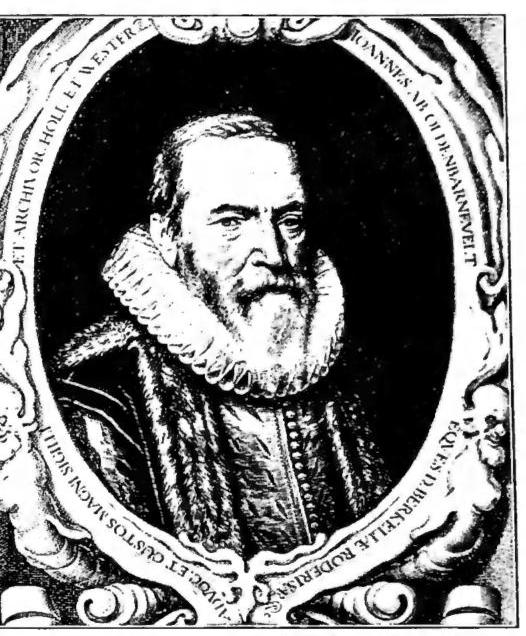
The offer of the comital dignity was not repeated to his seventeen-year-old son Maurizio (the firstborn, Filippo Guglielmo, whom Philip II had had kidnapped from the University of Leuven, lived as a Catholic in Spain), but the States appointed him Statholder in succession to his father. The sovereignty of the rebellious provinces was offered to the King of France and to Elizabeth of England, but both refused II. The latter, however, sent her confidant, the earl of Leicester, who remained in the country until 1587, earning the enmity of the leaders of Holland because of the exclusive support he gave to the Calvinists. After his departure, the States General, tired of seeking abroad, assumed sovereign power themselves (1588). In this way, the Union of Utrecht, which originally was merely a military alliance, assumed the character of a constitution for the entire duration of the Republic of the Seven United Provinces of the P. B. It was in fact the vague nature of the system that left broad scope for the interplay of internal political forces. For example, the essential question of whether the Republic was a federal state or a federation of states was never resolved, and in practice now one concept and now the other prevailed. In general, the powerful province of Holland, which by itself accounted for 58% of the entire federal budget, professed the second theory, while the six “small provinces,” together with the princes of Orange, followed that of a more closely knit union. The internal “constitution” varied slightly from province to province: in Holland, the great mercantile bourgeoisie concentrated in the various cities dominated; each city had one vote in the Provincial States. Among the Dutch cities, Amsterdam predominated, having succeeded Antwerp as the world entrepôt; Antwerp had been recaptured by Farnese in 1585, resulting in a veritable exodus of Calvinists and other merchants toward Amsterdam. In the other provinces, the rural nobility predominated, closely dependent on the House of Orange. In contrast to the various “Provincial States,” the States General, established at The Hague, sat permanently. There was no restriction on the freedom of the provinces to delegate as many deputies as they wished to this “Permanent Congress of Ambassadors”; the vote, however, was taken by province, and in theory unanimity was required for every important decision. A strange semi-monarchical aspect of the Republic derives from the fact that the high office of Statholder became virtually (in theory from 1747 onward) hereditary in the House of Orange. In theory, the office was provincial, but, with the exception of Frisia (at least during the seventeenth century), the princes of Holland were almost always simultaneously Statholders of the various provinces and, moreover, as “captains general,” commanded the armed forces. After the Statholder, the most important figure was the “grand pensionary” of the province of Holland (an exponent of the latter’s particularism against the unifying tendencies of the Oranges), who was responsible for directing the foreign affairs of the entire Republic. Indeed, while Prince Maurizio continued the struggle against the Spaniards, the pensionary Oldenbarnevelt continued the diplomatic work of Guglielmo il Taciturno. Although not yet de iure, Spain recognized de facto the independence of the rebellious provinces, which not only were able to keep the Scheldt blockaded but also to continue their colonial expeditions at Spain’s expense (1602, foundation of the East India Company; 1619, foundation of Batavia in Java; 1621, foundation of the West India Company; 1626, purchase of the-
(the island of Manhattan; foundation of New Amsterdam, now New York).
In this period the country’s artificial conversion to Protestantism resulted in the fact that Catholics could already be spoken of as a minority in a distressing situation. The ecclesiastical organization had, since 1559, raised the ancient see of Utrecht to the dignity of an archdiocese with five suffragan sees: Haarlem, Middelburg, Deventer, Groninga, Leeuwarden. Events, however, had forced the new bishops to cease their activity shortly after their installation. To provide for the Catholics of the northern Netherlands, the Holy See established the “Missio Holandica” under a titular archbishop, dependent from 1622 onward on the newly established Congregation of Propaganda Fide. The Union of Utrecht had prohibited all non-Calvinist worship in the Republic, while guaranteeing freedom of conscience. In practice, Catholics could celebrate worship only by paying substantial gratuities (“recognition money”) to the various judicial authorities. The mission numbered 220 stations in 1622; 320 in 1671; and 383 in 1701. Its original defect was a continual rivalry between the secular and regular clergy, which several times made intervention by Rome necessary.
Stadtholder Frederick Henry, nicknamed the Poliorcetes, consolidated the Republic’s dominion and, in 1629, after a lengthy siege, captured Boscoducale, the capital
Frederick Henry was succeeded in the statholderate by his son William II, who, wishing to resume the war in alliance with the French, came into conflict with the Dutch oligarchy, and principally with the city of Amsterdam, against which he finally attempted a coup d’état (1650). But immediately afterward he died at the age of 24, one week before the birth of his son William II. The provincial States of Holland did not appoint a new Statholder, inducing the sister provinces to follow their example. The grand pensionary John de Witt, the leading representative of the Dutch oligarchy, then dominated, and the Republic’s commercial power reached its apogee. Rivalry with England led to two naval wars (1652–54 and 1665–67), during the second of which the Dutch fleet penetrated the Thames almost as far as London. In European politics de Witt attempted to preserve the balance, but his policy failed when, in 1672, Louis XIV, allied with Charles II of England, invaded the Republic. The anger of the Orangist masses turned against de Witt, who was barbarously murdered together with his brother Cornelius.
William III was appointed Statholder and captain-general. Thanks to the celebrated « line of inundation », the French, who had already seized Utrecht, were unable to invade the province of Holland, while the fleet under the command of the great admiral Michiel de Ruyter held the English at bay, and they promptly made peace (1674). With France, on the other hand, the war ended with the Treaty of Nijmegen (1678); but even after that Treaty, William III regarded himself as the champion of the European balance against the aggressions of the Sun King, to such an extent that he organized an expedition against England (1688) and assumed its crown together with his wife after expelling his Catholic father-in-law James. From then on, the political history of the two countries proceeded in parallel.
In the religious sphere, the infiltration of Jansenism brought about the end of the « Missio Holandica ».
William III, for whose descendants the office of Statholder had been made hereditary, died without children (1702). Only in 1747 was the other office entrusted to William IV, head of the so-called Frisian branch of the dynasty. In this way, for the first time, the seven provinces were united under the aegis of a single sovereign ruler. Yet neither he nor his son William V (1751–95) were equal to their task, nor were the ruling classes, who brought upon themselves all the disadvantages of a true oligarchy. The Orangist Party increasingly relied upon England and Prussia, while the liberals (or « patriots »), who were increasingly numerous, relied upon France. In 1795 the French army entered the country at the invitation of the « patriots », and the Republic of the United Provinces was transformed into a Batavian Republic, with no further discrimination among citizens on religious grounds. Under Napoleon, the Batavian Republic was in turn transformed into the Kingdom of Holland (the first time in history that this name became official) under Louis Bonaparte, until in 1810 Napoleon incorporated the country into his Empire, of which Amsterdam
was declared the third capital; the leaders of the « Liberation Movement » proclaimed sovereign the then Prince of Orange, eldest son of the old William V, who had died in exile (November 1813), and two years later, when the Congress of Vienna reunited Belgium with the northern provinces, king of the P. B. under the name of William I. As is well known, the union failed, not least because of the King’s incomprehension and the Protestant spirit of the northern regions in relation to the predominantly Catholic southern regions; while the Catholics of the north, although by then in possession of full political rights, still felt too weak and uncertain to assert themselves. Moreover, in Belgium the King pursued an ecclesiastical policy similar to that of Joseph II of Austria. Nevertheless, in 1827 the King concluded a concordat with the Holy See establishing the episcopal sees of ’s-Hertogenbosch and Amsterdam, but the Protestants obstructed II. After the Treaty of Belgian separation (1839), the old King abdicated in favor of his son William II, who was much more favorable to Catholics and promulgated the Constitution of 1848.
Five years later (1853), under William III (1849–90), Pius IX restored by the brief Ex qua die arcano the Catholic hierarchy, with its metropolitan see at Utrecht and suffragan sees at Haarlem, s-Hertogenbosch (Boscoducale), Breda, and Ruremonda. The new ecclesiastical province nevertheless remained under the jurisdiction of the Congregation of Propaganda Fide until 1908. The Catholics, who had been obliged to collaborate with the liberals out of fear of the Protestants, after 1870 formed with the latter the so-called coalition with the antirevolutionary and Christian-historical parties, in order to support the « school struggle », that is, the demand for the rights of confessional education—a struggle that ended with the complete equalization of the latter and with the establishment of the state school system. The foremost « emancipator » and leader of the Catholics was at that time Monsignor Ermanno Schaepman (1844–1903). The coalition dissolved in 1926, when the Protestant parties opposed the opening of a legation at the Holy See.
In 1890 King William III was succeeded by his daughter Wilhelmina. During the war of 1914–18 the Kingdom maintained a strict, though precarious, neutrality. In May 1940, on the contrary, despite its neutrality, the Kingdom was invaded by the German army, and the Queen departed for London with her government and continued the struggle. In 1941 the Netherlands Indies too suffered a harsh occupation by the Japanese. The European territory was partially liberated in the autumn of 1944, and the two provinces of Holland (southern and northern) only in May 1945, after an atrocious « winter of hunger ». Meanwhile, a strong nationalist independence movement arose in the Indies which, supported by the United Nations, led to the end of Dutch sovereignty (December 1948) and to the proclamation of the Netherlands–Indonesian Union. In August of the same year the Queen abdicated in favor of her daughter Juliana. After the elections of 1946, the government was formed by the two Catholic People’s and Labour parties.
The P. B. today comprise one metropolitan diocese, Utrecht (v.), and four suffragan dioceses: Breda (v.), Haarlem (v.), ROERMOND (v.), s-Hertogenbosch (v.).
III. LEGAL STATUS OF THE CHURCH
The Dutch Constitution establishes equal freedom for all religious confessions (art. 168) and assures all of them the protection of the law (art. 169). Adherents of the various religions enjoy the same civil and political rights and may likewise hold dignities, perform functions, and occupy offices (art. 170); in practice, however, Catholics are barred, for example, from entering the diplomatic and consular service.Worship is permitted inside religious buildings and, in general, in enclosed places, within the limits of public order; it is forbidden outside them, with the exception of those regions where it was permitted, according to the laws and regulations, in 1887, when the Constitution was promulgated, with many amendments that are still in force.
The various religious confessions and their ministers are guaranteed the financial provisions, pensions, and other benefits that they already received from the State. No governmental intervention is required for the publication of religious instructions (art. 174). The Holy See is entirely free in the appointment of bishops.
Dutch legislation permits divorce (art. 254 of the Civil Code) and recognizes only marriage contracted through the civil rite, which must precede the religious one. In 1940, moreover, the Chambers approved a bill which, amending art. 888 of the Civil Code, restricts the scope of the impediment of affinity, thereby constituting a new offense against the marriage bond according to the canonical conception.
Holland has maintained diplomatic relations with the Holy See since 1815; nevertheless, there was a lengthy interruption, from 1870, when, following the occupation of Rome, it abolished its legation, until 1915, when, after the outbreak of the First World War, it found it expedient to reestablish, albeit temporarily, its representation at the Holy See. In 1923 the legation once again became permanent.
The papal representation did not suffer any interruptions, although it too was not spared unhappy vicissitudes. In 1899, in fact, the Holy See was compelled to remove the internuncio from The Hague, having been excluded from the Peace Conference. The representation thus remained entrusted to a chargé d’affaires until 1910, when the decision was taken to entrust the administration of the Internunciature in the P. B. to the pro tempore nuncio of Belgium, with the rank of internuncio.
In 1921 the papal representation was restored to its full status, so that the two parties are now represented respectively by an apostolic internuncio residing at The Hague and by a plenipotentiary minister.
IV. LITERATURE
One can speak of a genuine literature of the P. B. only from the thirteenth century onward. Everything written before that belongs generically to Germanic literature. The writers of the P. B. still each use their own dialect; the southern dialects (Brabant, Flanders) are particularly important. The literary genres are approximately those of contemporary French literature: French influence is in fact considerable. The Carolingian chivalric romance is reflected in the concise romance Karel en Elegast. The tale Floris en Blancfloer is distinguished by the delicacy of its tone; but more characteristic of the spirit of the P. B. is the satirical animal epic Van den Vos Reinaerde, a parody of chivalric romances. The same period also produced the prose and lyric poetry imbued with the mysticism of Hadewych, a “béguine” from Brabant: this is the highest expression of the poetry of the time. Important as a “mirror of the thirteenth century” is the didactic and moralizing work of Jacob van Maerlant (1235–1300), who, besides chivalric romances, also wrote lives of the saints and “scientific” works for popular use (his Rijmbijbel, or Bible in verse, deserves particular mention).The fourteenth century is notable for the vigorous mystical prose of Jan van Ruusbroec (1294–1381), among whose works De chierheit der gheestelike Brulocht (The Ornament of Spiritual Marriage) is recalled; it exerted considerable influence on the devotio moderna (v.). Also of interest are several lives of saints and legends (especially Beatrice), miracles, and mystery plays (Marien van Nieuwenheden and Elckerlyc). The popular farces manifest the realistic sense so characteristic of the P. B. Spiritual and secular songs complete the literary picture of this period.
In the period of transition toward the Renaissance, the struggle between the old and the new faith is reflected. Anna Bijns wrote her Refereinen (often apologetic in character). Marnix van St. Aldegonde wrote, with anti-Catholic aims and in prose, De Biëncoef der H. Roomsche Kerke (The Beehive of Holy Roman Church); he is responsible for the Dutch national anthem. After the fall of Antwerp (1585), the center of culture and literature moved northward. The seventeenth century—the golden age—was also a period of flourishing letters. Joost van den Vondel (1587–1679), who converted to Catholicism in 1641, may truly be regarded as the “prince” of Dutch poets; his tragedies are particularly important. Of commercial origin and self-taught, he succeeded in deepening his knowledge of the classics and theology; from this union of studies and interests arose his lyrical dramas (Lucifer and Adam in Exile) and his didactic poems (Mysteries of the Altar). His famous drama Gijsbrecht van Aemstel is still performed every year. As a lyric poet too, Vondel ranks among the greatest poets of his age.
The most characteristic exponent of the Renaissance is Pieter Cornelisz Hooft (1581–1647): while his dramas (Granida, a pastoral drama in the manner of Guarini’s Pastor Fido) are rather feeble, he owes his fame instead to his lyric poems and prose. In his Nederlandse Historiën he sought to revive the style of Tacitus. Gerbrand Adriaensz Bredero (1585–1608) displayed considerable gifts in lyric poetry and comedy (De Spaanse Brabander): in his comedies and