
COMENIUS (KOMENSKY), GIOVANNI AMOS. – Czech educationalist, born in Niunice, Moravia, on 28 March 1592, died in Amsterdam on 15 November 1670.
LIFE. – The information concerning his very troubled life is somewhat uncertain. He belonged to the “Union of Bohemian Brethren,” one of the earliest pietist Protestant sects. He lost his parents at an early age, and later regretted the delay with which he was sent to school: hence his first reflections and experiences concerning the education of the young. Having then passed from the school of Pferou, in Bohemia, to the Calvinist University of Herboru, he had Giovanni Enrico Alsted as his teacher of philosophy.
He then composed a Lexicon latino-boemum and conceived an extensive encyclopedia: Amphitheatrum universitatis rerum. In 1614–16, having returned to his homeland, he taught at the school of Pferou, where he had his first fruitful pedagogical experiences and became aware of his vocation as an educator. He thereafter maintained a constant and fervent correspondence with the best-known contemporary pedagogues, particularly with Alsted and Andreà, whose works aroused in him a lively impulse toward reflection. From 1618 to 1621 he devoted himself to various studies at Fulnek in Moravia, and there he married. From there, in 1621, he had to flee because of Ferdinand II’s persecution of the “Bohemian Brethren,” and went to Bohemia. Europe was then being ravaged by the Thirty Years’ War, and he had the sorrow of seeing his library destroyed and his manuscripts scattered, while grave family misfortunes afflicted him: the death of his wife and of two children. In 1624 he married again.
Following an imperial edict of proscription, he had to leave Bohemia in 1628 and went to Leszno (Lissa) in Poland, where the sorrows of exile and family misfortunes encouraged strange deviations in his mind: he placed his faith in exalted persons who declared themselves prophets and announced the liberation of his homeland. Meanwhile, he did not neglect his pedagogical studies: he sought Ratke’s and Andreà’s advice on didactic questions and studied the works of the major pedagogues of his time. He meanwhile conceived a great work to aid language learning through the intuition of things, and in fact published, in 1631, the Ianua linguarum reserata, while he was
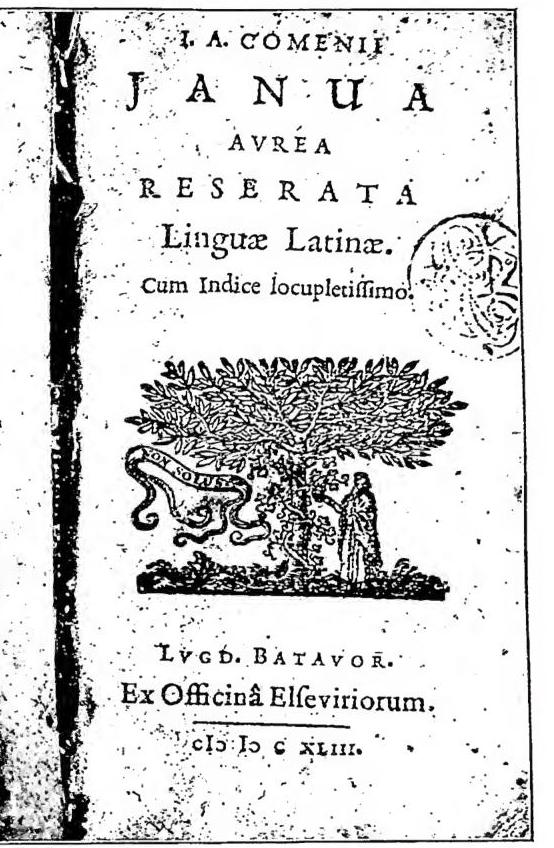
In the preface to this work he acknowledges that he had been preceded by the Jesuits, with a book of similar content and title: Quia Patres isti tale hoc totius linguae compendium primi tentarunt, quod inventum est grate agnoscimus, quod erratum condonamus benigne. He says that he knew this work in various editions, including a German one in eight languages from 1629. The work is by the Irish Jesuit Fr. Guglielmo Bathe, published anonymously in its first edition: Ianua linguarum, seu modus maxime accommodatus, quo patefit aditus ad omnes linguas intelligendas, industria Patrum hibernorum Societatis Iesu... edita (Salamanca 1611; V. SOMMERVOGEL, CHARLES, I, 1009). Meanwhile, he took part in the pansophic movement and in the naturalistic currents then maturing in Europe. In 1633 he published the Ianuae linguarum reseratae vestibulum and was elected « senior » of his community. Since political events deprived him of his last hopes of returning to his homeland, he went to England, where he composed the Via Crucis, dominated by the idea—sometimes expressed naïvely, but deeply cherished and felt—of a spiritual brotherhood of men under the inspiration of God, in a mystico-pietistic sense. And since his reputation as a pedagogue had by then become very widespread, he was asked for advice by France, Holland, Sweden, and even America. From Sweden he received the task of preparing texts to improve teaching in schools. In fact, in 1647 he published the Linguarum methodus novissima and other texts for the teaching of Latin. He then returned to Lissa, where in 1648 he suffered another serious domestic bereavement: the death of his second wife. In the same year, when the Thirty Years’ War had ended, he hoped to return
to his homeland, but exiles belonging to religious sects were not permitted to return, and thus C. remained in exile.
Prince Sigismondo Rakoczy of Transylvania invited him to Saros Patak, where he was entrusted with the direction of a pansophic school; it was during this period that he completed the work Orbis rerum sensualium pictus, strongly inspired by the new intuitive method.
He was subsequently invited to Amsterdam, where he spent his final years and wrote Ventilabrum sapientiae, in which, with a modesty equal to the sincere passion that animated his entire life, he brought to light the errors and deficiencies of his works. The Traditio lampadus also dates from this period; in it, in view of all that still remained to be done to improve humanity, he recommended the continuation of his work. He worked intensely until his final days, publishing for the first time his major work, the Didactica magna.
THE THOUGHT. – His thought, given the encyclopedic multitude of his works, their sometimes naïve and not always clear form, and the somewhat visionary tendencies of his spirit, may appear tied to outdated traditions, but is in reality attentive to contemporary scientific and philosophical currents, and powerfully dominated by a great idea: the reform of humanity through a rational culture, in conformity with human nature.
The human soul has the power to understand everything; it has an insatiable thirst for knowledge that reveals its destiny and its supernatural end. There is a marvelous capacity in man to draw wisdom from within himself, through the impulse of his nature, so richly endowed by God, because “within man there is truly everything: there is the lamp, the light and the oil, the wick and everything necessary”; he must be helped to kindle the flame. It is the duty of those who govern to order the schools toward this end. Education gives nothing from outside to the consciousness, but helps it kindle the inner light that must enable it to see within itself and in the great world of nature the marvelous treasures of God’s wisdom.
Bacon’s scientific naturalism passes, through the work of C., into modern pedagogical thought and teaching methods, and is suggestively joined to a profound religious vision of life, of the purpose assigned to it by God, and to a hope for pacification and fraternity among men, finally united in a clear awareness of their common origin and end. The three major works of C. are: the Ianua, the Orbis, and the Didactica. All of them brought to the school the broad contribution of the modern scientific spirit and inspired naturalistic pedagogy and the active school. Rousseau and Pestalozzi found in him their great precursor. No less than Pestalozzi, he had faith in education, a deeply humanitarian spirit, and the cult of the human personality. He differs from Rousseau and Pestalozzi in that he recognizes man’s deterioration through original sin, but, like Rousseau and Pestalozzi, he lacks the Catholic concept of Grace, which raises fallen nature and helps it attain perfection. Thus C. wrongly believes that man possesses within himself the strength and adequate means to rise and attain perfection, even though he admits in general that this strength comes from God, but as author of nature, not as Redeemer and author of Grace.
The first two works, the Ianua and the Orbis, highlight the relationship between word and thought, and warn education of the futility of any linguistic teaching founded on memory rather than on the development of thought and on real intuitions. Teaching must therefore be intuitive; for this reason C. gives us in the Orbis pictus an early example of an illustrated book for children, in the sense that the learning of words must always be joined to that of things, and in the sense that every form of knowledge must begin with the senses and then pass, according to the law of gradual progression, to the intellect.
C.’s most extensive work is the Didactica magna, Universale omnes omnia docendi artificium exhibens, in which, amid prolixity, repetitions, and sometimes pedestrian examples, there predominates a living idea and a vigilant concern to make pedagogical principles and educational practice systematic. This work expresses the principles on which C. bases education, as well as a curriculum that he proposes to rulers as necessary in a well-ordered State.
Education must be universal; everyone must be educated, because only education can bring nature to the fullness of earthly life, in order to direct it toward its ultimate end, which is supernatural: the full possession of God. Contrary to the prejudices of the age, there must be no fear of educating the people and women. Instruction must also embrace everything; the curriculum proposed by C. is broad: he wishes to repeat, “everything to everyone.” He therefore wants the school organized according to various stages corresponding to the stages of human development, with a method of “cyclical instruction.” For the first time, a “school of the mother’s womb” is introduced, which must exist in every home through the work of the mother; likewise, he is among the first to propose a “school of the national language,” preceding the “Latin school,” and intended to be extended to everyone. The cycle of studies is then completed with the “Academy.” Young people between the ages of 12 and 18 who can and wish to devote themselves to classical studies must be able to attend the Latin school. Such a school must exist in every city, whereas the Academy, which is to receive young people between the ages of 18 and 24, must exist in every State and every province.
The “everything to everyone” implies the cyclical method, in the sense that all the functions of the spirit are exercised at every stage of schooling. His “everything to everyone” also reveals his pansophic, encyclopedic ideal, which he shared with his age and expressed with naïve enthusiasm.
The education of the senses and the intellect must tend toward that of the will, as the harmonizing force of all the faculties.
In the enumeration of teaching rules, in the frequent and sometimes pedestrian comparisons between the education of man and the development of natural things, lies the negative and outdated aspect of C.’s pedagogical thought, which seems to wish to form the spirit from without.