
COMBONI, DANIELE. — Bishop and missionary in Africa, born in Limone sul Garda (15 March 1831), he was educated for the priesthood by Nicola Mazza, apostle of charity in Verona. Won over to the African missionary ideal by Angelo Vinco, who had returned from Central Africa (1849), he followed him there in 1857, advancing as far as S. Croce on the White Nile (6th degree of north latitude). There he saw firsthand the wretched conditions of those tribes and swore in his heart to devote himself entirely to their redemption, even after ill health forced him, under obedience, to return to his homeland (1859). Two years later, the mission of Central Africa was practically destroyed: in only 16 years, 44 missionaries had died there, and the others had abandoned it, with the exception of one who remained to guard the buildings in Khartoum.
In 1864, while he was praying at the Altar of the Confession in S. Peter’s, C. conceived his Plan for the regeneration of Africa (Turin 1864), centered on the principle of “promoting the conversion of Africa through Africa.” He proposed, in fact, educating Black people to make them teachers, catechists, and priests; he even envisaged the subsequent foundation of small theological and scientific universities in Africa for the most gifted minds.
Encouraged by Pius IX, he began an extensive effort to penetrate the Catholic circles of Europe in order to win sympathy, aid, and vocations for Africa. In Paris he lived for six months with Massaia, then recently returned from Ethiopia, who inspired him to work for Black people.
In 1867 he opened two institutes in Cairo for Black people to be trained for the apostolate in Central Africa. In the same year, with the support of Msgr. Luigi di Canossa, bishop
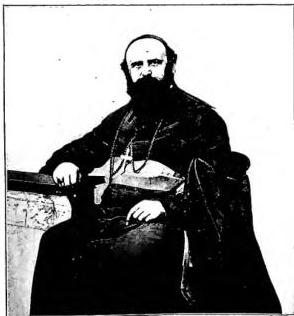
Appointed provisional apostolic vicar of Central Africa (1872), and then (1877) apostolic vicar and titular bishop of Claudiopolis, he established his residence in Khartoum, but undertook long journeys through Nubia, Kordofan, and Dar-Nuba and founded stations at el-Obeid, Delen, and Berber. Slavery was then widespread in the Sudan. C. never ceased to raise his voice against this scourge, addressing himself particularly to the khedive of Egypt and to the local authorities, who were not infrequently complicit in the disgraceful trade. For his part, he kept the doors of his missions open to persecuted slaves, whom he welcomed and restored to freedom, often after making them Christians. For these he opened an agricultural colony at Malbes, where they could earn their livelihood through work.
His reports and his extensive correspondence are rich in information and observations useful for the history of African civilization. He compiled a Nubian dictionary of high scientific value, to which must be added considerable studies on the language of the Denka.
Worn down by fevers, he died in Khartoum on 10 October 1881. The ordinary proceedings for his beatification cause have been instituted.
BIBLI: F. X. Geyer, Mgr. D. C., Bolzano 1882; M. Grancelli, Mons. D. C. e la missione dell'Africa centrale, Verona 1923; I. Dellagacoma, I missionari camilliani con mons. C., there 1924; M. Grancelli, Mons. D. C., there 1926; H.-Wohnhass, Bischof D. C., Ellwanger 1937; A. Capovilla, Il servo di Dio D. C., 6ª ed., Verona 1949. Agostino Capovilla