
ETHIOPIA. – An inland state of northeastern Africa embracing, together with the true Ethiopian highlands, some of the neighboring regions, with an area estimated at about 1.1 million sq km.
SUMMARY:
I. Geography
II. History
III. Literature
IV. Theology
V. The Ethiopian rite
VI. Christian antiquities.I. GEOGRAPHY.
The highlands, intersected by deep valleys, are divided into well-defined and usually isolated regions: from the low marginal lands (qolla), with a tropical climate, largely covered by forests but often malarious, one passes to the higher regions (dega, above 3,300 and up to 4,600 m), where summers are cool and winters relatively harsh, through intermediate mountain territories (1,800–2,400 m; woinadega), whose healthy climate, of subtropical or temperate character with slight temperature variations and abundant rainfall, makes them more habitable. Most of the country is especially suited to pasture (cattle, sheep, horses and mules), with scattered cereal crops (wheat, millet, maize, barley) and industrial crops (coffee), while in the lower plains the forest is here and there interrupted by clearings that yield durra, cotton, tobacco, etc. Mineral resources are not lacking (platinum, gold, rock salt), but they play only a modest part in the country’s economy. The deficiency and difficulty of communications are the gravest obstacle to the development of Ethiopia, whose promising progress had been given a tremendous impetus by the brief Italian occupation (1936–41). Unfortunately, the recent war has halted or perhaps compromised this promising development.
Of the 10 million inhabitants living in the country, about one third are Abyssinians (from the Eritrean frontier to the Auasi), one third Galla (southern part of the highlands), and the remainder Somali, Sidama, Negroes and Negroids. The ancient Ethiopian language, Ge’ez, is preserved by the Monophysite Coptic Church, to which belong the Amharic and Tigrinya peoples; from it derive Amharic, which is the official language, and the Tigrinya dialects. Islam is widespread among the Galla and prevalent among the Somali and Danakil; pagans are also numerous.
The capital Addis Ababa (160,000 inhabitants) in Shoa, and Harar (25,000 inhabitants) in the homonymous region, are the most important urban centers.
The Empire of Ethiopia is a hereditary monarchy with very ancient origins, which in its modern form presides over a feudal administration of semi-independent territories governed by kings (negus) and vassals (war).
II. HISTORY.
SUMMARY:
I. The dawn of Christianity in Ethiopia
II. The dependence of the Ethiopian Church on Alexandria
III. Christianity in Ethiopia until the 7th century and the influence of the Syrians
IV. From the decline of the Aksumite kingdom to the first Solomonids (end of the 13th century)
V. The Solomonids up to the Muslim irruption
VI. The crisis of the 16th century and the mission of the Jesuits
VII. From the restoration of Monophysitism to the end of the controversy over the Union in 1878
VIII. The most recent times in Eritrea and Ethiopia
IX. Catholic missions.I. THE ORIGINS OF CHRISTIANITY IN ETHIOPIA
Christianity, to which Ethiopia has remained faithful for now sixteen centuries, has been the fundamental factor in the political and cultural history of that African region. Already the southernmost limit of the territories of the preaching of St Mark in East Africa, Ethiopia, after the fall of Christian Nubia in the 14th century, remained a Christian island surrounded on all sides by Muslims. The struggle to preserve political independence thus became, in Ethiopian history, identical with the defence of the Christian Church against the alām. This explains, for instance, why in Amharic atammana means both “to convert” (and this is its etymological value) and “to subjugate (politically)”, a new meaning assumed in the course of history. For this reason too, from the cultural point of view, Ethiopia, though an African country and geographically cut off from Mediterranean cultural currents, has historically maintained, through Christianity and its own Christian Church, the closest contacts with the countries of the Near East (and often also of the West), so that Ethiopian culture reveals itself daily more as having unfolded on the margins of the Mediterranean world. In this sense it may be said that Christianity gives Ethiopia its historical individuality.Small Christian communities already existed at least in the first decades of the 4th century A.D. in the commercial emporia of the Kingdom of Aksum, which in the port of Adulis had both the starting-point of its maritime communications with the opposite Arabian shore of the Red Sea and a staging-post on the trade route between the Greco-Roman world and India. The beginnings of the spread of Christianity in Ethiopia are precisely linked to this situation.
Rufinus was writing in 403 and had spoken with Aedesius himself. But he does not name the country to which his narrative refers. This is known only from comparison with a contemporary document: the letter which the Emperor Constantius wrote shortly before 356 to the two brothers, lords of Aksum, Aizanas and Sazanas. This letter is preserved in the Apology of St Athanasius (PG 25, 656–657); and in it the Emperor invites the Aksumites to send back to Egypt “the bishop Frumentius”, who had been ordained by Athanasius, so that he might submit to the patriarch (pro-Arian) George, who was devoted to the Emperor.
To these Western documents correspond the Aksumite inscriptions; the most important group of these refers indeed to King ‘Ezana, who in his protocol declares himself “son of Mahrem unconquered by an enemy” (Mahrem is the Mars of South-Arabian paganism imported into Aksum). In his most recent inscription, however, King ‘Ezana removes the reference to the pagan god and invokes “the power of the Lord of heaven, who is in heaven and on earth, conqueror of all”. The conversion of the ruler of Aksum to Christianity thus took place during the reign of ‘Ezana. As for the chronology, it suffices here to recall that St Athanasius was elected bishop of Alexandria on 7 June 328 (the consecration of St Frumentius as first bishop of the Ethiopian region, according to Rufinus, took place shortly afterwards); and that the pro-Arian “bishop” George, to whom St Frumentius was said to have had to submit according to the Emperor Constantius’s letter, took possession of the see on 24 February 357 (and fled from Alexandria at the end of August 358).
II. LA DIPENDENZA DELLA CHIESA ETIOPICA DA ALES-
SANDRIA. — A question of no small historical importance has been raised regarding the reasons why Frumentius, although he was a Syrian, went to present himself in Alexandria rather than Antioch; and, receiving episcopal consecration from St. Athanasius, thus placed Ethiopia under the jurisdiction of the Alexandrian patriarchate. These reasons have been sought in possible pre-existing hierarchical ties between the Greek-Roman Christian communities of Adulis (and the nearby regions) and the neighboring episcopal sees of Egypt. That the Alexandrian see sought to assert its jurisdiction over the communities along the maritime route to India is entirely natural, especially when one recalls that this route began at Clysma in the Gulf of Suez, in territory on this side of Rhinocolura (al-‘Arif), the traditional boundary between Alexandria and Antioch. Yet above and beyond these historical considerations, one must certainly take into account a fundamental religious fact: namely, the severe crisis that, in the heat of the struggle waged by St. Athanasius against Arianism, then divided Alexandria from Antioch. It thus seems natural that St. Frumentius should have sought St. Athanasius’s intervention in Ethiopian affairs rather than turning to the Arian-leaning circles in Antioch.
III. CHRISTIANITY IN ETHIOPIA UP TO THE 7TH CENTURY
The influence of the Syrians. — Thus established, a see
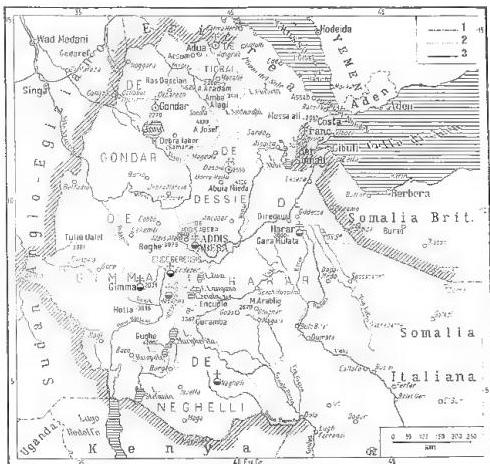
ETIOPIA — 1) State boundaries; 2) Ecclesiastical circumscriptions; 3) Railways.
The establishment of an episcopal see in Ethiopia, dependent on Alexandria and entrusted from the outset to a prelate foreign to the country, meant that after the conversion of the sovereign Christianity became the official religion of the Kingdom of Aksum. It has been suggested that the decision of ‘Ezanā may have been influenced by the opportunity to please the Emperor of the East; yet the very letter of Constantius, mentioned above, is proof of Aksum’s independent stance toward Byzantium on religious matters.
The ties with Egypt appear temporarily strengthened at the time of the Council of Chalcedon, if one accepts the recent conjecture that identifies one of the eastern signatories as “the bishop of Koptos and Adulis” (Koptos being modern Qift in Egypt). Also from the 5th century is the bishop Moses of Adulis, whose brief account of a journey to India has been preserved in the Book of Alexander the Great by Pseudo-Callisthenes.
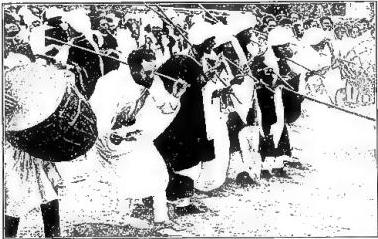
Meanwhile, the first indications appear of a curious role that distant Ethiopia was to assume: namely, a place of refuge—and sometimes even of preservation—for dissidents whose residence had become impossible in the Near East. Thus Longinus, sent to evangelize Nubia, meets at ‘Alwah in 580 “some Aksumites who had fallen into the fantastic heresy of Julian (of Halicarnassus) and declare that Christ suffered the Passion in an impassible and immortal body” (John of Ephesus, Ecclesiastical History, IV, in Corpus Scriptorum Christianorum Orientalium, Scriptores Syri, 3rd series, III, Louvain 1936, p. 239 [English trans. by E. W. Brooks, p. 180]). Alongside these visionaries, the existence in Aksum of Melitian practices has also been conjectured, inasmuch as the liturgical dances still uniquely preserved in the Ethiopian Church have been linked to a cathartic rite of the Melitians described by Theodoret (PG 83, 425).
A similar movement accounts for the immigration into Ethiopia of a number of monks from Syria of Monophysite belief: an immigration that local tradition obscures, for example, in the story of the “Nine Saints,” whose Acts, although written much later, preserve references to the saints’ origins in the Eastern (Roman) Empire and to names of persons or places in Syria. This immigration of propagandists of Monophysitism was probably not the sole cause determining the adherence of the Ethiopian Church to the doctrine of Dioscorus, for it is highly likely that, rather than an explicit adherence, the transition occurred with the prevailing Monophysite influence in the Alexandrian patriarchate. Yet the contacts procured by that immigration certainly helped to render the Ethiopian Church’s position in the Christological controversy active and polemical.
That, moreover, a missionary effort was still necessary within Ethiopia itself in the 6th and 7th centuries is shown not only by hagiography, which recounts the deeds of monks converting pagans; the very circumstances surrounding the introduction of Christianity—beginning as the religion of the sovereign—necessitated a work of diffusion and apostolate. ‘Ēsānā himself designates the Divinity with the periphrasis “Lord of heaven and earth,” a designation that recent studies have traced to a similar periphrasis in South Arabian inscriptions, where, however, one recognizes not Christianity but a vague monotheism. Later, the Divinity is designated in Ethiopia (and still today) by the name Egnī’abehēr “Lord of the earth,” not without some reference (at least in popular psychology) to the victory of the one God of Christianity over the Earth (Behēr), which was one of the principal pagan deities in Ethiopia. Similar significant ambiguities persist even at the end of the 7th century, when the Ethiopian translator of Sirach renders the name of the Lord in two passages (Eccl. 31:8; 37:2) with the Ethiopian name ‘Astar, namely the well-known Semitic pagan deity Astarte.
IV. FROM THE DECLINE OF THE AKSUMITE KINGDOM TO
PRIME OF THE SALOMONID DYNASTY (END OF THE 13TH CENTURY). — This is followed by the long period of the decline of the Kingdom of Aksum (7th–12th centuries), the shifting of the capital to central E., in the region of Lāstā, under the dynasty of the Zāguē, until in 1270 the centre of the Ethiopian state moved still further south with the subsequent dynasty of the Salomònids, which had its political origin in the land of the Amara. Of this period of Ethiopian medieval history there are still very few direct documents, and history remains consequently rather obscure, also because the study of the monuments (and particularly that of the churches of Lālibelā, in Lāstā) is today in a phase little more than initial. Nevertheless, from the point of view of religious history, it is possible to note
ETIOPIA - A woman consecrated of very ancient origin in use within the Ethiopian Church.
Certain important facts can be established with certainty:
1. The Ethiopian Church continues to depend hierarchically on the patriarchate of Alexandria. The metropolitan of Ethiopia is chosen and consecrated by the patriarch. His office is for life. Upon the death of a metropolitan, the Ethiopian sovereign sends an embassy to Egypt to request a new metropolitan, offering the patriarch gifts of homage. The metropolitan of Ethiopia is always an Egyptian and not an Ethiopian. This is justified by an (apocryphal) canon of the Council of Nicaea (no. 42 in the Ethiopian compilation), later included in the Nomocanon of Ibn al-'Assāl (mid-13th century), a juridical compilation for use by the Coptic Church (of Egypt).
The evangelization of the pagan lands of Ethiopia was intensified by the transformation of the Kingdom of Aksum, a descendant of the South Arabian kingdoms, into a state that now had a strictly Ethiopian character and extended into the African highlands. The Acts of some Zāguē kings, considered saints of the Ethiopian Church, and the legendary figure of the apostle of the south, Gabra Manfas Qeddus, preserve for us, albeit distant in time, echoes of this activity.
2. Islam arose in the 7th century; and while the Ethiopian sovereign, victorious champion in Arabia itself of the religion of the one God, enters Muslim tradition as the generous host of Muslims forced to flee to the African shore from the persecutions of pagan Arabs, historically Muslim expansion obstructed Ethiopia’s communication routes with the West and, by forming Muslim petty states on the very eastern African coasts and later on the Ethiopian highlands themselves, forced the negus to a long and bloody struggle that would last until the contemporary era. In this sense, within the Christian Kingdom of Ethiopia, for centuries the fierce defense of the country’s independence coincided with the heroic religious existence, within the Ethiopian Church, against Islam. Thus, the national character of Ethiopian Christianity and its significance in the life and structure of the country must be assessed historically.
V. THE SALOMONIDS UP TO THE MUSLIM INVASION — The dynasty of the Salomonids continued, and indeed intensified, the struggle against the Muslims in Ethiopia. In 1285 it ceded the sultanate of Shoa, and much of the territory was annexed to the Christian Ethiopian state; the sultanate of Ifāt, which succeeded Shoa, was soon afterwards subdued during the reign of the negus 'Amda Seyon I (1314–44) in a difficult campaign. The victorious enterprises of Dāwit I (1382–1411), Jeshāq (1414–22), and Zare'a Ja'qob (1434–68) led the Ethiopian state to its greatest external expansion and to good conditions of internal political consolidation. This new situation in Ethiopia was not without consequences for the history of the Church in the same period. The characteristics of this period are:
1. The metropolitan, an Egyptian appointed by the Alexandrian patriarch, was at the head of the Ethiopian Church, although during the reign of Zare'a Ja'qob there was a covert hint of some Ethiopian aspiration for a national metropolitan. In 1430 the patriarch unusually sent to Ethiopia two associated metropolitans and a bishop, all Egyptians, and this gesture and the more frequent special missions regularized relations with Alexandria.
Meanwhile, however, a hierarchy of the regular clergy had gained strength, which in an earlier period had come to recognize the supremacy of the abbot of St Stephen’s of Hayq. This recognition was also aided by the personality of the abbot Ijesus Mo’a (of the second half of the 13th century), later venerated as a saint by the Ethiopian Church. Later, as the capital of the Salomonids moved southward into the region of Shoa, the abbot of the Shoan monastery of Dabra Libānos replaced that of Hayq at the head of the regular clergy (first half of the 15th century). The abbot of Dabra Libānos, in his new capacity, took the title of ežagē and asserted and maintained his power over the Ethiopian monasteries, which he has preserved for five centuries down to the present day, not without struggles against the crown and the opposition of the northern monasteries, which claimed descent from Eustathius (Ewostātēwos), a 14th-century monk venerated as a saint in Ethiopia.
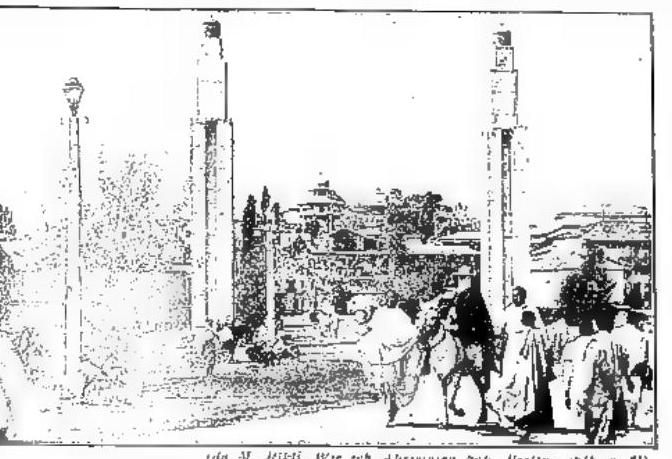
ETHIOPIA - Ancient quarter of the government of Emperor Menelik.
Human, but only the form that he alone knows. Hence their denial, or rather their allegorical interpretation, of the creation of man (Gen. 1:26–27) in the image and likeness of God. Moreover, the Mikaelites maintained the impossibility of representing the shapeless Trinity in three distinct Persons and thus acknowledged in the Trinity “three names, but one Person, one Hypostasis, one image.” Thus, on the other hand, at least according to their adversaries, by refusing to see in the Trinity anything more than three names, the Mikaelites adhered also to the heresy “of Mount Sion,” namely the denial of the Eucharist, since they could not (given the indistinctness of the Persons) admit transubstantiation, in which the bread and wine are changed into the Body and Blood of the Son through the descent of the Holy Spirit invoked together with the Father and the Son in the epiclesis of the Eastern liturgies.
The Stephanites, instead, “refused to venerate Mary and the Cross of her Son.” This heresy, which earned its followers the name of sara Mārjān (“enemies of Mary”), was harshly repressed by Negus Zare’a Ja’qob, though traces of it persisted into the reign of Na’od (1494–1508).
VI. THE CRISIS OF THE 16TH CENTURY AND THE MISSION OF THE JESUITS
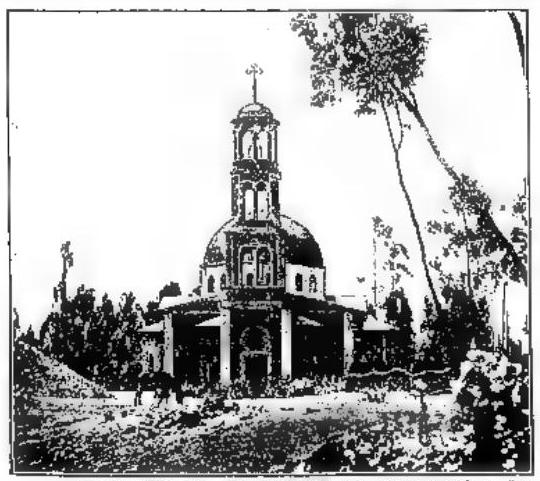
This period of prosperity in Ethiopia was followed in the 16th century by the greatest crisis of the Ethiopian state due to the Muslim invasion led by the “left-handed” (Amharic: Grāhī), the imām Aḥmed ibn Ibrāhīm, and the subsequent victorious campaign of the emir Nūr ibn Mujāhid, who defeated and killed in battle in 1559 the negus Claudio. After the Muslim onslaught, which in a few years led to the occupation of almost all of Ethiopia, came the invasion of the Galla (pagans), who, advancing from the southern regions still inhabited today by the Borana tribes, managed to overpower both Christians and Muslims in Ethiopia, exhausted by their long conflict. The resistance, truly heroic in every sense, against the Muslim threat led Ethiopia to seek the intervention of Portugal, which after the great maritime discoveries of the late 15th century had entered into relations with Ethiopia. The military valor of the Portuguese and the glorious martyrdom of Cristóvão da Gama (son of Vasco), their first commander in Ethiopia, beheaded by order of the “left-handed” on 30 August 1542 at the age of 26, strengthened the ties between the two countries; and at the same time Ethiopia maintained active relations with the Holy See, notably from the pontificate of Clement VII (who solemnly received in Bologna in 1533 the Portuguese Francisco Álvares, ambassador of the negus) to that of Paul III.(from U. Monneret de Villard, Un Duo di chiesa etiopeia, in Africa Italiana, 6 (1851), p. 2)
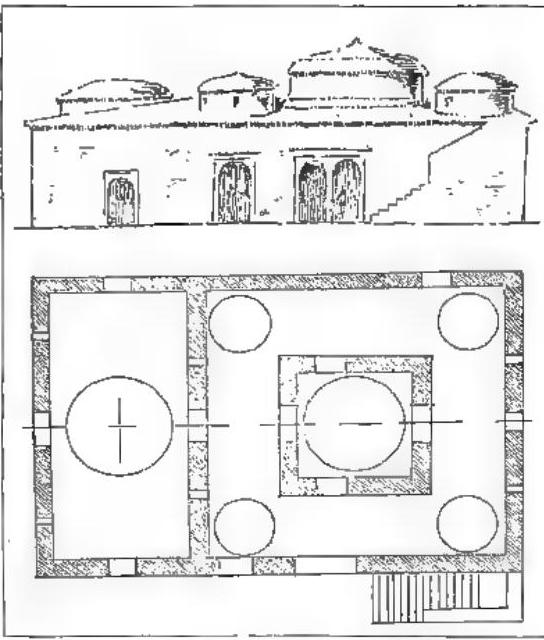
ETHIOPIA — Plant and elevation of the medieval church of Framona.
Meanwhile, after the death in 1530 of the metropolitan Márqos, an interesting and adventurous figure of the Portuguese expedition, João Bermudes, attempted to have himself recognized as metropolitan both by the Ethiopian sovereign and by the Holy See. But in 1555 the first group of missionaries of the Society of Jesus left Lisbon for Ethiopia, led by Fr. Andrea Oviedo, a Spaniard; to St. Ignatius of Loyola he addressed his “Recuerdos que podran ayudar para la reduction de los reynos del Preste Juan a la union de la Iglesia y religion catholica,” a fundamental document also for the delicate understanding of Eastern psychology, which the saint’s supreme prudence and discretion admirably reveal. The arrival of the Jesuit mission constitutes an essential event in the religious and cultural history of Ethiopia. After a difficult period of struggle and hardship under the patriarchate of Oviedo (d. 9 July 1577) and even more in the following twenty years, when only three missionaries remained (Manoel Fernandez, Antonio Fernandez and Francisco Lopez) and had to endure the hardest conditions of life, the mission flourished again with the arrival (26 April 1603 at Massawa) of Fr. Pietro Paes, also a Spaniard. He was an exceptional figure of missionary, scholar and explorer, and through his apostolate he achieved the greatest triumph by inducing the negus Susenjos to proclaim his adherence to Catholicism, as the negus himself announced in his letter of 3 July 1614 to Fr. Claudio Acquaviva, Superior General of the Jesuits. This union lasted until 1632, when a political movement led by Fásilidas, son of the negus Susenjos, forced the sovereign to abdicate and the new ruler then restored the Monophysite doctrine by decree.
VII. FROM THE RESTORATION OF MONOPHYSITISM TO THE END OF THE POLEMIC ON THE ANOINTING AND THE UNION IN 1878
From the mid-seventeenth century until the contemporary era Ethiopia fell into a state of isolation as a consequence of the crises just mentioned. This political decline of the country, which, with the exception of some attempts by rulers such as Ijásu I (1682–1706), Baláffá (1730–55), maintained barely its formal independence, ended much later with the reign of the energetic Teodoro II (1855–68), who, though often by force of arms, succeeded once more in unifying the state. With Giovanni IV (1872–80) and Menelik II (1889–1913) contacts were reopened with Europe, which the colonial movement of the nineteenth century had now brought to the very borders of Ethiopia itself.
The question became more complicated with entirely extraneous elements, such as the traditional rivalry of the northern monasteries (of Tigre), which were ardent anointists, against the southern monasteries and notably Dabra Libános, supporters of the unionist doctrine. Later, in 1763, the abbot Enoc (Hēnok) of Dabra Libános had published under his auspices a pamphlet (entitled Kārrō “Knife,” whence the followers were called Kārroč, almost “knifemen”), which formulated a new doctrine on the cited passage of Acts: “The Son, consubstantial with the other two persons of the Trinity, does not receive from them separately what he already possesses in his divine nature; he is therefore at once the Anointer, the Anointed and the Anointing.” The new doctrine led to the deposition and excommunication (by the metropolitan) of Abbot Enoc and to the condemnation of the aforementioned pamphlet.
At the beginning of the 19th century (between 1798 and 1803) the ancient dispute took on two new forms: that of the two births (Amharic: Halat ledat), upheld by the northern monks already “unctionists” and their followers, according to which “the Son had two births”: one from eternity from the Father, and one from the Virgin Mary, in which—it is claimed—at the very moment of the Nativity the union of the natures occurred through an unction of the Holy Spirit (pure unctionists) or through an unction of the Son Himself (Kārroč, “cutters”). The other doctrine, called that of the three births (Amharic: Sast ledat), maintained by the monks of Dabra Libānos and generally in the south, declared that “the Son had three births”: one from eternity from the Father, one from the Virgin Mary, and a third when the flesh of Jesus, at the moment of its union with the Word, received in “grace” the Holy Spirit, thereby becoming “the firstborn of every creature.” This “grace” (for which Jesus is called in Amharic ja-saga lāg, “Son of grace”) is not to be understood in the Augustinian sense, but as a divine γνῶσις for the humanity of the son of Mary at the point when this humanity was about to be totally united with the divine nature of the Word. In this sense, “grace” was a new interpretation of the doctrine of unction understood as “honor,” already, as we have seen, upheld by the monks of Dabra Libānos.
The long struggle came to a close through the intervention of Negus Giovanni IV at the meeting of Boru-mēdā in May 1878, when the sovereign, with his well-known vehemence of feeling, declared himself in favor of the doctrine of the two births in the formulation of the Kārroč, and the abbot in office of Dabra Libānos, the Ečagē Teofilo, was compelled to adhere to that doctrine. Even today, moreover, in the Ethiopian theological schools the polemical arguments against the doctrine of the three births, which has proved the loser, are still taught.
VIII. THE MOST RECENT TIMES IN ERITREA AND E
In the most recent times, instead, the question of the genearchy has been the most debated in E. Already Negus GIOVANNI IV, resuming what he had done four-
ETIOPIA — Modern Church in Addis Abeba,
near the residence of the Abuna.
Eritrea was then removed from the jurisdiction of the metropolitan of Ethiopia, and by an agreement between the Italian government and the Alexandrian patriarchate it was declared directly subject to the see of Alexandria.
This arrangement lasted until December 1936, when, after the annexation of Ethiopia to Italy, the Egyptian metropolitan of Ethiopia, Cirillo, withdrew to Egypt. An assembly of the Ethiopian clergy meeting in Addis Ababa then elected as metropolitan one of the Ethiopian bishops already consecrated in Alexandria, Abuna Abrehām. After the death of Abuna Abrehām in 1939, a second Ethiopian metropolitan, Abuna Johannes, was elected to succeed him. When the British occupied Ethiopia in 1941, the Ethiopian metropolitan was deposed and the Egyptian metropolitan Cirillo returned to office. However, new difficult negotiations between the Ethiopian government and the Alexandrian patriarchate led to a further compromise in July 1948, whereby the patriarchate, while reaffirming and recognizing afresh the bond of hierarchical dependence of the Ethiopian Church on the see of Alexandria, for its part admitted for the first time the principle of choosing the metropolitan of Ethiopia from among the native bishops of that state.
The fate of Eritrea remains undecided, since the 1929 agreement was implicitly considered void with the appointment of Metropolitan Abrehām in December 1936, Eritrea having been recognized as coming under his jurisdiction, for which a bishop was even appointed. The decision on Eritrea’s political destiny has since been deferred by the peace negotiations in Paris up to the present, and thus the question of its ecclesiastical hierarchies (Monophysite) remains open.
For the bibliography, see below: LETTERATURA.
Enrico Cerulli
IX. CATHOLIC MISSIONS
After the first and second Jesuit missions, it can be said that an abyss opened between Ethiopia and Rome. There were, however, attempts by some missionaries, especially Capuchin and Conventual Franciscans, to whom the Holy See entrusted the enterprise, but these failed at the outset, and the few who managed to set foot in the forbidden kingdom paid for their audacity with their blood (thus the two French Capuchins, Agatangelo and Cassiano, were martyred on 7 August 1638).Only the Lazarist G. Sapeto succeeded in entering Ethiopia and settling in Adwa (1838), winning the goodwill of the people and the local clergy; through an embassy, missionaries were requested from Rome: thus in 1839 the first true mission was established under the title of the Apostolic Vicariate of Abyssinia. The indefatigable Italian Lazarist Giustino de Jacobis, the first shepherd of the mission, immediately founded a seminary for the indigenous clergy, from which, in 1852, fifteen priests emerged. The work was carried out especially among the schismatics of Tigray and Adwa, and nearly five thousand conversions were obtained.
With the martyrdom of the first indigenous priest (Abba Guebrè Michael, 1885), the exile of De Jacobis and his death (1860), following the persecution by Emperor Theodore, that first missionary experience came to a close.
Meanwhile, a new mission had been created, following the request of the French explorer A. d'Abbadie, namely the Apostolic Vicariate of the Galla (30 April 1826), entrusted to the care of the Italian Capuchin Friars Minor. Guglielmo Massaia (later a cardinal) was the great apostolic and pastoral figure of that mission; only after six years of wandering did he reach the territory entrusted to him (1852). But his apostolic work was carried out especially among the Kaffa, and, as a unique example in missionary history, he created a traveling seminary from which ten indigenous priests emerged. Following the persecution by Negus Theodore and the suppression of religious orders in Italy, these two missions passed to their respective French families (the Vicariate of the Galla in 1863; that of Abyssinia in 1865). Massaia, however, returned to lead the French confreres and worked for eleven years in Shewa, from which he was expelled during the persecution of John IV (1876). In 1881, Massaia’s successor, Fr Taurin Chagne, settled in Harar: attempts to return to Shewa were in vain, and new persecutions arose, especially from the schismatics and Muslims. Schools and a leper colony were founded. In 1915, Fr Marie-Bernard founded the Congregation of Indigenous Sisters.
The Vicariate of Abyssinia, passed to the French Lazarists, was reorganized; a seminary for the indigenous clergy was established. In 1894, part of its territory was detached to form the Apostolic Prefecture of Eritrea (v. ERITREA).
In 1913 the Apostolic Prefecture of Kaffa was erected and entrusted to the Consolata Institute.
ETIOPIA — Function on Palm Sunday with the bishop H.E. Msgr. Santa visiting the Mission of the Sacred Heart of Jesus at Umbi. — Apostolic Vicariate of Gimma.
of Endeber and Hosanna. The territory north of the apostolic vicariate of Addis Ababa depends on the Sacred Congregation for the Oriental Church, and the rest on the Propaganda Fide.
From this new organization and through the zeal of the missionaries, the missions of Ethiopia gave promise of great fruits when the Second World War overwhelmed everything: some missionaries were driven out, others interned or imprisoned.
In 1947 the Holy See appointed a new Apostolic Delegate. In conclusion, it can be said that since 1836 the missionary effort in Ethiopia, although not entirely fruitless, certainly did not achieve the hoped-for results. The moral difficulties are immense; the missionaries have always clashed both with a schismatic nation where people, clergy and civil power are identified, and with an altered form of Christianity. The extreme resistance of the Ethiopian schism is due to the extreme cohesion of three forces: the people’s distrust bound to its traditions, the hostility of leaders steeped in prejudices against Catholicism, and the opposition of the dominant clergy attached to their position and their goods.
III. LITERATURE.
OUTLINE:
I. General characteristics
II. Patristics
III. Apologetics
IV. Dogmatics and ascetics
V. Canon law
VI. Hagiography
VII. Apocalyptic and miscellaneous writings.I. GENERAL CHARACTERISTICS
Ethiopian literature is, for the most part, of a religious nature, with the principal exception of the Royal Chronicles, which, however, down to the contemporary period, were also the work of ecclesiastics. It is also commonly said that Ethiopian literature is essentially one of translation, and this may be considered broadly accurate, although in the various periods there are original works by Ethiopian authors, and although, on many occasions, the translations are also reworkings and thus reveal certain interesting aspects of Ethiopian psychology. In an earlier and more ancient period, translations were generally made directly from the Greek; in a later period, from the Arabic.
Below, the principal works of Ethiopian religious literature are listed by category. The Scriptures were indeed translated into Ethiopian from the Greek: the New Testament, according to preliminary research, follows the Syro-Western version (rather than that in use in the patriarchate of Alexandria), and this is considered evidence of the intervention of Syrian monks who emigrated to Ethiopia. The Scriptures, however, were subjected to more than one revision at the hands of the metropolitans. It is highly desirable that research on the Ethiopian Scriptures be resumed by scholars.
II. PATRISTICS
The Ethiopian schools have preserved three anthologies of the writings of the Holy Fathers (all intended to uphold Monophysite doctrine):1. the Qirillos (St Cyril). It comprises three treatises by St Cyril of Alexandria (De recta fide ad Theodosium; Prophoneticus ad Reginus; Quod Christus sit unus) and a collection of 25 homilies attributed to various Fathers (from the Council of Nicaea to that of Ephesus). The texts were translated from Greek.
2. Timothy Aelurus. It contains two pastoral letters by Timothy Aelurus, Patriarch of Alexandria, from Gangra to his faithful and to the city of Constantinople. Attached to the letters are extracts from the Fathers and a summary (by Timothy Aelurus himself) of the “acts or definitions of the Council of Chalcedon.” The original Greek of the letters is lost to us; Timothy Aelurus survives only in this Ethiopian version and in Armenian (with fragments in Chinese).
3. The Confessio Patrum (Arabic: al-iʿtirāf al-abāʾ), an anthology of patristic passages from St Frumentius to Patriarch Christodulus of Alexandria (1047–77 AD). The collection was translated from Arabic into Ethiopian, probably in the first half of the 16th century. In Ethiopian it bears the title Hājmānota Abas (Fides Patrum); since the 16th century it has held the greatest importance in theological instruction.
III. APOLOGETICS
The controversy with Muslim religious propaganda was the subject of a work in the 16th century by the abbot 'Enbāqom (of Dabra Libānos), entitled Anqāṣa Amīn (“Gate of Faith”). Later, various polemical pamphlets in defence of Monophysitism were composed by Ethiopian ecclesiastics during their discussions with the Jesuit missions; such as the Maqāṣa Hājmānōs (“Treasure of the Faith”), the Ṣamāna nafs (“Refuge of the Soul”), and the Fehḥārē Malakot (“Exposition of the Godhead”). To this same category may be assigned the two books of the negus Zare'a Jā'qob (1434–68): Maṣḥafa Berhān (“Book of Light”) and Maṣḥafa Milād, in which he combats not only local Ethiopian heresies but above all the lingering remnants of paganism still prevalent at that time.IV. DOGMATICS AND ASCETICS
The original Ethiopian work on heresies, entitled Maṣḥafa Mettīr (“Book of the Mystery”), was composed at the beginning of the 15th century by GĪYORGIS OF SAGLĀ. A characteristic feature of religious literature, however, is provided by the pamphlets and small treatises on dogmatic theology (most of these are in the form of a catechism, with questions and answers), composed by Ethiopian ecclesiastics during and after the Jesuit mission. These works, which clarify the doctrine received in the Ethiopian Church, were prompted by contacts with the Catholic world that led to a re-examination ofETHIOPIA - The Church of Lekenis in Leka, built ca. 1910.
A special place is held by the so-called Books of the Monks (Maṣḥafta Manakunāt), which also reached Ethiopia through the Arabic version: Fīkēsijos («Philoxenus») on monastic life, a work by the Syriac author Philoxenus of Mabbūz (of the 6th century); Mār Jeshāq («Blessed Isaac»), that is, the third book of the ascetical works of Isaac of Nineveh (Syriac, 6th century); Aṛgāxī Manfauhā (The Spiritual Old Man), a treatise on asceticism by the Syriac writer (also of the 6th century) John Saba.
V. RIGHT
The two great collections of canons, the "Sinodo" (Senodos), translated from Arabic into Ethiopian perhaps at the end of the 13th century, and the "Didssalīja" (Didesqaljā), which has also preserved for us the so-called Canons of St Hippolytus of Rome, were later supplemented by the translation (again from Arabic) of the Nomocanon of Ibn al-'Assāl, which in Ethiopian took the title of Fethā Nāgast ("Laws of the Kings") and was legendarily attributed to the Fathers of the Council of Nicaea.VI. HAGIOGRAPHY
A most singular work is the Ethiopian book of the Miracles of Mary (Yaʿamra Mārṣām), which consists of a collection of pious narratives from Western Europe, formed (12th century) in northern France and later enriched with Italian and Spanish contributions. This collection was translated from French into Arabic in the Latin East between 1237 and 1286; and with the addition of other narratives relating to Syria, the Holy Land, and Egypt it reached Ethiopia, where it was translated from Arabic into Ethiopian at the end of the 14th century. From the reign of Zare’a Jāʿqob onwards, readings from this book have been ritual in the Ethiopian Church. Numerous are the Acts of Saints translated into Ethiopian from Greek, such as the Life of St Paul the Hermit and the Life of St Anthony, the work of St Athanasius; and for the most part from Arabic, such as the Acts of SS Quiricus and Julitta, martyrs; of St Cyrus the physician; of St Basilides; of St Barbara; of St Athanasius, etc. But rich also is the original hagiographical literature: from that relating to the major saints of the Ethiopian Church, such as the Acts of Takla Hāymānot, the Acts of Eustathius, those of Gabra Manfas Geddus, to those of the “nine saints,” to the lives relating to local saints of the individual provinces, such as that of the region of Lāsiā, cradle of the Zaguē dynasty (Acts of King Lālibalā; Acts of King Naʿakueto Laʿab; Acts of King Jāmerbanna Krestos; Acts of Queen Masqal Kebrā), or that of the region of Lake Tānā (Acts of Jāfgeranna Krestos; Acts of Batra Mārjām; Acts of Krestos Samrā; Acts of Zamada Mārjām).The Ethiopian Synaxarium is a translation, made from Arabic in the 14th century, of the Synaxarium of the Coptic Church; but many notices relating to Ethiopian saints have been inserted, some of which are not without importance for local history.
VII. APOCALYPTIC AND MISCELLANEOUS WRITINGS
The Ethiopians’ predilection for apocalyptic writings has led Ethiopian literature to include (and in some cases to be the only Christian East to preserve) many works of this kind. Among them are cited: the Apocalypse of St Peter; the Vision of Mary; the Qalēmenas, a collection of pseudo-Clementine writings; the Testament of Our Lord; the Book of the Testament; the Wisdom of the Sibyls; the Epistola Apostolorum; the Apocalypse of Sceumte; the Apocalypse of Abba Nabjūd; the Fehkārē Ijasus, “Declaration of Jesus.”A special place is held by the Book of the Mysteries of the Cycle and of the Earth, an original work by the Ethiopian Bā-hājla Mikā’ēl from the 15th century, which draws on disparate sources still not well studied.
For the Ethiopian versions of the Bible, v.: ALESSANDRIA D'EGITTO: 3. Storia del patriarcato di Alessandria; copti.
IV. THEOLOGY.
I. ETHIOPIAN WRITERS
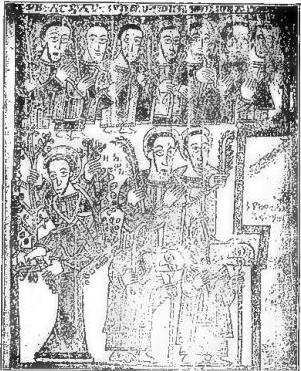
I. Guidi distinguishes four periods in the religious literature of the Ethiopian Church. The first, called Aksumite, extends from the 5th to the 7th century; the second begins in the 13th century under the dynasty of the Solomids; the third comprises the 15th century, dominated by the literary activity of the emperor ETIOPIA — Part of a representation of Christ’s triumphal entry into Jerusalem. Above: 1) His 12 disciples with Him, and Zacchaeus climbing a sycamore; center: “Zacchaeus” at bottom right; “Behold the elders” — miniature from an Eritrean codex of the 15th century — Paris, Bibliothèque Nationale, ms. abb. n. 105, f. 9.Emperor ZARA’ YA’QOB; the fourth spans the 16th–19th centuries. For the principal works see above: 3. LETTERATURA.
II. CHARACTERISTICS OF ETHIOPIAN THEOLOGY
Unlike what occurs in the other Monophysite Churches, Ethiopian theology is entirely free from the direct influence of philosophy. Nor can one speak among them of properly so‑called theological schools. The Ethiopians, rather, show themselves most tenaciously attached to their more or less traditional formulas, corresponding to the texts of Scripture and of the Holy Fathers; this gives rise within their ranks to frequent and interminable disputes.Also characteristic in Ethiopian theology is the predominant power of imperial authority in settling controversies. This is explained by the constitution of the Ethiopian Church, which, until 1937, lacked a supreme ecclesiastical authority.
III. DOCTRINE
In 1936 the Anglican canon Douglas published a complete summary of Ethiopian beliefs, based on the answers given by the principal debterā (doctors) to the questions posed by Anglican missionaries in 1922. Without being able to treat each question individually, it suffices here to mention their teaching on the Union of the two natures in Christ, on the Trinity, and on the Madonna, the three fundamental truths of their faith graphically attested by Zare'a Ja'qob when he ordered everyone to have the names of the Father, the Son, and the Holy Spirit inscribed on their forehead; on the right arm: “I renounce the devil and become the servant of Mary”; on the left arm: “I adore Christ my God.”1. Monophysitism
It is not known exactly when the Ethiopians took a position among the opponents of the Council of Chalcedon. Some maintain that this occurred at the end of the 5th century with the arrival of Byzantine monks; others prefer a date after 637. In any case, they refuse to use the Christological formula “one Person in two Natures.” But to what extent does their monophysitism extend? According to the Jesuit missionary Fr. Paez, followed by ancient Catholic writers, the Ethiopians profess a true monophysitism. Modern scholars, however, argue that theirs is merely nominal monophysitism. Indeed, Zare'a Ja'qob already renewed the condemnation of Eutyches in his own time, and Claudius in his Confession does not hesitate to state: “As for the two natures (of Christ), according to our doctrine they do not exist separately but united in one, yet without confusion or any alteration whatsoever.” Moreover, the Ethiopian Catholic priest Abba Jalou-Socquar is of the opinion that there is not even nominal monophysitism or Severianism among them; it all comes down to a linguistic impossibility of expression, since the term Bahrej — “nature” — also has the meaning of Hēlāq — “essence.” Among the consequences of monophysitism in Ethiopia is the dispute over the Anointing of Christ (cf. supra: s. History).2. Anthropomorphism
By the middle of the 15th century, the belief that God has a human form like ours, since He made man in His own image, was already deeply rooted among the Ethiopians. Against this, the priest Za-Mhā'di intervened, followed by a certain Gamaliel and several others, who proclaimed “God has no face.” In 1459 they were condemned by the Council of Amhara, presided over by Zare'a Ja'qob, who proposed the formula: “The Father has no other form except the human. The Son has no other form except that of the Father. The Holy Spirit has no form other than that of the Father and the Son.” This is the formula that has been repeated in Ethiopian catechisms down to the present day.3. Mariology
The Ethiopians have always been ardent devotees of the Virgin Mother of God. They even use, in the feasts of the Virgin and that of St. Dakesio (St. Ildefonso of Toledo), a special Marian anaphora, of which two texts are known: an ancient one published in 1937 by Abba Tekle Sambaraj and the current text, translated and commented upon by S. Euringer. In this anaphora, as well as in the exceedingly rich Marian hymnography, the privileges of the Virgin are expounded, or rather asserted: her Divine Maternity, her Co-redemption, her fullness of Grace, her Assumption into heaven in body and soul, her perpetual Virginity, and also quite clearly her Immaculate Conception.In the field of Mariology, the dispute over the veneration of the Madonna is famous. The doctors of Tigray taught: “To the Mother of God belongs honor or glory, and to her Son (wa-la-Waldā) belongs adoration.” The monks of Dabra Libānos in Shoa, however, maintained: “To the Mother of God, like to her Son (za-māela Waldā), belongs adoration.” The words wa-la-Waldā and za-māela Waldā became like the banners of two opposing armies that fought fiercely until John IV, at the Council of Vello (1878), prescribed that all should adhere to the teaching of Tigray.
V. RITE.
The Ethiopian rite is a branch of the Coptic rite; it differs only in the general traits of its physiognomy and in certain particulars.
I. GENERAL CHARACTERISTICS
There is a certain exuberance, a youthful spontaneity, a naive search for novelty, produced by an accumulation of texts and an uncritical imitation of strange ways of dressing and acting that sometimes cause disorder; all this is due more to the lack of a central control than to a lower level of culture. Some of the prayers at the beginning of the Mass are not taken from the Eucharistic liturgy of the Coptic rite, but from the blessing reserved to the bishop; at the first incensation, there are four prayers instead of the one in the Coptic rite; the Oratio post Evangelium is recited before the Gospel; in the hours of the Divine Office there are two or three dismissal prayers before the final prayers. The deacon wears on his head a tiara, a gift from the kings and queens of the country; liturgical dancing, still in use for solemn feasts, gives a particular character to processions, no less than the accompaniment of singing with sistra and the stamping of feet.A characteristic feature is the influence of Judaism, due to the advent of the Solomonic dynasty (from the 13th century), an influence that is manifested in the internal construction of the church: a small, enclosed central edicule containing the altar represents the Holy of Holies, which only the priest may enter; around it is a circular space separated from the rest of the church, where only the clergy and cantors may stand; the faithful therefore see nothing of the Eucharistic liturgy and often remain outside. Jewish influence is also seen in the celebration of the Sabbath, to the point of treating it as a sacred entity, as in the anaphora of St. Athanasius, and in the numerous allusions to the Old Testament and its patriarchs. For the sacred vestments cf. T. M. Sambaraj, De indumentis sacris ritus Aethiopici, Rome 1930.
II. PARTICULAR CUSTOMS
For the Mass, the text of 19 anaphoras is known; the ordinary one is that of the holy Apostles, drawn from the Traditio apostolica of St Hippolytus. In many anaphoras the words of consecration, through an excessive desire for clarity, are defective. Since vines are lacking in the region, the eucharistic wine is prepared from grape berries placed in water and then pressed. At Baptism milk and honey are given to the newly baptized. The anointing of the sick has fallen into disuse.There exist or have existed in various regions three types of horologion, in addition to the Coptic one.
The rite comprises a rich variety of liturgical hymns. For the degguā, a kind of antiphonary for the entire year, attributed to Jared, cf. C. Conti Rossini, Aethiopica, II, in Riv. Studi Orient., 10 (1923-25), p. 515. For the Marian hymnography cf. A. Grohmann, Aethiopische Marienhymnen, Leipzig 1919. To the calendar and the synaxarion was added the “proper” of Ethiopian saints in the 16th and 17th centuries.
The chant and music of the Ethiopian liturgy have no relation to those of other Christian liturgies and are little studied and little known: cf. E. Wellesz, Studien zur äthiopischen Kirchenmusik, in Oriens Christ., 9 (1920), pp. 4-106, with the observations of S. Euringer, ibid., 10-11 (1923), pp. 151-54.
The liturgical language is the ancient language of the kingdom of Axum, Geʿez.
VI. ANCIENT CHRISTIAN ANTIQUITIES.
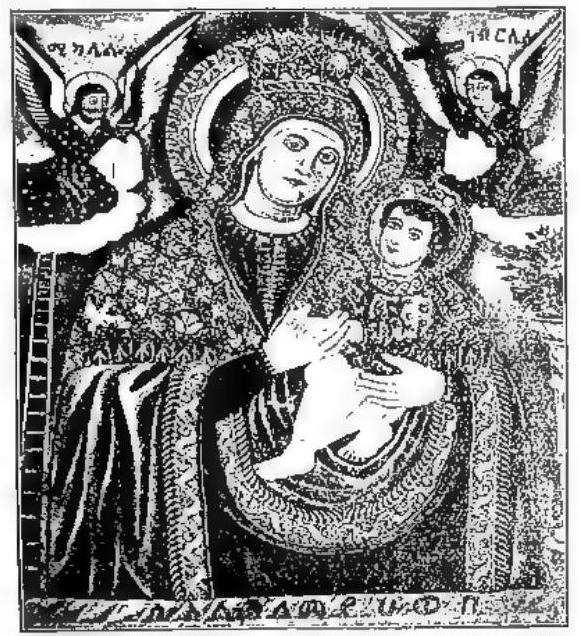
ETIOPIA — The Virgin and the Child, with two angels bearing the symbols of the Passion. Modern Ethiopian icon.
The pagan era still existing in Aksūm. When and how the kingdom passed from the South-Arabian type of paganism to Christianity is not known exactly, but this must have occurred in the second quarter of the 4th century and through the work of missionaries from Syria. The first bishop known is Frumentius, consecrated by Athanasius of Alexandria, thus after 328; but the account of his adventures, as transmitted by Rufinus, is too steeped in folkloristic motifs to be considered a reliable historical document. The Syrian origin of the mission is, however, confirmed by the considerable number of Ethiopian terms concerning religion, the Church or liturgy that derive precisely from Syriac, and even better by the architectural type of the oldest Christian religious monuments of Abyssinia. These are found along an ancient road that starts from the port of Adulis, follows the Haddaš valley to ascend the plateau, and through Qohaytö, Taḥonda', Kaskasë, Yeḥä reaches Aksūm. Our knowledge of the monuments of the Aksūmite period is far from satisfactory: almost everything we know is gathered in the great publication of the German archaeological mission (which, however, mainly concerned itself with the monuments of the pagan era), except for Adulis where incomplete excavations were carried out by the Paribeni-Gallina mission and by the Swede Sundström.
Despite this scant documentation, the oldest type of church is fairly well defined. Externally it forms a rectangle, since the apse never projects but is hidden behind the eastern wall; the sanctuary consists of an apse enclosed between two chambers, according to the most widespread Syrian type. The apse is always square or rectangular, following a type widely diffused in Syria, except at Adulis where it is semicircular in the eastern basilica and horseshoe-shaped in the northern one: the latter form has parallels in Syria at the church of Burg Ḥedar (eastern church), at the western church of Zebed dated to the year 512 and at the eastern church of the same locality. The body of the church is divided into three naves by two rows of pillars, generally monolithic and square with chamfered corners. At most there are six such pillars on each side (ruin 6 of Qohaytö, church excavated by Sundström at Adulis), but there are also very short naves where there is only one pillar on each side (ruin 7 of Qohaytö, northern church of Adulis). The western part of the religious building sometimes consists of a rectangular locale (narthex), as we certainly have at the northern church of Adulis or at ruin 5 of Qohaytö, but at other times of three locales, as at the church of Sundström at Adulis or at ruin A of Taḥonda' (where the northern locale seems to contain a staircase), preceded by one or three other external locales. Construction is always in stone and, in a characteristically Aksūmite manner, the external facing of the walls is never flat but formed by very large offsets. To these plans there are two special exceptions: at the eastern church of Adulis there is no division into three naves, but in the centre of the body of the church there is a ring of eight square pillars that would suggest the support of a dome; and at the oldest cathedral of Aksūm there is a very complex plan reproduced in a drawing by Alvarez that seems confirmed by some recent soundings. However, complete excavations are needed. The presence of staircases suggests the existence of galleries, as will later be found at Debra Damo or at Lalibalä. Nothing has been preserved of the detailed decorative forms of the buildings, which were probably similar to those of the great pagan stelae of Aksūm: as reflections of the methods, we still find them in the buildings of the high Middle Ages.
During this period the centre of Abyssinian civilisation shifted south of the region properly speaking of Aksūm, towards the centre of the Ethiopian plateau and more precisely in Lastä. An exception is the ancient church of the Aamara (demolished in the 19th century) located in the northern region. This, like the church of Debra Damo, shows the persistence of Aksūmite planimetric forms: the latter can be compared with ruin A of Taḥonda' and in elevation it presents galleries overlooking the central nave which receives no light from the outside, i.e. according to a type also found in Nubia. It should be noted that the decorative forms of Debra Damo and especially the carved wooden ceilings belong to a much more recent period. The church of Imraha, in Lastä, presents instead a new structure: it is a basilica without the usual narthex or front chambers on the western side, with the body of the church divided into three naves by two rows
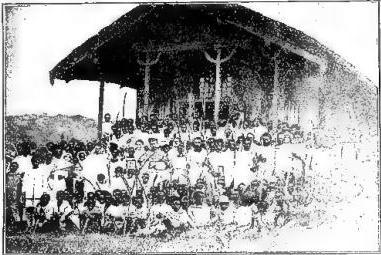
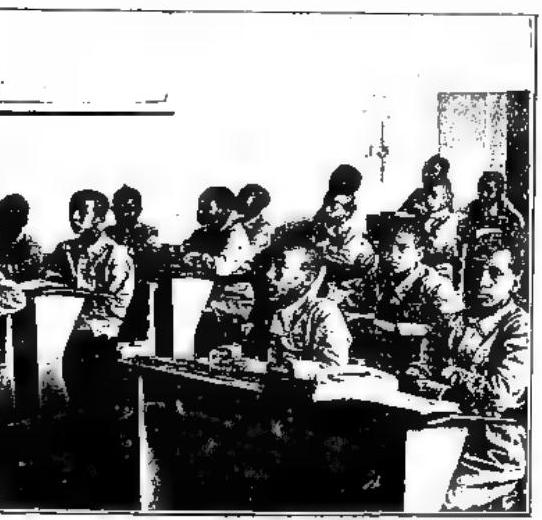
ETIOPIA — A hall of an Italian school for natives — Amara.