
BARBARA, saint, martyr. — No historical memories worthy of credence have been preserved concerning the life and martyrdom of B. The Passio is a late compilation (7th century), full of improbabilities and probably of Egyptian origin. It was soon translated into Latin and adapted to its new environment; three recensions of this version are known, and some of the martyrological notices of the 9th century were based upon them. The Saint is said to have been martyred, at the beginning of the 4th century, under the emperor Massimiano, in a city that varies according to the texts of the Passio and the authors of the martyrologies: Antioch, Heliopolis near Eucata, Nicomedia, Rome, and even a region, Tuscia, are mentioned.
The day of the martyrdom and feast is fixed, both in the East and in the West, on 4 December; Adon, followed by Usuard, assigns it to the 16th of the same month, as does the Coptic calendar.
The content of the Passio may be summarized approximately as follows: B., a young woman of rare beauty, is shut up by her father, Dioscoro, in a comfortable tower so that she may not be contaminated by the world. Her father, having learned that she was a Christian (she had baptized herself), denounces her to the prefect of the province, Martiniano; after she is condemned, her father undertakes to carry out the capital sentence, but shortly after the execution a thunderbolt incinerates the unworthy parent. The texts of the Passio known to us, with one or two exceptions, present a s. Giuliana as B.’s companion in martyrdom.
The oldest monument commemorating s. B. dates from the 8th century and consists of a painting discovered in the church of S. Maria Antiqua at the Roman Forum. From the 9th century onward, testimony concerning the cult—churches, oratories (the text of Giovanni Diacono in the life of s. Gregorio Magno [IV, 89: PL 75, 234] has value only for the end of the 9th century), altars, monasteries, and so forth—becomes increasingly abundant, in the West as in the East. Later she was numbered among the 14 Holy Helpers (v.) and was invoked especially to obtain the grace of receiving the Sacraments at the point of death. Artillerymen and miners chose her as their patroness, so that she might protect them from any fatal explosion, which could bring about their death, just as the crash of the thunderbolt, according to the Passio, incinerated her inhuman father.
BBL.: BHL, 913-14 (supplement, pp. 40-41); BHG, 213-218 (cf. Anal. Boll., 64 (1946), p. 249); BHO, 132-34; Martyr. Romanum, p. 564; Lanzoni, pp. 385, 541-43; P. Paschini, S. B. Note agiografiche (Lateranum), Roma 1927 (critical study); E. Tea, La basilica di S. Maria Antiqua, Milano 1937, p. 290. See also Anal. Boll., 60 (1942), p. 273, poems in the vernacular on s. B.; ibid., 64 (1946), p. 10, invocation: «quand le tonnerre tombera, Ste Barbe nous préservera». A. Pietro Frutaz
ICONOGRAPHY. — While the crown, the palm, and the sword, the instrument of her final martyrdom, characterize the Saint as a martyr, her iconography also includes the peacock, a tower whose three windows allude to the Most Holy Trinity, and, from the
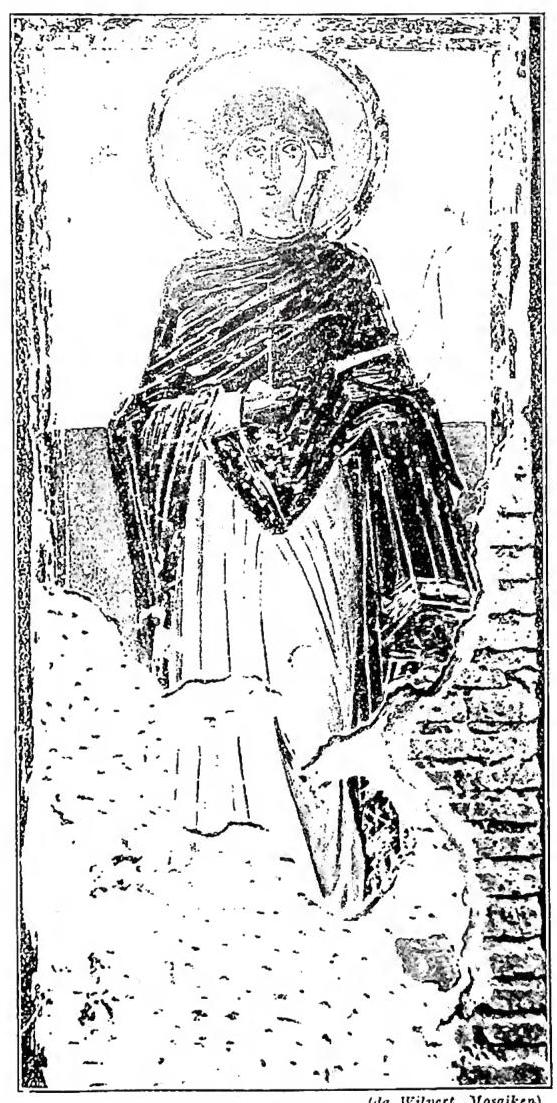
(from Wilpert, Mosaiken)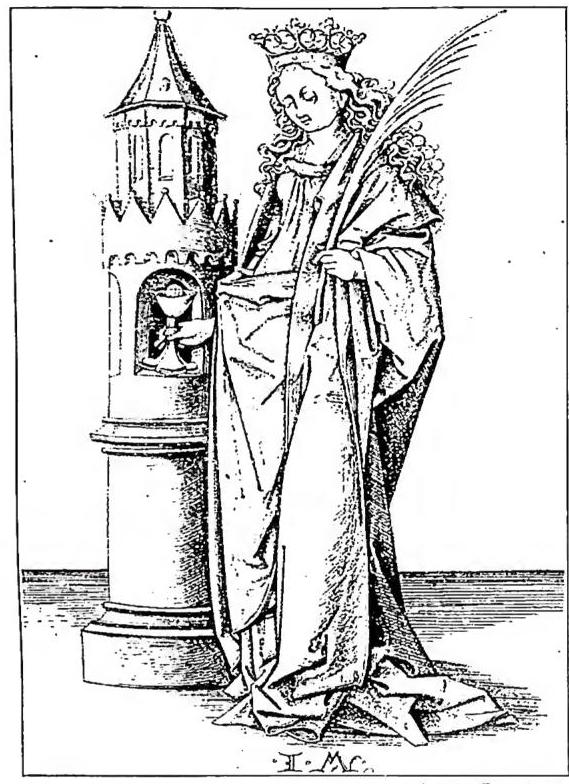
#### BARBARELLI, GIORGIO: V. GORGONE.