
BARBARI. — The word, Greek in origin, initially meant those who stammered, that is, those who spoke a language other than Greek, and was therefore also applied to peoples of ancient civilization such as the Carians, Persians, and Egyptians. As a Hellenic national consciousness and a proud sense of superiority grew, the word came to designate peoples of an inferior civilization, uncultivated and uneducated. The word passed into Latin, at first with its original linguistic meaning, so that one could say Plautus vortit barbare, meaning that he translated from Greek into Latin. In the usage of the imperial
period, the word designated populations not subject to Roman rule and living according to forms of civilization different from the Greco-Roman, and generally more primitive and immature. More particularly, when one speaks of b., one thinks of those who caused the Roman government the greatest concern: the peoples bordering the north and north-east, that is, the populations beyond the Rhine and beyond the Danube.
According to Jesus’ injunction, «euntes, docete omnes gentes», the preaching of the Gospel was not to recognize boundaries, and the principle of the equality of all men before God was to tend to make the concept of b. disappear. In any event, material reasons (the impossibility of penetrating uncivilized countries without cities and roads, and the state of hostility with the empire) meant that Christianity entered among the b. with some delay and, if anything, earlier beyond the eastern frontiers than beyond the northern frontiers of the empire. A passage of Tertullian, which says that Getuli, Sarmatians, Dacians, Germans, and Scythians already believe in Christ (Adversus Iudaeos, 7, 7), and one of Justin (Dialog. cum Tryphone, 117), which states that Christianity had also reached the nomads ἀμαξόβιοι, cannot be taken in the full breadth of their meaning.
A region of Upper Mesopotamia, Osroene, with its capital Edessa, which remained outside the boundaries of the Roman province of Syria and was governed by its own royal dynasty, bound to Rome by ties of clientage, claimed extremely ancient Christian origins. One of its kings, Abgar, is said actually to have exchanged letters with Jesus and to have invited him to his country to be cured of an illness. The pious legend, which became widespread throughout the eastern world, took shape especially following the conversion of King Abgar IX (v.), who ruled from 179 to 214; this conversion must have been followed by that of a considerable part of his people.
In Persia, Christianity encountered firmly established and venerated religions, with priestly castes possessing ancient and well-disciplined traditions, such as Mazdaism and Mithraism; yet perhaps it was precisely through minds accustomed to religious speculation that new ideas could be introduced, as may be shown by the rise of Manichaeism (v.) in the same region at this time. Moreover, it must not be forgotten that within the boundaries of the Persian kingdom, and especially in the provinces of Mesopotamia, substantial Jewish communities had been settled since the time of the Second Babylonian Empire, and could easily be approached by preachers of the Gospel. Christianity could therefore also enter Persia fairly early; Dionysius of Alexandria, around the middle of the third century, knew of Churches in Mesopotamia and was aware of their relations with Churches in other countries, while Bardesanes’ dialogue on the Laws of Countries (third century) presupposes a considerable spread of Christianity as far as Bactriana and the other more easterly regions of the Persian state (v. PERSIA).
Armenia, which with its lofty mountains overlooks Asia Minor and Mesopotamia, was closely watched by the Parthians and the Romans, who, while leaving it independent, sought to have in its sovereign a person devoted to their interests. Armenia, too, has traditions that would trace the evangelization of the country back to the apostolic age, but more reliable information places the arrival of the first Christian teachings around the third century, through Cappadocia. The true founder of the Armenian Church was Gregory the Illuminator (v.), who, having been educated in the Christian faith at Caesarea in Cappadocia, succeeded at the end of the third century in converting the Armenian king Tiridates and, with him, a large part of the population. Also insufficiently prepared, partly because of the immaturity of their language (only in the fifth century did Bishop Sahag introduce among them a script with its own alphabet) for the subtleties of theological disputes, the Armenians adhered to the Monophysite heresy, in which a large part of them remain (v. ARMENIA).
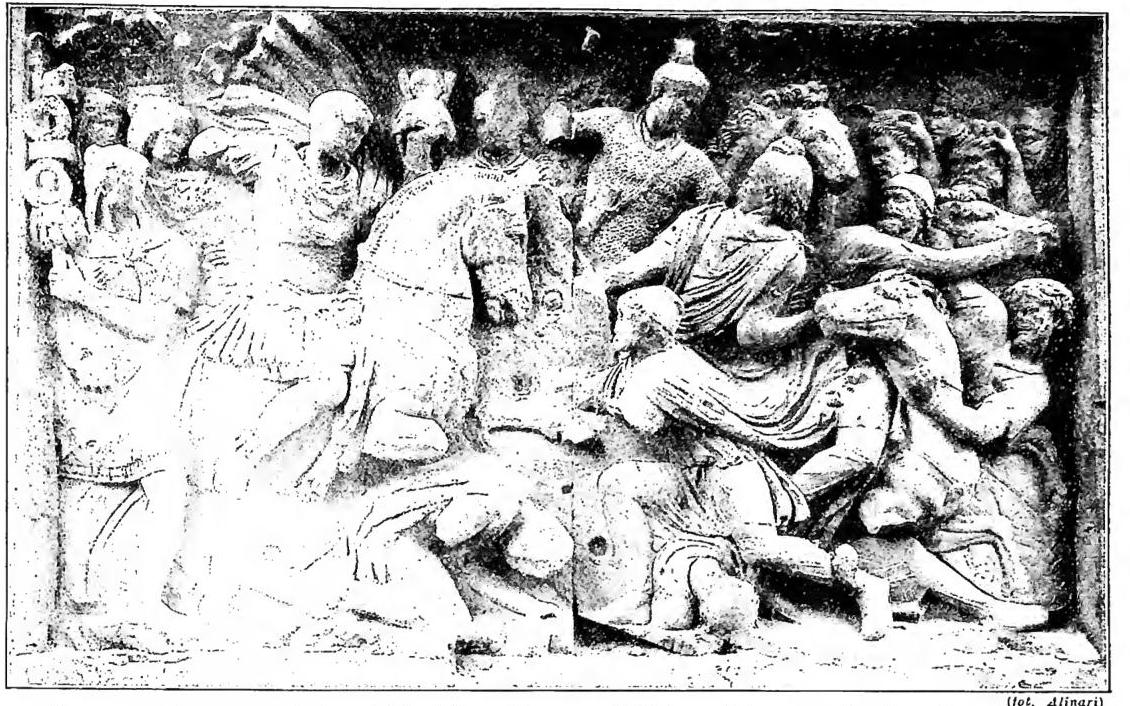
(fol. Alinari) BARBARI — The victorious emperor of the b. Relief from the time of Trajan, reused in the decoration of the Arch of Constantine — Rome.
The mission farther than any other from the borders of the Roman Empire was that of India, which tradition entrusted to the apostle St. Bartholomew. The Sicilian Pantænus, a teacher in the Didaskaleion of Alexandria, who went in the second half of the 2nd century to carry the good news to India as well (should this name properly be understood as referring to the Indian peninsula, or to southern Arabia?), is said to have found there copies of the Gospel in Aramaic, brought by St. Bartholomew (v.). There is no difficulty in admitting that Pantænus may have gone to India. During the period in which he lived, an Egyptian-Roman merchant fleet regularly departed every year from the port of Myos Hormos on the Red Sea for the eastern seas, and shortly before this an unknown author had compiled that Periplus Maris Erythraei which has been preserved for us. Naturally, what is told us about the discovery of the Gospels in Aramaic is less certain (v. INDIA).
On a return journey from India, the holy brothers Frumentius and Edesius (v.), the first preachers of Christianity in the region, are said to have landed in Ethiopia (4th century). Their history is related to us by Rufinus (d. 410), and in agreement with this date it is known that the king of Aksum, Ezānā, was in contact with Constantius II and embraced Christianity. Later, through the work of Egyptian missionaries, the Ethiopians became Monophysites (v. ETIOPIA).
On the northern coasts of the Black Sea some group of Christians may have lived, but their existence has not been proved, unlike what appears to have been the case on the western coasts of the same sea, in the so-called Scythia Minor, where there were Greek colonies and which was annexed to the Roman province of Moesia Inferior, and in Chersonesos Taurica (Crimea), where colonies from Miletus had likewise arrived and where the Bosporan kingdom had been established.
It is now appropriate to consider the activity of Christian propaganda among those peoples who were then more properly known by the name of b., and who later invaded and shattered the Western Empire, and who still constitute the most compact core of Christian peoples.
It is possible that Christianity penetrated very early among those b. as well, but it is easy to understand how, in the absence in their lands of origin of a social organization of the Greco-Roman type, and in the absence of cities, the preaching of the Good News remained entrusted to the zeal of wandering missionaries, while centers of assembly, hierarchies, and places of worship were lacking, and the primitive traces consequently disappeared. Still in the 5th century some bishops of Gaul noted with a certain regret that in the tractus Armoricanus, where Britons driven out by the Angles and Saxons had taken refuge, itinerant priests celebrated the sacred mysteries on portable tabulae (cf. L. Duchesne, in Revue de Bretagne et de Vendée, 7 [1885], p. 4).
In addition to the usual difficulties caused by the lack of roads and by the hostility of semi-savage populations, suspicious and ill-disposed toward every foreigner, one must also add the very frequent state of internal warfare among the various tribes and of external warfare against the empire. And when barbarian populations gradually came to settle within the borders of the empire, it cannot be said that their conditions for Christian preaching immediately improved to any great extent.
The b. began their existence within the borders of the empire with every kind of violence and brutality. And Christians, who had never been rebels against the empire, who accepted and admired its institutions, appreciated its benefits, and believed the pax romana to be willed by Divine Providence, and who—finally—not long before had experienced the immense joy of seeing the empire become Christian, could not immediately divest themselves of the deep-rooted, centuries-old feeling of contempt and repugnance characteristic of civilized populations toward the b.; a feeling that was now bound to be aggravated by the arrogance and ferocity of the newcomers. The belief that the collapse of Rome would signify the end of the world led people to regard these invaders as ministers of evil, to be left to divine punishment. This feeling of horror was manifested especially when the incursions of the Huns took place. It required time for such deeply rooted prejudices to diminish, and for their un-Christian spirit to become apparent.
On the other hand, the presence of the b. within the borders was a reality that could not be ignored; not only that, but it was extending and becoming ever more firmly established, while the empire’s inability to defend itself was becoming increasingly evident. De Labriolle therefore writes correctly: «Were the churches to shut themselves up in regret for the past, and admit that, bound to a civilization in evident ruin, Christianity too must perish with it?» (A. Fliche and V. Martin, op. cit., bibl., IV, p. 356). Thus began that indispensable evolution which was to bring Christianity closer to the invaders, an evolution singularly facilitated by the cultural and moral superiority of the Christian ecclesiastical hierarchies. De Labriolle further writes: «The Catholic hierarchy could not fail to realize that its position was constantly improving, that its social function was becoming predominant. It felt itself much freer and more powerful in the face of the divided, scattered, incoherent forces of the b. than it had been within the powerful organism of the Roman State. With its regular structure, its solidarity, and its dominion over souls, the Catholic hierarchy represented that order of which everyone vaguely felt the need; indeed, it represented something more authoritative than order itself: the right to speak in the name of God and, when necessary, to invoke heavenly vengeance upon anyone who failed to recognize its authority» (ibid., p. 358).
In the regions beyond the Danube and beyond the Rhine, there are no reliable records of Christian communities or bishoprics before the 4th century, not even in the province of Dacia, which was annexed to the Roman Empire for more than a century and a half (107–274).
Irenaeus’s testimony concerning the «churches founded in the Germanies» (Adversus haereses, I, 10, 2) must refer to the two cis-Rhenane Germanies, and chiefly to the more distinctly Roman cities of Trier, Cologne, and Mogontiacum, for which bishops are known to us as early as the 3rd century. The great masses of barbarian populations beyond the Rhine and beyond the Danube had remained pagan, practicing a form of paganism known only imperfectly through legends of the late Middle Ages.
But when they formed more solid and stable groupings, and when they entered Roman territory and established kingdoms there, Christian propaganda developed among them more easily and with greater success. Conversions were not infrequently mass conversions: the baptism of the chief brought about that of the entire tribe. Around the middle of the 4th century, among the Goths, who for several years had been governed by a firmly established monarchy, the first general conversion and the formation of a church took place. Ulfila (v.), consecrated bishop for his people by Eusebius of Nicomedia, returned to his homeland and devoted himself with great zeal to preaching and civilizing his people. Having introduced an alphabetic writing system in place of the old runic characters, he translated a large part of the sacred books into Gothic. He then carried out his apostolate more particularly among that part of the Visigoths who, driven out by the Huns, were

Britannia, although so remote from the classical world and having entered the Roman Empire only under Claudius, nevertheless embraced Christianity more promptly than almost all the Germanic peoples.
At the Synod of Arles in 316, three British bishops were present, and Pelagius was born in Britannia around the middle of the 4th century; s. Augustine had to combat his doctrines.
Ireland, which had always remained outside the boundaries of the empire, received Christian missionaries sent by Pope Celestine I (422–32), but its conversion is owed especially to the Briton s. Patrick, who, having been prepared in ecclesiastical culture by Germanus of Auxerre, landed there in 432 and carried out an intense apostolic ministry until 461.
Roberto Paribeni
CANON LAW. — The designation of b. is used here particularly for the Germanic peoples who settled along the borders of the empire.
The vestiges of the oldest Germanic law found in Caesar (De Bello gallico) and Tacitus (Germania, Agricola) attest, together with the primitive character of this law, the absence of that sense of justice and equity which characterized Roman law, even
in its initial phase. In the same period in which Tacitus depicts the Germans, any penetration of Christian influence into their legal customs must be ruled out.
In the territory of Germany proper, it is only from the eighth century, through the work of Winfriedo, who later became St. Bonifatius, that one can speak of a genuine movement toward the Catholic faith.
The situation was different, however, among the Germans living outside their homeland. When the b., especially those belonging to the militiae foederatae, seized the provinces of the Roman Empire and progressively established their dominion there (beginning in the fifth century), most of them had abandoned their idolatrous beliefs in order to accept the Christianity of Arius. Yet they gradually came into contact with Roman civilization, which was by then imbued with Christian principles.
It is well known that imperial legislation, beginning with Constantine, had developed predominantly under the influence of the Church and its teaching.
Moreover, for this very reason the Church had appropriated a considerable part of Roman law and made use of it in its external relations. Through the two aforementioned and convergent influences—Roman-Christian civilization and the direct activity of the Church—the Germans imperceptibly altered their own norms, receiving ever greater Roman and canonical legal elements into the body of their laws.
Thus, when the lex Ribuaria adopts, through Roman law, the institution of manumissio in ecclesiis and, for its part, emphasizes its spiritual motive and external formalities in a Christian sense, it then takes care to declare openly that the Church itself lives according to Roman law, thereby revealing the two aspects of the new spiritual orientation of the people to whom that law was addressed: Christian Romanitas and the law of the Church.
Here is the relevant text: "Hoc etiam iubemus, qualiscumque Francus Ribuarius seu tabularius servum suum pro animae suae remedium seo pro precio secundum legem Romanam liberare voluerit, ut (eum) in ecclesia coram presbyteris, diaconibus, seo cuncto clero et plebe, in manu episcopi servo cum tabulas tradat, et episcopus archidiacono iubeat, ut ei tabulas secundum legem Romanam, quam ecclesia vivit, scribere faciunt" (ed. Sohm, in MGH, Leges, V, p. 242).
The Church itself, moreover, became a propagator of Roman laws among the barbarian peoples, seeing in these laws a suitable instrument for the easier dissemination of its moral principles, while nevertheless not neglecting to revise these laws and adapt them to its equity and spiritual doctrine whenever it deemed this necessary.
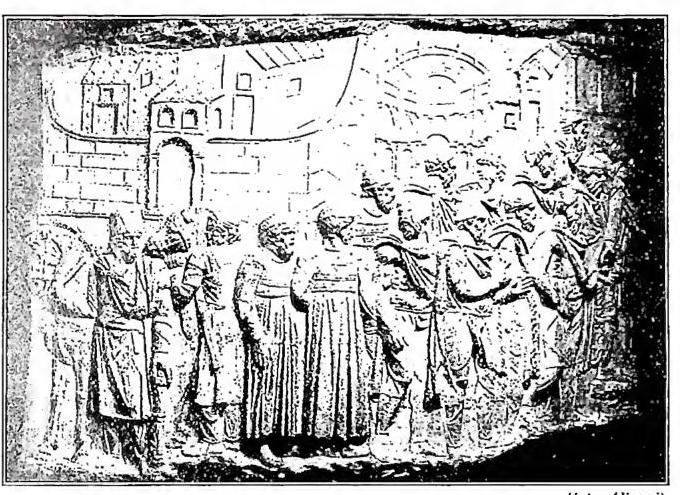
BARBARI - Ambassadors of barbarian peoples received by the Emperor Trajan. Detail of Trajan’s Column (cast) - Rome.
Among the canonical institutions adopted by this king in Lombard legislation was the transformation of marriage, no longer understood as the purchase of the woman, according to the original Germanic conception, but as “coniunctio quam Deus praecepit” (chap. 117), in which the man “cum solo anulo eam subharrat.” This is the rite of the wedding ring (subharratio cum anulo), understood as signum fidei. In receiving the ring, the woman, no longer a passive object of the marriage transaction, expressed her consent and manifested it to the bridegroom and to the orator. Through the evident influence of the Church, Liutprand also adopted the institution of bequests for the soul, with its “donatio post obitum” (chap. 6), while at the same time leading the law of his people to accept testamentary dispositions, unknown to the original Germanic custom. The same king expressly adopted the canonical rule concerning matrimonial impediments based on degrees of kinship, affirming “quia canones sic habent” (chap. 32), “quia Deo teste papa urbis Romae qui in omni mundo caput ecclesiarum et sacerdotum est, per suam epistolam nos adortavit (sic!), ut tale coniugium fieri nullatenus permitteremus” (chap. 33).
But where Germanic custom could not be overcome, as in the case of the duel, the feud, and ordeals, these institutions were redirected by the Church’s persuasion toward causing less harm. Efforts were made to limit the use of the duel by proposing in its place a regular, but more streamlined, trial. Attempts were made to avert the feud (family vengeance) by increasingly opposing it with the remedy of equivalent compositiones (monetary fines). Ordeals (judgments of God) were combated by demonstrating the futility of their evidentiary efficacy and inculcating fear of divine punishment in the guilty person who would impudently dare to challenge divine wrath.
Certain institutions then appear to have been introduced into later Lombard law as a result of canonical principles, such as that of a valid and perfect obligation arising from pure consent (stantia), in contrast to the Roman pactum nudum, which was incapable of creating a true obligation.
Nor should it be concealed that the Church itself experienced some influence in its law through its association with Germanic law. This was partly due to the existence of ecclesiastical centers living according to Germanic law. A typical example in Italy was the monastery of Farfa, which followed Lombard law. Hence, especially in several areas, canonical procedure drew upon Germanic principles and forms, and the legal structure of certain relationships seems to recall the mechanism of corresponding Germanic institutions. In this latter connection, one may note the very correspondence between the ancient distinction in canonical marriage between coniugium initiatum and coniugium ratum (adopted by Gratian in his Decretum) and the Germanic distinction between desponsatio and traditio, indicating the two stages of Germanic marriage. The first phase of both types of marriage represents a genuine stage, albeit an initial and imperfect one, of the marital relationship.
Greater, however, was the influence that the Church managed to exercise among the Franks, and especially beginning with the Carolingians, when the first of them, Charlemagne,
was invested with the dignity of Roman emperor and assumed, among other powers, the particular one of the tuitio Ecclesiae.
But this, which was supposed to be a function of support and assistance to the Church in its spiritual mission, soon degenerated into immoderate interference in the affairs and even the discipline of the Church; hence arose the conflict between the two powers, which led to the bitter struggle over investitures.
Nevertheless, instead of diminishing, this conflict increased the religious spirit, and Christian morality increasingly found its way into the inspiration of secular law itself and into the improvement of customs.
It was in fact that Pietro Crasso, a supporter of Henry IV in his struggle with Gregory VII, who repeated, from Epistle 147 of Pope Leo I, the principle of the subordination of civil law to canon law, when he wrote in his famous libellus de lite: “in his quae vel dubia fuerint aut obscura, id novimus sequendum, quod nec praeceptis evangelicis contrarium, nec decretis sanctorum patrum inveniatur adversum” (Defensio Enrici IV regis, chap. 4).
The legislation of the Frankish emperors, moreover, deserved to be collected by ecclesiastics, as shown by FONTENELLE, BERNARD (v.) Benedict the Levite (v.), the latter of whom also introduced into his own collection the tripartite division into capitularia ecclesiastica, mundana, and mixta. This also formally reveals the prevailing adherence of that civil legislation to Christian principles. On the other hand, the profound religious feeling of that age is revealed when one reflects on the innumerable series of donations made to the Churches to secure the salvation of the soul, on the frequency with which even lay lords entered monasteries as oblates, and on the spirit of extensive penitence that preceded and followed the advent of the year One Thousand.
The same spirit of adventure and the combative nature of the Germanic population were directed toward the good by the Church, giving rise to the first pilgrimages to the Holy Land and to the Crusades, with the establishment of those orders of Christian chivalry that performed so many glorious and civilizing deeds in the name of the faith. In this way, through its slow but sure work of civilization and elevation among the b., its preaching of peace and rapprochement between victors and vanquished, its elevation of the humble classes, its mitigation of personal and serfdom-based bondage, and the intimate penetration of Christian principles into the rough consciences of the b., the Church—also relying here upon the superior law and civilization of the Roman population—was bringing to maturity that leaven of renewal which bore fruit in the Christian Middle Ages, wholly animated by faith and devotion to the noblest ideals, so promising for civilization and so fervent in religious life. - Vedi Tav. LII.