
BARBARICA, ARTE. – The designation “barbarian art” comprises the artistic manifestations of the northern peoples, and in particular of those of Germanic origin, who invaded the territory of the Roman Empire between the 4th and 9th centuries.
This definition also includes the art of peoples who remained outside the Roman sphere, such as the Scandinavians and the Irish, as well as that of certain nomadic peoples, for example, the Avars and the Scythians, who came from Asia.
Most scholars have taken the year 375 as the beginning of the immigration and thus of the manifestations of barbarian art that are of greatest interest to us. But the movement of the northern peoples and the development of their art had already begun much earlier, with the struggle of the Germanic peoples against the Roman Empire (around 166) and with the advance of the Marcomanni and the Goths, who moved from the Baltic to the Black Sea, bringing into their works traces of the contacts they had had with the Mediterranean peoples. Important objects of Roman art (goldsmiths’ work, ceramics, glass, and examples of glyptic art) had in fact penetrated, from the earliest centuries onward (the Hildesheim treasure), even into the Scandinavian countries; this did not, however, remove the predominance of Celtic influence from the art of Germany at that time. In the manufacture of certain categories of objects, on the other hand, technical peculiarities are found, such as filigree, which demonstrate contacts with the culture of Hellenistic southern Russia and the Danubian countries. In the 3rd century, a characteristic art was already developing in the new kingdoms of the Goths in southern Russia and of the Vandals in Slovakia. At that time, for example, there appeared for the first time a type of broad fibula (derived from Roman prototypes), which subsequently became common in the art of all the Germanic peoples (examples occur in the tombs of Sacrau near Breslau, dated to around the year 300). Soon afterward, the use of glass pastes and stones was also adopted. It can be seen clearly that in the first period, that is, until the middle of the 6th century, geometric ornament and color predominated, and that later, until the middle of the 8th century, ornament with animal forms developed, stylized and deformed in an abstract manner; the human form is almost entirely absent.
The various artistic products of the different ethnic groups became progressively more clearly differentiated from one another, even though contacts existed among them. Thus the art of the Goths of the Black Sea is distinguished from that of the same Goths who occupied Italy; and the art of the western peoples who formed the Merovingian kingdom (Franks, Thuringians, Alemanni, and Bavarians), of the Lombards (after the year 568) in Italy, of the Angles, Saxons, and Jutes in England (from the middle of the 5th century), and of the northern peoples in Denmark and the Scandinavian peninsula is defined with increasing clarity.
Among the objects of barbarian art preserved today, religious works are extremely scarce, such as the gold crosses from Lombard tombs in Italy and southern Germany; in sculpture, what is known above all is the decoration of Lombard monuments in northern Italy and of Visigothic churches in Spain. In architecture, as shown by the churches of Ravenna and Capua, the old forms of Italian art predominate; only the Visigoths created an autonomous style.
The work of the Goths is of the utmost importance for the development of barbarian art. In the great kingdom they created during the 3rd century in southern Russia, they underwent various influences: those of the country’s old Hellenistic culture, of Roman provincial art, and of Sarmatian, Persian, and Central Asian peoples. From this mixture of different styles, dominated by the taste of the Goths, a new style of well-defined character arose around the beginning of the 4th century, whose typical feature is its liveliness of color. Goldsmiths’ work, as can be seen in the Petrossa treasure, dating from before 376 (now lost), displays an extremely rich use of precious stones, destined to develop even further during the 5th century. To a great extent, the goldsmiths’ work was executed in cloisonné; this technique of setting stones in compartments, especially red almandines, came from Persian and Indian art; the stones themselves used by the Goths were for the most part supplied by India, already cut.
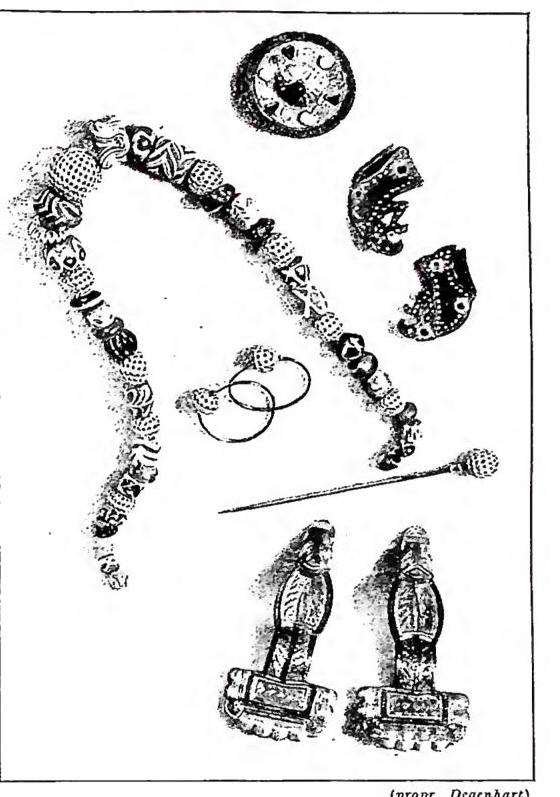
(properly Dyprakert) BARBARICA, ARTE - Goldsmithery of barbarian art. Art of the Rhine and northern Gaul (7th century) - Berlin, State Museum.
Technically different, even though often decorated with almandine, are the works of the Ostrogoths in Italy (443–555), as can be seen in the fragments of Theodoric’s cuirass, formerly in the Ravenna museum. The cellwork arrangement, composed of triangles surmounted by disks, recalls the frieze running around the exterior of the king’s tomb in Ravenna.
The Lombards left few traces during their migrations. They produced genuine works of art especially after their arrival in Italy (568–774), learning the technique of cellwork (Zellenverglasung) from the Goths and filigree from the East. As ornament
they preferred interlacing, as can be seen not only in goldsmithery (for example, the crosses from tombs) but also in sculpture. Animal ornament reached the Lombards from the north and developed in their art later, after 630. In time, however, Lombard culture increasingly adapted itself to Italian taste, also undergoing Byzantine influence; thus, among the objects found in the tombs of Nocera Umbra and Castel Trosino (Rome, National Museum and Museum of Palazzo Venezia), or of Civezzano (Cividale, museum), distinctly Byzantine ornaments are found.
Among the most important works are several pieces belonging to Queen Theodolinda, such as the binding of a Gospel book, presented to her by Pope Gregory the Great in 603, and the fragment of a helmet with the portrait of King Agilulf (591–615), of more purely barbarian workmanship (Florence, Bargello Museum). The sculptural ornaments, with the same interlacing or animal-figure motifs (Rome and Ravenna), show a greater influence of Italian style. Certainly made by Lombards was the altar that Duke Ratchis (744–49) erected in S. Martino at Cividale in memory of his father Pemmo; similar to it is the baldachin of Patriarch Callistus (about 740). More refined is the style of the sarcophagus of Theodore (died in 720) at Pavia, and that of S. Cumminianus at Bobbio, where, alongside Byzantine-influenced forms, Irish motifs are found, such as also occur in the miniatures of northern Italy («scriptoria» of Verona, Bobbio, or Novara).
The art of the peoples of the Merovingian kingdom underwent, until the end of the 6th century, the strong influence of provincial Roman art, as can also be seen in pottery and glassware, and at the same time that of Gothic art, to which its love of color is attributable. In a second period (600–750), an autonomous style took shape, expressed especially in goldsmithery, although works with oblique incisions still reveal derivations from Roman art. In Italy, where interest in cellwork arose through contact with the Lombards, the first influences of the so-called animal style can be observed, probably coming from the Anglo-Saxons (mid-6th century). Alemannic art also produced liturgical vessels, such as Duke Tassilo’s chalice at Kremsmünster (777), and reliquaries, such as the fine example at Chur; it was often receptive to Irish influences, especially in miniature painting (for example, the «scriptorium» of S. Gall, and the works of Corbie, Luxeuil, Fleury, and Laon, in which Oriental traces nevertheless persist). Greater connections with the old Roman culture are noticeable in the western regions (Trier, Mainz, Cologne), where there are several ivories certainly still made by foreigners, perhaps Orientals.
The Germanic peoples—the Saxons, Angles, and Jutes—who invaded England between 441 and 449 brought with them the art of their former lands. But by the end of the 5th century they had become independent and developed an autonomous style, divided between a group of Jutes around Kent, who maintained contacts with Merovingian art, and a group of Anglo-Saxons in the north. In the various pieces of the Sutton Hoo treasure from the beginning of the 7th century (British Museum), decorated in different techniques with filigree, glass, and stones such as almandine, contacts can be recognized with French, Lombard, and Scandinavian art, and pieces imported from Byzantium are also found.
With Christianity, around the middle of the 7th century, new currents entered. Irish influences also arrived from Kent, in goldsmithery and painting, with the animal style (Book of Darrow, end of the 7th century). Stone crosses are characteristic in sculpture; the oldest example is that of Collingham (Yorkshire), from 651, with interlacings and the symbols of the Evangelists. In the more important crosses (Ruthwell and Bewcastle), influences of the Christian East are evident, and these also persist in the highly important miniatures.
(properly Volbach)
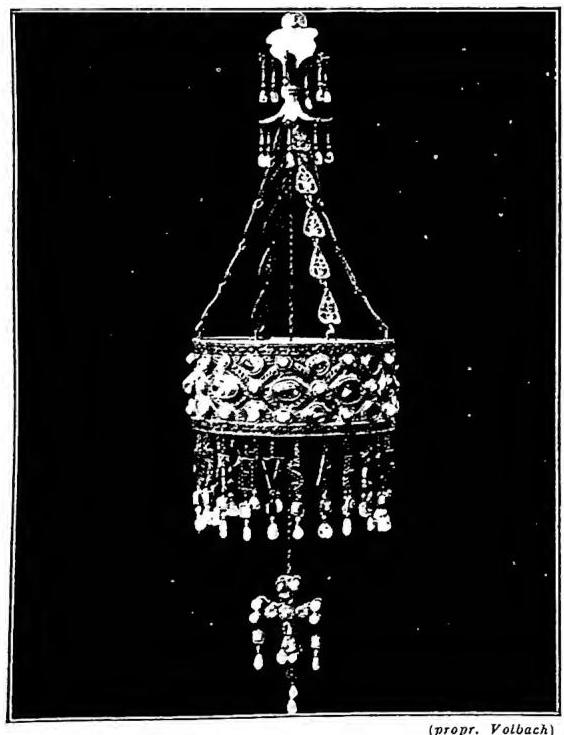
BARBARICA, ARTE — Gold crown decorated with gems from the treasure of Guarrazar (7th cent.) — Madrid, Prado Museum, formerly in the Cluny Museum.