Machine translation of the 1948–1954 Italian original. The original text is authoritative.
CHRISTIAN ORIENT. - Beyond the individual entries, to which cross-references are made, a comprehensive overview is necessary to provide general orientation on this vast subject.
CONTENTS:
I. Geographical and historical overview
II. Characteristics
III. The problem of union
IV. Christian art.
I. GEOGRAPHICAL AND HISTORICAL OVERVIEW.
I. DEFINITION OF THE EASTERN CHURCHES AND ORIGINAL CIRCUMSCRIPTIONS
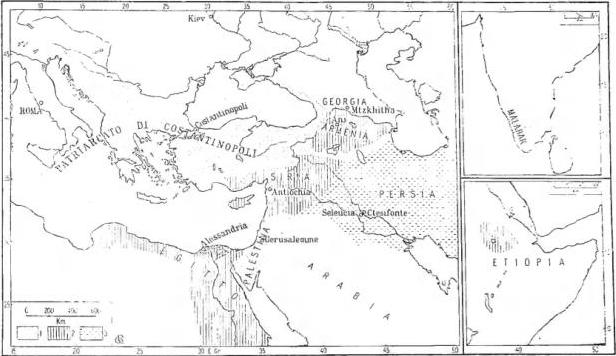
By "Christian East" (Oriente Cristiano) we mean the Churches of the eastern part of the Roman Empire and the communities that arose in dependence on them beyond the Empire's borders. The division of the Empire, initiated for administrative reasons by Diocletian, became definitive after the death of Theodosius (395). The boundary was marked by the Sava and Drina rivers. In the eastern part, the patriarchates of Alexandria, Antioch, and Constantinople were established. That of Jerusalem arose later, separating from Antioch in 451 (Council of Chalcedon). For the history of the patriarchates, V. the individual entries. The first Churches founded outside the imperial borders at a time when the patriarchates were still in formation are: the Church of Persia, with its see at Seleucia-Ctesiphon, born in the 2nd century, apparently dependent on
CHRISTIAN ORIENT - The Christian Orient on the eve of the Byzantine schism (1054): 1) Orthodox; 2) Monophysites; 3) Nestorians.
Edessa; the Armenian Church, founded at the end of the 3rd century by St. Gregory the Illuminator under the jurisdiction of Caesarea in Cappadocia; the Church of Ethiopia, inaugurated in the 4th century through the efforts of the see of Alexandria. These five Churches—Alexandria, Antioch, Constantinople, Seleucia-Ctesiphon, and Armenia—are to be considered original, and all existing Eastern Churches derive from them. To these five original circumscriptions correspond the five rites: Alexandrian, Syro-Western or Antiochene, Byzantine, Syro-Eastern, and Armenian. As for faith, Eastern Christians are divided into Catholics and non-Catholics. The latter are distinguished into "Orthodox," Monophysites, and Nestorians.
DISSIDENTS
1. Nestorians
(Seleucia - Ctesiphon; Syro-Eastern Rite),
Iraq, Iran, Syria and dispersed ca.
Malabar (Western India)
Total
2. Monophysites
Syrians (Jacobites [Antioch] Syro-Western),
Near East and dispersed ca.
Jacobites in India (Seleucia - Ctesiphon [Syro-Western], 1931),
80,000
2,000
82,000
100,000
508,000
Copts in Egypt (Alexandria; Alexandrian Rite) ca.
Ethiopians (Alexandria; Alexandrian Rite) ca.
Armenians (today: Catholicosates: Echmiadzin [Soviet Armenia], Sis [Cilicia, today Syria]; Patriarchates: Jerusalem and Constantinople) and dispersed ca.
Total
900,000
4,000,000
2,500,000
8,008,000
3. "Orthodox" or Byzantines
(Constantinople, unless otherwise noted.
All of Byzantine Rite)
a) Greeks:
Patriarchate of Constantinople
Dodecanese, formerly Italian
Greece
Cyprus (Antioch)
America
b) Melkites:
Patriarchate of Antioch (1935)
Patriarchate of Jerusalem
(Antioch) (1931)
Patr. of Alexandria
Sinai (Antioch)
c) Slavs (Russians and Ukrainians):
in Russia ca.
dispersed ca.
"Orthodox" of Poland (1932)
Serbs (1936)
Bulgarians (1938)
"Orthodox" of Czechoslovakia (1930)
d) Romanians
e) "Orthodox" of Hungary
f) Albanians (1936)
g) Baltic Countries:
Lithuania (1923)
Latvia
Estonia (1922)
Finland
h) Georgians (Antioch)
Total
Total dissidents:
110,000
170,000
6,000,000
300,000
200,000
180,000
60,000
110,000
100
95,000,000
1,500,000
3,954,500 6,785,000 5,350,000145,600
13,067,000
40,000
200,700
55,000
180,000
209,000
70,000
2,500,000
136,186,900
144,276,900
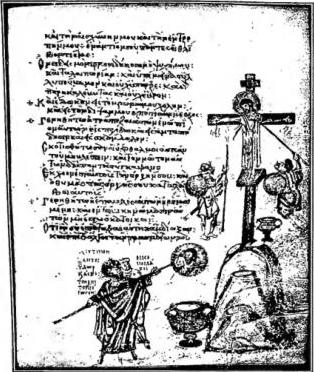
BIBL.: T. Uspenski, L'art byzantin chez les slaves, II. Paris 1932, pl. 32. CHRISTIAN ORIENT - Christ offered vinegar. Iconoclasts cover the images of Christ with lime. 9th-century miniature. CATHOLICS
Chaldeans, 'Irāq, Irān, dispersed (1937)
141,000
Malabarese (1947)
947,109
Total
1,088,109
Syrians, Near East and dispersed (1932)
71,300
Malankarese, India
60,000
Copts (1948)
63,000
Ethiopians
35,000
Armenians, Near East and dispersed ca.
100,000
Total
329,300
Greeks in Constantinople and Greece
3,000
Melkites, Near East and dispersed ca.
170,000
Ruthenians in Poland, Czechoslovakia, Hungary, Romania, America (1932)
The only entirely Catholic group are the Maronites (Antioch; Syro-Western Rite) Near East and dispersed (1932) 366,000
Total Catholics: 9,122,809
N.B. The figures are approximate. Some, e.g., those for Russians and Armenians, are highly problematic. Where a date is added, the figures are taken from an official statistic.
III. THE HISTORICAL DEVELOPMENT OF DISSIDENT CHURCHES IN THE CHRISTIAN ORIENT - What strikes most today in the situation of the Christian Orient is the variety and diversity of rites, dogmas, and jurisdictions. The main cause is the fact that in the East there was no predominant ecclesiastical center, as Rome was in the West, but rather several centers of great authority: Jerusalem, Antioch, and Alexandria, while Constantinople joined them only later and never succeeded in unifying the Christian Orient as Rome did the West. The diversity in faith is the sad legacy of Christological disputes, which led to the schism of various Churches. Nestorianism, condemned at the Council of Ephesus (431), was embraced, also for reasons of political opposition to the Roman Empire, by the Church of Persia at the Synod of Seleucia-Ctesiphon in 486 (v. NESTORIO). This Church carried out a very significant missionary activity as far as India and China. Remnants of those Churches founded by the Nestorians are still found today among the Eastern Christians of India, who in part, around the mid-17th century, passed to the opposite heresy of Monophysitism and to the Syro-Western Rite. Monophysitism, condemned by the Council of Chalcedon (451), brought division to the patriarchates of Antioch and Alexandria and separated the entire Churches of Armenia and Ethiopia from the universal Church. In the patriarchate of Antioch, almost half of the people remained in the true faith. Around the mid-6th century, the Monophysite part of the patriarchate was organized into a separate Church by Jacob Baradaeus, whence the Monophysite Syrians are called "Jacobites" (v.). In Egypt, almost the entire population embraced Monophysitism after orthodoxy lost its support from Constantinople following the Arab invasion (ca. 640). The Monophysites there are called "Copts" (v.), meaning "Egyptians." Those who remained in the true faith in the patriarchates of Antioch, Jerusalem, and Alexandria were called "Melkites" by their Monophysite adversaries, that is, "imperial" (from malhā basileús, Byzantine emperor).
In the Churches that broke away from the Catholic Church due to Christological disputes, the ancient rites remained, while in the rest of the Christian Orient the Byzantine Rite prevailed, which explains why today the vast majority of Eastern Christians follow that rite, also given the fact that the number of Nestorians and Monophysites greatly diminished due to Islamic domination, to which the Churches of Syria, Palestine, Egypt, Persia, and Armenia were subjected for as many as 13 centuries. Constantinople, which as the second Rome became the most important ecclesiastical center of the Christian Orient, largely succeeded in unifying the Eastern Churches in terms of rite, discipline, and faith, but could not, separated as it was from the 11th century onward from the center of the universal Church, that is, from Rome, maintain jurisdictional unity in the Christian Orient, which instead fragmented into a considerable number of autocephalous Churches. Constantinople introduced its rite into the Churches it founded among the Slavic peoples, but failed to keep them under its jurisdiction, since they, basing themselves on the same principle that had given rise to the primacy of Constantinople—that is, that the capital of a Christian kingdom has the right to preeminence also in the ecclesiastical sphere (can. 28 of the Council of Chalcedon)—demanded one after another
independence from the mother Church; the Bulgarian Church first in 927 and definitively in 1870, the Serbian Church first in 1346 and definitively in 1830, the Russian Church in 1448. The Romanian Church, of Latin origin, was Byzantinized toward the end of the 9th century due to political dependence on Bulgaria of the regions now called Romania. This Church obtained its independence in 1865.
The ancient patriarchates of Alexandria, Antioch, and Jerusalem were Byzantinized starting from the 10th century. Weakened by Christological controversies and the Arab invasion, they sought the support of Byzantium. The Byzantine political expansion in the second half of the 10th century in Syria favored the Byzantinization of the Antiochene patriarchate. During the Crusades, the patriarchs of Antioch and Jerusalem resided almost entirely in Constantinople and naturally became its subjects. This dependence was complete during the Turkish domination due to the policy of the sultans, who wanted the patriarch of Constantinople to be the head of all "Orthodox" Christians in their Empire. Likewise, Alexandria was subjected to Constantinople. Recently, these patriarchates have regained their independence.
The tables refer to the "Orthodox Churches" of Central Europe and the Baltic countries. The "Orthodox" of Czechoslovakia are mostly Ruthenians who immigrated to the Subcarpathian regions. The same applies to a large part of the "Orthodox" of Hungary; the other part is of Romanian origin. The "Orthodox" of the Baltic countries derive from the "Orthodox" propaganda carried out in those countries by the Russians during the tsarist era. The "Orthodox" Churches of the Baltic countries, except the Finnish one after the Second World War, were incorporated into the patriarchal Church of Moscow, to which the "Orthodox" of Czechoslovakia and Hungary also submitted.
IV. ORIGIN OF THE UNITED COMMUNITIES
On the Eastern Schism, that is, of the Patriarchate of Constantinople, V. this entry. The schism that occurred in the 11th century tore all of Eastern Christendom from the unity of the Church. Today, at least 9 million people have found the way back. The various united groups were formed almost entirely in modern times. The only entirely Catholic Eastern Maronites (v.) of Lebanon, who united with Rome, according to the reliable testimony of William of Tyre, in 1181. During the time of the Crusades, the union of the Armenians of Cilicia (1198) was also effected, though it lasted only until the collapse of that kingdom (1375). The unions of the Greeks, concluded at the Councils of Lyon (v. 1274) and Florence (v. 1439), were not very enduring. The discussions at Florence, however, were useful, as they served to clarify dogmatic differences and thus prepare the way for subsequent unions.
The most important unions of the modern era in Ruthenians (v.) and the Romanians.
The western and southwestern part of the Metropolis of Kiev, from the 14th century onward, was politically incorporated into the Lithuanian-Polish state, which favored its orientation toward Rome. The principal and immediate motive for the actual union was the decline of the "Orthodox" Church in those regions. The union was signed by two bishops delegated to Rome on 23 December 1595 and later ratified by a synod held in Brest-Litovsk in October 1596.
The union of the Romanians of Transylvania was favored by the conquest of that country by Emperor Leopold I (1691) and prepared by the unionist work of the Jesuits. The union was concluded first in a synod held in Alba Iulia in March 1697 and again in October 1698. These two united Churches, which are by far the largest, today find themselves in the most distressing straits under the communist regime. In March 1946, the union of the Ruthenians in Galicia and in December 1948 that of the Romanians in Transylvania were...
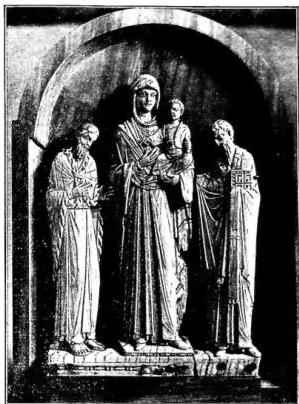
ORIENTE CRISTIANO - Madonna of the Hodegetria type between St. John the Baptist and a holy bishop (St. John Chrysostom or St. Basil). Dumbarton Oaks, Washington D. C.
In the Near Asian and African East, relatively significant united communities have formed, so that 28% of the Christians in those regions are Catholic. It is true that the number of those Christians is not very large due to centuries of oppression by Muslims. The merit of converting a considerable part of Near Eastern Christianity belongs to Latin missionaries. The conversion was favored by the fact that Christians hoped for protection from the West, especially from France.
The first to convert was a group of Nestorians, who became Catholic around the mid-16th century. The occasion was a double election. One of the elected, Giovanni Sulăqă, sought support from the Franciscans of the Holy Land, who sent him to Rome, where he became Catholic. This first union lasted only a little over a century. The patriarch Simone XIII (1667-1700) returned to Nestorianism. Today’s Nestorians descend from the apostates of that time. With those who remained faithful, mainly in Dijarbekir, and those who remained Nestorian in 1552 and were now converted, the present-day Chaldean Catholic Church was formed around 1800.
The Catholic Syrians, converted from the beginning of the 17th century through the work of missionaries, initially had their own patriarch in the person of Bishop Andrea Akigian (1667-1677). The series of Melkite Catholic patriarchs begins with Cirillo VI Tanas in 1724; that of the Armenians with Bishop Abramo of Aleppo in 1740. In Constantinople, Armenian Catholics have had their own bishop since 1758. The Coptic Catholic community was formed in the 19th century. Leo XIII gave it its own hierarchy in 1895.
In India, after the arrival of the Portuguese, the reunion of the Nestorian Christians of Malabar (v. MALABARESI) was achieved in the 16th century. By the mid-17th century, almost all
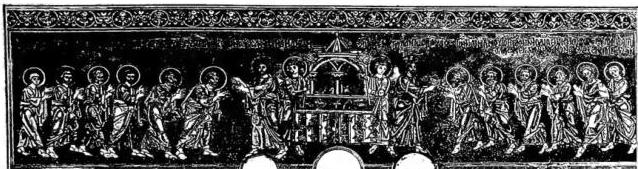
CHRISTIAN ORIENT - Christ distributing the Eucharist to the Apostles under both species. Mosaic (11th century) - Kiev, Cathedral of St. Sophia. Copy by Prince Brailovsky - Vatican City, Congregation for the Oriental Churches.
those Christians, primarily due to a lack of understanding on the part of the Portuguese Jesuit missionaries, temporarily relapsed into schism. The Italian Carmelites succeeded in bringing most of them back into union. The others found support with the Jacobite patriarch of Antioch and thus became Jacobites. Among them, a very promising movement for union has recently begun, since 1930.
In Ethiopia, the union achieved by the Jesuits in the first half of the 17th century did not endure, also due to the errors committed by the missionaries. Missions were successfully resumed only in 1839 through the efforts of the Lazarists under the guidance of Blessed Giustino de Jacobis. Thus began the formation of a united Ethiopian community, which had its own bishop in 1930. Some smaller groups of united Christians in Europe should also be mentioned. Not a few Serbs, toward the end of the 16th century, emigrated from Turkey into the domains of the Austro-Hungarian monarchy and partly became Catholic. For them, the diocese of Križevci was founded in 1777, which, since the end of the 1914 war, has included all Oriental Catholics of Yugoslavia belonging to various ethnic groups.
The Italo-Albanians (v. ITALO-ALBANESI) of Calabria and Sicily descend from Albanians who emigrated to Italy in the second half of the 15th century and there became Catholic. Their status was regulated by the constitution Etsi pastoralis of Benedict XIV (1742). Among the Bulgarians of Constantinople, a movement toward union began around 1860. Later, Catholic groups formed in Thrace and Macedonia. After the 1914 war, almost all sought refuge in Bulgaria itself. Since 1923, they have had an apostolic administrator. Among the Greeks, it was only toward the end of the last century that some Catholic communities were established in Thrace, which in 1911 had their own bishop in the person of the convert Isaia Papadopoulos. After the First World War, many Greek Catholics emigrated with their bishop from Turkey to Athens. Since 1932, even those remaining in Constantinople have had their own bishop. In the eastern territories of Poland, a very promising work for union among the White Russians began in 1923; they had already been united but had returned to schism only under the pressure of the Tsarist government. The war severely damaged this effort. Small groups of Catholics are also found among Russians who emigrated to Europe, America, and the Far East.
Thus, the work for union has already achieved considerable success and has been able to regain for the unity of the Church 5-6% of Oriental Christians. It is true, however, that even today the Oriental Churches separated from Rome form, as a whole, a strong bloc that opposes every unionist effort with the most tenacious resistance. In vast regions, such as Russia, Bulgaria, and Greece, efforts have so far yielded only insignificant success. Indeed, in many "Orthodox" circles, a muted hostility still prevails against everything Catholic, and every attempt at rapprochement is interpreted as a thirst for domination and a design to subjugate and annihilate "Orthodoxy."
From a human perspective, the most serious causes of this difficulty seem to derive from the Eastern system of the state Church, that is, from the identification of Church and nation. For the Oriental Churches, whose borders coincide with those of the nation and which have led their autonomous lives for centuries, the idea of submitting to a head who does not belong to their own nation is almost inconceivable. They have forgotten that they too obeyed him before the schism, although this submission would be felt more today than in the early centuries. Moreover, reunion would mean for the separated having to renounce a large part of their past, recognizing their own error and the heresy, or at least the schism, of their great men. Not to mention their fear, this time unjustified, of losing their particular ecclesiastical characteristics, especially in liturgies. Isolated and peripheral cases of Latinization contrary to Rome's norms have also hindered unionist work.
BIBL.: R. Janin, Les Eglises séparées, Paris 1930; id., Les Eglises orientales et les rites orientaux, 3rd ed., ibid. 1935; S. Congregazione Orientale, Statistica con cenni storici della gerarchia e dei fedeli di rito orientale, Vatican City 1932; C. de Clercq, Les Eglises unies d'Orient, Paris 1934; G. Ricciotti, Roma cattolica e O. c., Florence 1935; C. Gatti-C. Korolevskii, I riti e le Chiese orientali, I, Il rito bizantino e le Chiese bizantine, Genoa 1943; G. Smit, Roma e l'O. c., Rome 1944; Incontro ai fratelli separati d'Oriente, ibid. 1945; G. de Vries, O. c. ieri e oggi, ibid. 1950. Journals: Unitas (Rome); Orient. christ. periodica (ibid.); Irénikon (Chevetogne); Eastern Churches quarterly (Ramsgate). Guglielmo de Vries
II. CHARACTERISTICS.
II. CHARACTERISTICS.
### I. JURIDICAL.The general characteristics of Eastern canon law (especially that of the dissidents) may be indicated as follows: a) the multiplicity of juridical systems admitted within the same Church; b) its traditionalism; c) its particular stance toward the State, differing from that of Catholics and Protestants; d) its practical nature and the absence of systematic and scientific elaboration.
1. Those who have studied Latin canon law and begin to examine the Eastern one are struck, at first, by the multiplicity of juridical systems it encompasses: not only among Churches that consider one another heretical or schismatic (Nestorians, Monophysites, the so-called "Orthodox," Eastern Catholics), but even among the different parts of the same Church, profound differences often exist.
This is especially true for the Greco-Russian Church. One may compare, for example, the law of the Russian Church, with its voluminous collections of ordinances, decrees, and decisions, to the archaic law of a patriarchate such as Antioch or Jerusalem. This difference stems from the so-called principle of autocephaly, according to which all particular Churches are independent of one another and subject only to the ecumenical council, the last of which recognized by all is the Second Council of Nicaea (787). On the other hand, among all these Churches—particularly those united in an ecclesiastical body, but also among the others—there exists a certain kinship and common principles and traits that distinguish them from Western juridical systems. There is a shared foundation of laws and canons, and for many, a common history lived under the same external conditions, which has influenced a mutual assimilation.
2. Common to the various laws of the Eastern Churches, for instance, is traditionalism. The so-called Apostolic Canons, those of the ecumenical and regional councils of the 4th century and following, still constitute valid law. It was a strange spectacle for a Latin to see, in the years 1926-27, Metropolitan Antonio of Kiev and Metropolitan Eulogius of Paris contesting the legitimacy of their mutual claims with citations from the Apostolic Canons, the Canons of Antioch, of Sardica, etc. In several of the smaller Churches, the principal core of law consists of sources from the 4th to the 10th century; after the 14th century, the law has remained unchanged, with the exception of certain customs whose authority is uncertain.
3. While the Catholic Church, especially after the 11th century (but also before [V. GELASIO I]), has strongly insisted on its independence from the State, the Eastern Church has considered the ideal of its relations with the State to be concord and mutual harmony, to the point that, in exchange for the protection granted by the State, the Church is ready to concede it broad authority in ecclesiastical matters. In this way, until recent times, the task of legislating on the constitution of the Church, the administration of goods, matrimonial law, etc., in States with an "Orthodox" majority, generally falls to the state authority, excluding only what pertains to faith and worship.
4. The canons of the ecumenical and regional councils, the decrees of patriarchs, the canonical decisions of bishops or jurists, canonical collections (v.) and nomocanons, owe their origin to practical needs and were issued without systematic regard. Only in recent times have partial codifications been made and ordinances with a more general character been promulgated. The Russian Church, in particular, had embarked on this path; the All-Russian Council of Moscow (1917-18) had undertaken the codification, if not total, at least of a large part of canon law.
Canonistic science has also produced some
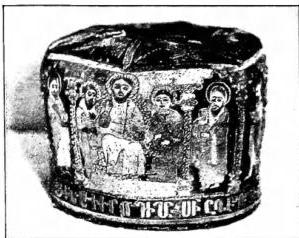
(Courtesy of the Rev. Abbot of the Mechitarists - Venice)
ARMENIAN PRIESTLY CROWN from 1738.
Venice, Church of San Lazzaro, Treasury.
A valuable systematic exposition of canon law has also been produced among the Russians, Greeks, Romanians, Serbs, etc. The best-known authors are Bishop Nikodim (Milaš), Suvorov, Pavlov, Berdnikov, Zankov, and Konstantinos Rhallis.
Emilio Herman
II. LITURGICAL
Despite differences in faith and ecclesiastical jurisdiction, Eastern and Western Christians share a common Christian liturgy, that is, a single Sacrifice in bread and wine mixed with water, seven sacramental rites (though in some Churches one or another may have fallen into disuse), the consecration of the altar, of chrism, of monks, of virgins, the blessing of water, of a new house, etc., funeral rites; furthermore, the liturgical year with the cycle of Christmas and Epiphany, with the Paschal cycle preceded by Lent and prolonged until Pentecost; also the cult of the Cross, of the Most Holy Mary, and of the saints; then, the use of a place of worship comprising two main parts, the nave and the elevated sanctuary, the use of incense, candles, sacred vestments, etc.; finally, the great Christian dogmas expressed in word and action or symbolically represented in liturgical rites and customs.
The characteristics of Eastern rites fall under three headings:
1. External elements: in the church, the sanctuary is separated from the nave by a wall with doors (if the wall is adorned with images, it is called an iconostasis), or by a veil: the altar has retained the form of a table; among the sacred vestments, the phelonion of the Byzantines or the cope of others differs in form from the Latin chasuble; cuffs tighten the ends of the sleeves of the priest’s inner garment; the orarion of the deacon hangs from his left shoulder; in some rites, the sign of the Cross is made from right to left; in all, the priest blesses with a handheld Cross; besides the two-knee genuflection, they know the prostration in which the forehead touches the ground (not extended as among the Latins); the chant is monodic (like Gregorian chant) except among the Slavs and Armenians, who also use polyphony: however, at least during the Holy Sacrifice, the chant accompanies the celebrants’ actions and is not performed for its own sake; the deacon is not only the minister of the celebrant but also directs the collective prayer of the faithful; as for concelebration, it should be noted that true and full concelebration exists among Catholics of the Byzantine and Maronite rites and among the dissidents of the Russian Church; among others, there is an imperfect, decorative, honorary concelebration, because only the celebrant recites the consecratory words. The Eucharistic bread is leavened, except in the Armenian rite and among the Maronites and Malabarians.
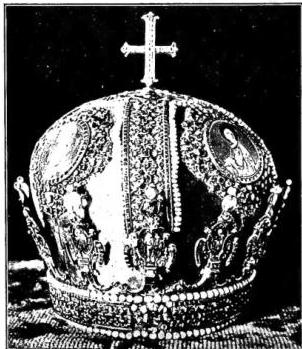
(from G. Lubonicki, Alt. Russland, Munich 1912, pl. 7)
ORIENTE CRISTIANO - Mitra of Patriarch Nicone (1655) - Moscow, Cathedral.
2. Each Eastern rite possesses certain ceremonies and customs that are particular to it; far rarer are the ceremonies found in all rites in contrast with Western rites. To this category belongs the rite of genuflection performed by all Eastern Christians on the day of Pentecost. Likewise, in the manner of ordering an office, particularly in beginning and concluding it, each Eastern rite employs specific elements (prayers, invocations, dialogues, salutations, readings, blessings, etc.) and arranges them in a highly stable order. Some resemblance may be discerned among the ritual structures of the Byzantine, Armenian, and Syro-Western rites.
The most evident case for all, however, is that of the anaphora, which is a logical literary composition, highly homogeneous and—with the exception of some anomalies—composed in all rites of the same prayers in the same order: the dialogue of the preface, the theological oration, the Sanctus, the Christological oration, the anamnesis, the epiclesis, the intercessions, and the final doxology.
3. The religious thought expressed in the texts. Here, dealing with nuances and emphases, one must guard against any exaggeration and even more against exclusions. Some studies on this subject have been conducted solely for the Byzantine rite, not without preconceived ideas.
It can be said that in Christ, the emphasis is placed on divinity; through His Incarnation, humanity has been saved, and less is said of individual salvation to be achieved through personal cooperation and appropriate means. Not only humanity but the entire cosmos participates in the renewal brought by the Incarnation of the Word, in the triumph of life over death in Christ’s Resurrection, and awaits with profound longing His second coming in glory. From their misery, the supplicating cries of the faithful often rise toward the merciful God, just as the celebrant frequently confesses his unworthiness and asks the Spirit to compensate for his spiritual infirmity: these are words that Western liturgical prayer does not ignore but places less often on the lips of its priests and faithful.
The Eastern rites differ from the Latin negatively, in that they lack certain Latin usages to which one would be wrong to attribute a necessarily dogmatic value, such that their absence would denote an error in faith. For example, the Filioque, unknown in the chanting of the Creed even in Rome before the 10th century; the simple genuflection on one knee, which is a feudal custom; the genuflection at the Incarnatus est of the Creed; the elevation after each consecration with the corresponding genuflections; the prescriptions regarding the manner of keeping hands joined or extended, of holding the thumb joined to the index finger after the consecration; the well-established rubrics for the so-called low Mass: all these are foreign to the Eastern rites. They also do not know the use of the organ, statues, confessionals, nor some feasts of the Lord and the Virgin Mary introduced in recent centuries. The so-called extra-liturgical devotion, such as the exposition of the Blessed Sacrament, the Way of the Cross, the Month of May, did not arise where the liturgy, still sufficiently understood by the people, nourishes the piety of the faithful. However, under the influence of various causes that it is not opportune to determine here, Catholic Orientals and sometimes dissidents have adopted, according to circumstances, some or many of the aforementioned Latin usages, such as, for example, the episcopal mitre.
It is therefore not always easy at first glance to determine which usages are characteristic of the Eastern rites.
BIBL.: R. H. Connolly, The liturgical homilies of Narsai, Cambridge 1909 (in an appendix [pp. 87-103], E. Bishop highlights some characteristic points of the Chaldean rite); L. Gillet, Le génie du rite bizantin, in Les questions liturgiques et paroissiales, 9 (1924), pp. 81-90; C. Korolevskii, L'Uniditisme, Amay 1937; S. Salaville, Liturgies orientales, Paris 1932, pp. 72-94; N. Gogol, La divine liturgie, French trans., Amay 1934.
Alfonso Raes
III. SPIRITUALITY
Attempting to encapsulate the spirituality of the Christian East and its centuries-long history in a few lines necessarily leads to formulas that are either too rigid or too vague. The reader of this summary must, from time to time, soften or clarify its contours.
The term spirituality has two meanings: a) in a broad sense, it encompasses all of theology as the principle and foundation of Christian life; b) in a strict sense, it is the set of practical consequences this theology has on life. Many discussions prove fruitless because this distinction is not taken into account. Moreover, the connection between these two fields is not so tight that any dogmatic difference immediately entails a divergence in spiritual character. East and West lived for a long time in a spiritual communion too profound for scholastic controversies of the 9th or 14th centuries to have significant repercussions on the spirit of the Christian people. The controversy over the procession of the Holy Spirit in the time of Photius, or that over the nature of Grace in the time of Gregory Palamas, did not destroy the ancient fundamental spiritual unity, nor did they prevent Greeks and Russians of more recent centuries from quenching their religiosity at Latin and Italian sources. Only in recent times have some Eastern theorists attempted to transpose speculative differences into practical spirituality. This spirituality, despite its fundamental unity, does indeed present particularities that distinguish it from the West (there are also nuances among the different parts of both the Christian East and West).
Generally speaking, Eastern spirituality is dominated, on the one hand, by a very profound sense of divine transcendence (St. Ephrem, the anti-Eunomians, Pseudo-Dionysius, the liturgy) and, on the other, by an acute sense of sin and the struggle that must be waged against it (Origen, the Desert Fathers, John Chrysostom, monasticism, etc.). Between this dizzying theology and this tragic anthropology, the economy or Christology appears in all its theoretical splendor and practical importance. It has been said that the Christian East sees in Christ the Logos with such a preference as to end up excluding devotion to His Holy Humanity or His Passion. This is an error against which the writings and the
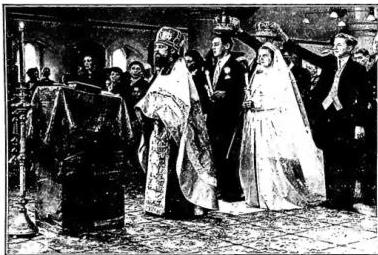
(photo: Publilote)
The Christian East – Nuptial Ceremony. Marriage of Prince Alexis Melikoff to Miss Juliet Namer (1 October 1948) – London, Russian Orthodox Church on Buckingham Palace Road.
life of the most illustrious Eastern figures, from St. Ignatius of Antioch, through Origen and St. Maximus the Confessor, to Nicholas Cabasilas and the most recent Russian saints. The imitation of Christ is especially a traditional theme. Alongside Christ, the East venerates the Theotokos Mary and the saints, particularly through the veneration of icons, so violently contested and so heroically defended from the 7th to the 9th century. All these diverse elements converge in a vast theocentric synthesis: man, having been created in the image and likeness of God but having lost this likeness through sin, the Word of God became man to deify man (St. Gregory Nazianzen): «becoming himself what his image was, he restored the likeness and made man like the invisible Father through the (now) visible Word» (St. Irenaeus, Adv. haer., 5, 16 [ed. W. Harvey, II, Cambridge 1857, p. 368]). As for the means used to attain the salvation accomplished through the Incarnation and Redemption, these include, alongside the Sacraments (sometimes held in low esteem by Messalianism or neglected due to certain excesses of anchoritism), various ascetic practices, from rigorous mortification, especially of one’s own will, to prayer in all its forms, which constitutes its summit. The tendency toward contemplation—less in its speculative Evagrian or Dionysian structure than in its simpler, charismatic, and "neptic" varieties—asserts itself everywhere: "remembrance of God," continuous prayer, "compunction," "spiritual feeling," "theology" in the sense of mystical perception. The great manifestation of this pursuit of salvation and this desire for union with God is monasticism (v.), whose importance and influence throughout the East cannot be overstated. The command given to St. Arsenius by a heavenly voice—«Flee, be silent, live in stillness (ἡσύχαζε)»—represents an ideal for ascetics of all times, to such an extent that the last great outpouring of mysticism, in the 14th century, Hesychasm (v.), for there culminate the teachings, examples, and aspirations of all previous hesychasts. There are, however, two novelties in this movement that earn it the name of Neo-Hesychasm: on the practical side, a method of "physical and scientific" prayer designed to hasten the attainment of contemplation; on the theoretical side, the Palamite doctrine of Grace with its theological presuppositions. Not all saints and doctors, however, were equally favorable to this contemplative tendency; some of the greatest, such as St. Basil and St. Theodore the Studite, and in general the proponents of cenobitism, insist rather on asceticism and social virtues: they connect more directly with primitive Christian spirituality, where the martyrdom of conscience or submission takes the place of bloody martyrdom. The contemplatives or hesychasts, meanwhile, depend—more or less consciously and to varying degrees—on Christian Alexandrianism. Nevertheless, all agree, in theory, in seeking perfection in charity toward God and neighbor. The difference lies in how charity is considered: more in its subjective demands or more in its objective unfolding. The subjective and personal perspective predominates in the anchoritic and hesychastic tendency (St. Basil already reproaches it: Reg. fus., 7: PG 31, 928-33): particular emphasis is placed on apatheia*, though without falling—except in rare cases—into the excesses that would justify the suspicions of St. Jerome or Gerson; much, sometimes too much, importance is given to experimentation and feeling, and while they do not go so far as to declare them necessary (as do the Messalians, Pseudo-Macarius, Symeon the New Theologian), they at least insistently preach their normality and sweetness. For this reason, a Vladimir Soloviev believed he had to accuse the East of easily lapsing, under the guise of contemplation, into lazy passivity. This reproach would be unjust if directed at the Church or even cenobitic monasticism; indeed, there have been many charitable institutions and magnificent examples of lives dedicated to others (such as, e.g., St. John the Almsgiver [619]). Eremitism itself, though less devoted to external works of charity, has nonetheless effectively cultivated among its adherents and the Christian people the purity of charity, its disinterestedness, and its exquisite delicacy, characteristic of Eastern hagiography.
BIBL.: M. Viller-K. Rahner, Aszese und Mystik in der Väterzeit, Freiburg im Br. 1939. Ireneo Hausherr
### III. THE PROBLEM OF UNION.
I. NORMS OF THE HOLY SEE
The schism of the 11th century tore all of the Christian East from Rome, except for the Greek-rite communities of southern Italy. When, a century and a half later, the Fourth Crusade subjected a vast portion of the Byzantine Empire to Latin domination, the question arose of how to treat these Christians, hitherto schismatic, and how to judge their rites. After some hesitation, the Fourth Lateran Council (1215) decided that such rites and customs would be tolerated provided they posed no danger to souls nor were contrary to ecclesiastical good morals. With this decree begins the long series of pontifical declarations (Honorius III, Innocent IV, Nicholas III, Eugene IV, Leo X, Clement VII, Clement VIII, Paul V, Benedict XIII, Benedict XIV, Pius VI, Pius IX, Leo XIII, Benedict XV, Pius XI, Pius XII, and others: cf. A. Petrani, De relatione iuridica inter diversos ritus, Rome 1930, pp. 14-25), which have given the Eastern Christians solemn assurances for the preservation of their particular rites, initially in a more reserved manner, later with spontaneous and generous enthusiasm, but always setting such understanding as the foundation for their reunion with the Roman Church.
The decretal Sub catholicae fidei of Innocent IV (1254) sought to provide more concrete norms for the application of the principles established in the case of the Greeks of Cyprus and the Archipelago. However, conflicts over the interpretation of the fixed criteria did not cease, even when, for nearly two centuries, the Armenians of the Kingdom of Lesser Armenia were united with the Catholic Church. The modern era marks a new epoch for the apostolate among the separated of the Christian East. The same zeal for souls that drove the religious of ancient and recent Orders to the spiritual conquest of the New World also gave new ardor to the apostolate among dissident Christians. The unions achieved in the 16th century have been discussed above.
In Rome, colleges for Eastern Christians were established, and the printing of Eastern liturgical books was undertaken. But especially the constitution of the Sacred Congregation for the Propagation of the Faith (1622) united and coordinated these initiatives. A rather different apostolate from that of the Middle Ages began, in which the Holy See had sought to proceed primarily through diplomatic means, winning over patriarchs and civil leaders of nations. Now the general front was set in motion. The Sacred Congregation of Propaganda Fide directed everything with its instructions, rescripts, and responses. The Collectanea S. Congregationis de Propaganda Fide (2 vols., Rome 1907) collects the numerous sources concerning this apostolate. However, few documents have a general scope; rather, it is the continuity in the application of norms that gradually creates a uniform discipline regarding the Christian East. A solemn and further confirmation of these norms was obtained through that great canonist on the Chair of Peter, Benedict XIV. In a series of constitutions that have remained classical, he established Eastern law in its relations with Catholic tradition; such are the constitutions: Eti pastoralis (1742), given for the Italo-Greeks; Demandatum (1734), addressed to the hierarchy of the Melkite Church; Eo quamvis tempore (1745) and Anno vertente (1750), concerning the Copts; Ex quo primum (1756), published on the occasion of the second edition of the Greek Euchologion. But especially the constitution Allatae sunt (1755), addressed to the missionaries of the East, touches on the fundamental questions of their apostolate. Subsequently, the Sacred Congregation of Propaganda Fide, on the basis of these pontifical documents, created a body of norms and rules that constituted almost a code for missionary work among Catholics and dissidents of the East. Among the most important documents for relations between missionaries and Eastern Christians are, for example, the responses given to the Apostolic Delegate of Egypt on December 11, 1838 (Collectanea, I, n. 879, p. 500). Numerous are also the responses and instructions concerning communicatio in sacris (cf. I. J. Szal, The communication of catholics with schismatics, Washington 1948). Pius IX, in the constitution In suprema (1848) and again in Arcano divinae providentiae, on the occasion of the Vatican Council (1869), renewed the invitation to the separated Eastern Christians to return to the Church. Leo XIII did the same in Orientalium dignitas (1894). This solemn act, together with the other testimonies given by the distinguished Pontiff in favor of the Christian East, aroused new hope and new fervor. Among other initiatives, an apostolate among the educated classes was also considered, with the establishment of a college of Greek culture, preferably in Constantinople. The project did not succeed at that time. But the Assumptionists, who, at the invitation of the Supreme Pontiff, had dedicated themselves in a particular way to the apostolate for the East, began at that time the well-known journal Echos d'Orient in their house in Kadıköy. A measure of exceptional importance was taken by Benedict XV when, in 1917, he established a new Sacred Congregation dedicated solely to the affairs of the Christian East, simultaneously suppressing the Sacred Congregation of Propaganda Fide pro negotiis ritus orientalis, founded by Pius IX in 1862. In the same year, the Pontifical Oriental Institute was opened in Rome, intended for advanced studies concerning the Christian East and, according to the motu proprio of its foundation, also open to dissident Eastern Christians. The successor of Benedict, Pius XI, placed even greater emphasis on the requisites necessary to achieve the return of the separated brethren to the Church. In the encyclical Ecclesiam Dei, published on the occasion of the third centenary of the death of St. Josaphat (1923), he invited all Catholics to collaborate with him, rightly understanding « that such unity, rather than through discussions and other stimuli, is to be promoted by the examples and works of a holy life, especially with charity toward the Slavic brethren and other Eastern Christians... Just as the dissident Eastern Christians must, laying aside ancient prejudices, seek to know the true life of the Church, so the Latins must understand more deeply the history and customs of the Eastern Christians...». The entire encyclical Rerum Orientalium (1928) addresses the importance of Oriental studies for the reunion of the dissidents, warmly recommending the Pontifical Oriental Institute to the hierarchy of the entire Catholic world. Finally, the Holy Father Pius XII followed in the footsteps of his predecessors. While in the encyclical letters Orientalis Ecclesiae (1944), in honor of St. Cyril of Alexandria, Orientales omnes (1945), published on the occasion of the 250th centenary of the union of the Ruthenian Church with Rome, and Sempiternus Rex (1951), commemorating the 15th centenary of the Council of Chalcedon, he reaffirmed that the dissidents need not fear any diminution of their traditional rites and customs, with the promulgation of the motu proprio: Crebrae allatae sunt (on matrimonial law) and Sollicitudinem nostram (on judgments), he presented the first fruits of the new Code of Eastern Canon Law, a work long in preparation and which demonstrates the effective interest that the Holy See has for the spiritual well-being of the Christian East (cf. V. COMMISSIONI PONTIFICE). Emilio Herman
II. CATHOLIC WORKS FOR UNION
1. Prayer for union. — The most important prayer is undoubtedly the votive Mass ad tollendum schisma, formerly called ad unitatem Ecclesiae, which, although composed to resolve the Great Western Schism, is now directed especially to implore the return of the separated, « ut omnes unum sint ». This is followed by the novena of Pentecost, ordered by Leo XIII in the encyclical Divinum illud munus (9 May 1897) for all Catholic Churches, and accepted also by not a few Anglicans, Old Catholics, and "Orthodox". Greater diffusion was achieved by the Octave of Unity from the feast of the Chair of St. Peter to the Conversion of St. Paul (18-25 January), an initiative of the Episcopalian pastor Paul Watson and accepted in the Catholic Church by Pius X. The Dies Orientis, or day of prayers for the East, is particularly recommended by the Holy See to seminaries and Catholic colleges.
In 1851, the Union of Prayers for the Conversion of Russia and for the extinction of the schism among the Slavic peoples was founded in Brussels; and in 1855, another was established in Bourges with the aim of obtaining « per Maria Immacolata la conversione dei Greci scismatici ». Better known and more important is the Association of Prayers in honour of Mary Immaculate for the return of the Greco-Russian Church to Catholic unity, founded before 1862 by the Barnabite Fr. Cesare Tondini de' Quarenghi, also called the Work of Fr. Schuvalov. In 1887, the Primatial Archconfraternity of Prayers and Good Works for the Return to Catholic Unity of the Dissident Churches of the Eastern Rite arose, placed under the patronage of Our Lady of the Assumption, through the work of the Augustinians of the Assumption, who rapidly propagated it across various nations of Europe and the Near East. Other initiatives of this kind could be mentioned here, such as the League of Sacrifices for Russia, which, founded by the Apostolic Administrator of Lugano on 9 January 1929, gathered the adhesion of more than 700 religious houses.
2. Associations. — Beyond prayer for the East, there are associations to promote union. The following may be enumerated: the Association of SS. Cyril and Methodius for the return of separated brethren to the bosom of the Catholic Church, founded in 1851 by the Bishop of Maribor, Anton Martin Slomšek, later called the Apostolate of SS. Cyril and Methodius under the protection of the Most Holy Virgin Mary, which has been and continues to be the most fruitful in unionist works and publications; the Catholica Unio of the Benedictine Fr. Augustin von Galen, established in Vienna in 1923; the Society of St. John Chrysostom of English Catholics, born in 1926; the Catholic Near East Welfare Association, founded in the United States by the Jesuit Fr. Walsh; the Het apostolat der Hereiniging, centre of the powerful unionist movement in Holland; the flourishing Obra misional of the Christian East in Spain, definitively established in 1947 under the protection of the Cardinal Primate of Spain.
In Italy, two unionist associations arose in 1930, namely the Pious Association of St. Nicholas of Bari in Rome, and in Palermo the Italian Catholic Association for the Christian East, which, under the direction of Card. L. Lavitrano, exercises a true and profound unionist apostolate, chiefly through the Oriental Weeks organised in the principal Italian cities.
While the upheaval of the last world war noticeably diminished the activity of these two associations, Fr. C. Boyer, professor at the Gregorian University, gave life in 1945 to Unitas, which, however, concerns itself with dissidents in general, whether they be "Orthodox" or Protestant.
These associations have promoted the celebration of unionist congresses, sometimes even with the participation of separated Easterners: among these, the most important were the Conventus Velehradenses, now suspended, which were held periodically in Velehrad (Moravia-Czechoslovakia) from 1910 until the outbreak of the war.
3. Centres of study. — In the desire to prepare a select clergy for work in the East, Gregory XIII already opened in Rome the Greek College of St. Athanasius, followed by others, principally under the pontificates of Leo XIII and Pius XI. Currently existing in Rome are the Greek College of St. Athanasius, the Ruthenian College of St. Josaphat, the Maronite College (temporarily closed), the Armenian College, the Romanian College, the Russian College, the Ethiopian College, and the Institute of St. John Damascene, intended for priests of the various Eastern rites who perfect their studies.
These institutes aim at the formation of the clergy. Benedict XV, on 15 October 1917, established the Pontifical Oriental Institute, open indiscriminately to Latins and Orientals, to Catholics and dissidents, for the cultivation of Eastern ecclesiastical studies, with the faculty to confer academic degrees. Other Oriental institutes, though without university character, arose in other places, such as the Seminary of St. Basil and the student residence Istina in Lille, the Benedictine priory of Amay-sur-Meuse, later transferred to Chevetogne, the Missionary Institute of Lublin, the Seminary of Dubno; to which may be added the Catholic schools of the East, among which the Jesuit University of St. Joseph in Beirut stands out.
4. Press
The flourishing of these works is the unionist press, with numerous journals published in various languages, such as Apostolat Sv. Cyrilla a Metodije in Olomouc (Moravia), Der christliche Orient in Munich, Apostolat der Hereiniging in Holland, L'unité de l'Église (until 1937) and Russie et chrétienté in France, Oriens in Poland, The Eastern Churches Quarterly of the Benedictines of Ramsgate in England, Cirillometodzki in Zagreb, Oriente in Madrid, Irénikon in Chevetogne (Amay) in Belgium, and in Italy the Bollettino of the Greek Abbey of Grottaferrata, L'O. c. e la unità della Chiesa by Mons. Cesare Spallanzani in Reggio Emilia (until 1943), and Unitas, the organ of the association of the same name, published in Rome in Italian, French, and English.
BIBL.: C. Tondini, La prière et l'appui du St-Siège et de l'épiscopat dans l'oeuvre de la réunion des Eglises, Paris 1876; M. Jugie, La prière pour l'unité chrétienne, ibid. 1919; M. Gordillo, Le opere di un pontificato [Pio XI] per l'unità della Chiesa, in Piet unum alle, 5-6 (1941), pp. 65-78; id., La preghiera per il ritorno degli Orientali dissidenti, in Incontro ai fratelli separati di Oriente, Roma 1945, pp. 478-92; id., Opere per promuovere il ritorno degli Orientali dissidenti, ibid., pp. 467-77; C. Korolevskii, Alcune notizie intorno alle opere per l'assistenza ai cattolici di rito orientale, in Unitas, 4 (1949), pp. 5-64. Maurizio Gordillo
III. THE CHRISTIAN EAST AND NON-CATHOLIC CHRISTIANS, ESPECIALLY ANGLICANS
5. Until 1800
In 1574, German Lutherans sent a Greek translation of the Augsburg Confession to the Patriarch of Constantinople, Jeremias II; a correspondence followed. From 1624, the archdeacon Critopoulos, who had studied in Oxford, England, for seven years, spent three years among German and Swiss theologians, for whom he wrote a Confession of Faith. Meanwhile, in Poland, Orthodox and Protestants temporarily united to oppose the recently formed Ruthenian Uniate Church (1596), and in Constantinople, Catholics and Protestants, supported by the diplomatic efforts of their co-religionist ambassadors, attempted to win over the "Orthodox," already greatly weakened in the Ottoman Empire. The climax occurred when Cyril Lucaris, then patriarch, issued a profession of faith (1629) that was almost entirely Calvinist. Protestants used it in their propaganda to demonstrate the orthodoxy of their doctrine; Catholics used it to demonstrate the necessity of union with Rome; the "Orthodox" reacted by condemning it in no fewer than six synods during the 17th century and approving (Jerusalem 1672; Constantinople 1691) a point-by-point refutation in the Confession of Dositheus. Between 1716 and 1727, some of the English Nonjurors, prompted by the visit to England of delegates from the Patriarchate of Alexandria to raise funds, conducted a lengthy correspondence with the four Eastern Patriarchs, with the intermediary and approval of Peter the Great of Russia, in an attempt to achieve union with the "Orthodox." This correspondence ended only when the Archbishop of Canterbury, Wake, explained to Constantinople the schismatic status, relative to the Anglican Church, of his correspondents.
6. From 1800 to 1916
The Oxford Movement in the Anglican Church, with its partial return to Catholic doctrine and its characteristic Branch Theory of the universal Church, gave new impetus to Anglo-Orthodox relations. An Oxford professor, William Palmer, visited Russia (1840-51) and then Greece, but failed to persuade these Churches of the orthodoxy of the Anglican position and ultimately (1855) became a Catholic. Between 1860 and 1870, first the Protestant Episcopal Church of America and then the Church of England established committees to promote relations with the "Orthodox," and there was some exchange of letters. In 1874 and 1875, official conferences were held in Bonn between the "Orthodox" (Russians and Greeks, and in 1875 also Romanians and Serbs), English and American Anglicans, and the "Old Catholics"; in these meetings, all parties agreed on certain declarations regarding the canons of Scripture, Tradition, Confession, the Eucharist, and the doctrine of the Trinity with a compromise on the Filioque, partly prudently vague; nevertheless, the agreement did not receive full approval from the Holy Synod of Russia nor from some Anglicans. Since then, all Lambeth Conferences made references to Anglican relations with the "Orthodox," and no opportunity for official contact and courteous cooperation was missed. In 1897, the Anglican response to the papal Apostolicae curae was sent to all "Orthodox" Churches, where it aroused great interest and numerous Russian and Greek studies on the validity of Anglican ordinations, studies that criticized the 39 Articles and demanded doctrinal reforms of the Anglican Church as a prerequisite for any exchange. In 1901, Anglicans circulated among the "Orthodox" an explanation of their teaching, which was favorably received by some Greeks. In 1902, Joachim III of Constantinople sought the opinions of eight "Orthodox" Churches on union with the West. The longest response came from Russia, which in reality demanded that all Anglicans, not just those of the High Church, desire and embrace "Orthodox" faith in every detail. In 1906, the Association of Anglican and Western "Orthodox" Churches was founded, still active today. Shortly afterward, the Patriarch of Constantinople agreed that Anglicans and Greeks could administer certain Sacraments to members of each other's Churches when a minister of their own Church was unavailable. In 1912, the Holy Synod of Russia invited an Anglican cleric to give courses on Anglicanism in Russia. During this period, however, the initiative always came from the Anglicans, whose efforts were directed more toward the Russian Church than the Greek, and although their spokesmen always went beyond Protestant elements to emphasize agreement with Catholic doctrine (sometimes even to the point of dishonesty), no tangible results were achieved: they were always urged to repudiate the 39 Articles and amend their other formularies in favor of "Orthodoxy."
7. From 1916 onward
After the Bolshevik Revolution, Anglicans turned more toward Constantinople. Indeed, events followed rapidly. In 1918, Archbishop Meletius of Athens, while in America and England on business, had conferences with Anglicans. In 1919, permanent committees for the study of union were established in Constantinople, Athens, London, and America. In January 1920, Constantinople issued an encyclical letter "to all the Churches of Christ wherever they may be" to encourage friendly relations and especially cooperation on practical matters. "Orthodox" delegates were invited to the 1920 Lambeth Conference, and Meletius, then Patriarch of Constantinople, sent one who reported that Anglicans ardently desired intercommunion, but that their conception of the Church allowed diversity of opinion even on essential doctrines, and advised caution, especially since Anglicans were simultaneously attempting to forge a union with nonconformist sects. Nevertheless, the visit bore some fruit.
One of the Patriarch's delegates, Prof. Comnenos,
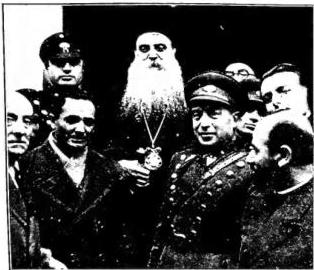
(per cortesia del P. Ortiz, S. J.)
ORIENTE CRISTIANO - Patriarch Athenagoras of Constantinople, after his visit to the President of the Republic of Ankara (February 1949).
wrote a pamphlet (1921) in favour of Anglican Orders, and in 1922 the Patriarch, in a letter to Canterbury and in an encyclical to all the "Orthodox" Churches, announced that Anglican Orders could "administratively" "by economy" be considered valid by the "Orthodox" in the same way as Catholic and Armenian Orders. Only Jerusalem and Cyprus immediately followed Constantinople. Since then, signs of friendship multiplied. In America and Australia, Anglicans were permitted to administer Baptism and Marriage to individual "Orthodox". There was an exchange of "letters of enthronement" between Canterbury and Constantinople on new appointments to these sees. In 1925, all the "Orthodox" Churches (excluding Yugoslavia and, naturally, Russia) were represented at the Nicene celebrations in Westminster Abbey. In 1928, the Fellowship of St. Alban and St. Sergius was founded with the aim of promoting friendly relations between Anglicans and exiled Russians.
The 1920 experiment was repeated at the Lambeth Conference of 1930, when a large "Orthodox" delegation visited London, led by Meletius, then Patriarch of Alexandria. Discussions were held with a committee of Anglican bishops, in which the "Orthodox" again received assurance that the Anglican Communion admits a real presence in the Eucharist, which is a mysterion, and that Ordination conveys the grace peculiar to each Order, and that this too is a mysterion. To satisfy "Orthodox" doubts, these and other declarations were submitted to a plenary session of the Conference and were declared "a sufficient account of the doctrine and practice" of the Anglican Communion. On 25 December 1930, Alexandria extended recognition "for administration" to Anglican Orders. In 1931, "Orthodox" and Anglicans met in conference for further doctrinal discussions, which, however, yielded no immediate results. The "Orthodox" delegates, on their return journey, met with the "Old Catholics" in Bonn, but having only the authority to report to their respective Churches, although they reached a verbal doctrinal agreement, they could not arrive at conclusive decisions. The "Orthodox" had hoped to convene a pan-"Orthodox" synod in which Anglican Orders and union would be discussed and established jointly, but this was prevented by the opposition of the Turkish government. Thus, in 1936, the Romanian Church invited an Anglican delegation to Bucharest, and this delegation reached an agreement with the Romanian delegates on a formula encompassing "apostolic succession, Holy Order, the Sacraments in general, Tradition, and Justification", which, subsequently accepted by the Holy Synod of Romania and by both English convocations (as "a legitimate interpretation of Anglican faith"), though not without opposition in both countries, featured in a Romanian recognition of Anglican Orders. In 1938, the Greek Church, albeit with broad reservations, admitted that "the Church, after examining special circumstances, can administratively recognise the Orders of an Anglican who enters the 'Orthodox' Church".
Throughout this period, there were many friendly contacts and exchanges of visits. The "Orthodox" Churches (except the Russian Church) took part in various ecumenical congresses (v. ECUMENISMO), although at Lausanne (1927) and Edinburgh (1937) they withdrew from the concluding communiqués. At Amsterdam (1948), only Constantinople and Greece were fully represented, and the majority of delegates again wished to make a special declaration, but were thwarted by the minority. In the Greek Church, after Amsterdam, there is a strong divergence of opinion on the advisability of further participation in all topics of these conferences. The Russian Church, and with it all the other Slavic "Orthodox" Churches, in a resolution approved at the centenary celebrations of 1948, refused to cooperate and condemned such movements, simultaneously expressing their aversion to recognising Anglican Orders. In the central and permanent committees of the World Council of Churches and the resulting Movements, the "Orthodox" were regularly represented by members, among whom Archbishop Germanos, apocrisary of Constantinople to Canterbury, Prof. Alivisatos of Greece, and Fr. Florovsky of the exiled Russians are noteworthy, but there appear to be increasing doubts about the advisability of such participation, and a desire is emerging to limit cooperation to practical matters, omitting all doctrinal discussion.
BIBL.: W. Palmer, Notes of a visit to a Russian Church, Londra 1917; J. A. Douglas, The relations of the Anglican Church with the Eastern Orthodox, ivi 1921; G. K. A. Bell, Documents on Christian Unity, I Londra 1924, II ivi 1930, III ivi 1948; G. J. Slosser, Christian Unity: its History and Challenge, Londra 1920; I. N. Karmiri, Ὀρθοδοξία καὶ πραταγενεσθῆς, Atene 1937; id., The Lambeth conferences, nn. 1-6, ed. R. T. Davidson, 1929, 1930 e 1948. In addition to the frequent articles in The Christian East (1920-38) and Echos d'Orient, cf. J. Gill, The Church of England and Reunion, in Unitas, 2 (1947), pp. 145-56, 267-86; id., The Dissident Oriental Church and Amsterdam, ibid., 3 (1950), pp. 117-28; id., La Chiesa ortodossa e il movimento ecumenico, in La scuola cattolica, 77 (1949), pp. 320-27. Giuseppe Gill
IV. DOGMATIC DIVERGENCES
8. General character of the divergences between Catholics and dissident Orientals
For over a century, there has been a tendency to almost eliminate the dogmatic divergences between Catholics and separated Orientals.
In 1858, A. Ritschl, followed by numerous Protestant authors and some Catholics, reduced the contrast to mere liturgical differences. The importance that Orientals attach to these is not denied, whether in internal disputes among themselves (as exemplified by the treatise of Dionysius Bar Salibi against the Armenians) or in relation to the Latin Church. However, it is undeniable that the principal struggle took place in the field of dogmatic truths. This is attested by the history of Catholic and Oriental relations; although in modern times, attention is directed more toward the differing mentalities of the East and the West, to the extent that, as the metropolitan of Lviv, A. Šeptyc’kyj, states, Orientals differ from Westerners even when they agree in affirming a doctrine. Indeed, in 1913, A. Harnack insisted on the distinct spirit of Eastern Christianity, which distances it from Western Christianity. Rightly, A. de Ivanka, in the article Orient et Occident (in Irénikon, 9 [1932], pp. 409-21), warns against exaggerating this contrast.
It is a fact that doctrinal divergences have crystallized into very precise dogmatic formulas, around which lengthy disputes have taken place and continue to this day. These will be briefly discussed, focusing attention on the Churches of the Byzantine-Slavic East and setting aside the Nestorian and Monophysite Churches, for whose doctrines V. ARMENIA; COPTI; ETIOPIA; GIACOBITI; MONOFISITI; NESTORIO E NESTORIANESIMO, V. La Chiesa nestoriana.
2. First lists.
- In the second half of the 9th century, a first list of divergences between Latins and Byzantines appears in the encyclical letter of Photius to the Orientals, written in 867 (PG 102, 721-41), where, alongside the Saturday fast, the celibacy of the Latin clergy, and other disciplinary and liturgical usages, the doctrine of the Latins on the procession of the Holy Spirit from the Father and the Son is denounced. Neither in this document nor in his other writings (excluding the pamphlet Against Those Who Say Rome Is the First Throne, which appears to be of a much later period) is there open opposition to the primacy. Nevertheless, it is certain that Photius targeted it, as evidenced by the letter of St. Nicholas I to Hincmar of Reims (PL 119, 1152-61), from which the list of Byzantine accusations is taken by Ratramnus of Corbie and other Latin polemicists against Photius.
Two centuries later, the patriarch Michael Cerularius, writing to Peter III of Antioch (PG 120, 789-96), enumerates 22 errors of the Latins, concerning almost exclusively liturgical and canonical discipline. In the realm of dogma, Cerularius reaffirms opposition to the Filioque (v.) and to the Roman primacy, already entirely decayed, since the Pope had admitted "the heresy of the Filioque." Furthermore, he attacks the use of unleavened bread (v.), opening a new polemic that gave rise to innumerable treatises on the Eucharistic bread. The accusations of Cerularius are gathered and increased in number, regarding Latin usages, by the famous Pamphlet Against the Franks, attributed by Hergenröther to Photius but actually written at the end of the 11th century and widely disseminated in the Byzantine and Slavic East. Byzantine polemicists, such as Matthew Angelos Panaretos and many others, seek new points of divergence (A. Palmieri collected as many as 62), mostly liturgical. As for doctrine, two new divergences emerge: the question of Purgatory, raised in 1231 and already considered in the pamphlet of the Constantinopolitan Dominicans of 1250, and that of the Epiclesis, which appears for the first time, at least among the Byzantines, in Nicholas Cabasilas and Symeon of Thessalonica around the mid-14th century.
3. The five Florentine differences. - Thus, in 1438, at the opening of the Council of Ferrara-Florence, it was already common to speak of the five differences between Greeks and Latins, namely: 1) the procession of the Holy Spirit from the Father and the Son; 2) the insertion of the Filioque into the Nicene-Constantinopolitan Creed; 3) Purgatory, a dispute that also extends to the general question of the Last Things; 4) the matter and form of the Most Holy Eucharist, for which the Byzantines required leavened bread and the invocation of the Holy Spirit, called Epiclesis; 5) the primacy of the Roman pontiff. These are the five topics discussed in the assemblies of Ferrara and Florence and defined in the bull of union of the Greeks, which, however, passes over in silence the question of the Epiclesis, on which full agreement had been easily reached.
These five divergences are found in the writings of both supporters and opponents of the Union of Florence, such as Joseph of Methone, Cardinal Bessarion, Mark Eugenicus, George Scholarius, and, after them, in the polemical works of Gabriel Severus, Maximus the Peloponnesian, Elias Miniates, and many others.
(fot. P. S. S. S. S.)
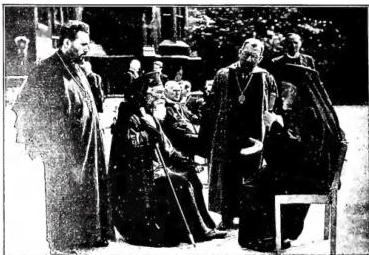
ORIENTE CRISTIANO - Lambeth Palace Ecumenical Conference (July 1948): from left to right: the parish priest Timiades, the metropolitan of Edessa, Professor Alivisatos of the University of Athens, Archbishop Germanos of the Ecumenical Patriarchate of Constantinople - London.
4. New Points of Contrast. - These latter writers also speak of Baptism by infusion and Communion under one species. The proclamation of the dogma of the Immaculate Conception in the bull Ineffabilis of 8 December 1854 and the Vatican definition on the infallibility of the Roman pontiff gave rise to new discrepancies, so that the patriarch of Constantinople Antimo VII, in his encyclical of 1895, presents the following list of "Latin errors": 1) the procession of the Holy Spirit from the Father and the Son; 2) the addition of the Filioque to the Creed; 3) Baptism by aspersion or infusion; 4) the azymes; 5) the Epiclesis; 6) Communion under one species; 7) Purgatory, Indulgences, and immediate retribution before the Last Judgment; 8) the Immaculate Conception of the Mother of God; 9) the Roman primacy; 10) papal infallibility.
5. Current State. - It is quite clear that over the nine centuries of separation, these doctrines have been presented in somewhat different forms, which cannot be explained in a very brief summary (v. AZIMI; BATTESIMO; EPICLESI; FILIOQUE; IMMACOLATA CONCEZIONE; PRIMATO DI GESÙ CRISTO; PURGATORIO). It should only be added that, despite numerous disputes, the differences have rather widened and deepened; first with the affirmation of Palamism (v.), whose influence is so strong in the doctrine of Grace and that of the Last Things; later with the contribution of ancient and recent Protestantism, whose influence is manifested in not a few points of sacramental theology, in the dogma of Redemption, and principally in the field of ecclesiology. If for many centuries the predominant controversy was that of the Filioque, today, principally after the predominance of the Slavophile school of Alexei Stepanovich Khomjakov, it can well be said that the most serious divergence lies, even more than in the doctrine of primacy, in the very concept of the Church and its unity and catholicity.
BIBL.: A. Palmieri extensively addresses the divergences between Catholics and Byzantine-Slavs in Theologia dogmatica orthodoxa, II, Florence 1913, pp. 1-168. Furthermore cf.: M. Jugie, Un théologien grec du XVIe siècle. Gabriel Sévive et les divergences entre les deux Eglises, in Echos d'Orient, 16 (1913), pp. 97-108; A. Malvy, Les divergences dogmatiques entre l'Eglise romaine et l'Eglise orthodoxe greco-slave, in Nouvelle revue théologique, 51 (1924), pp. 321-332, 400-25; M. Jugie, Theologia dogmatica christianorum orientalium ab Ecclesia catholica dissidentium, 5 vols., Paris 1926-35; A. Sceptyckij, Deux mentalités, in Irénikon, 1 (1926), pp. 232-35, 261-266; A. de Ivanka, Orient et Occident. Une contribution au problème du schisme, ibid., 9 (1932), pp. 409-21; B. Schultze, Pensatori russi di fronte a Cristo, 3 vols., Florence 1947-49; M. Gordillo, Compendium theologiae orientalis, 3rd ed., Rome 1950. Maurizio Gordillo
(from Antioch on-the-Orontes, III, Princeton 1938, p. 44, fig. 27)
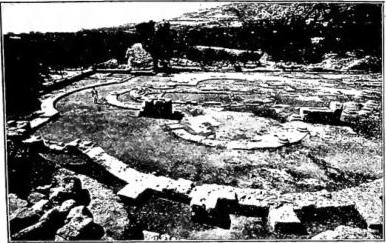
CHRISTIAN ORIENT - North side of the quadrilobate martyrion of Seleucia.
IV. CHRISTIAN ART.
It was aptly observed by J. von Schlosser how the political-administrative reform of the Roman Empire carried out by Diocletian, with a system of coordinates delineated by the spheres of influence of the two Augusti and the two Caesars, determined the framework of the entire development of the countries around the Mediterranean; and how the north-south axis, separating the Latin West from the Greek East, became increasingly marked during the Middle Ages, generating that detachment of the Western world from the Eastern one that persists to this day. But east of this axis, conditions are not uniform, and from an archaeological point of view, two territories with peculiar and in many respects discordant characteristics are determined from the earliest Christian times. To the north, that which has Byzantium as its center, occupying the entire Balkan peninsula, later aggregating the Slavic countries and dominating a more or less deep fringe of territory along the northern, western, and partly southern coasts of the Anatolian peninsula, where that neo-Hellenism which is called Byzantine art develops and lives: to the south and east of this, all the regions where Hellenism, which had already strongly established itself, must struggle against the resurgence of indigenous traditions with deep historical roots, which penetrate and gradually dominate II. This is what truly and only should be called the Christian Orient, and all its archaeological history from the 3rd to the 8th century can be said to lie precisely in this struggle between a purely Asian thought that seeks to impose itself and the existence of a Hellenistic tradition too great to die quickly. Indeed, it always lurks hidden and has truly unexpected resurgences.
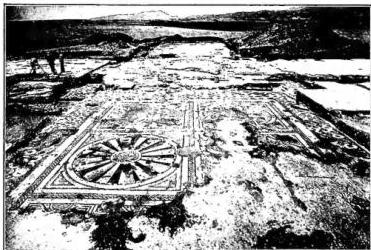
But while the Byzantine part knew and was able to maintain its unity for a not brief period under the hegemony of an art of the capital (Reichkunst) that imposed itself, the Christian Orient demonstrated centrifugal forces from the outset, and the great theological disputes often masked ancient political rivalries and irreconcilable economic divergences. On the one hand, therefore, an artistic unity that was also a linguistic unity (the two things being in a certain sense one), on the other the rise of artistic schools with well-defined territorial character simultaneously with the formation of national languages. And these languages ascend to literary significance precisely through the work of groups opposed to central power and religiously classified as heretical: Coptic with Gnostic writings, Manichaean texts, Hierakas; Syriac with Bardesane, the original of the Acts of St. Thomas, etc. An index and at the same time an effect of separatist force and nationalist tendencies. Thus, the Christian art of Egypt, that of Syria, Mesopotamia, Anatolia, and Armenia soon take shape with their own peculiar and unmistakable characteristics, which, on closer inspection, were already revealed, if not so marked, in the preceding Hellenism. This Eastern Hellenism is, in fact, very poorly known (and this is one of the weakest points in the archaeological studies of the Christian Orient in the first Christian centuries), since the complete destruction of the great Hellenistic cities has deprived us of fundamental documents. The great architectural monuments of Alexandria, Antioch, Gaza, and so on have disappeared, and we know of them only what literary sources tell us: we are reduced to the knowledge of monuments in the interior of the country, in secondary centers, monuments which, except perhaps for some cases in Syria, were not the most significant. Knowledge is based mainly on secondary constructions or on decorative works of art that do not convey the essential, even if among them are productions of the first order, such as the floor mosaics recently brought to light by the excavations of Antioch.
The presence or absence of a Hellenistic tradition distinctly marks the formation and development of the various territorial arts listed above; it is most evident between those that arose within the ancient boundaries of the Empire and that of Mesopotamia, which always lay outside it (the ephemeral Trajanic conquest is of no importance) and where Hellenism was limited to a few Seleucid póleis that, while maintaining their structure under the Parthians, certainly lost it with the Sāsānids. A telling example is that if in Egypt, Syria, and Anatolia, and in the first Armenian monuments, the church, even with variants and new characteristics, derived its forms from the Hellenistic basilica, in Mesopotamia it modeled itself on the great halls of Eastern palaces. And other examples can be cited.
Among the various artistic schools into which the art of the Christian Orient fragmented, one holds absolute predominance for its creative force and power of expansion: it is the architecture of Syria. It elaborated all possible transformations of the basilica that the Christian Orient conceived and exported them not only to Asia but also to Egypt and Abyssinia, and westward into the Byzantine environment and through it, to Italy. But, it must be noted, it did not know how to go beyond the sphere of variations on the basilical motif and ascend to a new conception of architectural space: this was reserved for the Byzantines. Thus, Syriac architecture knew how to elaborate numerous variations of the planimetry of central buildings, round or polygonal, from the Constantinian "Great Church" of Antioch onward, but it did not know how to complete the architectural thought with the perfect solution of the covering, that is, the dome connected with the base polygon. Although having before their eyes examples of pendentive connection (already attempted in the earliest Egyptian architecture) known to Syriac Hellenism (baths of Gerasa, tomb of Samaria, etc.), and although knowing the squinch connection of Asian invention and spread by the Sāsānids, they did not go beyond the drum covered with a pyramidal wooden roof. Even the problem of the dome marked a triumph of Byzantine architects. This proves the limitation of the thought of Christian architects of the Christian Orient, which would develop only in Armenia, but after that 8th century which marks the limit of the period with which we are concerned here.
Where, instead, the Christian Orient fully developed its intrinsic vision, its characteristics, and its genius was in the decoration of monuments and in what are called the minor arts. Not in the floor mosaics, of which we have a very rich series, especially in Palestine, precisely datable up to the 8th century. If one starts from the rich series of floor mosaics—
The Christian East made little use of figural sculpture.
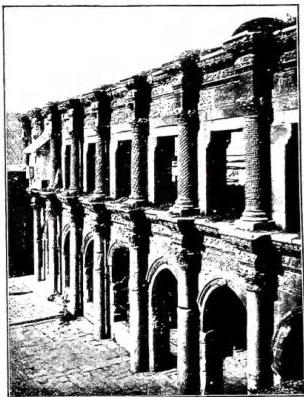
(from G. Straygowski, L'ancien art chrétien de Syrie, Paris 1926, between pp. 115-16, fig. 18)
Starting from the rich series of Hellenistic floor mosaics in Antioch (where only the inclusion of some, though not abundant, specifically Eastern and particularly Sasanian motifs is observed), one sees that this art lives and evolves while remaining firmly within the Hellenistic pictorial vision, with its fantastical and intricate architectures, genre scenes, and animal representations, entirely outside the true Eastern spirit. It even continues into the first century of Muslim domination, when, paradoxically, a curious return to pure Hellenism is observed in the (parietal but purely decorative) mosaics of the Damascus Mosque, which recall the art of Pompeii and Herculaneum. Evidently, these are works by craftsmen who passed down both technique and spirit from father to son, evolving yet remaining outside the true Eastern spirit. Where this spirit fully reveals itself is in wall painting and miniatures, with its characteristics already fully developed in the paintings of Dura-Europos. First, the distinctly Asian concept of continuous narration, which had already triumphed in Rome itself thanks to the great architect of Hadrian, Apollodorus of Damascus; the love of portraiture and historical composition; the abstraction of the human figure from its environment, which is often eliminated or merely suggested rather than depicted; and above all, the organization of the scene according to a principle of frontality, so that the viewer is drawn into it, enhancing the transcendent and reinforcing the meaning of subjects drawn almost entirely from religious history. In terms of form, there is an intense love of polychromy, a continuous need for rich color evident in every production (even in jewelry and cloisonné goldsmithing), and a compulsion to cover every surface (horror vacui), even if necessary through series of simply juxtaposed scenes (as early as the Dura synagogue) or through a complex of ornaments, as if the wall were covered by a tapestry—a principle that would develop to excess in the subsequent Islamic era. These latter tendencies also apply to sculpted decoration, which tends to cover every part of the building, overlapping what should be the expression of its constructive function: a Syrian door lintel is decorated as if it were a facing slab, and interlaces and meanders cover column shafts from Egypt to Mesopotamia (columns reused in the courtyard of the Diyarbakır Mosque). Few examples remain from which the result of applying such principles can be seen: perhaps the best is provided by the apses of the great triconch cella of the Red Monastery near Sohag, with the rich sculpted decoration framing the niches, while the rest of the walls and the columns were covered by painted decoration.
CHRISTIAN ORIENT - Columns from a Christian building (5th century), reused in the courtyard of the Diyarbakır mosque.
both in low relief and in high relief or in the round. Egypt is the region that has preserved the most numerous and important examples, with a series of sculptures that, due to the provenance of the most distinctive examples, was called the "school of Ahnās" but was also widespread in other locations of Middle Egypt, particularly in Bahnasa. The origin of its sculptural language is likely to be sought in the Nabatean environment: compare the reliefs of Hirbet at-Tannur. It certainly lasted until the 6th century, and a curious revival of its forms appears in the 8th century in the figural stuccoes of the Umayyad Palace of Hirbet al-Mefger. However, the fact that the majority of the subjects it treated
are drawn from Hellenic mythology and very few are Christian leads one to think that it was the creation of one of those residual pagan groups that had a long life in Egypt until the Justinian period. All the remaining figural sculpture that has come down to us in the Christian Orient has nothing to do with art. The same very late persistence of Hellenic motifs and subjects is also documented in Egypt in the art of weaving: but here, as has been observed for the Palestinian floor mosaics, it is probably a matter of the transmission of workshop formulas within a guild as strongly organized as that of the weavers. Even ivory sculpture, which produced marvelous works such as the cathedra of Massimiano now in Ravenna, shows the persistence of a Hellenistic artistic content and language, combined but not fused with Eastern forms and spirits.
And it is in this dualism, which the Christian Orient was unable to overcome between a powerful Hellenistic tradition and a distinctly Eastern spirit, that its tragedy and the impossibility of rising to a high sphere of expression lie.
CHRISTIAN ORIENT - Cruciform church of S. Babila and floor mosaics (387) - Kaussie, Antioch.
It perhaps lacked the time, as by the mid-7th century the Islamic conquest cut short its possibilities for development. - Vedi tav. XX. Ugo Monneret de Villard
Cite this article
“ORIENTE CRISTIANO.” Enciclopedia Cattolica, vol. IX (1952), p. 208. Azione Romana digital edition, https://azioneromana.com/article/oriente-cristiano.