
GERSON, JEAN. – Theologian and chancellor of the University of Paris, b. on 14 December 1363 in the hamlet of Gerson (from which he took his name), in the village of Barby (county of Réthe, diocese of Reims), d. at Lyon on 12 July 1429.
The firstborn son of a peasant from Champagne, he entered the College of Navarre in Paris as a scholarship student in 1377. Magister artium in 1382, G. began his theological studies under the direction of masters such as Lorenzo di Chavanges, Egidio des Champs, Enrico d'Oyta, Enrico di Langenstein, and Pietro d'Ailly, who took him under his protection. His activity began on Septuagesima Sunday in 1388, when he displayed his talent as an orator with a notable Latin sermon at the College of Navarre. From May to July 1388, he was part of the university embassy, led by Pietro d'Ailly, which at Avignon, before Clement VII, negotiated the condemnation of Giovanni di Montson, who had declared the Immaculate Conception contrary to the faith. Later, on 8 December 1401, G. delivered an important French sermon, Tota pulchra es, in favor of the Immaculate Conception, and took an interest in the readmission of the Dominicans to the University in 1403.
Beginning in 1388, G. taught two courses on the Bible and then commented on the Sentences. On 18 December 1392 he obtained his licentiate in theology and, probably in 1394, his doctorate. Until the question of the authenticity of the schematic commentary on the Sentences, which the manuscript of the Bibliothèque nationale in Paris (lat. 15156) attributes to G., is resolved, too much will remain unknown to define G.’s initial theses and doctrinal affiliations. Little is known about the exact nature of the theological doctrines proposed at that time in Paris, about the real influence and personality of Occam himself, a passionate dialectician rather than a system-builder. If Pietro d'Ailly seems willingly to have submitted himself to this influence, G. cannot be regarded as a link between Occam and Luther. His epistemology and psychology bear the imprint of Neoplatonism and the negative theology of Pseudo-Dionysius. The voluntarism of G.’s moral theology is difficult to interpret and may find its place within the Bonaventurian current. His observations on justification and predestination are made according to the classical distinction, for the theologians of the period, between potentia Dei absoluta e ordinata. Another crucial point is the Gersonian attitude concerning the value of the elements of the sacrament of Penance. Although G. considered the Occamist acuteness concerning divine ideas with admiration, he nevertheless returned to the Augustinian tradition. Beyond the speculative intemperance of the formalizantes such as Giovanni da Ripa and Luigi da Padova, he sought to recover the solid doctrine of s. Bonaventura and s. Tommaso d'Aquino.
At the beginning of his career, and even before receiving his licentiate in theology and being elected chancellor, between 1390 and 1394, G. delivered many sermons in French at court. In them he sought to interest the ruling classes in a peaceful solution to the schism, to turn them away from an exclusively elemental policy, to prevent unfortunate initiatives, or to remove certain practical obstacles. In 1393 he became first almoner to the duke of Burgundy, Filippo l'Ardito, who had acquired a predominant position in French politics after the young king Carlo VI’s first fit of madness, which occurred on 5 August 1392.
The Avignon pope, Benedetto XIII, appointed G., on 13 April 1395, chancellor of Notre-Dame and of the University of Paris. The moment was extremely important. It could be hoped that Benedetto XIII would accept the solution of which G. was an advocate (De schismate). In the face of the Pope’s reticence, the chancellor displayed considerable impatience, but remained hostile to the aggressive attitude of certain university circles and, although he intervened with pamphlets and consultations, refused to participate in the withdrawal of obedience from Benedetto XIII, which was voted by the Council of Paris (14 May–18 July 1398).
Having become dean of S. Donato at Bruges, G. resided in that city for three months at the end of 1396 and, a second time, for two months at the beginning of 1398. But in Paris, while continuing to preach moral and social reform at court, he manifested his powerful reforming spirit by offering, alongside his regular courses, a series of lectures on the spiritual life. Pietro d'Ailly, who had become bishop of Cambrai, sat at the feet of the chair of his former pupil. G. conceived his work in the form of a trilogy, often interrupted, whose integral parts were arbitrarily separated by the editors: first, the birth and development of the spiritual life (De vita spirituali animae); then, the various movements of this deified life (De impulsibus); finally, its perfection under the name of contemplation (De mystica theologia). The historical interpretation that saw in G. the prototype of those spirits of the late fourteenth century who would belatedly seek intellectual equilibrium in an infrarational mysticism is entirely outdated. Mysticism was rather, for G., the normal crowning of a structure resting on secure foundations. Although by its very nature the intellectual way helps one to enter into intimate contact with God, it is nevertheless the affective way that introduces one into this contact. The difficulties that G. encountered at the beginning of his office may, thanks to his stays in Bruges, have helped precipitate an evolution that other causes had already set in motion. Nevertheless, in the present state of research, G. appears above all to have been a theologian concerned with synthesizing and placing at the service of all souls the doctrine of the great contemplatives.
(courtesy of the Rev. Prof. G. Caves)
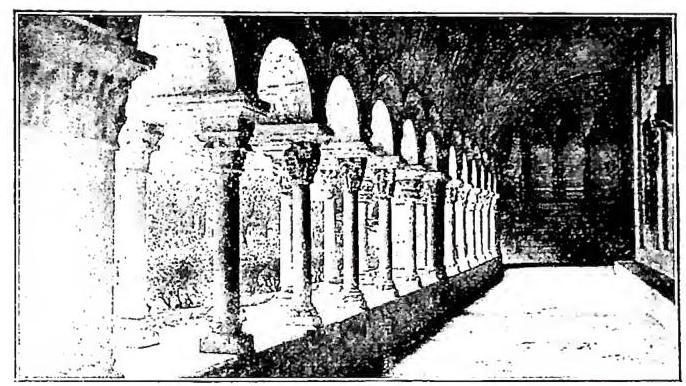
GERONA, DIOCESE of – Cloister of the Cathedral (13th century) – Gerona.
During the first quarter of 1399, G. undoubtedly sent a letter of spiritual direction to a Carthusian of Hérinnes, Bartolomeo Clantier, concerning the De ornata spiritualium muptiarum of Giovanni van Ruysbroeck, whose unexpected publication in the Opera omnia offered, much later, a fundamental document in the centuries-old polemic between theologians and mystics. But, in the eyes of its author, this hastily written text did not possess such importance. On 27 March, most probably, G. delivered in Paris, within the cycle of his university sermons for Holy Thursday, an important discourse for his cosmic mysticism. From 4 June 1399 to 21 Sept. 1400 he stayed in Bruges, where he composed, for his sisters, several French treatises, among them La mendicité spirituelle and La montagne de contemplation. He began commenting on La gerarchia angelica of Pseudo-Dionysius, elaborated projects for the reform of theological instruction, and, while intending to resign his office, fell ill. Once recovered, he returned to Paris, where in 1401 he composed the De distinctione verarum visionum a falsis and, in 1402, his De parvulis ad Christum trahendis, a work of capital importance for the history of pedagogy. His French preaching then turned toward the people, although he did not become parish priest of St-Jean-en-Grève until 1408. He invited these simple listeners to the contemplative life also through the sermon Videmus of 21 May 1402. Three days earlier, in his famous Vision against the Roman de la rose, he had brought this naturalistic doctrine to trial, refraining from any direct allusion to works or persons. This episode is very well known to the general public, but is partly distorted. Indeed, it is now certain that, in the controversy that opposed Cristina de Pisan to Gontier Col and Giovanni di Montreuil, G. was not the notable clerc of the first conversations, of whom Cristina speaks. The intervention of Pietro Col, canon of Paris, in favor of the Roman prompted G., in Oct. 1402, to issue a private warning. Faced with the obstinacy of this ecclesiastic, on 24 Dec. he insisted, in his fourth discourse Poenitemini, on a formal condemnation, which had been more laconic on the 17th. But this condemnation affected only the final part of the Roman, since, as a poet, G. had not been insensitive to the beauty of the work as a whole. This intervention seems to have borne fruit in Giovanni di Montreuil himself, who was by no means a rebel despising G.’s possible narrowness of spirit. Nourished by classical works, the chancellor was in fact regarded as a master by this humanist and by many others. The fact is rich in historical significance. Clearly placing himself within the tradition of the Ciceronian theme already modified by s. Agostino, Vir Christianus dicendi peritus, G. adapted it, in a wholly original and significant manner, to the spirituality of his age: Vir Christianus in sacris litteris eruditus. This new formula guided the development of French humanism during the 15th and 16th centuries, to the point that, through a clear line of dependencies, it would find its most secure demonstration in the work of Guglielmo Budé.
The period 1402–1403 is characterized by intense activity. On 8 Nov., the two Lectiones contra vanam curiositatem in negotio fidei defined G.’s position regarding the technical problems of the school. Faithful to the spirit of s. Bernardo, the chancellor set out to bring back to the sobriety of Christian faith the speculative intemperance that was afflicting the University of Paris. Between Oct. 1402 and the end of March 1403, the Trilogus in materia schismatis developed the thesis of the restoration of obedience. At the same time, he composed the third part of his trilogy on the spiritual life: the De mystica theologia speculativa
(courtesy of Prof. A. Combes).
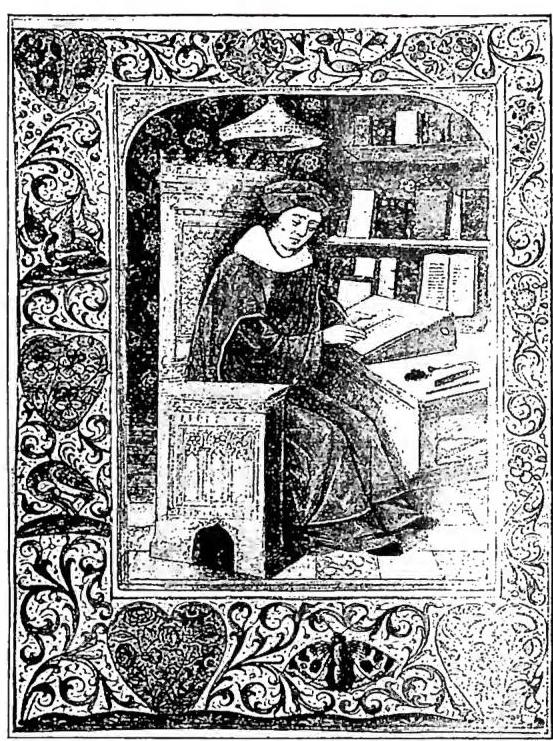
GERSON, JEAN – G. in his study. French miniature from the end of the 15th or beginning of the 16th century, serving as the frontispiece to a codex of the Imitation of Christ, entitled as follows: Incipit Liber primus Johannis Gersonii, cancellarii Parisiensis, de Imitatione Christi – Paris, National Library, Nouvelles acquisitions latines, 3024, fol. 2.
A new important period in G.’s life began with the restoration of obedience to Benedict XIII, which was celebrated by the chancellor in Paris on 4 June 1403. On 9 November, at Marseille, he offered the Pope the homage of the repentant University. On 1 January 1404, at Tarascon, he set forth a reform programme that was not lacking in boldness. Having become a member of the Chapter of Notre-Dame of Paris on 28 January 1404, he defended the honour of the University against Charles of Savoisy on 19 July. On 7 November 1405, before the court, though the ailing King was absent, he delivered the most famous of his speeches, the Vivat rex, directed in part against the tyranny of the Duke of Orléans. It is nevertheless inaccurate to think that G. expressed ideas that sanctioned revolt and prepared the way for tyrannicide, and that he later repudiated them. The Decem considerationes principibus utilissimae, on which reliance was long placed, is an apocryphal and tendentious work! G. was too moderate to embrace the revolutionary theories of an Occam or a Marsilius of Padua.
During 1407 he devoted himself chiefly to the affairs of the schism. Having been designated, together with Pierre d’Ailly, to take part in the embassy that was to negotiate the meeting at Savona between the two Popes, he delivered in French at Notre-Dame, on 18 March, a farewell speech, Vade in pace, in which he offered useful advice to the embassy. It achieved no result, either at Marseille or in Italy. Having withdrawn to Genoa, the chancellor composed there, from September to November, the practical part of his treatise De mystica theologia, which was published in its complete form around Easter 1408. Responding to the appeal of the Archbishop of Reims, he opened the council of that province on 4 May and delivered there two sermons on the duties of prelates and priests in general.
Meanwhile, on 23 November 1407, at Paris, John the Fearless had had the Duke of Orléans assassinated. On 8 March, the criminal found his apologist in the theologian Jean Petit. Since G. clearly condemned the theory of tyrannicide defended by Petit only in 1413, this delay has been judged very severely, but there are reasons to excuse II.
The sermon Veniat pax closed the fourth assembly of the clergy of France. G. had shown himself very moderate, although, disappointed by the popes’ most recent policy, he had clearly perceived the strong reaction in French circles against Benedict XIII, who had excommunicated Charles VI. During this period of French neutrality, he avoided every excessive measure and argument. He did not attend the Council of Pisa, but in 1409 he began composing the treatise on the unity of the Church. Between 5 June and 8 July he completed it with the inquiry entitled De auferibilitate papae ab Ecclesia, in which, seized by fear that the schism might prove impossible to overcome, he set forth his conciliarist theories. From 31 July to 5 August G. made his final visit to Bruges; he was relieved of his office on 30 June 1411. Shortly before 25 December 1409 he preached in Paris before the King the sermon Pax hominibus, in favour of the return of the Greeks, a speech that bears witness to his concern for the unity of the Church. During the same year, after studying the Passions de l’âme, he composed a short work, Sur la méditation.
The following three years seem empty: G. was very ill during this period. The revolt of 1415 spread and applied, with summary executive justice, the theory of tyrannicide. G. himself was threatened in his person and possessions. The victorious return of the Armagnacs to Paris finally enabled him, on 4 September, to insert in his French speech Rex in sempiternum the famous seven propositions drawn from Jean Petit’s speech of 1408. He demanded their condemnation. It cannot be believed that G. vacillated between the party of the Burgundians and that of the Armagnacs in order to defend his personal interests. There is no contradiction between the doctrine of the Vivat rex of 1405 and that of the Rex in sempiternum of 1413. G. showed himself above all a Frenchman, devoted to the person of his King and defender of Christian doctrine; nevertheless, even under these political circumstances favourable to his intervention, opposition remained strong, as is shown by the reactions of the Council of the Faith, held in Paris from 30 November 1413 to 19 February 1414, which reached an episcopal sentence of condemnation on the 23rd of that same month. As in the controversy over the Roman de la rose, G. would have liked to reduce the entire discussion to a doctrinal process. In reality, however, there was a trial of individuals which, over four years, embittered the chancellor’s life and ultimately forced him into exile. The Bishop of Arras, Martin Porée, G.’s implacable adversary, attributed excessive expressions to the latter, which historians have wrongly accepted as genuine.
On 21 February 1415 G. arrived at the Council of Constance, of which he was not, as has been said, the soul, but the victim. The persistence of the schism and his profound zeal, which sought to prevent the disorders caused by crimes and heresies, inspired in him ineffective expedients and genuinely erroneous theses (v. CONCILIARISM), which were later employed by the Gallicans of the 17th century, though abusively treated by them as abstract and non-occasional theories. Moreover, apocryphal treatises have been attributed to him, above all the De modis uniendi by Thierry de Niem. In his sermon of 21 July, Prosperum ita faciet, G. subjected the exercise of the Pope’s sovereign power to certain restrictions, while stating without reservation that the Council could not infringe either the absoluteness of the papal power conferred by Christ or, still less, diminish II.
At Constance, however, Martin Porée and Pierre Cauchon also defended John the Fearless against the accusation of heresy; and although on 6 July 1415 only the first thesis denounced by Gerson, Quilibet tyrannus, was condemned (which satisfied no one), on 15 January 1405 the judgment of the Council of Paris was annulled. G. then gave his conciliar activity an increasingly spiritual orientation. As early as 26 April 1415 he had delivered an admirable speech on prayer, and on 3 August, while examining the canonization of St. Bridget, he had been led to publish his De probatione spirituum. During 7 and 8 September 1416 he wrote or spoke on the cult of St. Joseph, one of G.’s deepest and most original devotions, in favour of which, as early as 17 August 1413, he had sent a letter to all the Churches. Dated 17 January 1417 are a sermon and a treatise on the union of Christ and the Church; dated 3 April 1418 is the treatise Sur la véritable religion et perfection, in which he defended, against the Dominican Matteo Grabon, the religious movement that arose in the Low Countries and was designated by the expression devotio moderna.
La riconquista sanguinosa di Parigi da parte dei Borgognoni, il 28 dic. 1418, condannò G. all'esilio. Una prima tappa lo condusse a Rattenburg (Inn) dove dal giugno all'ag. 1419 compose la sua grande opera De consolatione theologiae. Gli ultimi dieci anni della vita sua furono di una attività spirituale e letteraria intensa. All'abbazia di Mölk (Austria) compose il suo grande poema eroico Josephina. Dopo aver rifiutato l'offerta di una cattedra all'Università di Vienna, accettò, nel 1419, l'ospitalità che gli offrì suo fratello Giovanni, priore dei Celestini a Lione. Nel 1425 prese dimora, sempre a Lione, presso la Collegialità di S. Paolo, dove l'arcivescovo gli assegnò una abitazione e una rendita. Durante questo periodo G. rivede le sue opere e ne compose di nuove di carattere soprattutto morale e contemplativo, ma di mole considerevole e la cui semplice enumerazione sarebbe già di per sé lunga. Basta ricordare il suo De concordia metaphysicae cum logica, finito il 24 dic. 1426; il Collectorium super Magnificat degli sa. 1426-27, di grande importanza per la dottrina spirituale, per la mariologia e la teologia eucaristica; la sua Consultation en faveur de Jeanne d'Arc del 14 maggio 1429, fu il canto del cigno.
BIBLI: Per tutto l'argomento cf. la copiosa monografia di I. B. Schwab, Johannes G., Würzburg 1858, che non è ancora stata sostituita. Si citeranno qui soltanto i lavori che sono stati pubblicati dopo la bibliografia data alla fine del lavoro di sintesi parziale di I. L. Connolly, John G. reformer and mystic, Lovanio 1928. I volumi di A. Combes indicati infra contengono molti sviluppi e studi bibliografici e cronologici che superano il campo delimitato dai loro titoli rispettivi.
Sulla biografia: M. J. Pinet, La vie ardente de G., Parigi 1929; H. Dacremont, G., ivi 1929; E. Vansteenberghe, G. à Bruges, in Revue d'histoire ecclésiastique, 31 (1935), pp. 5-52; P. Glorieux, L'année universitaire 1392-93 à la Sorbonne à travers les notes d'un étudiant, in Revue des sciences religieuses, 19 (1939), pp. 429-82.
Sulle opere: Opera omnia, 5 voll., a cura di E. Dupin, Anversa 1706. Edizioni o riedizioni a cura di E. Vansteenberghe in Revue des sciences religieuses, 13 (1933), pp. 165-85, 393-424; 14 (1934), pp. 191-218, 370-95; 15 (1935), pp. 232-66; 16 (1936), pp. 33-46, 441-73; 19 (1939), pp. 24-47; a cura di A. Pons, Les sept Heures de la Passion, Parigi s. d.; a cura di A. Thomas, Jean G. et l'éducation des dauphins de France, ivi 1930; a cura di I. B. Monnoyeur, Le traité de Jean G. Initiation à la vie mystique, ivi 1943 (La montagne de contemplation. La mendicité spirituelle). Frammenti di opere sono stati pubblicati criticamente da A. Combes, Essai sur la critique de Ruysbroeck par G., I: Introduction critique et dossier documentaire, ivi 1945, pp. 615-869. Per il Commentaire inédit des Sentences attribuito a G., cf. E. Longpré in Archivium Franciscanum historicum, 23 (1930), pp. 251-252 (senza riserva) e A. Combes in Archives d'hist. doctr. et litt.
du moyen âge, 12 (1939), pp. 365-85 (pone il problema senza concludere). Circa i manoscritti originali francesi di una sessantina di sermoni francesi di G. e circa le edizioni parziali realizzate dopo Dupin, cf. L. Sorrento, Discorsi francesi del G. Il problema dei manoscritti, in Medievalia, Brescia 1943, pp. 287-316; L. Mourin, L'oeuvre oratoire française de J. G. et les mus. qui la contiennent, in Archives d'hist. doctr. et litt. du moyen âge, 15 (1946) pp. 225-61. La passione Ad Deum vadit è stata oggetto di una edizione non critica da dom G. Frénard, Parigi 1947, che, contrariamente all'edizione anteriore di Carnahan (detta critica), tiene conto dell'insieme dei manoscritti. Dieci sermoni francesi sono stati pubblicati criticamente e studiati dal punto di vista dottrinale, letterario e linguistico da L. Mourin. Six sermons français inédits de Jean G., Parigi 1946; Le sermon « Puer natus est nobis », in Les lettres romanes (Lovano), 2 (1948), pp. 315-24; 3 (1949), pp. 31-43, 105-45; Le sermon « Factum est proelium », in Recherches de théol. enc. et médiévale, 16 (1949), pp. 99-154; i sermoni « Ave Maria » e « Suscepinus », in Scriptorium (Bruxelles), 2 (1948), pp. 321-40; 3 (1949), pp. 99-68.
Sulla filosofia, teologia dogmatica e morale: oltre alle opere d'insieme, si consultera con prudenza W. Dress, Die Theologie Gersons, Gütersloh 1931, al quale ha recato grandi correzioni I. B. Monnoyeur, La doctrine de G. augustinienne et bonaventurienne, in Etudes franciscaines, 46 (1934), pp. 600-97.
Sulla teologia mistica: M. I. Pinet, La montagne de contemplation. La mendicité spirituelle. Etude..., Lione 1927; I. Steltenberger, Die Mystik des Johannes G., Breslavia 1928; P. Pourrat, J. G. et l'appel à la contemplation mystique, in Revue apologétique, 49 (1929), pp. 427-38; J. B. Monnoyeur, G. et l'appel à la contemplation, in La vie spirituelle, 23 (1930), pp. 49-68; A. Combes, L'authenticité geronienne de l'« Annotatio doctorum qui de contemplation », in Archives d'hist. doctr. et litt. du moyen âge, 12 (1939), pp. 291-364; id., Jean G. commentateur dionysien, Parigi 1940; id., G. et Pomeris, in Archives..., 14 (1945), pp. 394-500; id., Essai, cit., I, completato da Sur la date des sermons universitaires de G. Pour la fête du Jeudi-Saint, in Archives..., 15 (1946), pp. 331-482; id., Essai, cit., II, La première critique geronienne de « De ornata spiritualium nuptiarum », Parigi 1948.
Sulle teorie politiche: A. Coville, Jean Petit. La question du tyrannicide au commencement du XVe siècle, Parigi 1932; C. Schaffer, Die Staatslehre des J. G., Colonia 1935.
Sul grande scisma e teorie ecclesiologiche: cf. N. Valois, La France et le grand schisme d'Occident, 4 voll., Parigi 1896-1902 ed i complementi e le correzioni in A. Combes, Jean de Montreuil et le chancelier G. Contribution à l'histoire des rapports de l'humanisme et de la théologie en France au début du XVe siècle, ivi 1942; H. Iedin, Storia del Concilio di Trento, I, Brescia 1949, p. 15 e passim.
Su G. e la storia letteraria francese: per la polemica sul « Roman de la rose » cf. A. Combes, Jean de Montreuil, cit.; id., G. et la naissance de l'Humanisme, in Revue du moyen âge latin, 1 (1945), pp. 259-84; L. Mourin, Sermons français de G., op. cit.; F. Simone, Rassegna di studi sul Quattrocento francese, in Rivista di letterature moderne, 2 (1947), pp. 152-69.
Andrea Combes-Luigi Mourin-Franco Simone