
AUGUSTINE AURELIUS, Bishop of HIPPO, Saint. — One of the four great Doctors of the Western Church.
SUMMARY:
I. The Man
II. The Works
III. The Doctrine
IV. Pedagogy
V. Conclusion.I. THE MAN.
1. TAGASTE AND MADAURA
Aurelius Augustinus was born at Tagaste (now Souk-Ahras) in proconsular Numidia on 13 November 354. Though not of Roman blood, as Father Concetti maintained (Sant'A. antipapiniam, Tolentino 1930, pp. 1 ff.), he was so in language and education. In Book IX of the Confessions, he paints a portrait of his mother Monica, a most pious woman who instilled in him the first Christian truths and above all the transcendent authority of Jesus Christ. His father, Patricius, was a pagan but later converted to Christianity. After his early studies in Tagaste, the boy was sent to Madaura, where he received that classical training which he would later harshly criticize for the place it gave to the mythology of Greek and Latin poets. His Christian faith weakened in that environment to the point that, upon returning to Tagaste and idling there while waiting for his father to gather sufficient means to send him to Carthage, he could not resist his emerging passions and began that dissolute life which he recounts and laments in his Confessions.2. CARTHAGE
Such moral disorders persisted into the following year, when he continued his studies in the African capital. Augustine’s youthful failings are neither to be denied nor diminished, against his explicit testimony, but neither are they to be exaggerated, since they do not appear to have exceeded, or even equalled, what was unfortunately the conduct of most. Indeed, it seems that not many months passed during his stay in Carthage before he adopted a certain regularity by entering into a faithful union, though without marriage, with the woman who became the mother of his son Adeodatus, of whom he would say to the Lord: “You had made him well” (Confessions, IX, 6). Thus he reached his nineteenth year, in which, reading Cicero’s Hortensius—a now lost work that urged the pursuit of philosophy—he was so deeply moved that he changed the direction of his life and took as his ideal the search for wisdom. To whom, however, should he turn? The philosophers did not speak of Christ, and Augustine had retained Monica’s lessons too deeply to do without Him: “All that was without this name, however refined and truthful in style, did not fully win me over” (Confessions, III, 4, trans. O. Tescari, 4th ed., Turin 1946, p. 69).He opened the book of Scripture: he found little elegance of style and much obscurity of thought. Coming into contact with a sect that called itself Christian yet claimed to account for everything by reason alone and required no faith (the Manichees, whose leader Mani professed himself “an apostle of Jesus Christ” [*Contra epistulam Manichaei*, 5, no. 6]), Augustine was won over and remained in the sect for nine years, though he remained in the lower rank of hearers and was quite restless and doubtful despite his proselytizing. Like the Manichees, he believed that every being, even God, was material; that evil was a substance derived from a first evil principle; and that our actions did not proceed from our freedom but from the struggle between good and evil elements within us. Yet he was struck by the responses a Catholic named Elvidius gave to the Manichees’ attacks; he could not see how the Manichaean cosmogony squared with the teachings of the physicists, so that when a certain Faustus, a renowned Manichaean who should have resolved his difficulties, confessed that he could not, Augustine began to distance himself from the sect.
3. ROME AND MILAN
At that very time (autumn 383), he left his turbulent students in Carthage to go to Rome and open a school. There he had occasion to observe the low morality of the Manichaean leaders, which further alienated him from them. He then asked himself whether wisdom might not be found in the New Academy, as illustrated by Carneades and Cicero, which, despairing of finding the truth, contented itself in all things with adhering to what was most probable. Poorly paid by the students of Rome, Augustine competed for and won a chair of rhetoric in Milan. He visited Bishop Ambrose, who had once been prefect of the city, and for two consecutive years (384–86) listened to his sermons to the people every Sunday. The words of St Ambrose awakened in the African rhetorician reflections that gradually led him back to the faith of St Monica. He began by recognizing that the spiritual interpretations the bishop gave to the Old Testament removed the difficulties raised by the Manichees; and this was enough for him to resume his place as a Catholic catechumen. Yet certainty still eluded him.It was then that God led him to see, on the one hand, that an authority charged with teaching us necessary truths was not to be rejected a priori but rather, since we are so incapable of finding the truth within ourselves, one must suppose that some religious authority had been established by Providence; and on the other, that no religious authority in the world could compare with the Catholic Church and its Holy Scriptures. The conversion of the empire, the depth and simplicity of the holy books, the miracles and deeds of the martyrs—all indicated that the necessary aid for humanity had been given in the doctrine preached by St Ambrose (Confessions, VI, 4, no. 6).
Thus Augustine had returned to the Church of his childhood and adhered to it firmly, though he still struggled to reconcile Catholic doctrine with his philosophical principles, which remained those of Manichaean materialism. He believed that God is spirit but could not conceive of Him as such; he believed in freedom but could not understand how it was possible. In short, he had rediscovered faith (Confessions, VII, 7, no. 11), but intellectual peace still eluded him. This came to him through the Neoplatonists. An enthusiastic follower of Plotinus placed in his hands the Enneads of the Alexandrian master, and reading them, he had a revelation of the spiritual world: “I entered, under Your guidance, into my inmost self... I entered and saw, with the eyes of my soul—whatever those may be—a light unchangeable” (Confessions, VII, 10, no. 16, trans. G. Capello, Turin 1945). He understood that every substance, as such, is good, and that evil, consisting only in the privation of good, cannot be a first principle. It was a joy, but also a danger—that of pride, like so many philosophers.
Yet Augustine still lacked harmony between his conduct and his faith. Monica had succeeded in sending away the mother of Adeodatus and was preparing a suitable marriage for Augustine, but in the meantime he had taken another concubine and groaned under the chains of sin. The victory, more beautiful than he imagined, came through reading St Paul, his fervent prayers, and the many examples set before him. He discovered in the Apostle’s letters, in their true sense, the mystery of the incarnate Word and the necessity, for rebirth, of human humility and the grace of God, and he began to beg for his own healing. He then learned of so many men and women who had abandoned
he abandoned everything to live solely for God and finally exclaimed: “The unlearned arise and take the kingdom of heaven: and we, with our learning, bereft of sense, continue to wallow in flesh and blood!” (Confess., VIII, 8, no. 19). He withdrew to the garden, wrestling with his thoughts and weeping, until he heard the chant of a child repeating: take up and read. He opened the book of the Apostle and lighted upon this passage: “Not in revelry and drunkenness, not in debauchery and licentiousness, not in strife and envy: but put on the Lord Jesus Christ” (Confess., VIII, 12, no. 29, trans. O. Tescari, Torino 1946, p. 284). All uncertainty vanished at once: “Thou hadst converted me to Thyself, persuading me to seek neither wife nor any other hope of the world” (ibid., no. 30, ibid., p. 285).
4. CASSICIACO
The autumn holidays came quickly, and Augustine, with Monica, Adeodatus and a few friends, went to a villa at Cassiciacum (now Cassago in Brianza; cf. F. Meda, La controversia sul «Rus Cassiciacum», in Miscell. Agost., II, Roma [1931], pp. 49-59). There, while tending the estate and giving lessons to two young men, he wrote several Dialogues and prepared for Baptism. Receiving it from St Ambrose at Easter 387, Augustine decided to return to Africa, but while awaiting the ship his mother Monica, only a few days after the famous ecstasy shared with her son, died at Ostia. He then lingered another year in Rome, but in the autumn of 388 he finally returned to Africa for good.5. HIPPO
In his native Tagaste he joined with friends to form a community, but when he visited Hippo one day the popular acclamation forced him to accept priestly ordination to assist the aged bishop Valerius (in 391). Four years later Valerius had him consecrated bishop (in 396), and when the old man died the following year Augustine was left as bishop of Hippo (cf. A. Casamassa, s. V. ENOCH. Ital., I, pp. 913-23; S. Zarb, De anno consecrat. episcop. s. Aug., in Angelicum, 10 [1933] pp. 261-85).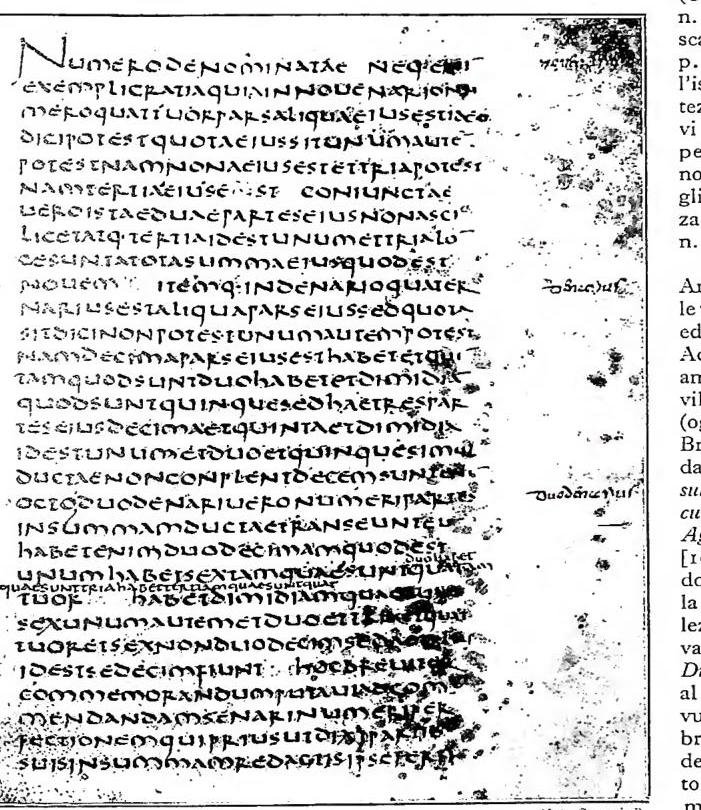
His memory was soon held in veneration: the Martyrologium Hieronymianum (p. 472), the Carthaginian Calendar, Victor of Vita and Prosper (Martyrologium Romanum, p. 365) all record him.
His body, deposited in Hippo, was rescued from the danger of Vandal profanation and carried to Sardinia by African bishops in exile. Liutprand, king of the Lombards, ransomed it “magno pretio” from the Saracens and transferred it to Pavia, to the monastery of St Peter in Ciel d’oro (Beda, Chronicon, in MGH, Scriptores Antiquissimi, XIII, p. 321; Paul the Deacon, Historia Langobardorum, VI, 48), where in the fourteenth century a splendid mausoleum was erected over II.
II. HIS WORKS
It is unnecessary to list here all of Augustine’s works, for which various indices exist in PL 46 (cf. Casamassa, s. V. ENOCH. Ital., I, pp. 913-23; S. M. Zarb, Chronologia operum s. Aug., Roma 1934). PL 32-46 reproduces the Maurist edition (11 vols., Paris 1679-1700); the Corpus Scriptorum Ecclesiasticorum Latinorum is issuing a new one, of which 17 volumes have appeared (Vienna 1887-1922). The principal works follow.
A) Polemical works. — 1. Directed chiefly against the “Neo-Academicians,” the Cassiciacum dialogues were written: Contra Academicos, De beata vita, De ordine, Soliloquia, De immortalitate animae (PL 32). A controversy that began at the end of the last century and lasted many years concerned the relation of these early works of Augustine to his Confessions. After Harnack (Augustin's Confessionen, Giessen 1888) and G. Boissier (La conversion de saint Augustin, in Rev. des Deux Mondes, 85 [Jan. 1888]), many saw an opposition between the penitent of the Confessions and the philosopher of the Dialogues. Yet a series of historians (F. Wörter, J. Martin, E. Portalié, J. Nørregaard, J. Mausbach, U. Mannucci, etc.) have conclusively shown that no such opposition exists; indeed, the Dialogues cannot be properly understood apart from the light of the Confessions.
2. Against the “Manichees” Augustine wrote, even before returning to Africa, De moribus Ecclesiae catholicae et de moribus Manichaeorum (PL 32). The principal anti-Manichaean works that follow are all in PL 42: Acta contra Fortunatum manichaeum (392); Contra epistolam quam dicunt fundamenti (397); Contra Faustum manichaeum libri 33 (397-98); Contra Secundum manichaeum (395). Other works, more apologetic than polemical, also target Manichaeism: De vera religione (390: PL 34), De utilitate credendi (391: PL 42). Writings against Marcionism and Priscillianism likewise refute the same errors (PL 42): Ad Orosium contra Priscillianistas et Origenistas (415), Contra adversarium legis et Prophetarum (420), De libero arbitrio (395: PL 32), De Genesi contra Manichaeos (389: PL 34).
3. Against the “Donatists,” the schismatics who disturbed the African Church throughout the fourth century until their defeat in 411 by Augustine’s arguments and imperial decrees, the saintly Doctor wrote many works (PL 43), of which we list the principal: Psalmus contra partem Donati (394), a curious didactic and popular poem composed in sixteen-syllable lines ending with the same assonance; Contra epistolam Parmeniani (400), De baptismo (401), Contra litteras Petiliani (401-405), Breviculus collationis cum Donatistis (411).
4. Against the “Pelagians” the works contained in PL 44 and 45 were written. The principal are: De peccatorum meritis et remissione (411), De spiritu et littera (412), De natura et gratia (415), De gestis Pelagii (417), De anima et eius origine (420), Contra Iulianum libri 6 (421), Contra secundam Iuliani responsionem imperfectum opus, a work left unfinished at his death.
5. Against the “Semi-Pelagians,” both at Adrumetum and in southern Gaul: De gratia et libero arbitrio (420), De correptione et gratia (426), De praedestinatione sanctorum (428), De dono perseverantiae (428). Augustine also wrote against the Arians (PL 42): Contra Maximinum haereticum (428), Contra sermonem Arianorum (418) and compiled critical notices on all heresies: De haeresibus (428: PL 42).
B) Works that Augustine devoted, at least predominantly, to quiet study of problems rather than to controversy may be divided into philosophical, biblical and dogmatic.
6. Philosophical works
After the dialogues written at Cassiciacum, few of Augustine’s writings are purely philosophical. His philosophy must be extracted from works whose primary aim is not philosophizing. Yet we note: De immortalitate animae (387), De quantitate animae (388), De musica libri 6 (389), De magistro (389).7. Biblical works
The holy bishop continually meditated on Sacred Scripture. He attempted four times to comment on the first chapters of Genesis, and the fourth attempt resulted in the important work De Genesi ad litteram libri 12 (401–15: PL 34). He wrote a concordance of apparently contradictory passages in the Gospels: De consensu evangelistarum libri 4 (400). He explained to the people, in sermons delivered or written, the Gospel of St. John: Tractatus 124 in Ioannis evangelium; Tractatus 10 in epistolam Ioannis ad Parthos (c. 416: PL 35) and the Psalms: Enarrationes in Psalmos (PL 36–37). (For chronology, V. S. M. Zarb, in Augelicum, 12–17 [1935–40]).8. Dogmatic works
Especially important are: De diversis quaestionibus ad Simplicianum (397: PL 40); De Trinitate libri 15 (400–16: PL 42); Enchiridion ad Laurentium (423–24); De civitate Dei libri 22 (413–27: PL 41), whose first books are polemical against the pagans, while the others are an exposition of doctrine and the destiny of the Church. In the field of morals: De bono coniugali (400); De sancta virginitate (401); De adulterinis coniugis (420); Contra mendacium (422: PL 40).C) Sermons. — Today, following the recent discoveries of Dom Morin, Dom Lambot, and Dom Wilmart, more than 500 sermons of St. Augustine are counted (PL 38–39). For the chronology, still only incompletely established, V. A. Kunzelmann, Die Chronologie der Sermones des Hl. Aug., in Misc. Agost., II, Rome 1931, pp. 417–520.
Two Augustinian works teach the art of preaching and teaching profitably: De doctrina christiana, especially in the fourth book (397–426: PL 34); De catechizandis rudibus (400).
D) Letters (PL 33). — The Benedictine edition counts 270 letters, of which 53 are addressed to Augustine and 9 by Augustine are included among the opuscula; moreover, 6 others have been discovered and 3 are among the works, so that the number of Augustine’s letters is 217. Almost all are doctrinal, and not a few have the scope and importance of true treatises.
E) Original and most precious are the two works that reveal St. Augustine himself and his writings (PL 32): the Confessiones (397–98), written to praise God and His grace; the Retractationes (426), or critical review of his own writings.
III. HIS DOCTRINE.
To conform to the internal order of Augustinian thought, the following topics are treated in succession: certainty, the one and triune God, creation, illumination, original sin, the incarnate Word, grace, the Church, the sacraments, the Christian life, and finally the life to come.
SUMMARY:
I. Certainty
II. God
III. The Trinity
IV. Creation
V. Illumination
VI. Original Sin
VII. The Incarnation and Redemption
VIII. Grace
IX. The Church
X. The Sacraments
XI. The Christian Life
XII. Eschatology.I. CERTAINTY
1. Reason. — A. had passed through the neo-Academic environment and felt the grip of doubt. The sceptical difficulties barred the way to philosophy. A. wished to remove them: a task of importance, since in this struggle against the historical forms of scepticism and probabilism the fundamental problem of the value of knowledge was at stake.He begins by bringing forward the classical arguments against scepticism, showing the impossibility of thinking without relying upon some certainty. In every affirmation the universal principles of thought are implied, to which assent cannot be refused. Human action is not possible unless it is illumined by some certainty (Contra Acad., III, 9 ff.). The attention must be shifted from the ever-changing sensible impressions to the reasons which the intellect intuits.
There is, however, a privileged case of intellectual intuition, which the most strenuous attempts of the sceptics cannot obscure: it is the case of the cogito. On this point A. relies with the same assurance that Descartes was later to display, and he formulates propositions almost identical with those of the French philosopher. In whatever hypothesis, he who thinks knows that he thinks and that he is, and in affirming he cannot err: “Never, therefore, can he err or lie who says that he knows that he lives” (De Trin., XV, 12, no. 21). Here there is no room for fear of error: “In those truths I fear no argument of the Academics who say to me: and if perhaps I err? If I err, I am. He who is not, cannot certainly err: therefore, I am, if I err” (“Per hoc sum si fallor,” De civit. Dei, XI, 26). Descartes in his second meditation says: “Sum si me fallit” (the evil genius). The difference from Descartes lies in this, that A. does not regard the certainty of his own existence as the only one that resists methodological doubt, nor as the first that the philosopher can affirm. The cogito for the man of Hippo is merely one of the truths that we necessarily know, with this property, that we grasp it in every act of thought and can therefore oppose it more effectively to the sceptic.
What is important for A., and what Descartes overlooks, is not that we know a truth, but that we know the truth, that is, not merely what appears, but what is absolutely and for every mind. We become aware of it in perceiving our own existence, but also in learning many other truths not logically connected with the certainty of our existence, yet known to us naturally. Since reasoning is nothing else than an ordered succession of intellectual insights, the certainties obtained by deduction are no less authentic nor less firm than immediate certainties. In short, whenever an intellection takes place, it is a testimony and a guarantee to itself (In Ioan., tr. 5, no. 4). The intellect, when it knows, knows that it knows: “No one knows the false, except when he knows it to be false, and in knowing this he knows the true” (De Trin., XV, 10, no. 17). The existence of certainty is a fact, and from this fact reflection takes its departure to discover the highest truths: “If you do not see what I say, or if you doubt that it is true, see at least that you do not doubt of doubting, and if it is certain that you find yourself in doubt, seek whence it is certain” (De vera relig., 39, no. 73). To seek this is the same as to seek the causes of the universal and the necessary. A. will use this point as a starting-point to know the spiritual nature of the soul, to arrive at God, to find in us the image of the divine Trinity. The fact of intellectual intuition is therefore a fundamental stone in Augustinian thought.
2. Faith. — a) Necessity. — There exists, then, a knowledge whose principle is reason. There is, however, another source of knowledge, which must always be kept in mind, namely, the faith taught by the Catholic Church. A. had returned to this faith impelled by two series of thoughts: on the one hand, the impotence of reason alone to solve fundamental problems, and on the other the manifest authority of the Church. His apologetic is founded upon the same thoughts. To the Manichees, who claimed to be satisfied with reason, he demonstrates the necessity of faith. Every human knowledge, even the most determined, begins with faith, that is, with adherence to some testimony, whether human or divine. Reason, however, absolutely speaking, always precedes faith, because it is for reason to decide whether one ought to believe. “No one believes unless he has first thought that he ought to believe” (De praedestinatione SS., 2, no. 5). Believing is therefore a reasonable act (cf. Epist. 120, no. 34). If one consults one’s own experience, even that of an A., and the history of human thought, it becomes clear that there must be in the world an authority constituted by Providence to instruct men in the most essential truths. For how few, even among philosophers, have succeeded in forming a right idea of God, in demonstrating the immortality of the soul, in discovering the nature of happiness.
b) The Church. — Now, that providential authority is manifestly the Catholic Church. Three considerations have especially struck our Doctor: the light contained in the Scriptures, the miracles, and the rapid spread of the Church. The Bible answers our questions, and its teaching is so clear that all can understand it and so profound that the most learned always find in it new lights (Confess., VI, 5, no. 8; cf. Epist., 137, 5, no. 17). The purity of its doctrine demonstrates its transcendence (De civit. Dei, X, 18).
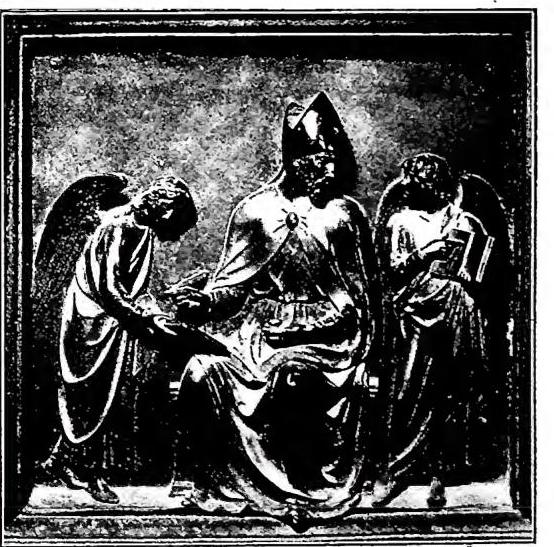
(photo: ‘Almari’)
SAINT AUGUSTINE — Bronze panel from the door of the new sacristy. Luca Della Robbia (1446) — Florence, Cathedral.
Among the signs of divine intervention for the foundation of Christianity, the one to which Augustine devotes the greatest attention is the very existence of the Church. The correspondence of the Church’s doctrine to the needs of the heart, the rapidity and extent of its diffusion, the conquest it has made of elevated minds, the consent given to its moral teaching by peoples—even if they fail to observe it—the heroism of its martyrs, and the holy lives of so many of its members: all this cannot but be providential. God could not have permitted, much less continually favored, Christianity if it were an illusion and a deception (De moribus Ecclesiae catholicae. Cf. Despiney, Le chemin de la foi d'après s. A., Vézelay 1930).
c) Holy Scripture. — Where is the doctrine of the Church to be found? It is in Holy Scripture. Augustine acknowledges the authority of the deuterocanonical books (De doctrina christiana, 2, 13), though he has doubts about the authorship of the Epistle to the Hebrews, and he regards all Scripture as inspired and consequently free from error. He wrote the De consensu evangelistarum to reconcile the apparent contradictions presented by the different Gospels. If a text seems to me false, he says, I must suppose either that the reading is inaccurate, or that it has been misinterpreted, or that I do not understand it (Contra Faustum, XI, 5). A single statement of Holy Scripture may have several meanings, all willed by the Holy Spirit; this applies to allegorical meanings, but Augustine admits that the meanings of Scripture also include those that a reader finds useful when reading the sacred book (Confess., XII, 31, n. 42). In practice, however, he made little use of this doctrine; in his didactic works, he laboriously seeks the literal sense (cf. De Gen. ad litt.). He is more free in his Sermons and in the Enarrationes in psalmos. It must be acknowledged in general that many of his interpretations are not accepted by modern exegetes, and it should also be noted that he took pains to avoid any conflict between the sacred text and human science. He sternly warns against interpretations that might deserve the scorn of unbelievers (ibid., I, 19, n. 39).
d) Tradition. — Scripture is not the only source of faith; not everything revealed to the Apostles was committed to writing (De baptismo, V, 29, n. 31). What the Church has always believed must have come from the Apostles (ibid., IV, 24, n. 31). Tradition is the voice of the Church, which is manifested in its councils (De baptismo, II, 4, n. 5). Even faith in the inspiration and infallibility of Scripture is guaranteed to us by the authority of the Church: “I would not believe in the Gospel if the authority of the Catholic Church did not persuade me” (Contra epist. Manich., 5, n. 6). The path is clearly marked out: one first believes in the Church (for various reasons, but also for reasons drawn from the Gospel regarded as a mere historical document accepted on human faith) and then believes of the Gospel whatever the Church teaches concerning II.
II. DIG
1. Existence. — In the Soliloquies, Augustine, in dialogue with himself, says: “I wish to know God and the soul. Nothing else? No, nothing else” (Solil., I, 2, no. 7). Indeed, he scarcely says anything that cannot be referred to one or the other of these two subjects; in fact, he most often treats them together, using knowledge of one to penetrate more deeply into the other. Let us first examine his doctrine on God.The existence of God can be admitted by a certain faith; indeed, one may begin by admitting it in that way, but it can also be rigorously demonstrated. God is admitted by faith when one relies on the universal belief of men, and also when one adheres, without great reflection, to the natural inclination of reason, which finds in God the cause of the universe. God is demonstrated when careful reasoning leads to Him as to its necessary conclusion, that is, when one can say: “God exists, He truly exists, supremely. We do not merely hold Him firmly by faith, but now it seems to me that we understand Him with a certain knowledge, though very slight” (De lib. arb., II, 15, no. 39).
It has been debated whether Augustine proposed several arguments for the existence of God. It seems that in a certain sense he employs a single manner of arguing, sometimes more explicitly stated, sometimes abbreviated or condensed; but since this manner is quite complex, all the classical proofs of the existence of God are found within it, and from time to time they clearly appear recognizable.
Here is a text written around 395, which seems to contain all the articulations of Augustine’s reasoning: “The human mind, when judging visible things, can recognize that it itself is better than all visible things. Yet, because of its defects and its progress in wisdom, it confesses its mutability and thus discovers above itself the unchangeable Truth; and clinging to this Truth, as it is said: My soul clings to You, it becomes happy, finding within itself He who is also the Creator and Lord of all visible things. Then it no longer seeks visible things outside itself, not even in the firmament, which either do not exist or are found with no profit and great difficulty, unless, through the beauties outside, it finds the Artist within, who first works the higher beauties in the soul and then the lower ones in the body” (De div. quaest. LXXXIII, q. 45, no. 1).
The argument takes its starting point in the sensible world. Augustine once developed this dialectical moment in this way: “The beauty of the earth is like the voice of a mute earth. You reflect and see its beauty, you see its fertility, you see its powers, how it conceives the seed, how it often produces what was not sown: you see this and, by your consideration, you in some way question it; this very examination is a questioning. And when, admiring it, you have examined it and scrutinized it and discovered in it great power, great beauty, a wondrous virtue, since it could not have such virtue in and of itself, you immediately come to mind that it could not have been from itself, but from that Creator... Is it not true that, considering all the beauty of this world, the same beauty answers you unanimously: ‘Not I, but God made me’?” (In ps. 144, no. 13. See also Sermo 141, chap. 2).
It is clear that here both the cosmological argument, drawn from the contingency of beings, and the teleological argument, proceeding from the order of beings, are expressed. The appeal to the principle of causality is also explicit, though not distinct; nor should this cause surprise, for the human mind cannot do without II.
One might already conclude to a cause of the world, distinct from sensible realities. But could this cause perhaps be found in intelligible realities revealed by experience? To exclude this, Augustine continues his journey, and in seeking what lies above the sensible universe, he first finds the senses, which, through their sensations, judge in some way of things. But the intellect is manifestly superior to the senses, since it judges them, regulates them, measures them, and passes judgments that not only state how things are, but how they ought to be. Neither time nor space can limit its dominion.
Is there then nothing above the intellect?
Are we the ultimate source of the ideas that govern all things? It is clear that we are not. Each of us is limited to his individuality, in time and space; he is not, therefore, the source of the universal and the necessary. Each of us must learn and progress; often he errs, corrects himself, struggles to see clearly: he is not, therefore, the measure of truth, but continually measures himself against rules that he has not made and by which all his activity is judged. Above him, therefore, resides Truth, that is, an absolute reality, the exemplar of all other realities, without whose existence he could not even pass judgment, not even on his own existence: “I would more