
MENZOGNA. — From the Latin mentitio-onis, that is, a false assertion. With regard to the question of the nature and morality of lying, the opinions of scholars of all times and schools are not in agreement, owing in large part to the real difficulty of reconciling, consistently with sound principles, two moral attitudes operative in the common consciousness of human beings: one, that lying is decidedly reprehensible; the other, that in certain situations the truth cannot be told without incurring extremely serious private and public dangers, or without betraying inviolable secrets. Some, in their devotion to sincerity, coldly sacrifice the demands of social life; this tendency, initiated by Aristotle (Eth. Nic., I. 7, chap. 4), reaches its extreme in Kant and the Kantians. Others, on the contrary, in their excessive justification of social necessities, weaken the innate horror of lying and go so far as to elevate it into a noble system for great political and military achievements. This current goes back to Plato (Rep., I. 1, n. 5); but it reaches the incredible in the political doctrines of the utilitarians.
Catholics maintain a position of equilibrium between the opposing doctrines, although they do not always agree on the justification to be given for their conclusions. Already with s. Agostino, Catholic doctrine on lying had, one may say, reached its definitive form.
I. NOTION
L. consists in speaking contrary to one’s own thought: locutio contra mentem. Here, “speaking” means communicating one’s thought, whatever the means may be: either the ordinary means of speech or another, for example, writing, gesture, and the like. The expression “one’s own thought” must likewise be clarified.Thought is the mental reproduction of extramental reality. Between extramental reality and the thought that reproduces it, there may be conformity: in that case there is truth in the thought and, possibly, in the speech that communicates it; or there may be contradiction: in that case there is falsity in the thought and, possibly, in the word that communicates II. Speech, therefore, may refer to two clearly distinct terms: immediately to the thought communicated; mediately to the reality that this thought reproduces. If it refers immediately to the thought it communicates, there is sincerity or l., according as there is conformity or contradiction between them. If, instead, it refers to external reality through the thought that reproduces it, there is truth or falsity, according as the thought itself is true or false. Thus speech is sometimes sincere and false at the same time: when it expresses, with conformity, a thought that is false through an unconscious error. Conversely, it is lying and true at the same time when, a thought already false being reversed in l., the external expression of speech comes to conform, without the awareness of the person uttering it, to the reality of things, and is therefore true. Similarly, it is not l. to express a parabolic, allegorical, or otherwise metaphorical thought with conformity. Indeed, the use of metaphorical language, without being morally reprehensible, may constitute an elegance of style.
In short, the essence of l. lies entirely and solely in the immediate relation of contradiction between thought and its external communication. The various means of communication have no bearing on it, nor do the various relations—of truth, falsity, or metaphor—through which thought in turn connects with the reality of things.
These are all certain notions, fully confirmed by common sense. Among all peoples, one who says one thing while thinking another is a liar; and one who, though mistaken, is nevertheless sincere is not regarded as such.
II. MORALITY
To the question: why is lying blameworthy; in what does its moral ugliness consist, many different answers have been given. Of all these, the most authoritative, and also the most convincing, is that of s. Agostino (Enchiridion, chap. 22).Man is sociable by nature. His imperfections make him in need of the help of others; his perfections urge him to share them with those who lack them. Hence the necessity and natural joy of establishing contact with others, especially the spiritual contact of thoughts, aspirations, and ideals through speech. Without speech, the souls of men would be isolated worlds, closed to one another. Whoever uses speech implicitly manifests the intention of communicating his own mind. Lying (locutio contra mentem) consists in this flagrant contradiction: since it is speech, it seeks to attain the natural end pursued through speech, namely, the communication of one’s thought; but since it is contrary to one’s thought, it betrays that end, communicating to the listener what is present, in a different form, in the mind of the speaker: the moral malice of lying lies in the intentional betrayal of the natural function of speech.
Some observations will serve to clarify this:
a) The social order of men is twofold, according as it is founded on justice or on charity alone. In the former, the obligation to communicate derives from the right possessed by others to demand such communication; in the latter, it derives either from charity toward oneself (providing for one’s own needs) or toward others (helping them in theirs). Speech serves immediately and always the order of charity; only sometimes, and secondarily, does it also serve that of justice.
b) The moral malice of lying in no way presupposes, and still less derives from, the right supposedly possessed by the listener to know the thoughts of the person who lies to him. If that right in fact exists, lying is blameworthy independently of its violation.
c) Neither prudent charity, and still less justice, obliges one to communicate all one’s thoughts to everyone. Therefore neither silence nor speech that withholds from others the truth of one’s thoughts is lying; only speech that, in communicating it, positively alters it is lying.
d) The malice of lying is, theologically, always slight and never grave, because speech tends to realize the social order of charity through the communication of the individual truths conceived by individual men. But these truths are always limited and contingent and, precisely for that reason, are never essentially necessary to the social order of charity. It follows, therefore, that this order is never gravely injured by lying, which, by betraying the natural function of speech, denies it only limited and contingent truths. The guilt is therefore always venial, unless it is inspired by formal contempt for essential truth as such, or by other gravely illicit purposes.
e) Moreover, this venial malice is so intrinsic to lying that it is absurd to conceive of its separation from II. Not even God could bring this about; hence theologians declare lying in God to be absurd, and likewise deem it absurd that he should permit it—even once—to man. Indeed, the two contrasting constituents of lying—word and thought in opposition—constitute in themselves that flagrant contradiction which is its malice: namely, the betrayal of the natural function of speech. If there is lying, that contradiction necessarily exists; if it is absent, there is no longer lying. From this it follows that, since it is not lawful to do evil in order to achieve good, even the noblest and most sacred ends can never lawfully be attained through the use of lying. Good faith may perhaps excuse the agent, but it can never justify the act. Therefore jocose lying, that is, lying uttered for the sake of amusement, and officious lying, that is, lying uttered for professional purposes, are always illicit. If lying is inspired by ends that are evil in themselves, then, in addition to its own malice, it also assumes the specific malice of those ends. This is the classic harmful lie.
III. L. AND THE NECESSITIES OF SOCIAL LIFE. — The lie is intrinsically immoral. Yet no one condemns so many false expressions as the necessities of social life require. Thus a confessor, when questioned about his penitent, may reply — even confirming it under oath — that he does not know about him what in fact he does know. In the same way, any secret may be protected from the indiscretion of others. A physician may calm the anxieties of a seriously ill patient by giving him hopes of recovery which he is convinced cannot in any way be entertained. Similar replies protect us or others from the threat of imminent dangers. Even out of simple courtesy, recourse is had to the use of many false expressions. Desiring the tranquillity of our home, we have it said to anyone looking for us that we are not at home at all. Provided that these expressions are not abused, their lawfulness is admitted by everyone, even by scholars. But how, then, can this be reconciled with the unlawfulness of the lie? The difficulty is indeed grave. S. Agostino limited himself to stating this one principle: to lie is one thing, to conceal one’s thought is another; just as asserting what is false is one thing, and not telling the truth is another. And indeed, in many cases, silence or an evasive phrase will suffice to preserve the secret, avert a threat, or be courteous. But on many other occasions silence or an evasive phrase is precisely such as to betray those purposes. One can then neither remain silent nor evade the question; one must say something; yet one’s own thought cannot be expressed without danger. Is a false answer lawful in such circumstances? Along with the great majority of sound men, Catholic doctors answer in the affirmative. They then seek the principle that can account for this, without prejudice to the preceding doctrine concerning the lie. And here many of the justifications advanced are unconvincing. Some are contradictory to the very concept of the lie, or else undermine the basis of its condemnation. Others, in order to preserve these secure notions, perform dialectical acrobatics which do not withstand criticism and have every appearance of ingenious subterfuges. Still others are partially valid in some of the situations mentioned above, but not in all. Among the latter, mental restriction (v.) seems to be included. Here, then, is what is considered the true reason.
First of all, it should be noted that these expressions are permitted, not because, while remaining true lies, necessity justifies them. No necessity can make lawful what is intrinsically unlawful; and such is the lie. If those expressions are lawful, they can be so only on the supposition that they are not lies. Indeed, those who use them,
(fot. U. Orlandini)
LIE — Truth tears out the tongue of Fraud. School of Wiligelmo
(12th cent.) — Modena, Cathedral.
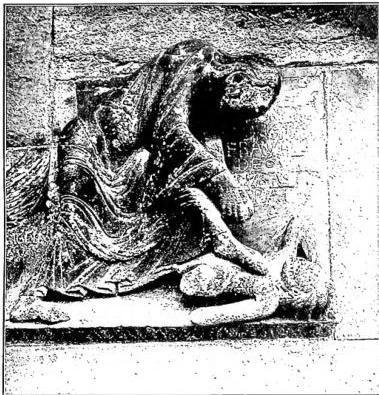
This is precisely what occurs in our case. When it becomes necessary to keep our thought concealed and, on the other hand, an indiscreet question does not allow us to remain silent or evade it, then our answer—whatever it may be—does not at all fulfil the function of communicating our thought. Precisely for this reason—with the necessary presupposition of the lie removed—it lies outside its scope. Thus sensible persons—not considering such answers serious—do not give them credence; or at least remain in doubt. If someone believes them to be serious answers, he is naïve, like one who mistakes a joke for something serious and a theatrical performance for reality. Or else he is acting in
bad faith. He pretends not to understand that the impertinence of his own question compels the other person to defend his thought; and, in order to defend it, to give an answer which—whatever its verbal meaning—means only this: you have no right to know what I think.
All this is at once entirely legitimate and perfectly consistent with the preceding doctrine on the lie; indeed, it is a logical consequence of II. When the use of such expressions is determined solely by social necessity and not left to individual discretion, abuses need not be feared. Outside necessity, the Christian cult of sincerity fully prevails, according to the admonition of Our Lord Gesù Cristo: “let your speech be: yes, yes; no, no; what is more than this is already evil” (Mt. 5, 37).