
PRUDENZA. - I. NATURE
It was defined by Aristotle (Ethica, I, VI, ch. 5; Sum. Theol., 2ᵃ-2ᵃ, q. 47, a. 2, arg. Sed contra) as sound judgment concerning what ought to be done. Now, if what one wishes to do is directed toward a particular end—for example, victory in war or the welfare of the people—p. will be particular (military, governmental, etc.). But if the end of action is the ultimate end of the whole of human life, then one has p. par excellence, the intellectual and moral virtue that judges and commands what in individual cases must be done or omitted in order to act honestly. S. Agostino, following Cicero (De offic., III, 47), speaks of p. as cognitio rerum appetendarum et fugiendarum (Lib. de diversis quaest., q. 614; PL 40, 51).
In mythology and art, p. is symbolized by a charioteer (the charioteer of virtue) who, standing on the chariot, surveys the road and urges on the horses, representing the other virtues (Sum. Theol., 1ᵃ-2ᵃ, q. 58, aa. 4-5). Insofar as it surveys, it is an intellectual virtue; insofar as it guides and keeps one on the right path, it is a moral virtue (ibid., a. 3 ad 1; 2ᵃ-2ᵃ, q. 181, a. 2 ad 3). To this virtue, the most remote antiquity, both pagan (Cicero, De invent., II, ch. 53; De officis, I, ch. 5) and Hebraic-Christian (Sap. 8, 7; s. Ambrogio, Exposit. in Luc., I, V, nn. 49, 62; PL 15, 1738), looked as one of the fundamental virtues. Sacred Scripture (Prov. 3, 13-14; 4, 5-9; Sap. 6, 9; Eccl. 6, 18-37) extols the prudent man and identifies p. with wisdom, since it is proper to the wise man to order his entire life toward the ultimate end, as the prudent man does. Naturally, Sacred Scripture has chiefly in mind infused virtue (v. appresso) and contrasts true p. with a prudentia carnis, which pursues carnal goods as the ultimate end of life (Rom. 8, 6-8).
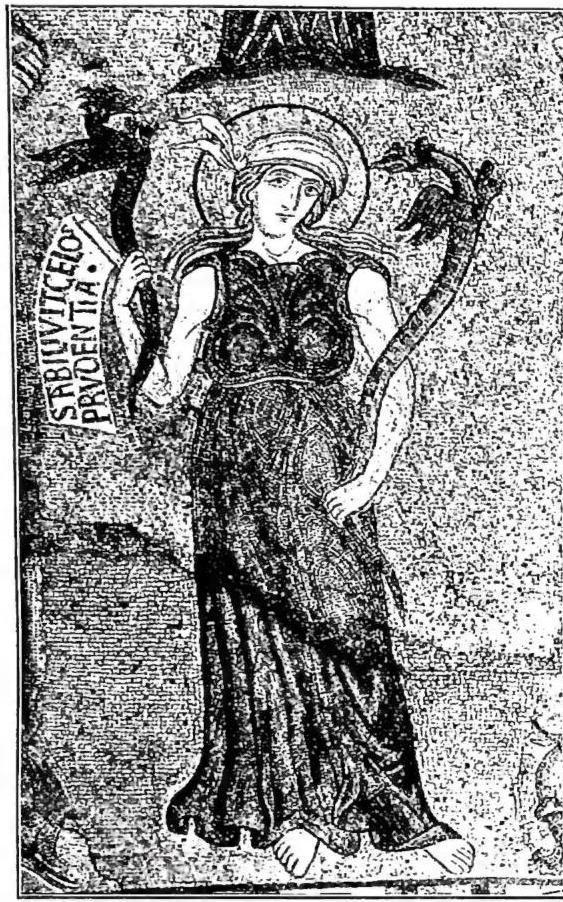
(phot. Anderson)
PRUDENZA — The thirteenth-century mosaic of p. — Venice, Basilica of S. Marco.
common to them the practical judgment that conscience must issue, guided by p.; conscience is an act or a faculty, not a virtue. P. is the virtue governing and disciplining the whole of moral life, directing and regulating action because it knows the supreme principles of the practical order and knows how to apply them to practical life. The act by which, in the face of a practical case, a judgment is issued concerning the morality of an act is conscience; and for this act to be performed well, practical reason must be perfected by the habit of the virtue of p. Conscience, therefore, is also an act of the virtue of p.
P. is a true moral virtue, both because it requires moral predispositions and because of its object. This consists in human acts, intrinsic to the agent, whether a physical person or a community, insofar as they must be performed or omitted in order to act honestly. Its object also includes the moral virtues, which it directs as their moderator and to which it is so closely linked that neither can it exist in a perfect degree without all the other moral virtues, nor can these exist without p. Thus, the act of any other virtue belongs to it not insofar as it is an act of fortitude, chastity, etc., but insofar as it is to be performed hic et nunc, that is, in those determinate circumstances of time and environment, and in accordance with the proper end. The aspect of such an act at which p. aims is its practical truth, that is, its rectitude or orientation toward the ultimate end. Yet the virtue of p. does not attend only to the external circumstances of the virtuous act to be performed; it also determines how and to what extent the act must be performed (medium virtutis), the mean in which the moral virtues consist, the proper mean between excess and deficiency,
between too much and too little. Because of this characteristic it is called the measure and rule of the other virtues and is therefore rightly regarded as the first cardinal virtue. Whoever possesses p. possesses, in some way, the other virtues as well; but whoever lacks p. possesses neither fortitude, nor justice, nor temperance, because without p. it is impossible to choose the means rightly for attaining the end (Sum. Theol. 1a-2ae, q. 65, a. 1).
Psychologically, p. acts by examining the various means of attaining the ultimate end in concrete circumstances, judging which of them are to be implemented or omitted, and finally commanding the execution that follows; hence its acts are said to be deliberating, judging, and especially commanding («actus imperandi est principalis et proprius actus prudentiae»: ibid., 2a-2ae, q. 47, a. 8).
II. SPECIES
In addition to natural prudence, considered thus far (acquired prudence), acquired through experience and through the effort of the soul directed toward the good, there also exists, if one is in the grace of God, infused prudence, which extends also to supernatural acts and directs the theological virtues as well, to which it is likewise subordinate, indicating when their acts are to be performed.For prudence to be perfect, insofar as it is an intellectual virtue, it requires experience, moral tact, docility, sagacity, and the proper use of reason; insofar as it is a moral virtue, it requires foresight, circumspection, and precaution. These virtues, which in traditional Latin terminology are called memoria, intellectus, docilitas, solertia, ratio, providentia, circumspectio, and cantio, are called by the scholastics the «integral» parts of prudence (ibid., 2a-2ae, q. 48, a. unic.).
Its specific or subjective parts are: personal (or monastic) prudence, which guides one in directing oneself well, and social prudence, which directs the acts of society toward the common good and is divided into military, economic or familial, and legislative or political prudence, according to the various communities and forms of government. Among these, personal prudence is prudence in the full sense; legislative prudence is the most perfect (ibid., 2a-2ae, q. 50, a. 2).
The «potential» or complementary parts are moral common sense (synesis), moral skill (eubula), and moral discernment (gnome) (ibid., 2a-2ae, q. 51, a. 2, ad 1).
III. ORIGIN AND REMOTE SUBJECT
Natural prudence may be fostered by psychological and biological predispositions and by the environment, but in fact it is acquired through the repetition of prudent acts: for this reason it is not ordinarily found in the young, who lack experience, and it is lost when the passions—especially lust, avarice, and pride—disturb the intellect or the will and, indirectly, through forgetfulness and disuse. Infused prudence is received and lost together with sanctifying Grace.IV. CONTRARY VICES
By way of deficiency, prudence is opposed by imprudence, which is subdivided into numerous vices, such as docility, negligence, lack of foresight, lack of caution, circumspection, memory, and the other subjective or integral parts of prudence, as well as rashness (against eubulia) and inconsiderateness, contrary to sound judgment and moral perspicacity. By way of excess, there are the vices of the prudence of the flesh (Rom. 8:6), cunning, and deceit, whether by means of signs and words (fraud) or by means of actions (deception).The vices opposed to prudence, observes St. Thomas, when they exceed by deficiency, have lust as their source; when by excess, avarice (Sum. Theol., 2a-2ae, q. 55, a. 8). Therefore, effective means of attaining prudence are: 1) fervent prayer to the God of all light; 2) control of disordered passions, especially avarice and lust; 3) consideration of events sub specie aeternitatis.