
CASTITÀ. — Moral virtue that regulates the appetite for sexual pleasure associated with the generative act. It is a virtue because it entails the soul’s dominion over the body, to be maintained through the power of the will (Sum. theol., 2a-2ac, q. 151, a. 2); it concerns both the one and the other—the soul as subject, the body as matter (ibid., a. 1, ad 1m); it is annexed to the cardinal virtue of temperance, which aims precisely to regulate the pursuit and use of sensible pleasures (ibid., a. 3, ad 3m). And since sexual pleasure, according to the Creator’s order, serves generation by facilitating the fulfillment of a task necessary for the preservation of the species, yet at the same time burdensome with obligations and responsibilities, it follows that it is not licit outside marriage, whose essential and primary end is generation.
I. THEOLOGY
1. Species
Chastity is divided into perfect and imperfect or common. Perfect chastity consists in complete renunciation of every sexual pleasure, even those licit within marriage (in this respect it coincides with virginity); imperfect chastity consists in renunciation of the sexual pleasures forbidden according to the state of life in which one finds oneself. Thus every sexual pleasure remains forbidden to all both before marriage (premarital or youthful chastity) and in the state of widowhood (c. vedoviæ); in the married state, on the other hand, those acts that run contrary to the purpose and prerogatives of marriage remain forbidden. Hence it follows that common chastity is always a duty for everyone and admits no exceptions, whereas perfect chastity is freely chosen, constitutes one of the evangelical counsels, and may become a duty in certain particular states (v. CELIBATO; VERGINITÀ).Generally, chastity is a virtue of struggle and conquest, following the rebellion of the flesh against the spirit caused by original sin; but it may happen that God grants not merely a prompt and even easy victory over temptation, but the definitive suppression of every sexual movement; this is then the gift of chastity (cf. the example of s. Tommaso d'Aquino, in L. H. Petitot, S. Thomas d'A., Parigi 1923, p. 32).
2. Concomitant virtues of chastity
a) The first guardian of chastity is the feeling of modesty, which is a delicate sensitivity toward everything that can lower human dignity and restraint in the face of any manifestation that alludes to sexual relations; it is, however, fundamentally a gift of nature, something instinctive and not an achievement of the will. The latter can nevertheless influence it, even causing it to weaken and disappear, or refining and directing it so as to increase its efficacy (cf. J. de la Vaissière, La pudeur instinctive, Parigi 1935). — b) Above feeling, and already in the sphere of virtue, are found: 1) pudicity, whose object is discretion, reserve, and respect for everything, especially when manifested in external acts, that concerns generation (Sum. theol., 2a-2ac, q. 151, a. 4); 2) continence, which is the constant will to preserve chastity by overcoming every contrary difficulty; 3) abstinence, which, although distinct from chastity in its immediate object, namely, the regulation of the pleasures of the nutritive function, nevertheless greatly benefits chastity, both because it protects it from the dangers arising from intemperance and because, given the interdependence of human acts and habits, it helps to strengthen the soul’s dominion over the senses (ibid., a. 3).3. Motives and advantages
The virtue of chastity can rest upon motives belonging solely to the rational order, such as the commandment of the natural law, respect for the dignity of the human person, order in social life, the pride of keeping the flesh subject to the spirit and overcoming, through victory, the eternal antagonism that divides them (cf. Rom. 7, 14-25), and the benefits accruing from it to the individual in body and soul; to the family, which is thereby more firmly bound by a higher and more serene love; and to society, which is thereby preserved from enfeeblement and decline, produced by the fact that the biers outnumber the cradles, and from dissoluteness, which spreads disease and material and moral ruin. These reasons, even amid an almost universal corruption, did not escape the gentiles, who recognized and praised the merits of chastity in their literature and philosophy (cf. Cicerone, De nat. deorum, II, 28; Tuscul. disput., I, 30; Salustio, De bello Iugurt., 1-2; Catullo, Carmen, 62, 39-58); they knew how to demand greater purity from those who approached the divinity and dealt with sacred things, designating it by the particular term castimonia; and they surrounded, for example, the Vestals with greater respect. In any case, the maxim casta placent superis, in its underlying meaning, is common to all peoples.But faith offers the practice of chastity other reasons that are far higher, more sound, and more efficacious: a) respect for the body, which, through Baptism and the infusion of sanctifying Grace, becomes the temple of the Holy Spirit; then, so to speak, is consecrated by the real presence of Jesus in Eucharistic Communion; and is finally destined for the glory of the resurrection; b) the dignity of the Christian, who becomes a member of the mystical body, of which Jesus is the head; c) to this must be added the example and instruction of the Savior (it suffices to cite the sixth beatitude: «blessed are the pure in heart, for they shall see God» [*Mt. 5, 8]), as well as an entire series of praises proclaimed by Holy Scripture, whether of the virtue itself (Tob. 3, 16; Sap. 3, 13; Ecli. 42, 9-10; Is. 56, 4-5) or of the persons distinguished by it (Joseph [Gen. 39, 6-12]; Judith [Iud. 16, 26]; Susanna [Dan.* 13, 63]); d) in patristic and ascetic literature chastity has commonly been called the «angelic virtue», because it makes man like an angel. And this is true; in reality, however, it is a specifically human virtue, because the angel has neither a body nor senses to control, whereas man must conquer this mastery for himself.
4. Education in chastity. — Chastity is a delicate and fragile virtue, while the struggle is arduous and at times painful and heroic (we bear within ourselves the fomes of concupiscence; we often live surrounded by an environment dense with provocations; we are subject to the temptations of the devil); vigilance and the timely use of the means suggested by religion and also by science are therefore extremely necessary. The means suggested by science will be indicated later; as for the means suggested by theology and asceticism, they may be divided into positive and negative.
a) Negative means. — Education in chastity entails avoiding occasions: idleness; solitude; melancholy and sadness; bad reading that overexcites the imagination and passions; dangerous shows and amusements; compromising companions; situations that encourage weakness and easy acquiescence, which gradually cause one to lose self-control (promiscuity and exaggerated camaraderie, flirtations, «flirt», particular friendships).
b) Positive means. — 1) To educate the sentiment of modesty, refining it and maintaining it in the proper mean, which differs according to age, profession, and customs, so as to avoid false prudishness, which makes one ridiculous and is at times also dangerous. 2) To educate the will to desire resolutely, whatever the cost, while reflecting, however, that this often amounts to desiring what one would not wish to desire. Hence one should practise self-mastery when the waters are calm, so that victory may later be easy during the storm. Otherwise one falls into weakness and mere wishful thinking: “I had asked You for purity in these words: Give me purity and chastity, but not yet. I was afraid that You might grant my request too soon and that I might too soon be cured of the disease of sensuality; I preferred to give it free rein rather than extinguish it” (s. Agostino, Confess., VIII, chap. 7: Pl. 32, 757). 3) To educate the intellect by recalling lofty ideals and forming sound convictions, to be continually deepened through frequent reflection (one’s own dignity, the beauty of c., preparation for marriage, the ideal of virginity or of marriage or of an active apostolate). 4) To guard the senses and the heart. The example of David is a powerful lesson: «vidit mulierem... erat autem pulchra nimis... et tulit eam» (II Sam. 11:2-4). 5) Bodily mortification, expressly recalled by Jesus Christ when c. is concerned: “This kind of demon can be driven out only by prayer and fasting” (Mc. 9:28); to which the Church echoes in the Preface of Lent, making us address the Lord, «qui corporali ieiunio vitia comprimis, mentem elevas». 6) Finally, one may recall the great advantages that derive from good spiritual direction, in order to have guidance in temptations, in possible falls, and in the efforts required to rise again and persevere.
c) Supernatural means. — All merely natural means, however good, are insufficient to form a perfectly chaste soul and to give it that splendour and grace which captivates; it is necessary to have recourse to supernatural means: 1) an ever greater awareness of our supernatural greatness: Grace, the presence of God in the soul in a state of grace; 2) constant prayer to obtain the strength necessary for victory, turning especially to the mediation of the Vir-
(courtesy of Dr B. Degenhart)
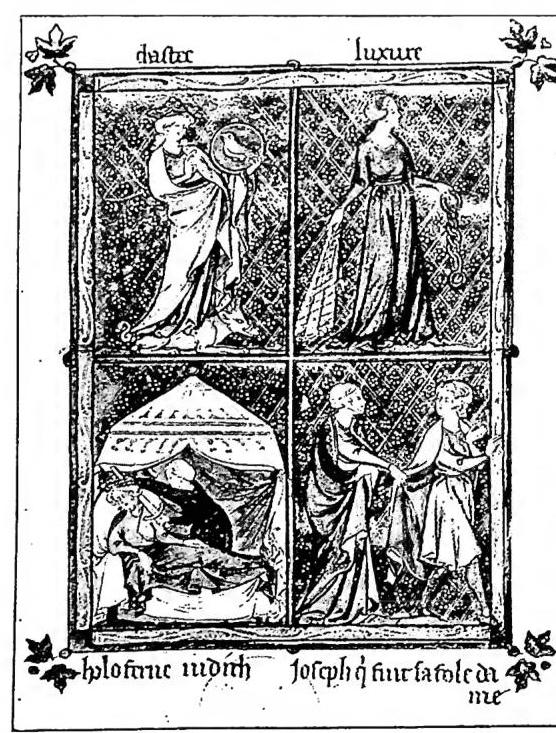
CASTITÀ – Depiction of C. and Luxuria, with the related biblical stories of Giuditta and Giuseppe – Paris, Mazarine Library, ms. 870, fol. 147.
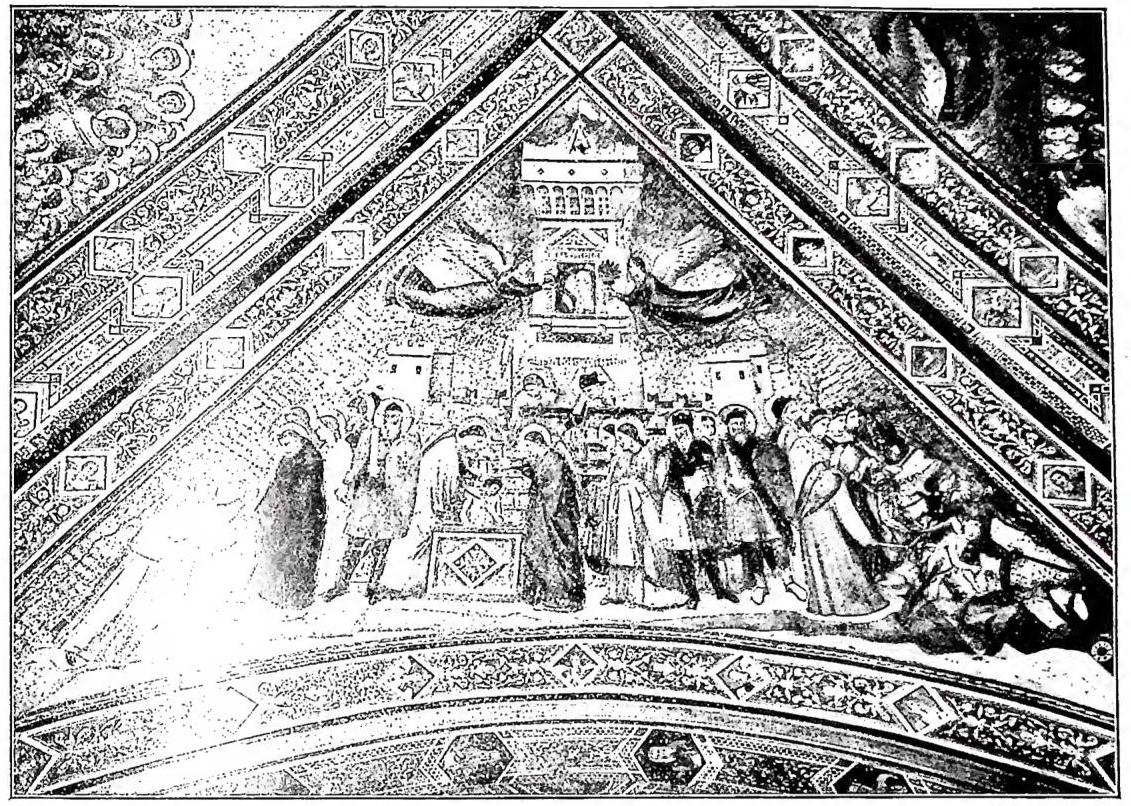
CASTITÀ - Chastity in the turreted castle, defended by Purity (Munditia) and Fortitude (Fortitudo). Fresco by the so-called “Master of the sails,” a follower of Giotto (14th century). Assisi, lower church of S. Francesco.
5. The educator in chastity
In those who deal with this delicate and difficult problem—parents, educators, confessors: a) a clear knowledge is necessary of what biology teaches concerning the various stages of development, the various ages, and the physiological and psychological phenomena that accompany them. The method to be employed must in fact vary according to the different stages, since the tendencies, thoughts, aspirations, and knowledge to which minds open are different; the situations of environment and companionship are likewise different. The right word is needed for each particular case, limited to the requirements it entails in terms of knowledge, self-correction, and orientation (v. MEDICINE). b) Even more necessary is a great sense of understanding and compassion, indeed of an already anticipated expectation, which stifles all astonishment before hearts that open and await a word to encourage or reanimate them, advice to guide or recall them. Nothing is more illegitimate than surprise and distrust on the part of the educator, because hearts might close and fatal consequences might ensue. c) On the always-debated problem of “sex education,” V. SESSUALE, EDUCAZIONE.6. Chastity is neither impossible nor harmful
To excuse defeats in the field of chastity, an entire dense web of pretexts and excuses has been woven. But these are nothing more than an attempt to disguise the lack of self-discipline and self-mastery, and they reveal only the indulgent weakness that recoils from effort. Two pretexts, however, have been sought to cloak themselves in the tinsel of a false science: “chastity is impossible; chastity is harmful to health and character.” Neither pretext has any scientific foundation whatsoever. “The entire history of the Church testifies, through its saints, its popes, its founders of religious Orders, its missionaries, and its countless works, that continence is a factor neither of physical weakening nor of moral deterioration. Continence creates a reserve of strength. Sexual economy promotes longevity and the various forms of intellectual activity” (cf. E. Bon, Medicina e religione, Italian translation, 2nd ed., Turin 1946, pp. 650–51). The same finding emerges from numerous inquiries conducted among physicians and among young people themselves (cf., e.g., F. Olgiati, I nostri giovani e la purezza, Milan 1918; L. Scremin, La continenza sessuale giovanile e l’igiene, Turin 1944). It may therefore be said that the battle for chastity is difficult and at times approaches heroism; but for this reason the means offered above all by religion come to our aid. It may also be observed that there may be particular cases in which the warning of s. Paul is to be applied: “I say to the unmarried and to widows: it is good for them to remain as I am; but if they cannot contain themselves, let them marry; for it is better to marry than to burn” (I Cor. 7, 9); but one can never advise yielding to the sexual impulse, just as one does not advise suicide to someone who feels driven to kill himself, because impulses must be corrected, not indulged.7. Vow of chastity
The vow of chastity entails two things: a) renunciation of marriage; b) the prohibition, for a second reason deriving from the virtue of religion, of what is already prohibited by the VI and IX commandments.a) Vow of chastity and marriage. - 1) The solemn vow of chastity, pronounced by religious men and women, and the reception
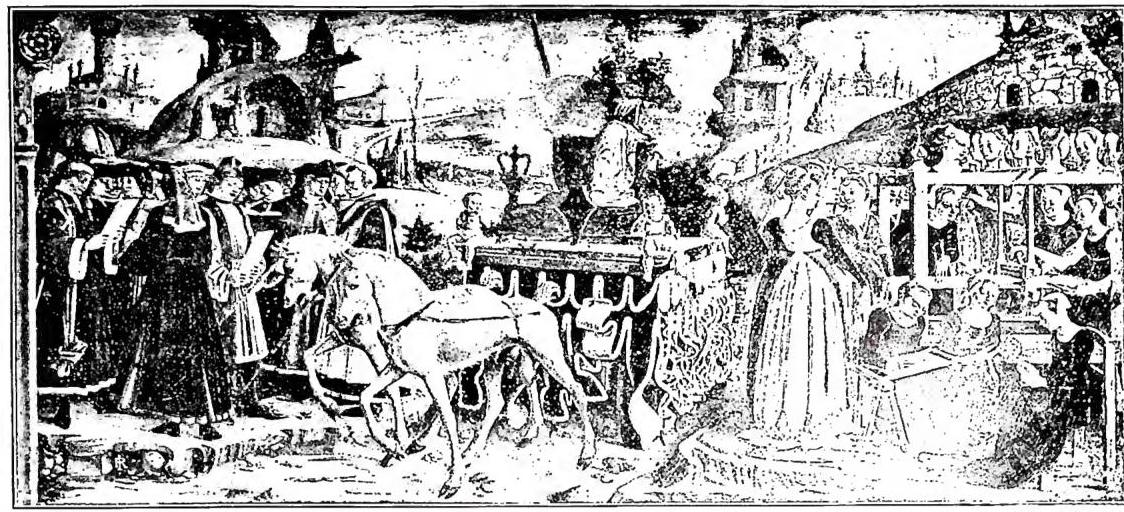
CASTITÀ - Triunfo di Minerva (o della C.) sul carro tirato dai liocorni. Affresco di F. Cossa e C. Tura (sec. XV). Ferrara, palazzo Schifanoia.
di un Ordine sacro costituiscono un impedimento dirimente al matrimonio, lo rendono, cioè, invalido (CIC cann. 1072-73); 2) il tentativo di matrimonio, dopo i voti solenni o gli Ordini sacri, importa una scomunica riservata simpliciter alla S. Sede (can. 2388 § 1); 3) il voto semplice di c., pronunciato dalla maggior parte dei religiosi e religiose (e anche da alcuni che vivono nel mondo) costituisce per il matrimonio solo un impedimento impediente, lo lascia, cioè, valido, ma lo rende illecito (can. 1058); e importa una scomunica riservata all'Ordinario (can. 2388 § 2).
c) Le condizioni del voto di c. - 1) Questo può essere perpetuo o temporaneo; per le persone che vivono nel mondo può avere come oggetto la c. perfetta o anche solo la c. comune nei suoi vari stati; 2) richiede sempre, però, per la validità, di essere un atto pienamente volontario, il che suppone che si conosca, almeno quanto alla sostanza, l'oggetto del voto.
II. MEDICINE
8. Natural means
Regarding the preservation of the virtue of chastity, for the Christian there applyfirst and foremost, in an absolute sense, the moral means that direct and sustain the will with the supernatural help of divine Grace. Keeping our nature in mind, however, the natural aids placed at our disposal by medicine and pedagogy must not be neglected. From this derives the necessity that the work of the priest or educator, particularly when the vicious inclination is violent, be supported by that of a reliably Christian physician; this is an absolute condition, because “nisi doctor vere christianus sit, gravium malorum causa esse potest” (G. Antonelli, Medicina pastoralis, I, Rome 1905, no. 547).
The natural means that medicine can place at the service of morality for the preservation of chastity are hygienic, medicinal, and psychological in nature; the study and application of medicinal means falls within the physician’s competence.
9. Hygienic means
In normal subjects who have been rationally educated, chastity as a virtue (understood as freely willed continence) can be facilitated by general hygiene, without resorting to direct therapeutic interventions. If the general hygienic rules prove ineffective, the suspicion arises that this may be systematic incontinence resulting from some mental illness (e.g., dementia praecox), or from an abnormal stimulus, in the distinctly morbid forms of hypergenitalism. In these cases, the “treatment” of incontinence is the treatment itself of the mental illness and of the “hypergenital temperament” accompanying endocrine disorders, and falls within the competence of the general practitioner or specialist.With regard to a generally favorable hygienic regimen, it is necessary to insist on the avoidance, or at least the very moderate use, of coffee and alcohol, particularly of flavored spirits or beverages with a high alcoholic content (liqueurs, aperitifs, distilled spirits). From the standpoint of quality, a well-regulated and carefully chosen diet can be of great assistance in preserving chastity. A diet poor in protein, particularly protein of animal origin (v. ASTINENZA), combined with a way of life in which work and rest, exercise and outdoor sport, and sufficient sleep—which must not degenerate into laziness and softness—are regulated according to sound principles of balance, on a cool, firm bed (a mattress stuffed with corn husks is excellent), while respecting the natural needs of our being: such a hygienic arrangement represents a far more valuable aid than might appear at first sight.
Constipation and insomnia must be taken seriously and carefully eliminated. Physical activity and a suitable diet, combined with habitual regularity in schedule and bowel evacuation, are worth far more than many laxatives, without their harmful effects. If there is insomnia, in the sense that the subject has difficulty falling asleep, and if this does not depend on a poor arrangement of the evening hours (the habit of staying up late, or of devoting the final hours of the evening to amusements that exhaust and overstimulate the nervous system, or the misguided practice of inducing sleep by reading in bed), it is advisable to resort to some mild nervous-system sedative (chamomile tea or tea made from lemon bark, possibly combined with 20–60 drops of ethereal tincture of valerian, or alcoholic tincture of passionflower, or fluid extract of hawthorn flowers, or ¼–1 tablet of Luminal or Gardenal, 0.10); in more resistant cases, the physician will suggest a more powerful sleeping medication. Sexual overstimulation is sometimes encouraged by local causes (urinary infections, metabolic disturbances, parasites) and by minor malformations, the most troublesome of which is phimosis; in mild cases, cleansing with lukewarm water is sufficient, while in severe cases surgical treatment is required.
10. Medicinal means
The hygienic precautions recommended to make the struggle for attaining chastity easier operate particularly on a negative plane, being directed toward excluding, or at least reducing as much as possible, the contribution of the “aphrodisiac causes”—that is, whatever, in the form of foods, drugs, pleasurable substances, sensory excitations (smell, hearing, sight), images and mental recollections with sexual content, and so forth, excites the erotic sense by promoting the sexual reflexes (erection, ejaculation). The action of “aphrodisiacs” may be indirect, through modifications of the general condition, or direct, by increasing the excitability of this or that part of the reproductive apparatus (encephalic and spinal centers, peripheral reflexogenic zones). Knowledge of substances and circumstances with aphrodisiac action, and reasonable abstinence from them, can be of considerable benefit in the struggle to preserve chastity. Morally, it is not permissible for a physician to prescribe, or for an individual to take, aphrodisiacs when the individual is not in a condition to make legitimate use of the sexual function (marriage). If the substances used, besides their aphrodisiac action, also have other effects necessary or simply useful for the general well-being of the organism, their administration is licit by virtue of the principle of double effect. Treatments with testicular extracts are not morally prohibited when undertaken with a view to their predominantly general tonic and strengthening action (v. ENDOCRINE, GLANDOLE).By contrast, a positive action may be exerted by medicinal “anaphrodisiacs,” which tend to diminish the irritability of the genital reflexogenic zones and the reflex nervous excitability of the spinal sexual centers (sacral and lumbar centers of erection and ejaculation), of the sensory and psychic cortical zones, and of the subcortical nuclei of gray matter, particularly the “optic thalami,” where the affective and emotional content of sensations is elaborated and utilized.
Drugs specifically diminishing sexual sensitivity were recommended in the past, from camphor “per nares,” according to the aphorism of the Salernitan school, to plants such as chaste tree and flax (for cilices and garments); but in reality, if sexual sedatives exist, they coincide with general sedatives of the nervous system, such as bromides, alone or combined with camphor (monobromated camphor: 0.20–0.40 two or three times a day). Hops and hop powder, once highly esteemed as anaphrodisiacs, are now considered almost devoid of efficacy.
The only true specific therapy for incontinence, when the acquired habit causes the periphery to impose itself urgently upon the nervous centers and puts good will and sincere resolve to a severe test, is surface anesthesia of the glans in men, according to S. Baglioni and G. Amantea, using solutions of stovain or percain, and of the female erogenous zone through the application of cold.
11. Psychological means
These may be of a high-effective not in the form of suggestion, which is always a form of coercion, but as persuasion. The causes (or vivid pretexts) of incontinence may be profound; if one reaches their root, one sometimes finds a certain coherence among them, by which they impose themselves upon the subject. At times, there is a lack of rational conviction that the pursuit of sexual pleasure as an end in itself is a grave moral evil (a lack, unfortunately, sometimes fostered by those who fear that, by removing it, they might turn a material sin into a formal sin). Added to this is the idea that it is advisable to make early use of the sexual function in order to bring about the earlier or better development of the sexual organs, and to prevent the onset of diseases. At other times, an imperfection, or one believed to be such, distances the individual from the idea and hope of marriage and turns him inward, creating a condition favorable to unnatural forms of incontinence. Or it is uncertainty regarding life or vocation, or a kind of “virile protest” (Adler) that the young man unconsciously believes to be required by his sexual dignity. Far more effectively than physical and pharmacological treatments, it is psychic therapy, sustained by faith, that triumphs over vice and makes c., understood in its natural value as well, desired and consciously practiced, an affirmation of character and dignity.
5. The education of c. and the physician. — Whoever knows how things unfold understands that the true and irreplaceable educator of c. is the mother. Here, however, the physician has the task of combating the prejudice widespread among women that male youth cannot, for physiological reasons, live chastely while awaiting marriage. The mother, freed from this prejudice, will educate children of both sexes with greater conscious strength according to a single sexual morality, drawing the means for such an education from religion. Religion alone opens the mind to understand and appreciate the reasons for premarital continence and, by making known the sanction against transgressors, reinforces the personal responsibility of individuals and clearly reveals the gravity of the natural and divine law; but it is necessary that parents be supported in their work by the physician’s word, which demolishes erroneous interpretations of the meaning of certain physiological phenomena occurring in the course of normal sexual development; thus, for example, spontaneous seminal emissions, which in adolescents are a source of confusion and errors unfavorable to continence, and in parents a cause of apprehension because of the erroneous belief that they represent a danger to health and a warning of the need for sexual activity. The physician, not misled by prejudice or dishonesty but strengthened by experience, can affirm that c. can be lived and practiced continuously from puberty, or regained if lost, without harm to the individual’s physical and mental health.
It is the physician’s task to answer the question whether sexual renunciation is or may be harmful to nervous or mental equilibrium. This question is governed more by psychological and moral than by organic factors, because c. is all the more harmless insofar as it expresses a purpose and a “purity of heart,” to which not continence but incontinence is grave and repugnant. Medicine that wishes to be merely pathological physiology poorly understands this problem; equally inadequate are those medico-psychological attitudes that do not recognize the objective validity of the moral law; thus “those physicians who consider continence harmful ignore the powerful significance of the ethical moment” (Monakov); an “ethical moment” that is neither fear, aesthetics, nor mysticism, but the rational conviction that sexuality is neither autonomous nor anarchic, and that a sexual morality exists as part of a general morality. The truth is that renunciation is less difficult when the instinct has not been artificially stimulated or diverted at its origin, and that education’s task is to prevent such stimulation and deviation.
The relations between continence and psychic hygiene appear differently according to age and circumstances. After Freud, who launched an offensive against sexual morality, it is indispensable to mention infantile continence in its three phases: the first preceding the “Oedipus complex,” the second when the subject is subject to it (around the end of the third year in the male), and the third when he finally frees himself from it (v. PSICANALISI). According to the “sexual metaphysics” of psychoanalysis, it is in this last phase that the cause of conflicts and consequent psychoneuroses is established in the subconscious, with which c. will later come into conflict. Taking into account the criticisms of Sachs and Jung, one can infer from the elements of truth submerged in the Freudian construction that curiosity and sexual interest awaken early; hence the pedagogical conclusion that one should neither exacerbate the former nor evade the latter with fables too far removed from the truth, with drastic prohibitions, threats, or ill-considered punishments. The prepubertal period is the most suitable for correcting any sexual defects that might later seriously complicate the problem of continence (phimosis, cryptorchidism, adipose-genital dystrophy). C. in adolescence is certainly not harmful (pathogenetic), but it may become the nucleus of obsessive ideas and scruples (pathoplastic) when pubertal phenomena pose the first vivid questions to the adolescent. Nature, as it prepares for the function and makes it comprehensible, indicates the proper time for the first concrete explanations, without which continence lacks its motive and those phenomena remain—or become—mysterious: when disclosed, their accurate interpretation would reveal the reasons for c. and prevent the emergence of scrupulosity; when concealed (because of the discomfort the adolescent feels at the mere thought of revealing them), they may create an “inferiority complex,” unfavorable to continence, and in any case prevent the attainment of that balance between intellectual virtue and moral virtue which alone makes youthful c. healthy, joyful, and fruitful. Insufficient education alone is the cause of those psychological disturbances that are unfortunately passed off as “diseases of continence.” Naturally, such instruction must be imparted with great wisdom and due regard for the concrete circumstances of the various subjects. It is not continence, then, that is harmful, but the false ideas adolescents form about the meaning of sexual attraction, periodic hemorrhages, seminal emissions during sleep, and possibly the consequences of masturbation (which are sometimes even confused with venereal diseases). If false notions about the consequences of masturbation persist even after the bad habit has ceased, the fear or terror that these consequences will continue or manifest themselves later removes the tranquility and serenity that are the fruit of continence in itself.
In particular, according to Marañón, c. during adolescence, until complete sexual development and differentiation in the male, avoids the risk of placing sexuality on a false path; indeed, according to the Spanish clinician, youthful continence, until the age of 25 in our climates, is a favorable condition for effectively combating the attenuated forms of psychic intersexuality, which is of great importance in the conduct of many men.
In youth, for both sexes, continence is for the most part continence of waiting, and as such it does not preclude the possibility of “occasions,” often inevitable, that may put it to a severe test, which is not the case with that c. which from then onward presents itself as perpetual and as such derives satisfaction from itself. It is certain that continence of waiting can be burdensome during the engagement, particularly for the male, because the “occasion” is here necessarily near at hand, and not dishonourable; at times, even among persons who are morally sound and pure of heart, a critical moment will arise in which the intensity of love comes close to exceeding the threshold value of modesty, and love seeks union with increasing urgency. Self-discipline can, and must, impose itself, but the conflict between nature and will becomes acute and gives rise in man to more or less intense pains in the sexual sphere that seminal emission would cause to disappear. These “pains of the engaged” are not dangerous and, when the patient understands their meaning, have no repercussions in the psychic sphere.
Continence imposed by extrinsic circumstances even upon someone with a vocation to marriage is easily endured by a normal person who knows how to organize his activity, and more easily by a woman. The psychological problem may instead become painful for someone who is or believes himself to be homosexual, while at the same time finding marriage repugnant and even contemplating following his deviation. This continence is lived without satisfaction, as a “destiny,” and the patient takes refuge in it as the only solution permitted to him. It is asserted that a connection may exist between repressed homosexuality and paranoia; but Hastings inclines to believe that paranoid symptoms are less severe when resistance to the deviation is conscious. This example would once again demonstrate that the psychological and psychic consequences of continence, even in extreme cases, are not invariably less unfavourable when consciousness clearly grasps the terms of the conflict, and that the moral virtue of c. should not be separated from intellectual life (knowledge of the motives for which the will chooses continence).
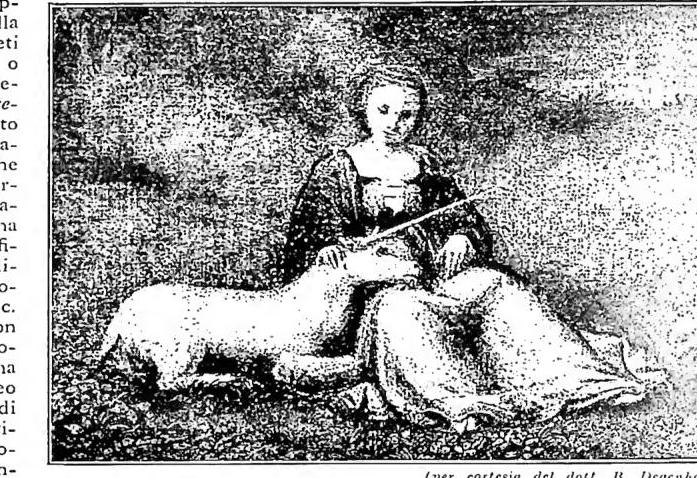
(courtesy of Dr B. Urquhart) CASTITÀ — Depiction of C. by Giorgione. Amsterdam, Lang collection.
At the beginning of the 16th century, Perugino (Louvre), Luca Signorelli (National Gallery, London), and Lorenzo Lotto (Pallavicini Gallery, Rome) showed complete independence from the traditional models, which nevertheless continued to be followed in miniatures. The French preferred emblems to the elegant Italian depictions (in the stained-glass windows of the church of Ercy, at the beginning of the 16th century, C.’s chariot is drawn by an owl and an elephant), while her depiction in a fortress continued to appear (miniatures in the National Library of Paris).
The Flemish sometimes depicted her as a wrinkled old woman brandishing an aspergillum (prints by Martin Heemskerk, 16th century).