
EUCHARISTIC COMMUNION. – It is real participation, under the external appearances of bread and wine, in the sacrificial banquet, in which the faithful partake of the body and blood of Christ.
SUMMARY:
I. Effects
II. Necessity
III. Subject
IV. Dispositions
V. Preparation and thanksgiving
VI. First C
VII. Frequent C
VIII. Communion of the sick
IX. The question of Communion under both or only one of the Eucharistic species
X. Communion at home
XI. Minister of Communion
XII. Place
XIII. Time
XIV. Rite.I. EFFECTS
The effects of Eucharistic Communion are the individual and social union of the faithful with Christ, directed toward the glorification of soul and body.Individual union (incorporatio) is taught sublimely by Jesus Christ in the discourse of the promise: the two mysteries of Trinitarian life, namely, the mutual indwelling of the Father in the Son and the procession of the Son from the Father, are in some way repeated in Christ’s relations with the faithful: “He who eats my flesh and drinks my blood remains in me and I in him... As the Father, who has life in himself, sent me and I live through the Father, so he who eats me will live through me” (Io. 6, 55-57). This Trinitarian-Eucharistic theme was masterfully developed by s. Ilario di Poitiers (d. 368) against the Arians. S. Paolo speaks of a “κοινωνία” (I Cor. 10, 16), that is, of so profound a union of the communicant with the body of Christ as to suggest to s. Giovanni Crisostomo and s. Cirillo Alessandrino a parallel with the Incarnation, an idea later taken up by Thomassin (d. 1695) and by Leone XIII in the encyclical Mirae Caritatis (1902). Other Fathers, however, preferred to illustrate this mystery through comparisons drawn from nature: conjugal union (s. Efrem), the fusion of two liquefied elements (s. Cirillo A.), physiological assimilation (s. Ireneo and s. Agostino), the penetration of burning coal or red-hot iron by fire (s. Giovanni Damasceno, Teofilatto), and the kinship resulting from natural sonship (s. Cirillo di Gerusalemme: οὐκ ἄνθρωπος τοῦ Χριστοῦ Cat. Myst., 4, 1; PG 33, 109). The idea underlying the biblical texts and patristic analogies pleased the scholastics and was accepted by the Fourth Lateran Council of 1215 (Denz-U, n. 430) and by the Council of Firenze (1439: Denz-U, n. 698: “Huus sacramenti effectus, quem in anima operatur digne summentis, est adunatio hominis ad Christum”).
Social union (concorporatio) is revealed in the classic Pauline text, I Cor. 10, 17: “We all, though many, form one bread, one body, because we partake of one bread.” This ecclesiological insight is extensively employed by the Didaché, by s. Cipriano, by s. Ilario di Poitiers (“Christus... per sacramentum corporis sui in se universam Ecclesiam continens”: In Ps. 125, 6; PL 9, 688), by s. Giovanni Crisostomo (“nobis corpus suum inseruit, ut unum quid simus corpus iunctum capiti”: Hom. 46 in Io. n. 3; PG 59, 261), and especially by s. Agostino, who, in his controversy with the Donatists, shows them, in order to convert them, the very inner meaning of the Eucharist, which they preserved together with the Church that by their rebellion they were sundering: “The faithful know the body of Christ if they do not neglect to be its members. Let them become the body of Christ, if they wish to live by the body of Christ... O Sacrament of piety, O sign of unity, O bond of charity. Whoever wishes to live knows where to live and from where to draw life. Let him draw near and believe, let him be incorporated so that he may be given life. Let him not shrink from union with the other members; let him not be a diseased member that must be cut off; let him not be crooked, of whom one would be ashamed, but let him be beautiful, perfect, healthy; let him cling to the body, live of God and for God, and now toil on earth in order later to reign in heaven” (In Io., tr. 26, n. 13; PL 35, 1612). These words, vibrant with faith, if they did not touch the hearts of the Donatists, moved the Christian Middle Ages and filled with hope the Tridentine assembly, which drew from the Eucharist the auspices for the return of the erring to the bosom of the Church: “Finally, the Holy Council, with a father’s heart, admonishes, exhorts, begs and implores, by the mercies of our God, that all and each of those who glory in the Christian name may unite in peaceful harmony in this sign of unity, in this bond of charity, in this symbol of concord” (Denz-U, n. 882).
The glorious resurrection (ius ad gloriam) is promised by Jesus Christ in the discourse at Cafarnao: “He who eats my flesh and drinks my blood has eternal life, and I will raise him up on the last day” (Io. 6, 54). This divine promise was especially dear to the first Christians, who were forced to live in a world that regarded the resurrection of the flesh as madness. S. Ignazio M. extols the Eucharist as “the medicine of immortality and the antidote against death” (Eph. 20,2), and s. Ireneo combats Gnostic errors precisely by demonstrating the intimate bond between the Eucharist and the future resurrection of bodies. The Eucharistic theme frequently recurs in the catacombs, because the nascent Church saw in the body of Christ precisely the symbol and cause of immortality. For centuries the liturgy has repeated the antiphon of s. Tommaso: “O sacrum convivium in quo... futurae gloriae nobis pignus datur,” and Leone XIII, echoing patristic thought, once again affirmed at the beginning of our century: “Corpus immortale Christi semen inserti immortalitatis, quod aliquando erumpet” (enc. Mirae Caritatis).
These effects are substantially common to all the Sacraments; it is therefore legitimate to ask in what sense they may then be attributed in a particular way to the Eucharist. This problem emerged clearly in Christian thought only in the sixteenth century. Card. Mendoza (d. 1566), whose genuine teaching had until then been unknown, was the first to resolve II. The Eucharist, he said, unlike the other Sacraments, produces a particular effect that endures even when the species vanish; it consists in the communication to the soul and body of the faithful of the perfections with which the humanity of Jesus Christ was adorned by virtue of the hypostatic union.
This special charism, to be identified with sacramental Grace, is a “donum quoddam christificum” that renders the communicant’s soul Christ-like, just as sanctifying Grace renders the baptized person deiform. By virtue of this Christifying gift, the communicant is united more perfectly than in the other Sacraments to Jesus Christ, whose perfections he shares and whose image he reflects; he is more closely joined to the Mystical Body and possesses a more firmly grounded right to the glorious resurrection of his body.
This opinion, properly understood, could have won only assent; instead, because it was expounded at length, with ambiguous expressions (unio naturalis), and in a work that was never printed but that everyone claimed to know, it soon gave rise to discussions lasting two centuries. Theologians of great renown became involved in them, such as Luis de León, Diego de Tapia, Thomassin (in support), Suárez, Vasquez, the Salmantiensi (in strong opposition), card. Cienfuegos and card. Belluga (with exaggerated elaborations). Mendoza’s explanation, substantially true, is not complete, because it does not clarify how this Christifying gift of the Eucharist produces a more perfect union with the head and members of the Mystical Body and a greater right to bodily resurrection.
It seems to us that this gap can be filled by considering the Christifying gift (to be identified with the sacramental Grace proper to the Eucharist) against the general background of the sacramental economy and in the light of the thought of s. Tommaso, who, although he did not formulate the synthesis, nevertheless established its principles and scattered its precious elements here and there.
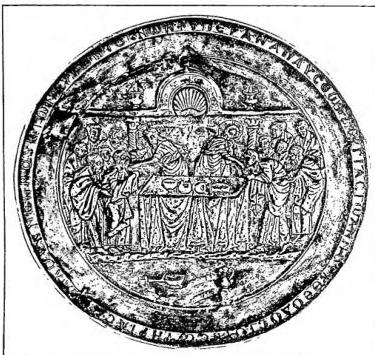
(from L. Bréhier, La sculpture et les arts mineurs byzantins, Porigi 1936, inv. 34)
[COMMUNION EUCHARISTIC - Christ distributes the Eucharist to the Apostles.
Paten found at Rihā on the Orontes (6th century) - Cambridge, Fogg Art Museum.
Now these effects (which taken together truly constitute a « donum christificum ») bring about, as is easy to understand, full incorporation into Christ, the most perfect union among the faithful, the highest claim to the glorification of soul and body; thus individual believers, as well as the Church as a whole, attain the summit of spiritual perfection, maturity for the beatific vision: after the Eucharist, nothing remains but glory. This doctrine is especially suited to explaining the individual importance of the Eucharist (the dignity of the human person in the light of his union with Christ) and its social importance (the harmony of the faithful, families, classes, and nations in this vinculum charitatis and this symbolum unitatis).
Only one point remains to be clarified: namely, in what way the Eucharist may be called the special cause of the resurrection of the body. Mendoza and Contenson (d. in 1674) held that the donum christificum was almost a physical germ divinely preserved in mortal remains and that, at the moment ordained by God, like a spark beneath the ashes, it would rekindle life where death reigned. The salmanticenses, on the other hand, are of the opinion that the sacramental Grace of the Eucharist, inhering in the soul, will on the Day of Judgment become an instrument in God’s hands for giving life to bodies. M. De la Taille presents the more common and more certain doctrine. By infusing into the soul the greatest supernatural gift, the Eucharist is an indirect cause of a more glorious resurrection. For the soul bears a transcendent relation to the body: this tendency will reach its fulfillment at the end of the world, when God reunites bodies with their respective souls. At that moment, the soul perfected by the Eucharist will communicate « per quandam redundantium » its splendor to the body. Thus it is easy to understand that the bodies of those who derived more perfect and more abundant grace from the Eucharist will shine with a particular light among the other glorified bodies.
II. NECESSITY
Here another problem arises, namely, whether the special effect of the Eucharist in its threefold branching (incorporatio, concorporatio, ius ad gloriam) is necessary for attaining eternal life. The answer depends on what was said previously: the Eucharist is like the crowning, the consummatio, of the sacramental economy. Therefore the other Sacraments, being as it were beginnings, necessarily tend toward the Eucharist as their normal completion and end.This logical conclusion is confirmed by St. Thomas (Sum. Theol., 3°, q. 73, a. 3) and by the catechism of the Council of Trent (n. 228): « Eucaristia est omnium Sacramentorum finis ». Once this principle is established, it is legitimate to conclude that the Sacraments produce their effects efficiently insofar as, through a mysterious ordering, they are drawn finaliter toward the Eucharist. Now, given that Baptism in re or in voto is necessary as a means for eternal life, it follows that the Eucharist, not insofar as it is sacramentally received, but insofar as it is the end of Baptism, is indispensable for attaining eternal life. For salvation, therefore, a dynamic tendency toward perfect incorporation into the Eucharist is necessary: this tendency is objectively inherent in Baptism received in re or in voto. Thus children who die with only the baptismus aquae are saved, as is an infidel who, although he does not know Christianity, desires (baptismus flammata) to do what God has established for human salvation and therefore implicitly (votum implicitum) desires Baptism; in this desire he necessarily tends toward the Eucharist, which is the completion of Baptism.
This doctrine, today very widespread, seems to be derived from St. Augustine according to the authoritative interpretation of his disciple, St. Fulgentius of Ruspe, and from many texts of St. Thomas harmonized with one another (cf. Sent. 4, d. 4, q. 2, a. 2, q. 5, ad 2); Sum. Theol., 3°, q. 68, a. 2; q. 73, a. 3; q. 80, a. 3). Bibl. On the individual effects: G. Toniolo, L'Eucaristia e la società, Turin 1922; G. Gasque, L'Eucharistie et le Corps Mystique, Paris 1925; C. Petroccia, Universae fraternitatis causa, Montecassino 1926; M. De La Taille, Mysterium Fidei, 3rd ed., Paris 1931, pp. 476–616 (a broad and magisterial treatment, with personal positions); S. Simonis, De causalitate Eucharistica in Corpus Mysticum doctrina s. Bonaventurae, in Antonianum, 8 (1933), pp. 193–228; P. Berrocchi, Il simbolismo ecclesiologico dell'Eucaristia in s. Agostino, Bergamo 1937; F. Cuttas, Pain vivanti, Paris 1937; F. Connell, The Sacrament of divine Charity, in Angelicum, 14 (1937), pp. 87–101; A. Piolanti, Il Corpo Mystico e le sue relazioni con l'Eucaristia in s. Alberto M., Rome 1939; H. De Lubac, Corpus Mysticum, L'Eucharistie et l'Eglise au moyen âge, Paris 1944; E. Bergh, La Sainte Communion. Sei effetti, Brussels 1946; E. Hugon, La Sainte Eucaristia, Italian translation by G. S. Nivoli, Turin 1947, pp. 170–81; E. Doronzo, De Eucharistia, I, Milwaukee 1947, pp. 448–76; F. Cuttas, Communion: effetti, in DSp, II (1948), cols. 1118–1207.
On the nature of the effects: F. Mendoza, De naturali cum Christo unitate libri V, quos primum edidit prolegamenti criticitiae animadversionibus locupletavit A. Piolanti, Rome 1948; in the prolegomena the author’s thought (developed in 400 pages of the text) is summarized and the controversy is outlined in its main features. For the explanation proposed cf. A. Piolanti, De Sacramenti, II, Rome 1945, pp. 192–96.
On the necessity of the Eucharist: F. Suarez, De Eucharistia, disp. 40, sect. 2; Salmanticensi, De Eucharistia, disp. 3, dub. 1, § 9, n. 16; M. De la Taille, op. cit., pp. 586–612; E. Springer, De SS. Eucharistiae virtute atque necessitate, in Gregorianum, 9 (1928), pp. 118–38; 609–27; J. Filograssi, De S. Eucharistia, Rome 1947, pp. 334–54 (these authors attribute to the Eucharist an efficient causality with respect to the other Sacraments); R. Pizzorni, De necessitate medii Eucharistica secundum s. Thomam, in Divus Thomas, 52 (Piacenza 1949), pp. 3–40 (a richly developed treatment of the Thomistic principles mentioned above). On the C., the teaching of Pius XII in Mediator Dei, part 2°, n. 3, in AAS, 39 (1947), pp. 562–68, is normative. Antonio Piolanti
III. SUBJECT
Every living and baptized person is capable of receiving the Eucharist. The unbaptized would indeed receive the Body and Blood of Jesus Christ, but only materially, without any sacramental effect, since Baptism is the door, that is, the indispensable condition for being able to receive all the other Sacraments. For this reason the Church has never given the C. to her neophytes, not even to the most fervent among them. Against the practice, then, prevailing in certain places of placing a consecrated host in the mouths of the dead, as a kind of viaticum and seed or pledge of immortality, she intervened repeatedly, considering it an intolerable abuse (cf. Council of Hippo of 393, can. 4 [Mansi, III, col. 919]; Third Council of Carthage of 397, can. 5 [ibid., col. 895] and Fifth of 419, can. 22 [ibid., IV, col. 428]; Synod of Auxerre of 575, can. 12 [ibid., IX, col. 913]; Council in Trullo of 692, can. 83 [ibid., XI, col. 979]). The following may therefore receive the Eucharist:1. Baptized children, even if they have not yet attained the use of reason.
For a long time, in fact, children in the Church received Communion immediately after Baptism, as adults did. The text of s. Cipriano is illustrative; speaking of children betrayed by their relatives during the persecution, he places these words in their mouths before the divine Judge: « We have done nothing wrong; nor did we abandon the food and the chalice of the Lord, to turn voluntarily to profane contaminations » (De lapsis, 9: PL, 4, 473; cf. also: id., Epist., 63 ad Caecilium, 8 [ibid., 380]; s. Agostino, Epist., 98, 4 [ibid., 33, 361]; id., Contra duas epist. Pelagianorum, I, II [ibid., 44, 576]; Constitut. Apostolicae, I, VIII, 13 [PG 1, 1109]; Canones Hippolyti, n. 112, in L. Duchesne, Origines du culte chrétien, 3rd ed., Paris 1902, p. 533; Ordo Romanus XI, ed. M. Andrieu, Les Ordines Romani du haut moyen âge, II, Louvain 1948, p. 446). And after this first C., the children continued to receive Communion frequently, at first under the species of wine and then also under that of bread (cf. s. Cipriano, De lapsis, 25: PL 4, 485; s. Agostino, Sermo de verbis apostoli [I Tim., 1, 15], 6: ibid., 38, 944). On certain days, moreover, they were summoned outside the time of the services in order to consume what remained of the consecrated bread after the c. of the faithful (cf. Niceforo, Hist. eccl., I, XVII, 25 [PG 147, 280]; Evagrio, Hist. eccl., I. IV, 36 [ibid. 86, 2769]. Indeed, the belief eventually arose that the C. was absolutely necessary for the salvation of children before the use of reason; this erroneous opinion, condemned by the Council of Trent (sess. XXI, chap. 4, can. 4; Denz-U, no. 937), nevertheless demonstrates the importance attributed from the earliest centuries to this nourishment of life that is the Eucharist, so that not even children were to be deprived of II.
In the East, the practice still continues today in certain places; in the West, however, it became increasingly restricted until disappearing in the 12th century. The manner of giving Communion generally consisted in dipping a finger into the consecrated wine and offering it to the child to suck.
The discipline currently in force, already established by the Fourth Lateran Council and the Council of Trent (sess. XXI, chap. 4, can. 4), is expressed as follows by the CIC: «Children who, on account of the weakness of their age, do not yet have knowledge and appreciation of the Sacrament are not to be given the C. They may, however, receive it at the point of death, provided that they know how to distinguish the body of Christ from ordinary food and adore it with reverence» (can. 854 §§ 1 and 2).
2. Demented persons who have never possessed the use of reason are to be treated like children and therefore may not receive the C., not even as viaticum.
3. It may instead be received, even outside the danger of death, by other demented persons during lucid intervals; by the possessed when they are themselves; by epileptics and delirious persons outside moments of paroxysm; by the half-witted and deaf-mutes when they possess sufficient discernment and know how, in some way, to distinguish Eucharistic bread from ordinary bread; and by dying persons deprived of their senses, provided that one may suppose that they had previously desired it and are in the grace of God. Naturally, care must always be taken to avoid any danger of profanation.
IV. DISPOSITIONS
1. As regards understanding, it is required that the baptized person have attained the age of discretion, that is, the use of reason (CIC, can. 859 § 1), to the extent sufficient to commit even a venial sin, and possess a knowledge of Christian doctrine proportionate to his or her age and capacity. The person must therefore know the truths strictly necessary for eternal salvation and approach the sacred table with that respect which is appropriate to his or her young years (ibid., can. 854 § 3).2. As regards the soul, the following are required: a) the state of grace. The Eucharist is not a Sacrament of the dead; it was not instituted to remit mortal sins (cf. Conc. Trid., sess. XIII, can. 5; Denz-U, 887), but to preserve and increase supernatural life; it therefore presupposes in the recipient possession of this life. “Let each man examine himself, and so eat of that bread and drink of that blood, for he who eats and drinks unworthily... eats and drinks his own condemnation” (I Cor. 11, 28-29). Consequently, anyone conscious of being in mortal sin must, before approaching the C., go to confession; nor is it sufficient first to make an act of perfect contrition, except in the event that there is a necessity to receive Communion and confessors are unavailable (Denz-U, 880 and 893). b) Immunity from excommunication (CIC, can. 2260 § 1) and from personal interdict (ibid., can. 2274 § 2).
3. As regards the body, the natural fast is required, that is, absolute abstinence from everything having the character of food or drink. The discipline of the Church in this matter was different in the beginning. Since Jesus instituted the Eucharist and distributed the C. to the Apostles during the paschal banquet, it is easily understood that the first faithful repeated that rite in the same circumstances
(v. AGAPE). This is indicated for Jerusalem by Act. 2, 42, 46; for Corinth by I Cor. 11, 17-22; for Smyrna by the letter of St. Ignatius (ad Smyrnenses, 8: PG 5, 714). But the practice changed very soon, and by the fourth century the Eucharistic fast had become universal, apart from a few extremely rare exceptions, against which both bishops and councils did not fail to protest and take action (cf. H. Moureau, loc. cit., cols. 500-501). This fast required for the C. must be understood as extending to anything digestible and assimilable that comes from outside and is taken as drink or food. It is therefore not broken by a few drops swallowed as saliva (e.g., in cleaning the teeth and mouth) or by inhalation (e.g., road dust, tobacco smoke). The fast is reckoned from midnight (understood according to solar, mean, legal, local, or extraordinary time) until the moment of the C. Various circumstances, however, may intervene to grant dispensation: a probable danger of death (CIC, can. 858 § 1); the necessity of avoiding the profanation or destruction of the sacred species (the hatred of evildoers, bombardments, fire; the necessity of avoiding scandal or infamy); a particular indult, e.g., permitting something liquid to be taken before the C. or shortening the duration of the fast by reducing it to a few hours.
4. As regards demeanor, external decency is required, with due regard for propriety; this entails, especially for women, correctness in dress and attire according to the norms of sound modesty.
V. PREPARATION AND THANKSGIVING
The Eucharist, like all the other Sacraments, acts of itself (ex opere operato) and produces in the one who receives it with the proper dispositions an increase of sanctifying Grace, even if, on the other hand, his spiritual activity is weak. But the better the personal dispositions (l’opus operantis) brought to it, the greater will be the effect produced. Hence the concern to have a careful preparation precede C. and an appropriate thanksgiving follow it (cf. decree Sacra Tridentina Synodus of 17 Dec. 1905: Acta S. Sedis, 38 [1905-1906], p. 404). Pius XII strongly urges this concern, founded on gratitude and understanding of the divine gift received, in the encyclical Mediator Dei of 20 Nov. 1947 (AAS, 39 [1947], pp. 521-595), recalling the action of the Church, which «has inserted suitable prayers, enriched with indulgences, in the liturgical books, by which sacred ministers can suitably prepare themselves before celebrating and receiving Communion and, once Holy Mass has been completed, manifest their thanksgiving to God» (ibid., p. 567).The method to be employed is free, depending on the situation, health, circumstances, and also the preferences of each soul; ordinarily, acts of faith, humility, and love are recommended for preparation, and acts of gratitude, offering, and especially petition for thanksgiving. The time to be devoted to it may also vary; but, just as those are reprehensible who, under the pressure of haste and even thoughtlessness, reduce everything to a few minutes, so those are praiseworthy who linger over it for a while (commonly at least a quarter of an hour), following the counsel of the Imitation of Christ (IV, chap. 12): «Withdraw into solitude and enjoy your God, since you possess him whom the whole world cannot take from you»; a counsel that sums up a long Christian tradition, as may be discerned from the Holy Fathers and ascetical writers down to our own days (cf., on the subject, M. Viller, Communion [pratique], in DSp, II, cols. 1207-34).
VI. THE FIRST COMMUNION
1. History. — The question concerning the age of First Communion arose when, over the course of the 12th century, the practice of giving Communion to children before they had reached the use of reason gradually became less common and was finally clearly prohibited.The reasons for this change, which was soon to become a disciplinary law for the Western Church, are not clearly known; perhaps disorders and irreverence, so easy among children, played a part; as did abuses and negligence on the part of those who should have supervised the distribution of Communion; and the abolition, which occurred around that time, of Communion for the laity under the species of wine also, which would have appeared singular had it been continued, as was generally the custom, for children. The fact is that at the beginning of the 13th century a decree of the Fourth Lateran Council (1215), in opposition to the decline of the practice of Confession and Communion, determined the number of times each year that a Christian must confess and receive Communion: “Every member of the faithful of either sex, when he has reached the years of discretion, must confess at least once a year and receive devoutly, at least at Easter, the sacrament of the Eucharist, unless, on the advice of his confessor, he should judge that he ought to abstain from it for some time for a reasonable cause. Anyone who refuses to do so shall be forbidden to enter a church and shall be deprived, at death, of ecclesiastical burial” (Denz-U, 437). The decree was rapidly disseminated, but since it did not determine what constituted the years of discretion, it also gave rise to controversies that unfortunately lasted until the 20th century, to the very great detriment of souls (cf. the decree Quam singulari of 8 Aug. 1910). Proceeding, in fact, from an incorrect interpretation of the words “years of discretion” and of the expression “receive devoutly,” and under the influence of certain arguments drawn from the penalties imposed by the decree against those who resisted and from their applicability according to the general norms of law, people wished to distinguish two ages of discretion, one for Confession and the other for Communion; for the former requiring the age at which one can distinguish good from evil and therefore sin; for the latter, instead, a greater age, at which knowledge of Christian doctrine would be fuller and the disposition of the soul more mature. For this they established the ages of ten, twelve, or fourteen years; Jansenism, later, exaggerating beyond all limits the need for proper preparation, sought to postpone it until eighteen or twenty years. That this interpretation of the decree was erroneous appears for several reasons: a) the Lateran Council makes no distinction whatever, but requires the same age for the two precepts it imposes. Therefore, if for Confession the age of discretion is that at which one distinguishes good from evil, that is, when one has attained the use of reason, the same must be said of Communion; b) this, in fact, was how the principal interpreters and theologians of the 13th century understood it, for whom the age of discretion was equivalent to the use of reason (cf. Sum. Theol., 3°, q. 90, a. 9 d. 3m, where s. Tommaso speaks of «aliqualis usus rationis» as sufficient for admission to Communion, and his commentators: P. Ledesma, In s. Thomam, 3°, q. 80, a. 9, dub. 6; G. Vázquez, In 3° part. s. Thomae, disp. 214, cap. 4, n. 43; for other ancient testimonies, L. Andrieux, op. cit., pp. 94-136). Thus the Council of Trent (sess. XXI, cap. 4; Denz-U, 933), referring back to the Lateran Council, gives no other reason for not giving Communion to children than that they cannot sin; from this it follows that, once they have reached the age at which this possibility exists (that is, the use of reason), they must be able to receive Communion. The Catechismus romanus (part 2°, De Sacram. Euchar., n. 63) speaks explicitly of the use of reason.
Nevertheless, the thesis, which might be called preconceived, continued to prevail in practice, despite other explanations and condemnations by the Church. The harm resulting from it was serious, because in this way childhood, kept far from Christ, found itself deprived of something like a vital sap, of an aid more effective than any other for preserving its innocence in the struggle against passions and the allurements of its surroundings, and encountered vice before it had even received its preserving antidote.
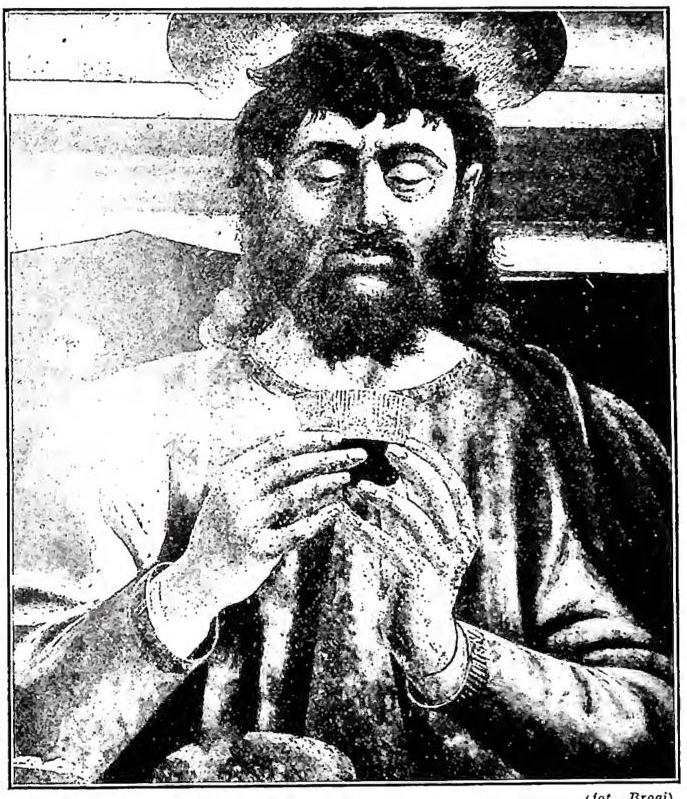
(photo by Brogl)
COMUNION - St. James in the act of receiving the Consecrated Chalice. Detail of the Last Supper. Fresco by Andrea del Castagno in S. Apollonia (1445-50) - Florence.
From this time onward, children are also bound by the annual obligation to receive the two Sacraments; b) for their first admission to them, full and perfect knowledge of Christian doctrine (which will be acquired later) is not required, but only that of the principal mysteries of the faith and sufficient understanding to distinguish the Eucharistic bread from common bread and to receive it with the devotion possible at that age; c) the judgment regarding these sufficient dispositions belongs to the confessor and to the parents or those who take their place. Furthermore, according to the CIC (can. 854 §§ 4 and 5), the parish priest has the duty to supervise, even through an examination if he deems it appropriate, that children do not approach their first Communion before having reached the use of reason, and without sufficient preparation; as well as to ensure that, once the use of reason and sufficient preparation are attained, children are nourished by this divine food.
VII. FREQUENT COMMUNION
I. Practice and its evolution. — The practice of frequent Communion (that is, several times a week or even daily) is already suggested by the very institution of the Eucharist and by the matter chosen for consecration. Jesus Christ, in fact, spoke of "bread come down from heaven," of "bread of life," highlighting its analogies with the "manna of the desert" (Jn. 6:59), so that the disciples could easily understand that, just as the body is nourished by bread every day and the Israelites were nourished by manna every day, so too the soul may be nourished by the heavenly bread every day. And when He placed on the lips of the faithful, in the Pater, the request for "our daily bread," this must be understood, with nearly all the Fathers of the Church, not so much as material bread but rather as the Eucharistic Bread.The early Christians understood this. For daily Communion, there are no clear and decisive indications for the first two centuries; this does not mean it did not exist at all; rather, there are indications for frequent Communion, especially on Sundays. It is known, in fact, that the faithful were steadfast in the teaching of the Apostles and in prayer, not only, but also in the fractio panis (Acts 2:42; 20:7; 1 Cor. 11:2-34; Jude 5:12-13; Didaché, 14:1; St. Justin, Apol., I, 67, 5; PG, 6, 430). These citations align with the letter of Pliny to Trajan (X, 97), which speaks of Christian gatherings on a fixed day (stato die) to celebrate their banquets. From the end of the 2nd century to the 5th, indications for daily Communion abound. Tertullian (De idol., 7; PL 1, 669) reports that Christians extended their hands every day, according to the rite of the time, to receive the Body of Christ; St. Cyprian attests for Africa: "qui in Christo sumus et Eucharistiam quotidie ad cibum salutis accipimus" (De orat. domin., 18; PL 4, 531). For Egypt, there is the testimony of Clement of Alexandria (Quis dives salvetur, 23; PG 9, 628) and Origen (In Genesim hom., X; PG 12, 218); for Asia Minor, that of St. Basil (Epist., 93; PG 32, 484); for northern Italy, that of St. Ambrose (De benedict. patriarch., 9, 38; PL 14, 686); for Spain, that of St. Jerome (Epist., 71, 6; PL 22, 672); for Gaul, that of Cassian (De coenob. instit., VI, 8; PL 49, 277); for Rome, besides the indication of St. Jerome (Epist., 48, 15; PL 22, 506), there is the example of St. Melania the Younger, who "nunquam cibum corporalem accepit, nisi prius Corpus Domini communicasset" (M. Rampolla del Tindaro, S. Melania giuniore, senatrice romana, Rome 1905, p. 205). However, it should not be forgotten that differences in practice soon manifested in the various Churches; St. Augustine notes that in some, the faithful communicated every day, in others only on Saturdays and Sundays, and in still others only on Sundays (Epist., 54, 2; PL 36, 200). Even among the Christians of the same Church, defections were noted; St. John Chrysostom, for example, laments that among his people, not a few communicated only once or at most twice a year, while others did so frequently (In epist. ad Hebr., hom. XVII, 4; PG 63, 131) and deplores that while the Holy Sacrifice was celebrated every day, Communion was nevertheless neglected (In epist. ad Ephes., hom. III, 4-5; PG 62, 28). In Milan, St. Ambrose regrets that the indifference of the East was also evident among his people (De Sacram., V, 24; PL 16, 452). A great decline in the frequency of Communion is especially noted beginning in the 9th century; and it continued to grow, despite the example of the most fervent souls and the reminders of local councils, so much so that in the 12th century, the Fourth Lateran Council (1215) was compelled "propter iniquitatis abundantiam, refrigerante caritate multorum" (Sum. Theol., 3, q. 80, a. 10, ad 5 m) to go to the extreme limit of indulgence, imposing the obligation of only one annual Communion, at Easter (cap. 21; Denz-U, 437), and sanctioning it with penalties. The fervent preaching of the Franciscans and Dominicans then established and consolidated the practice of Communion on the three Paschal feasts (Christmas, Resurrection, Pentecost); the great theologians and mystics (St. Bede the Venerable, St. Peter Damian, St. Bonaventure, St. Thomas Aquinas, the Imitation of Christ, G. Savonarola) insisted on a much greater frequency, up to daily Communion; but the response they encountered among the clergy, spiritual directors, Third Orders, confraternities, and consequently among the laity, was generally very limited. It is necessary to descend to around the middle of the 16th century to observe a true revival of Eucharistic life; and this is due both to the Council of Trent, undoubtedly a stimulant for frequent Communion (sess. XXII, cap. 6; Denz-U, 882, 944; Catech. Romanus, part 2, cap. 4, n. 63) and to the vigorous impulse given by the new religious Orders: Theatines, Barnabites, Capuchins, Jesuits, and by the small congregations of reformed priests, by Bonsignore Cacciaguerra with his companions of St. Jerome of Charity, by St. Philip Neri, by St. Charles Borromeo, who with word and pen combated deeply rooted prejudices and the sophisms that cloaked themselves in respect for the Most Holy Sacrament, and stimulated a more intense Eucharistic practice. Not all, it is true, insisted on daily Communion; many (such as St. Francis de Sales, and the great theologians, F. Toledo, J. Vázquez, F. Suárez, P. Laymann, J. de Lugo) without condemning it at all, approving and even advising it in certain cases, maintained a more reserved attitude and were content to promote, as the ordinary norm, weekly Communion. The advent of Jansenist doctrines, with their rigor and restrictions, disturbed and disrupted this development, rich in extraordinary fruits for souls; but if the episode was stormy (cf. the work of the leading representative of Jansenism, A. Arnauld, De la fréquente Communion, Paris 1643, refuted by the Jesuit D. Petau, and condemned in some of its assertions by Alexander VIII [7 Dec. 1690; Denz-U, 1312-13]) and succeeded in extending its influence to our times, it delayed but could not uproot the movement begun, especially since in the meantime various ecclesiastical documents encouraged and urged the frequency of Communion (e.g., the response of the Sacred Congregation of the Council to the Bishop of Brescia of 24 Jan. 1387: Analecta iuris pontif., 8th series, pp. 782-83; the decree Cum ad aures of 12 Feb. 1679 [Denz-U, n. 1147-50]).
2. Current discipline. — However, as uncertainties and hesitations persisted, especially regarding the necessary and sufficient dispositions for frequent and above all daily Communion, Pius X deemed it opportune to remove all delay and definitively clarify the doctrine to be followed, by means of the decree of the Sacred Congregation of the Council of 20 Dec. 1905, Sacra Tridentina Synodus (Denz-U, 1981-90).
The key points of the decree can be summarized as follows: a) frequent and daily Communion should be accessible to all, regardless of class or condition; b) the only required conditions are: the state of grace and right intention, which entails approaching Communion not out of habit, vanity, or human respect, but to satisfy God’s pleasure and the good of one’s soul; c) since more perfect dispositions yield greater fruit, attention must be paid to preparation and thanksgiving (v. above); d) the confessor is the judge of frequency; e) with this, all contentious disputes regarding the dispositions for frequent and daily Communion must now cease (the CIC maintained these directives, recalling the desire of the Council of Trent (Denz-U, 944) that the faithful who attend Mass participate more intimately in the Sacrifice through real union with the divine Victim by means of Communion (can. 863; cf. also the encyclical Mediator Dei, part 2, point 3); this is to be recommended and promoted especially in seminaries and all Christian educational institutions (decree, Sacra Trid. Synodus, n. 7), while always ensuring full freedom to prevent sacrilege (Sacred Congregation of the Sacraments, 8 Dec. 1932).
VIII. EUCHARISTIC COMMUNION TO THE SICK
The sick (and by illness here may also be understood old age or very frail health) who have been confined to bed or to their room for about a month, with no hope of soon recovering (that is, within three or four days), may, with the advice of their confessor, receive Communion once or twice a week, even if they have previously taken medicine (solid or liquid) or some liquid (CIC, can. 858 § 2).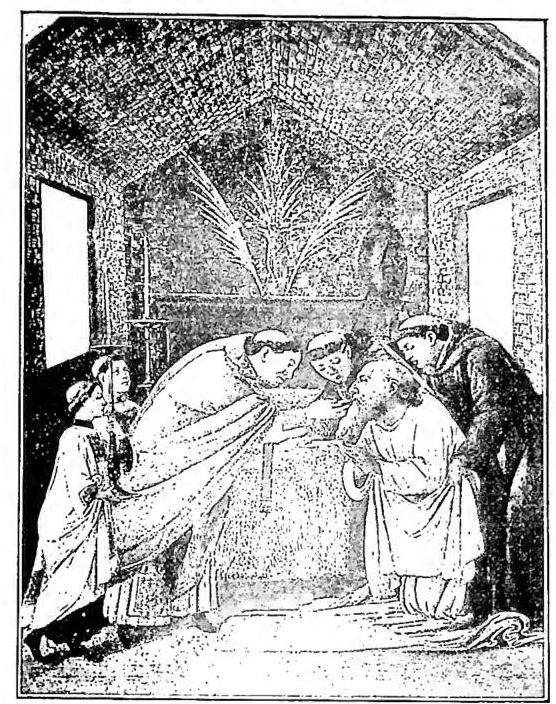
IX. THE QUESTION OF COMMUNION UNDER BOTH OR ONLY ONE OF THE EUCHARISTIC SPECIES
1. Communion under both species
Jesus Christ had instituted the Eucharist under the two species of bread and wine and under this form had distributed it to the Apostles at the Last Supper. Hence the constant and almost universal practice of the Church, in both the East and the West, of administering Communion under both species to all the faithful.This usage, at least for Communion within churches, lasted until the twelfth century; the testimonies to it are so clear and abundant that it was never called into question (cf. the texts, collected or mentioned, in J. Corblet, op. cit., I, p. 608 ff.; E. Dublanchy, op. cit., III, coll. 554-55). Initially, the faithful would sip a little of the consecrated wine from the celebrant’s chalice itself or from other equally consecrated chalices (ministerial chalice), either directly or by means of a reed; but over time, two new practices were introduced: a) immixtio (mixture). The acolytes held ready other vessels filled with wine, intended for the faithful, which was not consecrated, and after the celebrant’s Communion, they would pour into them from his calix sanctus a few drops of the Precious Blood. The mixture could still be called sanguis dominicus, though not consecrated, because the wine «commistus sanguine Domini, sanctificatur per omnem modum» (Ordo Roman., I, II, n. 16: PL 78, 982). This practice, which appears in the Ordines Romani as early as the seventh century (G. A. Jungmann, op. cit., II, p. 465), and was already known much earlier in the East, preserved the symbolism of the Eucharist as Sacramentum unitatis et pacis, while at the same time avoiding the great inconveniences caused by Communion under both species due to diminished faith, namely the danger of spilling the Blood and the possible souring of any remaining quantity in the chalice after distribution to the people. Later, when this practice fell into disuse, the custom remained of sipping a little ordinary wine after Communion; the act was inspired by reverence for the Eucharist, for fear that, while coughing, some particle of the Host might escape from the mouth and be profaned (J. Schuster, Liber Sacramentorum, II, 4th ed., Torino 1944, p. 100). b) Intinctio, which consisted in dipping the Host into the consecrated wine before distributing it to the faithful. This practice, still observed in Eastern rites, survives in the Roman Mass only as a faint trace: the rite of breaking off a piece of the consecrated Host and letting it fall into the chalice. In antiquity, however, it was much more widespread, especially for the symbolism attached to it, signifying that in the Eucharist the Body and Blood of Jesus Christ are not separated but remain united, as in a living man. It was used especially for communicating the sick under both species.
The first mention of intinctio is found in canon 2 of the Third Council of Braga (Mansi, XI, p. 155), which, however, condemns it as contrary to the Gospel account, according to which the bread and wine were distributed separately to the Apostles (only Judas had received the bread dipped in wine; hence the designation «Communio Iudaica» for intinctio). The Council of Clermont in 1096, presided over by Urban II, likewise condemns it (can. 28: Mansi, XX, p. 818), but with the limitation «nisi per necessitatem et cautelam», so that intinctio could be practiced when the necessary precautions were taken to avoid spilling the Precious Blood. Paschal II (Epist., 535: PL 163, col. 442), on the other hand, admits the exception only for children and the sick, who «panem absorbere non possunt».
2. Communion under one species
Although Communion under both species was common until the twelfth century, there are nevertheless numerous examples, even in the earliest years of Christianity, of Communion under one species alone:a) Domestic Communion. In the first centuries, Christians were accustomed to take the Eucharist to their own homes and consume it themselves. Now, this removal of the Eucharist can be understood as referring only to the species of bread; indeed, it is often clearly indicated as such, though examples are not lacking to show that the species of wine were also taken away. b) Communion to the sick was often administered under both species, but often also under one species alone; indeed, this latter method eventually became more common, as it was more convenient (J. Corblet, op. cit., I, p. 611, 631; E. Dublanchy, op. cit., III, coll. 557-58). c) To children, immediately after baptism, Communion was given only under the species of wine (s. Cyprian, De lapsis, 25: PL 4, 485). d) To children were given the remains of the consecrated Host left over after the Communion of the faithful (v. above). e) The Masses of the Presanctified (v. PRE-SANCTIFIED), celebrated in the East on all fasting days during Lent and in the West on Good Friday, presuppose the Communion of the celebrant, and in various places also of the faithful, under the species of bread alone. f) The very texts of Popes s. Gelasius I and s. Leo the Great (v. below), cited by proponents of Communion under both species (v. below), demonstrate that the faithful communicated only under the species of bread, since, in fact, even the Manichaeans, who rejected the species of wine, infiltrated among them.
3. Toward the prescription of Communion under the species of bread alone
Already by the eleventh century, Communion under the species of bread alone was increasingly prevalent, not only to avoid any danger of profanation of the Precious Blood, but also as a means to combat the erroneous interpretation of some, who held that Jesus Christ was not wholly present under each of the two species.Indeed, around the year 1100, the abbot of St-Trond, Rudolph, writes: «Hic et tibi cautela fiat, ne presbyter aegris - aut sanis tribuat laicis de sanguine Christi - nam fundi posset leviter; simplexque putaret - quod non sub specie sit totus Iesus utraque» (J. Bona, Rerum liturgicarum, lib. II, cap. 18, § 1; cf. also Innocent III, De sacro altaris mysterio, IV, 13: PL 217, 866). St. Thomas (Sum. Theol., IIIª, q. 80, a. 12) observes: «provide in quibusdam ecclesiis observatur ut populo sanguis sumendus non detur, sed solum a sacerdote sumatur». It is difficult to determine precisely when Communion under the species of bread alone became
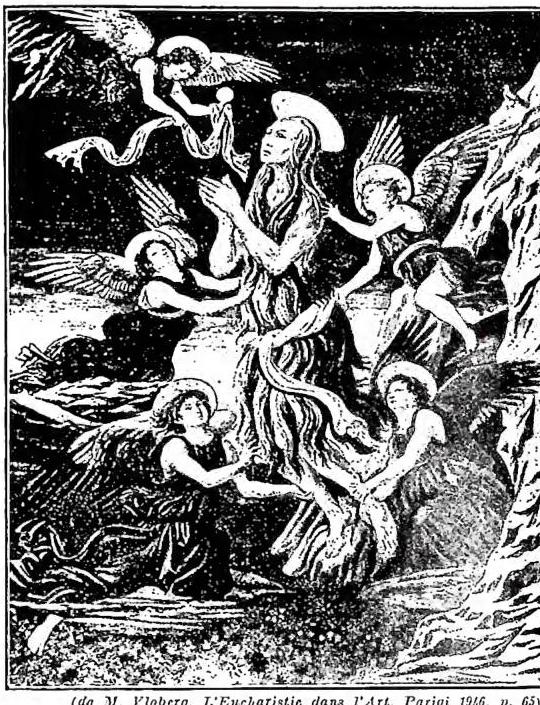
4. The unfoundedness of the Utraquist arguments. — a) In the discourse in which he promises the Eucharist, Jesus said: «Nisi manducaveritis carnem Filii hominis, et biberitis eius sanguinem, non habebitis vitam in vobis» (Jn 6:54). But the double indication of flesh and blood, of eating and drinking, has no other purpose than to determine the reality of the Eucharistic presence of the whole Christ, to better make understood that the Body and Blood form the perfect nourishment of the Christian. Now, the presence of the whole Christ with his flesh and blood is found under each of the species. Therefore, whichever of the two is received, the whole Jesus Christ is received, and his precept is fulfilled. Moreover, Jesus attaches eternal life as the fruit of Communion. Now, this fruit is promised even to Communion under one species; for he said: «Ego sum panis vitae;... hic est panis qui de caelo descendit, ut si quis ex ipso manducaverit, non moriatur» (Jn 6:48-50). b) At the Last Supper, after the consecrated bread, Jesus offered the chalice to the Apostles, saying: «Bibite ex hoc omnes» (Mt 26:27); and, after Communion, he added: «Hoc facite in meam commemorationem» (Lk 22:19). But the command to drink from the chalice was not addressed to all Christians but to those present at the Last Supper; and the addition, «Hoc facite in meam commemorationem», expresses the power conferred upon the Apostles and their successors to reproduce what he had done, offering, like him, the Eucharistic sacrifice (Conc. Trid., sess. XXII, cap. 1 and can. 2; Denz-U, nn. 938 and 949). Now, this sacrifice, referring to that of the Cross, requires by its nature the distinct consecration of bread and wine and, as its completion, the Communion of the celebrant under both species. But the Communion of the laity and the non-celebrating clerics—
(from M. Viborg, L'Eucharistie dans l'Art, Paris 19/6, p. 68)
COMMUNION - C. of St. Maria Egiziaca.
Painting by the Pollaiolo brothers (ca. 1460). - Staggia, parish church.
priests who are not celebrating does not pertain either to the essence or to the integrity of the sacrifice. c) The words of St. Paul (I Cor. 11:28): «Probet autem seipsum homo, et sic de pane illo edat, et de calice bibat» refer primarily and principally to the preparation necessary to receive Communion worthily and fruitfully; the mention of the two species is merely incidental and only notes the existence of the practice at that time of communicating under both species, without intending to establish a precept valid for all times and for all. d) St. Leo the Great (Sermo 42 de quadragesima, 5: PL 54, 279) and St. Gelasius I (in Decr. Gratiani, part 3, dist. 2, De consecratione, cap. 12) ordered that Communion henceforth be received under both species: «aut integra Sacramenta percipiant, aut ab integris arcentur». But the prescription, as is clear from the text, concerned the Manichaeans, who rejected wine as a diabolical thing, and, wishing at the same time to be considered Catholics, mingled, in order not to reveal themselves, with the other faithful, who evidently at that time communicated only under the species of bread (cf. Benedict XIV, De Sacrificio Missae, sect. 1, n. 362).
5. The reasonableness of the practice introduced by the Latin Church. — The reasons that led the Church to establish Communion under the species of bread alone are indicated by the Catechismus romanus (part 2, sect. 4, n. 66): the danger of spilling the precious Blood from the chalice onto the ground, a difficult thing to avoid when administering Communion to a large crowd of people; the scarcity of wine in many regions, making it very costly and difficult to procure; the natural aversion of many either to wine or at least to drinking it from the same chalice as others or with the same straw; the danger of infection that could arise from this; the danger that, since the Eucharist must always be ready for administration to the sick, the species of wine might turn sour if they had to be preserved too long; and finally (and this is the most important reason) to combat the heretical opinion that the consecrated bread contained only the body of Christ and the consecrated wine only the blood.
X. EUCHARISTIC COMMUNION AT HOME
In the first three centuries of the Church, when approaching the priest and attending divine services was not always easy, especially during times of persecution, and when the sudden onset of the danger of martyrdom required greater divine strength to support human weakness, Christians were accustomed to bringing the Eucharist into their own homes and partaking of it themselves. The first certain testimony is offered by Tertullian, who, wishing to dissuade his wife from possible second marriages with a pagan in the event he preceded her in death, says to her: « Can your husband be unaware of what you secretly taste before any other food? And if he knows it is bread, will he not suspect it to be something else, about which so many rumors circulate? And if he were ignorant of such calumnies, ... could he not suspect that, under the appearance of bread, some poison is concealed? » (Ad uxorem, II, 5: PL 1, 1296).The Eucharist, taken from the priest, was wrapped in a white linen (domenicale), enclosed in a small box (arca, arcula), and placed in a secure location in the home, surrounded by sacred reverence. Indeed, St. Cyprian relates a miraculous event concerning a Christian woman: « cum arcam suam, in qua Domini sanctorum fuit, manibus indignis temptasset aperire, inde igne surgente deterrita est » (De lapsis, 26: PL 4, 486). St. Basil attests to this practice among the desert solitaries, the faithful of Alexandria, and other regions of Egypt (Epist. 93 ad Caesariam patriciam: PG 32, 485); St. Jerome, reproaching certain Christians who showed less respect for the Eucharist at home than in church, warns them: « An alius in publica, alius in domo Christus est? Quod in ecclesia non licet, nec domi licet » (Epist. 48 ad Panumachium, 15: PL 22, 506). Thus placed in the hands of the faithful, the Eucharist was carried on journeys as a pledge of protection (St. Ambrose, De ecclesia fratris sui Satyris, 1, 43: PL 16, 1304), or used as a remedy against illnesses (St. Augustine, Opus imperf. contra Iulianum, 3, 162: PL 45, 1315).
The practice of Eucharistic Communion at home, as necessities and conditions of the times changed, began to decline in the 5th century. However, even in the Middle Ages, some customs persisted that were linked to the ancient familiarity of the faithful with the Eucharist. Monks, for example, traveled with the Eucharist suspended around their necks; priests, according to the statutes of St. Boniface, did likewise (Hefele-Leclercq, III, 929, n. 4). Moreover, even in the 19th century, Pius IX, during his flight to Gaeta, carried the Eucharist with him in the same pyx already used in similar circumstances by Pius VI. XI. MINISTER OF Eucharistic COMMUNION - 1) The ordinary minister of Eucharistic Communion is the priest alone; the extraordinary minister is the deacon, when there exists a grave cause (e.g., the priest is occupied elsewhere and the faithful would otherwise have to wait too long) and with the license (which may also be presumed in case of necessity) of the Ordinary or the parish priest (can. 845). 2) A cleric who is not yet a deacon and even laypersons, in the absence of clerics, may communicate themselves and others to preserve the Eucharist from profanation or fire, but they must request the license from the Ordinary if they have the time and means to do so.
XII. PLACE
1) Eucharistic Communion may be distributed anywhere Mass is celebrated, including in a private oratory, unless there is a particular prohibition by the Ordinary (can. 869). 2) It is desirable that the faithful receive Communion during Mass, as the fuller and more intimate participation in the Holy Sacrifice (encyclical Mediator Dei, 20 November 1947: AAS, 39 [1947], p. 564). 3) Outside of Mass, Communion may be distributed only in churches, public and semi-public oratories; also in private oratories if they have an indult to reserve the Blessed Sacrament and there are no particular prohibitions (can. 1265 § 1), and in any decent and honorable place with the permission of the Ordinary (Sacred Congregation of the Sacraments, 5 January 1928). 4) To the sick, except in the case of Viaticum (v. VIATICO), Communion may be brought privately by any priest (can. 849 § 1).XIII. TIME
Eucharistic Communion may be distributed: 1) every day, except Good Friday, on which only Viaticum is permitted; and on Holy Saturday only during the solemn Mass or immediately thereafter (can. 867 §§ 1-3). 2) Only during the hours in which Mass may be celebrated, unless some reasonable cause suggests otherwise (can. 867 § 4).XIV. RITE
In antiquity, the consecrated bread was placed in the hands of the faithful, which were held open or crossed, and the communicant then received it themselves.St. Cyprian (De lapsis, 26: PL 4, 486) explains that the faithful, having received the bread on the open palm, should then close it, reopening it only when, having returned to their place, they consumed II. Women did not receive the Eucharist on bare palms but on palms covered with a white veil. The practice of placing the consecrated bread directly into the mouth is recorded as early as the fifth century but did not become universal until the tenth century. Perhaps to this change we owe the innovation of receiving Communion while kneeling, whereas previously it was done standing, preceded by a bow as a sign of devotion. The formulas accompanying the act of distributing Communion also varied greatly over the centuries. The priest, presenting the consecrated bread, would say: Corpus Christi; later, the formula changed from an assertive to a deprecatory form, for example, Corpus Domini nostri I. C. custodiat animam tuam. The faithful always responded with "Amen" to express the assent of mind and heart. Today, in the Roman liturgy, the "Amen" is pronounced by the priest himself, except during the pontifical Mass for the consecration of new priests.
The diversity of the rite does not concern only the formulas used but also the entire complex of Eucharistic distribution (unleavened or leavened bread; bread alone, or bread dipped in the consecrated wine). For this reason, the CIC establishes: 1) every priest must distribute Communion according to his own rite; 2) the faithful, however, even for devotion alone, may receive Communion in different rites; 3) nevertheless, the faithful are still advised to follow their own rite for Paschal Communion (can. 852).
For Communion to the dying, V. VIATICO.
For Paschal Communion,