
CLERMONT-FERRAND, DIOCESI of. - In France, currently comprising the department of Puy-de-Dôme; it is a suffragan of Bourges, includes 5 archpriestships (Clermont, Ambert, Thiers, Issoire, and Riom), 53 deaneries, and 520 parishes, and has about 500,000 inhabitants. The major seminary is located at Riche-Lieu (Chamalières). The bishop of Clermont has the privilege of the sacred pallium (28 January 1894).
The city of Clermont, anciently Arverni, became an episcopal see in the second half of the 3rd century. Initially, it included the entire ancient civitas Arvernorum (Auvergne); in 1317, the diocese of St-Flour was separated from II. The first bishop was Austremonius; among the most notable others are: Sidonius Apollinaris (v.), who was Prefect of Rome in 468 and bishop of Clermont from 470 to 489; Stephen Aubert (1340–42), cardinal in 1342, pope under the name Innocent VI in 1352; and the famous preacher Massillon (1717–42). In Clermont were born Gregory of Tours (d. 594) and Blaise Pascal (1623–62).
In 1095, Pope Urban II held a council there at which the First Crusade was proclaimed.
Clermont possesses a state university comprising faculties of Law, Letters, and Sciences; a preparatory school of medicine and pharmacy. The patron saint of the diocese is St Austremonius. The cathedral, Notre-Dame, is a fine French Gothic building begun in 1248 and consecrated in 1346. The church of Notre-Dame du Port, in Romanesque style (11th century), is a pilgrimage destination.
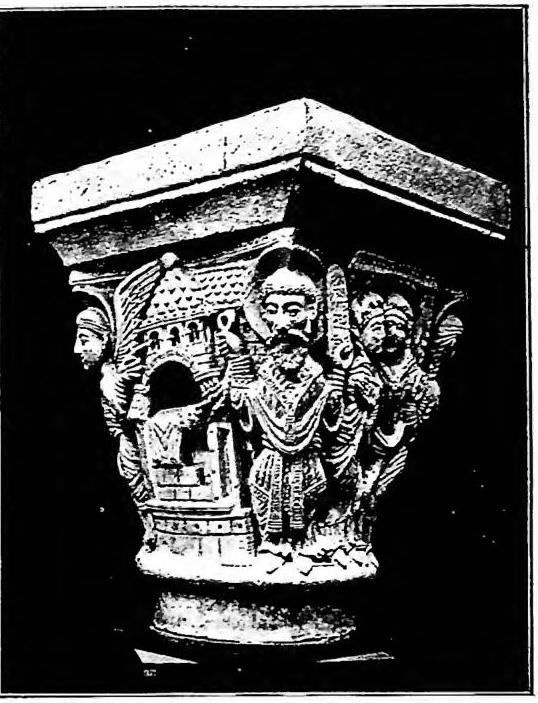
(photo: Archives photographiques)
CLERMONT-FERRAND - Zaccaria e la Visitazione. Capitello di una colonna della navata di Notre-Dame du Port (fine sec. XI).
pieno di sepolcri; nell'interno stavano gli altari di S. Giuliano e di S. Basilissa antiochena. Da esse provengono molti sarcofagi scolpiti. Altra chiesa piena di sepolcri era quella di S. Illidio o Allirio vescovo sepolto nel suburbano, dove riposavano pure altri vescovi; la chiesa fu detta poi S. Maria inter Sanctos.
La chiesa di S. Stefano nel suburbano di C. fu eretta dal vescovo Namazio (446-62) e i soggetti degli affreschi che dovevano decorarne le pareti vennero indicati ai pittori dalle illustrazioni di un manoscritto contenente historias actionis antiquus (Gregorio di Tours, Histor. Francor., II, 17). La bella serie dei sarcofagi cristiani scolpiti con scene tratte dal nuovo e dal vecchio testamento mostra quanto sia stata fiorente la comunità della chiesa di C. Essi vennero pubblicati prima dal Le Blant, più recentemente dal Wilpert. Sidonio Apollinare (m. nel 489) fu sepolto nella chiesa di S. Saturnino e più tardi traslato in quella di S. Genesio. Il suo epitaffio metrico venne copiato ed è conservato da un manoscritto di Madrid (E. Le Blant, II, n. 562). È noto pure il carme sepolcrale dello zio di Gregorio di Tours, Gallo (m. nel 551) che fu sepolto nella basilica di S. Lorenzo (ibid., n. 559). Si conoscono poi le iscrizioni di un presbitero di nome Privato, di due diaconi Innocenzo (CIL, XIII, I, 1489) ed Emellio morto nel 37° anno di Clotario (a. 548 se Clotario I; 621 se Clotario II); in S. Cassio era sepolta una Georgia sacrata Christi (CIL, XIII, I, 1491). Gregorio di Tours riporta l'iscrizione metrica composta da Sidonio Apollinare per il sepolcro di Abramo abate di S. Quirico (m. nel 477 ca.) di cui egli costruì la chiesa (Vitae patrum, 3). L'epitaffio di una Lupa è del 555 al tempo di re Teobaldo; l'altro, d'un Remesto, è del 612. - Vedi Tav. CXX.
culte des martyrs, 2ª ed., Bruxelles 1933, pp. 79-320, 342-45; Wilpert, Sarcofagi, p. 34 e tav. 27, 2; p. 117 e tav. 99, 1; pp. 232, 296, 303, 337 e tav. 184, 5; pp. 294, 299, 310 e tav. 230, 5. Enrico Josi